Rural Telemedicine Use Before and During the COVID-19 Pandemic: Repeated Cross-sectional Study - XSL FO
←
→
Page content transcription
If your browser does not render page correctly, please read the page content below
JOURNAL OF MEDICAL INTERNET RESEARCH                                                                                                            Chu et al

     Original Paper

     Rural Telemedicine Use Before and During the COVID-19
     Pandemic: Repeated Cross-sectional Study

     Cherry Chu1, MSc; Peter Cram2,3, MD, MBA; Andrea Pang4, MPH; Vess Stamenova1, PhD; Mina Tadrous1,5, PharmD,
     PhD; R Sacha Bhatia1,4, MD, MBA
     1
      Women's College Hospital Institute for Health System Solutions and Virtual Care, Women's College Hospital, Toronto, ON, Canada
     2
      Division of General Internal Medicine and Geriatrics, Sinai Health System and University Health Network, Toronto, ON, Canada
     3
      Department of Medicine, University of Toronto, Toronto, ON, Canada
     4
      Institute for Clinical Evaluative Sciences, Toronto, ON, Canada
     5
      Leslie Dan Faculty of Pharmacy, University of Toronto, Toronto, ON, Canada

     Corresponding Author:
     R Sacha Bhatia, MD, MBA
     Women's College Hospital Institute for Health System Solutions and Virtual Care
     Women's College Hospital
     76 Grenville St
     Toronto, ON, M5S 1B2
     Canada
     Phone: 1 416 312 9147
     Email: sacha.bhatia@wchospital.ca

     Abstract
     Background: The COVID-19 pandemic has led to a notable increase in telemedicine adoption. However, the impact of the
     pandemic on telemedicine use at a population level in rural and remote settings remains unclear.
     Objective: This study aimed to evaluate changes in the rate of telemedicine use among rural populations and identify patient
     characteristics associated with telemedicine use prior to and during the pandemic.
     Methods: We conducted a repeated cross-sectional study on all monthly and quarterly rural telemedicine visits from January
     2012 to June 2020, using administrative data from Ontario, Canada. We compared the changes in telemedicine use among residents
     of rural and urban regions of Ontario prior to and during the pandemic.
     Results: Before the pandemic, telemedicine use was steadily low in 2012-2019 for both rural and urban populations but slightly
     higher overall for rural patients (11 visits per 1000 patients vs 7 visits per 1000 patients in December 2019, P
JOURNAL OF MEDICAL INTERNET RESEARCH Chu et al
KEYWORDS
chronic disease; chronic illness; COVID-19; health care; health services; older adults; remote; rural; pandemic; population;
telemedicine; virtual care
This study aimed to measure the utilization of telemedicine in
Introduction rural and urban populations and among at-risk patient groups
Access to health care services in rural communities has proven in rural Ontario prior to and during the COVID-19 pandemic,
challenging among individuals for many reasons. There is a and to describe the characteristics of rural patients who have
scarcity of health care professionals serving rural populations, used telemedicine.
and consequently, rural residents face barriers to health care
access, such as long travel times, limited public transportation Methods
and associated costs, and time away from work. Ontario is
Canada’s most populous province with over 14,000,000 people,
Study Design and Data Sources
and, at >1,000,000 km2, it has a larger area than Texas and We conducted a population-based, repeated cross-sectional
Montana combined. While most of Ontario’s population is study of monthly and quarterly rural ambulatory telemedicine
situated in the southern region of the province in urban areas, visits in Ontario, Canada, beginning prior to the COVID-19
approximately 10% of the population resides in rural areas [1], pandemic (January 1, 2012) and extending to June 30, 2020,
including the northern regions of the province. The Ontario using data from the following administrative databases: (1)
Telemedicine Network (OTN) is an organization funded by the OHIP, which records all health services delivered by physicians
provincial government, which aimed to initially increase health to Ontario residents and (2) Registered Persons Database, which
care access among the rural population by facilitating 2-way contains demographic information of all patients covered under
videoconferencing between patients and care providers [2]. OHIP. We linked each patient’s postal code of residence to
However, prior to the COVID-19 pandemic, telemedicine census-based neighborhood income measures and then stratified
adoption was modest in Ontario [3], in part owing to strict patients across the province into neighborhood income quintiles.
requirements for both the patient and the physician, such as To understand telemedicine uptake among patients with various
attending a virtual visit at an OTN facility, and using an chronic conditions, we defined individual patient cohorts on
OTN-approved communication platform [4]. A prepandemic the basis of select chronic ambulatory care conditions, using
study from Ontario revealed that Northern Ontario, a the Discharge Abstract Database, which records all in-patient
predominantly rural region in the province, saw markedly higher hospital admissions, the National Ambulatory Care Reporting
annual rates of telemedicine use than the mostly urban Southern System, which contains data on all hospital- and
Ontario, and even within Northern Ontario, rates of telemedicine community-based ambulatory care (including emergency
use were higher in the “very rural” than in the “less rural” department visits), and various Institute for Clinical Evaluative
populations [5]. Sciences (ICES)–validated disease-specific registries. ICES is
an independent, nonprofit research institute whose legal status
The COVID-19 pandemic has posed a unique challenge for under Ontario’s health information privacy law allows it to
rural patients—particularly those who are more susceptible to collect and analyze health care and demographic data without
the disease—such as older adults and those with chronic consent for health system evaluation and improvement.
diseases. In particular, there has been a need to balance chronic Databases were linked using unique encoded identifiers and
disease management with the risk of virus transmission, either analyzed at the ICES. The use of these databases for the purpose
during health care consultations or when traveling from rural of this study was authorized under clause 45 of Ontario’s
to urban areas [6]. In order to reduce virus transmission in the Personal Health Information Protection Act [8], which does not
health care setting, the Ontario Health Insurance Plan require review by a research ethics board.
(OHIP)—the government health insurer across the
province—introduced temporary billing codes that broadened Population
the range of modalities eligible for reimbursement beyond We identified all patients residing in the rural regions of Ontario
OTN-approved videoconferencing platforms, including by using the rurality index for Ontario (RIO) and their
telephone calls and many other types of technology [7]. While ambulatory visits through telemedicine through relevant
a limited number of studies have reported substantial increases physician billing codes (Multimedia Appendix 1). The RIO
in the use of telemedicine during the pandemic, there are score has been established by the Ministry of Health and
currently no published data on the use of telemedicine in rural Long-Term Care as a method to fairly and consistently measure
communities or on the potential differences in telemedicine a community’s degree of rurality based on its postal code in
uptake between rural and urban populations during the order to allocate governmental funding for rural health programs.
pandemic. An understanding of rural telemedicine uptake and The RIO score is derived from three measures: population
how it has been affected by the COVID-19 pandemic can density, distance from a basic referral center, and distance from
provide insight into the utility of telemedicine in rural areas, an advanced referral center [9]. A higher RIO score indicates a
particularly among vulnerable and at-risk populations; moreover, higher degree of rurality, with a maximum score of 100. Rural
this information can contribute to the development of targeted residents have been defined as patients with a RIO score of ≥40,
approaches to increase telemedicine access where uptake was which is a standard cut-off used by the provincial government
limited. [10]. We compared the rates of rural telemedicine visits to those
https://www.jmir.org/2021/4/e26960 J Med Internet Res 2021 | vol. 23 | iss. 4 | e26960 | p. 2
(page number not for citation purposes)
XSL• FO
RenderXJOURNAL OF MEDICAL INTERNET RESEARCH Chu et al
of urban visits, the latter defined with a RIO score ofJOURNAL OF MEDICAL INTERNET RESEARCH Chu et al
Prior to the pandemic, the rates of telemedicine visits were low observed among patients aged 51-64 years (53 visits per 100
and stable; however, the onset of the pandemic led to a surge patients), followed by those aged 31-50 years (42 visits per 100
in telemedicine use across all age groups. The highest rates were patients), and those aged 18-30 years (32 visits per 100 patients).
reported among adults aged ≥65 years, approaching 77 visits The lowest rates of telemedicine use were observed among the
per 100 patients in the second quarter of 2020 as opposed to 4 youngest group of patients (aged 0-17 years, 16 visits per 100
visits per 100 patients in the fourth quarter of 2019. The next patients). These findings are illustrated in Figure 3.
highest telemedicine usage rates during the pandemic was
Table 1. Characteristics of rural patients who received at least 1 telemedicine visit in 2012, 2016, and 2020.
Variables Number of patients, n (%) P value
2012 (n=14,666) 2016 (n=27,145) 2020 (n=290,401)
Age group (years)JOURNAL OF MEDICAL INTERNET RESEARCH Chu et al
Figure 1. Rate of telemedicine visits per 1000 eligible patients in Ontario by rurality, 2012-2020.
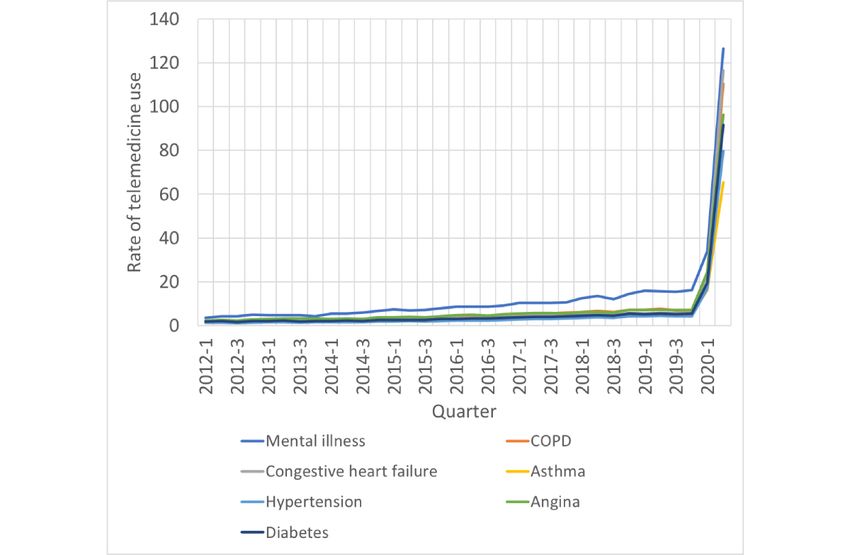
Figure 2. Rate of telemedicine visits per 100 rural patients by chronic disease, 2012-2020. COPD: chronic obstructive pulmonary disease.
https://www.jmir.org/2021/4/e26960 J Med Internet Res 2021 | vol. 23 | iss. 4 | e26960 | p. 5
(page number not for citation purposes)
XSL• FO
RenderXJOURNAL OF MEDICAL INTERNET RESEARCH Chu et al
Figure 3. Rate of telemedicine visits per 100 rural patients by age group, 2012-2020.
may have resulted from an increase in in-person visits during
Discussion this period.
Principal Findings Telemedicine usage increased rapidly among all age groups in
In this population-based study, we sought to quantify the impact rural areas, although the usage rate increased with age. Older
of the COVID-19 pandemic on rural telemedicine use across a adult patients used telemedicine at the highest rate during the
large, geographically and demographically diverse region. While pandemic and children and adolescents used telemedicine the
telemedicine use before the COVID-19 pandemic was higher least. Telemedicine usage varied among patients with different
in rural areas than in urban areas of Ontario, the use of chronic diseases, those with mental illness and with congestive
telemedicine was modest. Broad telemedicine usage in Ontario heart failure making maximum use of telemedicine, and those
was low in part owing to the lack of billing codes for many with other ambulatory sensitive chronic conditions making
types of telemedicine services outside of the substantial use of telemedicine. This study is the first to quantify
government-operated videoconferencing platform. With the the rates of telemedicine use in rural populations, particularly
initiation of these temporary fee-codes allowing reimbursement among older patients and those with chronic diseases.
for other forms of telemedicine visits during the pandemic, Health care access has been a major challenge for rural patients
usage increased rapidly, with the temporary visit codes in many jurisdictions, particularly for chronic disease
comprising the vast majority of telemedicine visits. The onset management and access to specialist care. Previous studies have
of the pandemic led to a rapid increase in telemedicine usage described the increasing trend of telemedicine use specifically
in both rural and urban areas of Ontario, with high adoption of among rural beneficiaries even prior to the pandemic [13].
telemedicine among patients in urban areas and those in less Numerous advantages are associated with the adoption of
rural areas, compared to those in the most remote regions of telemedicine in rural regions, such as saving of time and costs
Ontario. We speculate that higher rates of urban telemedicine associated with traveling, reduction of hospital readmissions,
use during the pandemic coincide with generally higher rates prevention of emergency department visits, and increasing the
of urban health care use as telemedicine became ubiquitous. availability of inpatient beds for patients requiring critical care
We note that the slight reduction or plateau in the telemedicine [14]. Rural telemedicine has been shown to improve health care
usage rates among both urban and rural populations from April access and quality in various areas, ranging from trauma and
to June 2020 coincided with the loosening of lockdown critical care [15-17], family medicine [18], pediatrics [19], and
restrictions after the first wave of the COVID-19 pandemic and cancer care [20]. In fact, several randomized controlled trials
have reported that telemedicine-based care can lead to similar
https://www.jmir.org/2021/4/e26960 J Med Internet Res 2021 | vol. 23 | iss. 4 | e26960 | p. 6
(page number not for citation purposes)
XSL• FO
RenderXJOURNAL OF MEDICAL INTERNET RESEARCH Chu et al
and potentially better outcomes compared to in-person care the reimbursement of telephone visits, as telephone calls may
among rural patients [21,22]. be easier to access for older adults than videoconferencing. Our
findings are concurrent with those of a similar study we
Furthermore, previous studies have reported that populations
conducted, which focused on the rates of telemedicine visits in
overall have increased their use of telemedicine and virtual care
the entire patient population in Ontario, and we previously
during the pandemic [23] to avail of both urgent and nonurgent
reported that the increase in telemedicine usage rates from before
care [24], and benefits have been observed within various
the pandemic to during the pandemic was similar across age
subspecialties [25,26]. Telemedicine allows health care
groups, with older adults showing the highest rates of
professionals to safely deliver care by reducing the risk of
telemedicine use during the pandemic [3].
potential exposure to the care provider and the patient,
preserving personal protective equipment, and lessening patient Limitations
loads at hospitals and facilities [27]. This proves especially The limitations of this study include a shortage of data
useful in rural settings, where a significant proportion of the comparing different modalities of communication technology,
population are older adults and are at a higher risk of specifically telephone versus video visits. The new COVID-19
COVID-19. billing codes reimburse for telemedicine delivered through
Telemedicine uptake has surged across several groups of patients various modalities, and the type of modality used is not available
with chronic diseases, potentially highlighting the importance in administrative data sets. The lack of clinical granularity that
of remote management of chronic conditions. This finding is accompanies the use of administrative data also implies our
concurrent with published data on the use of telemedicine among inability to deduce the reasons for telemedicine use and assess
patients with various chronic diseases, such as diabetes [28] the quality of care in our study population.
and congestive heart failure [29], and particularly among patients
Conclusions
residing in rural or remote areas [30]. Although rates of
telemedicine use increased among patients with chronic disease, Our study investigates the trend in telemedicine use among
the proportion of telemedicine users with chronic disease patients residing in rural Ontario before and during the
appeared to decrease slightly over the years, suggesting a COVID-19 pandemic. Rural patients globally face many barriers
potentially increased uptake of telemedicine overall. We to care, and telemedicine has proved important in helping
hypothesize that with the widespread use of telemedicine, a patients access the health care services they need. Uptake of
greater proportion of healthier patients used telemedicine for telemedicine services increased after the onset of the pandemic
their health care needs. Longitudinal studies on the changes in for the rural patient population of Ontario and across various
the trends of telemedicine usage, particularly in the subgroups, including those who are older or those with chronic
postpandemic period, are needed. disease. Telemedicine use appears to have increased more
significantly among patients residing in less rural areas
Despite evidence on the effectiveness of virtual ambulatory care compared to those residing in more rural areas during the
for older adults [31], some studies have reported the challenges pandemic. Further studies are required to assess the potential
of adopting telemedicine in this population, owing to barriers barriers to telemedicine experienced by rural populations
such as disabilities or lack of devices, proper internet compared to those experienced by urban populations and the
connectivity, and experience with technology [32,33]. However, impact of telemedicine compared to that of in-person care on
our study shows that telemedicine usage increased significantly other forms of health care utilization, outcomes, and quality of
among older adult patients during the pandemic. This was likely care among vulnerable and at-risk patient groups in the rural
a result of the new COVID-19 billing codes, which allowed for population.
Acknowledgments
This study was supported by the ICES, which is funded by an annual grant from the Ontario Ministry of Health and Long-Term
Care. This study was also supported by a grant from the US National Institute on Aging provided to PC (R01AG058878). Parts
of this material are based on data and information compiled and provided by the Ontario Ministry of Health and Long-Term Care
and the Canadian Institute for Health Information. The analyses, conclusions, opinions, and statements expressed herein are solely
those of the authors and do not reflect those of the funding or data sources; no endorsement is intended or should be inferred.
Conflicts of Interest
None declared.
Multimedia Appendix 1
Supplemental Tables.
[DOCX File , 14 KB-Multimedia Appendix 1]
Multimedia Appendix 2
Rate of telemedicine visits per 1000 rural patients, by region.
https://www.jmir.org/2021/4/e26960 J Med Internet Res 2021 | vol. 23 | iss. 4 | e26960 | p. 7
(page number not for citation purposes)
XSL• FO
RenderXJOURNAL OF MEDICAL INTERNET RESEARCH Chu et al
[PNG File , 49 KB-Multimedia Appendix 2]
Multimedia Appendix 3
Medical specialties of physicians who delivered any rural visit in 2012, 2016, and 2020.
[DOCX File , 14 KB-Multimedia Appendix 3]
References
1. Illustrated Glossary. Statistics Canada. 2017 Nov 15. URL: https://www150.statcan.gc.ca/n1/en/pub/92-195-x/
92-195-x2016001-eng.pdf?st=BimwLQLd [accessed 2021-03-30]
2. Brown EM. The Ontario Telemedicine Network: a case report. Telemed J E Health 2013 May;19(5):373-376. [doi:
10.1089/tmj.2012.0299] [Medline: 23301768]
3. Bhatia RS, Chu C, Pang A, Tadrous M, Stamenova V, Cram P. Virtual care use before and during the COVID-19 pandemic:
a repeated cross-sectional study. CMAJ Open 2021;9(1):E107-E114 [FREE Full text] [doi: 10.9778/cmajo.20200311]
[Medline: 33597307]
4. Keeping Health Care Providers informed of payment, policy or program changes. Re: Changes to the Schedule of Benefits
for Physician Services (Schedule) in response to COVID-19 influenza pandemic effective March 14, 2020. Ontario Ministry
of Health and Long-Term Care. 2019 Nov 15. URL: http://www.health.gov.on.ca/en/pro/programs/ohip/bulletins/4000/
bul4731.aspx [accessed 2021-03-30]
5. Eaton D, Hogenbirk J, McLean J, Nashkawa D, Simpson C, Skinner M, et al. Rural Ontario Foresight Papers. Rural Ontario
Institute. 2019. URL: https://www.ruralontarioinstitute.ca/uploads/userfiles/files/
Rural%20Ontario%20Foresight%20Papers_Oct%2023.pdf [accessed 2021-03-30]
6. Bhatia RS, Shojania KG, Levinson W. Cost of contact: redesigning healthcare in the age of COVID. BMJ Qual Saf 2021
Mar;30(3):236-239. [doi: 10.1136/bmjqs-2020-011624] [Medline: 32763977]
7. Keeping Health Care Providers informed of payment, policy or program changes. Re: Changes to the Schedule of Benefits
for Physician Services (Schedule) in response to COVID-19 influenza pandemic effective March 14, 2020. Ontario Ministry
of Health and Long-Term Care. 2020 Mar 13. URL: http://www.health.gov.on.ca/en/pro/programs/ohip/bulletins/4000/
bul4745.aspx [accessed 2021-03-30]
8. Personal Health Information Protection Act, 2004. Government of Ontario. URL: https://www.ontario.ca/laws/statute/
04p03#BK63 [accessed 2021-03-30]
9. Kralj B. Measuring Rurality - RIO2008_BASIC: Methodology and Results. Ontario Medical Association: Economics
Department. 2009 Feb 02. URL: https://content.oma.org//wp-content/uploads/2008rio-fulltechnicalpaper.pdf [accessed
2021-03-30]
10. Glazier R, Zagorski B, Rayner J. Comparison of Primary Care Models in Ontario by Demographics, Case Mix and Emergency
Department Use, 2008/09 to 2009/10. Data Discovery Better Health. 2012 Mar. URL: https://www.ices.on.ca/Publications/
Atlases-and-Reports/2012/Comparison-of-Primary-Care-Models [accessed 2021-03-30]
11. Schull MJ, Azimaee M, Marra M, Cartagena RG, Vermeulen MJ, Ho MM, et al. ICES: Data, Discovery, Better Health.
IJPDS 2020 Mar 11;4(2):1135. [doi: 10.23889/ijpds.v4i2.1135] [Medline: 32935037]
12. Turcotte M, Schellenberg G. A Portrait of Seniors in Canada. Statistics Canada. 2006. URL: https://www150.statcan.gc.ca/
n1/en/pub/89-519-x/89-519-x2006001-eng.pdf?st=wBkQ3eIv [accessed 2021-03-30]
13. Mehrotra A, Jena AB, Busch AB, Souza J, Uscher-Pines L, Landon BE. Utilization of Telemedicine Among Rural Medicare
Beneficiaries. JAMA 2016 May 10;315(18):2015-2016 [FREE Full text] [doi: 10.1001/jama.2016.2186] [Medline: 27163991]
14. Telehealth Use in Rural Healthcare. Rural Health Information Hub. URL: https://www.ruralhealthinfo.org/topics/
telehealth#:~:text=Telehealth%20allows%20small%20rural%20hospitals,distances%20to%20access%20specialty%20care
[accessed 2021-03-30]
15. Ricci MA, Caputo M, Amour J, Rogers FB, Sartorelli K, Callas PW, et al. Telemedicine reduces discrepancies in rural
trauma care. Telemed J E Health 2003;9(1):3-11. [doi: 10.1089/153056203763317602] [Medline: 12699603]
16. Heath B, Salerno R, Hopkins A, Hertzig J, Caputo M. Pediatric critical care telemedicine in rural underserved emergency
departments. Pediatr Crit Care Med 2009 Sep;10(5):588-591. [doi: 10.1097/PCC.0b013e3181a63eac] [Medline: 19451850]
17. Zawada ET, Herr P, Larson D, Fromm R, Kapaska D, Erickson D. Impact of an intensive care unit telemedicine program
on a rural health care system. Postgrad Med 2009 May;121(3):160-170. [doi: 10.3810/pgm.2009.05.2016] [Medline:
19491554]
18. Norris T, Hart G, Larson E, Tarczy-Hornoch P, Masuda D, Fuller S. Low-bandwidth, low-cost telemedicine consultations
in rural family practice. J Am Broad Fam Med 2002;15(2):123. [Medline: 12002196]
19. Marcin JP, Ellis J, Mawis R, Nagrampa E, Nesbitt TS, Dimand RJ. Using telemedicine to provide pediatric subspecialty
care to children with special health care needs in an underserved rural community. Pediatrics 2004 Jan;113(1 Pt 1):1-6.
[doi: 10.1542/peds.113.1.1] [Medline: 14702439]
https://www.jmir.org/2021/4/e26960 J Med Internet Res 2021 | vol. 23 | iss. 4 | e26960 | p. 8
(page number not for citation purposes)
XSL• FO
RenderXJOURNAL OF MEDICAL INTERNET RESEARCH Chu et al
20. Sabesan S, Larkins S, Evans R, Varma S, Andrews A, Beuttner P, et al. Telemedicine for rural cancer care in North
Queensland: bringing cancer care home. Aust J Rural Health 2012 Oct;20(5):259-264. [doi:
10.1111/j.1440-1584.2012.01299.x] [Medline: 22998200]
21. Fortney JC, Pyne JM, Mouden SB, Mittal D, Hudson TJ, Schroeder GW, et al. Practice-Based Versus Telemedicine-Based
Collaborative Care for Depression in Rural Federally Qualified Health Centers: A Pragmatic Randomized Comparative
Effectiveness Trial. AJP 2013 Apr;170(4):414-425. [doi: 10.1176/appi.ajp.2012.12050696] [Medline: 32015700]
22. Morland LA, Greene CJ, Rosen CS, Foy D, Reilly P, Shore J, et al. Telemedicine for anger management therapy in a rural
population of combat veterans with posttraumatic stress disorder: a randomized noninferiority trial. J Clin Psychiatry 2010
Jul;71(7):855-863. [doi: 10.4088/JCP.09m05604blu] [Medline: 20122374]
23. Webster P. Virtual health care in the era of COVID-19. The Lancet 2020 Apr;395(10231):1180-1181. [doi:
10.1016/s0140-6736(20)30818-7] [Medline: 32278374]
24. Mann D, Chen J, Chunara R, Testa P, Nov O. COVID-19 transforms health care through telemedicine: Evidence from the
field. J Am Med Inform Assoc 2020 Jul 01;27(7):1132-1135. [doi: 10.1093/jamia/ocaa072] [Medline: 32324855]
25. Smrke A, Younger E, Wilson R, Husson O, Farag S, Merry E, et al. Telemedicine During the COVID-19 Pandemic: Impact
on Care for Rare Cancers. JCO Glob Oncol 2020 Jul;6:1046-1051 [FREE Full text] [doi: 10.1200/GO.20.00220] [Medline:
32639877]
26. Novara G, Checcucci E, Crestani A, Abrate A, Esperto F, Pavan N, Research Urology Network (RUN). Telehealth in
Urology: A Systematic Review of the Literature. How Much Can Telemedicine Be Useful During and After the COVID-19
Pandemic? Eur Urol 2020 Dec;78(6):786-811. [doi: 10.1016/j.eururo.2020.06.025] [Medline: 32616405]
27. Using Telehealth to Expand Access to Essential Health Services during the COVID-19 Pandemic. Centers for Disease
Control and Prevention. 2020 Jun 10. URL: https://www.cdc.gov/coronavirus/2019-ncov/hcp/telehealth.html [accessed
2021-03-30]
28. Jones MS, Goley AL, Alexander BE, Keller SB, Caldwell MM, Buse JB. Inpatient Transition to Virtual Care During
COVID-19 Pandemic. Diabetes Technol Ther 2020 Jun;22(6):444-448. [doi: 10.1089/dia.2020.0206] [Medline: 32396395]
29. Jerant AF, Azari R, Nesbitt TS. Reducing the cost of frequent hospital admissions for congestive heart failure: a randomized
trial of a home telecare intervention. Med Care 2001 Nov;39(11):1234-1245. [doi: 10.1097/00005650-200111000-00010]
[Medline: 11606877]
30. Jaglal SB, Haroun VA, Salbach NM, Hawker G, Voth J, Lou W, et al. Increasing access to chronic disease self-management
programs in rural and remote communities using telehealth. Telemed J E Health 2013 Jun;19(6):467-473 [FREE Full text]
[doi: 10.1089/tmj.2012.0197] [Medline: 23570277]
31. Batsis JA, DiMilia PR, Seo LM, Fortuna KL, Kennedy MA, Blunt HB, et al. Effectiveness of Ambulatory Telemedicine
Care in Older Adults: A Systematic Review. J Am Geriatr Soc 2019 Aug;67(8):1737-1749. [doi: 10.1111/jgs.15959]
[Medline: 31066916]
32. Lam K, Lu AD, Shi Y, Covinsky KE. Assessing Telemedicine Unreadiness Among Older Adults in the United States
During the COVID-19 Pandemic. JAMA Intern Med 2020 Oct 01;180(10):1389-1391. [doi:
10.1001/jamainternmed.2020.2671] [Medline: 32744593]
33. Fisk M, Livingstone A, Pit SW. Telehealth in the Context of COVID-19: Changing Perspectives in Australia, the United
Kingdom, and the United States. J Med Internet Res 2020 Jun 09;22(6):e19264 [FREE Full text] [doi: 10.2196/19264]
[Medline: 32463377]
Abbreviations
ICES: Institute for Clinical Evaluative Sciences
OHIP: Ontario Health Insurance Plan
OTN: Ontario Telemedicine Network
RIO: rurality index of Ontario
Edited by R Kukafka; submitted 05.01.21; peer-reviewed by C Hawke, E van der Velde, M Mueller; comments to author 08.02.21;
revised version received 03.03.21; accepted 24.03.21; published 05.04.21
Please cite as:
Chu C, Cram P, Pang A, Stamenova V, Tadrous M, Bhatia RS
Rural Telemedicine Use Before and During the COVID-19 Pandemic: Repeated Cross-sectional Study
J Med Internet Res 2021;23(4):e26960
URL: https://www.jmir.org/2021/4/e26960
doi: 10.2196/26960
PMID: 33769942
https://www.jmir.org/2021/4/e26960 J Med Internet Res 2021 | vol. 23 | iss. 4 | e26960 | p. 9
(page number not for citation purposes)
XSL• FO
RenderXJOURNAL OF MEDICAL INTERNET RESEARCH Chu et al
©Cherry Chu, Peter Cram, Andrea Pang, Vess Stamenova, Mina Tadrous, R Sacha Bhatia. Originally published in the Journal
of Medical Internet Research (http://www.jmir.org), 05.04.2021. This is an open-access article distributed under the terms of the
Creative Commons Attribution License (https://creativecommons.org/licenses/by/4.0/), which permits unrestricted use, distribution,
and reproduction in any medium, provided the original work, first published in the Journal of Medical Internet Research, is
properly cited. The complete bibliographic information, a link to the original publication on http://www.jmir.org/, as well as this
copyright and license information must be included.
https://www.jmir.org/2021/4/e26960 J Med Internet Res 2021 | vol. 23 | iss. 4 | e26960 | p. 10
(page number not for citation purposes)
XSL• FO
RenderXYou can also read


