ScanBalt Clinical Research Network - Network building between pre-clinical study centres and clinical facilities - ITC solutions for conducting ...
←
→
Page content transcription
If your browser does not render page correctly, please read the page content below
March 2006

ScanBalt Clinical Research Network

- Network building between pre-clinical study centres and clinical facilities
- ITC solutions for conducting clinical trials

Author: Helene Alavere, Estonian Genome Project Foundation
Participants:

Estonian Genome Project Foundation

Paul Stradins Clinical University Hospital

Sahlgrenska University Hospital

Pipeline Biotech

Tartu Biotechnology Park Ltd.

Curonia Research Ltd.

Moby Solutions Ltd.
Title:
  ScanBalt Clinical Research Network

Nordic Innovation Centre project number:
 04096

Author(s):
 Helene Alavere

Institution(s):
  Estonian Genome Project Foundation

Abstract:
 The idea of the ScanBalt Clinical Research Network is to take advantage of existing knowledge and
 experience of the universities, hospitals and companies in the meta-region and to link flexibly pre-
 clinical study centres and clinical facilities in the modern ITC infrastructure in order to create a
 dynamic and comprehensive platform for high quality academic and commercial research projects.

  There is a growing demand for highly specific clinical trials. The Nordic-Baltic countries and regions
  are too small on their own to be able to supply large enough trial groups. Through cooperation the
  Nordic-Baltic region can position itself on the clinical research testing map to the benefit for
  researchers, entrepreneurs and society as a whole. The idea of the project is to take advantage of
  the existing knowledge and experience of the universities, hospitals and companies in the Nordic
  and Baltic areas to create a dynamic and comprehensive platform for high quality pre-clinical and
  clinical research. ScanBalt Clinical Research Network is envisaged to link flexibly pre-clinical animal
  study centres and clinical facilities in the 21st century ICT infrastructure in the Baltic Sea area.

  As a result of the project completed mapping of the competencies and resources in the field of pre-
  clinical research, clinical trials, and mobile ICT solutions for conducting clinical trials was carried out.
  Based on this a database for the purpose of competencies and partner search was created. The
  project results support the understanding, that the patient recruitment network in the region is very
  needed to be competitive in clinical research. However, the scope of the continued activities should
  be more focused and the goal should be establishing a financially feasible and working network that
  could be used for patient recruitment in the overall ScanBalt region, as this was identified to be the
  hardest problem arising from the relative smallness of the region’s countries in the world scale.

Topic/NICe Focus Area:
 Life sciences

ISSN:                                     Language:                        Pages:
                                            English                         10

Key words:
 preclinical research, clinical trials, ITC solutions, databases, networks, ScanBalt

Distributed by:                           Contact person:
  Nordic Innovation Centre                 Helene Alavere (Project Manager)
  Stensberggata 25                         Estonian Genome Project Foundation
  NO-0170 Oslo                             Tiigi 61 B
  Norway                                   504 10 Tartu
                                           Estonia
                                           Tel: +372 7 440 240
                                           Fax: +372 7 440 241
                                           Mob: +372 50 62 542
                                           helene.alavere@geenivaramu.ee
                                           www.geenivaramu.ee

                                                     III
ScanBalt Clinical Research Network
Project number: 04096
Participating organizations:
Estonian Genome Project Foundation Tartu Biotechnology Park Ltd.
Tiigi 61b Tiigi 61b
50410 Tartu, Estonia 50410 Tartu, Estonia
Koit Kikas Andrus Tasa
Tel: +372 7440240 Tel: +372 7383053
Fax: +372 7440241 Fax: +372 7440235
E-mail: koit.kikas@geenivaramu.ee E-mail: atasa@ebc.ee
Paul Stradins Clinical University Hospital Curonia Research Ltd.
Pilsonu iela 13 Sakala 17
LV-1002, Latvia 10141 Tallinn, Estonia
Prof Valdis Pirags Ardo Reinsalu
Tel: 3717069307 Tel: +372 6512673
Fax: 3717069955 Fax: +372 6512671
E-mail: pirags@latnet.lv E-mail: ardo@docobo.com
Sahlgrenska University Hospital Moby Solutions Ltd.
SE-41345 Rüütli 6
Göteborg, Sweden 51007 Tartu, Estonia
Prof Bo Samuelsson Linnar Viik
Tel: +46313421369 Tel: +372 5135555
Fax: +4631417631 Fax: +372 64122537
E-mail: bo.samuelsson@clinchem.gu.se E-mail: linnar@mobi.ee
Pipeline Biotech
Røvedvej 1
DK-8380
Trige, Denmark
Rasmus Nelund
Tel: +46313421369
Fax: +4631417631
E-mail: rn@pipeline-biotech.dk
IVProject summary
ScanBalt Clinical Research Network was a pilot project, which overall aim was to give added value
to the vision of ScanBalt BioRegion: to be a globally competitive meta-region. Specific objectives
of the project were:
1. to map the resources and competencies of clinical research in the region;
2. to create a virtual meeting point and database;
3. to identify the personalities of continued activities in the network.
To achieve abovementioned goals, at first three work groups were formed: pre-clinical, clinical, and
ICT solutions for conducting clinical trials. The aim of the preclinical and clinical subproject was to
set up the organizational and IT infrastructure enabling the coordinated high quality and flexible
clinical research. The aim of ICT work group was to map the existing technologies, which have the
most suitable solutions for building a comprehensive platform for patient follow-up. Also a steering
committee and work group leaders were selected. They met three times during the project in order
to share information about the development of the process, to discuss the necessary improvements
in database development, and to confirm the future activities needed.
In order to increase the level of contacts needed to enlarge the size of database, the project partners
recruited so called affiliated partners to trigger cooperation and to inform the potentially interested
persons/institutions about the project and its aims using their local network. Hence, partner search
through partners took place. In addition other projects and existing databases were used to increase
the number of entries in the database. Leaflets with a short overview of the project aims and
benefits, and instructions to join the database were disseminated at several international conferences
and events in Sweden, in Estonia and in Belgium. Two workshops during the project were carried
out to bring interested parties together to introduce them the project, its results, and to collect
feedback regarding the project´s benefit and suggestions for database improvement.
From technical barriers of the project communication problems (language barriers) were often the
obstructive factors in the process of finding suitable cooperation partners for database enlargement.
This was especially so in Estonia, Latvia, Russia, Poland, as well as in Germany and Finland as the
web pages include information only in the local language.
However, the principal problem that the project partners faced during the project was the clash of
interests. Especially large clinical researh organisations (CROs) saw the project as a competitor in
their field and are at the moment not really ready to cooperate. Nevertheless, several participants
had the experience, that smaller CROs are very much interested in the ScanBalt Clinical Research
Network. Although hospitals readily gave the data, the majority of hospitals were in an opinion, that
before the patient recruitment network has not achieved financial sustainability, they are not willing
to participate in it actively. Hence, hospitals are ready to network, if somebody else funds it. It also
appeared that companies are not interested in mapping, if these do not generate any revenue and
profits to them. They are not very keen in looking far ahead. Hence, as a result of the project it was
concluded that the discrepance of interests between different potential partners and participants in
ScanBalt Clinical Research Network (all kinds of hospidals, CROs, university research groups and
private companies that offer pre-clinical, clinical or ICT services for conducting clinical trials) is so
big that it is not reasonable to try to create a big universal network that would have data of all the
possible patients.
Despite some setbacks all project aims were achieved. In the field of ICT solutions the project
concentrated on the latter phases of drug development mapping existing technologies, which have
the most suitable solutions for patient follow-up. However, innovative medicine calls for
involvement for new technologies already in the development process. ICT solutions are important
Vtools for drug discovery, because they can significantly reduce drug-discovery costs and time-to-
market. Some phases of pre-clinical drug development where IT is more and more important are
following:
First in Man
Is this molecule
Selection of safe?
Selection of gene molecules best
targets fitting Predictive /virtual /
in “silico”
The target Toxicology PK PD
And test that it does what is
needed (i.e. animal models)
1. Molecular classifiers with
chips and advanced
2. Molecular docking
bioinformatics
Figure 1. The importance of ITC solution during the phases of pre-clinical drug development (Berta Villegas, ScanBalt
Clinical Research Network – ScanBalt Forum 2005, Oslo)
With an aim to boost cooperation and to reduce drug-discovery costs also a database for the purpose
of easy access to competencies, partner search and cooperation regarding clinical research in the
region was created as a result of this project. During the project 205 entries of companies,
universities, and other organizations were collected in the fields of pre-clinical and clinical research
as well as information and communication technologies providers. There are database entries from
ten different countries: Denmark, Estonia, Finland, Germany, Latvia, Lithuania, Norway, Poland,
Russia, Sweden, USA, and Singapore. Also core persons and institutions necessary for future
activities were contacted.
As a result of the mapping process it turned out that the public private partnerships (PPP) in form of
joint collaboration in the the field of clinical research is very needed. There exists also a growing
need for the exploitation of cross-disciplinary innovation potential to make clinical studies easier,
faster, safer and of higher quality, thus stimulating the competitiveness of academic research as well
as the capacity of the industry to develop new drugs faster. From the point of view of the ScanBalt
Clinical Research Network project partners as well as participants, efficient patient recruitment
network and new ICT solutions could be the best ways to address public health challenges in the
Nordic-Baltic region, because uncoordinated action reduce the capacity to enrol patients in clinical
studies, increasing the costs of clinical research, and hampering scientific productivity. Considering
the smallness of the Nordic-Baltic region it has to centralize the resources to pool competence and
increase effectiveness in order to be competitive in the world context.
However, it was agreed that the scope of the continued activities should be more focused as
otherwise it would start competing with big clinical research organizations and this is not needed, as
it would be difficult to achieve a competitive advantage or some unique point, that would justify the
networks existence. Therefore, it was proposed, that the network could specify itself on some
VIspecific disease area and enable deeper research and cooperation possibilities. The goal should be
establishing a financially feasible and working network, that could be used for patient recruitment
in the overall ScanBalt region.
To conclude, as a result of the pilot project the initial mapping of spearhead competencies, potential
partners and participants in ScanBalt Clinical Research Network was carried out. The database that
was compiled based on this data is beneficial to researchers, CROs, hospitals (especially clinical
trial units), and private companies, that offer pre-clinical, clinical or ICT services for conducting
clinical trials. Having regard to future activities knowledge of existing problems, obstackles and
needs in the drug development are of value.
Based on this gained knowledge it was concluded that the future vision of the project based on this
pilot is to set up a working patient recruitment network in the ScanBalt region starting from the
network based one disease area, the most probably diabetes. The new organisation will be based on
the interconnection of networks of academic infrastructures (trial unists and clinical research
centres) for clinical research as well as of hospitals interconnection with industrial partners. This
network could provide substantial support through services facilitating transnational trials. Based on
the results of this project it will be possible to extend the network stepwise to other disease areas
after the „base” network has achieved its viability.
Next step from ScanBalt is to concentrate on the technical project with preparing a detailed plan to
this end, to pinpoint acting partners for the first disease specific network as well as to prepare a
preliminary financial plan for the first step.
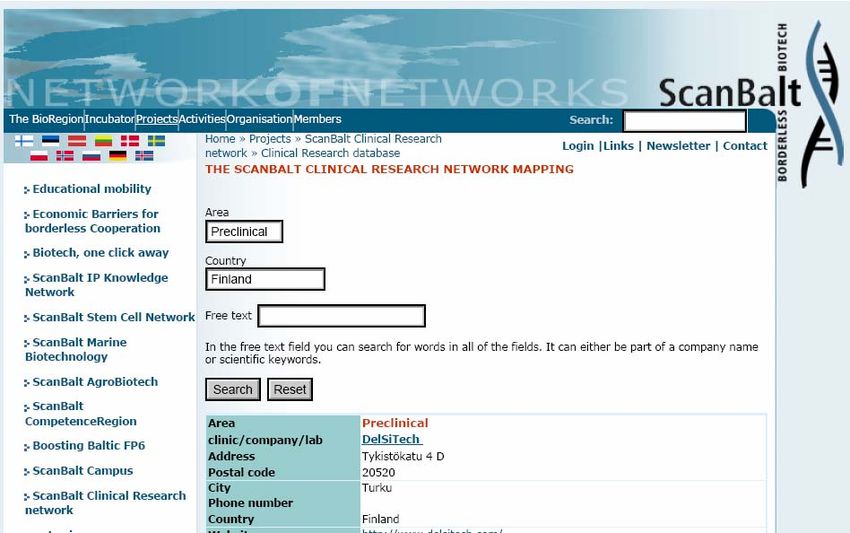
VIIAppendix 1. An example page from the database
VIIIIX
Appendix 2:
The vision, mission and strategy for financially sustainable network

The vision of the follow-up proof of concept project to the ScanBalt Clinical Research
Network pilot project is to set up a working patient recruitment network in the ScanBalt
region embracing one disease area - diabetes. The new organization will be based on the
interconnection network of academic clinical research infrastructures, hospitals, patients and
industry.

This diabetes network has to provide effective and efficient infrastructure for prompt
recruitment of patients and for clinical trial management: legally and organizationally sound
tool for electronic selection of patients from different clinical databases and research sites,
efficient system for obtaining approvals by ethics committees and obtaining informed consent
from participants, appropriate management IT tool for conducting and monitoring clinical
trials and securing the quality of the data generated.

The transnational pattern of the planned thematic network will most probably be a challenge.
Careful mapping of legal systems and inner regulations of the partnering networks/databases
will be crucial to address the cross-border nature of the network. Effective contractual system
between partners will be a necessary output of the legal exercise. Another pillar for the
sustainable clinical research infrastructure will be well balanced basic rules and financial
conditions of the partnering. The pricing conditions for users of the network have to be
enough to maintain and develop the system yet affordable and competitive for partners in
academic endeavor. Additionally appropriate IT infrastructure for conducting clinical trials
has to be selected, adjusted and, if necessary, developed.

To achieve above, a capable and motivated lead partner as well as active local partners are
needed. It will be an advantage to make the network operational by the opening of the funding
possibilities under FP7, including the planned Innovation Medicine Initiative Technology
Platform.

The Estonian Genome Project Foundation in cooperation with Tartu Biotechnology Park and
Sahlgrenska University Hospital has started to select partners as well to design general out
line for this proof of principle project. It will be important to engage an industrial pharma
partner in early phase of the planning of the project. So, in parallel preliminary talks with a
leading diabetes company Novo Nordisk have been initiated. The draft project plan and
application is scheduled to be completed by October, 2006.

The proof of concept project, if successful, can be stepwise extended to other therapeutic
areas as well as to wider European regions.

                                              X
Nordic Innovation Centre
The Nordic Innovation Centre initiates and finances
activities that enhance innovation collaboration and
develop and maintain a smoothly functioning market in
the Nordic region.
The Centre works primarily with small and medium-
sized companies (SMEs) in the Nordic countries. Other
important partners are those most closely involved with
innovation and market surveillance, such as industrial
organisations and interest groups, research institutions
and public authorities.
The Nordic Innovation Centre is an institution under the
Nordic Council of Ministers. Its secretariat is in Oslo.
For more information: www.nordicinnovation.net
Nordic Innovation Centre Phone: +47-47 61 44 00 info@nordicinnovation.net
Stensberggata 25 Fax: +47-22 56 55 65 www.nordicinnovation.net
NO-0170 Oslo
NorwayYou can also read


