Science with SOFIA - Bernhard Schulz - 8-Jun-2020 - SOFIA Science Center
←
→
Page content transcription
If your browser does not render page correctly, please read the page content below
Science with SOFIA
                      8-Jun-2020

               Bernhard Schulz
              Deputy Director
SOFIA Science Mission Operations, NASA Ames
   Deutsches SOFIA Institut, Univ. Stuttgart
   SOFIA Workshop, 8-10 June 2020, DSI Universität Stuttgart   1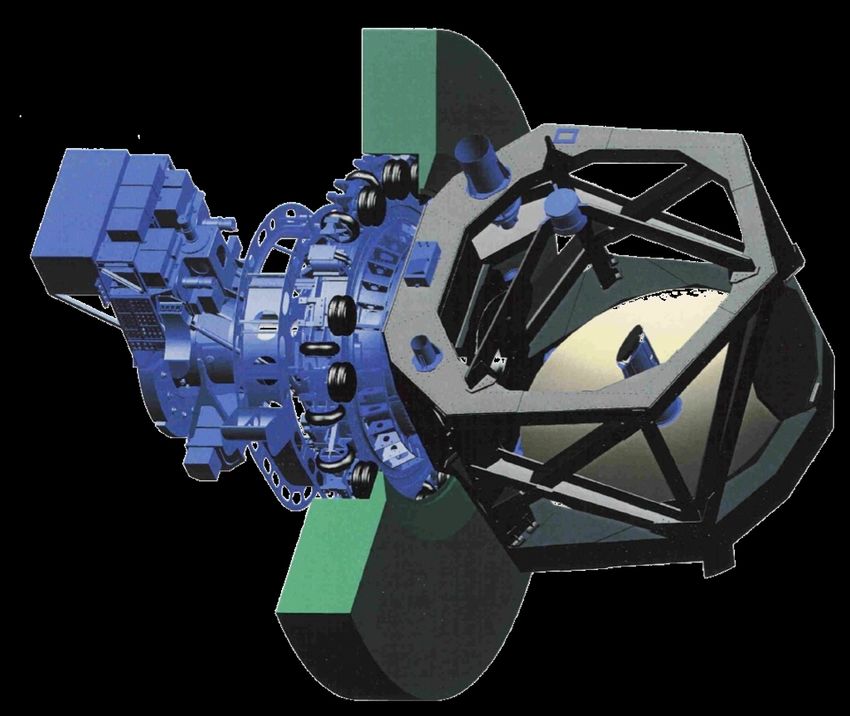
Overview

• Infrared and why do we care

• SOFIA the Stratospheric Observatory for Infrared Astronomy

• Science Examples

• Instrumentation and capabilities

• Observing with SOFIA

• Proposal Tools

                   SOFIA Workshop, 8-10 June 2020, DSI Universität Stuttgart   2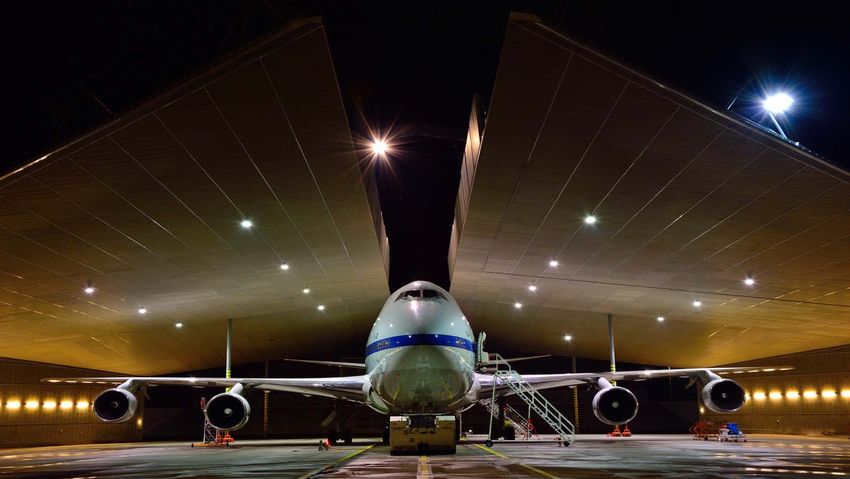
Radiant Heat

                                      Infrared

•   “Heat Rays” had been described
    before year 1800 in the literature.
•   It was known that this radiation
    can be reflected using mirrors.
•   Herschel showed in 1800 “radiant
    heat” as part of the solar
    spectrum using thermometers.
•   We now call the rays he
    observed, infrared light.

                      SOFIA Workshop, 8-10 June 2020, DSI Universität Stuttgart   3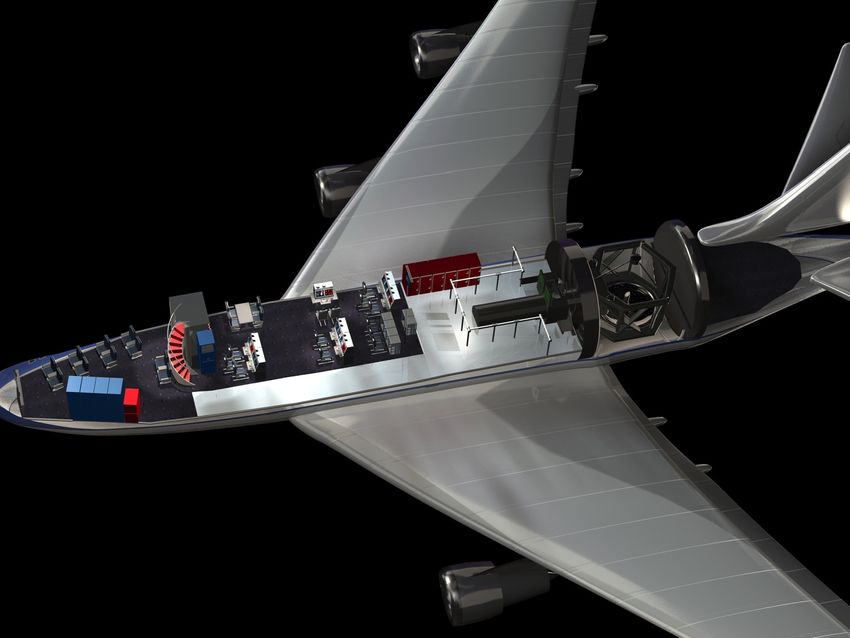
Why Infrared?
• In a nutshell:
    – Dust in space absorbs visible light but becomes transparent in the
      infrared.
    – Dust in space re-radiates absorbed energy in the infrared like a “gray
      body”, with the peak emission wavelength determined by its temperature.
    – Atoms and molecules in gas phase and as dust, sometimes ionized,
      provide a rich collection of unique diagnostics (many vibrational and
      rotational) in the Near-, Mid-, and Far-Infrared.
    – Aligned non-spherical dust grains can polarize continuum emission.
• Infrared broad band photometry/imaging:
    – Temperature / optical depth
    – Dust grain sizes / mass, etc.
• Infrared spectroscopy
    – Constituents of gas and dust, temperature, density
    – Molecular abundances and dust composition
    – Radial velocities of dust or gas components, etc.

                     SOFIA Workshop, 8-10 June 2020, DSI Universität Stuttgart   4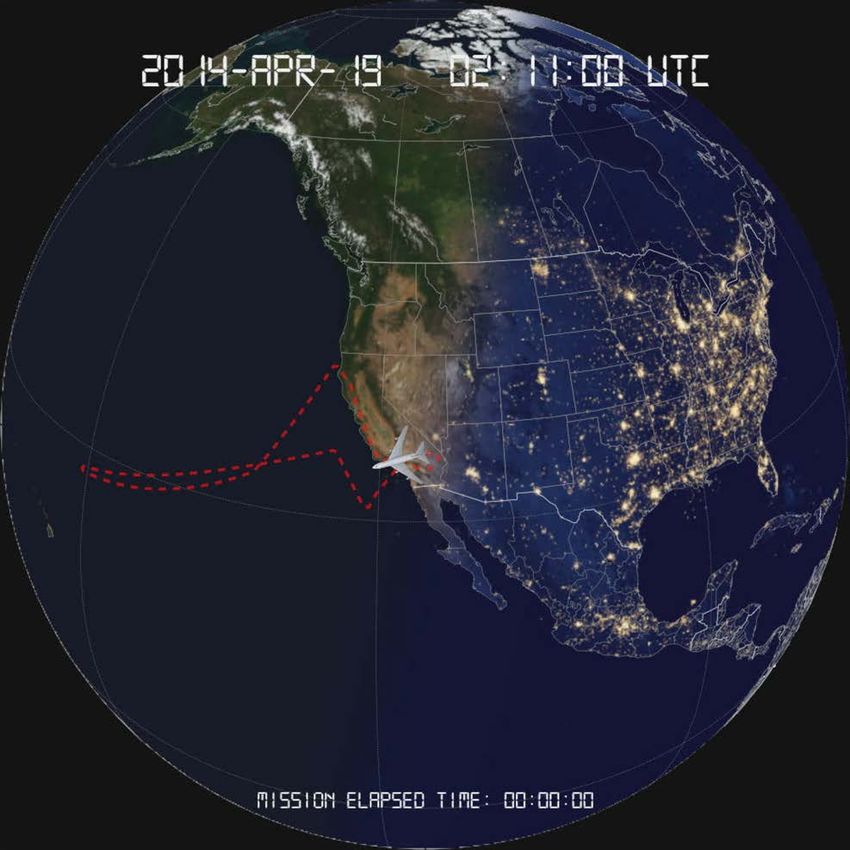
Star Formation
     Filaments everywhere:                                   Fundamental
         The Turbulent ISM                                    questions
                                                            • Where do we
                                                              come from?
                                                            • How did our solar
                                                              system form?
            Herschel PACS 70, 160 μm,                       • How are stars
                 + SPIRE 500 μm                               born?
                                                            • What regulates
                                                              the collapse of
                                                              the ISM?

                          Andre et al. 2010

SOFIA Workshop, 8-10 June 2020, DSI Universität Stuttgart               5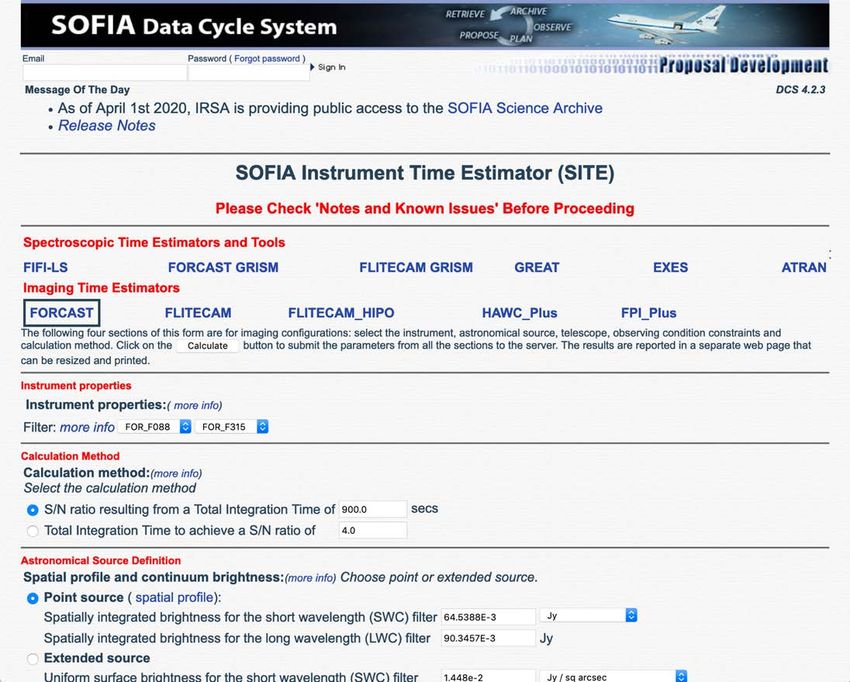
The Energy Budget of the Universe

                                                      •     CMB originated short after the
                                                            Big Bang when radiation and
                                                            matter separated

                                                      •     COB mainly from radiation of
                                                            stars and black holes

                                                      •     CIB from optical and UV
                                                            radiation absorbed by dust
                                                            and re-radiated in the infrared

                                                      •     Since matter and light
CMB: Cosmic Microwave Background                            separated (CMB), half of the
COB: Cosmic Optical Background                              optical radiation emitted in the
                                                            Universe was converted into
CIB: Cosmic Infrared Background
                                                            infrared radiation

                   SOFIA Workshop, 8-10 June 2020, DSI Universität Stuttgart          6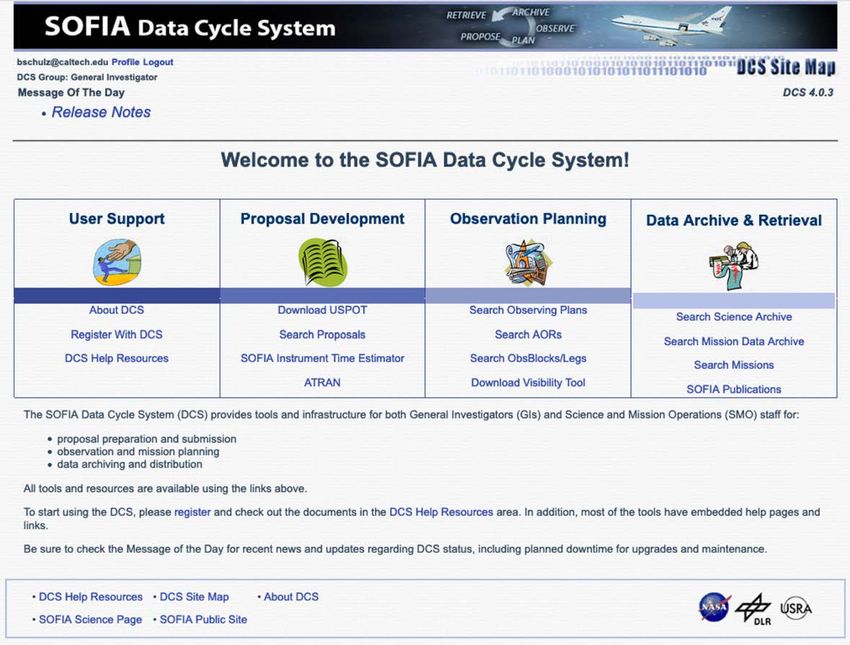
The Earth’s Atmosphere
                               •  Except for the useful function of
                                  supporting life, the Earth’s atmosphere
                                  is very bad
                               …for astronomers

                               •    Most of the electromagnetic spectrum is
                                    blocked from reaching the surface by water
                                    (H2O) and other molecules (O3, CO2).

                               •    Exceptions:
                                      –   long wavelength radio waves
                                      –   Some Infrared wavelengths
                                      –   Visible light
                               •    Solutions:
                                      –   Airplanes (good for instrument
                                          development, residual atmosphere)
                                      –   Balloons (cheap, residual atmosphere,
                                          limited instrument retrieval)
                                      –   Spacecraft (no atmosphere, most expensive,
                                          no instrument retrieval)

SOFIA Workshop, 8-10 June 2020, DSI Universität Stuttgart                 7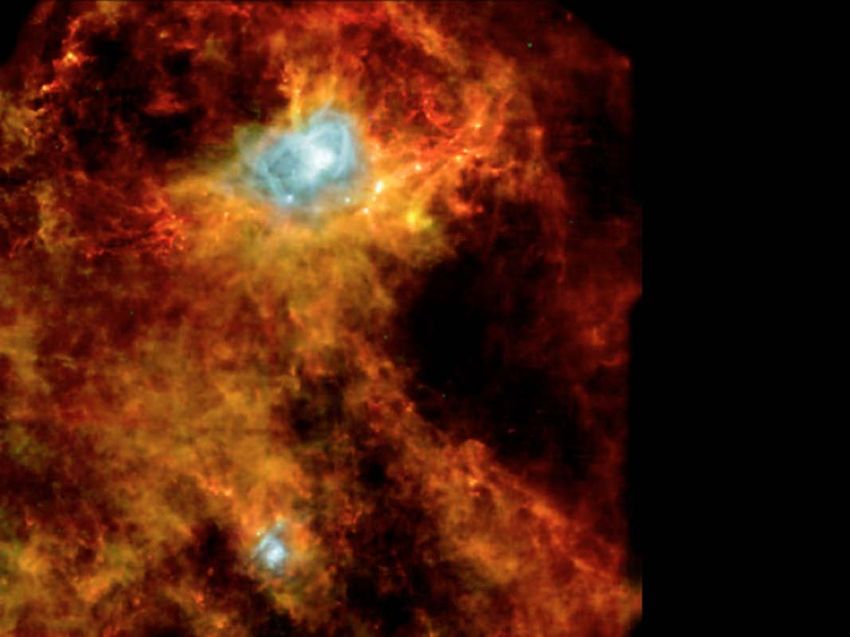
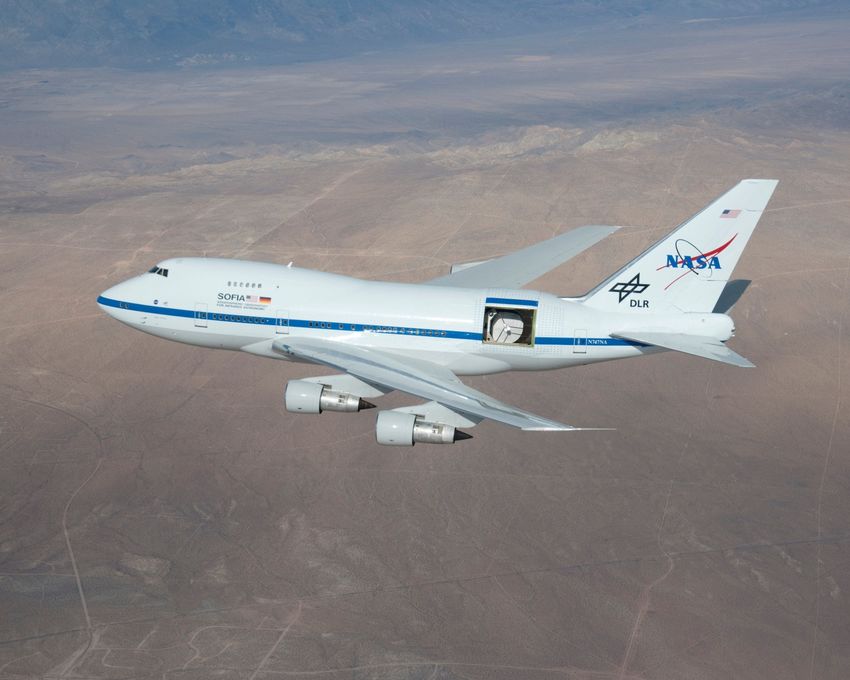
SOFIA Stratospheric Observatory for Infrared Astronomy

•   SOFIA: Modified B747SP aircraft with a 2.7m telescope
•   Joint Program between the US (80%) and Germany (20%)
•   Unique FIR access (5 - 320 μm) for the astronomical community
•   Flies up to 13.7 km (45,000 feet), above 99.9% of the water vapor in the
    atmosphere
•   Suite of infrared imagers, spectrometers and polarimeters
•   Operated by NASA, DLR, USRA, and DSI
•   Regular science operations began in 2014 (Design lifetime 20 years)

                       SOFIA Workshop, 8-10 June 2020, DSI Universität Stuttgart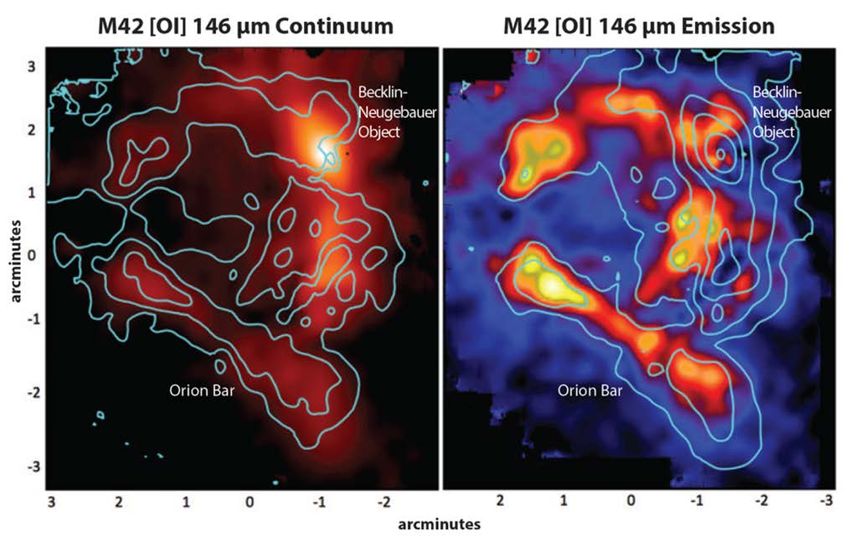
SOFIA Interior Layout

              Science crew       Mission Ops
                stations           stations
                                                                                     Telescope
     Main cabin

                                                                                             Pressure
                                                                                             bulkhead

     Educator/Outreach
         stations
                               Science
                             instrument

                         SOFIA Workshop, 8-10 June 2020, DSI Universität Stuttgart               9      9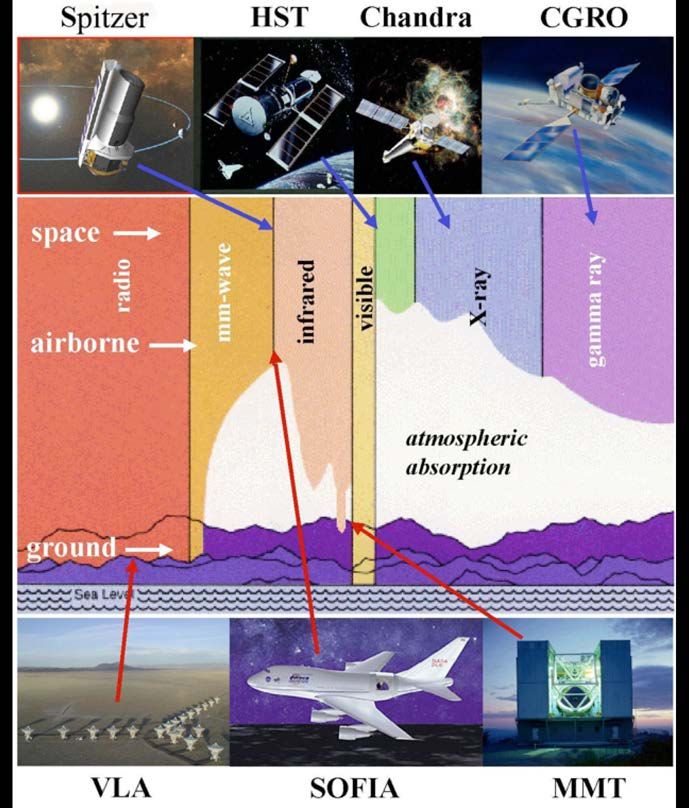
Science Flight On-Board of SOFIA

Telescope with GREAT                Instrument Team                                Aurora Australis

 Telescope Operators          Preliminary Data Reduction                      Pilots posing with Aurora

                       SOFIA Workshop, 8-10 June 2020, DSI Universität Stuttgart               10
THE SOFIA TELESCOPE
§ The telescope is
a major
contribution from
Germany
§ 2.7 meter
diameter mirror
2.5m illuminated
INSTRUMENT
§ Wavelength: 0.3
to 1,600 microns
§ Installed weight:
17 metric tons
Forward Aft
SOFIA Workshop, 8-10 June 2020, DSI Universität Stuttgart 11The Hidden Infrared Universe
SOFIA measures: To determine:
• CO • Age
• Dust • Composition
• Fine structure • Density
• Hydrides • Gas Dynamics
• HD • Magnetic Fields
• NH3 • Pressure
• PAHs • Shocks
• Water • Temperature
SOFIA provides community access to the mid- and far-infrared sky, impossible to observe from the ground
or any current space-based telescopes; it fills the spectral gap between JWST’s longest wavelength (28 μm)
and ALMA’s shortest wave-length (320 μm).
SOFIA Workshop, 8-10 June 2020, DSI Universität Stuttgart 12Science Examples SOFIA Workshop, 8-10 June 2020, DSI Universität Stuttgart 13
GREAT
             First Detection of Helium Hydride in Space
                                                                              •      HeH+ First molecule of
                                                                                     different atoms that
                                                                                     formed after the Big
                                                                                     Bang

                                                                              •      HeH+ reacted then
                                                                                     with neutral H
                                                                                     providing pathway to
                                                                                     H2

                                                                              •      Conditions in
                                                                                     planetary nebulae
                                                                                     predicted to be right
Güsten et al. 2019, Nature                                                           for its formation today

                                                                              •      Line at 2.01 THz
GREAT = German Receiver for Astronomy at Terahertz Frequencies                       observed with GREAT

                         SOFIA Workshop, 8-10 June 2020, DSI Universität Stuttgart                 14
HAWC+
SOFIA/HAWC+ Detection of a Gravitationally Lensed Starburst Galaxy at z= 1.03
27-band spectral energy
distribution (SED)
modeling including the
new SOFIA/HAWC+ data
by Ma, et al (2018).
Constraints on the
8ʹʹ fractional AGN
contribution to the total
3-color image of the
gravitationally lensed system IR luminosity (in this case
using HST F105W (blue), F160W negligible).
(green), and Keck Ks (red)
SOFIA/HAWC+ 89μm detection of imaging data
J1429-0028. The source is (Timmons et al. 2015)
unresolved.
SOFIA Workshop, 8-10 June 2020, DSI Universität Stuttgart 15HAWC+
M82 M82
“SOFIA/HAWC+ Polarization in
Galaxies: It’s All About the
Magnetic Fields”, Lopez-
Rodriguez 2018, AAS Press HAWC+ 53 µm
Release 123.07
M82 – Dust grain polarization
aligned with starburst outflow.
HAWC+ 53 µm
NGC 1068
NGC 1068 – Magnetic field is
well ordered and traces spiral
arms.
HAWC+ 89 µm
SOFIA Workshop, 8-10 June 2020, DSI Universität Stuttgart 16HAWC+
20”
Magnetic Field at the 0.8 pc
Galactic Center
• SOFIA/HAWC+ polarimetry at
53μm traces magnetic field lines
• SOFIA/FORCAST reveals arcs of
dusty material surrounding and
possibly feeding the massive BH Sgr A*
+
• How strong would the magnetic
field have to be to affect the
galactic center dynamics?
• Does the magnetic field control
or even quench the flow to the
massive BH?
Lopez-Rodriguez, Lau & HAWC+ Science Team
SOFIA Workshop, 8-10 June 2020, DSI Universität Stuttgart 17GREAT
The Dragon in Orion
3D representation of [CII] velocity data Pabst et al. (2019), Nature
• One square degree [CII]
map (1.9 THz/158µm) of
Orion SF-Region observed
with upGREAT
• Measured in 40h where
Herschel HIFI would have
taken 2000h
• Interaction of massive
stars with their
environment regulates
the evolution of star
forming galaxies
SOFIA Workshop, 8-10 June 2020, DSI Universität Stuttgart 18FIFI-LS
M17-SW Fine-structure Lines M17-SW M17-SW Continuum
[OIII]52µm 3 57µm
2 [NIII]57µm 63µm
[OI]146µm 2 88µm
146µm
1
1 153µm
arc minutes
arc minutes
158µm
0
0
-1 -1
-2 -2
-3 -3
2 1 0 -1 -2
3 2 0 1 -1 -2
arc minutes
reference pos. R.A. 18h20m24.s82 DEC -16o11’34."9 (2000) arc minutes
reference pos. R.A. 18h20m24.s82 DEC -16o11’34."9 (2000)
M17-SW is a well studied Photon-Dominated Region (PDR), the
transition region from ionized to molecular gas.
The lines from ionized and neutral species trace the different
regimes. Also the color temperature of the continuum indicates the
transition from a warmer to a colder phase.
SOFIA Workshop, 8-10 June 2020, DSI Universität Stuttgart 19Recent Dimming of Betelgeuse
Dimming of Betelgeuse: SOFIA investigates this Reg Supergiant
• SOFIA organized an observing campaign and managed to take data with 3
different instruments between February and March to provide key scientific data
to the community for understanding/studying the changes in this red supergiant.
• EXES high resolution Mid-IR spectra are about to be published in a paper. FIFI-LS
and GREAT spectral data are in the process of being analyzed.
• The Data becomes public once pipeline processing is complete.
• SOFIA has issued a Flash Call for science funding to speed up analysis.
before
Image from ESO/VLT
after H2O H2O
H2O
EXES Spectra (preliminary)
SOFIA Workshop, 8-10 June 2020, DSI Universität Stuttgart 20Pluto Occultation
• Occultation of 12-mag star by Pluto on 2015 June 29
• Simultaneous SOFIA observations with HIPO, FLITECAM, &
Focal Plane Imager.
• Final ground-based shadow updates required course
adjustments of 230 km
• Detection of strong “central flash” confirms accuracy of
course corrections
• Comparison of multi-wavelength observations allowed
detailed analysis of atmospheric profiles and aerosol content.
Focal Plane Imager+ observation of Pluto
occultation event on UT 2015-06-29 16:55.
Video is approximately 4X real time.
As observed by SOFIA, the central bright
flash represents starlight refracted by the Departure shot by
atmosphere of Pluto when the star was New Horizons Mission
completely behind the planet. to Pluto.
SOFIA Workshop, 8-10 June 2020, DSI Universität Stuttgart 22Instrumentation SOFIA Workshop, 8-10 June 2020, DSI Universität Stuttgart 23
The Scientific Instruments
 FPI+      Focal Plane Imager Plus
                                          FORCAST Faint Object Infrared Camera
                                                  for the SOFIA Telescope
                                                                                                      Echelon-Cross-Echelle
                                                                                                 EXES Spectrometer

 λ = 0.36–1.10 μm Optical Camera,               λ = 5–40 μm Grism Spectrometer                    λ = 4.5–28.3 μm High Resolution
 R = 0.9–29.0     always running!               R = 100–300                                       R = 1,000–105   Spectrometer

HAWC+         High-resolution Airborne
              Wideband Camera Plus         FIFI-LS Far Infrared Field-Imaging
                                                   Line Spectrometer                      GREAT German  Receiver for Astronomy
                                                                                                at Terahertz Frequencies

 λ = 50–240 μm Bolometer Camera                   λ = 51–203 μm   Grating                         λ = 63–612 μm    Heterodyne
 R = 2.3–8.8   & Polarimeter                      R = 600–2,000   Spectrometer                    R = 106–108      Spectrometer

                                     SOFIA Workshop, 8-10 June 2020, DSI Universität Stuttgart                         24
Science Instruments on SOFIA synergy with ALMA
Ground Based NIR/Optical GREAT
Two Spitzer Channels
SOFIA
EXES Instruments
ALMA EXES
FIFI-LS FIFI-LS
FORCAST
FPI+
FORCAST grisms GREAT
HAWC+
FORCAST HAWC+
FPI+
future in development
upgrades
ALMA Atacama Large Millimetre Array (Chile)
SOFIA Workshop, 8-10 June 2020, DSI Universität Stuttgart 25Science Instruments on SOFIA
Ground Based NIR/Optical GREAT
Two Spitzer Channels
SOFIA
EXES Instruments
52, 57, 63, 88, 122mu
ALMA EXES
FIFI-LS FIFI-LS
FORCAST
FPI+
JWST FORCAST grisms Unique abilities GREAT
HAWC+
FORCAST HAWC+
FPI+ ++
in development
Future overlap with JWST
ALMA Atacama Large Millimetre Array (Chile)
JWST James Webb Space Telescope (in development)
SOFIA Workshop, 8-10 June 2020, DSI Universität Stuttgart 26SOFIA Is Unique
• Access to Mid- and Far-Infrared
– No satellite mission beyond 28µm within the next decade
– Unlike many balloon experiments the instruments are returned safely
– Flexible and comprehensive instrument suite
• Fast turn-around for new instruments
– State of the art technology (allowable to have “problems”)
– Instrument access in flight
– Broken instruments can be repaired and flown again
• Inertial platform
– Fast mapping
– Small Sun-avoidance angle (40˚ sun above horizon, ~25˚ sun below horizon)
• Venus, comets, ToOs (novae, SN etc.)
• World-wide access
– Northern and Southern hemisphere
– Occultations
• Long baseline temporal studies
– Designed for 20 year life time
SOFIA Workshop, 8-10 June 2020, DSI Universität Stuttgart 27Mid-/Far-IR Observatories in Time
ISO
S
IN
IG
OR
A
IC
SP
1995 2000 2005 2010 2015 2020 2025 2030
Year
SOFIA Workshop, 8-10 June 2020, DSI Universität Stuttgart 28Observing with SOFIA SOFIA Workshop, 8-10 June 2020, DSI Universität Stuttgart 29
Proposing and Observing with SOFIA
•   Annual proposal call
     – Call for Proposals beginning of July, Proposal Deadline beginning of September
     – Cycle Start end of April of the following year
•   Two phase proposal process (much like HST):
     – Phase 1: Science justification and Technical feasibility
     – Phase 2: Detailed observation definition (After selection)
•   Only one* instrument on the plane at the time:
     – Flight Series (2-3 weeks) planned after proposal selection
     – Some constraints of timing sensitive observations
     – ToOs are welcome but need to be clear on instrument/timing requirements
•   Queue/Service mode observations
                                                                                     No flights by guest
     – Guest Observers (GOs) are welcome to fly, but not required
                                                                                      observers during
     – Limited real-time modifications allowed                                           COVID-19
     – Participation can provide a better understanding of data
•   Data are pipeline processed by the Science Center (/PI teams)
     – However, SOFIA is still inside of the atmosphere, so residual effects are unavoidable
       and need to be understood by the user.

      * FPI+ in science mode is always available
                         SOFIA Workshop, 8-10 June 2020, DSI Universität Stuttgart                 30
Telescope Observing Limits
“Azimuth” Range
+/- 3 Degrees
Slewing in “Az” is accomplished by turning
the plane!
Many other boundary conditions
SOFIA Workshop, 8-10 June 2020, DSI Universität Stuttgart 31SOFIA Scheduling Constraints
– Telescope elevation limited to 23 - 60 degrees
– Flights must:
• BeWater Vapor at Altitude Over the Year
38,000 ft
Northern Summer Northern Winter
40,000 ft
Water Vapor content decreases with altitude and is less in winter.
During the northern summer with less favorable water vapor conditions in the north,
SOFIA observes from New Zealand and schedules aircraft maintenance work.
SOFIA Workshop, 8-10 June 2020, DSI Universität Stuttgart 33Typical SOFIA Flight SOFIA Workshop, 8-10 June 2020, DSI Universität Stuttgart 34
SOFIA Scheduling
• Once proposal selection is finalized, agree on high-level
  schedule of instrument campaigns, maintenance, and
  deployments
• The location and length of the Flight Series are matched to
  the target pool
• Flight plans are sensitive to exact dates (field rotations,
  LOS rewinds, SUAs…)
   – Most efficient baseline flight plan determined by software from
     millions of options
• About 10 weeks before the start of a series, final flight
  planning starts
• Flight plans set ~6 weeks before first flight
   – Posted to SOFIA web site
   – GO invitations sent out (nominally 2 GO seats /flight)

                  SOFIA Workshop, 8-10 June 2020, DSI Universität Stuttgart   35
Working Schedule as of 9-May-2018
Cycle 6 Daily Overview – Page 1 of 2 •
•
May use for operations planning
Approval of the schedule by the Program Management Board
forthcoming
Maintenance / Upgrades #15 w/ 'C Check'
Eng Run FCF Ferry
S M T W T F S S M T W T F S S M T W T F S S M H W T F S S M T W H F S
8 9 10 11 12 13 14 15 16 17 18 19 20 21 22 23 24 25 26 27 28 29 30 1 2 3 4 5 6 7 8 9 10 11 12
April -- 2018 May -- 2018
Cycle 6 Start
Europa NZ
SI Install OC#6 E EXES OC#6 G GREAT LFA/HFA OC#6 H (NZ) GREAT Time Media
SI Install Eng LO 2 Flights SI Rem SI Install 2 Flights LFA/HFA Aircraft Prep Ferry CHC - 2 flts Prep Orient 8 Flights LFA/HFA Post Down Prep Swap
S M T W T F S S M T W T F S S H T W T F S S M T W T F S S M T W T F S
13 14 15 16 17 18 19 20 21 22 23 24 25 26 27 28 29 30 31 1 2 3 4 5 6 7 8 9 10 11 12 13 14 15 16
May -- 2018 June -- 2018
Titan
Tour Tour Tour Tour Tour Tour
Code O
OC#6 H (NZ) GREAT Safety Day OC#6 I (NZ) HAWC+ FPI+ 2 flts
Down Prep 8 Flights 4G/HFA Post Down Prep SI Rem. Down SI Install 8 Flights Post Down Prep Prep Titan Prep FerryPMD
S M T W T F S S M T W T F S S M T H T F S S M T W T F S S M T W T F S
17 18 19 20 21 22 23 24 25 26 27 28 29 30 1 2 3 4 5 6 7 8 9 10 11 12 13 14 15 16 17 18 19 20 21
June -- 2018 July -- 2018
COSPAR
Tour
OC#6 I (NZ) HAWC+ MD Inst. Maintenance / Upgrades #17 OC#6 J FORCAST
Tour Crew Rest SI Rem. Eng LO CR Eng LO Chk Flt MD Rem SI Install SI Install 10 Flights
S M T W T F S S M T W T F S S M T W T F S S M T W T F S S M T W T F S
22 23 24 25 26 27 28 29 30 31 1 2 3 4 5 6 7 8 9 10 11 12 13 14 15 16 17 18 19 20 21 22 23 24 25
July -- 2018 August -- 2018
OC#6 J FORCAST SI Install OC#6 K HAWC+
SI Rem. SI Install LO (H) 10 Flights
S M T W T F S S H T W T F S S M T W T F S S M T W T F S S M T W T F S
26 27 28 29 30 31 1 2 3 4 5 6 7 8 9 10 11 12 13 14 15 16 17 18 19 20 21 22 23 24 25 26 27 28 29
August -- 2018 September -- 2018
San Francisco
Fleet Week
Code O
Safety Day OC#6 K HAWC+ OC#6 L EXES
SI Rem. SI Install SI Install 8 Flights SI Rem. SI Install SI Install
S M T W T F S S H T W T F S S M T W T F S S M T W T F S S M T W T F S
30 1 2 3 4 5 6 7 8 9 10 11 12 13 14 15 16 17 18 19 20 21 22 23 24 25 26 27 28 29 30 31 1 2 3
October -- 2018 November -- 2018
Key Observing Cycle: 6 Baseline Science Flights: 100 (TBD) Baseline RHs: 796 (TBD) Planned Obsv Prog Flights*: 98 Estimated RHs*: 780 (*Year to date + Estimate)
S Weekend day H US or German Holiday F Instr. Commissioning Flight F Baseline Observing Flight F Ferry/Maint./Non-Sci Flight F Educator on Flight F Return to Base (RTB) Flight
7 (black text with no fill) 4 (day of week box H or GH w/ red fill) 6 (bold white text, purple fill, bold border) 6 (bold white text, blue fill, bold border) 6 (bold white text, green fill, bold border) 6 (white star on day of week) 6 (single slash through day and date)
F Work day F Line Operations F Contingency Instr. Comm. Flight F Contingency Obser. Flight F Contingency Ferry/Maint./Non-Sci Flt F Media/VIP on Flight F Canceled Flight
6 (black text w/ day box grey fill) 6 (bold border) 6 (day box with purple fill) 6 (day box with blue fill) 6 (day box with green fill) 6 (yellow star on date) 6 (x through day and date)
F AFRC Regular Day Off F Possible Maint/Up. Check Flt F Deployment Observing Flights S Short Flight S Half Sci. & Half Ferry/Maint./Non-Sci F Cont./Alternate Flight F Deploy P1 Cont/ P2 Alt Flight
6 (day and date shown in red) 6 (day and date box filled with lt. green) 6 (bold white text, light blue fill, bold border) 28 (colored fill only lower half, bold bdr.) 13 (two colored fill) 6 (blue/orange fill, bold border) 6 (lt. blue/ lt. orange fill, bold border)
Distributed: 9 May 2018 SOFIA Workshop, 8-10 June 2020,
Slide DSI9Universität
Revision: May 2018 Stuttgart Page 36
1SOFIA Data Cycle System (DCS)
https://dcs.arc.nasa.gov
SOFIA Workshop, 8-10 June 2020, DSI Universität Stuttgart 37Unified SOFIA Proposals and Observation Tool (USPOT)
https://www.sofia.usra.edu/science/proposing-and-observing/uspot-manual
• Aid to prepare proposals
including observations.
• Feeds proposal details into
SOFIA DCS for planning.
Proposal Observations
SOFIA Workshop, 8-10 June 2020, DSI Universität Stuttgart 38Exposure Time Estimation
https://dcs.arc.nasa.gov/proposalDevelopment/SITE/
SOFIA Workshop, 8-10 June 2020, DSI Universität Stuttgart 39Exposure Time Estimation
Be aware of atmospheric opacity! [OI] 63.1837µm
• For spectroscopic -500km/s +500km/s
observations, it is critical
to check the
atmosphere’s Atmosphere
transmission at the
observing wavelength.
• For EXES, FIFI-LS, and
GREAT the variation of
earth’s velocity may be
important. Included in
Time estimators.
https://dcs.arc.nasa.gov/proposalDevelopment/SITE/
SOFIA Workshop, 8-10 June 2020, DSI Universität Stuttgart 40Data Available in IRSA
Currently Available
Cycles 2-7
7 Instruments
Archival
Research!
https://irsa.ipac.caltech.edu/applications/sofia/
SOFIA Workshop, 8-10 June 2020, DSI Universität Stuttgart 41Science Instruments
Wavelength Range
Name Principal Investigator Description Resolving Power R=λ/Δλ Field of View Features
Visible light high speed
FPI+ Jürgen Wolf,
camera
0.36 – 1.10 μm 8.7’ x 8.7’
(Focal Plane Imager Plus) Universität Stuttgart, DSI R = 0.9 – 29.0 1024x1024 CCD
Facility Instrument
FORCAST Mid-IR Camera & Grism 3.2’ x 3.2’
(Faint Object infraRed Terry Herter, 5 – 40 μm
Cornell University Imaging Spectrometer R = 100 – 300
2x(256x256)
CAmera for the SOFIA Si:As, Si:Sb
Telescope) Facility Instrument
EXES Mid-IR High Resolution
Matthew Richter, 4.5 – 28.3 μm 1” – 180” slit lengths
(Echelon—Cross- UC Davis Echelle Spectrometer R = 1,000 – 105 1024x1024 Si:As
Echelle Spectrograph) PI Instrument
HAWC+ Far-IR Bolometer 53, 89, 154, 214 μm from 1.4’ x 1.7’ (53 μm)
(High-resolution Charles Dowell,
JPL, Caltech Camera and Polarimeter ~20% bands to 4.8’ x 6.1’ (214 μm)
Airborne Wideband 3x(32x40) bolometer
Camera-Plus) Facility Instrument Δλ = 9 – 43 μm
FIFI-LS Far-IR Dual Channel
51 – 120, 115 - 203 30” x 30” (Blue)
(Field Imaging Far- Alfred Krabbe, Integral Field Grating
μm 60” x 60” (Red)
Infrared Line Universität Stuttgart, DSI Spectrometer 2x(16x25) Ge:Ga
Spectrometer)
R = 600 – 2,000
Facility Instrument
GREAT, upGREAT Far-IR Heterodyne, 63 – 612 μm
Rolf Güsten,
(German REceiver for MPl für Radioastronomie, multi-pixel (0.49-4.74 THz 7 diffraction limited
Astronomy at Terahertz Bonn Spectrometer bands) heterodyne receiver
frequencies) PI Instrument R = 106 – 108
SOFIA Workshop, 8-10 June 2020, DSI Universität Stuttgart 45Atmospheric Transparency
• The infrared is a key SOFIA Mauna Kea
part of the spectrum
for studying young
stars, galaxies, planets,
and the interstellar
medium.
• The Earth’s
atmosphere is opaque
to large parts of the
infrared wavelength
range. Water vapor
absorbs much of this
radiation.
• Stratosphere is a place
with much less water
vapor.
SOFIA Workshop, 8-10 June 2020, DSI Universität Stuttgart 46Species Accessible to SOFIA
Within many environments: Interstellar Medium, Diffuse Clouds, Molecular
Clouds, Proto-stellar Disks, Debris Disks, Planetary Atmospheres, Comets
§ Ionized Gas - [SI] 25.25 μm; [FeII] 25.99,35.35 μm, [SIII] 33.48 μm, [SiII] 34.81 μm; [Ne
III] 36.0 μm, O [III] 52 μm, [N III] 57 μm, [O I] 63.18 μm (4.75 THz), [O III] 88.35 μm, [N
II] 122 μm, [O I] 145 μm, and [C II] 158 μm; high-rotational CO
§ Molecular - OH at 53 μm, 79 μm, 84 μm, 119 μm, and 163 μm, and H2O at 58 μm, 66
μm, 75 μm, 101 μm, and 108 μm, NH3 166 μm (1.8 THz)
§ Hydrides – CH 149 μm (1.46 THz), SH 217 μm (1.38 THz), OD 119 μm (2.51 THz),
(1.391 THz), HCl, HF (1.23 THz), ArH+, 13CH+
§ PAHs - 6.2, 7.7, 8.6 and 11.2 μm and longer wavelengths
§ Water H2O - 6.1, 8.91, 34.9, 58, 66, 75, 101, 108 μm, … 231 μm …
§ Deuterated Hydrogen HD – 28.5 μm, 56.2 um, 112 μm (2.674 THz)
§ Ices – Hydrocarbon, NH3, H2O - 43 μm, 63 μm (crystalline), 47 μm (amorphous)
§ Organics/Nitriles – C2H2, C4H2, C3H3+, C3H4, C2N2, CH4, “haystack condensate” at
45.45 μm
§ Cations – ortho-D2H+ 203 μm (1.47 THz), para-H2D+ 219 μm (1.37 THz)
§ …
SOFIA Workshop, 8-10 June 2020, DSI Universität Stuttgart 47Protoplanetary Disks
• Dust disk emits IR
radiation.
• Dust Temperature
increases with
proximity to star.
• Wavelength tells
distance to star.
• Gap in IR-spectrum
corresponds to gap
in disk.
• Possible location of
new forming planet
“sweeping” up
material.
SOFIA Workshop, 8-10 June 2020, DSI Universität Stuttgart 48FIFI-LS
Jet-related Excitation of the [C II] Emission in the Active Galaxy
NGC 4258 with SOFIA/FIFI-LS
“… as much as 40% (3.8×1039 erg s−1) of the total [C II]
Appleton, et al. (2018, ApJ, 869, 61) luminosity from the inner 5 kpc of NGC 4258 arises in shocks
and turbulence […], the rest being consistent with [C II]
excitation associated with star formation.
(a) Contours of [C II] emission superimposed on false- a) Spitzer IRS image of H2 0-0 S(3) 9.7μm (green) , PAH
color HST F657N WFC3 image over inner 3 kpc of 11.2μm (red), and PAH 7.7μm (blue). PAH dominated (blue
NGC 4258 border) H2 line emission (green border).
(b) Zoom-in on the [C II] emission (WFC3 image b) Same with SOFIA [C II] contours superimposed.
different color table)
SOFIA Workshop, 8-10 June 2020, DSI Universität Stuttgart 49Mapping Orion in [CII]
• ALMA is now using the [CII] line at 158 µm as
a star formation rate indicator for z>5. Is this
line a good star formation rate indicator?
• Goal of this study (Tielens et al. in prep)
was to further examine the use of the [CII]
line as a tracer of star formation rate,
measure the amount of molecular cloud
mass not measured by CO (“CO-dark”
gas), and semi-empirically determine the
photo-electric heating efficiency over a
wide range in incident UV fields.
Herschel-HIFI would have needed 2000 hours
for this project (approx. 7% of the Herschel
mission) 40 Hrs SOFIA
SOFIA Workshop, 8-10 June 2020, DSI Universität Stuttgart 50FIFI-LS
“FIFI-LS Mapping of M42 at 146 Left: The far infrared continuum is shown, which peaks at the Becklin-
µm”, L. Looney, et al. In prep Neugebauer object but also clearly shows the Orion Bar and a similar
structure to the north-east.
Right: Additionally, the [OI] line emission traces the photon-dominated
regions around the Trapezium stars where the star’s UV radiation
irradiates the surrounding molecular cloud.
SOFIA Workshop, 8-10 June 2020, DSI Universität Stuttgart 51HAWC+
Examined the interstellar polarization spectrum using HAWC+ Observations of Rho Oph A
HAWC+ observations at 89 and 155 µm of the Rho Oph – Santos et al., 2018, AAS Press
star forming region. Release 130.04
Changes in grain alignment from diffuse to dense
regions is consistent with Radiative Alignment Theory
(RAT).
Herschel/PACS 160 µm map of L1688 Herschel/PACS 70 µm map of
Rho Oph A
Additional tests of RAT theory, presented by Andersson
et al., demonstrates radial alignment of grains around
IRC +10216 (AAS Press Release 414.04).
SOFIA Workshop, 8-10 June 2020, DSI Universität Stuttgart 52Astronomy Picture of the Day SOFIA Workshop, 8-10 June 2020, DSI Universität Stuttgart 53
Hyperluminous IR Galaxies: What powers them?

                                                                                                SOFIA/HAWC+ 89μm

                                                                                                               Star-formation SED

                                                                                                         AGN Emission
Data taken on October 2017 (OC5N)

D. Riechers/Cornell and colleagues detected z=3.9                              Data taken on May 2017 (OC5E)

galaxy/AGN APM08279+5255 (lrest=11, 18 & 31                               A. Cooray/UC Irvine and colleagues
μm) with SOFIA HAWC+. Spectral Energy                                     measured the z=1.03 galaxy
                                                                          HATLASJ1429-0028 demonstrating SOFIA’s
Distribution at shorter wavelengths that ALMA
                                                                          HAWC+ capabilities. Another ~50 HATLAS
cannot access, measures hotter dust at these                              galaxies missing FIR photometry still to be
redshifts, to identify and characterize AGN in                            observed (Ma et al 2018).
bright but dusty galaxies at high redshift.

                                    SOFIA Workshop, 8-10 June 2020, DSI Universität Stuttgart                                54
ATRAN
https://atran.arc.nasa.gov/cgi-bin/atran/atran.cgi
• Atmospheric Transmission
• atmospheric transmission as a function
of wavelength
• On-line tool ATRAN developed and
kindly provided to the SOFIA program by
Steve Lord.
• ATRAN is necessary for planning SOFIA
high-resolution spectroscopic
observations.
• Also for medium resolution
spectroscopy – e.g. FIFI-LS observations
of [O I], the Doppler shift of
atmospheric lines can have significant
impacts on the sensitivity
• For spectral regions accessible from the
ground (e.g. l=10-13µm), very strong
motivation must be provided for using
e.g. SOFIA/EXES instead of
Gemini/TEXES
[O I] 3P1-3P2 63.183705 µm
SOFIA Workshop, 8-10 June 2020, DSI Universität Stuttgart 55Spatial Resolution
SOFIA is diffraction limited above wavelengths of 25µm
pointing jitter ["] 1.3
diameter [m] 2.5
Other
SOFIA 2.5m Missions
Wavel. [micron] FWHM ["] FWHM [“]
SOFIA FORCAST 19.7 2.4
MSX 21.0 2.5 12.0
Spitzer MIPS 24.0 2.7 6.0
SOFIA FORCAST 37.0 3.9
Herschel PACS 70.0 7.2 5.6
Herschel PACS 160.0 16.2 10.7
SOFIA Workshop, 8-10 June 2020, DSI Universität Stuttgart 56You can also read


