Scientific Committee on Thermal Factors (SCTF) - Global Heat ...
←
→
Page content transcription
If your browser does not render page correctly, please read the page content below
Scientific Committee on Thermal Factors (SCTF)
                     1st Meeting of ICOH SCTF (2018-2021)
Meeting on the Occupational Health and Productivity Impacts of Workplace Heat in
                  Relation to Global and Local Climate Change

Time: Friday, 3 May 2019, 9:00a.m. to 12:00p.m.

Venue: Massey University, Wellington, New Zealand

Participants: Annex I

Aims:
A. To receive updates on the scientific evidence on increasing environmental and
workplace heat as a health risk factor from globally active scientists and discuss gaps in
the evidence;
B. To establish contacts for potential new research collaboration;
C. To discuss plans for the ICOH SCTF and to discuss a proposed SCTF plan for a global
consensus report on methods to quantify heat effects on occupational health and
productivity in the context of climate change.

                                                                                        1
1. Welcome and Introduction
   1.1 Jason Lee and Tord Kjellstrom welcomed onsite and online participants. Participants
       of the meeting introduced themselves. Tord Kjellstrom established the lack of
       attention given to the impact of heat on occupational health and need for more
       epidemiological studies, especially on migrant workers with high manual work and
       poor health status. Jason Lee encouraged the committee to harness their various
       expertise to address this mandate.

2. Announcements
   2.1 Advertisement of SCTF ICOH membership: prospective members may apply with the
       endorsement of three ICOH members (Annex II).

   2.2 The next in-person meeting will be held in conjunction with the International
       Conference on Heat-related Illnesses in Kitakyushu, Japan. The conference is on 27-
       28 Oct 2019 and is to be organized by Seichi Horie.

   2.3 A new Heat Health and Work Productivity Research Programme will be initiated at
       the NUS Global Asia Institute from July 2019 (http://www.gai.nus.edu.sg). Jason Lee
       encouraged members to consider tapping on this platform to foster collaborative
       research.

3. Summary of Presentations from the 27th Epidemiology in Occupational Health
   (EPICOH) conference on 29 April – 2 May 2019.
   3.1 Onsite members (bold and underlined) recapped their presentations from the Mini
       Symposium on Climate Change and from the Occupation Health Effects of Heat
       session at the conference. Abstracts can be found online. Blesson Varghese was not
       present.

   3.2 Mini Symposium on Climate Change
       3.2.1 Andreas Fluoris, Lucka Kajfez Bogataj, Tord Kjellstrom, Nathan Morris, Lars
              Nybo
              Solutions to prevent occupational health and productivity effects of heat
              Abstract available at: Occupational and Environmental Medicine Apr 2019, 76
              (Suppl 1) A68; DOI: 10.1136/OEM-2019-EPI.183;
              Abstract: https://bit.ly/2VUqpjy
              Presentation: https://bit.ly/2MeHLIG

       3.2.2 Vidhya Venugopal, PK Latha, S Rekha, K Manikandan, Tord Kjellstrom
             Risk factors for heat strain – comparing indoor and outdoor workers in the
             changing climate scenario

                                                                                          2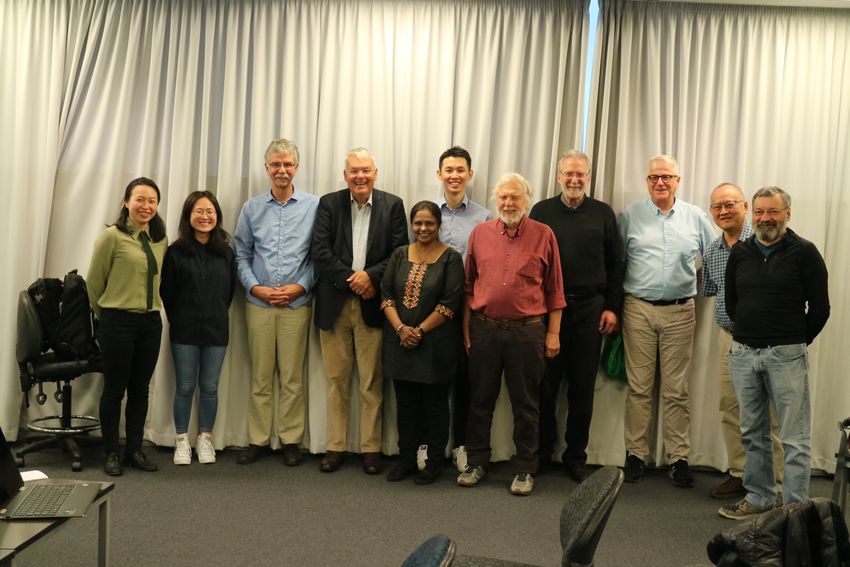
Abstract available at: Occupational and Environmental Medicine Apr 2019, 76
          (Suppl 1) A68-A69; DOI: 10.1136/OEM-2019-EPI.184;
          Abstract: https://bit.ly/2wp4PJI
          Presentation: https://bit.ly/2XcJSxx

   3.2.3 Wenjia Cai, Mengzhen Zhao, Yidan Chen, Can Wang
         Estimating economic impact of heat on china’s labor productivity: new
         evidence from a CGE model
         Abstract available at: Occupational and Environmental Medicine Apr 2019, 76
         (Suppl 1) A69; DOI: 10.1136/OEM-2019-EPI.185;
         Abstract: https://bit.ly/2Mfrmn9

   3.2.4 Jason Lee
         New initiatives in international collaboration for describing the occupational
         heat hazards via epidemiological studies and modeling
         Abstract available at: Occupational and Environmental Medicine Apr 2019, 76
         (Suppl 1) A69; DOI: 10.1136/OEM-2019-EPI.186;
         Abstract: https://bit.ly/2JJpS2B

3.3 Presented at Occupation Health Effects of Heat Session
    3.3.1 Marc Schenker, Diane Mitchell, Tracey Armitage, Daniel Tancredi
           Risk of heat related illness in latino agricultural workers: environmental
           temperature and activity levels
           Abstract available at: Occupational and Environmental Medicine Apr 2019, 76
           (Suppl 1) A71-A72; DOI: 10.1136/OEM-2019-EPI.192;
           Abstract: https://bit.ly/30OpMf7

   3.3.2 Bruno Lemke, Tord Kjellstrom
         Epidemiological descriptions of occupational health effects of climate change
         Abstract available at: Occupational and Environmental Medicine Apr 2019, 76
         (Suppl 1) A72; DOI: 10.1136/OEM-2019-EPI.193;
         Abstract: https://bit.ly/2EB0qrW
         Presentation: https://bit.ly/2WaAn5H

   3.3.3 Blesson Varghese, Alana Hansen, Susan Williams, Peng Bi, Dino Pisaniello
         Heat and injury in the workplace: perspectives from health and safety
         representatives
         Abstract available at: Occupational and Environmental Medicine Apr 2019, 76
         (Suppl 1) A72; DOI: 10.1136/OEM-2019-EPI.194;
         Abstract: https://bit.ly/2K8xZoJ

                                                                                     3
3.3.4 Blesson Varghese, Dino Pisaniello, Alana Hansen, Susan Williams, Peng Bi
      Exploring occupational injury experiences during hot weather: a national
      survey of health and safety professionals
      Abstract available at: Occupational and Environmental Medicine Apr 2019, 76
      (Suppl 1) A72-A73; DOI: 10.1136/OEM-2019-EPI.195;
      Abstract: https://bit.ly/2Mh2L1e

3.3.5 Ashley Akerman, Jim Cotter, Tord Kjellstrom
      Occupational heat exposure and cardiovascular health risks related to climate
      change in pacific countries;
      Abstract available at: Occupational and Environmental Medicine Apr 2019, 76
      (Suppl 1) A73; DOI: 10.1136/OEM-2019-EPI.196;
      Abstract: https://bit.ly/2VWIg9R
      Presentation: https://bit.ly/2Meg0jv

3.3.6 Matthias Otto, Tord Kjellstrom, Bruno Lemke
      Occupational heat stress due to climate change: estimating future heat wave
      hazards
      Abstract available at: Occupational and Environmental Medicine Apr 2019, 76
      (Suppl 1) A73; DOI: 10.1136/OEM-2019-EPI.197;
      Abstract: https://bit.ly/2MakQ0R
      Presentation: https://bit.ly/2I6T54f

                                                                                 4
4. General Discussion
   Purpose of the collaboration meeting was to find converging points for all researchers
   working on interdisciplinary heat & health work.

   4.1 The committee discussed the perimeters of the research, i.e. the recipients of
       outputs. While research needs to define “occupation” with care to establish
       consistency, Tord Kjellstrom mentioned that heat, unlike lead, would inevitably
       impact most workers. Jason Lee summarized that there is a need to walk the line
       between being relevant, so that the research gets picked up, and confining the study
       within occupational health research.

   4.2 The committee briefly discussed about its target audience. There is a consensus that
       the research needs to be relevant to attract funding. It was suggested that there
       should be an emphasis on element of safety risks to gain attention. Carin Hakansta
       highlighted the funding opportunities with EU in collaboration with Swedish
       Researchers that needs to be harnessed.

   4.3 Besides scientific papers/reports, outputs should be made layman. Jason Lee
       proposed utilizing social media as a platform to gain awareness. Tord Kjellstrom
       encouraged the committee to conduct more studies in collaboration with sports
       scientists/physiologists to ensure strong physiological basis in prospective findings.

   4.4 Jason Lee encouraged young members to join the committee. Young members can
       benefit from the wealth of experience in the present committee as much and as
       soon as possible.

   4.5 Committee also agreed that scientific research at this point is key. Manoj Potapohn
       noted that this committee should aspire to provide practical interventions and offer
       long-term solutions.

   4.6 Marc Schenker suggested that the focus of the committee could be to refine risk
       estimates and advocacy for better protective solutions.

   4.7 Wen-Jia Cai emphasized doing calculations of economic impacts (both direct and
       indirect) of heat stress in the current scenario and estimate future economic losses
       that might encourage industries to be proactive in protecting workers health.

   4.8 Ross di Corleto highlighted the impact of heat on accidents, that positioning heat
       impact on safety would heighten the importance of the committee’s work. Jim
       Cotter and Elspeth Opperman stressed on the need to study cognitive abilities,
       behavioral responses and cultural understandings of heat stress and its management.

                                                                                           5
5. Conclusions
   5.1 To jointly prepare a scientific summary report of heat effects on working people and
       to identify gaps in current evidence.

   5.2 To prepare an agreed standard protocol for field studies of heat effects at
       workplaces, and to promote its use to produce data for a global picture of this
       occupational health problem.

   5.3 To develop new joint analysis of the potential future impacts of heat on occupational
       health and productivity.

   5.4 To seek funding for these joint activities.

                                                                                          6
Annex I

      List of Attendees

   1. Present:

      Tord KJELLSTROM (Advisor), Health and Environment International Trust, Mapua
      Jason LEE (Chair), National University of Singapore, Singapore
      CAI Wen Jia, Tsinghua University, Beijing
      Dave MCLEAN, Massey University, Wellington
      Ross DI CORLETO, Monitor Consulting Services, Brisbane
      Carin HAKANSTA, Karolinska Institute, Stockholm
      Bruno LEMKE, Nelson-Marlborough Institute of Technology, Nelson
      Matthias OTTO, Nelson-Marlborough Institute of Technology, Nelson
      Manoj POTAPOHN, Chiang Mai University, Chiang Mai
      Marc SCHENKER, University of California, Davis
      Vidhya VENUGOPAL, Sri Ramachandra University, Chennai
      ZHAO Meng Zhen, Tsinghua University, Beijing

   2. Present via Web:

      Yoonjung AHN, Florida State University, Florida
      Matt BREARLEY, Charles Darwin University, Darwin
      Jim COTTER, Otago University, Otago
      Nicholas GOH, National University of Singapore, Singapore
      Seichi HORIE, University of Occupational and Environmental Health, Kitakyushu
      Yuri HOSOKAWA, Waseda University, Tokyo
      Elspeth OPPERMAN, University of Munich, Munich
      Dennis WESSELBAUM, Otago University, Otago

                                                                                      7
From left: Cai Wen Jia, Zhao Meng Zhen, Matthias Otto, Tord Kjellstrom, Vidhya Venugopal,
Jason Lee, Bruno Lemke, Marc Schenker, Dave Mclean, Manoj Potapohn, Ross di Corleto

                     Yoonjung Ahn                                    Yuri Hosokawa

                     Matt Brearley                                   Elspeth Opperman

                     Jim Cotter                                      Dennis Wesselbaum

                     Seichi Horie                                    Nicholas Goh

                                                                                        8
Annex II

       Value of Membership in ICOH SCTF

           9 Feb 2019

                                              VALUE OF MEMBERSHIP IN
                                  ICOH SCIENTIFIC COMMITTEE ON THERMAL FACTORS

           The International Commission on Occupational Health (ICOH) is the oldest scientific association in
           the field founded in 1906, with more than 2000 members in 93 countries. ICOH is an NGO
           recognized by the United Nations and has a close working relationship with the International Labour
           Organization and World Health Organization. Reports produced within ICOH can therefore have a
           more effective influence on occupational health and safety policies and practices around the world.
           ICOH holds a global conference every 3 years (the next one is in Melbourne, Australia in 2021) and
           organizes other special meetings and consultations each year.

           ICOH has 37 Scientific Committees on specific topics of importance in Occupational Health and
           Safety. One of these topics is Heat and Cold conditions in workplaces, which creates serious health
           risks and undermines labour productivity in many jobs. Climate change will create new challenges
           for this area. The Scientific Committee on Thermal Factors (SCTF) includes experts in this field, and
           organizes meetings, web-based discussions, linkages between scientists in different countries and
           disciplines, as well as produces consensus reports on key topics.

           The Chair of the SCTF for 2019-2021 is Dr Jason Lee, National University of Singapore (email:
           phsjlkw@nus.edu.sg) and the Secretary is Sirkka Rissanen, Finnish National Institute of Occupational
           Health and Safety (email: Sirkka.Rissanen@ttl.fi).

           The current plans for the SCTF is to become an active research and analysis network of dedicated
           scientists working for protection of working people from excessive heat and cold exposures in
           current and future work environments, including analysis of climate change impact and mitigation
           analysis. This will enable SCTF members: to become co-authors on reports in major scientific
           journals, to collaborate across country boundaries, to get recognition for their own research work,
           and to be part of future funded global activities.

           Please consider joining ICOH and this Scientific Committee!

           Membership is not extremely expensive. The 3-year fees for 2018-2020 are:

             Countries with GDP (USD)          < 5,000        5,000 - 15,000       >15,000
                  Active Members               45 CHF             72 CHF           345 CHF
           Young Members < 34 years old        30 CHF             45 CHF            72 CHF
           Retired Members 65 years old        30 CHF             60 CHF            90 CHF

           For further information, please check: http://www.icohweb.org/site/members-info.asp

           Sincerely Yours
           Jason Lee

                                                                                                                   9
You can also read


