Secretary, NSW Health - AN AGREEMENT BETWEEN: Sydney Local Health District - Sydney Local Health ...
←
→
Page content transcription
If your browser does not render page correctly, please read the page content below
2018-19 SERVICE AGREEMENT

       AN AGREEMENT BETWEEN:

Secretary, NSW Health
                       AND THE

               Sydney
  Local Health District
                FOR THE PERIOD
      1 July 2018 – 30 June 2019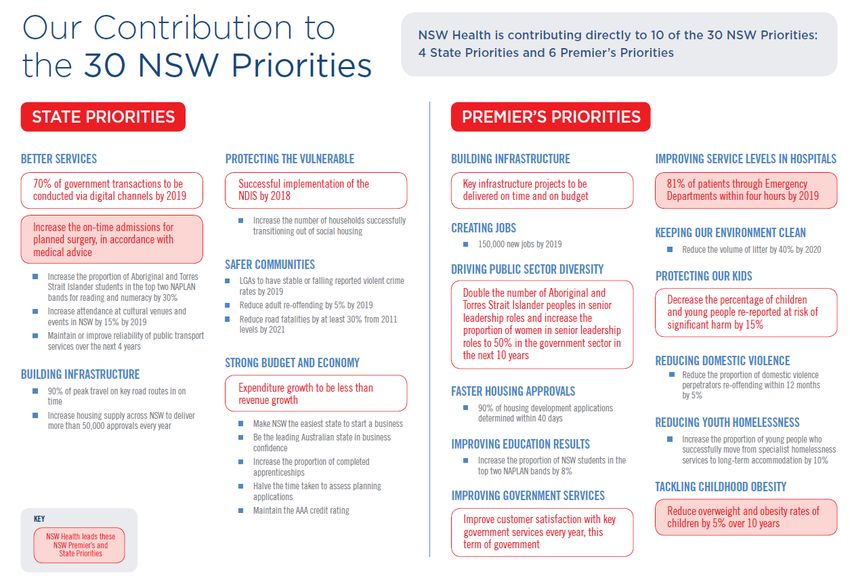
NSW Health Service Agreement — 2018/19
Principal Purpose
The principal purpose of the Service Agreement is to set out the service and performance
expectations for the funding and other support provided to Sydney Local Health District (the
Organisation), to ensure the provision of equitable, safe, high quality, patient-centred
healthcare services.
The Agreement articulates direction, responsibility and accountability across the NSW Health
system for the delivery of NSW Government and NSW Health priorities. Additionally, it
specifies the service delivery and performance requirements expected of the Organisation that
will be monitored in line with the NSW Health Performance Framework.
Through execution of the Agreement, the Secretary agrees to provide the funding and other
support to the Organisation as outlined in this Service Agreement.
Parties to the Agreement
The Organisation

The Hon Ronald Phillips
Chair
On behalf of the
Sydney Local Health District Board

           30 July 2018
Date:                        Signed:

Dr Teresa Anderson AM
Chief Executive
Sydney Local Health District

Date:   3°                   Signed:

NSW Health

Ms Elizabeth Koff
Secretary
NSW Health

Date:                        Signed:

                                               1
Contents
1. Objectives of the Service Agreement ............................................................................. 3
2. CORE Values ................................................................................................................ 3
3. Culture, Community and Workforce Engagement .......................................................... 3
4. Legislation, Governance and Performance Framework .................................................. 4
Schedule A: Strategies and Priorities ................................................................................... 7
Schedule B: Services and Networks .................................................................................. 14
Schedule C: Budget ........................................................................................................... 19
Schedule D: Purchased Volumes ....................................................................................... 24
Schedule E: Performance against Strategies and Objectives ............................................. 26
21. Objectives of the Service Agreement
To articulate responsibilities and accountabilities across all NSW Health entities for the
delivery of the priorities of the NSW Government and NSW Health.
To establish with Districts and Networks a performance management and accountability
system for the delivery of high quality, effective health care services that promote, protect
and maintain the health of the community, and provide care and treatment to sick and
injured people, taking into account the particular needs of their diverse communities.
To develop effective partnerships with Aboriginal Community Controlled Health Services
and ensure the health needs of Aboriginal people are considered in all health plans and
programs developed by Districts and Networks.
To promote accountability to Government and the community for service delivery and
funding.
2. CORE Values
Achieving the goals, directions and strategies for NSW Health requires clear and co-ordinated
prioritisation of work programs, and supportive leadership that exemplifies the CORE Values
of NSW Health:
Collaboration – we are committed to working collaboratively with each other to achieve the
best possible outcomes for our patients who are at the centre of everything we do. In
working collaboratively we acknowledge that every person working in the health system
plays a valuable role that contributes to achieving the best possible outcomes.
Openness – a commitment to openness in our communications builds confidence and
greater cooperation. We are committed to encouraging our patients, and all people who
work in the health system, to provide feedback that will help us provide better services.
Respect – we have respect for the abilities, knowledge, skills and achievements of all
people who work in the health system. We are also committed to providing health services
that acknowledge and respect the feelings, wishes and rights of our patients and their
carers.
Empowerment – in providing quality health care services we aim to ensure our patients
are able to make well informed and confident decisions about their care and treatment.
We further aim to create a sense of empowerment in the workplace for people to use their
knowledge, skills and experience to provide the best possible care to patients, their
families and carers.
3. Culture, Community and Workforce Engagement
Districts and Networks are to ensure appropriate consultation and engagement with patients,
carers and communities in relation to the design and delivery of health services. Impact
Statements are to be considered and, where relevant, incorporated into health policies.
Consistent with the principles of accountability and stakeholder consultation, the engagement
of clinical staff in key decisions, such as resource allocation and service planning, is crucial to
the achievement of local priorities.
3Engagement Surveys
The People Matter Employee Survey measures the experiences of individuals across the
NSW Health system in working with their team, managers and the organisation. The
results of the survey will be used to identify areas of both best practice and improvement
opportunities, to determine how change can be affected at an individual, organisational
and system level to improve workplace culture and practices.
The Junior Medical Officer Your Training and Wellbeing Matters Survey will monitor the
quality of supervision, education and training provided to junior medical officers and their
welfare and wellbeing. The survey will also identify areas of best practice and further
opportunities for improvement at an organisational and system level.
The Australian Medical Association, in conjunction with the Australian Salaried Medical
Officers Association, will be undertaking regular surveys of senior medical staff to assess
clinical participation and involvement in local decision making to deliver patient centred
care.
4. Legislation, Governance and Performance Framework
4.1 Legislation
The Health Services Act 1997 (the Act) provides a legislative framework for the public health
system, including setting out purposes and/or functions in relation to Local Health Districts (ss
8, 9, 10).
Under the Act the Health Secretary’s functions include: the facilitation of the achievement and
maintenance of adequate standards of patient care within public hospitals, provision of
governance, oversight and control of the public health system and the statutory health
organisations within it, as well as in relation to other services provided by the public health
system, and to facilitate the efficient and economic operation of the public health system
(s.122).
The Act allows the Health Secretary to enter into performance agreements with Local Health
Districts in relation to the provision of health services and health support services (s.126). The
performance agreement may include provisions of a service agreement.
Under the Act the Minister may attach conditions to the payment of any subsidy (or part of any
subsidy) (s.127). As a condition of subsidy all funding provided for specific purposes must be
used for those purposes unless approved by the Health Secretary.
4.2 Variation of the Agreement
The Agreement may be amended at any time by agreement in writing between the
Organisation and the Ministry.
The Agreement may also be varied by the Secretary or the Minister in exercise of their general
powers under the Act, including determination of the role, functions and activities of Local
Health Districts (s. 32).
Any updates to finance or activity information further to the original contents of the Agreement
will be provided through separate documents that may be issued by the Ministry in the course
of the year.
44.3 National Agreement - Hospital funding and health reform
The Council of Australian Governments (COAG) has reaffirmed that providing universal health
care for all Australians is a shared priority and agreed in a Heads of Agreement for public
hospitals funding from 1 July 2017 to 30 June 2020. That Agreement preserves important
parts of the existing system, including activity based funding and the national efficient price.
There is a focus on actions to improve patient safety and the quality of services and reduce
unnecessary hospitalisations. The Commonwealth will continue its focus on reforms in
primary care that are designed to improve patient outcomes and reduce avoidable hospital
admissions. See http://www.coag.gov.au/agreements
4.4 Governance
Each Health Service and Support Organisation must ensure that all applicable duties,
obligations and accountabilities are understood and complied with, and that services are
provided in a manner consistent with all NSW Health policies, procedures plans, circulars,
inter-agency agreements, Ministerial directives and other instruments and statutory
obligations.
Districts and Networks are to ensure
Timely implementation of Coroner’s findings and recommendations, as well as
recommendations of Root Cause Analyses.
Active participation in state-wide reviews.
4.4.1 Clinical Governance
NSW public health services are accredited against the National Safety and Quality Health
Service Standards.
https://www.safetyandquality.gov.au/our-work/assessment-to-the-nsqhs-standards/nsqhs-
standards-second-edition/
The Australian Safety and Quality Framework for Health Care provides a set of guiding
principles that can assist Health Services with their clinical governance obligations. See
http://www.safetyandquality.gov.au/wp-content/uploads/2012/04/Australian-SandQ-
Framework1.pdf
The NSW Patient Safety and Clinical Quality Program provides an important framework for
improvements to clinical quality.
http://www1.health.nsw.gov.au/pds/ActivePDSDocuments/PD2005_608.pdf
4.4.2 Corporate Governance
Each Health Service and Support Organisation must ensure services are delivered in a
manner consistent with the NSW Health Corporate Governance and Accountability
Compendium (the Compendium) seven corporate governance standards. The Compendium is
at: http://www.health.nsw.gov.au/policies/manuals/pages/corporate-governance-
compendium.aspx
Where applicable, they are to:
Provide required reports in accordance with the timeframes advised by the Ministry;
Review and update Manual of Delegations (PD2012_059) to ensure currency;
Ensure NSW Auditor-General’s, the Public Accounts Committee and the NSW
Ombudsman’s recommendations where accepted by NSW Health are actioned in a timely
and effective manner, and that repeat audit issues are avoided.
54.4.3 Safety and Quality Accounts
Standard 1, Clinical Governance, of the National Safety and Quality Health Service Standards
describes the clinical governance, and safety and quality systems that are required to maintain
and improve the reliability, safety and quality of health care, and improve health outcomes for
patients. Standard 1 ensures that everyone – from frontline clinicians to managers and
members of governing bodies, such as boards – are accountable to patients and the
community for assuring the delivery of health services that are safe, effective, integrated, high
quality and continuously improving.
Districts and Networks complete Safety and Quality Accounts to document achievements, and
affirm an ongoing commitment to improving and integrating safety and quality into their
functions. The Account provides information about the safety and quality of care delivered by
the Organisation, including key state-wide mandatory and locally selected high priority
measures, patient safety priorities, service improvements and integration initiatives. The
Account must also demonstrate how the Organisation meets Standard 1.
Consistent with the National Agreement, Districts and Networks must continue to focus on
reducing the incidence of Hospital Acquired Complications. Through the Purchasing
Framework, NSW Health has incentivised Districts and Networks to locally invest in quality
improvement initiatives to specifically target these complications. It is expected that the Safety
and Quality account articulates the incentivised initiative/s, and provides details on the
approach and outcomes.
4.4.4 Performance Framework
Service Agreements are central components of the NSW Health Performance Framework,
which documents how the Ministry monitors and assesses the performance of public sector
health services to achieve the expected service levels, financial performance, governance and
other requirements.
The performance of a Health Service is assessed in terms of whether the organisation is
meeting the strategic objectives for NSW Health and Government, the Premier’s priorities, the
availability and implementation of governance structures and processes, performance against
targets and whether there has been a significant critical incident or sentinel event.
The Framework also sets out the performance improvement approaches, responses to
performance concerns and management processes that support achievement of these
outcomes in accordance with NSW Health and Government policy and priorities.
Performance concerns will be raised with the Organisation for focused discussion at
performance review meetings in line with the NSW Health Performance Framework available
at:
http://www.health.nsw.gov.au/Performance/Pages/frameworks.aspx
6Schedule A: Strategies and Priorities
NSW Health Strategies and Priorities are to be reflected in the strategic, operational and
business plans of the Ministry and NSW Health Services and Support Organisations.
Delivery of the Strategies and Priorities is the mutual responsibility of all entities.
NSW: Making it Happen
NSW: Making it Happen outlines NSW Health’s State Priorities, including 12 Premier’s
Priorities that together define the NSW Government’s vision for a stronger, healthier and
safer NSW. As delivery of both Premier’s and State priorities is the responsibility of all NSW
Government Agencies, all entities work together to ensure successful delivery, in both lead
and partnering agency capacities.
Election Commitments
NSW Health is responsible for the delivery of 102 election commitments over the period to
March 2019. The Ministry of Health will lead the delivery of these commitments with support
from Health Services and Support Organisations – see also
http://nswtreasury.prod.acquia-sites.com/sites/default/files/pdf/2015-2016_Budget_Papers_-
_Election_Commitments_2015-19.pdf
Minister’s Priority
NSW Health will strive for engagement, empathy and excellence to promote a positive and
compassionate culture that is shared by managers, front-line clinical and support staff alike.
This culture will ensure the delivery of safe, appropriate, high quality care for our patients
and communities. To do this, Health Services are to continue to effectively engage with the
community, and ensure that managers at all levels are visible and working collaboratively
with staff, patients and carers within their organisation, service or unit. These requirements
will form a critical element of the Safety and Quality Account.
7NSW - Making it Happen
8NSW State Health Plan: Towards 2021
The NSW State Health Plan: Towards 2021 provides a strategic framework which brings
together NSW Health’s existing plans, programs and policies and sets priorities across the
system for the delivery of the right care, in the right place, at the right time. See
http://www.health.nsw.gov.au/statehealthplan/Publications/NSW-state-health-plan-towards-
2021.pdf
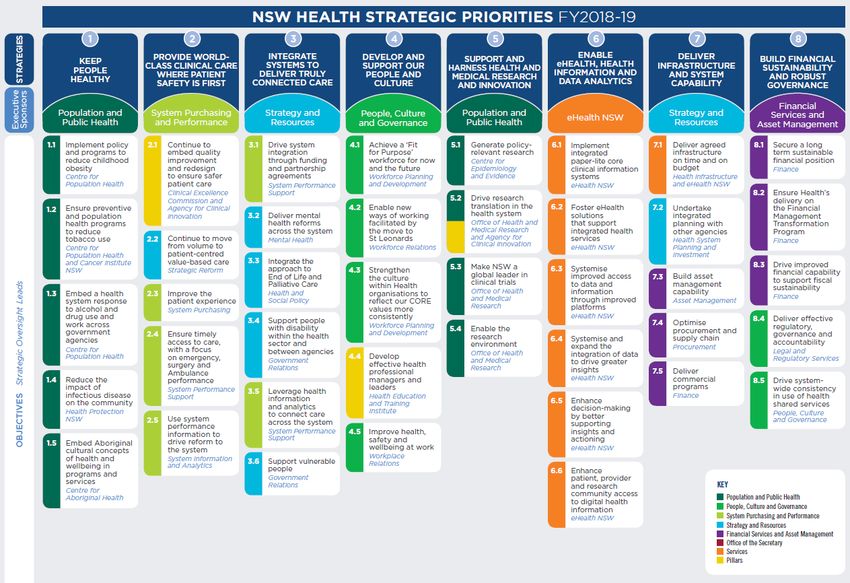
NSW Health Strategic Priorities 2018-19
The NSW Health Strategic Priorities 2018-19 builds on and complements the NSW State
Health Plan: Towards 2021 and aligns with the NSW State and Premier’s Priorities. The
approach outlined in the plan frames the Ministry’s role as system manager for NSW Health,
strengthens system governance and establishes a strategic planning framework that:
Embeds a new cross-functional approach to strategic planning and delivery in the
Ministry including tighter direction and leadership;
Allows a flexibility about how we go about achieving this in order to encourage innovation
and continuous improvement; and
Applies tight ownership around the deliverables which will enable transparency in
monitoring results.
This will provide the system and stakeholders with an overview of system priorities, and
transparency and clarity on where strategic effort will be focused each year, while also
delivering business as usual.
910
Local Priorities
Under the Health Services Act 1997, Boards have the function of ensuring that strategic
plans to guide the delivery of services are developed for the District or Network and for
approving these plans. Local Health Districts and Specialty Health Networks are responsible
for developing the following Plans with Board oversight:
Strategic Plan
Clinical Services Plans
Safety and Quality Account and subsequent Safety and Quality Plan
Workforce Plan
Corporate Governance Plan
Asset Strategic Plan
It is recognised that each District and Network will implement local priorities to deliver the
NSW Government and NSW Health priorities, and meet the needs of their respective
populations.
The District’s local priorities for 2018/19 are as follows:
Maintenance of overall performance of SLHD: SLHD will continue to achieve
Performance Level 0 in accordance with the NSW Ministry of Health Performance
Framework throughout 2018/19.
Surgical Performance: the District will continue to be leaders in relation to surgery and
ensure all patients are admitted within the clinically appropriate timeframe for their surgery.
Quality and Safety: SLHD will continue to focus on and improve performance on all key
safety and quality measures.
Capital Works: the following major capital works projects are a priority for SLHD in 2018/19:
Fulfilment of the SLHD Asset Strategic Plan, including the redevelopment of Royal
Prince Alfred Hospital (RPAH), Canterbury Hospital and Phase 2 of the Concord
Repatriation General Hospital (CRGH) redevelopment
Commencement of the Phase 1 redevelopment of CRGH
Expansion of the RPAH Emergency Department to increase the number of
resuscitation beds from 3 to 8
Planning: the following plans will be developed in 2018/19:
RPAH Strategic and Clinical Services Plans
Concord Hospital Strategic Plan
Canterbury Hospital Strategic and Master Plans
Balmain Hospital Strategic Plan
SLHD Diabetes Strategy
SLHD Health Advancement Plan
SLHD Cardiothoracic Service Plan
SLHD Genomics Development Strategy
Inter-sectoral Inner West Youth Health and Wellbeing Plan
SLHD Research Strategic Plan 2018 – 2022
11Information and Communications Technology: SLHD will continue to improve and
enhance our services, including:
Complete the implementation of eMR2 across all facilities
Complete the roll out of eMeds across all facilitates
Implement PowerChart Maternity, PowerChart Cardiovascular and PowerChart
Oncology and Haematology
Leading Better Value Care: SLHD is committed to the further development, implementation
and evaluation of the Leading Better Value Care initiatives.
Investing in the Early Years: SLHD will continue to redesign its child and family health
services to better meet the needs of families with children 0-5 years, in particular those
families requiring additional support. New service modalities will be explored, including
telehealth and targeted outreach. Resources will continue to be reallocated to ensure
sufficient capacity to provide two-year sustained health home visiting to those families
requiring additional support. The most complex families will be offered care coordination for
all family members, with health and social care needs in scope.
Research: SLHD will continue leading collaborative research partnerships and research
through both Sydney Research and Sydney Health Partners. SLHD will also continue
conducting and implementing research through the Translational Research Grants Scheme
and continue to implement the Research Ethics and Governance Information System
(REGIS).
Enhancement of the Surgical and Robotic Training Institute: RPAH provides basic and
advanced level robotic training to surgeons from New South Wales, Australia and overseas
in an industry partnership with Intuitive Surgical and Device Technologies. The purpose-built
facility commenced delivering training in March 2017 and SLHD will continue to build the
profile of the Institute with industry partners and the broader surgical community.
Enhancement of the Peritonectomy Program: The Peritonectomy Program delivered the
projected activity in 2017/18 and will be enhanced in 2018/19 in line with MoH funding
activity. The Model of Care is multidisciplinary in approach and the program will continue to
develop within a translational research framework.
Neuro-Intervention (NI) Services: As the neuro-interventional workforce is small across
Australia, SLHD is committed to the continued growth and fostering of an increasing NI
workforce at RPAH.
Stroke Service: RPAH plans to continue increasing both inpatient and outpatient services
including TIA, stroke and neurovascular treatments, within this includes a preoperative
assessment following stroke, specific stroke consults within the inpatient population and a
specific young stroke clinic. All clinics are multidisciplinary in nature including neurology,
neurosurgery, interventional neuroradiology and nursing. All incorporating a comprehensive
stroke service model. RPAH aims to increase the capacity to treat patients with stroke,
vascular disease, aneurysms, and other complex neurological and vascular conditions in an
efficient, cost effective and clinically advanced manner.
12Establishment of Cardiology Service at Canterbury Hospital: SLHD is committed to the
establishment of a Cardiology service at Canterbury Hospital, including: cardiac clinics,
enhanced ECHO service and the implementation of strategies associated with the ACI
Leading Better Value Care CHF initiative.
Establishment of Endocrine Service at Canterbury Hospital: SLHD is committed to the
establishment of an Endocrine Service at Canterbury Hospital, including diabetes clinics that
will better serve our disadvantaged community, as well as implement strategies associated
with the ACI Leading Better Value Care management of inpatient diabetes initiative.
Defence Force Centre of Excellence (DFCoE): SLHD is committed to the further
development of a Model of Care and the establishment of a pilot DFCoE service at CRGH.
Continued Implementation of the Outpatient Transformation Project: the Project aims
to revolutionise the District’s outpatient services by improving patients’ and families’
interactions with services and will be further rollout in 2018/19.
13Schedule B: Services and Networks
Services
The Organisation is to maintain up to date information for the public on its website
regarding its relevant facilities and services including population health, inpatient services,
community health, other non-inpatient services and multipurpose services (where
applicable), in accordance with approved Role Delineation levels.
The Organisation is also to maintain up to date details of:
Affiliated Health Organisations (AHOs) in receipt of Subsidies in respect of services
recognised under Schedule 3 of the Health Services Act 1997. Note that annual Service
Agreements are to be in place between the Organisation and AHOs.
Non-Government Organisations (NGOs) for which the Commissioning Agency is the
Organisation, noting that NGOs for which the Commissioning Agency is the NSW
Ministry of Health are included in NSW Health Annual Reports.
Primary Health Networks with which the Organisation has a relationship.
Networks and Services Provided to Other Organisations
Each NSW Health service is a part of integrated networks of clinical services that aim to
ensure timely access to appropriate care for all eligible patients. The Organisation must
ensure effective contribution, where applicable, to the operation of statewide and local
networks of retrieval, specialty service transfer and inter-district networked specialty
clinical services.
Key Clinical Services Provided to Other Health Services
The Organisation is also to ensure continued provision of access by other Districts and
Health Services, as set out in the table below. The respective responsibilities should be
incorporated in formal service agreements between the parties.
Service Recipient Health Service
Aged Care tele-medicine and face to face clinics Western NSW LHD, Far West NSW LHD (tele-
medicine only), Northern NSW LHD (tele-medicine
only)
Medical Oncology (through Lifehouse) Western NSW LHD, Southern NSW LHD
Geriatrician, Endocrinology, Cardiology, Chronic Care, Aboriginal Medical Service Redfern
Drug Health and Paediatric Clinics
Fracture Liaison Service Illawarra Shoalhaven LHD, Mid North Coast LHD
Renal Services Western NSW LHD, Southern NSW LHD
Diabetes Service (tele-medicine and face to face clinics) Western NSW LHD, Far West NSW LHD (face to
face only)
Oral Health Services South Eastern Sydney LHD, South Western
Sydney LHD
Foot Service tele-medicine clinics Far West NSW LHD
Cancer Genetics Combined Service with SW Sydney LHD
Cancer Services Combined Service with SW Sydney LHD
Residential Facility for people with HIV Dementia (Yaralla All NSW LHDs
House )
Professor Marie Bashir Centre Eating Disorder Unit All NSW LHDs
Mental Health Intensive Care Unit – Concord Hospital Statewide
Mental Health – Walker Unit Statewide
14Service Recipient Health Service
Joint Investigation Response Team (JIRT) Northern Sydney LHD, South Eastern Sydney
LHD
Subspecialist tissue-based diagnostic Neuropathology Statewide
services:
Forensic Neuropathology services
Creutzfeldt-Jakob disease (CJD) diagnostic
laboratory
MGMT promoter methylation testing, H3.3
sequencing
Nerve biopsy diagnostic service
Note that New South Wales prisoners are entitled to free inpatient and non-inpatient services in NSW
public hospitals (PD2016_024 – Health Services Act 1997 - Scale of Fees for Hospital and Other
Services, or as updated).
Non-clinical Services and Other Functions Provided to Other Health Services
Where the Organisation has the lead or joint lead role, continued provision to other
Districts and Health Services is to be ensured as follows.
Service or function Recipient Health Service
Information Management and South Western Sydney LHD; components
Technology hosted by SLHD
Cancer Registry Hosted by South Western Sydney LHD
Sydney Health Care Interpreter Service South Eastern Sydney LHD; Sydney
Children’s Hospitals Network (Randwick); St
Vincent’s Health Network Sydney; Justice
Health & Forensic Mental Health Network;
Chris O’Brien Lifehouse
Heterosexual HIV Service (Pozhet) Statewide
Multicultural HIV and Hepatitis Service Statewide
Electronic Medical Records South Western Sydney LHD; hosted by SLHD
Cross District Referral Networks
Districts and Networks are part of a referral network with other relevant Services, and must
ensure the continued effective operation of these networks, especially the following:
Critical Care Tertiary Referral Networks and Transfer of Care (Adults) - (PD2018_011)
Interfacility Transfer Process for Adult Patients Requiring Specialist Care - (PD2011_031)
Critical Care Tertiary Referral Networks (Paediatrics) - (PD2010_030)
Tiered Network Arrangements for Maternity and Neonatal Care in NSW
NSW Acute Spinal Cord Injury Referral Network - (PD2010_021)
NSW Trauma Services Networks (Adults and Paediatrics) - (PD2010_021)
Children and Adolescents - Inter-Facility Transfers –(PD2010_031)
Roles and responsibilities for Mental Health Intensive Care Units (MHICU), including
standardisation of referral and clinical handover procedures and pathways, the role of the
primary referral centre in securing a MHICU bed, and the standardisation of escalation
processes will be a key focus for NSW Health in 2018/19.
15Supra LHD Services
The following information is included in all Service Agreements to provide an overview of
recognised Supra LHD Services and Nationally Funded Centres in NSW. Supra LHD
Services are provided across District/Network boundaries and are characterised by a
combination of the following factors:
Services are provided from limited sites across NSW;
Services are high cost with low-volume activity;
Individual clinicians or teams in Supra LHD services have specialised skills;
Provision of the service is dependent on highly specialised equipment and/or support
services;
Significant investment in infrastructure is required;
Services are provided on behalf of the State; that is, a significant proportion of service
users are from outside the host District’s/Network’s catchment
Ensuring equitable access to Supra LHD Services will be a key focus. Supra LHD locations
and service levels are as follows:
Measurement
Supra LHD Service Locations Service Requirement
Unit
Services to be provided in
Royal North Shore (38) accordance with Critical Care Tertiary
Westmead (49) Referral Networks & Transfer of Care
Nepean (21) (Adults) PD2018_011.
Liverpool (34) (1 new in 2018/19) Units with new beds in 2018/19 will
Royal Prince Alfred (51) need to demonstrate networked
Adult Intensive Care
Beds Concord (16) arrangements with identified partner
Unit
Prince of Wales (22) Level 4 AICU services, in accordance
John Hunter (24) (1 new in with the recommended standards in
2018/19) the NSW Agency for Clinical
St Vincent’s (21) Innovation’s Intensive Care Service
St George (36) Model: NSW Level 4 Adult Intensive
Care Unit
Concord - McKay East Ward Provision of equitable access.
Hornsby - Mental Health Intensive
Care Unit
Prince Of Wales - Mental Health
Mental Health Intensive Care Unit
Access
Intensive Care Cumberland – Yaralla Ward
Orange Health Service - Orange
Lachlan ICU
Mater, Hunter New England –
Psychiatric Intensive Care Unit
Dependent on the availability of
matched organs, in accordance with
The Transplantation Society of
Adult Liver
Access Royal Prince Alfred Australia and New Zealand, Clinical
Transplant
Guidelines for Organ Transplantation
from Deceased Donors, Version 1.0—
April 2016
Services to be provided in
Prince of Wales accordance with Critical Care Tertiary
Severe Spinal Cord Royal North Shore Referral Networks & Transfer of Care
Access
Injury Service Royal Rehabilitation Centre, Sydney (Adults) PD2018_011 and Critical
SCHN – Westmead and Randwick Care Tertiary Referral Networks
(Paediatrics) PD2010_030
St Vincent's (38)
Westmead (71)
Blood and Marrow Royal Prince Alfred (26)
Transplantation – Number Liverpool (18) Provision of equitable access
Allogeneic Royal North Shore (26)
SCHN Randwick (26)
SCHN Westmead (26)
Blood and Marrow St Vincent's - to Gosford
Transplant Access Westmead – to Nepean, Provision of equitable access
Laboratory Wollongong, SCHN at Westmead
16Measurement
Supra LHD Service Locations Service Requirement
Unit
Westmead
Royal Prince Alfred Provision of equitable access.
Complex Epilepsy Access
Prince of Wales
SCHN
Extracorporeal Services to be provided in
Membrane Royal Prince Alfred accordance with Critical Care Tertiary
Access
Oxygenation St Vincent's Referral Networks & Transfer of Care
Retrieval (Adults) PD2018_011.
To provide Heart, Lung and Heart
Lung transplantation services at a
level where all available donor organs
with matched recipients are
transplanted. These services will be
Heart, Lung and available equitably to all referrals.
Heart Lung Access St Vincent's (96) Dependent on the availability of
Transplantation matched organs in accordance with
The Transplantation Society of
Australia and New Zealand, Clinical
Guidelines for Organ Transplantation
from Deceased Donors, Version 1.0—
April 2016.
Royal Prince Alfred
Royal North Shore Access for all women with high risk
Royal Hospital for Women pregnancies, in accordance with NSW
High Risk Maternity Access Liverpool Critical Care Networks (Perinatal)
John Hunter PD2010_069.
Nepean
Westmead
SCHN Randwick (4)
SCHN Westmead (23)
Royal Prince Alfred (22)
Services to be provided in
Royal North Shore (16)
Neonatal Intensive accordance with NSW Critical Care
Beds Royal Hospital for Women (16)
Care Service Networks (Perinatal) PD2010_069
Liverpool (13) (1 new in 2018/19)
John Hunter (19)
Nepean (12)
Westmead (24)
St George (116) Provision of equitable access for
Peritonectomy Number
Royal Prince Alfred (60) referrals as per agreed protocols
SCHN Randwick (13) Services to be provided in
Paediatric Intensive
Beds SCHN Westmead (22) accordance with NSW Critical Care
Care
John Hunter (up to 4) Networks (Paediatrics) PD2010_030
Services to be provided in
accordance with Critical Care Tertiary
Concord Referral Networks & Transfer of Care
Severe Burn
Access Royal North Shore (Adults) PD2018_011 and NSW Burn
Service
SCHN Westmead Transfer Guidelines (ACI 2014) and
Critical Care Tertiary Referral
Networks (Paediatrics) PD2010_030
In accordance with 2013 Sydney
Sydney Dialysis Dialysis Centre funding agreement
Access Royal North Shore
Centre with Northern Sydney Local Health
District
Hyperbaric Provision of equitable access to
Access Prince of Wales
Medicine hyperbaric services.
Provision of equitable access for all
Haematopoietic
referrals as per NSW Referral and
Stem Cell
Number of Protocol for Haematopoietic Stem
Transplantation for St Vincent's (10)
Transplants Cell Transplantation for Systemic
Severe
Sclerosis, BMT Network, Agency for
Scleroderma
Clinical Innovation, 2016.
17Measurement
Supra LHD Service Locations Service Requirement
Unit
Neurointervention Royal Prince Alfred
Services Prince of Wales As per the NSW Health strategic
endovascular clot Access Liverpool report - Planning for NSW NI Services
retrieval for Acute John Hunter to 2031
Ischaemic Stroke SCHN
Services are to be provided in line
St Vincent’s with the clinical service plan for organ
Organ Retrieval retrieval. Services should focus on a
Access Royal Prince Alfred
Services model which is safe, sustainable and
Westmead meets donor family needs, clinical
needs and reflects best practice.
Norwood Procedure
for Hypoplastic Left Provision of equitable access for all
Access SCHN
Heart Syndrome referrals
(HLHS)
Nationally Funded Centres
Service Name Locations Service Requirement
Pancreas Transplantation – Westmead
Nationally Funded Centre As per Nationally Funded Centre
Paediatric Liver Transplantation – SCHN Westmead Agreement - Access for all patients
Nationally Funded Centre across Australia accepted onto
Islet Cell Transplantation – Nationally Westmead Nationally Funded Centre program
Funded Centre
18Schedule C: Budget
Part 1
19Part 2
2018/19
Sydney LHD $ (000's)
Government Grants
A Subsidy* -$1,078,746
B In-Scope Services - Block Funded -$143,863
C Out of Scope Services - Block Funded -$187,800
D Capital Subsidy -$3,717
E Crown Acceptance (Super, LSL) -$32,464
F Total Government Contribution (F=A+B+C+D+E) -$1,446,590
Own Source revenue
G GF Revenue -$249,556
H Restricted Financial Asset Revenue -$38,318
Schedule C Part 2
I Total Own Source Revenue (I=G+H) -$287,874
J Total Revenue (J=F+I) -$1,734,463
K Total Expense Budget - General Funds $1,746,298
L Restricted Financial Asset Expense Budget $25,387
M Other Expense Budget $770
N Total Expense Budget as per Attachment C Part 1 (N=K+L+M) $1,772,454
O Net Result (O=J+N) $37,991
Net Result Represented by:
P Asset Movements -$34,250
Q Liability Movements -$3,741
R Entity Transfers
S Total (S=P+Q+R) -$37,991
Note:
The Ministry will closely monitor cash at bank balances during the year to ensure compliance with
this NSW Treasury policy.
* The subsidy amount does not include items E and G, which are revenue receipts retained by the
LHDs/SHNs and sit outside the National Pool.
20Part 3
2018/19Shared Services & Consolidated Statewide Payment Schedule
Sydney LHD $ (000's)
HS Service Centres $5,719
HS Service Centres Warehousing $26,318
HS Enable NSW $1,983
HS Food Services $27,484
HS Charges
HS Soft Service Charges
HS Linen Services $8,724
HS Recoups $9,397
HS IPTAAS $2
HS Fleet Services $3,861
HS Patient Transport Services $6,573
HS MEAPP
Total HSS Charges $90,061
eHealth
EH Corporate IT $5,988
EH Information Services ICT SPA $5,010
Total eHealth Charges $10,998
Schedule C Part 3
IH Transports
Interhospital Ambulance Transports $1,956
Interhospital Ambulance NETS $86
Total Interhospital Ambulance Charges $2,041
Interhospital NETS Charges - SCHN $125
Payroll
Total Payroll (including SGC, FSS, Excluding LSL & PAYG) $837,260
MoH Loan Repayments
Loans
Treasury Loan (SEDA) $932
Total Loans $932
Blood and Blood Products $24,244
NSW Pathology $53,432
Compacks (HSSG) $1,869
TMF Insurances (WC, MV & Property) $11,183
Energy Australia $14,602
Total $1,046,748
Note:
This schedule represents initial estimates of Statewide recoveries processed by the Ministry on
behalf of Service Providers. LHD's are responsible for regularly reviewing these estimates and
liaising with the Ministry where there are discrepancies. The Ministry will work with LHD's and
Service Providers throughout the year to ensure cash held back for these payments reflects actual
trends. Consistent with prior years procedures, a mid year review will occur in January with further
adjustments made if required.
Note: The amounts ab ove include GST, where applicab le.
21Part 4
2018/19 National Health Funding Body Service Agreement - Sydney LHD
Period: 1 July 2018 - 30 June 2019
National Reform Agreement Commonwealth
Schedule C Part 4
Acute 158,284
ED 21,772
Mental Health 20,120
Sub Acute 13,417
Non Admitted 49,889
Activity Based Funding Total 263,482
Block Funding Total $70,152,756
Total 263,482 $70,152,756
22Capital Program
SYDNEY LHD
BP2 Estimated BP2 BP2 BP2 Balance
ASSET AUTHORISATION LIMITS Cost to Complete at BP2 Allocation
SMRT
ETC Expenditure to 30 Est. Est. Est. to
30 June 2018 2018/19
2018/19 June 2018 2019/20 2020/21 2021/22 Complete
2018/19 Capital Projects
$ $ $ $ $ $ $ $
WORKS IN PROGRESS
SYDLHD Minor Works & Equipment P51069 9,433,500 0 9,433,500 9,433,500 9,433,500 9,433,500
Asset Refurbishment/Replacement Strategy - Statewide P55345 0 1,151,114
RPA Energy Efficiency Government Program (EEGP) P56125 6,992,173 1,675,036 5,317,137 5,317,137
TOTAL WORKS IN PROGRESS 16,425,673 1,675,036 14,750,637 15,901,751 9,433,500 9,433,500
TOTAL ASSET ACQUISITION PROGRAM 16,425,673 1,675,036 14,750,637 15,901,751 9,433,500 9,433,500
PROJECTS MANAGED BY HEALTH INFRASTRUCTURE
MAJOR WORKS IN PROGRESS
Concord Hospital (Phase 1A and 1B) Upgrade P56167 341,200,000 10,000,000 331,200,000 30,000,000 75,000,000 100,000,000 105,000,000 21,200,000
TOTAL MAJOR WORKS IN PROGRESS 341,200,000 10,000,000 331,200,000 30,000,000 75,000,000 100,000,000 105,000,000 21,200,000
TOTAL MANAGED BY HEALTH INFRASTRUCTURE 341,200,000 10,000,000 331,200,000 30,000,000 75,000,000 100,000,000 105,000,000 21,200,000
Notes:
Expenditure needs to remain within the Asset Authorisation Limits indicated above
Minor Work s and Equipment > $10,000 includes a confund contribution of $2,566,000
This does not include new and existing Locally Funded Initiative (LFI) Projects which will be included in Initial Capital Allocation Letters
23Schedule D: Purchased Volumes
Strategic
Growth Investment $’000 NWAU18 Performance Metric
Priority
Activity Growth inclusive of Local Priority Issues
As per Schedule E /
Acute Activity of New Service
Inclusive of Metabolic Services, Endovascular Clot Identified / Plan
Retrieval and Neurointerventional Radiology and Statewide
2 - 169,442 Developed for
Elective Surgery Assistance – Hip and Knee Surgeries Statewide Surgery
Approach
Emergency Department 2.4 - 23,187 As per Schedule E
Sub-Acute (Admitted and Non-Admitted) 2 - 11,955 As per Schedule E
Sub and Non Acute Inpatient Services –
3.3 - 1,617 As per Schedule E
Palliative Care Component
Non-Admitted 2/3 - 50,199 As per Schedule E
Public Dental Clinical Service – Total Dental
1 - 65 897 (DWAU) As per Schedule E
Activity
Mental Health Admitted 3.2 - 16,596 As per Schedule E
Mental Health Non-Admitted 3.2 - 8,396 As per Schedule E
Mental Health Reforms
Specialist child and adolescent community
3.2 - 161 Client-related hours
mental health services
Specialist adult community mental health
3.2 - 89 Client-related hours
services
Specialist older persons community mental
3.2 - 179 Client-related hours
health services
Service Investment
Activity of new service
Peritonectomies 2 55 - identified
Activity of new service
Extended Pelvic Extenteration 2 1,071 - identified
Activity of new service
Sarcoma 2 1,086 - identified
Lifehouse
Price Adjustment
2017/18 was annualised, the xx is the difference on top 2 373 - -
provided for 2018/19
Activity of new service
Activity 2 - 356 identified
Strategic Priority Target Performance Metric
STATE PRIORITY
Elective Surgery Volumes
Number of Admissions from Surgical Waiting List - All
2.4 24,215 Number
Patients
Number of Admissions from Surgical Waiting List - Children
2.4 859 Number
< 16 Years Old
24Strategic
Growth Investment $ ‘000 NWAU18 Performance Metric
Priority
NSW HEALTH STRATEGIC PRIORITIES
Providing World Class Clinical Care Where Patient Safety is First
Hospital Acquired Complications (HAC) Demonstration of
2.1 350 - reduction in HAC
initiatives
ETP 2.4 82 - ETP Trajectory
Leading Better Value Care – Program Support Performance against
2.2 250 - LBVC Deliverables
Transition
Integrate Systems to Deliver Truly Connected Care
Demonstration of
Integrated Care Strategy delivery of activities
The Integrated Care purchasing model for 2018/19 outlined in the approved
converts 25% of the existing recurrent funding for
Activity Work Plan and
Integrated Care for People with Chronic Conditions
3.1 1,638 118 meeting data collection
(ICPCC) (previously the Chronic Disease requirements (including
Management Program) into purchased activity for
monitoring, evaluation,
each LHD/SHN. This is shown as NWAU for each
and the Patient Flow
LHD/SHN. Portal)
Commence
implementation of local
Clinical Redesign of NSW Health Responses 417 VAN service redesign
to Violence, Abuse and Neglect 3.6 with general escalation - and recruitment of
applied for 2018/19 permanent clinical staff
where staffing gaps
have been identified
Enable eHealth, Health Information and Data Analytics
Data quality improvement – clinical coding / Data quality
6.3 250 -
documentation improvement
Complete Stage 1
LEAP and transition of
EDWARD business implementation at least one data
$250,000 to be allocated to Intra Health for EDW - One-off 6.3 500 - stream (AP, ED or WL)
for 2018/19 as per LHD/SHN
Program Management
Plan
Dental Services DWAU
DENTAL SERVICES PROVIDED TO SOUTH WESTERN SYDNEY LOCAL HEALTH DISTRICT
TOTAL 19,977
Dental services provided by Sydney Local Health District to South Western Sydney residents will be managed in line with the
NSW Health Performance Framework.
A quarterly report will be provided by the Centre for Oral Health Strategy to South Western Sydney Local Health District and
Sydney Local Health District to monitor activity against the target. The report will include a breakdown of activity by specialist
services, long waiting list adult patients and acute/episodic care adult patients in line with agreed definitions.
From 2018-19, The Centre for Oral Health Strategy will convene regular meetings with metropolitan public oral health services
to discuss and develop collaborative solutions to patient flow issues.
25Schedule E: Performance against Strategies and Objectives
A. Key Performance Indicators
The performance of Districts, Networks, other Health Services and Support Organisations is
assessed in terms of whether it is meeting performance targets for individual key performance
indicators for each NSW Health Strategic Priority.
Performing Performance at, or better than, target
Underperforming Performance within a tolerance range
X Not performing Performance outside the tolerance threshold
Detailed specifications for the key performance indicators are provided in the Service
Agreement Data Supplement along with the list of improvement measures that will continue to
be tracked by the Ministry’s Business Owners - see
http://hird.health.nsw.gov.au/hird/view_data_resource_description.cfm?ItemID=22508
The Data Supplement also maps indicators and measures to key strategic programs including
Premier’s and State Priorities
Election Commitments
Better Value Care
Patient Safety First
Mental Health Reform
Financial Management Transformations
B. Strategic Deliverables
Key deliverables under the NSW Health Strategic Priorities 2018-19 will also be monitored, noting
that process key performance indicators and milestones are held in the detailed Operational
Plans developed by each Health Service and Support Organisation.
26A. Key Performance Indicators
Safety &
Under
Strategic Quality Not Performing Performing
Measure Target Performing
Priority Framework X
Domain
Strategy 1: Keep People Healthy
Get Healthy Information and Coaching
Individual - 10.0 variation
See Data variation exceeded
Health Variance (%) below Target
Supplement below Target Target
Healthy Children Initiative - Children’s Healthy Eating and Physical Activity Program (%):
Primary schools - Trained primary schools
1.1 Population achieving agreed proportion of Live Life
>=60 =60
Health Well @ School program practices (%)
Early childhood services – Sites achieving
Population agreed proportion of Munch and Move
>=60 =60
Health program practices (%)
Smoking During Pregnancy - At any time (%):
Aboriginal women Decrease Decrease
Increase on
Equity from previous No change from previous
previous year
year year
Non-aboriginal women Decrease Decrease
Increase on
Equity from previous No change from previous
1.2 previous year
year year
Pregnant Women Quitting Smoking - By ≥1% and
4% increaseSafety &
Under
Strategic Quality Not Performing Performing
Measure Target Performing
Priority Framework X
Domain
Patient Overall Patient Experience Index (Number)
Centred >=8.5 8.2 and =8.5
2.3 Culture
Patient Patient Engagement Index (Number) >=8.5 8.2 and =8.5
Centred
Elective Surgery:
Access Performance - Patients treated on time (%):
Timeliness &
Category 1 100 =93
Category 2 >=97 =97
Accessibility and =95
>=97 =97
Accessibility and =1 N/A 0
Accessibility
Timeliness &
Category 2 0 >=1 N/A 0
Accessibility
Timeliness & Category 3
0 >=1 N/A 0
Accessibility
Emergency Department:
Emergency treatment performance -
Timeliness & >=71
Patients with total time in ED =81 =81
Accessibility and =80
Timeliness &
ambulance to ED =90 =90
Accessibility and 5 and =70 =70
Follow up within seven days (%) 13 and
Effectiveness =20 24 hours (Number) and 5
Mental Health Reform:
Pathways to Community Living - People Increase on
Patient Increase on
transitioned to the community – (Number) Decrease from
Centred previous No change previous
(Applicable LHDs only - see Data previous quarter
3.2 Culture quarter quarter
Supplement)
Patient Peer Workforce Employment – Full time Increase on Increase on
equivalents (FTEs) (Number) previous Decrease from
Centred No change previous
previous quarter
Culture quarter quarter
28Safety &
Under
Strategic Quality Not Performing Performing
Measure Target Performing
Priority Framework X
Domain
Patient Electronic Discharge Summaries Increase on
Decrease from
3.5 Centred Completed - Sent electronically to State Increase No change previous
previous month
Culture Clinical Repository (%) month
Domestic Violence Routine Screening –
>=60 and
Effectiveness Routine Screens conducted (%) 70 70
=90 and
Effectiveness 100 =85 and
Efficiency 12 months (%) 100 =90
=0
10 >= 10
4.5 Safety (% change) Increase and =75
Research 95 =95
calendar days - Involving more than low risk and =75
Research 95 =95
calendar days - Involving more than low risk and +/- 10 < +/- 10
7.1 Finance On budget NA
(%) of budget of budget
Asset Maintenance Expenditure – As a
>= 5 and
7.3 Finance proportion of asset replacement value (% >=10 =10
< 10
change)
Strategy 8: Build Financial Sustainability and Robust Governance
Purchased Activity Volumes - Variance (%):
Finance Acute admitted– NWAU
Finance Emergency department – NWAU
Finance Non-admitted patients – NWAU Individual - > +/-1.0 and
> +/-2.0 +/-2.0Safety &
Under
Strategic Quality Not Performing Performing
Measure Target Performing
Priority Framework X
Domain
Expenditure Matched to Budget - General >0 but
On budget or >0.5 On budget or
Finance Fund -Variance (%) =0 but
On budget or >0.5 On budget or
Finance - General Fund - Variance (%) =B. Strategic Deliverables
Leading Better Value Care
The Leading Better Value Care (LBVC) Program creates shared priorities across the NSW health
system to improve health outcomes, improve the experience of care for patients, carers and
clinicians and provide efficient and effective care. The main components of this approach include
the following:
The Ministry of Health will continue as system administrator, purchaser and manager and will
articulate the priorities for NSW Health. Performance against delivery of the priorities will be
monitored in line with the NSW Health Performance Framework.
Districts and Networks will continue to provide services established through LBVC in 2017-18
and determine local approaches to deliver new LBVC initiatives in 2018-19.
The Pillars, as required, will continue to support Districts and Networks in a flexible manner
that can be customised to meet local needs and will support measurement as required.
Districts and Networks will participate with Pillars in evaluation, monitoring and regular
reporting on the progress of the LBVC initiatives as specified in the Monitoring and Evaluation
Plans.
In 2018/19, Districts and Networks will:
Continue to provide clinical services in the most appropriate care setting for patients in LBVC
Tranche One (T1) initiatives of Osteoporotic Refracture Prevention (ORP), Osteoarthritis
Chronic Care Program (OACCP), Renal Supportive Care (RSC) and High Risk Foot Services
(HRFS) through designated HERO clinics.
Implement the LBVC solutions for Chronic Heart Failure (CHF), Chronic Obstructive
Pulmonary Disease (COPD) and Diabetes.
Continue to undertake and report on the agreed solutions to reduce falls in hospital.
Participate in monitoring, evaluation and other studies (e.g. costing) of LBVC initiatives
Formative evaluations will occur throughout 2018-19 in consultation with the Districts and other
stakeholders.
Undertake regular reviews of activity associated with all T1 initiatives.
Work with the Ministry of Health and lead Pillar agencies to participate in data gathering and
other activities to support the development and implementation of LBVC Tranche 2 (T2)
initiatives for:
o Bronchiolitis.
o Hip Fracture.
o Cancer care (optimal care pathways for colorectal cancer; hypofractionation).
o Wound Management.
31You can also read


