Setting New Priorities for the ECB's Mandate - European ...
←
→
Page content transcription
If your browser does not render page correctly, please read the page content below

IN-DEPTH ANALYSIS
Requested by the ECON committee
Monetary Dialogue Papers, June 2020

           Setting New Priorities
           for the ECB’s Mandate

          Policy Department for Economic, Scientific and Quality of Life Policies
                        Directorate-General for Internal Policies
           Authors: Christophe BLOT, Jérôme CREEL, Emmanuelle FAURE and
                                     Paul HUBERT                                    EN
                                 PE 648.812 - May 2020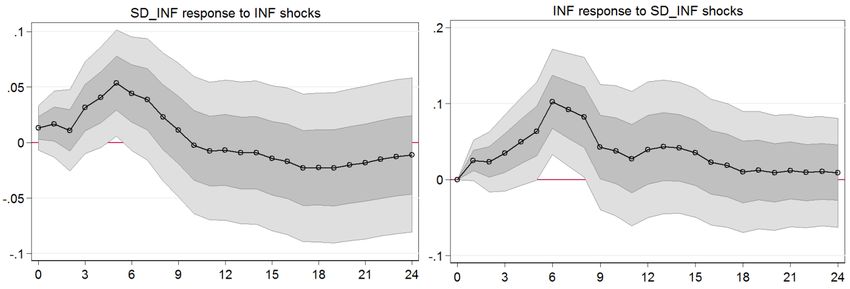
Setting New Priorities
     for the ECB’s
       Mandate
       Monetary Dialogue Papers
             June 2020
 Abstract
 Beyond price stability, the EU Treaties assign to the ECB a range
 of secondary objectives. We investigate the linkages between
 price stability and these objectives to assess whether they are
 independent, complementary or substitutable, which is
 important to refine the definition of the mandate. Keeping the
 current mandate would not provide leeway for the ECB to reach
 other objectives. We propose to broaden the mandate to include
 employment and financial stability. Enhanced coordination
 should contribute to fulfilling the objectives.
 This document was provided by the Policy Department for
 Economic, Scientific and Quality of Life Policies at the request of
 the committee on Economic and Monetary Affairs.
This document was requested by the European Parliament's Committee on Economic and Monetary
Affairs.

AUTHORS
Christophe BLOT, Sciences Po – OFCE & Université Paris Nanterre
Jérôme CREEL, Sciences Po – OFCE & ESCP Business School
Emmanuelle FAURE, Université Paris Nanterre
Paul HUBERT, Sciences Po – OFCE

ADMINISTRATOR RESPONSIBLE
Drazen RAKIC

EDITORIAL ASSISTANT
Janetta CUJKOVA

LINGUISTIC VERSIONS
Original: EN

ABOUT THE EDITOR
Policy departments provide in-house and external expertise to support EP committees and other
parliamentary bodies in shaping legislation and exercising democratic scrutiny over EU internal
policies.

To contact the Policy Department or to subscribe for updates, please write to:
Policy Department for Economic, Scientific and Quality of Life Policies
European Parliament
L-2929 - Luxembourg
Email: Poldep-Economy-Science@ep.europa.eu

Manuscript completed: May 2020
Date of publication: May 2020
© European Union, 2020

This document is available on the internet at:
https://www.europarl.europa.eu/committees/en/econ/econ-policies/monetary-dialogue

DISCLAIMER AND COPYRIGHT
The opinions expressed in this document are the sole responsibility of the authors and do not
necessarily represent the official position of the European Parliament.
Reproduction and translation for non-commercial purposes are authorised, provided the source is
acknowledged and the European Parliament is given prior notice and sent a copy.
For citation purposes, the study should be referenced as: Blot, C., Creel, J., Faure, E. and Hubert, P.,
Setting New Priorities for the ECB’s Mandate, Study for the Committee on Economic and Monetary Affairs,
Policy Department for Economic, Scientific and Quality of Life Policies, European Parliament,
Luxembourg, 2020.
Setting New Priorities for the ECB’s Mandate

CONTENTS
LIST OF ABBREVIATIONS                                                                                     4
LIST OF FIGURES                                                                                           5
LIST OF TABLES                                                                                            5
EXECUTIVE SUMMARY                                                                                         6
1.   INTRODUCTION                                                                                         7
2.   LINKAGES BETWEEN PRICE STABILITY AND SECONDARY OBJECTIVES                                            9
     2.1. Relevant secondary objectives for the fulfilment of general policies                            9
     2.2. Correlation between primary and secondary objectives                                            9
3.   HOW MANY OBJECTIVES FOR THE ECB?                                                                   15
     3.1. Unchanged mandate: which objectives could be achieved?                                         15
     3.2. Extending the mandate                                                                          16
           3.2.1. A dual mandate…                                                                        17
           3.2.2. … or a triple mandate?                                                                 17
     3.3. Should other objectives be introduced explicitly in the mandate?                               18
4.   NEW TOOLS OR ENHANCED COORDINATION TO ACHIEVE SECONDARY OBJECTIVES?                                20
     4.1. Tools to foster financial stability and financial integration                                  20
     4.2. Enhanced coordination of monetary and fiscal policies                                          21
5.   CONCLUDING REMARKS ON THE ROLE OF COORDINATION                                                     22
REFERENCES                                                                                              23
ANNEX: EMPIRICAL RESULTS                                                                                25

                                                   3                                            PE 648.812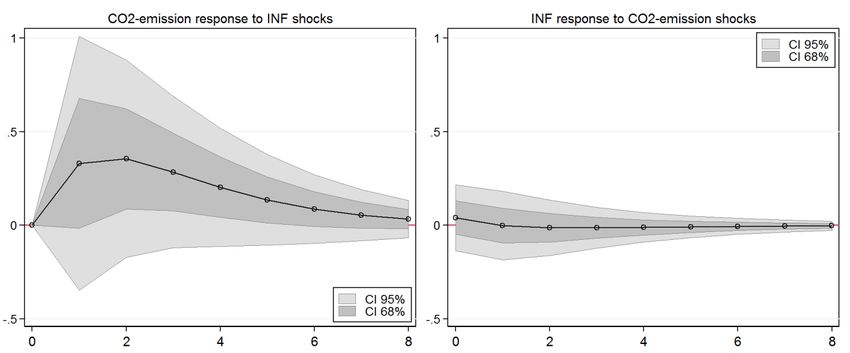
IPOL | Policy Department for Economic, Scientific and Quality of Life Policies

LIST OF ABBREVIATIONS
 CI                 Confidence interval

 CIFI               Composite indicator of financial integration

 CISS               Composite indicator of systemic stress

 EA                 Euro area

 ECB                European Central Bank

 EP                 European Parliament

 GDP                Gross domestic product

 GHG                Greenhouse gas

 MEP                Member of European Parliament

 PBSG               Primary balance sustainability gap

 SSM                Single supervisory mechanism

 TEU                Treaty of the European Union

 TFEU               Treaty on the Functioning of the European Union

 TFP                Total factor productivity

 VAR                Vector autoregression

PE 648.812                                             4
Setting New Priorities for the ECB’s Mandate

LIST OF FIGURES
Figure 1:    The link between inflation and the dispersion of inflation rates                              11
Figure 2:    The link between inflation and the dispersion of interest rates on housing loans              12
Figure 3:    The link between inflation and sovereign debt sustainability                                  13
Figure 4:    The link between inflation and financial stability                                            26
Figure 5:    The link between inflation and asset price-based financial integration                        27
Figure 6:    The link between inflation and the dispersion of interest rates on corporate loans            28
Figure 7:    The link between inflation and the dispersion of sovereign bond rates                         29
Figure 8:    The link between inflation and unemployment                                                   30
Figure 9:    The link between inflation and inequality                                                     31
Figure 10:   The link between inflation and technological progress                                         32
Figure 11:   The link between inflation and GHG emissions                                                  33

LIST OF TABLES
Table 1:     Summarised test results                                                                       14
Table 2:     Correlation with euro area inflation                                                          25

                                                    5                                             PE 648.812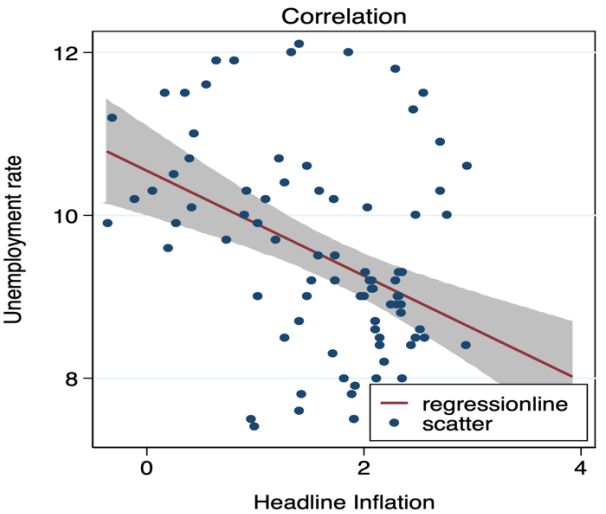
IPOL | Policy Department for Economic, Scientific and Quality of Life Policies

EXECUTIVE SUMMARY
•   In a statement announcing the review of its monetary policy strategy, the European Central
    Bank (ECB) stated that it will, in addition to price stability, also take into account how "other
    considerations, such as financial stability, employment and environmental sustainability,
    can be relevant in pursuing the ECB's mandate". The key question is which precise objectives
    shall be taken into account and how the ECB might reach them, keeping in mind that some trade-
    offs vis-à-vis the primary objective may arise.
•   We choose relevant indicators of these secondary objectives and compute their respective
    correlation coefficient with the inflation rate in the euro area; hence, we illustrate the statistical
    interactions between these objectives and the primary objective of the ECB.
•   When objectives are complementary, the ECB can achieve other objectives while still
    maintaining price stability. This may be the case, for instance, with heterogeneity of inflation
    rates. When there is no relationship, achieving price stability does not help in fulfilling the other
    objective as highlighted, for instance, for financial stability, financial integration, technological
    progress, climate change and inequality. Challenges are more complex when objectives are
    substitutable. In this case, trade-offs may arise.
•   Keeping the current mandate is inevitably the baseline case to be considered but it may not
    enable the ECB to achieve macroeconomic and financial stability. This suggests the need to
    broaden the mandate of the ECB to integrate full employment and financial stability because these
    objectives, socially important, are closely connected with monetary policy. Yet, it must be
    acknowledged that this would entail a change in the Treaty, which remains a difficult task.
•   We do not recommend assigning the ECB with tasks it cannot be held accountable for and
    which are highly political. This is notably the case with climate change or inequality. It would be
    hazardous to set in stone in the Treaty an objective relating, for instance, to a desired level of
    greenhouse gas emissions and to leave the ECB to be accountable for achieving it.
•   The global financial crisis highlighted the institutional flaws of the Economic and Monetary
    Union (EMU). Price stability may not be enough to prevent external imbalances. The ECB might
    consider changing its definition of the price stability target to avoid discrepancies between
    national inflation rates. This change does not require to modify the Treaty as the ECB has discretion
    to specify its target.
•   Adopting new objectives for monetary policy may require additional instruments. In any case,
    higher transparency is needed if the ECB implements supposedly conflicting policies as regards the
    primary and secondary objectives.
•   The COVID-19 crisis has shown that shared identification of shocks is crucial to remove the
    risk of inappropriate policies (monetary contraction and/or permanent fiscal expansion after
    a negative supply shock). Coordinated monetary and fiscal policies help to bolster their
    respective effects and to achieve their objectives.
•   Even if climate change does not enter the mandate, monetary policy may yet contribute to
    the transition to a low-carbon economy through the purchase of assets such as green bonds,
    as long as quantitative easing (QE) programmes are still activated. But the question whether
    to issue those bonds is foremost a policy decision taken by governments.

PE 648.812                                             6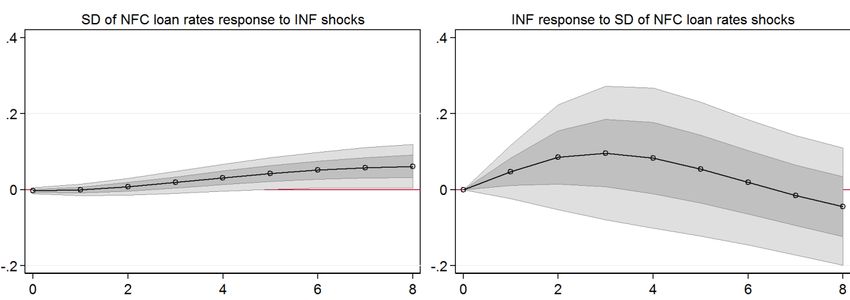
Setting New Priorities for the ECB’s Mandate

1. INTRODUCTION
The Treaty on the Functioning of the European Union (TFEU) provisions on the ECB’s mandate are clear
as regards the primary objective – price stability –, but they are broad regarding the so-called secondary
objectives of supporting “the general economic policies in the Union with a view to contributing to the
achievement of the objectives of the Union”. The questions arise as of how the ECB might reach
objectives like “aiming at full employment”, improving “the quality of the environment”, or the
promotion of “technological advance” (all three mentioned in Article 3 of the Treaty of the European
Union [TEU]) and whether those secondary objectives interact with the primary objective of price
stability. If they do not, should monetary policy look for another instrument to complement its work?
If they do and some arbitrage arises, should monetary policy be designed differently? These are the
questions at the centre of this paper.
While dealing with these questions, it is noteworthy that we will focus exclusively on the economic
perspective. We will not refer to legal issues pertaining to the interpretation of the ECB’s mandate or
the hierarchy between objectives whenever the conclusions we may reach would require a legal
change in the ECB’s mandate.
It is obvious that the long list of secondary objectives in the ECB’s mandate may raise some trade-offs
vis-à-vis the primary objective. It is certainly the reason why a hierarchy is introduced in the Treaty
stating that the achievement of these secondary objectives should not jeopardise the primary one:
trade-offs will automatically vanish and the priority of inflation targeting will prevail.
However, the economic context has substantially changed since the establishment of the ECB. The
global financial crisis of 2007-2009, the subsequent sovereign debt crisis and the COVID-19 crisis have
all tended to modify the priorities or preferences of policymakers: banking stability, public debt
sustainability, climate change and macroeconomic stabilisation have come out as major challenges,
whereas price stability was constantly achieved, with the inflation rate actually under-performing its
“below, but close to” 2 percent target.1 Taking for granted that the ECB’s mandate remains the same as
the one enshrined in the TFEU, it is of utmost importance to study whether the ECB‘s policy oriented
towards price stability has facilitated or deteriorated the achievement of other objectives.
In the following, we do not wish to take any predetermined stance on the possible merits of monetary
policy to achieve secondary objectives. Although climate change is a very important issue and its
mitigation an important objective, we do not take for granted that monetary policy is best suited or
suited at all to deliver on this objective. What we wish to do is to analyse whether the different
objectives assigned to the ECB behave as substitutes, independent from one another or
complementary. For instance, has pursuit of price stability intensified climate change, has it had no
impact on climate change, or has it mitigated climate change? It is only after this analysis that we
proceed with some recommendations on which objectives are most worth pursuing with monetary
policy in the euro area and on how to achieve them.
In our empirical analysis, we start with the investigation of the linkages between the price stability
objective and secondary objectives or, expressed a bit differently, we investigate the correlation and
causality between the inflation rate, as a natural indicator of the fulfilment of the primary objective,
and relevant indicators of the fulfilment of secondary objectives. In a first step, we thus identify a few
key indicators of “full employment”, “the quality of the environment” and other secondary objectives.

1
    Average inflation over the period 2015-2019 has not exceeded 1%.

                                                          7                                            PE 648.812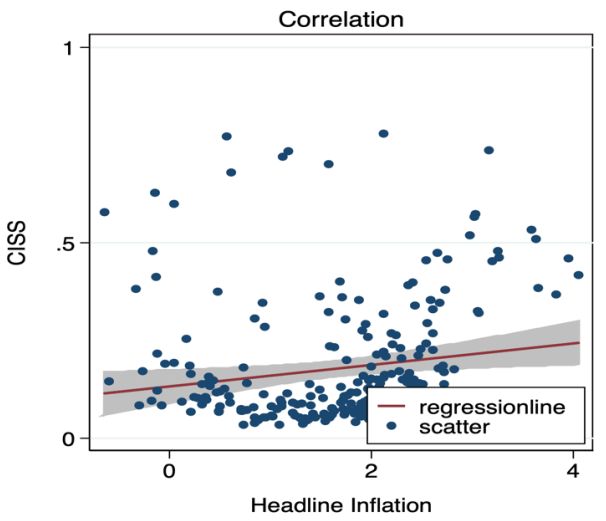
IPOL | Policy Department for Economic, Scientific and Quality of Life Policies

Then, we study pairs of indicators, always including the inflation rate, and check whether a significant
correlation and causal relationship arises. For each pair, there are three possible outcomes: i) no
(significant) correlation, ii) a significant correlation that does not generate an arbitrage, and iii) a
significant correlation that reveals an arbitrage. If, for example, price stability and financial stability are
significantly correlated, a secondary objective like, e.g. financial stability, is not worth being specifically
targeted: as a side effect, achieving price stability would enable to achieve financial stability. There is
no arbitrage. On the contrary, if one shows that an arbitrage arises, because price stability is negatively
correlated with financial stability (and the latter is among the secondary objectives), a policy oriented
towards price stability may worsen financial stability. If this outcome is costly for the euro area, dealing
with the trade-off is a priority. It may either require an additional instrument or dedicated
communication from the central bank to explain how the trade-off is handled. It may also call for
coordinating policies to reach both objectives. Now, if price stability and financial stability are not
correlated, an additional monetary instrument to help achieve the latter is necessary if the achievement
of the secondary instrument is considered important but, in contrast with the former case, it would not
require cooperative policies (provided the new instrument has no impact on inflation).
Hence, the case for a change in the ECB’s mandate may arise when an arbitrage emerges between the
different objectives and it is costly to the euro area. An extension of monetary policy instruments is an
option in this case. Finally, when the inflation rate is not correlated with the secondary objective and
the latter has gained interest from the ECB, it may be worth discussing a clarification of the mandate
and the possible extension of instruments to enlarge the scope of monetary policy.
As an important side note, the German Federal Constitutional Court (FCC)’s ruling on the Public Sector
Purchase Programme (PSPP) of 5 May 2020 is quite topical. Actually, the ruling introduces a distinction
between the “monetary policy objective” and the “economic policy effects arising from the
programme”. Thus, it ignores the necessary interactions between the monetary policy instruments, the
ECB’s primary objective and other macroeconomic and financial variables required to fulfil the
mandate. Meanwhile, it also completely overlooks the secondary objectives of the ECB.

PE 648.812                                             8
Setting New Priorities for the ECB’s Mandate

2. LINKAGES BETWEEN PRICE STABILITY AND SECONDARY
   OBJECTIVES
2.1.     Relevant secondary objectives for the fulfilment of general policies
The TFEU is clear about the ECB’s main price stability objective. Article 127 (TFEU) states that:
        "The primary objective of the European System of Central Banks (hereinafter referred to as 'the
        ESCB') shall be to maintain price stability. Without prejudice to the objective of price stability,
        the ESCB shall support the general economic policies in the Union with a view to contributing
        to the achievement of the objectives of the Union as laid dawn in Article 3 of the Treaty on
        European Union."
On the other hand, Article 3 Treaty on European Union (TEU) is only broadly defined and includes the
following (paragraph 3):
        "The Union shall establish an internal market. lt shall work for the sustainable development of
        Europe based on balanced economic growth and price stability, a highly competitive social
        market economy, aiming at full employment and social progress, and a high level of
        protection and improvement of the quality of the environment. It shall promote scientific and
        technological advance."
In a statement announcing the review of its monetary policy strategy, the ECB stated that it will, in
addition to price stability, also take into account how "other considerations, such as financial stability,
employment and environmental sustainability, can be relevant in pursuing the ECB's mandate".
Beyond whether these “other considerations” are taken into account as a means to reach price stability,
the question of which “other considerations” should be considered remains open.
Based on the objectives mentioned in the Treaty, we consider 8 secondary objectives that the ECB
could consider:
    •   financial stability,
    •   financial integration (or said differently, the prevention of financial fragmentation),
    •   reduction of inflation heterogeneity among euro area countries,
    •   sovereign debt sustainability,
    •   macroeconomic stability,
    •   social progress,
    •   technological progress, and
    •   climate change mitigation.
This paper will attempt to consider the link between those secondary objectives and the ECB’s primary
one, price stability.

2.2.     Correlation between primary and secondary objectives
For each secondary objective enumerated above, we chose relevant indicators and first computed the
correlation coefficient with the inflation rate in the euro area in order to illustrate the statistical
interaction between these objectives. We interpret these correlations cautiously. The aim is to point to
potential interactions and the direction of those relationships. Then, we carry additional statistical

                                                      9                                              PE 648.812
IPOL | Policy Department for Economic, Scientific and Quality of Life Policies
analyses to examine further the relationship with price stability and provide more detailed
conclusions. 2
We conduct three complementary tests in order to estimate the dynamic correlation and the direction
of the link between the ECB’s main objective and the secondary objectives considered. 3 First, we draw
a scatterplot of inflation and each secondary objective variable (the regression line is accompanied by
a 95% confidence interval) to assess the strength of the relationship and the influence of outliers.
Second, the cross-correlogram provides evidence of a dynamic correlation between the contemporary
inflation rate and each other variable at different time periods. Finally, we estimate a VAR model that
includes inflation and each secondary objective variable at a time, and plot the response functions of
each variable to shocks to the other. This test can be thought of as a Granger causality test and provides
some insights on the direction of the link between the primary and secondary objectives and whether
it is the main objective that drives the secondary or the other way. It helps to understand if the unique
mandate of price stability may be detrimental or not to other objectives, and whether other objectives
should be considered.
Based on the test results, three types of relation with the primary objective are defined (later
summarised in Table 1):
• The primary and secondary objectives are independent, there is no stable link between both on
which policymakers could rely.
• The primary and secondary objectives are complementary, the pursuit of price stability may
enable to attain a second objective.
• The primary and secondary objectives are substitutable, the pursuit of one would be detrimental
to the achievement of the other.
Our analysis has found the following results:
• Positive correlation between the inflation rate and its standard deviation: higher level of inflation
seems to be linked with higher inflation dispersion across euro area countries.
• Strong negative relation is found between the inflation rate and the cross-country standard
deviation of interest rates on housing loans to households: more inflation goes together with less
dispersion in housing loan rates.
• Positive relation between inflation and improved debt sustainability. 4
We document the detailed analysis for these indicators where we found a statistically significant
relationship. The details for other indicators are reported in the Annex. 5 The underlying data is available
upon request.
2
Table 2 in Annex shows the raw correlation between the different indicators and the headline inflation.
3
We provide the outcomes of these additional statistical analyses for variables whose correlation is low in the Annex and
confirm that there is no stable relationship with the ECB primary objective.
4
To assess debt sustainability, we compute the difference between actual primary surplus and the primary surplus that
would stabilise the debt-to-GDP ratio at 60 percent. This difference is called the primary balance sustainability gap (PBSG).
5
We also find a negative relation between the unemployment rate and the inflation rate, consistent with the Phillips curve,
and that higher inflation is also associated with higher financial stability. However, these two correlations are not
confirmed with the additional tests. This is consistent with the literature that provides evidence of a flattening of the
Phillips curve (Coibion and Gorodnichenko, 2015; Galí and Gambetti, 2019; Del Negro et al., 2020) and Blot et al. (2015)
that show that the link between price and financial stability is null in the euro area and the US.
PE 648.812 10Setting New Priorities for the ECB’s Mandate
The statistical analysis provides preliminary insights in pairwise correlations and causalities. By
construction, this exercise has two shortcomings though. First, the analysis is neither based on a
structural nor on a multivariate analysis, and it may not fully account for more complex interactions
between objectives. For example, we cannot reject that a missing variable explains some pairwise
correlation or causality. Second, the empirical tests are not informative on the impact of the actual
policy tools used by the ECB on secondary objectives. Finding a complementarity between primary and
secondary objectives cannot be interpreted in terms of the effectiveness of ECB’s tools. For these
reasons, the discussion on ECB’s objectives and tools does not hinge only on the empirical results. The
latter give a first research orientation that we confront with the existing literature and with current
debates on the design of central banks and the definition of their mandates.
Figure 1: The link between inflation and the dispersion of inflation rates
Source: Authors’ computations. The dark (resp. light) grey-shaded areas represent confidence intervals for one (resp. two)
standard error(s).
In Figure 1, the cross-correlogram (upper right panel) and the regression line (upper left panel) show a
positive relation between inflation rate and its dispersion in the euro area. Higher inflation is associated
with higher dispersion of cross-country inflation rates. The correlation is positive and stronger at lag 4:
contemporary inflation is mostly related to its standard deviation 4 months before. The impulse
responses give the same results: inflation dispersion has a positive effect on inflation, and inflation has
a positive effect on inflation dispersion. These causalities are significant at standard levels around the
6th month. The euro area aggregate inflation rate increases by 0.1 percentage point six months after a
11 PE 648.812IPOL | Policy Department for Economic, Scientific and Quality of Life Policies
shock to the dispersion of inflation rates. On the other hand, the dispersion of cross-country inflation
rates will increase by 0.05 points six months after a shock on inflation rates.
The positive and significant relation between these two variables suggests that inflation pressures will
be associated with more fragmentation among cross-country inflation rates in the euro area. According
to these empirical results, the objective of price stability and inflation homogeneity are
complementary. The pursuit of the actual unique objective of the ECB shall help to reach the cross-
country inflation rates homogeneity in the euro area.
Figure 2: The link between inflation and the dispersion of interest rates on housing
loans
Source: Authors’ computations. The dark (resp. light) grey-shaded areas represent confidence intervals for one (resp. two)
standard error(s).
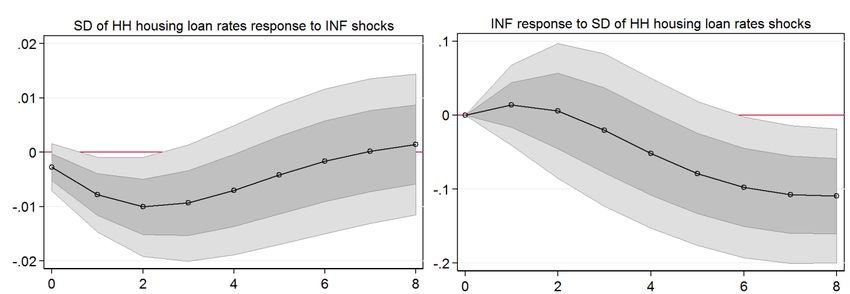
In Figure 2, the regression line (upper left panel) shows a negative relation between inflation rate and
the dispersion of interest rates on housing loans. The cross-correlogram (upper right panel) confirms
this result: the correlation is negative and becomes even more negative when the dispersion of housing
loan rates lags inflation by 13 months. Higher inflation is associated with less dispersion and so, less
financial fragmentation. Both impulse responses (lower panel) confirm this statistically negative link
between the two variables: an inflation shock causes less financial fragmentation via lower dispersion
of interest rates on housing loans for 3 months (lower left panel).
According to these empirical results, both objectives cannot be achieved together, so they are
substitutable and generate a trade-off. When the ECB follows its objective of price stability, it can
PE 648.812 12Setting New Priorities for the ECB’s Mandate
increase financial fragmentation by increasing the dispersion of interest rates on housing loans. The
reverse is not statistically true.
Figure 3: The link between inflation and sovereign debt sustainability
Source: Authors’ computations. The dark (resp. light) grey-shaded areas represent confidence intervals for one (resp. two)
standard error(s).
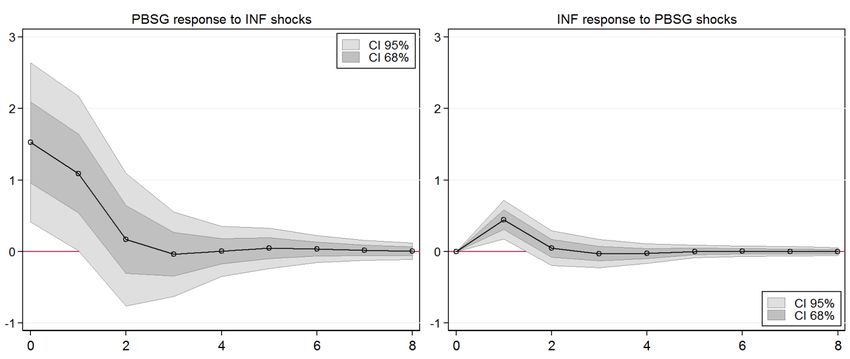
In Figure 3, an increase in primary balance sustainability gap (PBSG) illustrates an improvement in debt
sustainability. Results indicate a positive relation between inflation rates and sovereign debt
sustainability in the euro area: an increase in inflation rates is associated with improved sustainability.
We find the same results in the impulse responses: the PBSG will increase the year following an inflation
shock (lower left panel). The effect of a PSBG shock on the inflation rates in the euro area is also positive
and significant for almost 2 years during which inflation will rise.
The stable and positive relation between inflation and sovereign sustainability generates a trade-off:
these objectives are substitutable and cannot be achieved together. Even though monetary policy
can help reduce sovereign debt costs (see Blot et al. 2020c), focusing solely on the price stability
objective could deteriorate the sovereign debt sustainability in the euro area.
The results of the tests conducted are summarised in Table 1, highlighting the relationships between
the price stability objective and the potential variables representing secondary objectives. The next
two parts of the paper deal with the challenges raised by these three types of relationships.
13 PE 648.812IPOL | Policy Department for Economic, Scientific and Quality of Life Policies
If two objectives are independent, then the central bank cannot rely on the pursuit of one objective to
achieve the other. In this case, if the central bank wanted to expand its objective set, a new mandate
would be necessary.
The case of a complementary relationship seems to be the easy one. Achieving one objective would
not be detrimental to the other objective. However, one important question to deal with is that the
complementary of two objectives does not necessary mean that the instrument used to maintain price
stability will also be complementary with the secondary objective.
Finally, substitutable objectives generate trade-offs since the pursuit of one of the objectives might
affect negatively the other objective. This is the case for financial fragmentation and sovereign debt
sustainability since lower inflationary tensions mean more financial fragmentation among housing
loan rates and worsen sovereign debt sustainability of euro area countries.
Table 1: Summarised test results
Independent Complementarity Substitutability
Macroeconomic stability Inflation heterogeneity Financial fragmentation
(unemployment) (SD of inflation rates) (dispersion of housing loan rates)
Sovereign debt sustainability
Financial stability (CISS)
(PBSG)
Asset price-based financial
integration (CIFI)
Financial fragmentation
(dispersion of NFC loan rates)
Climate change
(GHG emissions)
Inequality
(top 1% / bottom 50% income)
Technological progress (TFP)
Financial fragmentation
(dispersion of sovereign rates)
Source: Authors’ classification.
Note: For each variable in the table, we summarize the results of the pairwise correlation, of the time dimension of the
correlation (correlogram) and of the causal tests (impulse response functions) of bivariate vector autoregressive models. For
example, the variable “inflation heterogeneity” is labelled “complementary” because the pairwise correlation is positive and
the correlation has been confirmed by the time dimension of the correlogram and by the impulse response functions.
PE 648.812 14Setting New Priorities for the ECB’s Mandate
3. HOW MANY OBJECTIVES FOR THE ECB?
Monetary history has emphasised that central banks have been assigned with various objectives before
being namely and firstly in charge of price stability (Goodhart, 2011). At the origin, one of the main
tasks of the Bank of England was to finance government expenditures, especially during periods of war.
During the 19th century, the tasks assigned to central banks evolved and their main objective became
financial stability through the emergence of the doctrine of the lender of last resort. It has indeed
motivated the creation of the Federal Reserve System via the Federal Reserve Act of December 1913
(Bernanke, 2013) after several decades of recurrent banking crises. Macroeconomic stability became a
prominent objective only after the Great Depression and World War II. Finally, Phillips curve critics and
the so-called risk of inflation bias, which was pointed out during the 1980s, have pushed the price
stability objective to the forefront. The establishment of the ECB and the design of its functioning and
status consecrated the new paradigm of monetary theory (Vincensini and Taugourdeau, 2009).
More recently, the episodes of financial and sovereign debt crises as well as the rise of new concerns –
climate change and inequality for instance – have raised issues on the role central banks can play and
eventually on the objectives or the hierarchy between objectives that should be assigned to central
banks. Regarding the ECB, the Treaty makes it clear that there is a hierarchy between the objectives
with a priority devoted to price stability and implying that other objectives may be fulfilled only to the
extent that they do not prevent the ECB from guaranteeing price stability. As emphasised in the
previous section, three options arise. The additional objectives may either be independent from the
main objective of price stability, complementary or substitutable with it.
In what follows, and keeping previous results in mind, several options regarding the mandate of the
ECB are contemplated. However, this discussion does not hinge only on the aforementioned results
but also draws on existing literature and current debates on the design of central banks and the
definition of their mandates. At this stage, the discussion is restricted to the objectives assigned to
monetary policy and to the instruments used by central banks in the conduct of monetary policy. It
should be kept in mind that the ECB has endorsed new responsibilities since 2012 within the European
Banking Union that goes beyond monetary policy per se. We discuss about the impact of these new
responsibilities and their associated tools on the design of monetary policy in the next section.
3.1. Unchanged mandate: which objectives could be achieved?
Keeping the current mandate is inevitably the baseline case to be considered. This option is the most
realistic one because it would be hard to find a political compromise on a Treaty change. In this context,
price stability would remain the priority of the ECB. However, enhancing price stability could also help
promote other objectives if they are complementary with it. As shown in the previous section, this
might be the case for the convergence of inflation rates in the euro area. Actually, higher inflation goes
generally together with higher volatility. Kim and Lin (2012) find indeed a two-way causality between
inflation and its variability consistent with theoretical models developed by Ball (1992) and Cukierman
and Meltzer (1986). Even if these analyses are based on time-series, they may also hold once applied to
a geographical area such as the euro area. However, it should be kept in mind that during the pre-crisis
period, despite low inflation in the euro area, the dispersion of inflation rates has been significant
leading to heterogeneity and increasing discrepancy in competitiveness, which has fed
macroeconomic imbalances. The recent experience suggests that keeping euro area inflation close to
the 2% target may not be sufficient to promote convergence and prevent the building up of
imbalances.
15 PE 648.812IPOL | Policy Department for Economic, Scientific and Quality of Life Policies Regarding climate change, correlation is found to be null and non-significant. Moreover, it may be pointed out that even if lower inflation would be positively correlated with less CO2 emissions, it would not necessarily lead the central bank to be able to target efficiently climate change as central banks are not equipped with instruments that could tackle this structural issue. Favouring bond purchases from corporates with low greenhouse gas (GHG) emissions is a proposition often put forward, for instance. However, it is not clear that this price distortion would indeed contribute to reducing GHG emission. Another (extreme) way to mitigate climate change is through economic activity. An economic slowdown would lower CO2 emissions. However, in the spirit of the Treaty, the price stability objective does not involve low economic growth. Inflation close to the target and output close to its potential might not contribute to reducing carbon use. Even if the analysis carried in the previous section has not highlighted a significant correlation between inflation and output, it is sometimes argued that price stability would also enhance growth, which is called the “divine coincidence” by Blanchard and Galí (2007). However, they show that such a situation is a particular case of a New Keynesian model where there are no “trivial” real imperfections. The trade- off between inflation and output would resurface once the model allows for real wage rigidities. In the long run, high or very high inflation is certainly costly and detrimental to economic growth. The question of a trade-off in the short and medium term has been revived over the last years. Many works (see e.g. Coibion and Gorodnichenko, 2015, Galí and Gambetti, 2019; Del Negro et al., 2020) have questioned the empirical relevance of the Phillips curve. Global supply chains and international drivers of inflation suggest that the link between inflation and output may have vanished as it seems to be indicated by a simple correlation analysis. How should the ECB deal with such a potential trade-off?The answer provided by the Treaty is to set a clear hierarchy between objectives. Consequently, when the conflict arises, because of supply shocks for instance, the ECB is supposed to give priority to the price stability objective. Yet, as discussed thereafter, this particular trade-off may also motivate a dual mandate. In the same vein, Schwartz (1988) described several channels through which price stability would promote financial stability, a view called the “conventional wisdom”. If this view were true, the ECB would contribute to financial stability by keeping inflation low. This was the consensus prevailing before the global financial crisis. The evidence seems however at odds with the conventional wisdom. The period before the global financial crisis was characterised by stable and low inflation. Yet, it has not prevented the build-up of financial imbalances. If the divine coincidence and the conventional wisdom hold, then a monetary regime primarily devoted to price stability would also foster economic growth and enhance financial stability. Consequently, the current mandate of the ECB would be the best way to achieve these additional goals, justifying a status quo. This may, however, not be the case, as available empirical evidence shows and as illustrated by our analysis, thus raising the issue of an extension of the mandate. Beyond the empirical link between the primary and secondary objectives, the ECB’s mandate relates to multidimensional aspects: whether the policy is structural or cyclical, whether the objective is of a very political nature (in which case the question of giving it to an independent institution would be very problematic), and whether the central bank has relevant instruments in its toolkit to tackle these secondary objectives. 3.2. Extending the mandate In the Treaty, the priority has been given to price stability because it was thought that there was a trade- off only in the short run. In the long run, monetary policy is supposed to be neutral in new Keynesian models so that central banks (and monetary policy) only affect prices. There is now some evidence that PE 648.812 16
Setting New Priorities for the ECB’s Mandate

the impact of monetary policy on output and employment may be long-lasting (Jordà et al., 2020).
Besides, while the EU Treaty makes a clear priority, this is not the case in the United States where
according to the Federal Reserve Act, the central bank pursues a dual mandate.6 Enlarging the mandate
may also be needed in case there is a political will to integrate other objectives which are unrelated to
price stability or for which there are trade-offs.

3.2.1.         A dual mandate…
Contrary to the mandate where price stability is the unique or main objective of monetary policy, price
stability and output (or employment) are given equal weight when central banks pursue a dual
mandate. In the United States, the Federal Reserve is mandated by the Congress – in the Federal
Reserve Act – to promote maximum employment and stable prices. Friedman (2008) claims that central
banks generally take account of both price and macroeconomic stability, suggesting that even when
the mandate is uniquely defined in terms of price stability, output stabilisation is not overlooked. Castro
(2011) has found, for instance, that the output gap entered significantly in the reaction function of the
ECB indicating that, at least implicitly, it accounted for output stabilisation. Under these circumstances,
the rationale to change the mandate would be reduced. Yet, Friedman (2008) considers that the dual
mandate, where both objectives are considered without priority, is more appropriate since trade-offs
are explicitly recognised, which notably provides the central bank with more leeway to address
macroeconomic stabilisation when the unemployment rate is very high (Rosengren, 2013).

3.2.2.         … or a triple mandate?
With the creation of the Banking Union in 2014, the ECB is now in charge of the supervision of the
largest European banks, de facto enlarging the scope of its mission. Furthermore, during the financial
crisis, the ECB has implemented a set of measures to meet the liquidity needs of the banking system
and played the role of lender of last resort, which was not explicitly assigned in the Treaty. Blot et al.
(2014) consider that the ECB has de facto followed a triple mandate focusing on inflation, growth and
financial stability. The Banking Union not only assigns the ECB with an additional mission, it also entails
a new instrument: the set of macro- and micro-prudential tools. Yet, there is also an issue regarding the
role that can be played by monetary policy to enhance financial stability.
Beyond the role of financial regulation, which clearly remains the main policy instrument to deal with
financial stability, some argue that monetary policy could complement this action (Woodford, 2012),
implying that standard tools, such as the interest rate, would be used to dampen financial imbalances.
Borio (2002) even claims that such a response should be systematic, a strategy known as “leaning
against the wind”. In practice, there are no central banks where this has been followed formally. There
is, however, a growing literature suggesting that monetary policy may affect financial risk via the risk-
taking channel. Consequently, price stability is not a sufficient condition to guarantee financial stability,
which may constitute an additional argument to integrate financial stability among the objectives of
monetary policy. Greenwood et al. (2016) suggest for example that monetary policy – through the size
of central bank’s balance sheet – may be used to promote financial stability by providing liquidity and
avoiding financial markets to create riskier assets.
With the outbreak of the COVID-19 crisis, the euro area faces a new recession and requires a large public
policy response. Public debt will increase, raising potential challenges for public debt sustainability.
The circumstances may remind of the situation after the global financial crisis and the sovereign debt

6
    The Federal Reserve is usually attributed a dual mandate, although as stated in the Federal Reserve Act, it should achieve
    “maximum employment” , “stable prices” and “moderate long term interest rates”.

                                                            17                                                   PE 648.812
IPOL | Policy Department for Economic, Scientific and Quality of Life Policies crisis, when the role of the ECB has proven to be crucial to break the vicious circles and to avoid a wider liquidity squeeze for sovereigns. Reis (2017) analyses the role of the quantitative easing (QE) policy to enhance public debt sustainability and financial stability. When there is a risk of public default, QE enables the central bank to “take the risk of default out of the balance sheet of the banks and into the balance sheet of the central bank” by issuing reserves, which are only held by banks. However, Reis (2017) argues that QE does not constitute monetary financing of deficits so that it would not bring central banks back to its original objective. Yet, it would be more relevant to reinforce coordination between monetary and fiscal policy than to elevate public debt sustainability as a central bank objective, as suggested in the next section. This analysis suggests broadening the mandate of the ECB to integrate full employment and financial stability, as those objectives, while being socially important, are closely connected with monetary policy. Yet, it must be acknowledged that this would entail a change in the Treaty, which remains a difficult task. 3.3. Should other objectives be introduced explicitly in the mandate? Beyond output stabilisation and financial stability, there may be additional objectives worth integrating explicitly in the mandate. Among them, inequality, climate change, financial integration and convergence have been considered in the previous section. Under which conditions should the mandate be broadened to other objectives? Two criteria may be stressed for the possibility to elevate additional objectives in the mandate of the central bank. First, those objectives must be deemed socially important. Second, monetary policy must be able to affect those objectives so that the ECB can be held accountable for. It would indeed be misguided to assign objectives that cannot be fully controlled by the ECB. Blot et al. (2016) discuss this issue in the context of the definition of the inflation target: if euro area inflation is driven by international factors rather than domestic factors, the ECB cannot influence inflation and be held responsible for reaching or missing the target. This entails the risk to undermine its credibility and accountability. The role of monetary policy with respect to inequality has been long neglected. It was implicitly considered that monetary policy had non-significant or indirect impact. This element has arisen recently in the policy debate and in the academic literature. Potential side effects of unconventional measures have emerged in the debate because these policies effectively inflate asset prices and could consequently raise inequality. However, there are distinct channels though which these measures affect income and wealth distribution and some have contradictory effects. In the end, conclusions regarding the sign and the magnitude of the effects of unconventional monetary policy measures on inequality are not clear. Auclert (2019) provide a description of these channels within a theoretical model with heterogeneous agents. The effect of monetary policy passes through income distribution because of its effects on employment, inflation and real interest rates affecting asset prices. He notably points out that the impact of monetary policy on income distribution is closely related to its impact on employment. Furthermore, the redistributive effect of monetary policy through asset prices is subtle and hinges on the composition of financial wealth indicating that not all financial assets holders gain from expansionary monetary policy. Empirical evidence has shown contrasting results on this issue. Besides, even if monetary policy has significant effects on inequality, the magnitude of the effect is small compared to the impact of fiscal tools (see e.g. Creel and El Herradi, 2019). Inequality is a highly political issue reflecting social choice which may differ across countries and across periods. It would therefore be hard to set in stone in the Treaty an objective relating to the desired level of inequality. This issue is highly political and assigning the ECB with this objective would inevitably bring the ECB in the realm of politics, which may not be compatible with independence. Nevertheless, it is relevant for policy makers to be aware of potential effect of their decisions on such a highly important social PE 648.812 18
Setting New Priorities for the ECB’s Mandate

objective. But instead of re-orienting the objectives assigned to the central bank, it may be more
relevant to increase fiscal-monetary coordination to better internalise the undesirable effects of
monetary policy on inequalities.
Regarding climate change mitigation, the terms of the debate are different. Although the aim is socially
important, there is no obvious connection with existing monetary policy tools. Monetary policy may
yet contribute to the transition to a low-carbon economy through the purchase of assets such as green
bonds, which are issued to finance projects contributing to this transition. This would, for instance,
entail re-orienting QE programmes. But whether to issue those bonds is foremost a policy decision
taken by governments. To the extent that the QE tool is still activated, the ECB could indirectly
contribute to climate change mitigation. This does not require a Treaty change.
Convergence is clearly a historical aim of the European Union. The achievement of the monetary union
in 1999 was an additional step toward European integration. The global financial crisis, however,
highlighted the institutional flaws of the EMU. Despite low inflation in the euro area – from 1999 to
2007, the average inflation was indeed close the 2% target –, divergence has been growing and
macroeconomic imbalances have triggered a crisis of the euro with the threat of a split that peaked in
2012 and in 2015 with the Greek crisis. As pointed in Blot et al. (2019a), “nominal divergence has led to
financial imbalances and to real divergence within the euro area”. The ECB has played a key role during
this period – through dedicated programmes such as the SMP (securities markets programme) and
OMT (outright monetary transactions) – to avoid more dramatic consequences. Therefore, nominal
divergence and financial fragmentation are linked and monetary policy has some power to fix the
fragmentation of sovereign markets. It is also important for the ECB to deal with fragmentation as it
impairs the transmission of monetary policy. It was by the way, the main motivation of the ECB for the
implementation of non-standard measures (Durré et al., 2014). Since tools are at the disposal of the
central bank, there may be a debate on the opportunity to add convergence in the list of objectives
assigned to monetary policy.
Finally, Blot et al. (2019b) also raised the issue of a change in the definition of the target for price
stability. Instead of seeking to achieve a 2% inflation for the euro area as a whole, the ECB might seek
to avoid strong discrepancies between national inflation rates and then the divergence that has been
at the origin of the euro area crisis. They claim that such a change may be achieved without changing
the Treaty as the ECB has leeway for defining its target. However, the ECB could be constrained in
accounting for nominal imbalances if convergence is added to the list of monetary policy objectives.

                                                  19                                           PE 648.812
IPOL | Policy Department for Economic, Scientific and Quality of Life Policies
4. NEW TOOLS OR ENHANCED COORDINATION TO ACHIEVE
SECONDARY OBJECTIVES?
The empirical characterisation of the linkages between the primary and secondary objectives joined
with a discussion on the merits of extending or clarifying the mandate of the ECB raise two issues: first,
the appropriate number of instruments at the ECB’s disposal and, second, the requirement of enhanced
cooperation with governments.
4.1. Tools to foster financial stability and financial integration
We already highlighted three worthy elements: first and foremost, empirical correlation and causality
results (section 2) between inflation rates, on the one hand, and measures of financial stability or
financial integration, on the other hand, have concluded that they were independent one from
another. Second, this empirical result does not object that monetary policy should target price stability
and financial stability, for instance (section 3); the empirical result makes this kind of double mandate
even easier to achieve, provided the tools used to achieve one target do not interfere with the other
one. Third, the creation of the Banking Union has given the ECB macro-prudential and micro-prudential
tools to achieve banking stability. To these regulatory tools, one should also add the different features
of non-standard monetary policies (like Targeted Long-Term Refinancing Operations, and asset
purchase programmes) that have alleviated the funding costs of banks and their balance sheet risks.
The ECB is already well-equipped with many tools that, according to the Tinbergen principle, permit
achieving several targets. If we take for granted that the chosen tools are effective at achieving their
allocated target, it remains that there are three pitfalls to escape.
The first one is to investigate whether the tool used to achieve the secondary target, e.g. financial
stability, is symmetric. Heterogeneity in economic and financial frictions across good and bad times –
for example, rising and plummeting asset prices – may produce asymmetric effects of monetary
policies. Blot et al. (2020a) have shown that monetary policy has asymmetric effect on stock price
imbalances in the euro area. 7
The second pitfall is transparency and communication. Assume the ECB implements supposedly
conflicting policies as regards the primary and secondary objectives, like raising the policy rate and
easing banks’ capital requirements. While both policies would be intended to achieve two
independent objectives, they may go in opposite directions, contraction in the former case and
accommodation in the latter. To limit misunderstanding on the actual stance of monetary policy, the
ECB should use two policy tools that do not have cross-effects on its primary and secondary objectives.
However, they may be very difficult to find and both instruments may well impact both objectives.
Hence, the ECB would be left with only one option: that of exposing that it has taken into account their
inter-relationships in its policies. We stress that communication on this is crucial. It is all the more crucial
that the strict legal separation between the Single Supervisory Mechanism (SSM) and the monetary
policy role of the ECB, enshrined in the SSM regulation, does not permit to coordinate both policies
explicitly, that is the monetary policy role of the ECB on the one hand, and its financial stability role on
the other hand.
The third pitfall relates to the dispersion of housing loan rates. The price stability objective runs counter
to the reduction in the dispersion, hence intensifying this source of financial fragmentation. This is an
7
For the US, Blot et al. (2020b) find that restrictive monetary policies have more traction on stock price bubbles than
expansionary decisions.
PE 648.812 20Setting New Priorities for the ECB’s Mandate
important issue because it impairs the transmission channel of monetary policy (via increased
heterogeneity on credit rates) and also weigh on inequality (via heterogeneity in the access to housing
and non-financial wealth). While monitoring of this dispersion mechanism is key, it might be in the
interest of the euro area to see the ECB develop common regulatory tools on housing loan markets to
have a more uniform transmission of policy rates to housing loan rates.
4.2. Enhanced coordination of monetary and fiscal policies
Beyond the discussion regarding the definition of the mandate assigned to the ECB and the
instruments that can be used to reach objectives, it is also crucial to account for interplays with other
instruments, which may be at the disposal of other institutions. Even if one considers that price stability
remains the main priority, the ECB may also account for the interactions between monetary and fiscal
policy. The difficulty to reach the “below, but close to” 2% target has illustrated that other forces might
counteract the effect of monetary policy and drive the ECB away from its objectives.
Under these circumstances, there may be a need to reinforce coordination between the institutions
that implement policies which weigh on the primary objective of the central bank, unless monetary
policy decisions are so powerful that they internalise the effect of the other instrument. Alignment with
fiscal policy is crucial for macroeconomic stability whether it involves price stability only or a dual
mandate. Achieving financial stability and assigning monetary policy with a role towards this objective
may also imply a better coordination with the institutions in charge of financial supervision (prudential
tools).
21 PE 648.812IPOL | Policy Department for Economic, Scientific and Quality of Life Policies 5. CONCLUDING REMARKS ON THE ROLE OF COORDINATION Finally, coordination may be useful if monetary policy can help other institutions to achieve an objective not assigned to the central bank. Empirical results in section 2 have shown that there was an apparent conflict between the objectives of price stability and debt sustainability. This conflict is not new: it is well-known that most periods of very high public debts have been followed by higher inflation. Moreover, the independence of the ECB is associated with the prohibition of monetary financing. That being said, debt sustainability is certainly key to the achievement of balanced economic growth. For the ECB, endowed with a secondary objective of so-called balanced economic growth, the interaction between its monetary policy decisions and debt sustainability should be closely monitored. Here again, coordination of policies of the ECB and euro area governments is much needed. Not only is the short run policy mix important to maximise the effectiveness of monetary policy, but also to remove default risk. We have already argued that monetary policy may not be best equipped to cope with climate change and inequality: public policies can better deal with incentives and externalities via shifts in taxes and in transfers. However, the latter may not be easily coordinated between 19 governments, whereas a federal institution like the ECB would prove useful at giving a common impetus. Hence, cooperation may be required between the ECB and euro area governments to foster both goals. This would not be detrimental to the primary objective of the ECB. The ECB could well dedicate a given share of its asset purchases to “green bonds”. It would require governments to back “green spending” by dedicated and easily identified bonds that the ECB may purchase (on secondary markets) with a priority. Their relative prices may turn out to be higher that non-green bonds, hence providing the former more liquidity. Results in section 2 also report that inflation, on the one hand, and total factor productivity (TFP) and macroeconomic stability, respectively, on the other hand, do not share a stable link. While the extension of the ECB mandate to macroeconomic stabilisation has been discussed previously, the commitment of the ECB towards technological progress seems less obvious. Nevertheless, indicators of macroeconomic stabilisation (e.g. unemployment rates) and technological progress (TFP) are useful at identifying demand and supply shocks, respectively. In this respect, it is important that the ECB and euro area governments cooperate closely on the identification of shocks in the euro area, either idiosyncratic or common, either supply or demand, to ensure an appropriate policy mix. The COVID-19 crisis has shown that shared identification is crucial as it removes the risk of inappropriate policies (monetary restriction and/or permanent fiscal expansion after a negative supply shock). It has also shown that coordination of monetary and fiscal policies helps to bolster their respective effects and to achieve their objectives: monetary expansion reduces the interest costs of the fiscal expansion and helps the latter be more effective at dampening the fall in demand while the fiscal expansion helps monetary policy achieve its inflation target. PE 648.812 22
You can also read


