Significance and Engagement Policy - June 2018 - Wellington City ...
←
→
Page content transcription
If your browser does not render page correctly, please read the page content below
Significance and
Engagement Policy
June 2018
ISBN: 978-0-947521-10-3
SIGNIFICANCE AND ENGAGEMENT POLICY                WELLINGTON CITY COUNCIL | OUR 10-YEAR PLAN 2018–28   167

Significance and Engagement Policy �

INTRODUCTION                                                                MAKING IT WORK IN PRACTICE
Wellington City Council (the Council) is responsible for                    There are some key questions for Council officers to
making decisions on behalf of its communities. The                          answer in making this work in practice. Some
Council considers community views and preferences                           decisions require the use of the Special Consultative
when making decisions and has flexibility about how                         Procedure under the Act. See Part 7 of this policy about
to engage with its communities6. Council gathers                            the requirements for these decisions.
information about the views and preferences from
                                                                            For all other decisions, Council is required to:
Wellington’s diverse communities in many ways and
uses this information to inform its decisions.                              • � Identify the objective – what is being sought to be
                                                                                achieved and why?
The Council aspires to actively engage with and work
collaboratively with its communities within the                             • � Identify all reasonably practicable options for
decision making roles. Engaging early and well,                                 achieving the objective
enables better decisions by ensuring that final                             • � Assess their advantages and disadvantages
decisions take into account or have regard to the views
of the community and those affected by the decision.                        • � Design the decision-making and engagement
At times (and subject to unique circumstances),                                 process taking into account:
engagement activities may need to go beyond the                                • � Sufficient knowledge of community views on the
Council’s standard approach.                                                       matter? If not, further engagement/consultation
The purpose of this policy is to explain how the                                   is appropriate.
community might be engaged in various types of                                 • � Significance (see Schedule 1)
decisions. This policy is required under the Local
                                                                            If Council has decided to consult, or is otherwise
Government Act 2002 (the Act). It includes:
                                                                            legally required to, ensure that consultation complies
• � The general approach to determining the degree of                       with consultation principles (see Part 8).
    significance of proposals and decisions(Parts 2, 3
                                                                            This can be illustrated in the following flowchart.
    and 4 of the Policy);

• � The criteria used to determine the extent to which
    proposals and decisions are of significance
    (Schedule 1);

• � Information on when, how and to what extent
    communities can expect to be engaged in decision-
    making processes and other matters; (Parts 5 and 6);
    and

• � A list of strategic assets owned by Council (Part 10
    and Part 11).

6   Unless the special consultative procedure must be followed, which prescribes a process.
168 WELLINGTON CITY COUNCIL | OUR 10-YEAR PLAN 2018–28 SIGNIFICANCE AND ENGAGEMENT POLICY
1. General approach
Consultation vs engagement no express requirement to consult the public, but we
will consider people’s views and preferences.
Consultation involves obtaining public feedback on
proposals; it is one form of engagement. The Council Engagement is a broader and ongoing process of
regularly consults communities through process such sharing information with the community and seeking
as the long-term plan which determine Council’s its feedback, with the purpose of involving the
strategic direction as well as how it sets budgets and community in the process of decision making. This
prioritises projects. process may include a more formal consultation
process to meet legal requirements. Our approach to
The Council will consult the community on significant
engagement is set out in section 6.
decisions, following the principles set out in section 82
of the Act (see Part 9). Council can also decide to There is a general expectation of officers that for more
consult at any time on a decision, where it considers significant decisions they will have a communication
that appropriate. For most Council decisions, there is and engagement plan which will apply the principlesSIGNIFICANCE AND ENGAGEMENT POLICY WELLINGTON CITY COUNCIL | OUR 10-YEAR PLAN 2018–28 169
of IAP2 engagement spectrum. Business units should Making decisions of high significance outside of the
work with engagement staff on how this can be applied Long-term Plan
to specific decisions.
There will be decisions of high significance that must
The details of this are not included in this policy. be made outside of the Long-term Plan process. The
Council will ensure an appropriate engagement and
Assessment criteria
decision-making process is followed and that this is
The Council must determine the level of significance addressed in a report to the Council. The Council will
of a decision based on criteria identifying the level of use the special consultative procedure when it is
significance and the likely impact of the decision on legally required to. Part 8 sets this out in more detail.
the current and future wellbeing of the city. It must
Reporting of decisions
also take into account any persons likely to be
particularly affected by or interested in the decision All reports by officers to Council or a Council
and the capacity of the Council to perform its role, as Committee which are seeking a decision will include a
well as the financial and other costs of doing so. statement addressing the issue of significance. If the
proposal is considered to be of high significance the
The criteria for assessing the degree of significance
report will describe how the relevant sections of the
The Council’s criteria for assessing the degree of Act and this policy have been addressed.
significance of a decision are:
When might the Council not carry out engagement?
• � the level of importance to Wellington City
There may be occasions when the Council may not
• � the level of community interest follow this policy, for example where failure to make a
• � the consistency of the proposed decision with decision urgently would result in unreasonable or
existing policy and strategy; and significant damage to property, risk to people’s health
and safety, or the loss of a substantial opportunity to
• � the impact on the Council’s capacity and capability. achieve the Council’s strategic objectives. The Act sets
The key factors to consider under each criteria are set out a process for the Council to follow if the Council
out in Schedule One, on the following page. When a has a good reason to make a decision outside of this
decision is indicated as “high” on two or more criteria policy.
it is likely to be highly significant. Other Council decisions and levels of reporting
2. Factors that guide the Council’s decision making For decisions of low or medium significance, the
process Council will comply with sections 76 to 82 of the Act.
Decisions of high significance in the Long-term Plan For decisions to be made under delegated authority
and for which there is no Council or committee report,
Decisions assessed to be of high significance to the the Council will not necessarily formally document the
Council and the community should normally be assessment of significance or the Council’s compliance
included in the Long-term Plan (LTP) process. This will with sections 76 to 82.
ensure that they are linked to community outcomes,
proposed in context with other major decisions, and The Council will ensure that, in fulfilling the above
put before the community within this planning and requirements, the level of attention, consideration,
consultation process and timing. disclosure, and engagement taken is in proportion to
the significance of the decision.
The Council will continue to make available all
information regarding the decisions it makes in
response to all written and verbal submissions from
individuals and groups in the community.170 WELLINGTON CITY COUNCIL | OUR 10-YEAR PLAN 2018–28 SIGNIFICANCE AND ENGAGEMENT POLICY
Schedule 1: The criteria and factors for assessing significance
RATING CRITERIA KEY FACTORS TO BE CONSIDERED � ENGAGEMENT7
High When a decision is indicated as high on two or more criteria it is likely to be highly significant.
Importance to Wellington City • � Any decision that would significantly alter the level of Large-scale publicity and promotion. This may include an informal phase followed by more formal forms of
Eg: The Long-term
service provided by the Council of a significant activity engagement. Promotion though a range of channels and events, potentially including hui, a focus on online
Plan, decisions to
(including a decision to commence or cease such an activities, newsletters and publications.
transfer strategic
activity)
assets to or from
Council or to • � Extent of costs, opportunity costs, externalities and
significantly alter subsidies
the level of service
provided by the • � Uncertainty, irreversibility, and the impact of the
Council of a decision in terms of the community’s sustainability and
significant activity resilience
(including to stop or
start a new group of Community interest • High levels of prior public interest or the potential to
activity), major new generate interest or controversy
roads, Local Alcohol
Policy. • Large divisions in community views on the decision
• � A moderate impact on a large proportion of the
community or a high impact on a moderate number of
persons
Consistency with existing policy • Decisions that are substantially inconsistent with
and strategy current policies and strategies
The impact on Council’s capacity • High capital or operational expenditure
and capability
• � A financial transaction with a value of greater than 10%
of rates revenue in the year of the decision
Medium • Relationship to factors under high and low significance If the Council chooses to conduct engagement, targeted engagement with the affected audience, online
criteria engagement with surveys or social media, information through libraries or service centres, or promotion
Eg:Works on main through local media.
roads and action
plans
Low � • Affects a limited number of individuals, to a low degree If the Council chooses to conduct engagement it might include localised promotion (eg display boards and local
media) briefings, the website or social media. Targeted engagement, for example through service users where
Eg: Redevelopment • � Has very little public interest appropriate. Information online and in local libraries and service centres, surveys and open days may be
of community halls, appropriate.
• � Low consequence for Wellington City
park improvements,
footpath and road • Low impact on the Council being able to perform its
works role
• � Able to be reversed
• � Is a strong logical step from a prior decision
7 The type and nature of the decision will guide how Council will go about communicating and engaging with its communities. Council will consider the extent to which community views and preferences are already
known in designing the engagement process. This table provides an indicative guide to this.SIGNIFICANCE AND ENGAGEMENT POLICY WELLINGTON CITY COUNCIL | OUR 10-YEAR PLAN 2018–28 171
3. The Council’s approach to engagement
Early engagement Informed engagement
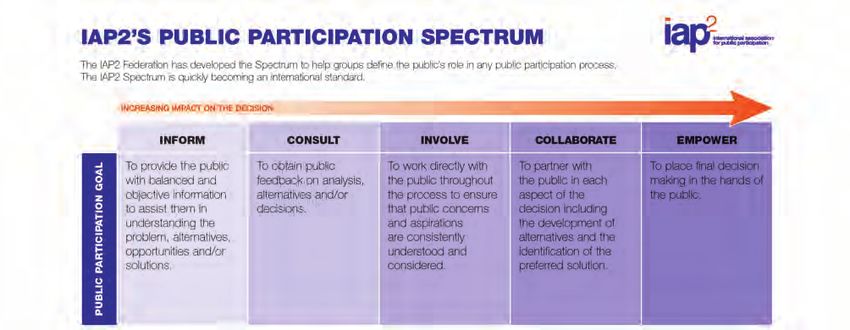
The assessment of the significance of proposals and The Council uses the International Association of
decisions, and the level of community engagement, Public Participation (IAP2) spectrum and decision-
will be considered in the early stages of a proposal orientation approach which indicates different
before decision making occurs and, if necessary, engagement approaches on a spectrum from providing
reconsidered as a proposal develops. The aim is to information through to community empowerment.
engage early so that the decision-making process is
well informed by those impacted by any decision.
The IAP2 Spectrum allows for different levels of As well as consulting on certain decisions we will seek
engagement depending on the decision; it does not to establish ongoing relationships with our
intend for all of the levels of engagement captured on communities to provide opportunities for matters to
the spectrum to be applied. be raised which are not currently under consultation.
We may do this in a variety of ways such as having a
How does the Council engage? presence at markets and public spaces, through our
The Council actively seeks to improve opportunities ongoing conversation channels, front line staff,
for engagement and ensure that final decisions take workshops and community events. The following is a
into account or have regard to the views of the list of channels the Council uses to have conversations
community and those affected by the decision. The with the community:
Council will monitor and report on how public input
• Facebook
has influenced decisions. The Council works with
communities on a number of levels including as • Annual plans
customers, stakeholders, citizens, ratepayers, subject • Twitter
matter experts and partners. It views engagement as a
genuine dialogue with its diverse communities to help • Reception
Council make better decisions. Council has working • Committee meetings
relationships with groups including:
• Festivals
• mana whenua, iwi and Māori organisations
• Forums
• community and business organisations
• Libraries
• government and education sectors
• Long-term plans
• residents and ratepayers.
• Radio
The Mayor and Councillors have a responsibility to
• Website
ensure there is effective community engagement. The
Council’s Community Boards are also responsible for • Councillors
communicating with local communities to help inform
• Events
and communicate local communities’ views.172 WELLINGTON CITY COUNCIL | OUR 10-YEAR PLAN 2018–28 SIGNIFICANCE AND ENGAGEMENT POLICY
• � Research panels 5. Special Consultative Procedure (SCP)
• � Community boards The special consultative procedure requires the
Council to prepare a statement of proposal and make
• � Newspapers
this publically available (and make the summary or a
• � Surveys full proposal widely available). It must allow feedback
of at least 1 month. Council must ensure people are
• � Frontdesk
given an opportunity to present their views to Council
• � Community centres through spoken interaction (or using sign language).
In any engagement programme, the Council will The Council must use the special consultative
consider how to meet the needs of our communities in procedure for some plans and processes including:
respect of language, accessibility and cultural
• � adopting or amending a Long‐term Plan;
expectations. When the Council identifies a group that
it believes should be involved but which is less able to • � adopting, amending, or revoking bylaws of
participate due to capacity or skills required it may significant interest to or impact on the public (for all
provide assistance to enable the group to participate. other bylaw matters Council will consult following
the principles in section 82 of the LGA);
We will involve participants who can provide
information and expertise the Council may not • � adopting, amending or revoking a Local Alcohol
otherwise have access to. Policy; and
The Council will work with groups that represent a • � setting rates.
community or sector recognising that early
Unless already explicitly provided for in the Long-term
engagement can facilitate improved mutual
Plan, we will seek to amend the Long-term Plan using a
understanding between groups with different
special consultative procedure, when proposing to
aspirations and perspectives.
alter significantly the intended level of service
Engagement with Māori provision for any significant activity undertaken by or
on behalf of Council, including commencing or ceasing
The Council acknowledges the unique status of Māori
such an activity; and when transferring the ownership
and the wider Māori community and is committed to
or control of strategic assets, as listed in Part 11.
ensuring that it provides opportunities for Maori to
contribute to in the decision-making process. The In these circumstances the Council will develop
Council is committed to providing relevant information that meets the requirements of section
information to inform Māori contribution and improve 82A of the Act, making this available to the public,
Māori access to the Council’s engagement and allowing submissions for a period of at least 1 month,
decision-making processes, as set out in section 81 of and will consider all submissions prior to making
the Act. decisions.
The Council will work with the city’s two mana 6. Principles of consultation
whenua iwi, the Port Nicholson Block Settlement Trust
When carrying out consultation, Council will follow
and Te Rūnanga o Toa Rangatira Incorporated, to
these principles of consultation (from section 82 of the
ensure their contributions are represented and their
Act)
status is publicly recognised. Council recognises that
early engagement with iwi is often the most effective - a) � identify people who will or may be affected by, or
in particular for those decisions which have greater have an interest in, the decision;
significance.
b) �provide them with reasonable access to relevant
The Council affirms its obligations to involving Māori information in an appropriate format on the process
in decision-making processes as set down in the Act, and scope of the decision;
which includes recognition of the Treaty of Waitangi.
c) � encourage people to give their views;
4. �Policy review d) �give people a reasonable opportunity to present
The Council will review the Significance and their views in an appropriate way;
Engagement Policy every three years or as required.
e) � listen to, and consider those views, with an open
This will be amended and confirmed through public
mind; and
consultation if necessary, separately or as part of the
Long-term Plan. f) � after the decision, provide access to the decision
and any other relevant material.SIGNIFICANCE AND ENGAGEMENT POLICY WELLINGTON CITY COUNCIL | OUR 10-YEAR PLAN 2018–28 173
Where the Act requires Council to consult on a Group or Whole-of-Asset Approach
particular draft policy or decision, Council will prepare
The Council takes a group or whole-of-asset approach9
and make available:
i.e. it means the group assets as a whole and not each
• � a description of what it intends to do, and why; individual asset within the group. Without limiting the
application of this provision to other assets, the
• � an analysis of the practical options (with
following examples of the application of this policy to
advantages and disadvantages); and
group assets are given:
• � a draft of the policy or relevant document (or details
• � “Water supply network assets” means those group
of the changes to any policy or document).
assets as a whole and not each individual pipeline,
7. Strategic assets reservoir, and pump station. The Council does not
consider that the addition or deletion of parts of
The Act requires that any decision that significantly
that group asset (being a part of the group asset as a
alters the level of service provided by the Council of a
whole) will affect the overall group asset’s strategic
significant activity (including a decision to commence
nature.
or cease such an activity) or transfers ownership or
control of a strategic asset to or from the Council must • � “Roading assets” and “reserve assets” mean those
be explicitly provided for in the Long-term Plan and group assets as a whole. Therefore, if the Council
can only be consulted on in the Long-term Plan, in acquires land for a new road (or the formed road
accordance with section 93E of the Act8. itself) or new reserve lands as a result of
subdivision, those additions are part of the day-to-
Legal framework Strategic assets are defined in section 5
day business of managing the roading and reserves
of the Act as: “...an asset or group of assets that the local
assets.
authority needs to retain if the local authority is to
maintain the local authority's capacity to achieve or • � Decisions that involve the transfer of ownership or
promote any outcome that the local authority control of an element of a group strategic asset
determines to be important to the current or future well- where the remaining assets of the group still enable
being of the community; and includes: the Council to meet its strategic outcome will not
on their own be regarded as a strategic asset.
a) � any asset or group of assets listed in accordance with
Examples include:
section 76AA(3) by the local authority; and
• � decisions to facilitate the development of the
b) �any land or building owned by the local authority
waterfront in accordance with the Waterfront
and required to maintain the local authority's
Framework (April 2001) or other similar policy
capacity to provide affordable housing as part of its
for the waterfront
social policy; and
• � disposal of former roads, provided that the
c) � any equity securities held by the local authority in:
Council has followed the road stopping
I. � a port company within the meaning of the Port processes under the Public Works Act 1981
Companies Act 1988:
• � disposal of individual reserves, provided that the
II. �an airport company within the meaning of the Council has followed the procedures in the
Airport Authorities Act 1966.” Reserves Act 1977 or the Local Government Act
Section 76AA (3) of the Act requires that the Council 2002 for areas managed as reserve but not
“must list the assets considered by the local authority covered by the Reserves Act. The Wellington
to be strategic assets.” These assets are determined to Town Belt Act 2016 does not allow removal of
be important to achieving the Council’s community land from the Wellington Town Belt except
outcomes. In addition, assets or groups of assets are under the provisions of the Public Works Act
listed as strategic if the Council ownership or control is 1981.
essential to the long-term provision of the associated
service.
8 � Section 93E of the Local Government Act 2002 covers the additional content of consultation documents for adoption or amendment of a
Long-term Plan where section 97 applies to proposed decision.
9 � Does not apply to equity securities in Wellington International Airport Limited174 WELLINGTON CITY COUNCIL | OUR 10-YEAR PLAN 2018–28 SIGNIFICANCE AND ENGAGEMENT POLICY
8. Schedule of Strategic Assets
Assets the Council owns that are strategic assets • � the core data set used to deliver Council services
under section 5 of the Local Government Act 2002:
• � the Council’s brand, Absolutely Positively
• � equity securities in Wellington International Airport Wellington - Me Heke ki Pōneke
Limited10
• � Wellington Zoo
• � the public rental housing held by the Council to
• � the assets of Zealandia – the Karori Sanctuary Trust
maintain affordable housing
that are owned by the Council
Assets the Council has determined to be strategic
• � Kiwi Point quarry
assets:
• � Southern Landfill.
• � the sewage collection, treatment and disposal
system, including the sewer network, pump
stations and treatment works
• � the land drainage system, including the stormwater
pipe network, waterways, and retention areas.
• � the water supply system, including reservoirs,
pump stations and reticulation
• � the roading network, including the public transport
infrastructure system and pedestrian networks
• � the shareholding in Wellington Cable Car Limited
• � the library service
• � swimming pool facilities
• � the ASB Sports Centre and network of recreation
centres
• � community centres
• � waterfront land and assets held on trust by
Wellington Waterfront Limited for the Council
• � all of the land and buildings in the area within the
Civic Square Heritage Area, as defined in the Design
Guide in the District Plan (Volume 2 - Area 5)
• � the Wellington Town Hall
• � the Michael Fowler Centre
• � the buildings and collections of the Wellington
Museum, City Gallery, Colonial Cottage Museum,
Wellington Cable Car Museum and the Carter
Observatory
• � St James Theatre, Opera House, and the Embassy
Theatre
• � artwork and literature collections, including public
art and collections held by libraries
• � reserves lands, including the Wellington Town Belt,
land held under the Reserves Act and land used for
parks, cemeteries, gardens, sports fields and
recreational areas
10 The Council’s group or whole-of-asset approach does not apply to these assetsJ006570
You can also read


