Year 5 Home Learning - Delce Academy
←
→
Page content transcription
If your browser does not render page correctly, please read the page content below
Year 5 Home Learning
                                                                     Week beg 8th March 2021

Please find below our learning for this week. All of the videos for each lesson are
uploaded to Google Classroom each day. The tasks below are also uploaded onto
Google Classroom. Follow along with the videos, and then complete the tasks below.

Reading
Lesson 1

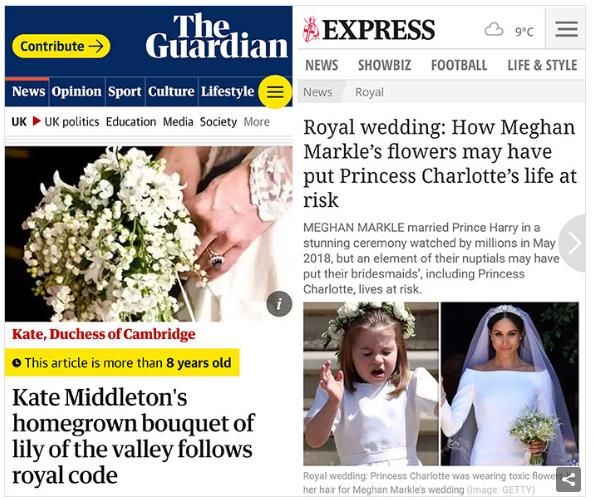
This week in Reading we will be looking at the impact and importance of newspaper
articles and the impact they have on the reader.

      Collaboration Matters Excellence in Everything Community First Equity for Everyone Continuous Growth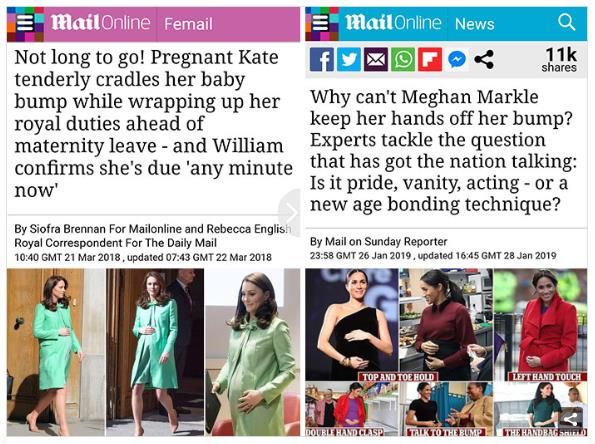
Collaboration Matters Excellence in Everything Community First Equity for Everyone Continuous Growth
Lesson 2

Continue reading this article and answer the questions on the selfie below.

       Collaboration Matters Excellence in Everything Community First Equity for Everyone Continuous Growth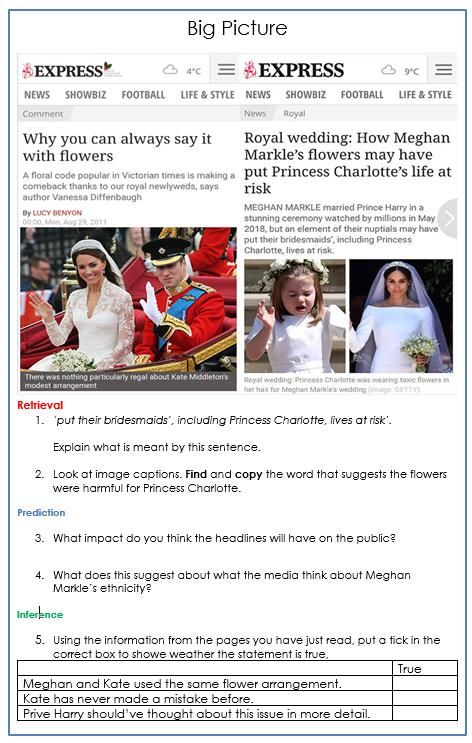
The sentence that has the highest impact is…………………………… because……………..

Lesson 3

   15 Headlines Show How Differently The British Press Treat
             Meghan Markle Vs Kate Middleton
Prince Harry and Meghan Markle, the Duke and Duchess of Sussex, shocked the public
when they announced on January 8 that they were leaving their position as senior
members of the royal family. One of the most notable changes they're making is to deny a
group of British press outlets first access to their personal press releases after years of press
coverage and editing decisions that they feel have been unfair and aimed to turn public
opinion against Meghan in particular.

Since the announcement, journalists unearthed some of the British media’s most snide and
judgmental headlines about Meghan and put them next to what the same outlets—
sometimes even the same authors—thought of similar situations when fellow Duchess Kate
Middleton was involved. Here are some of the things that British journalists only seemed to
think were wrong once Meghan did them.

       Collaboration Matters Excellence in Everything Community First Equity for Everyone Continuous Growth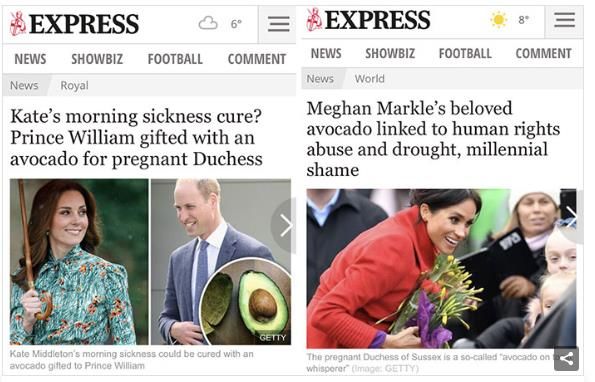
Kate: "Bumping along nicely! The Duchess was seen placing a protective hand on her
              tummy as she exited the event." Daily Mail: March 22, 2018
Meghan: "Personally, I find the cradling a bit like those signs in the back of cars: Baby on
Board. Virtue signaling, as though the rest of us barren harridans deserve to burn alive in
                             our cars." Daily Mail: Jan. 26, 2019

      Collaboration Matters Excellence in Everything Community First Equity for Everyone Continuous Growth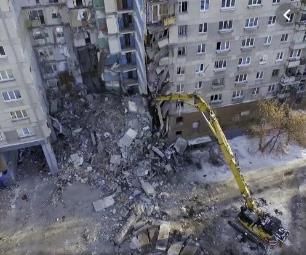
Using the sentence stems to support you, what inferences can you make about how the
                media view Megan Markle compared to Kate Middleton?
Lesson 4

Kate and William: "Prince William was given one of the green fruit – wrapped up in a bow
– by a little boy whose mother is suffering during her pregnancy too... 'He said he'd take it
 to [Kate] and see what happens – and said good luck for [the boy's] mummy.'' Express:
                                        Sept. 14, 2017

Meghan: "The pregnant Duchess of Sussex and so-called 'avocado on toast whisperer' is
wolfing down a fruit linked to water shortages, illegal deforestation and all round general
                    environmental devastation." Express: Jan. 23, 2019

      Collaboration Matters Excellence in Everything Community First Equity for Everyone Continuous Growth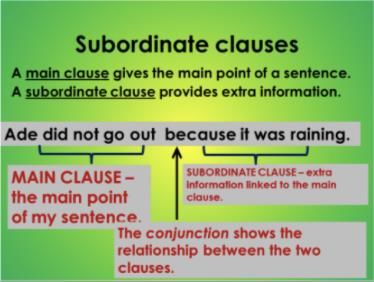
How                                                                           has
the media portrayed both Megan Markle and Kate Middleton? Do you think they have
been fairly treated? could there be a biased view towards Kate Middleton?

      Collaboration Matters Excellence in Everything Community First Equity for Everyone Continuous Growth
Lesson 5

Complete the LI below answering the questions from the text attached.

       Use the stems below to help answer the questions in the big picture above.

      Collaboration Matters Excellence in Everything Community First Equity for Everyone Continuous Growth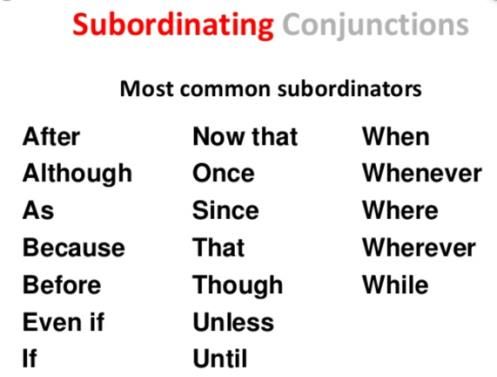
English
Lesson 1

Today we will be generating some exciting vocabulary to use in our newspaper report.
Newspapers normally use lots of rich vocabulary in their reports to make the story
descriptive for the reader.

Remember:

Nouns – these are naming words – ‘building, flowers, flat, Ade’
Adverbials – describe how, when and where an action takes place
Figurative language – descriptive language describing what could be seen/heard/smelt.
Noun phrases – using adjectives to describe the nouns ‘purple vines’
Remember to use a thesaurus to help you generate some rich vocabulary to use in your
writing.

LI: To generate suitable descriptive vocabulary

       Collaboration Matters Excellence in Everything Community First Equity for Everyone Continuous Growth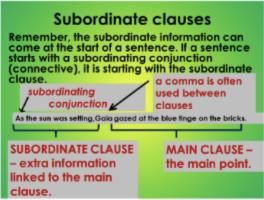
•   Use a range of visual and audible stimuli
•   Generate nouns and appropriate adjectives within noun phrases
•   Generate precise verbs to describe actions of the witnesses
•   Consider purposeful adverbials to describe where, how, when an
    action occurs
•   Use a thesaurus to improve your vocabulary choices
•   Consider the tone you are creating throughout your
    language choices
•   Use a thesaurus to extend your language awareness.

Task 1
Close your eyes and listen to this audio of a building falling. Imagine this was the tower block falling
under the might of the plants. Think about what you can hear.
https://www.youtube.com/watch?v=fRGEPVTrIMQ
Now add your vocabulary to the vocabulary grid below. An example has been done for you –
roaring thunder of a tumbling building.

Task 2
Now play the same clip again. This time we will have our eyes open. Think about what you can see.
Once you have watched the clip, describe everything you saw and add this to the vocabulary
grid. An example has been done for you – a tidal wave of smoke engulfed the stream of terrified
shoppers.

Task 3
Look at the images below. Think about how you can describe them. What do they look like? What
do you think they will smell like? How do you think they would feel? Add these words to the grid. – a
bold range of vibrant hues.

Task 4
Look at the images below. Think about how you can describe what you can see. These all
represent the aftermath of the buildings collapsing. What can you see? What do you think the
shoppers/passers-by can see? How do you think they would react to the building collapsing? Add
your ideas to the grid – remains stand haunting us.

        Collaboration Matters Excellence in Everything Community First Equity for Everyone Continuous Growth
Make sure you have filled out each box in the grid below.
Collaboration Matters Excellence in Everything Community First Equity for Everyone Continuous GrowthVocabulary grid
Purple vines
Roaring thunder of a tumbling Terrified shoppers
building Fearful residents
A tidal wave of smoke engulfed
the stream of terrified shoppers
A bold range of vibrant hues.
Remains stand haunting us.
At that moment,
Buildings
As soon as the building collapsed,
Flowers
Just then,
Vines
Residents
Lesson 2
Today we will be looking at relative clauses. These are a specific type of subordinate
clause which is used to adapt, describe and modify a noun. They are introduced using
relative pronouns – that, which, who, whose, where, when.
Click on the link to learn more about relative clauses.
https://www.bbc.co.uk/bitesize/topics/zwwp8mn/articles/zsrt4qt
We will be using the vocabulary we generated yesterday to create sentences using
relative clauses.
Collaboration Matters Excellence in Everything Community First Equity for Everyone Continuous GrowthLI: To include additional information for precision
◻ Create a main clause with a subject e.g. a person, building, flower
◻ Identify the subject within the clause and decide upon appropriate
relative pronoun (e.g. person – ‘who, which, whose’, place/thing
‘which, that’
◻ Provide suitable additional information within a relative clause
(between two commas)
◻ Include appropriate formal vocabulary
Task 1
Using your knowledge of relative pronouns and the vocabulary you generated yesterday, create
your own sentences using relative pronouns and relate clauses. One has been done for you.
Main clause Relative pronoun and relative Main clause
Subject eg. flower, building, clause
witness
described how crowds stood
Ade, who was a witness at the scene , paralyzed in disbelief as the building
suddenly disappeared into a cloud
of its own making.
Task 2
Now use your adverbials to make add detail to the sentences you have generated above.
Eg. It was reported by Ade, who was a witness at the scene, that crowds stood paralyzed in
disbelief as the building suddenly disappeared into a cloud of its own making.
What is the purpose of including relative clauses within your writing?
Relative clauses are purposeful because
___________________________________.
Collaboration Matters Excellence in Everything Community First Equity for Everyone Continuous GrowthLesson 3
Today we will be creating sentences using subordinate clauses.
A main clause is a sentence that makes sense on its own, e.g. John works hard at school.
If you want to add in more detail and information about where, when or why, you would
use a subordinate clause, e.g. John works hard at school when the classroom is silent.
Subordinate clauses always add extra information and are introduced with subordinating
conjunctions. They can also go at the start of a sentence but must be followed by a
comma when this is the case, e.g. when the classroom is silent, John works hard at school.
Some subordinating conjunctions are: because, when, after, so, until.
Click on the following link to find out more about main and subordinate clauses:
https://www.bbc.co.uk/bitesize/articles/zgds6g8
LI: to use main and subordinate clauses.
• Join a main clause with a subordinate clause using a conjunction.
• Use commas between clauses.
• Explain the meaning of a main and subordinate clause.
Use the subordinating conjunctions to write four sentences
assocoiated to The Boy in the Tower. Ensure you choose a
different conjunction within each sentence.
1. One of your sentences must have the subordinate
clause at the beginning of the sentence.
2. One of your subordinate clauses needs to be embedded within the main clause.
3. One of your clauses can be in the middle of a sentence.
4. Choose to place your subordinate clause in either of the positions above for your
fourth sentence.
Collaboration Matters Excellence in Everything Community First Equity for Everyone Continuous GrowthReflection:
Explain why it is important to use complex sentences within our writing.
What is the impact on the reader?
Lesson 4
Today we will be writing a ‘witness statement’ for our newspaper report. We will be using
the vocabulary we generated in Lesson 1 and the sentences we made using relative and
subordinate clauses. Think back to last week when we learnt about formal and informal
tone and language as this will be useful in our writing today.
A witness statement is a record stating what a person saw and heard when a particular
incident occurred. In this case the witnesses will be retelling what they heard and saw
when the tower blocks collapsed.
You will be writing a ‘witness statement’ from the viewpoint of one of the characters.
Remember if you are writing from the viewpoint of Ade, you will be writing informally as he
is a child. If you chose to write from the view point of a professional (e.g. police officer)
you will write in a formal tone.
Remember to include relative clauses and subordinate clauses. You must also include
what happened, how it happened, what you saw, heard, smelt and how it made you
feel (5 senses). Use the vocabulary from Lesson 1 to help you with this.
Collaboration Matters Excellence in Everything Community First Equity for Everyone Continuous GrowthLI: To recall events in the form of a witness statement.
• Include relevant information using the 5 senses
• Recall key events
• Maintain a formal tone to report key events if witness is a professional
(e.g. police officer)
• Maintain an informal tone to report key events if witness is a child (e.g.
Ade)
• Maintain past tense to recount events
• Use subordinate and relative clauses to include detail
• Select vocabulary for effect
Choose a character from the text and write a witness statement about the events that took
place the day the tower block collapsed.
Remember to use all of the exciting vocabulary we have generated as well as relative and
subordinate clauses. Write in past tense and think about the tone and language you will
use. Use the model below to help you.
e.g. ‘As I was walking my dog, I began to hear panic in the distance. The air began to fill with a thick,
grey smog. I was confused as I could not understand what was going on. I stopped walking just
outside the park and that is when I saw hordes of terrified shoppers screaming and running towards
the park. It was scary! Before I could turn around and run with them, the ground began to shake and
I saw the tower block sway. It was then that I felt sick and knew it was time to get out of there! I
turned and ran but it was too late. All we could hear was a loud crash and boom, I turned around
and that was it. One minute it was standing, next minute it was on the floor, in a million shattered
pieces. It was awful, like something out of a nightmare!’
Lesson 5
Today we will be looking over the witness statement we wrote yesterday and editing/up
levelling it. Use the checklist on the LI to ensure you have included all points in your writing.
You will then need to think about how the character would say their statement. We will be
listening to some of the witness statements, so be ready to read yours out!
LI: To edit and effectively up level a witness statement.
Collaboration Matters Excellence in Everything Community First Equity for Everyone Continuous Growth• Check and edit any spelling errors
• Ensure that the correct tine has been maintained throughout.
• Check and edit any grammar errors
• Maintain past tense to recount events
• Use subordinate and relative clauses to include detail
Use the following check list to edit/up level your writing from yesterday.
Capital letters for start of sentences/proper
nouns
Full stops at the end of sentences
Correct punctuation
Relative clauses using relative pronouns
Subordinate clauses using subordinating
conjunctions
Verbs in past tense
Adverbs and adverbials
Recalled key events using the 5 senses
How do you want the reader to feel when they read your witness statement? Why?
•I have tried to make the reader feel…using…
•When the reader reads…they should feel…because…
Maths
Lesson 1
Today we will be focusing on our outcome lesson for multiplication. We will be using all the
skills we have learnt to multiply decimals in a real life context.
Using this takeaway menu answer the multiplication questions on your learning intention.
Collaboration Matters Excellence in Everything Community First Equity for Everyone Continuous GrowthCollaboration Matters Excellence in Everything Community First Equity for Everyone Continuous Growth
Lesson 2

      Collaboration Matters Excellence in Everything Community First Equity for Everyone Continuous Growth
Lesson 3
Collaboration Matters Excellence in Everything Community First Equity for Everyone Continuous GrowthLesson 4
Collaboration Matters Excellence in Everything Community First Equity for Everyone Continuous GrowthLesson 5
Collaboration Matters Excellence in Everything Community First Equity for Everyone Continuous GrowthRE
Collaboration Matters Excellence in Everything Community First Equity for Everyone Continuous GrowthThis week in RE we will be identifying the importance of the crucifixion on Jesus’ purpose.
We will also look at how this links to the religious festival of Easter.
Why was Jesus crucified?
Easter celebrates the resurrection of Jesus from the dead, three days after he was
executed on the cross. This is called the crucifixion. The Easter story is at the heart of
Christianity. After Jesus was crucified on the Friday (now known as Good Friday), his body
was taken down from the cross, and buried in a cave tomb. The tomb was guarded by
Roman Soldiers and an enormous stone was put over the entrance, so that no-one could
steal the body.
On the Sunday, Mary Magdalene, followed later by some of Jesus' disciples visited the
tomb and found that the stone had been moved, and that Jesus' body had gone. Jesus
himself was seen that day by Mary and the disciples, and for forty days afterwards by
many people. His followers realised that God had raised Jesus from the dead. Christians
call this the Resurrection.
Jesus was crucified because he said there was only one God, and that he was the
anointed one. Jesus performed miracles which proved his divinity. He also said he was
King of the Jews - such a claim would have been considered treasonous, being a direct
challenge to the Roman authorities.
Click this link to learn more about the crucifixion and resurrection of Jesus:
https://www.youtube.com/watch?v=KlOnxUpvQAs
LI: To identify the impact of the crucifixion on Jesus’ purpose.
Collaboration Matters Excellence in Everything Community First Equity for Everyone Continuous GrowthUnderstand the religious aspect of Easter for Christians
Identify the factors that led to Jesus’ crucifixion.
Explain how humanity can learn from Jesus’ sacrifice.
Key vocabulary:
Jesus sacrificed crucified sins forgiveness resurrected ascended
Describe what Christians believe happened at Easter and why it is important using the key
vocabulary.
Christians believe that...
Jesus died for...
Jesus was crucified. This means…
After he died...
This was important because...
Can you think of something you could sacrifce and explain how that would help
others?
For example: computer games, favourite pair of trainers or toy.
Do you think it was necessary for Jesus to be crucified in order for humanity to learn a
lesson? Why do you think this?
I think that…
In my opinion…
Jesus did need to be crucified…
Jesus should not have been crucified…
Art
This week in art we will be using our digital skills to edit photos. We will experiment with
turning colour photos in to black and white as well as changing the brightness and
contrast on the photos to see the effect this has on shadows.
Use the video your teacher uploads on to Google Classroom to help you with this lesson.
LI: To experiment with digitally editing photos
Collaboration Matters Excellence in Everything Community First Equity for Everyone Continuous Growth● Use digital skills to experiment with editing photos.
● Investigate how to turn colour photos to black and
white
● Experiment with brightness and contrast
Task 1
Use Google to search for an image of tower blocks/ blocks of flats/ any other tall buildings.
Alternatively you could go outside and take your own picture of a tall building.
Task 2
Next, visit the following link to edit your photo – https://www.photopea.com/
On this site you can edit the photo and turn it black and white as well as change the brightness
and contrast.
Watch the video your teacher uploads on to Google Classroom to help you with this.
Task 3
How does manipulating a photo first help with understanding where the shadows are?
I think that…
Manipulating a photo first can help with understanding where the shadows are because…
I know this because…
Science
This week in science we will be identifying and describing the phases of the moon.
Click the link below to watch a video explaining the different phases of the moon and
why it does not just disappear during the day. Use this and the diagram below to help you
with your learning for today.
https://www.youtube.com/watch?v=f4ZHdzl6ZWg&ab_channel=FreeSchool#
Collaboration Matters Excellence in Everything Community First Equity for Everyone Continuous GrowthLI: To identify and describe the phases of the moon.
• Consider the amount of moon that can be seen.
• Label each moon phase.
• Explain why we see certain parts of the moon at different
times.
Key vocabulary:
Gibbous Crescent Waxing Waning Full Moon New Moon
Collaboration Matters Excellence in Everything Community First Equity for Everyone Continuous GrowthDraw each phase of the moon, in order and label each phase using the key
vocabulary to support you.
Explain why the moon appears to change shape and why we only see certain parts
of the moon at different times.
The moon appears to change shape because…
I know this because…
We only see certain parts of the moon at different times because…
Reflection:
Miss Lakha says, “My friend lives on the opposite side of the world
so she will see the same phase of the moon as me.”
Agree, challenge or build from this statement. Explain your reasoning.
PE
Over the next few weeks you will be pretending to be a fitness instructor who is creating
an exercise circuit for children at home. You will build the circuit up each week,
sometimes using household items.
Collaboration Matters Excellence in Everything Community First Equity for Everyone Continuous GrowthLI: To create an exercise circuit at home using items from
my house
https://www.youtube.com/watch?v=PYNbM9N7alI
You can scan the QR code for a fun, at
home workout using everyday
household items or you can watch the
video for inspiration and be creative!
We want to see your ideas too ☺
Gluteal Stretch Tricep Stretch
Hip and Thigh
Stretch
Calf Stretch Lunge
Warm up
Start with a warm up:
This term in PE you are going to be building a circuit at home, adding in new
exercises each week. Every week there will be new exercises to add. Below are two
more exercises for you to add to the circuit you have been building.
Exercise 1 – High knees
How can you incorporate high knees
into your circuit? How long will you do
this exercise for?
Exercise 2 – Press ups
Collaboration Matters Excellence in Everything Community First Equity for Everyone Continuous GrowthHow can you incorporate press ups in your
circuit? How many will you do in your circuit?
*Remember you can put your knees on the floor
if you need to.
How many times will you complete the full circuit?
Curriculum - History
This week in our history learning we will be looking at campaign methods in
preparation for when make a campaign and sell our badges. We will be
looking at previous campaigns, evaluating their effectiveness and their
impact on society.
History
LI: To research campaign methods.
Explore campaigns through time
Identify the linguistic features that were used in these
campaigns
Evaluate the impact that these campaigns had
Key vocabulary:
Campaign methods slogan audience reader successful effective
What is a campaign?
A campaign is an organised course of action to achieve a goal. There have been
many campaigns in the past, which we will look at today.
Task 1
Each image below is a slogan taken from a campaign. For each slogan, annotate
around it with the key message of the campaign and any linguistic features you
notice. This means you should look at the language used and comment on how
effective it is. Use the following questions to help you with your annotations:
What linguistic (language) features do you notice?
Collaboration Matters Excellence in Everything Community First Equity for Everyone Continuous GrowthHow does this impact the audience?
What is the key message the audience will hear?
How were the protestors feeling? Why might that be?
Slogan 1
Slogan 2
Slogan 3
Slogan 4
Slogan 5
Task 2
Pick 2 slogans that you think are effective and have a good impact. Why do you
think it is a successful slogan? How does it make you as a reader feel? Why?
This slogan is successful because…
It makes the reader feel….
It’s engaging because ……
Collaboration Matters Excellence in Everything Community First Equity for Everyone Continuous GrowthReflection
What makes a successful campaign? Why do you think this? Explain
In my opinion…
A successful campaign needs…
There should be…
I think this because…
It is vital that…
Collaboration Matters Excellence in Everything Community First Equity for Everyone Continuous GrowthYou can also read


