Sixth Grade- Why do Some Birds Have Two Homes When we Have One? - Whose Breakfast isn't for the Birds? - How Can my Breakfast Help the Birds? ...
←
→
Page content transcription
If your browser does not render page correctly, please read the page content below
Sixth Grade

 — Why do Some Birds Have Two
 		 Homes When we Have One?
 — Whose Breakfast isn't for the
		Birds?
 — How Can my Breakfast Help
		the Birds?
Lesson 1                                                                                                                   6

Why do Some Birds Have Two Homes
When we Have One?
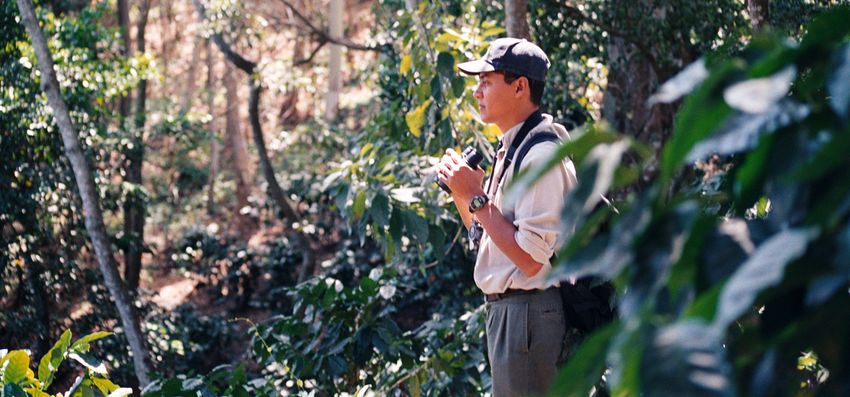
El Imposible National Park, El Salvador

Concept
  Many species of migratory birds have two homes: a temperate forest and a tropical rainforest.
  Their survival depends on the health of both forest systems. And the health of both forest sys-
  tems depends on the survival of migrating birds.

Essential Question
  Why do some birds need two homes, thousands of miles apart, when we only need one?

Introduction

Objectives
 1. Students will research different physical and be-
     havioral characteristics of birds and create theo-
     ries about their migratory behavior.

 2.   Students will research the natural histories of dif-
      ferent migratory birds and create diagrams de-
      scribing the bird's annual cycles of behavior.

 3.   Students will carry out a variety of mathematical
      calculations to understand the phenomena of bird
      migration.

Informational Introduction for the Teacher
  This lesson challenges students to explore the task
  of migration and understand how this important bird
  adaptation is related to temperate forest and tropical            ever experienced. Now imagine being outside in that
  rainforest ecology. By observing birds and sorting                weather every day for a week straight. These types of
  pictures, students' theories about migrations surface.            experiences are typical in the world of birds. Bird life
  These hypotheses are then tested as students form                 depends on their ability to move, find food and shelter
  new knowledge about forests and migrations. Students              and eventually mate. All of these behaviors are ulti-
  then explore the enormity of the task of migration by             mately linked to the forest in which they reside. In this
  using mathematics. Last, students research a select               lesson we'll discover how birds survive and how the
  bird and demonstrate their understanding of forest                forest helps them.
  ecology and bird migration by designing a creative
  diagram of a year in the life of a migratory bird.
                                                                   Step 1: Connect (the concept to prior knowledge)
Informational Introduction for the Students
  Consider the greatest distance you've ever walked in             Challenge
  one day. Were you tired? Imagine if your life depended             Students observe birds in nature and examine pictures
  on you walking that far for every day for a week                  of birds, then compare their own theories to experts'
  straight. Consider the coldest day of winter you've               theories on patterns of migration. Students consider

                     www.rainforest-alliance.org/curricula   -2-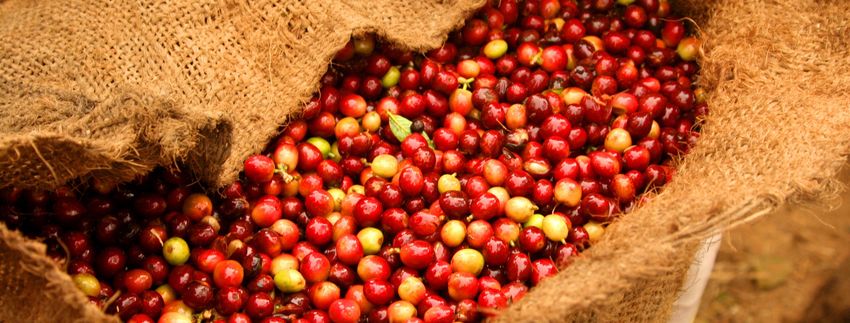
Lesson 1                                                                                                                      6

Why do Some Birds Have Two Homes
When we Have One?

 how migrating birds help sustain both temperate for-               •    Why do you think some species like chickadees
 ests and tropical rainforests.                                          live in below-freezing temperatures when snow is
                                                                         up to our hips and other species like warblers fly
                                                                         2,000 miles to live in a warm, rainy, luscious forest
Materials                                                                during the winter?
 •   photocopied pictures of overwintering and Neotro-              •    Why would a bird living in a tropical rainforest,
     pical migrant birds (one set per students)                          with plenty of shelter, refuge, food and resources,
        — overwintering birds                                            abandon its warm winter home at the onset of
            •   black-capped chickadee                                   spring, and risk the trials and tribulations of flying
            • American raven                                             2,000 miles north in order to raise a family, only to
            •   white-breasted nuthatch                                  fly back six months later?
            •   blue jay                                            •    Do you think warblers (and the other migrants) re-
            •   pileated woodpecker                                      ally require two homes? Or are these just affluent
            •   great horned owl                                         birds indulging in more than they need? What do
        — Neotropical migratory birds (the Neotropics                    the warblers have that the chickadees don't?
        include Mexico, Central America, South Ameri-               •    How do you think migrating birds can help sustain
        ca and the Caribbean)                                            both temperate forests and tropical rainforests?
            •   ruby-throated hummingbird
            •   turkey vulture
            • American robin                                       Step 2: Literature/Discuss (give expert information
            •   red-eyed vireo                                     book; ask questions)
            •   yellow warbler
            •   wood thrush                                        Challenge
                                                                     Students work with partners to research how experts
Procedure                                                           answer the questions posed in Step 1. After sharing
 1. Have the class observe birds at a feeder near the               and discussing their findings, students are challenged
     classroom or somewhere on the school grounds.                  to interpret a list of true or false statements.
     Ask students to make observations about each
     bird in order to determine whether each bird                  Materials
     migrates during winter months or spends winter in              •   sorted bird pictures from Step 1
     temperate forests.                                             •   research materials
                                                                    •  True/False statements
 2.   Have students work with a partner. Give each
      pair of students a set of bird pictures. Challenge           Procedure
      students to use their prior knowledge and obser-              1. Ask students to work together to make any correc-
      vations of the birds at the feeder to separate the                tions to their initial sorting based on the discus-
      pictures into two categories: (1) birds that live in              sion in Step 1.
      their area year round and (2) birds that migrate
      somewhere else during part of the year.                       2.   Students use field guides, birding books and Inter-
                                                                         net sources to research answers to the questions
  3. After sorting the bird pictures, have students dis-                 in Step 1. After finding answers, students make
     cuss their ideas about the following questions. Ask                 additional changes to their original sorting.
     them to share their theories for the entire class to
     discuss. Discussion questions:                                 3.   Challenge students to take the True or False quiz.
 •   What physical characteristics, if any, influenced                   Tell them that the answers will be revealed after-
     your decision to sort the birds into their respec-                  wards, and the quiz is intended to offer experts’
     tive categories?                                                    insights into bird migration.
 •   What behavioral characteristics, if any, influenced
     your decision to sort the birds into their respec-
     tive categories?

                     www.rainforest-alliance.org/curricula   -3-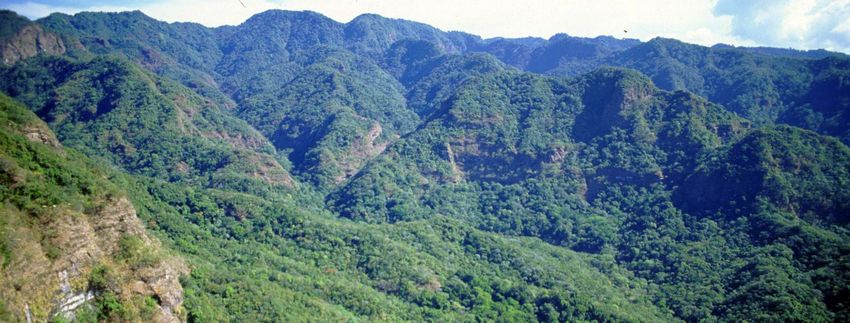
Lesson 1                                                                                                                   6

Why do Some Birds Have Two Homes
When we Have One?

True or False?                                                     4.    After taking the quiz, engage students in a discus-
•   Most birds that live in the northeastern United                      sion about the statements. Encourage students to
    States do not migrate. (False. Approximately 520                     explore their disagreements to expose the reason-
    of the 650 bird species that inhabit North America                   ing behind each of the class opinions.
    migrate)
•  There is much less food for birds to eat in temper-              5.   Reveal the correct answers and engage students in
    ate forests in winter. (True. Due to the cold weather                follow-up discussion about any confusing points.
    and snow, many food sources are inaccessible or
    have been eaten, forcing the birds to migrate)                 Internet resources: “Do penguins migrate?” (www.adelie.
•   Most non-migrating species depend on humans                    pwp.blueyonder.co.uk/FAQs/migrate.htm)
    to survive the winters in the northeastern United
    States temperate forest. (False. Most birds survive
    without the assistance of humans)                             Step 3A: Practice (math and learning centers)
•   Birds leave the rainforest in spring and migrate
    north because it gets too hot for them there. (False.         Challenge
   Birds migrate north to establish breeding sites, mate            Students make calculations to fully appreciate the
    and raise their young)                                         phenomena of bird migration.
•   Migration is a movement from temperate forests
    to tropical forests. (False. Some birds spend winter          Materials
    in temperate areas and migrate north to the Arctic             •   mathematical problems
   Circle to take advantage of the abundance of life               •   world atlas
    brought on by 24 hours of sunlight in the summer
    months)                                                       Procedure
•   Penguins migrate. (False. Penguins move periodi-                Challenge students to work individually on the prob-
    cally throughout each day after breeding season, but            lems listed below:
    they do not migrate)                                           •   How much energy do you spend coming to school
•   Some birds migrate as far as 22,000 miles in one                   each day?
   year! (True. Arctic terns make the longest migration                    — Calculate how many miles your school bus
    of any animal on Earth. Each year, they fly from the                    travels and multiply that number by the current
   Arctic to the Antarctic and back)                                        rate of gasoline.
•   Migrations is an adaptation birds have for survival.                   — If you walk to school, calculate how far and
   (True)                                                                   multiply that by the calories spent walking
•   Humans used to migrate like birds before modern                         certain distances (any calorie counter will offer
    heating systems. (False. Human migration generally                      this estimation. Estimate how many calories
    has a different meaning from bird migration. Hu-                        you burn in one week walking to school).
    mans have moved from place to place for many rea-                      — Find out how many miles one of the migra-
    sons, regardless of modern heating systems. Many                        tory birds flies in one year of travel. Calculate
    humans inhabited the northern latitudes despite the                     how many calories it would take for you to walk
    cold without modern heating conveniences)                               that distance.
•   Birds help forests by scattering seeds and eating                      — Find out how many calories are in your
    insects that may harm trees. (True. Birds are im-                       favorite foods. If you walked the distance a bird
    portant in maintaining a healthy food web in tropical                   travels, how much of that food would you have
    rainforests)                                                            to eat in order to fuel your trip?
•   Birds help forests by providing food for other ani-                    — Find out your bird of choice's favorite food.
    mals that eat them and in turn help disperse seeds                      Guess how many insects/other food your bird
    as well as nourish the forest soil with nutrients                       would have to consume in order to fly that
   when they die. (True. Birds are important in main-                       distance.
    taining a healthy food web in tropical rainforests)

                   www.rainforest-alliance.org/curricula    -4-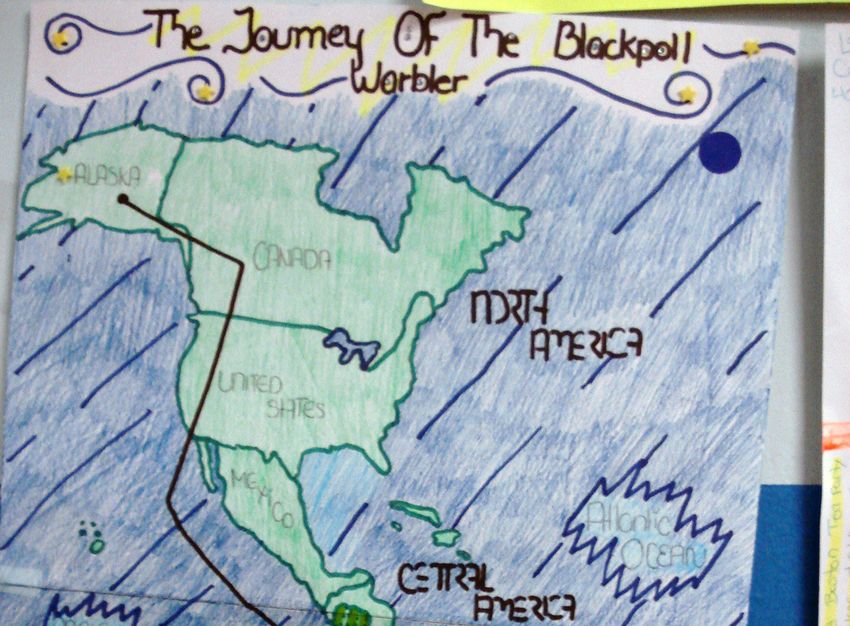
Lesson 1                                                                                                                      6

Why do Some Birds Have Two Homes
When we Have One?

Step 3B: Create (performance tasks related to                         4.   Using colored tape and index cards, students
standard indicators)                                                       translate their draft drawings onto the classroom
                                                                           floor. Each student's addition should highlight their
Challenge                                                                  bird's route to and from their temperate and tropi-
  Students choose a neotropical migrant species of inter-                  cal rainforest habitats. Encourage students to draw
 est, research its patterns of movement throughout                         symbols on index cards and tape them alongside
 the year and design a graphic representation of how it                    the route. The symbols should represent primary
  spends one year.                                                         activities at each of the birds' habitats and inter-
                                                                           mediate destinations. Specific dates of migrations
Materials                                                                  and a picture of their bird may also be helpful.
 •   black tape for outline of continents
 •   colored tape
 •   index cards                                                     Step 4: Present (edit work/students orally
 •   art supplies                                                    present projects)
 •   world atlas
 •   research materials (bird books, Internet)                       Challenge
                                                                       Students present their projects to younger students.
Procedure                                                              Students are challenged to explain what they know
 1. Students choose neotropical migratory birds                       about bird migration by taking others on a full year
     which interest them and research the following                   migration of their selected species.
     aspects of the species' natural history: winter
     range, summer range, migration arrival/departure                Materials
     times (online at www.birdnature.com/timetable.                   •   migration chart on classroom floor
     html), migration distances and duration of migra-                •   students' draft drawing of their selected bird spe-
     tion, feather coloration throughout the seasons,                     cies
     bird calls and songs, food sources, description of
     habitats, how the forest provides food and shelter,             Procedure
     etc.                                                             1. Students take younger students on a simulated
                                                                          tour of their selected bird's year. Their descrip-
 2.   Students create a draft drawing of their bird's                     tion should include things like time of migration,
      year. Each drawing should include a map of the                      reasons for migration, distance, how the forests
      bird's migration patterns and symbols to represent                  supply what the birds need, how the migrants
      different behaviors. For example, when birds are                    supply the forest with what the forest needs, and
      in mating season, the symbol may be a bird with                     knowledge of where this bird might be at the pres-
      bright plumage calling a female with hearts in the                  ent moment.
      air to denote attraction of a mate. This draft will be
      translated onto the large diagram on the class-                 2. After the younger student completes the tour, ask
      room floor.                                                        him/her to take on the role of tour guide, and
                                                                         explain what he/she learned about bird migration
 3.   Using a world map as a guide, students draw                        and its relation to forests.
      outlines (using chalk, black tape, etc.) of North
      America, Central America, and South America on
      the classroom floor.

                     www.rainforest-alliance.org/curricula     -5-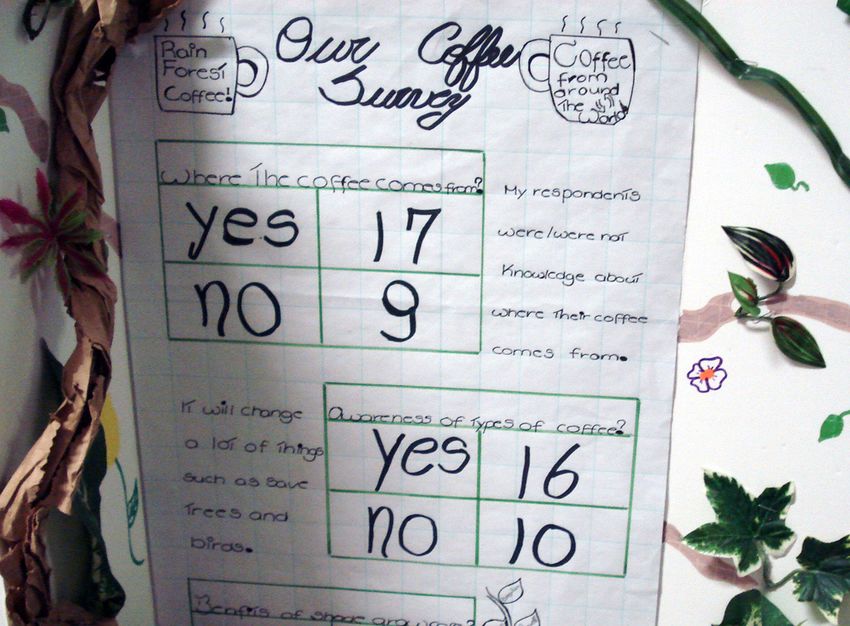
Lesson 1                                                                                          6

Assessment Rubric

Teacher observations of performance tasks with rubrics as listed below, as well as collected
work samples.

Assessment                                   3=P                       2=S            1 = NW
Guidelines                                (Proficient)            (Satisfactory)   (Needs Work)

Student works well with
partner to collect data.
Student is able to work
cooperatively to make de-
cisions about which birds
migrate.

Student makes appropri-
ate changes to sorted bird
groups based on class
discussion, researched
information, and the opin-
ions of others.

Student accurately repre-
sents the bird's behavioral
patterns using accurate
information and clear and
creative symbols.

Student is able to explain
clearly and accurately
the key aspects of the
bird's natural history and
explain how it is related
to temperate forests and
tropical rainforests.

                    www.rainforest-alliance.org/curricula   -6-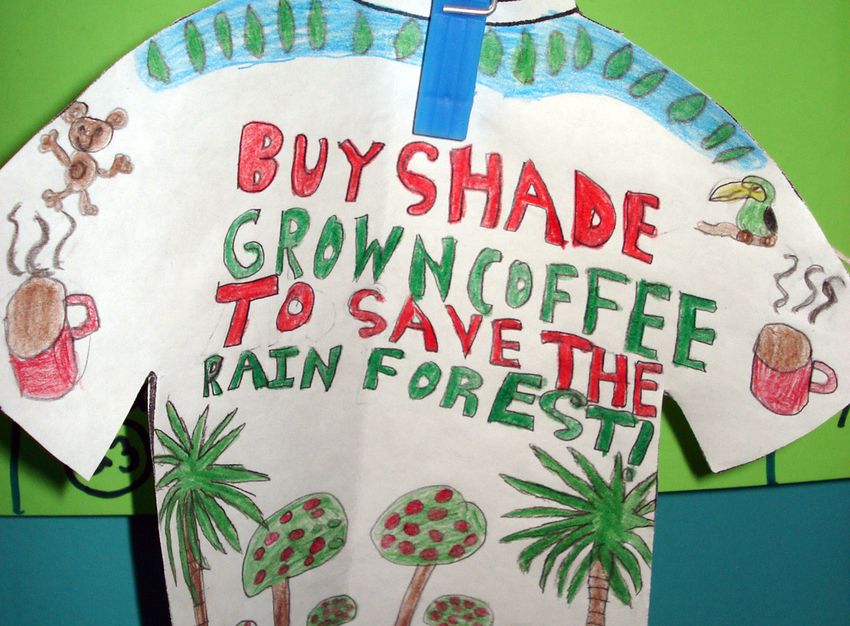
Lesson 2                                                                                                                    6

Whose Breakfast isn't for the Birds?
El Imposible National Park, El Salvador

Concept
  Coffee plants are grown in the same habitats required by many birds. Rainforests, temperate for-
  ests and the landscapes that link them must be carefully managed in order to ensure the survival
  of migratory birds.

Essential Question
  Whose breakfast isn't for the birds?

Introduction

Objectives
 1. Students will create, administer and analyze a
     survey designed to ascertain respondents' under-
     standing of where coffee comes from and their
     preferred types of coffee.

 2.   Students will research natural histories of different
      coffee types.

 3.   Students will compare migratory bird habitat with
      locations of coffee farming.

 4.   Students will write and send a letter to a coffee
      drinker illustrating the connection between their
      coffee, tropical forests and bird habitat.

Informational Introduction for the Teacher                           we will find out what people know about where their
  In this lesson, students generate first-hand knowledge             morning cup comes from and research how coffee is
  about the types of coffee preferred by members of                  connected to rainforests and migratory bird popula-
  their school community. They use survey data as a                  tions. Finally, we will offer them expert information on
  springboard for examining coffee production and its                their drink of choice so that they might become more
  relation to birds. Students consider the amount of cof-            aware of some of the impacts of drinking coffee, and
  fee consumed in the United States, where it is grown,              know what they can do to preserve bird habitat.
  range of rainforests in the tropics and locations of bird
  migration routes. Finally, students write letters to cof-
  fee correspondents illustrating the connection of their           Step 1: Connect (the concept to prior knowledge)
  favorite coffee type with birds and rainforests.
                                                                    Challenge
Informational Introduction for the Students                           Students develop, disseminate and analyze a survey
  The United States is the world's largest consumer of               on the particular types of coffee preferred by their
  coffee. More than half of the United States population             teachers, school staff, and parents.
  drinks coffee daily. Where does this coffee come from?
  Where is the nearest coffee farm? What does it have               Materials
  to do with birds? By surveying some coffee drinkers,               •   paper, writing utensils

                     www.rainforest-alliance.org/curricula    -7-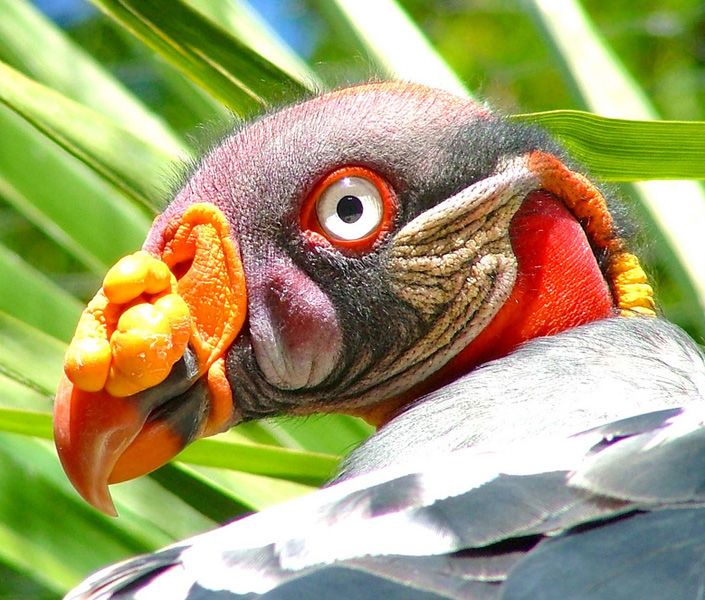
Lesson 2                                                                                                                   6

Whose Breakfast isn't for the Birds?

Procedure                                                          4.   Ask students which survey they think will be most
 1. Tell students they will be creating a survey for cof-               effective in finding the information they desire.
     fee drinkers to determine their knowledge of the
     drink and which types of coffee teachers, school              5.   Have students develop a list of questions to in-
     staff and parents prefer.                                          clude in the survey.

 2.   Lead students in a discussion of the possible ques-          6. Assist students in designing the survey.
      tions to investigate through the survey. Brain-
      storm possibilities. Some questions to pursue may            7.   After students survey teachers, staff and parents,
      include:                                                          compile the data.
 •    What are the most popular types of coffee?
 •    Do coffee drinkers know where their coffee comes             8. Ask students to generate a list of most popular cof-
      from?                                                           fee types.
 •    Are coffee drinkers aware of the different types of
      coffee (sun coffee and shade-grown)?                         9.   Engage students in a follow-up discussion about
 •    Do coffee drinkers know the benefits of shade-                    their survey. Ask questions:
      grown coffee?                                                •    How knowledgeable were the respondents about
                                                                        where their coffee comes from?
 3.   Offer students a variety of survey techniques.               •    How might informing people about the origins of
      Some examples are listed below.                                   coffee and the effects on the environment change
 •    open-ended                                                        things?
         — What country does your coffee come from?                •    Do you think it's important that people know
         — How does growing coffee affect the environ-                  where their coffee comes from?
          ment?                                                    •    Why or why not?
         — Where does most coffee come from?
 •    Likert scale: 1 = well informed, 2 = somewhat in-
      formed, 3 = little knowledge, 4 = don't know at all         Step 2: Literature/Discuss (give expert information
         — How knowledgeable are you about where                  book; ask questions)
          your coffee comes from?
         — How knowledgeable are you about the differ-            Challenge
          ent varieties of coffee?                                  Students research the history of coffee grown in one
         — How knowledgeable are you about shade-                  of the Latin American coffees preferred by one of their
          grown coffee?                                             survey respondents. They will use this information
 •    fixed answers: check the space next to all of the            during Step 4 to write and send a letter to this person
      words that describe the coffee you drink                     regarding the implications of their coffee preference
         — Costa Rican                                             on the lives of migratory birds.
         — Colombian
         — Brazilian                                              Materials
         — Kenyan                                                  •   survey results from Step 1
         — Kona                                                    •   world atlas
         — Indonesian                                              •   Rainforest Alliance supporting materials
         — Indian                                                  •   computers with Internet access
         — shade-grown
         — sun coffee                                             Procedure
         — flavored                                                1. Challenge students to use one of their survey
         — organic                                                     respondent's answers and research the natural
         — other (please specify: ____________)                        history of this type of coffee. Have students focus
 •    true/false                                                       on the Latin American coffee types. For example,
         — Coffee grows best in areas near the equator.                if the respondent checked "Costa Rican" and "Sun
         — Shade-grown coffee techniques can help                      Coffee," challenge the student to research the
          migratory birds.                                             Costa Rican rainforest areas, the specifics of coffee
                                                                       beans from Costa Rica (flavor, aroma, etc.), coffee

                    www.rainforest-alliance.org/curricula   -8-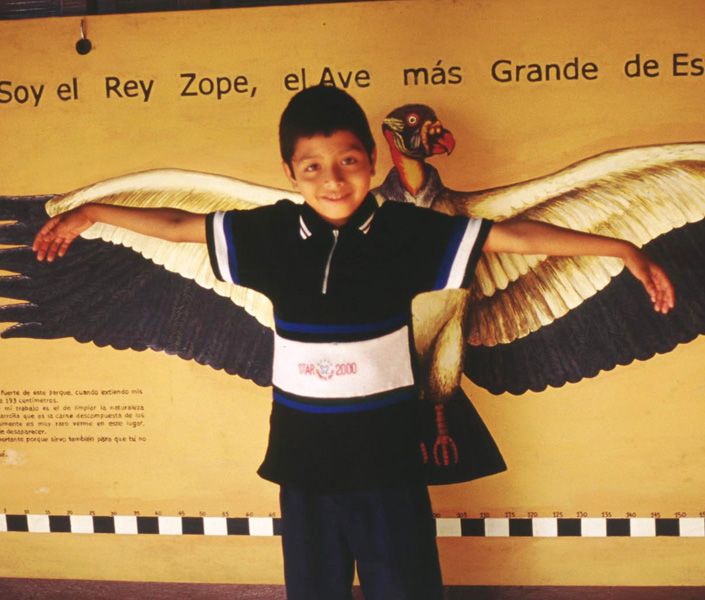
Lesson 2                                                                                                                       6

Whose Breakfast isn't for the Birds?

      farming in Costa Rica, and the possible environ-              Step 3B: Create (performance tasks related to
      mental impacts of sun coffee farming.                         standard indicators)

 2.   Have students compile their data. Tell students               Challenge
      they will be using their research later in the lesson           Students draw a map of North, Central and South
      when they will write a letter to survey respondents            America and illustrate the relationship between coffee
      about their favorite coffee.                                   production, coffee consumption and bird migration.

 Internet resources: Rainforest Alliance Certified Mar-
 ketplace (www.rainforest-alliance.org/find-certified),             Materials
 Northwest Shade Coffee Campaign (shadecoffee.org/                   •   world maps for each student, with countries out-
 shadecoffee), British Coffee Association (www.british-                  lined
 coffeeassociation.org)                                              •   colored pencils
                                                                     •   world atlas for reference
                                                                     •   field guides of North American birds
Step 3A: Practice (math and learning centers)                        •   rainforest poster (available in the Resource Index)

Challenge                                                           Procedure
 Through a series of guided calculations, students                   1. Hand out several world atlas references.
 develop a sense of survey respondent knowledge of
 coffee, how much coffee is grown in rainforests, and                2.   Challenge students to draw a large map of North,
 the impact of coffee farming techniques on migratory                     Central and South America, including outlines of
 birds.                                                                   countries

Materials                                                            3.   On their respective maps, challenge students to
 •   paper, writing utensils                                              identify the following. Have them use color to il-
                                                                          lustrate rainforest range and countries.
Procedure                                                            •    countries containing rainforest
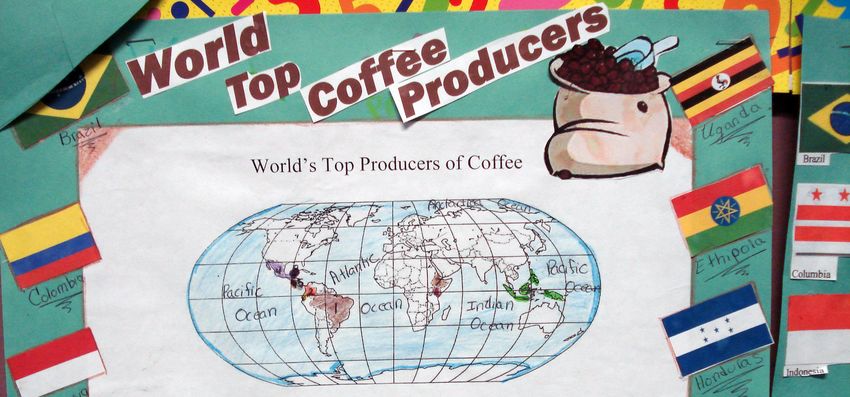
  Challenge students to complete the calculations and                •    countries exporting coffee
  answer the related questions:                                      •    major bird migration routes of a common North
 •   One acre of rainforest land can produce about                        American migratory bird
     1,000 pounds of shade-grown coffee in a year. If the
     United States imports 2.5 million pounds of cof-                4.   Challenge students to discuss the meaning of their
     fee in a year, how many acres of rainforest land is                  maps. Ask the following questions:
     needed?                                                         •    How does your map illustrate a connection be-
 •   The average American drinks 3.4 cups of coffee per                   tween coffee production and migratory birds?
     day. If half of the United States population drinks             •    Who might find this information valuable?
     this amount, how many cups does that equal?                     •    Why?
     If half of the world's population drank the same
     amount, how many cups would that equal (US and
     world population available at www.census.gov/                  Step 4: Present (edit work/students orally
     main/www/popclock.html)                                        present projects)
 •   How many acres of rainforest would be needed to
     satisfy the world's coffee consumption if half of the          Challenge
     people on earth drank 3.4 cups per day?                         Each student selects one teacher, school staff member
 •   Create a graph illustrating some aspect of the class            or parent to write and send a letter to highlighting the
     survey data. Use one of the following formats: Pie              complex connection between coffee production, con-
     chart of the most popular coffee types chosen,                   sumption, migratory birds and the health of temperate
     bar graph of the amount of knowledge people said                and tropical rainforests.
     they had about their coffee, chart depicting which
     countries are most preferred for their coffee beans.

                     www.rainforest-alliance.org/curricula    -9-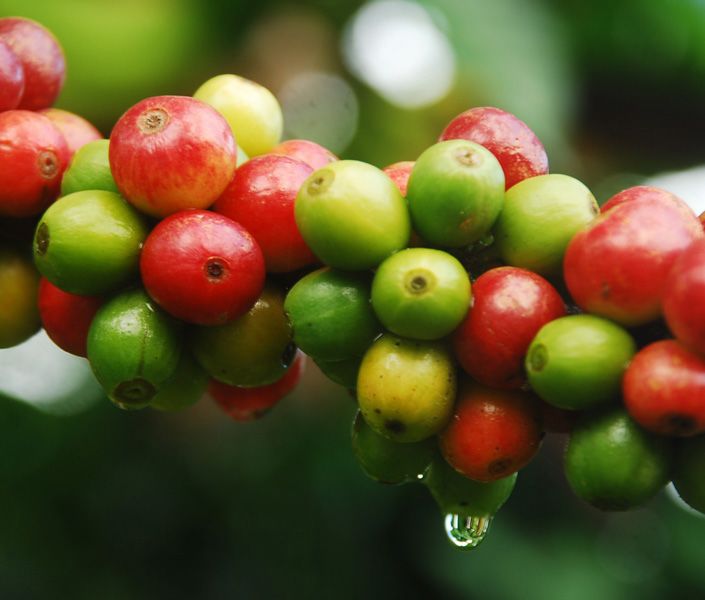
Lesson 2                                                           6

Whose Breakfast isn't for the Birds?

Materials
 •   map from Step 3B
 •   calculations from step 3A

Procedure
 1. Tell students that they will be writing a letter to
     their survey respondent in order to inform them
     about their choice of coffee and how it is related
     to migratory bird winter range, rainforests and
     temperate forests.

 2.   Challenge students to include the research discov-
      ered in Step 2, the calculations determined in Step
      3A and the map created in Step 3B to explain the
      key connections for the coffee drinker receiving
      the letter.

                    www.rainforest-alliance.org/curricula   -10-
Lesson 2 6
Assessment Rubric
Teacher observations of performance tasks with rubrics as listed below, as well as collected
work samples.
Assessment 3=P 2=S 1 = NW
Guidelines (Proficient) (Satisfactory) (Needs Work)
Student is actively en-
gaged in the process of
brainstorming, designing
and writing the survey.
Student offers insights
and respects others' opin-
ions.
Student uses resources
effectively in compiling
information about cof-
fee types. Student asks
relevant questions and
follows through in the
process of seeking an-
swers.
Student creates map in
Step 3B that is accurate,
to scale and effectively
depicts the categories
described. Student uses
resources effectively to
find necessary informa-
tion.
Student describes accu-
rately and clearly the con-
nection between coffee
consumption, bird migra-
tion, and coffee farming in
rainforest areas in letter
to survey respondent. Let-
ter is neat, professional
and engaging.
www.rainforest-alliance.org/curricula -11-Lesson 3 6
How Can my Breakfast Help the Birds?
El Imposible National Park, El Salvador
Concept
Our food choices may have an impact on rainforests. Sun-grown coffee farming destroys essen-
tial bird habitat in rainforest areas.
Essential Question
How can my breakfast help the birds?
Introduction
Objectives
1. Students will rank several pictures of farms based
on conservation of bird habitat.
2. Students will research sustainable coffee farming
techniques with conservation of bird habitat in
mind.
3. Students will design two farms with sustainability
of bird habitats in mind.
4. Students will send their farm designs to the Rain-
forest Alliance and the local agricultural coopera-
tive for comment.
Informational Introduction for the Teacher
This lesson guides students in an exploration of of coffee farming and compare them to what we know
sustainable agriculture and its relation to bird habitat. about agriculture in the United States. Our investiga-
First, students rank pictures of corn and coffee farms tion will include research of different farm types and
according to bird habitat conservation. Next, students designing the ideal coffee farm. Our designs will be
research different coffee farming techniques and their sent to experts in the field for review.
relation to bird habitat. Students design and create
maps of ideal farms to maximize both crop production
and bird habitat conservation. Finally, students send Step 1: Connect (the concept to prior knowledge)
farm designs to the Rainforest Alliance and the local
agricultural cooperative for review. Challenge
Students work in small groups to rank pictures of 10
Informational Introduction for the Students different coffee and corn farms according to what they
Go to any diner for breakfast and the first thing you think is in the best interest of a variety of birds.
hear from the waiter or waitress is “Would you like
coffee this morning?” Coffee is the second most traded Materials
commodity in the world. The beans are typically • pictures of farms (one set for each group), avail-
grown in areas of tropical rainforest. This form of able at www.rainforest-alliance.org/pictures/shade-
agriculture can be damaging to migratory bird habitat. coffee
In this lesson, we will investigate the different types
www.rainforest-alliance.org/curricula -12-Lesson 3 6
How Can my Breakfast Help the Birds?
Procedure 4. When all changes have been made, ask groups to
1. Divide class into groups of three or four. compare their rankings. If discrepancies arise, ask
students to explain their ideas on which farm is
2. Hand out a group of pictures to each group. better for birds.
3. Challenge students to rank the pictures according
to what they think is best for birds. For example, Step 3A: Practice (math and learning centers)
they might begin by finding the farm with the most
trees or the farm they think could support the Challenge
most diverse and abundant bird life. Students carry out a number of mathematical calcu-
lations designed to illustrate the impact of various
4. When students have completed their ranking, ask agricultural practices on bird populations.
them to explain why they chose to rank the farms .
the way they did. Materials
• paper, writing utensils
Step 2: Literature/Discuss (give expert information Procedure
book; ask questions) Challenge students to complete the calculations and
answer the related questions:
Challenge • Shade-grown coffee farms are typically home to
Students read about shade-grown coffee and sustain- 2/3rds of the normal bird life in a tropical rainfor-
able corn farming techniques and review a number of est. Sun coffee farms are typically home to 1/15th
pictures depicting these farms. Students use this infor- of the normal bird life in a tropical rainforest. If 225
mation to reevaluate the pictures they've ranked. They bird species are typically found in an undisturbed
then interpret the advantages of a shade-grown coffee rainforest, how many different types of birds
farm over sun coffee and conventional over sustain- would you expect to find in a shade-grown coffee
able farming techniques. farm?
• Using the same ratios from question 1, how many
Materials different types of birds would you expect to find in
• ranked pictures of farms from Step 1 a sun coffee farm?
• computer with Internet access • How might this information be useful in conserva-
tion of bird habitat in tropical rainforests?
Procedure • How about temperate forests?
1. Tell students they will be investigating different
types of coffee farms in order to reevaluate their
ranking. Their goal is to compare their interpreta- Step 3B: Create (performance tasks related to
tions to the information at a number of Web-links standard indicators)
about shade-grown coffee and other sustainable
agriculture techniques. Challenge
Students design two farms with sustainability of bird
2. Guide students to the Web sites listed below: habitats in mind. One farm is a corn farm in the east-
• Bird-Friendly Farming: A Win-Win Conservation ern United States and the other is a coffee farm in El
Solution (www.aaes.auburn.edu/comm/pubs/ Salvador.
highlightsonline/fall98/birds.html)
• EarthEasy: Shade-Grown Coffee (eartheasy.com/ Materials
eat_shadegrown_coffee.htm) • construction paper
• Northwest Shade Coffee Campaign: Why Shade • art supplies
Coffee? (www.shadecoffee.org/shadecoffee) • world atlas
• pictures of farms
3. After students research the different farm types,
invite them to make any changes to their rankings. Procedure
1. Challenge students to design two farms with
www.rainforest-alliance.org/curricula -13-Lesson 3 6
How Can my Breakfast Help the Birds?
sustainability of bird habitat in mind. One is a corn Materials
farm in the eastern United States and the other is • farm designs from step 3B
a coffee farm in El Salvador. The goal of each ideal
farm is to be able to grow crops and protect birds. Procedure
Tell students they will draw maps of their farms 1. Tell students they will be sending their farm de-
and send them to organizations for comment. signs to the Rainforest Alliance (an organization
that works with farmers in Latin America to help
2. Suggest to students they begin by creating a list of them grow crops sustainably) and to the local agri-
goals and practices designed to meet these goals. cultural cooperative for comment on their sustain-
For example: Goal: Produce two varieties of coffee ability practices.
(Robusta and Arabica) while preserving bird food
sources (i.e., insects). Practice: Grow Robusta 2. Challenge students to compose a short letter of ex-
plants in most shaded areas (it requires less spe- planation to the Rainforest Alliance and agricultur-
cific conditions), Arabica in full sun and eliminate al cooperative describing their farm designs. The
pesticide use. Have students write these goals in a letter should include a description of the assign-
chart form to be included on the map of their farm. ment, specific areas that the student would like
comment on and any questions about agriculture,
3. After students have completed their goals, hand coffee and birds that they would like answered.
out two large (11" x 14") pieces of paper and art
supplies. Challenge students to create the ideal
farm that will meet the goals they've created.
Step 4: Present (edit work/students orally
present projects)
Challenge
Students send their farm designs to the Rainforest
Alliance and/or the local agricultural cooperative for
comment on their sustainability practices.
www.rainforest-alliance.org/curricula -14-Lesson 3 6
Assessment Rubric
Teacher observations of performance tasks with rubrics as listed below, as well as collected
work samples.
Assessment 3=P 2=S 1 = NW
Guidelines (Proficient) (Satisfactory) (Needs Work)
While ranking farm
photos, student shows
enthusiasm, works well
with the group, respects
others' opinions, asks
good questions, uses prior
knowledge when consid-
ering pictures and offers
insights when appropriate.
Student uses resources
provided to rework the
ranking of pictures.
Student identifies con-
nections between farm
technique and its effects
on bird habitats.
Student's goals and cor-
responding practices are
logical and supported by
the research performed in
previous steps. Student's
goals and practices dem-
onstrate knowledge of dif-
ferent farming techniques
and their connection to
bird habitat.
Maps of ideal farms are
creative, visually engag-
ing and include a chart
listing goals and corre-
sponding procedure. Farm
designs clearly illustrate
knowledge of sustainable
farming techniques and
the relationship to bird
habitat.
www.rainforest-alliance.org/curricula -15-Sixth Grade Supplementary Materials — Teacher Summary — Resources — National Standards
Teacher Summary                                                                                                                6

El Salvador has the highest population density (260                 of Central America. El Imposible represents the only
people per square kilometer) and the lowest percent-                viable forests within El Salvador, and thus is a crucial
age of intact primary forest (about two percent) in all of          component of the Corridor.
Latin America. Much of the country is intensely farmed,
even the steepest slopes, making them susceptible to                El Imposible is characterized by middle elevation tropi-
landslides and flooding. El Salvador, like much of Central          cal montane forest. At its highest elevations, El Imposi-
America, was ravaged by civil conflict for most of the              ble has small remnants of cloudforest—the misty forests
70s and 80s. These conflicts stemmed in part from an                that are home to sloths, ocelots, orchids and bromeliads,
intense need for land among the many landless peas-                 among others. The park stretches down into the valleys,
ants. Most recently, the already hard-hit communities of            encompassing many spectacular waterfalls and rivers,
northern El Salvador were struck by major earthquakes,              where the forest changes over to lush rainforests replete
destroying much of the little infrastructure the area had.          with toucans, macaws, anteaters, capuchin monkeys,
                                                                    snakes and dozens of other birds species. Gone are the
Of the few remaining natural areas in El Salvador, El Im-           large mammals that could once be found in El Salvador's
posible (The Impossible) National Park has the greatest             forests—jaguars, tapirs, pumas—which could no longer
diversity of species of plants and animals in the country.          take the continued reduction of habitat. El Salvador's
At least 400 species of plants and many spectacular ani-            forests are crucial habitat for the millions of migratory
mal species, such as the ocelot, great curassow, black-             songbirds that travel south from the U.S. and Canada
hawk eagle and crested guan are making their last stand             each winter in search of warmer temperatures and
in El Imposible.                                                    fresh food supplies. Many of “our” birds in the North-
                                                                    east travel to the coffee forests of Central America each
Traders from Guatemala used to travel through the                   year—more than 3,000 miles each way!
mountainous forests of El Salvador to reach the local
markets, carefully leading their mules through the steep            El Imposible National park, created by government de-
Impossible Pass, from which the park takes its name.                cree on March 16, 1989, includes a core protected area of
The park is one of the few existing examples of the typi-           8,818 acres. The core of the park is restricted to scientif-
cal Mesoamerican Pacific coastal rainforests. It is a ma-           ic research and recreational uses, in much the same way
jor source of air purification for the northwestern part of         that our national parks are used. When the park was cre-
the country and the source of eight major rivers, which             ated, it was drawn on top of existing private lands. The
supply drinking water to the entire region and feed im-             government has pledged to help the families who live
portant coastal mangroves. Additionally, the park is part           inside the park to relocate by buying their land at a fair
of the Mesoamerican Biologic Corridor, a major conser-              price. However, in the 12 years since the park was estab-
vation initiative to create a connected series of protected         lished, none of the families have received compensation.
areas between the U.S. and Colombia, running the length             Surrounding the core is a buffer zone of 5,449 acres that

                     www.rainforest-alliance.org/curricula    -2-
Teacher Summary 6
are intended to be used for limited farming, while prohib- posible. Coffee is a major cash crop throughout Central
iting deforestation, hunting, fishing and any new building America. But due to price fluctuations and the high costs
in the area. Families living within the buffer zone have of agrochemicals, many small farmers are unable to pro-
been a key part of SalvaNatura's plan for managing El vide for their families on their small parcel of land. SN
Imposible. Many of the more than 100,000 residents of and RA help farmers to improve their quality, production
the are living at or below the poverty level, desperate for and income, while decreasing their impact on the fragile
an opportunity to provide a better life for their children wildlife of El Imposible. As part of their effort to promote
and themselves. SalvaNatura has long recognized that sustainable livelihoods among the communities of El
they must work with these families to help them meet Imposible, SN promotes wise soil management, planting
their economic needs while respecting the aims of the fruit trees (great habitats for birds and a good source of
national park. nutrition for children), using living trees as fences and
fire wood nurseries (most residents still sue wood to
All of the land within the buffer zone is privately owned. cook and heat, taking wood from the forest), and orga-
SalvaNatura has been fundraising over the years to buy nizes community projects including school nurseries
available land to help families relocate. Thus far, with and latrines.
support from international donors (including the Rain-
forest Alliance), SalvaNatura has purchased more than In addition to their efforts to increase the size of the
1,200 acres. All of SalvaNatura's lands are adjacent to the park, SalvaNatura has concentrated much of its efforts
park and within the buffer zone previously described. in promoting eco-tourism in the buffer zone. Hiking, bird
These lands are managed under the same restrictions as watching and archaeological trips are organized by a
the rest of the park. Wildlife habitat is growing and natu- group of trained guides from the community. These
ral regeneration is taking place in degraded areas. Sal- guides, many of them former hunters or loggers, are now
vaNatura is able to enforce park regulations that foster able to make a living without destroying the forest. To
natural regeneration of wildlife habitat on its property help others in the communities around the park, SN has
and on lands that belong to the Salvadoran government. provided small loans to help start up a family-owned
However, it is a constant struggle to enforce regulations inn, local restaurant, natural medicine stall, handicraft
on private properties in the buffer zone. gift shop and three country stores. These businesses
improve the experiences of visitors to the park, by pro-
The hillsides of El Imposible are well-suited to low- viding the comforts one expects when traveling, while
impact agricultural practices and have been farmed in providing a livelihood to local families.
some fashion for hundreds of years. SalvaNatura (SN)
and the Rainforest Alliance (RA) have been working with Another important project being carried out by Salva-
these small farmers to develop guidelines for growing Natura is environmental education for local children.
environmentally-sustainable coffee in the hills of El Im- Local schoolchildren are benefiting from the creation of
www.rainforest-alliance.org/curricula -3-Teacher Summary 6
“Los Habitantes del Imposible,” (the Residents of El Im- lection of national postage stamps. All of these projects
posible) a program held in 40 local schools to promote are part of SalvaNatura's efforts to provide the commu-
pride among the residents. The materials teach children nities of El Imposible with viable economic alternatives,
about what a special place they live in, and encourage raising them out of desperate poverty, so that they will
careful stewardship of the land. SalvaNatura supports be able to contribute to the preservation of El Salvador's
132 literary circles in neighboring communities and has very possible national park.
published numerous stories and guides, including a col-
www.rainforest-alliance.org/curricula -4-Resources 6
1 2 3
Resource Index Rainforest Products
Check out this page for additional supplemental ma- Check out a summary of products found in our homes
terials that complement these dynamic units and to and supermarkets that either originated in tropical
access many of the resources listed below. forests or are currently produced there.
www.rainforest-alliance.org/curricula/resources www.rainforest-alliance.org/articles/tropical-forests-in-
our-daily-lives
Slideshow (1) www.rainforest-alliance.org/articles/7-everyday-foods-
The Curriculum site provides a slideshow and script from-the-rainforest
about El Salvador that includes background informa-
tion about the animals, people and landscape of this
region. The slideshow can be download for viewing Park Profiles
in the classroom, printed out and read as a story, or A basic introduction to El Imposible National Park.
viewed online with the students. www.rainforest-alliance.org/adopt-a-rainforest/el-
www.rainforest-alliance.org/pictures/el-salvador-kids salvador
Unit-Specific Story (2) Rainforest Poster
The Rainforest Alliance has developed two original Download and print out this colorful two-page poster,
stories for use with this unit, available in English, which is available for you to use in explaining the lay-
Spanish and Portuguese. The stories are available to ers of the rainforest, its products and the environmen-
download and print or can be viewed onscreen. tal threats facing many rainforests around the world.
• Alex Goes Exploring in El Imposible Inside the Canopy – structure and species of the
www.rainforest-alliance.org/pictures/alex-explores- rainforest
el-imposible www.rainforest-alliance.org/publications/inside-the-
• Life in San Miguelito rainforest-canopy
www.rainforest-alliance.org/pictures/life-in-san-
miguelito Conservation Coffee Summary
Access an eight-page introduction to the issue, includ-
Species Profiles (3) ing a glossary of terms. These are appropriate for
The species profiles include photos, habitat, foraging students to read independently.
behavior, group relationships, threats and many more www.rainforest-alliance.org/sites/default/files/
facts. uploads/pdfs/curricula/conservation-coffee.pdf
• ocelot
• great curassow Venn Diagram Template
• king vulture Download a photocopy-ready Venn diagram designed
• blue-crowned motmot to complement this unit.
www.rainforest-alliance.org/species www.rainforest-alliance.org/sites/default/files/
uploads/pdfs/curricula/venn-brazil.pdf
www.rainforest-alliance.org/curricula -5-Resources 6
Certificate of Accomplishment
Print out colorful rainforest certificates for your stu-
dents to commemorate their completion of these units.
www.rainforest-alliance.org/curricula/certificate-of-
participation
www.rainforest-alliance.org/curricula -6-National Standards for Sixth Grade Lessons 6
Visual Arts Mathematics
Standard 2 Standard 6
Level 3: Grade 5–8 Level 3: Grade 5–8
• Knows how to use structures (e.g., sensory quali- • Understands and applies basic and advanced con-
ties, organizational principles, expressive features) cepts of statistics and data analysis
and functions of art • Reads and interprets data in charts, tables, plots
• Knows how the qualities of structures and func- (e.g., stem-and-leaf, box-and-whiskers, scatter) and
tions of art are used to improve communication of graphs (e.g., bar, circle, line)
one's ideas • Organizes and displays data using tables, graphs
(e.g., line, circle, bar), frequency distributions and
plots (e.g., stem-and-leaf, box-and-whiskers, scat-
Geography ter)
Standard 2
Level 3: Grade 5–8 Thinking and Reasoning
• Knows the location of places, geographic features
and patterns of the environment Standard 6
• Knows the relative location of, size of and distance Level 3: Grade 5–8
between places (e.g., major urban centers in the • Applies decision-making techniques
United States) • Makes decisions based on the data obtained and
the criteria identified
Standard 3 • Secures factual information needed to evaluate
Level 3: Grade 5–8 alternatives
• Understands the characteristics and uses of spa-
tial organization of Earth's surface
• Understands how places are connected and how Environment and Society
these connections demonstrate interdependence
and accessibility (e.g., the role of changing trans- Standard 14
portation and communications technology, regions Level 3: Grade 5–8
and countries Americans depend on for imported • Understands how human actions modify the physi-
resources and manufactured goods) cal environment
• Understands the environmental consequences of
people changing the physical environment (e.g.,
Life Sciences the effects of ozone depletion, climate change, de-
forestation, land degradation, soil salinization and
Standard 6 acidification, ocean pollution, groundwater quality
Level 3: Grade 5–8 decline, using natural wetlands for recreational
• Understands relationships among organisms and and housing development)
their physical environment
• Knows factors that affect the number and types of
organisms an ecosystem can support (e.g., avail-
able resources; abiotic factors such as quantity
of light and water, range of temperatures and soil
composition; disease; competition from other or-
ganisms within the ecosystem; predation).
www.rainforest-alliance.org/curricula -7-You can also read


