Harper Creek High School Core Classes 2020-2021 Course Selection Book
←
→
Page content transcription
If your browser does not render page correctly, please read the page content below
Harper Creek High School
                          Core Classes

                            2020-2021
                       Course Selection Book
The Harper Creek Board of Education approved for the 2020-21 school year, all courses
listed in the course catalogs as traditional/seated courses to be adapted for the delivery in
a virtual format, as discussed and reviewed. July 13, 2020

                                             1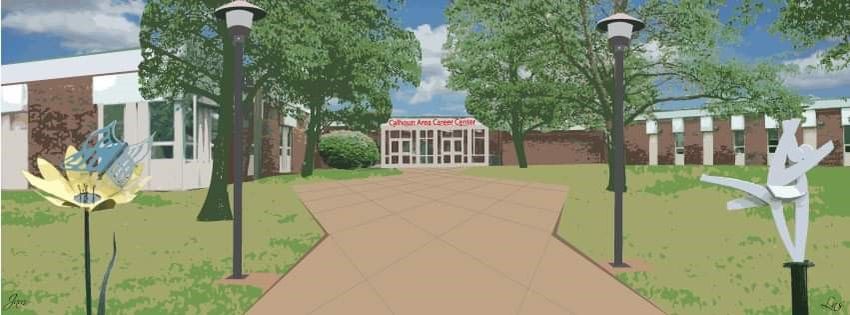
Table of Contents
High School Contacts 4
Letter from Principal, Dennis Anthony 5
Graduation Requirements 6
Certificate of Achievement 7
Grading Procedure /GPA 8
Class Schedule Worksheet 9
Career Pathways 10-11
Testing out Policy 12
Postsecondary Dual Enrollment 13
Online Blended Learning 14
Battle Creek Area Mathematics and Science Center 15
Calhoun Area Career Center 16
Academically Talented Youth Program/Michigan Seal of Biliteracy 17
Mission Statement 18
Language Arts 19
English l
English ll
English lll
Literature and Composition l
Literature and Composition ll
AP Literature and Composition
2
Table of Contents
Math 20-21
Algebra l
Algebra ll
Geometry
Math for Seniors
Pre-Calculus
Calculus l
AP Calculus
Statistics
Science 22
General Physical Science
General Biology
General Chemistry
Materials Chemistry
Physics
AP Biology
AP Chemistry
Social Studies 23
American History and Geography
Civics and Economics
World History and Geography
Senior Social Studies
AP U.S. History
AP United States Government and Politics
32020-2021 Course Selection Book
Harper Creek High School
12677 Beadle Lake Road
Battle Creek, Michigan 49014
Main Office: (269) 441-8450
Counseling Office: (269) 441-8417
High School Administration
Dennis Anthony, Principal Ed Greenman, Athletic Director
E-mail: AnthonyD@harpercreek.net E-mail: GreenmanE@harpercreek.net
Lisa Crawford, Assistant Principal
E-mail: CrawfordL@harpercreek.net
High School Guidance Staff
Megan Eickhoff, Counselor Kim Oaks, Counselor
E-mail: EickhoffM@harpercreek.net E-mail: OaksK@harpercreek.net
Lindsey Lovrenovic, Counselor Pam Schmanske, Secretary-Counselor’s Office
E-mail: LovrenovicL@harpercreek.net E-mail: SchmanskeP@harpercreek.net
4Students and Families:
The Harper Creek High School Core Course Description Guide offers a comprehensive listing of our school’s core course of-
ferings which have been designed as a varied and challenging academic curriculum. Careful planning and selection of cours-
es are important to the successful growth and achievement of academic goals throughout a student’s high school career.
All students will need to successfully meet the requirements for graduation listed hereafter. It is important for students to
develop a multi-year plan for their courses developed around, and consistent with, their Educational Development Plan
(EDP). This plan is first developed in middle school and should be reviewed and revised each year prior to selecting cours-
es.
Harper Creek High School’s primary goal is to provide our students with the skills and competencies needed to be success-
ful citizens and workers in a technological, multi-cultural and dynamic society. This goal can best be achieved through a col-
laborative partnership with students and families in rigorous pursuit of high levels of achievement. To do this, students
must pass courses in which they are enrolled so that all course options are available to them in each of the following years.
Families can support this need by monitoring that students are regularly attending all classes and completing assigned
tasks. Successful passing of courses leads to more elective options, including Advanced Placement (AP) courses, advanced
subject area courses, dual-enrollment, the Calhoun Area Career Center (CACC), the Battle Creek Area Mathematics and Sci-
ence Center (BCAMSC), and more.
The elective courses that are taught each year are ultimately determined by how many students sign up to take them dur-
ing the scheduling process. Due to staffing availability and class size limitations, it is essential that students select classes
they intend to attend and complete. There should be no expectations that students can “try out” a class and expect to
change it later.
Additionally, it is important for students and families to understand that a high school student cannot “drop” a class. Stu-
dents are expected to be enrolled and attending a full schedule each semester of each year. If a student does not like a
class or has lost the opportunity to earn credit in a class, it is the expectation that they are still required to attend and at-
tempt their best effort.
The high school staff encourages thoughtful selection of courses that meets not only current interests, but prepares stu-
dents for unknown opportunities and challenges in the future. While success in a rigorous high school curriculum cannot
guarantee future success, it will most certainly enable opportunities beyond high school and help prepare our students for
a future of their own choosing.
We look forward to the opportunity to partner with you in pursuit of your continued success, both individually and as a
member of our learning community.
Dennis Anthony
High School Principal
5Graduation Requirements
Regular Diploma
Normally, a student will complete graduation requirements in four (4) years. In order to receive a diploma and graduate, a
student will need to meet the school requirements for basic course work for their graduating class, and earn the total num-
ber of minimum credits. All seniors will be reclassified at the end of the first semester of their senior year.
A student enrolled in special education may be exempted from the State mandated-test. Such an exemption is made by the
IEP Team. The student may still need to earn the required credits indicated by the IEP or in a personal curriculum. For more
information about the different methods by which credits can be earned, refer to Policy 5460 in the Board Policy manual, a
copy of which is accessible electronically at www.harpercreek.net.
Additionally, students will qualify for a diploma when they:
▪meet the requirements for graduation through credits earned at HCHS in combination with those earned through the Battle
Creek Math and Science Center, CACC or early college, if enrolled in these programs.
▪Are in attendance full time at HCHS or enrolled in one of its combined programs.
▪Have successfully completed 20 hours of community service. A student may begin accruing hours at the completion of their
Junior year (June), not any earlier.
Subject Area
English 4 credits 2020 and after = 1 in last year
Social Studies 4 credits + 20 service hours
Science 3 credits
Math 4 credits 1 in last year
Physical Ed/Health (2 yrs Marching Band) 1 credit
Computers 1 credit
Fine Arts, Performing Arts, 1 credit
Vocational Education, Practical Arts
World Language Experience 2 credits
Electives 11 credits Class of 2020
13 credits Class of 2021 and after
Total Credits to Graduate 31 class of 2020.
33 Class of 2021 and after
Any exceptions to the above must be approved by the principal. All graduation requirements cited are the minimum that
will be accepted for eligibility for graduation. It is anticipated that most students will exceed these minimums.
6Certificate of Achievement
Certificate of Achievement
Any student who has an IEP at the completion of his or her 12th grade year may receive a Certificate of Achievement in lieu
of a diploma for successfully attending Harper Creek High School. While the criteria for earning the Certificate of Achieve-
ment are determined by the IEP, in consultation with teachers and parents, the following guidelines will apply:
English Language Arts 2-4 credits
Mathematics 2-4 credits
Science 2-3 credits
Social Studies 2-3 credits
Health & Physical Education 1 credit
Visual, Performing or Applied Arts 1 credit
World Language 0 credits
“On-line Learning Experience” 1 credit
Career Prep/Employability 1 credit
7Grading Procedure/GPA
Grades
Harper Creek High School has a standard grading procedure, as well as additional notations that may indicate work in pro-
gress or incomplete work. The purpose of a grade is to indicate the extent to which the student has acquired the necessary
learning. In general, students are assigned grades based upon test results, homework, projects, and classroom participa-
tion. Each teacher may place a different emphasis on these areas in determining a grade and will so inform the students at
the beginning of the course work. If a student is not sure how his/her grade will be determined, s/he should ask the teach-
er.
The school uses the following grading system:
A Outstanding 90%-100%
B Above Average 80%-89%
C Average 70%-79%
D Below Average 60%-69%
E Failing 0%-59%
I Incomplete
Advanced Placement courses* are given the following additional weight provided students complete an AP course and AP
exam. Students who complete Battle Creek Math & Science Center courses listed below, will also receive an extra grade
point.
A = 5.0
B = 4.0
C = 3.0
D = 2.0
E=0
*This does not include AP support classes.
Battle Creek Math & Science Center courses approved for 5.0 scale are:
Analytical Chemistry
Biotechnology 1 and 2
Organic Chemistry
Multivariate Calculus
Grade Point Average
To calculate a grade point average (GPA), assign a weighted point value to each course grade and divide by the total number
of credits. For partial-credit courses use the fractional value of the grade. For example, a half credit course with an earned
grade of C would be .5 x 2=1. Then add this to the other grades earned for total points earned. This total is then divided by
the total credits earned for the GPA. This can be done by grading period, semester, year, or for a series of school years.
8To make your course selections for the next school year, select from the list of courses for which you qualify and those that align
with your career pathway. Every student must be enrolled in five classes each semester. When making selections, pay attention
to prerequisites and be sure to select enough classes to fill your school day for five blocks each semester. Most courses fill one
block so you would choose ten classes to fill your schedule. Starting with the class of 2020, all students must have an English credit
during their senior year. Classes at the Calhoun Area Career Center and the Battle Creek Area Math and Science Center are equiv-
alent to four blocks per school year. Begin by selecting your required courses and then fill in your electives.
9th Grade 10th Grade
English: English I __ English:_English II________________________________
Math: Algebra I __ Math: Geometry________________________________
Science: Physical Science _________ Science: General Biology__________________________
Soc Studies: American History/Geography Soc Studies__Civics/Econ___________________________
P.E.: Physical Education/Health OR Swim/Health Elective:_________________________________________
Elective:_________________________________________ Elective:_________________________________________
Elective:______________________________________ ___ Elective:_________________________________________
Elective:______________________________________ ___ Elective:_________________________________________
Modified Block (40 Minute): _________________________ Modified Block (40 Minute): ________________________
Modified Block (40 Minute): _________________________ Modified Block (40 Minute): ________________________
11th Grade 12th Grade
English: English III /Lit & Comp I English: __English IV/Lit & Comp II ____________________
Math: Algebra II ___ Math: Senior Math ________________________________
Science: Physics or Chemistry or Material Chemistry _ Soc Studies: Senior Social Studies ____________________
Social Studies: World History/Geography Elective: ________________________________________
Elective: _____________________________________ Elective: ________________________________________
Elective: _____________________________________ Elective:_________________________________________
Elective:______________________________________ Elective:_________________________________________
Elective:______________________________________ Elective: _________________________________________
Modified Block (40 Minute): _________________________ Modified Block (40 Minute): ________________________
Modified Block (40 Minute): _________________________ Modified Block (40 Minute): ________________________
9What are the Six Career Paths? Might this Career Path be for you?
Arts and Communication:
Careers in this path are related to humanities and Are you a creative thinker? Are you imaginative, innovative and original? Do
performing, visual, literacy and media arts. These you like to communicate ideas? Do you like making crafts, drawing, playing a
include architecture, graphic, interior, and fashion musical instrument, taking photos or writing stories? This may be the career
design, writing, film, fine arts, journalism, languages, path for you!
media, advertising, and public relations.
Business, Management, Marketing and Technology:
Careers in this path are related to the business envi- Do you enjoy being a leader, organizing people, planning activities, and talk-
ronment. These include entrepreneurships, sales. ing? Do you like to work with numbers or ideas? Do you enjoy carrying
Marketing, computer/information systems, finance, through with an idea and seeing the end product? Do you like things neat
accounting, personnel, economics, and manage- and orderly? Would you enjoy balancing a checkbook, following the stock
ment. market, holding an office in a club, or surfing the Internet? This may be the
career path for you!
Engineering/Manufacturing and Industrial Technology:
Careers in this path are related to technologies neces- Are you mechanically inclined and practical? Do you like reading diagrams
sary to design, develop, install, and maintain physical and blueprints, and drawing building structures? Are you curious about how
systems. These include engineering, manufacturing, things work? Would you enjoy painting a house, repairing cars, wiring elec-
construction, service and related technologies. trical circuits, or woodworking? This may be the career path for you!
Health Sciences:
Careers in this path are related to the promotion of Do you like to care for people or animals who are sick or help them stay
health and treatments of disease. These include well? Are you interested in diseases and in how the body works? Do you
research, prevention, treatment and related health enjoy reading about science and medicine? Would it be fun to learn first aid
technologies. or volunteer at a hospital or veterinary clinic? This may be the career path
for you!
Human Services:
Careers in this path are related to economic , politi- Are you friendly, open, understanding, and cooperative? Do you like to work
cal, and social systems. These include education, with people to solve problems? Is it important to you to do something that
government, law and law enforcement, leisure, and makes things better for other people? Do you like to help friends with family
recreation, military, religion, child chare, social ser- problems? Do you like reading, storytelling, traveling, or tutoring young chil-
vices, and personal services. dren? This may be the career path for you!
Natural Resources and Agriscience:
Careers in this path are related to agriculture, environ- Are you a nature lover? Are you practical; curious about the physical world;
ment and nautral resources. These include agricultural interested in plants and animals? Do you enjoy hunting or fishing? Do you
sciences, earth sciences, environmental sciences, fish- like to garden or mow the lawn? Are you interested in the environment?
eries, forestry, horticulture and wildlife. This may be the career path for you!
10Career Categories Courses in School Sample Careers
Arts and Communication:
Journalism Language Arts Public Relations Executive
Advertising Public Relations
Dancer
Creative Writing Film Production Photography Communications
Film Producer
Foreign Languages Journalism Art Marketing
Fashion Designer
Radio and TV Broadcasting Music Journalist
Radio and TV Broadcaster
Business, Management, Marketing and
Technology:
Math Loan Officer Economist
Legal Secretary Hotel Manager
Accounting Office Admin. Language Arts
Office Manager Salesperson
Entrepreneurship Economics Computer science
Computer Programmer
Management Marketing General Business Travel Agent
Sales Finance Marketing
Computer Support Accounting
Engineering/Manufacturing and Indus-
trial Technology:
Architect Plumber
Architecture Precision Production Physical Science Robotics
Electrician Geographer
Construction Drafting Physics Engineering
Air Traffic Controller Auto Mechanic
Manufacturing Technology Math Chemical Engineer Draftsman
Mechanics and Repair Engineering Design Surveyor
Engineering Architectural Design
Health Sciences:
Language Arts Math Dentist Dental Hygienist
Dentistry
Doctor Nurse
Medicine Science Physics
Respiratory Therapist
Nursing Chemistry Nutrition
Physical Therapist
Nutrition and Fitness Anatomy and Physiology
Therapy and Rehabilitation
Human Services:
History Chef Teacher
Education
Lawyer Police Detective
Child and Family Services Language Arts
Social Worker
Law and Legal Studies Psychology
Firefighter
Law Enforcement Culinary Arts Cosmetologist
Cosmetologist Parenting
Natural Resources and Agriscience:
Math Farmer Conservation Agent
Agriculture Horticulture
Oceanographer Chemist
Forestry Earth Sciences Environmental Science
Landscaper Physicist
Life Sciences Environmental Science Chemistry
Marine Biologist Forester
Animal Health Care Wildlife Management
11Testing Out Policy
Testing Out
In accordance with Michigan State Law, Harper Creek Community Schools provides high school students with the
opportunity to “test out” of Michigan Merit Curriculum required courses. Students who have demonstrated
“Advanced” or “College Ready” designation on recognized MME assessments (see below) and then earn a qualify-
ing score on a Harper Creek Community Schools Test-Out Assessment receive credit for the equivalent course.
Credit earned through this route shall be designated on the student’s transcript solely as “T” – credit earned
through testing out and shall not be included in a computation of grade point average nor counted toward the total
required credits for graduation for any purpose. Likewise, students who attempt to test out of a course and do not
earn a qualifying score will not receive credit for the course.
A score of 77% on the HCCS Test-Out Assessment is considered a passing grade. An unsuccessful attempt to test out
of a course will not impact the student’s grade point average for any purpose and will not be noted on the stu-
dent’s transcript. However, a student may not retake the test nor appeal the test results and will need to take the
course in the traditional manner in order to receive credit for the course.
Students cannot take or enroll in a lower course sequence in the same CORE curriculum area as the course for
which they “tested out”.
Testing Out applications are due to the Main Office by the first Wednesday of December for tests to be given the
second week of December and the first Wednesday of May for tests to be given the second week of May.
Students who have been enrolled in a course shall also earn credit for a course in which they have demonstrated
“Advanced” designation on recognized MME assessments (SAT, PSAT, MSTEP) and then earn a 77% score or higher
on a final exam/assessment for the course. If the combined averages of the term grade and the exam/assessment
grade do not exceed a passing grade of 60%, the student transcript will reflect the “E” grade and shall be used in
computation for grade point average, however the credit earned shall be designated as a “T” – credit earned
through testing out.
For purposes of all Test-Out options aforementioned, recognized MME assessments include the PSAT and SAT - the
state assessments in English Language Arts and Math - and the MSTEP - the state assessments in Science and Social
Studies. “Advanced” status shall be earned in the content specific to the course desiring to Test-Out of for Science
or Social Studies on the MSTEP; or “College Ready” status on the Math PSAT/SAT for courses related to Math and
Science; or “College Ready” status on the Evidenced-Based Reading and Writing for all other courses.
12Postsecondary– Dual Enrollment Options
Postsecondary-Dual Enrollment Options
Any student in 9th, 10th, 11th, or 12th grade may enroll in a postsecondary (dual) enrollment program providing s/he meets
the requirements established by law and by the District. Any interested student should contact his/her counselor to obtain
the necessary information. Students are assisted in finding courses, completing applications, and looking up credit transfer
information.
Harper Creek High School has included these required considerations to establish the following guidelines for students and
for dual enrollment courses. These include, but are not limited to the following:
Principal approval.
The student is ready for a college experience.
Students are responsible for their own transportation.
Students are on track for attaining credits towards graduation as expected.
Student attendance records do not indicate a history of truancy (more than 10 days).
Students must have received a qualifying score on at least one of the following tests: MME, ACT, SAT, PSAT or Next Gen-
eration.
Additionally:
Dual enrollment courses may not replace any courses required or offered by Harper Creek High School. An exception to
this is if administration determines there is a scheduling conflict beyond the student’s control.
The dual enrollment course may not be in the subject area of physical education, theology, divinity, or religious educa-
tion; hobby and recreational courses are prohibited as well.
Students must take all state and district assessments during scheduled times. This includes, but is not limited to, the M-
STEP, PSAT, SAT and final exams.
If students have previously failed a dual enrolled course, the cost of the course must be paid back before you are eligible
to take another.
The HCHS schedule takes priority over dual enrolled courses. Should a dual enrolled course conflict with a HCHS schedule,
it is the student’s responsibility to adjust their dual enrolled courses. If students need assistance adjusting dual enrolled
schedules, they must contact their college advisor. This also includes planning for post-secondary transferable credits.
There is an allotted amount that HC will pay for the dual enrolled course. Should your course exceed that amount, the student
is responsible for the remaining balance. Students who fail to successfully complete their dual enrolled course, drop the class
after the college deadline, or fail the class outright, will be responsible for the cost of all expenses related to the class. All stu-
dents will be expected to return to Harper Creek any books or materials and supplies that the district paid for at the end of
each class.
Any student wishing to dual enroll must complete a Harper Creek High School Dual-Enrollment form prior to taking any cours-
es. It should be understood that the final grade will be determined by the post-secondary institution. Additional grading and
other information is available on the Harper Creek High School Dual-Enrollment form.
13Online/Blended Learning Program
Online/Blended Learning Program
The Board of Education recognizes the need to provide alternative means by which students achieve the goals of
the District.
An optional plan to meet the recognized educational needs of a student shall be approved by the Superintendent.
The Superintendent shall prepare a plan of educational options for use in meeting special needs.
Such options may include, but not be limited to, tutorial programs, independent study, correspondence courses,
educational travel, mentorship programs, summer school, early college entrance, internet, digital broadcasting,
or satellite course work offered by the school or any regionally accredited college or Michigan Virtual High School
(MiVHS).
Credit may be granted to the student upon complete evaluation of the program. The credit shall be placed on the
student's transcript. The amount of credit counting toward graduation shall comply with the District graduation
requirements.
The Superintendent shall establish administrative guidelines whereby each educational option is properly ana-
lyzed, planned, and implemented and complies with all applicable requirements of the State.
Harper Creek High School partners with Michigan Virtual High School to provide online-courses, offered in .5
credit and 1 credit lengths. Students interested in MiVHS classes should be self-motivated learners who are com-
petent in computer/internet skills and able to manage their time well. MiVHS courses must be selected and
scheduled the same time as other courses, and students are expected to maintain consistent communication and
contact with their assigned HCHS staff member regarding their progress in the MiVHS coursework.
14Battle Creek Mathematics and Science Center
Battle Creek Area Mathematics and Science Center (BCAMSC)
The Math/Science Center is located at 171 W. Michigan Avenue in Battle Creek. It provides programs (half-day
schedule), to 9th and 10th grade students in the morning, and 11th and 12th students in the afternoon. Harper
Creek High School students who are accepted may attend during each year of high school. Students who attend
off-site classes need to abide by the off-site campus schedule and not Harper Creek’s schedule except in cases as
determined by Harper Creek administration, including state mandated testing. For more information, contact the
Math and Science center directly at 269-965-9440.
Address: 171 Michigan Ave, Battle Creek, MI 49017
15Calhoun Area Career Center (CACC)
Calhoun Area Career Center (CACC)
The Calhoun Area Career Center is located at 475 E. Roosevelt in Battle Creek and is designed to be an exten-
sion of several area high schools. 11th and 12th grade students are eligible for the programs which predomi-
nately follow a half-day morning schedule and may run for a semester, a year, or two years. The CACC staff
will provide information and tours to students in the 2nd semester of 10th grade. Bus transportation is provid-
ed to and from the Harper Creek High School.
Information on scheduling, openings, hours, and application procedures can be obtained from the Guidance
Office, or by contacting the CACC at 269-968-2271.
Address: 475 E Roosevelt Ave, Battle Creek, MI 49017
16Academically Talented Youth Program
ATYP—Academically Talented Youth Program WMU
Students who participate in the ATYP at WMU are eligible for high school credits. Each student received 1 credit per
semester for ATYP. Credits for ATYP taken in middle school are applied after the first semester of the 9th grade year.
See your counselor for more information.
17Mission Statement
The mission of Harper Creek High School
is to develop respectful, responsible and
reasonable citizens who are life long learners.
Program Selection and Parent Involvement
The staff and administration of Harper Creek High School encourage parents to work with their student to devel-
op a four-year plan for high school that will help the student attain his/her educational and career goals. The
world that our students will enter is very different from the one we entered as high school graduates and we
must strive to educate, empower and equip our students for a future that is dynamic and ever-changing. Alt-
hough the traditional four-year college education is required for about a fifth of the jobs in the current labor mar-
ket, labor statistics indicate that more than half of the available 21 st century jobs will require training beyond high
school. Our students must be prepared to succeed in post-secondary training. Good planning in high school is an
important aspect of that preparation.
Standardized Tests
The PSAT/NMSQT (Preliminary Scholastic Aptitude Test/National Merit Scholarship Qualifying Test) is adminis-
tered to 10th and 11th grade students each fall. 9th grade students also take the PSAT 8/9 for additional practice.
The tests are given in October and again in April to monitor student growth and academic achievement. All stu-
dents will conclude their Michigan Merit Examination in their 11th grade year by completing the SAT and the M-
STEP.
The state-mandated M-STEP summative assessment, also taken in the spring of 11 th grade, consists of English
Language Arts, Mathematics, Science and Social Studies. This test is required for graduation.
The NWEA offers state-aligned, computerized adaptive tests, called Measure of Academic Progress (MAP). These
tests accurately reflect the instructional level of each student and measure growth over time. NWEA offers MAP
tests in the subjects of Mathematics, Reading, Language Arts and Science. The NWEA test is administered three
times per school year, fall, winter and spring.
18Art
Algebra I Algebra II
Algebra I provides a formal development of the algebraic This course emphasizes the development of facility
skills and concepts necessary for students to succeed in with algebraic forms, linear and quadratic expressions,
advanced courses. In particular, the instructional program powers and roots, and functions based on these con-
in this course provides for the use of algebraic skills in a cepts. Logarithmic, trigonometric, polynomial, and
wide range of problem-solving situations. The concept of
other special functions are also studied. Geometric
function is emphasized throughout the course. Topics in-
clude: (1) operations with real numbers, (2) linear equa-
ideas are used throughout the course. Measurement
tions and inequalities, (3) relations and functions, (4) poly- relationships are analyzed from an algebraic view-
nomials, (5) algebraic fractions, and (6) nonlinear equa- point. Transformations are employed to analyze
tions. graphs. Notions of a mathematical system found in
Prerequisite: None geometry (postulates, theorems, etc.) are utilized.
Many connections with calculators are made in this
course.
Completion of Geometry with 60% or better
Geometry
Geometry students examine the properties of two- and Math for Seniors
three-dimensional objects. Proof and logic, as well as inves- This course was designed to meet the State of Michi-
tigative strategies in drawing conclusions, are stressed. gan requirements for a senior math class. Students
Properties and relationships of geometric objects include
will learn various concepts in personal finance, as well
the study of: (1) points, lines, angles and planes; (2) poly-
gons, with a special focus on quadrilaterals, triangles, right
as other topics in probability and discrete mathe-
triangles; (3) Trigonometry; and (4) Logic, reasoning and matics. This course will contain practical applications
proofs. Use of graphing calculators and computer drawing of mathematics.
programs are encouraged. Prerequisites: Completion of Algebra I, Geometry
Prerequisite: Completion of Algebra I with 60% or better and Algebra II; Must be a senior to enroll in this
course.
Pre-Calculus
Pre-Calculus topics emphasize the background theory
a student must know to be successful in many calculus
courses, including analysis of functions, notions of lim-
it, and analytic geometry. Discrete mathematics topics
include formal logic, properties of natural numbers,
mathematical induction, sequences, combinatorics,
and graph theory. There is also manipulative algebra,
handling manipulations that have been de-
emphasized in the previous years, and careful devel-
opment of mathematical reasoning and proof.
Prerequisite: Completion of Algebra II with
60% or better
19Language Arts
English I (required) Literature and Composition I
Students in this class will read and comprehend litera- Students in this class will read a variety of complex texts
which may include Night, Beowulf, Canterbury Tales, Mac-
ture, stories, dramas, and poems as outlined in the
Beth, and Frankenstein. Students will continue to study lit-
common core curriculum. Students will write routinely
erature and work to develop their critical analysis skills to
for a range of tasks and audiences. Students will read prepare for college classes.
a variety of complex texts which may include Romeo Prerequisite: English III
and Juliet, The Odyssey, and To Kill a Mockingbird.
.
Prerequisite: None Literature and Composition II
Students in this class will focus upon the study of a diversity
English II (required) of literature to effect acquisition of thinking skills and
This class includes a second year of emphasis on com- writing effectiveness. These skills and this effectiveness
mon core curriculum competencies. Students will de- enable students to gain grater control of the world in which
they live. Specific thinking skills addressed are those of
velop reading strategies, writing skills, and speaking
classifying, analyzing, and synthesis. Texts may include
and listening competences. They will read a variety of
Their Eyes Were Watching God, Things Fall Apart, 1984, and
complex texts which may include The Crucible, A Rai- the Great Gatsby.Note that short stories, poems, and infor-
sin in the Sun, Of Mice and Men, and the Adventures of mational texts will be woven into the units and will vary. In
Huckleberry Finn. Students will also work to prepare addition, supplemental texts may be incorporated for en-
for the state assessment in language arts. richment purposes. Students should prepared for a college
Prerequisite: English I -preparatory schedule of reading and writing in this class.
Students should expect to be independent readers of text.
Prerequisite: Completion of Literature and Comp I with
English III teacher approval
Students in this class will read a variety of complex
texts which may include Night, a Shakespearian play, AP Literature and Composition
and Lord of the Flies. Students will continue to develop Students in this class will do critical reading, writing, and
analysis of both classical and contemporary literature.
their reading strategies, writing skills, and speaking
Through the close reading of select texts, students will
skills with a focus on real world application. Students
deepen their understanding of the ways writers use lan-
will also work to prepare for the state assessment in guage to provide both meaning and pleasure for their read-
language arts. ers. As they read, students will consider a work’s structure,
Prerequisites: English II style, AP vocabulary and themes; students will incorporate
these essential ingredients in their own writing. Students
English IV who successfully complete this course will be prepared
Students in this class will read a variety of complex and expected to take the AP Literature and Composi-
texts which may include The Great Gatsby, Animal tion Exam.
Farm, and The Things They Carried. Students will con- Prerequisites: Completion of Literature and Composition I
tinue to develop their reading strategies, writing strat- & II, or with instructor approval. Students must have
egies, and speaking skills with a focus on real world achieved mastery on the summer reading projects.
application.
Prerequisite: English III
20Math
Statistics A.P. Calculus
Students in this course will develop their statistical This course is a continuation of the topics taught in calcu-
reasoning as they look at real world data. Students will lus. It is for students who intend to continue their study of
make use of technology as they apply the statistical mathematics, and for those who will use calculus in other
techniques to the analysis of data. The Advanced fields of study. This course covers topics including limits,
Placement course outline for Statistics will be followed continuity, the definition of derivative, applications of de-
and students will be encouraged to take the A.P. exam. rivatives, rates of change, properties of graphs, The Funda-
Topics covered include: interpreting and observing mental Theorem of Calculus, definite and indefinite inte-
patterns in data, planning a study based on data collection gration, slope fields, methods of integration, and applica-
and analysis, producing models using probability theory tions of derivatives. Instruction and practice on these top-
and simulations, and using statistical inference to guide ics help students develop a solid understanding of func-
the selection of appropriate models. Students will be tions, graphs, limits, differentiation, and integration. Stu-
required to use a graphic calculator outside the dents anchor their understanding with examples demon-
classroom. strating the relationship between calculus and the world
Prerequisites: Successful completion of Pre-Calculus around them through questions in context. Throughout the
with 70% or better course students are required to use multiple approaches to
the understanding of calculus concepts. Students must be
Calculus I able to express solutions in numerical, graphical, analytical,
This course is the study of calculus with emphasis on the and written forms. Students who successfully complete this
following areas: Functions and Graphs, Limits and course will be prepared and expected to take the AP Exam.
Continuity, Differential and Integral Calculus. The Prerequisite: Completion of Calculus with a ‘C’ or better.
Advanced Placement Calculus AB outline will be followed.
Students will be encouraged to take the Advanced http://apcentral.collegeboard.com/apc/public/repository/
Placement Exam. It is suggested that students take both ap-calculus-course-description.pdf
Calculus I and A.P. Calculus to best enhance their chances
of scoring well on the Advanced Placement Exam.
Prerequisite: Successful completion of Pre-Calculus
21Science
General Physical Science (required) Physics (may be used for the 3rd required science credit or
This course provides an introductory study of the nature of senior math related credit if taking Chemistry or Material
matter and energy and the processes of physical and Chemistry as science credit)
chemical change as matter and energy interact. Students Highly recommended for all high school students, physics
will develop investigative skills as they explore topics in covers basic concepts such as the nature of motion, forces,
chemistry and physics based on the State Core Curriculum. energy, matter, heat, sound, and light. Although some
9, 10, 11, 12 Prerequisite: None mathematics will be used, the course emphasis’ the con-
ceptual understanding of physics.
General Biology (required) Prerequisites: General Physical Science and Successful
This course fulfills one credit in biological science. Completion of Algebra I and Geometry
.
Introductory material in genetics, evolution, cell theory,
ecology, and biochemistry are covered. Students will
engage in laboratory work which stresses understanding of AP Biology
content coverage. This course is aligned with NGSS. AP Biology is a comprehensive survey of general biology
9, 10 Prerequisite: None that includes biochemistry, cellular biology, molecular ge-
netics and heredity, biotechnology, diversity, structure and
General Chemistry (may be used as 3rd required science function of organisms, and ecology, and evolution. The two
credit or senior year math related credit if taking Physics main goals of AP Biology are to help students develop a
or Material Chemistry as science credit) conceptual framework for modern biology and an apprecia-
This class enables students to learn chemistry through tion of science as a process. This course will run 1 block per
experimentation and observation. Concepts, principles, and day all year. Students who successfully complete this
theories are organized so that students will learn to use course would be prepared and encouraged to take the AP
them intelligently. Key concepts are introduced at an Exam.
elementary level and then treated in greater depth. Atomic Prerequisites: Completion of General Biology with a ‘B’ or
structure, bonding, the periodic table, ionization energy better; successful completion of Algebra I, Geometry,
levels, quantum mechanics, molecular structure, and chem- General Chemistry or be taking General Chemistry concur-
ical reactions will be covered. Environmental issues and rently with the 1st semester of AP Biology.
consumer chemistry will also be covered in this course.
Prerequisites: Successful completion of Physical Science,
Biology, and Algebra I AP Chemistry
AP Chemistry is a two semester, two credit course that in-
cludes the following topics taught in a first year college in-
Materials Chemistry (may be used as 3rd required science troductory chemistry course: atomic structure and periodic-
credit or senior year math related credit if taking Chemis- ity, chemical bonding, stoichiometry, gas and solution
try of Physics as science credit chemistry, kinetics, equilibrium, and thermodynamics. Stu-
dents who successfully complete this course are recom-
This is a science and technology course introducing the con- mended to take the AP Exam. For more information, go to
cepts and applications of the chemistry of solids materials. http://www.collegeboard.com/student/testing/ap/
Students will learn about the fundamental chemistry of sub_chem.html?chem
metals, polymers, ceramics and composites through a se- Prerequisites: Students must have completed General
ries of project based units. Chemistry with a minimum grade of “B” OR with a grade
Prerequisites: Successful completion of Physical Science, of “C” AND the recommendation of their General Chemis-
Biology, and Algebra I try teacher. Students must have successfully completed
Algebra II
22Social Studies
American History and Geography AP U.S. History
This course is required for all freshmen, beginning with the The AP U.S. History course focuses on developing students’
class of 2012. It is designed to prepare students to under- understanding of American history from approximately
stand more fully the historical, political, and economic de- 1491 to the present. The course has students investigate
velopment of the United States from Second Industrial Rev- the content of U.S. history for significant events, individu-
olution to the present, so that students will be able to fully als, developments, and processes in nine historical peri-
participate in our democratic society. ods, and develop and use the same thinking skills and
Prerequisite: None (Required course for all freshmen) methods (analyzing primary and secondary sources, mak-
ing historical comparisons, chronological reasoning, and
Civics and Economics argumentation) employed by historians when they study
Civics and Economics is a required course involving the the past. The course also provides seven themes
study of what makes a democratic society function, and (American and national identity; migration and settlement;
what allows an individual to function as a consumer, pro- politics and power; work, exchange, and technology;
ducer, and responsible citizen. Students will acquire civic America in the world; geography and the environment;
and economic knowledge and skills that will foster a com- and culture and society) that students explore throughout
mitment to the fundamental values and principles essential the course in order to make connections among historical
to the continuation of a constitutional democracy. developments in different times and places.
Prerequisite: Completion of American History & Geogra- Prerequisites: Civics and American History with a grade
phy of B or better and/or teacher recommendation
World History and Geography
World History and Geography is a required course which AP United States Government and Politics
takes a global and comparative approach to studying the United States Government and Politics will give students
world and its past. Instruction will focus on allowing stu- an analytical perspective on government and politics in the
dents to develop a greater understanding of the develop- United States. This course includes both the study of gen-
ment of worldwide events, processes, and interactions eral concepts used to interpret U.S. government and poli-
among the people, cultures, societies, and environment tics and the analysis of specific examples. It also requires
around the world. familiarity with the various institutions, groups, beliefs,
Prerequisite: Completion of American History and Civics/ and ideas that constitute U.S. government and politics.
Econ Students should become acquainted with the variety of
theoretical perspectives and explanations for various be-
Senior Social Studies haviors and outcomes. Topics will include constitutional
This course is required for graduation. There is a 20 hour underpinnings of United States government; political be-
community service or senior thesis component that must liefs and behaviors; political parties, interest groups, and
be completed in the semester that students are enrolled in mass media; institutions of national government; and pub-
this class. This course is a study of the structure, activities, lic policy. Students who successfully complete this course
and problems of American society. Emphasis is placed upon will be prepared and expected to take the AP Exam.
the political and economic systems, elections, interest Prerequisite: Civics and American History or teacher rec-
groups, public policy, mass media, personal economics, ommendation
and current events.
Prerequisite: Completion of other required social studies
courses)
23You can also read


