Special Report: Fintech Credit Union Management - 5 PROBLEMS FINTECHS HELP SOLVE The right partners can help credit unions compete and succeed ...
←
→
Page content transcription
If your browser does not render page correctly, please read the page content below
Special Report: Fintech
Credit Union Management

              5 PROBLEMS FINTECHS
              HELP SOLVE
              The right partners can help credit
              unions compete and succeed.

                          SPONSORS

                          06   PSCU

                          08   FIS

                          10   PAYRAILZ

                          12   PRODIGY

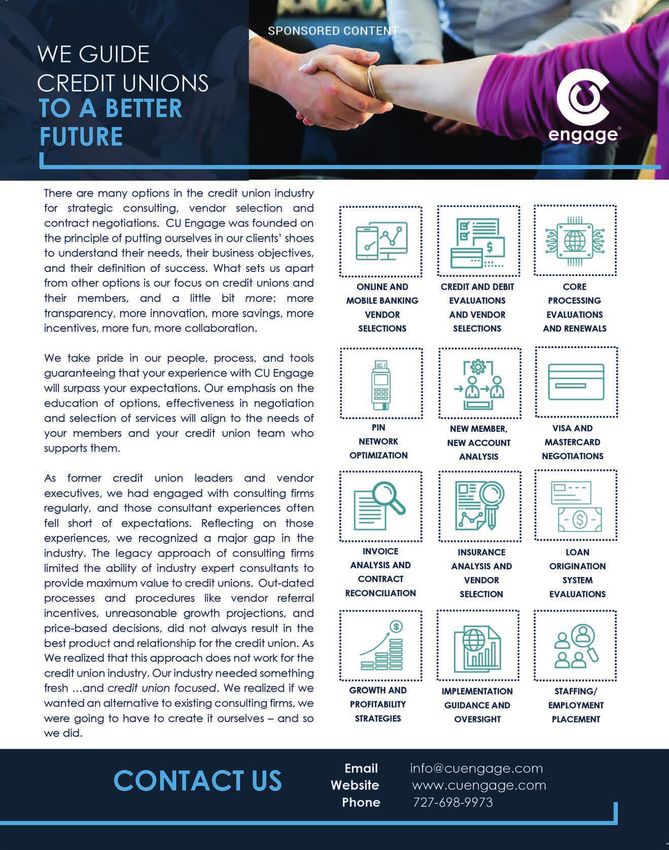
                          14   CU ENGAGE
SPECIAL REPORT: FINTECH

 5 Problems
 Fintechs Help Solve
                               C
                                        redit unions have all kinds of problems to       risk officer/president of CU recovery at CUESolu-
                                        solve. They must figure out how to protect       tions Bronze provider PSCU (pscu.com), St. Peters-
                                        their reputations by safeguarding member         burg, Florida. “While this method worked, it can’t
                                and organizational data. They must find ways to          compete with the latest wave of fraudsters skilled at
THE RIGHT                       compete with a whole host of financial industry          utilizing multiple channels to execute sophisticated
PARTNERS CAN                    players for consumers’ business. They must find          fraud schemes. Many older fraud detection systems
                                the delicate balance of being conservative enough        managed to prevent fraudsters from making final
HELP CREDIT                     to stay solvent in this tenuous economy, while           cash-outs but were unable to stop fraudsters in the
UNIONS COMPETE,                 still having the right mindset for taking the risks
                                required to get the tech they need to serve members.
                                                                                         first place.”
                                                                                           New technologies shaped by fintech can assist
PREVENT FRAUD                     Fortunately, CUs don’t have to go it alone. Fintechs   credit unions in this fight.
                                and other industry vendors can be among credit             For example, PSCU’s Linked Analysis takes a
AND FIELD                       unions’ allies in solving such key problems as how to:   proprietary approach to intercept and predict fraud
THE RIGHT                                                                                through the combined use of artificial intelligence,
                                                                                         anomaly analysis, phone printing technology, data
TECHNOLOGY      1. PREVENT FRAUD                                                         analytics and human intelligence. Related events
                The need for stronger fraud management has never                         are monitored across numerous channels to predict
FOR PROVIDING   been more apparent than during the COVID-19                              fraud before it happens. By analyzing data holisti-
THE KIND OF     pandemic, when the number of card-not-present
                transactions accelerated.
                                                                                         cally, across multiple channels, malicious patterns
                                                                                         of fraud are identified and intercepted.
SERVICE TODAY’S   “In the past, organizations detected fraud by                            “Fintechs offering members safety and security will
                analyzing activity on each platform using tools that                     be critical to the future, and authentication of mem-
MEMBERS         were not connected,” explains Jack Lynch, SVP/chief                      bers before transacting across any channel will be a
DEMAND.
BY STEPHANIE
SCHWENN SEBRING

 2   CREDIT UNION MANAGEMENT OCTOBER 2020
FOR C-SUITE, OPERATIONS

focus,” Lynch continues. “Leveraging AI to create a better member       date this shift, while value propositions need to reach beyond the
authentication experience in the future will also be an important       branch into all digital member interactions.”
component in reducing fraud. The concept of digital identities using
decentralized authentication technologies such as blockchain will
also play a role in creating this experience.”                          3. PROVIDE A BETTER DIGITAL EXPERIENCE
  Scalability and reach can help differentiate fraud prevention         With demand for digital banking tools at an all-time high in light
solutions.                                                              of the pandemic, credit union leaders are looking for the best tools
  With Linked Analysis, for example, PSCU’s fraud intelligence          and approaches to provide the superior, personalized experience
team can analyze data at scale across multiple channels and create      their members have come to expect and appreciate.
alerts about events either before or as they are happening. The           “One of these digital tools, artificial intelligence, enables the credit
company’s aggregate client data related to a fraudulent event is        union to provide a more personalized and intuitive experience, es-
combined with metadata from third-party sources. Intelligence           pecially in the area of payments,” notes Fran Duggan, CEO of CUES
is also gathered from a variety of sources, including 1,500 PSCU        Supplier member Payrailz (payrailz.com), Glastonbury, Connecticut.
owner credit unions.                                                    “AI learns the member’s patterns and habits to begin managing
  “While we were previously aware of the channels being at-             tasks, such as bill-pay, and shares recommendations concerning
tacked, we did not know to what degree fraudsters were operating        credit union products that may benefit the member, or areas where
across multiple channels and credit unions,” concludes Lynch. “In       the member can find additional savings within their own accounts.”
many cases, there were no instances of fraud being reported as the        Depending on the nature of a payment, whether it is a utility bill
fraudulent transactions appeared to be ‘good members’ conduct-          or P2P, a smart-driven digital payments solution can use its learned
ing routine transactions.”                                              understanding and the member’s transactional behavior to discern
                                                                        how the payment should be best executed. “Our solution is unique in
                                                                        that it manages this via a smart router, creating an experience that
2. COMPETE WITH THE BIG BANKS                                           is both proactive and intuitive for the member,” Duggan explains.
It can be very tricky for even a large credit union to compete with       Critical to the efficient use of AI and building a better member
the major bank down the street. “But securing a provider like FIS       experience is the speed in which transactions are processed.
can help credit unions obtain the exact tech as the big banks but         “Members are better able to manage their finances with greater
at a much quicker rate,” says Bill Hampton, division executive for      visibility into the transaction process, specifically when it comes
CUES Supplier member FIS (fisglobal.com), Jacksonville, Florida.        to quickly processing transactions,” adds Duggan. “For AI to serve
“This allows smaller, community credit unions to not only com-          its role, transactions must clear in near real-time. This makes it pos-
pete but win against bigger banks by delivering a more personal-        sible for the member to have an accurate view into their finances
ized member experience.”                                                and gives AI the ability to provide recommendations based on what
  The key is understanding the member experience holistically           is occurring in the account.”
rather than through individual product silos and then solving             “We’ve seen the rise of digital for some time now,” Duggan con-
problems through that holistic lens.                                    tinues. “We can look to other industries, like retail, and see consum-
  “For example,” Hampton explains, “consider what happens               ers opting for digital channels because these channels utilize tools
when a member loses a debit card in today’s COVID environment.          such as AI to provide a ‘do-it-for-me’ experience. Certainly, the pan-
We could instruct the member to go to a branch to receive a new         demic accelerated the adoption of digital channels in a compressed
card via instant issue, but they may not want to go into a branch.      timeframe, but many can agree we were bound to reach this point.”
So, we solve that by digitally issuing a new card in their wallet in      Moving forward, Duggan says, credit unions must remain agile
real-time that can immediately be used.”                                and think innovatively to build on the systems they have in place.
  Hampton notes there have been both positive and negative out-         “Technology will continue to change and adapt. Members will con-
comes during the digital journey. “Most credit unions, for example,     tinue to seek out experiences that remove much of the manual work
have several digital solutions acquired over the years,” he says.       when it comes to finances—because when it comes to payments, it’s
“However, the current pandemic made clear these digital assets          the experience provided that matters.”
weren’t knitted together to maximize their potential. The result
is credit unions rethinking their digital strategies and investments.
That’s where the open, flexible architecture of APIs (application       4. BE NIMBLE WITH NEW TECH
programming interfaces) is imperative.” That use of open APIs—          Member expectations are rapidly changing, and credit unions must
sometimes called “open banking”—enables third-party developers          find ways to compete and move quickly and efficiently with tech-
to build applications and services around the financial institution.    nology. Amber Harsin, CEO of CUES Supplier member Prodigy (cu-
  Historically, CUs have focused on providing fantastic face-to-        prodigy.com), a Salt Lake City-based fintech supporting credit unions
face service as a way to compete with the potentially less personal     with core processing technology, reflects that banking used to be
service of big banks. Due to the pandemic, face-to-face service is      something you first did at a branch—and later from your computer.
not as good an option as it was in the past.                              “Now, members expect to do their banking at any time and in any
  “Credit unions need to make the technological shift now, so the       place,” she says. “What’s more, they expect to be able to perform
same member experience occurs, regardless if it is via phone, app       sophisticated transactions, such as signing loan documents and
or website,” Hampton emphasizes. “These moments of truth are            opening accounts, not just inquiries or transfers.”
a critical juncture and must be solved in the channel the member          CUs must be as nimble as possible to remain relevant—both in
prefers. Varying automation tools can be evaluated to accommo-          organizational structure and with technology.

                                                                                                 CUmanagement.com CREDIT UNION MANAGEMENT       3
SPECIAL REPORT: FINTECH 5 PROBLEMS FINTECHS HELP SOLVE

                                 “Administratively, this includes reviewing policy        the right vendors, and ultimately negotiate the right
                               and procedure and actively removing noncritical            contract and pricing conditions.”
                               roadblocks that create friction to the member expe-          Done wrong, the process can be tedious and
                               rience,” Harsin explains. “It’s also about positioning     manual, which frequently leads to analysis pa-
                               APIs to extend your core services and technologies         ralysis. Done right, it deciphers the CU’s specific
                               as you see fit on the technology side. These empow-        needs and asks the right questions for a more
                               er credit unions to remain relevant and be respon-         compelling analysis of the options available. Add-
                               sive, even in the face of so many new challenges.”         abbo thinks it’s essential to analyze and structure
                                 Traditionally, CUs have had to choose between            the data elements to create an analysis for the
                               expensive, hardware-intensive in-house data pro-           review of credit union leaders and members of
                               cessing systems or overly simple, expensive service        the operations and members services teams.
                               bureau systems. Either way, these systems were not           “Vendor discussions also occur in a more mean-
                               designed to adapt in today’s fast-paced environment.       ingful way,” continues Addabbo. “For example,
                                 “Today, virtually all financial technology is            we ensure vendor demos cater to the specific
                               gravitating to the cloud,” Harsin adds. “Prodigy           requirements and use cases of each credit union,
                               keeps credit unions agile and relevant by providing        collaborate as a project team, and analyze the key
                               core processing systems designed from the ground           differentiators. Then, that data is used to make
                               up for cloud delivery. This adds the power and             vendor decisions more objective.”
                               flexibility of an in-house system while maintaining          Addabbo adds that the process enables separating
                               the ‘hands-off-the-hardware’ simplicity of a service       vendors and focusing on what is most important to
MORE ON FINTECH                bureau system.”                                            members. “This can sometimes be lost in the analy-
                                 Modern, API-driven architecture also gives the           sis of an RFP (request for proposal), thus fostering the
Finding a Nice                 ability to seamlessly integrate other third-party solu-    feelings of paralysis. What’s needed are more table-
Fit With Fintech               tions—including increasingly popular cloud-based           stakes responses from vendors and to help guide the
(cumanagement.com/             solutions, which can assist speed of transacting and       credit union to the right decision that provides the
0620finding)                   availability despite what is happening locally.            best member experience at the best value.”
                                 “Having that confidence and ability to deploy              Credit unions are also extremely collaborative.
Fintech: From Disruptors       today’s solutions, as well as tomorrow’s, are what           “Why not leverage that collaborative spirit? We
to Partners                    this nimbleness is all about,” Harsin continues.           find it invaluable, incorporating sentiments from
(cumanagement.com/             “It’s the agility to add key pieces that haven’t even      other clients to the process,” notes Addabbo. Con-
1019fintech)                   been thought of yet.                                       sider the example of a credit union choosing Visa
Civil War-Era Law Dooms          “When we first developed our cloud-based sys-            versus Mastercard or bringing credit card process-
OCC’s Fintech Charter          tem, we were literally at the forefront of data pro-       ing in-house or outsourcing. “What are the cost
(cumanagement.com/             cessing technology. We were confident that APIs            differences and the talent or FTEs required, for
0920civilwar)                  and the cloud were the future, but at the time,            example? What problems or challenges should
                               about 10 years ago, the jury was still out. We took        the credit union prepare for in the future? We can
                               a calculated risk, and our foresight has paid off.”        connect credit unions with their peers, helping
                                 All consumer-facing technology—whether it’s              them to learn through their experiences. And be-
                               Amazon, Google, Apple or the credit union down             ing completely agnostic from any provider allows
                               the street—must focus on making people’s lives             us to guide them to the right solution.”
                               simpler. “Advanced technologies like artificial in-          According to statistics cited in an article (tinyurl.
                               telligence (AI) will gain a stronger foothold in the       com/fintechstats) on spendmenot.com, fintech
                               financial services space, and savvy credit unions          firms are used by 50% of all banking customers.
                               will offer assistive technology, not reactive. This        So, it’s not surprising that 82% of traditional fi-
                               technology will make members’ lives simpler, the           nancial companies plan to increase collaboration
                               secret to staying relevant today.”                         with fintechs in the next three to five years.
                                                                                            Indeed, these are challenging, triple-crisis times
                                                                                          as credit unions grapple with a pandemic, the
                               5. FIGHT ANALYSIS PARALYSIS                                resulting uncertainty in the economy and social
                               Analysis paralysis can occur when a technology             unrest related to injustice. It’s a great time to have
                               decision becomes overwhelming and a CU’s leaders           all the problem-solving allies they can get.
                               feel incapable of moving forward with a decision.
                                 “It happens to financial institutions of any size, and   Stephanie Schwenn Sebring established and
                               it can boil down to being deluged with information         managed the marketing departments for three CUs
                               but unable to determine unique needs and business          and served in mentorship roles before launching
                               challenges,” says Jennifer Addabbo, co-founder and         her business. As owner of Fab Prose & Professional
                               partner of CU Engage (cuengage.com), St. Petersburg,       Writing, she assists credit unions, industry suppliers
                               Florida. “Our team can help credit unions navigate         and any company wanting great content and a clear
                               the evaluation process, ask the right questions, secure    brand voice. Follow her on Twitter @fabprose.

4   CREDIT UNION MANAGEMENT OCTOBER 2020
Need an Online Voting Platform?
CUES eVote
If the NCUA’s recent guidelines allowing for virtual annual meetings has   Early Setup Option Makes Your Life Easier
you searching for an online voting solution, take a look at CUES eVote.    Did you know you can put CUES eVote on
You’ll benefit from:                                                       retainer? The flexibility of CUES eVote means
                                                                           you can set your vote or survey up in advance,
  ➤ Hybrid elections offering paper, phone, mobile and
                                                                           and execute only if needed. Learn more at
    online balloting
                                                                           cues.org/eVote.
  ➤ Concierge service from a dedicated election coordinator
    who will personally help you every step of the way

Learn more when you view our demo video and sign up for a needs
assessment by visiting cues.org/eVote.
SPONSORED     CONTENT
                                                               Sponsored Content

                     How to Find “The One”:
                     Selecting a Digital Banking Partner
                     By Brian McNutt, VP, Product and Strategy, Lumin Digital

An already rapidly changing digital banking landscape has been               including how reports are run, the architecture of how data
put into overdrive as a result of the pandemic. Credit unions and            flows through the platform and how data is utilized in real-time
other financial institutions have been forced to be more agile than          to accomplish tasks.
ever before as the industry collectively tries to keep up with shifting
consumer preferences, needs and wants.                                       A good partner can help credit unions understand which solutions are
                                                                             working and which are not, and make suggestions about next steps.
Digital services that were relevant a mere six months ago may now            Creating models for potential feature usage while simultaneously
be obsolete, while others not even on the radar have been pushed to          harnessing user data – sometimes on a daily basis – is a must.
the forefront. Many credit unions that rely on vendors to develop and
deliver these services to members are carefully re-evaluating. Should        Some vendors are quick to rush in and offer assistance when a
they continue an existing relationship? Is it time to identify a new         contract is up for renewal. This type of reactive behavior is especially
provider? If so, what considerations should be top of mind when it           problematic as proposed features or solutions should have often
comes to evaluating new partners?                                            times been delivered or at least under consideration or development
                                                                             prior to this impending deadline – in other words, it puts the credit
Here are three important questions for credit unions to ask when it          union behind the eight ball. Credit unions would be well served to
comes to choosing a digital banking partner:                                 make predictions about future vendor performance based on
                                                                             past behavior.
Is the end-user experience a top priority?
Most credit unions and digital banking providers will agree that             Does the provider facilitate customized solutions?
member needs come first. But how can credit unions actually                  Digital banking platforms must be extendable, which is to say they
evaluate the user experience? Because it is difficult to illustrate during   should have the ability to add custom features based on individual
a sales demo, credit unions should make every effort to use the              credit union needs. No matter how good or sophisticated a digital
platform before committing to it. Then they can see for themselves           banking platform is, credit unions know their members better than
if it ticks all the user experience boxes. Is the experience pleasurable,    anyone. They might want to create and implement features that do
fast and snappy? Are there things that surprise and delight you? Or,         not fit into a vendor timeline or product vision. A good digital banking
on the flip side, does it require the user to take unnecessary steps?        partner should allow them to do that using either the vendor’s or the
                                                                             credit union’s in-house team, or a combination thereof.
While a firsthand trial run is preferred, there are questions
credit unions can ask potential providers to help the user                   For example, a credit union might have its own rewards program that
experience evaluation:                                                       it wants to be able to show on the digital banking dashboard, or it
 ■ What is the process for developing the user experience?                   might want to integrate to other third-party providers. Asking to see
 ■ How often does the vendor do releases?                                    behind the curtains of the SDK (Software Development Kit) during a
 ■ How many designers does the vendor have?                                  demo can help answer questions about the platform’s extendibility.
 ■ How is feedback collected and incorporated into the platform?
                                                                             Uncertain times require an even deeper understanding of current
Credit unions can help members make better use of digital and                and potential consumer behavior. A mutually beneficial relationship
remote channels and other contactless payments options that                  between a credit union and its digital banking provider requires clarity
are already available, which is especially important in the current          and transparency, support for digital tools with which many members
environment. Thinking ahead, credit unions should look for digital           may still be unfamiliar, and new products and services for members
banking providers that can help them build new experiences that              that may be particularly hard hit by COVID-19.
can address future member concerns and needs, such as managing
                                                                             Lumin Digital is redefining digital banking through its proprietary user
debt, establishing and balancing budgets and navigating government
                                                                             engagement platform. By utilizing user data and predictive analytics,
programs related to COVID-19. While no one could have predicted
                                                                             credit unions and other financial institutions can develop custom
the global pandemic and its widespread ramifications, providers
                                                                             experiences for consumers, creating a truly personalized journey and
should be able to quickly assess whether unforeseen events or
                                                                             connected relationship. Learn more at LuminDigital.com.
situations will be short- or long-lived, and pivot to develop solutions
that can be implemented in several different scenarios.
                                                                                Brian McNutt is the Vice President of Product and Strategy at
Does the provider use data to predict and prescribe?                            Lumin Digital. He has more than 14 years of experience delivering
A good digital banking provider should be able to do three main                 exceptional digital experiences to credit unions. Lumin Digital, a
things when it comes to data: 1) collect it in real time; 2) readily            PSCU company, provides members of PSCU Owner credit unions with a
access and analyze it; 3) use it to create future-state predictions.            tightly integrated and customized experience that rivals the offerings
Credit unions should ask to see data in action during a demo,                   available from the big banks.
The Digital Difference Starts Here.
                          Your Possibilities Delivered.              ®

Digital payments are about more than convenience, they’re about
connecting. PSCU has a broad range of solutions that help make
a difference in the lives of your members. Our digital banking and
analytics platforms are at the forefront of innovation, connecting
members with a world of new possibilities.

Payments ▪ Risk Management ▪ Digital Banking ▪ Analytics ▪ Loyalty   pscu.com
Mobile ▪ 24/7/365 Contact Center ▪ Strategic Consulting              844.367.7728
SPONSORED CONTENT
Data Is the
New Oil
T
wo of the most frequent questions I hear show a decline, someone who starts closing second-
from credit unions are: “How often do our ary accounts, a person who makes a balance transfer
members go to a particular large retailer?” on a credit card or the loss of a direct deposit. The
and “How can we learn more about our mem- critical point is that you need to be able to act on
H A S bers from their transaction behaviors?” Seems what your data is telling you.
I A simple enough, but it usually sets off a long-
winded explanation about how complicated it
Having the tools to see the data, identify
trends and take near real-time action is criti-
I I really is. Regardless, it is essential to be using cal. Sometimes all that’s needed is an outreach
the enormous cache of data that your organi- that sparks a friendly conversation. This can be
I I ’S zation has at its disposal in order to create the an opportunity to strengthen the relationship,
A A best possible experience for members. CUs that show you care and find that member’s specific
can use their data efficiently can solve com- need so you can deliver a personalized and
BY TIM NARGASSANS plex problems by using insights from retailer timely solution. In both hardships and good
frequency and transaction information. Here are times, data can be a tremendous tool to help
three key thoughts to help. break the ice and build relationships. Whether
it’s a difficult and unique circumstance or a
simple lack of incentives, your credit union
1. YOU CAN LEARN FROM YOUR DATA can help its members weather the storm.
AND PREVENT OR MINIMIZE ATTRITION
Credit cards are sometimes reported to have a 10-
15% natural attrition rate. That means if you’re not 3. CREDIT UNIONS NEED MORE
growing at least that much, you are losing market THAN BUSINESS INTELLIGENCE
share. What if you could reduce that rate? First, integrating machine learning is a must.
Consumers will still make essential purchases Your members want to know more than what
and critical payments, but you likely don’t know happened, they want to know why something
how their buying needs have changed until you happened and what is going to happen next. Data
examine the data. Maybe the decision to change science techniques like attribution and predictive
credit unions happened this year when they analytics must be seamlessly integrated into mod-
realized you didn’t have the digital offerings ern business intelligence systems. The interface
that they need during the pandemic, or maybe needs to be humanlike and in real-time. Natural
they were not aware of all your digital offerings. language processing, or human language query, is
Maybe you have world-class digital products, but a critical component; NLP is not just a feature but
MORE ON your members aren’t 100% familiar with them. the future. Real-time solutions are changing the
You likely had the data to save the member data integration landscape; business intelligence
ANALYTICS but not the analysis and tools to see what they must follow that lead.
e ower o sing wanted early enough. Learning to use the data I have heard the phrase, “Data is the new oil,”
ata to ri e ecisions and the insights gained from it can help both numerous times since the introduction of auto-
(cumanagement.com/ members and your credit union, especially dur- mation and robotic process automation solutions.
060320skybox) ing the current pandemic. In fact, your organization can be sitting on a
Data helps credit unions invest in the right tech- “well” of data just waiting to be examined. The
A id I ears, nology for members while finding ways to attract organizations that can use their data to create a
ata Analytics S ow new members. If you have the right combination personalized, creative member experience can
redit nions How to Hel of data, tools and partnerships, your business can market themselves as industry front runners.
(cumanagement.com/ continue to thrive and achieve new heights. The credit unions that do this will establish their
0320howhelp) brand as centered around innovation and creativity,
while most importantly, delivering a personalized
2. TIMELY AND RELEVANT experience for members.
MEMBER ENGAGEMENT IS KEY
The truth is that we see precursors in the data all the Tim Nargassans is a leader in the data solutions
time. Maybe it’s a high user of debit that starts to group at CUES Supplier member FIS (fisglo al co ).
CREDIT UNION MANAGEMENT BLET’S ADVANCE
THE MEMBER
EXPERIENCE
TOGETHER.
FIS is advancing credit unions and the member experience.
Our history of partnership with credit unions and in-depth
knowledge of the credit union marketplace spans over
40 years. We are dedicated to creating best-in-class credit
union and member experiences through a direct, trusted
partnership that delivers shared success.
www.fisglobal.com/cu2
©2020 FIS and/or its subsidiaries. All Rights Reserved. 856468SPONSORED CONTENT
Smarter Payments
in a Pandemic
C
redit unions of all sizes face an ongoing unions need to study such success stories and find
challenge in how to deliver a quality in- ways to emulate them.
branch member experience in a digital-
first banking environment. Credit union leaders
ARTIFICIAL understand that technology solves the challenge AI ONLY AS GOOD AS
THE UNDERLYING DATA
INTELLIGENCE in question—but with so many tools in the
industry, how does a credit union leader decide Unlike e-retailers, credit unions already possess
SUPPORTS which to choose? each member’s data. They can use this data to make
Artificial intelligence, or AI, presents a great solu- a “do-it-for-me” experience a reality. Data is the fuel
PERSONALIZATION tion to this challenge at hand. AI equips the credit behind AI, and leveraging this rich source of infor-
AND A QUALITY union leader with an intuitive tool to directly en- mation makes the member’s life easier.
gage with the member in the digital channel. Credit Focusing on AI can digitally deliver to mem-
MEMBER union leaders can use AI to provide a fresh member bers an experience that approaches the highly
EXPERIENCE. experience that maintains the personal touch of
the in-branch environment, while welcoming the
regarded traditional, in-person “private banker”
experience. When CUs use AI to bring to life the
member into the digital channel. personalization members appreciate, members
BY MICKEY AI also empowers the credit union to set itself gain a concierge-like experience previously
GOLDWASSER apart from competing financial institutions by only available to elite customers at the nation’s
providing a new degree of personalized service not largest banks. This strategic differentiator not
commonly found among community financial only manages the member’s day-to-day banking
institutions or large financial institutions serving needs, including paying bills, making payments,
holders of accounts with small balances. However, monitoring account activity and managing cash
credit union leaders need to understand the full for them, but allows the credit union to stand
capabilities of AI and how to appropriately deploy out among competitors.
it. More specifically, they need to know more about Adding this personal touch is especially crucial
how to effectively help members using AI, how to today. As the COVID-19 pandemic continues,
feed AI the best data possible (so the system delivers more members are turning to the digital channel
good outputs) and the best ways to use AI to their than ever before. By using AI, credit unions can
strategic advantage. maintain the high level of personalized service
they are known for, all within the growing digi-
tal channel.
‘DO IT FOR ME’
MORE ON AI Members want their credit unions to do it for
them—to proactively manage their financial LEVERAGING TECH TO CREATE
Serving Digital Donuts: affairs—including providing recommendations SMARTER, SAFER PAYMENTS
How Artificial Intelligence for specific products, automating everyday tasks Leveraging artificial intelligence and other
Is Changing Member and managing reoccurring payments. technology that enables smarter money man-
Service Think about the large e-retailers of today. Such agement strategically positions a credit union
(cumanagement.com/ companies as Amazon understand customers’ for success. In light of the COVID-19 pandemic,
0819donuts) shopping preferences and recommend additional credit union leaders must identify new ways to
products based on their browsing history and maintain the personal touch that first attracted
‘Artificial’ Intelligence
purchasing decisions. Amazon also tracks what many members to their organizations. In this
Sounds Scary, But It Isn’t
customers buy on a regular basis and allows them world driven by digital banking, credit unions
(cumanagement.com/
to set up repurchases on a schedule. Amazon must also ensure their digital capabilities mir-
0620scary)
takes all the hard work out of shopping for cus- ror—or outpace—those offered by other finan-
tomers because it uses technology to do every- cial institutions.
thing for them.
Success for companies like Amazon lies in Mickey Goldwasser is VP/marketing and chief of staff
the proactive approach used with each customer for CUES Supplier member Payrailz (payrailz.com),
based on the data collected by the e-retailer. Credit Glastonbury, Connecticut.
10 CREDIT UNION MANAGEMENT OCTOBER 2020PAY ANOTHER DONE payrailz A SMARTER PAYMENTS EXPERIENCE In a society that is increasingly focused on “Do it for me,” SMART makes the difference. Credit unions looking for smarter payments solutions start here. PAYRAILZ.COM
SPONSORED CONTENT

   When Shopping for Your Core
   Consider the Ownership Model
   A Review of Credit Union Cores and Ownership

T       he marketplace has spoken.
                                          at these big corporations makes           Private Companies
                                          them very slow to react. If it takes a    Private companies generally
        Progressive credit unions         corporation three years to develop        provide better service than public
        of all sizes are moving to        a product you need now, your credit       corporations and, because they’re
modern, API-driven core processing        union will have fallen behind by the      smaller, are also nimbler than
platforms. Sure, some legacy systems      time the product is available for you     their publicly traded counterparts.
built on outdated technology are still    to buy. In fact, three years from now,    However, it’s still important to
growing their market share a little,      it may not even be the product you        remember who they’re working for,
but the trend is to leave these archaic   need anymore.                             namely the company’s owners. Any
systems behind.                                Keep in mind, too, that at a big     owner of any tech company out there
     Once you’ve eliminated the           corporation, current customers            will tell you they’re looking forward
legacy systems, there are still a         aren’t their top priority. The truth      to a very lucrative exit at some point.
number of good core platforms             is, they’re not even the second           That’s why these systems can seem
whose architecture is well-suited         priority. A public company’s prime        expensive. Their profit motives are
for what’s happening today, as well       allegiance is to its shareholders. They   driven to provide financial wealth to
as what comes next. How do you            exist to make shareholders money.         a small group, not the credit union
narrow your search even further?          Your credit union just represents         industry.
     One important factor to consider     a supply of funds to achieve that.             Also, like public corporations,
is the ownership model of the             As a prospective customer, your           private companies derive additional
organization you’re thinking about        credit union is valuable because          income by selling you add-on
doing business with. When shopping        the provider needs that new money         modules with or after your
for core, credit unions have three        coming in. Once you sign, your            conversion. In other words, instead
options: public corporations, private     credit union instantly moves down         of getting a core platform that does
companies or CUSOs.                       to third place.                           everything you need, you get a core
                                               For example, it’s not uncommon       platform that can do everything you
Public Corporations                       for a giant corporate provider to sell    need if you pony up a lot of extra
Public corporations’ deep pockets         you an in-house system first to collect   money for the right add-ons.
make them attractive to some.             big up-front licensing fees, then a
The thinking is that because these        few years later, convince you to move
corporations have more money              to their old service bureau delivery      The CUSO Difference
to spend on development, they’re          model in order to increase the            The most obvious differentiator for a
going to produce better products.         recurring revenue they get from you.      CUSO is its ownership. All CUSOs are
The problem is, the bureaucracy                                                     owned, in full or in part, by credit
unions. That means the owners have core is money you won’t have to Best of all, because the CUSO
a vested interest in creating products spend with Prodigy. A TCO analysis owners and users are one and
that credit unions want and need. strongly favors CUSOs. the same, technology CUSOs can
What’s more, at least at Prodigy, every SnoCope Credit Union in remain very nimble. This means that
credit union that chooses us for core Washington, moved to Prodigy’s core when technology inevitably turns
becomes a part owner of the CUSO. solution and reported a savings of on a dime, your credit union will
That’s right; you actually own part of $100,000 in technology and related be positioned to turn on that same
your core processor. expenses per year. SnoCope’s CEO dime. The CUSO will always work in
Because the obscene profit Steve Ellis said, “What it all adds up your best interests because you’re
motives aren’t there, CUSO pricing is to is, we’ll have significantly better the owner: You are the CUSO.
generally more reasonable than non- core technology, considerably
CUSO pricing. However, you can’t more options, seamless third-party Prodigy is a CUSO owned, cloud-based
just look at initial cost to make your integrations, and all at a much more
comparison; you should consider the affordable cost.”
core, redefining core data processing
total cost of ownership (TCO). First American Credit Union from the ground up; modern architecture,
For example, at Prodigy, we don’t COO Phil Peters was fed up with his data accessibility, user experience, and
sell any add-on modules. Instead, big corporate core provider, so he simple pricing. There are no complex
when we add new functionality to went core shopping. After a lengthy
our core, we add it for everybody – search, the $107 million credit union or expensive hardware requirements;
free of additional charge. Commercial selected Prodigy. and updates are all automatic. Owned
checking account analysis, mortgage “This core was clearly developed by credit unions that have a vested
escrow and credit card processing by credit union people who had
interest in creating products the industry
are just three of the many features an active hand in developing the
included in the Prodigy core for software,” Peters said. “Everything wants and needs, Prodigy has the right
which virtually all non-CUSO core from all my years of working in a technology, the right people, and the
providers charge extra. Whatever variety of positions in operations that most meaningful tools for your credit
money your credit union would I would love to see in a core, it was
spend on add-ons from a non-CUSO there. It was remarkable.”
union and members.
The CUSO will always work in your best interests because you are the owner.
Request a demo today!
801.451.9101
elevate@cuprodigy.comYou can also read


