Chiam Heng Keng ECCE Council SSM Corporate Responsibility Seminar Series Johor Baru 2 October 2012 - Chiam Heng Keng
←
→
Page content transcription
If your browser does not render page correctly, please read the page content below

Chiam Heng Keng
                                ECCE Council
                SSM Corporate Responsibility
                             Seminar Series
                                  Johor Baru
                               2 October 2012
© Chiam Heng Keng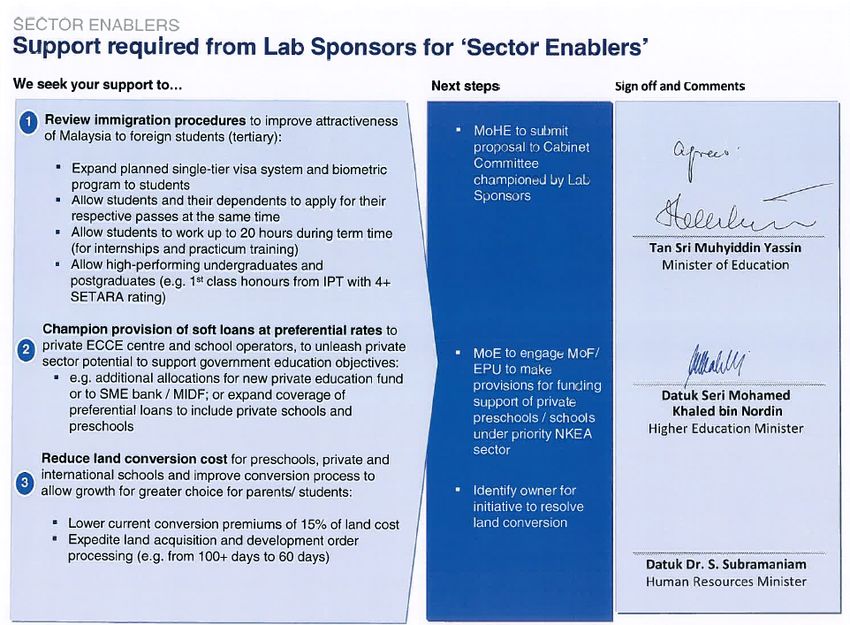

Transformation Programme (ETP)

     NKEA Lab held on 1
      June-30 July 2010

   EPP1 Ramping Up Early
   Child Care & Education
Sign off by YAB Tan Sri Muhyiddin Yassin & YB Khaled Nordin
on 14th July 2010

OVERVIEW

 We target to increase output by USD 1.8 billion, GNI by USD
 1.3 billion from 2010 to 2020

 Targeted 2020 Revenue for ECCE                        Targeted 2020 GNI for ECCE
 USD mn                                                USD mn
                            1      2                              1          2
                                  147                                        70

                       1,683                                     1,204
                                            2,329                                     1,630

       499
                                                         356

   2010              Rapid      Leading    Total         2010   Rapid     Leading    Total
                     scale-     ECCE       potential            scale-    ECCE       potential
                     up/ramp-   training   output               up/ramp   training   GNI
                     up         centres                         -up       centres
                                 2020                                      2020

SOURCE: NKEA Lab analysis
Source & © Pemandu
7 enablers needed for the successful implement of EPP1
                   Expand sliding-scale voucher scheme for ECCE to
Unlocking          parents
demand
                   Enhance corporate participation in ECCE as CSR

                   Develop leading regional training centres for
                   ECCE

                   Revise licensing/approval process
Accelerating
supply
                   Provide ECCE preferential loan scheme

                   Partner with property developers and govern-
                   ment for land acquisition/leasing

Strengthening      Setup Council or industry association for quality
governance         control and professionalism
Achievement through PPP
Government       Expand sliding-scale voucher scheme for ECCE to
                 parents

                 Provide ECCE preferential loan scheme

                 Setup Council for quality control and
                 professionalism

                 Enhance corporate participation in ECCE
                 as CSR
ECCE Council
                 Revise licensing/approval process

                 Partner with property developers and government
                 for land acquisition/leasing

EPP2             Develop training centres for ECCE
ECCE COUNCIL Governance of the ECCE Industry To professionalize the Industry (Professional Development Board) To assure quality control (Professional Certification Board) Advocacy Link between the government and the industry
The Council was launched by YAB Tan Sri Dato’ Muhyiddin on 18
                        August 2011
Providing child care in the workplace Is a strategic reform initiative under the Economic Transformation Programme. To release parents, especially mothers to the workforce. To achieve 50% of women in the workforce.
According to neuro-scientists: At birth, the brain contains about 100 billion brain cells/neurons. Neurons need to be connected to be wired into functioning network. Outside world experiences through the senses enable neurons to connect or be wired.
Importance of ECCE By three, there are 1000 trillion connections, twice the number of connections in adults. Pruning of neurons & connections that are not used. Critical periods – windows of opportunities in formative years, if missed, lost opportunities. Stress changes brain’s architecture.
Global trend on quality child care Neuroscience findings on the importance of the experiences in the first five years of a child’s life on his/her brain development. Studies of economists, e.g. James Heckman, show investment in ECCE brings high returns. Besides, capital building, quality ECCE reduces dropout and crime rate, resulting in cost savings.
Provision of child care in the
workplace has:
social aspect which is
often overly
emphasized
economic aspect which
is frequently
underemphasized.Workplace culture, milieu,
employment policy
Employee’s wellbeing:
valued, health, stress
Employee’s peace
of mind, reduced Quality of child
absenteeism, care at home
productivity
Child’s wellbeingStudies and experiences on provision of workplace child care have shown: 1. Increasing employee retention Experiences of national banks in USA indicate 3 times likelihood of staying on Carlson Company, USA, 94% of parents using childcare said benefit of on-site childcare service be a factor for staying with Carlson. Pranda Jewellery, Thailand, “artisan are kings”; 2% turnover after opening childcare centre.
… 1. Retention Competition for high skilled workers Reduce turnover, save on advertisement, training and loss of manpower. Example: HSBC, UK has childcare programme since 1989; cost replacing an experienced employee equivalent to year salary. Areva, French energy plant, women returned sooner to work.
2. Enhance recruitment Accessibility to quality child care on-site is a strong recruitment tool. Especially attractive to those with no nearby extended family members or friends. Direct benefits include positive family-friendly environment.
3. Absenteeism Reducing unscheduled absenteeism In a survey conducted in USA unscheduled absenteeism costs an average of USD60,00 a year for small companies and USD 3.6 million for large companies. Besides, entire day absenteeism, there is late for work and leave early absenteeism due to child care problem.
3. Reduced absenteeism Survey, UK in 2002, more than ½ of employers interviewed attributed late attendance and leaving early absenteeism from childcare problems. Red Land Ross, Kenya, unplanned leave declined by 25% with opening of crèche.
4. Productivity Higher productivity from higher morale from not requiring to cover for absent parent-employees. Parents have peace of mind According to SOCFINAF manager: Better ability to concentrate and reduction in workplace injuries. Better relationship with management. Greater loyalty & commitment.
Benefits of Child Care in the Workplace Case 1: J.P. Morgan Chase provided back-up childcare services, employees with resources & referral consulting services to help them find stable quality childcare had an annual saving of USD 800,000, a 112% return on company investment.
Benefits of Child Care in the Workplace Case 2: Carlson & Carlson-related brands – champion (including Radisson hotels) for quality work-life related benefits. Voted the “The 100 Best Companies for Working Mothers” in 2001 by Working Mothers magazine and “The 100 Best Companies to Work” for in 2002 by Fortune magazine.
Women in high-skilled workforce
wants quality child care:
“… parents, particularly women,
refrain from entering the labor
force if a lack of high quality,
affordable ECCE exists.”
Krumenauer & Deller, 2009
In addition
1. Child care is a legitimate service
   industry; opens up business
   opportunities and generates revenue.
2. In Miami-Dade county, ECCE industry
   directly employs over 9000 workers
   and indirectly almost 4000, generating
   USD 8882.2 million.
3.Multiplier effects such as supporting
   jobs in other industries e.g.
   publication, furniture, educational
   materials, toys, security etc
Encouraging corporate participation in ECCE as CSR would
                                                                                                                   CSR
     increase enrolment into quality ECCE services
                            Ways for corporate participation in ECCE

                             Type1: On-site Child Care
                             Individual corporate company or the networking of corporate companies for providing
                             quality ECCE services for their staff at their premise or agreed premise.

                              Type2: Shared Child Care Services
                              A few companies in a vicinity network to set up a child care centre for their staff/
                              outsource their childcare services to a ECCE practitioner.

                             Type3: ECCE Fund
                             The employees use any chlid care services and the company establishes an
                             ECCE fund or subsidizes the childcare fee.

                                                                 Requirements:
    Why CSR in ECCE?
                                                                 ▪ Create greater awareness on the importance and
    ▪ Enhancing corporate participation into ECCE as                 the values of participating in ECCE
        their CSR would boost further demand for                 ▪   To continue reach out to recipients of the Prime
        private ECCE enrolment                                       Minister’s CSR awards and other notable
    ▪   For corporate company, it is an effective benefit            companies in Malaysia, and propose partnership
        programme to retain and attract female                       initiatives between them and quality ECCE
        workforce                                                    providers

SOURCE: NKEA Lab analysis
Types of childcare services
Other arrangements such as:
1. Partner with child care in the
community so that places are
reserved & subsidized.
2. Provide some form of financial
support e.g. voucher, funds etc.Example Administrators at the Inter Faith Care Center, a nursing home in the Arrowhead region, realized that child care options for their 120 employees were limited. In 2001, they worked with a local provider to move a community family child care program to existing space on the property of the nursing home. The nursing home provides subsidized rent and meals.
Example Solutions can be found within the business community: General Mills partnered with nearby Carlson Companies which offer on- site child care. Use Carlson’s childcare facilities.
Budget 2013 Shows the government’s recognition of the importance of the early formative years of a child’s life; the right of every child to quality ECCE and a fair start to life RM1.2 billion for preschool education in the public sector. RM380 million for placement of preschool teachers.
Budget 2013: Quality ECCE Launching grant of RM10,000 to operators for opening up private child care centres and preschools. A double deduction on allowances/ subsidies to employees and expenses for maintenance of childcare centres given to employers.
Budget 2013: Quality ECCE Income tax exemption for 5 years and industrial building allowance at the rate of 10% to operators of preschools and childcare centres. Implement a pilot project (TASKA OKU) for 6 categories of disabilities, namely Down’s Syndrome, autism, blindness or partial, hearing and speaking disabilities, physical disabilities and learning difficulties.
Summary The importance of ECCE is beyond a shadow of a doubt. Research findings of psychologists, economists & businesses show high returns of investment in quality ECCE Child care is a critical component of the workforce development. Incorporate ECCE into businesses and economic development makes good economic sense.
Summary Investment in quality ECCE is a win-win situation: Government investments in high quality ECCE for low-income families generate savings through reduction in criminal justice, remedial education, security and welfare costs.
Summary: Win-win for all Business wins as quality, affordable, accessible child care facilities for their employees results in improved employee recruitment, retention, attendance & job satisfaction.
Summary: Win-win for all Communities win as parents have access to safe, quality care for their young children while they are at work. Children win as they have the opportunities to develop and become productive citizens.
Summary Need for partnership because: ECCE industry and parents cannot meet the ECCE needs of children in Malaysia alone. Increased public and private engagement is required to increase access to affordable quality child care.
Summary Review regulations on infra- structure, building, land use, tax credits and loans. The Government, non-profit agencies (associations), businesses, the ECCE Council, the ECCE, industry, society & parents have to partner for children’s and human capital development.
BUILDING THE FUTURE

                 “Give us, your children a
                 good today
                 and we will give you a
                 good tomorrow…”

CORPORATE RESPONSIBILITY TO EMPLOYEES
               (CRE)
Thank you
You can also read


