STAND ALONE BUSHFIRE PLAN - Previous Version Valid until August 2018 - Southern River College
←
→
Page content transcription
If your browser does not render page correctly, please read the page content below
STAND ALONE BUSHFIRE PLAN

Previous Version                   Valid until August 2018

This Version (Effective on)        August 2018

This Version (To be reviewed on)   July 2019
Index

 Introduction .................................................................................................................................................... 2
        Overview .......................................................................................................................................................... 2
        Bushfire Preparation checklist (refer to Appendix A) ...................................................................................... 3
 Communication ............................................................................................................................................... 3
        Preparing for Bushfire Season ......................................................................................................................... 3
        Pre-emptive Closure ........................................................................................................................................ 4
        During Evacuation............................................................................................................................................ 4
        Reopening the School ...................................................................................................................................... 4
 Types of Fire Event .......................................................................................................................................... 5
        1. Total Fire Ban ............................................................................................................................................... 5
        2. Catastrophic Fire Danger ............................................................................................................................. 5
         2.1 Planned Pre-emptive Closure .................................................................................................................. 6
         2.2 During a Planned Closure ........................................................................................................................ 6
         2.3 Re-opening School ................................................................................................................................... 6
        3. Bushfire ........................................................................................................................................................ 7
         3.1. Bushfire – Watch community ................................................................................................................. 7
            3.1.1 Advice ................................................................................................ Error! Bookmark not defined.
            3.1.2 Watch and Act ................................................................................... Error! Bookmark not defined.
            3.1.3 Emergency Warning ......................................................................................................................... 8
            3.1.4 All Clear ............................................................................................................................................ 8
         3.2. Bushfire – Act.......................................................................................................................................... 8
            3.2.1 Response when a bushfire starts and the school is open ................................................................ 8
                  3.2.1.1           Evacuation Procedure .................................................................................................... 8
                  3.2.1.2           Safer Location Procedure – if evacuation is not possible ............................................... 9
            3.2.2 Response when a bushfire starts and the school is closed .............................................................. 9
            3.2.3 Recovery ........................................................................................................................................... 9
 APPENDICIES ................................................................................................................................................. 11
        Appendix A: COMPLIANCE: Bushfire Preparation Checklist ........................................................................ 11
        Appendix B: Catastrophic Event Flow Chart .................................................... Error! Bookmark not defined.
        Appendix C: School Site Plan and Evacuation Routes ................................................................................... 14
        Appendix D: Communication Plan ................................................................................................................ 15
        Appendix E: Sample Emergency Response Contact List ............................................................................... 18
        Appendix F: SRC Communication Tree….……………………………………… ................................................ ………… 19

 1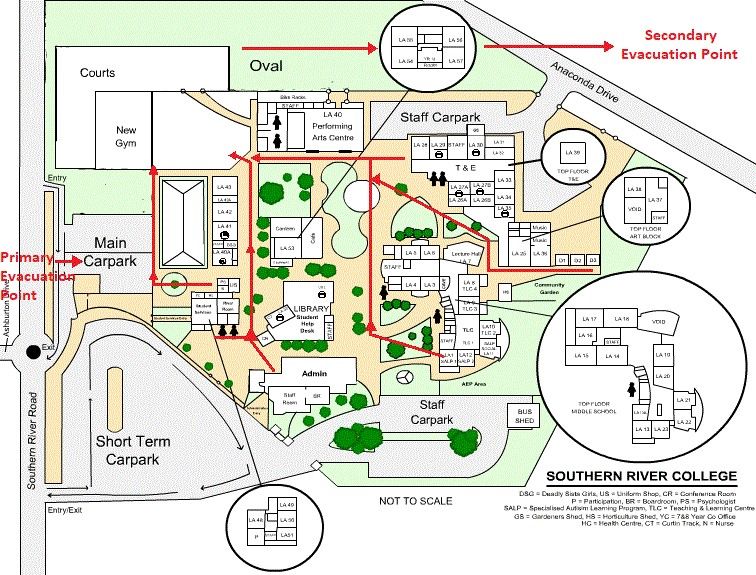
Introduction
This Stand-alone Bushfire Plan is for Southern River College and has been developed to assist Principals and their
staff prepare for a total fire ban, catastrophic fire danger rating, or a bushfire event. Sample messages to staff
and parents are included in the Principal’s Guide to Bushfire, as well as notices for the closure of the school.

The preparation of this Stand-alone Bushfire Plan should be developed in accordance with the Emergency and
Critical Incident Management Policy and the Principal’s Guide to Bushfire with input from local emergency
management agencies.

    Guidance notes:

    The College has 908 students and 116 staff. In 2019 there is one child in a wheelchair with mobility issues,
    there are high functioning autistic students on site. (None though that have mobility issues)

    The school has a remnant bush area which is sparsely vegetated on the west boundary and two major roads;
    Southern River Road on the southern boundary and Anaconda Drive on its northern boundary.

    Most students live within the local area and either walk to school or access the school by bus which creates
    another degree of complexity. Many school staff live outside the local area and on occasion the Principal is not
    present at school due to attending meetings or engagements on behalf of the school. In this situation the Year
    11/12 Deputy steps into the leadership role.

    The Gosnells fire station is located approximately 10 minutes away from the school in Maddington and the
    Gosnells Police station is located on Albany Highway. The closest medical centre that would deal with Bushfire
    emergency victims is at Armadale, approximately 15 minutes from the school.

    There are evaporative air conditioners in the school. These have been protected with ember screens.

Overview
General Information
This Bushfire Plan (BP) has been developed during Term 3 of each year after consultation with:
• families of students attending the School;
• members of the emergency services (e.g. DFES, Local Emergency Management Committee and/or
     Community Emergency Services Manager).

The BP outlines required actions to prepare the school before the bushfire season as per the Principal’s Guide to
Bushfire (refer Appendix A).

The BP also outlines activities to be undertaken by staff and students at the different levels of a bushfire
emergency including:
• on days of Total Fire Ban;
• Catastrophic fire danger rating;
• when there is a fire in the local district;
• when a bushfire is threatening or impacting on the site; and
• during the period immediately after a bushfire has impacted on the site (known as the ‘Recovery Phase’).

The New School Gym is the nominated as the Safer Location building for the school.
• This building has been prepared for a bushfire emergency and will safely accommodate all persons normally
    at the school.

Distribution
The Principal will forward a copy of the site BP to the Regional Executive Director to be held in the regional office.

The Principal or delegated officer will forward a copy of the site BP to the emergency services no later than the
31st August each year in the region.

The Principal or delegated officer will publish a copy of the school’s bushfire plan on the schools’ website at the
beginning of Term 1 each year.

2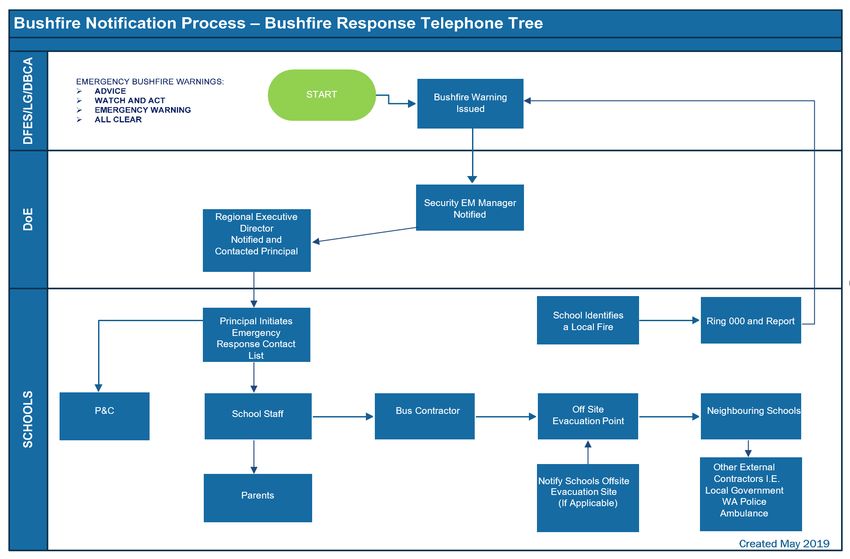
•    Details of the website to be provided to families of new students by the Principal or delegated officer during
     the enrolment process.
•    The Principal will ensure that all new staff members, relieving staff and visitors are briefed about the
     requirements of the BP during the site induction process.

The Principal will also include bushfire season reminders and information in site newsletters at least three times
each term when applicable. The School’s Information Booklet, updated in Term 1 each year, includes detailed
information about actions and procedures included in the BP.

All staff members are to receive pre fire season updates during Term 3 and ongoing information and instruction
about the contents and requirements of the BP during Term 4 and Term 1 staff meetings.
Bushfire Preparation checklist (refer to Appendix A)
The safety and wellbeing of students, staff and visitors is at all times the Department’s main priority. Staff are
not expected to fight bushfires.

The school will review (and update where appropriate) the plan on an annual basis.

Any bushfire advice received by the school from Department of Fire and Emergency Services (DFES), including
local DFES regional office, Local fire brigades and Community Emergency Services Manager, Local Government,
Local Government Local Emergency Management Committee, or external experts, is documented in the table
below, identifying the date and source of the advice.

    Date of Review     Reviewing Officer                                Date Submitted         Next scheduled
                                                                                               Review
    7/08/2017          Everal Miocevich, Michael Erith, Sharon          9/8/2017               14/8/2018
                       Harry, Frank DiFilippo and Theo Gummery
    14/8/2018          Everal Miocevich, Michael Erith, Sharon          27/08/2018             14/8/2019
                       Harry, Frank DiFilippo and Theo Gummery
    16/8/2019          Everal Eaton, Sharon Harry, Frank DiFilippo       23/08/2019            12/8/2020
                       and Michael Erith

Communication
There are several levels of communication requirements at school level before, during and after bushfire events.

Preparing for Bushfire Season
•    The Principal must ensure all students, staff (including relief) and parents are aware of the school’s Stand-
     alone Bushfire Plan. A copy of the school’s Stand-alone Bushfire Plan should be published on the school’s
     website. Suggested draft text for the school newsletter is available in Appendix B6 of the Principal’s Guide to
     Bushfire.
•    The Principal should establish contact with different members of the local community, including emergency
     services, DFES, local volunteer fire brigades, Western Australia Police Force, Local Government Local
     Emergency Management Committee and Community Emergency Services Manager.
•    Communication plans (including emergency contacts and a telephone tree) need to be in place for
     evacuation or planned closure. See Appendix D for a Communication Plan, Appendix E for sample
     emergency contacts and Appendix F for a sample telephone tree.
•    The school has an effective working emergency warning or alert system, and emergency communication
     equipment is available and working and tested at least once before the commencement of the Bushfire
     Season.
•    Schools have in place systems to account for students, staff and visitors in an emergency, such as class rolls
     (or equivalent) and visitor registers. Consideration should be in place for situations such as a loss of power
     affecting the ability to print from electronic sources.
•    Schools need to identify more than one suitable off-site location, in case one site is in the area of the
     bushfire.
•    Arrangements are in place in relation to school buses if appropriate (notification of contractors if pre-
     emptive closure is invoked; and the availability of buses if off-site evacuation is required).

3
Pre-emptive Closure
•   The Department of Education Incident Controller (normally the Deputy Director General Schools or
    delegated officer) will make the decision to close a school based upon advice from Emergency Services and
    this will be relayed to the Principal via the Regional Executive Director.
•   The Principal is to notify staff and parents of closure using emergency contacts and the Telephone Call Tree.
    See the draft message to parents in Appendix B7 of the Principal’s Guide to Bushfire advising of pre-emptive
    closure, being mindful of parents' level of literacy and understanding of English.
•   All other necessary parties are advised, including, but not limited to, other schools that may have siblings at
    the school, community users of the school facilities (including before and after school care, or holiday
    programs, community kindergartens, on site contractors, Parents and Citizens Association and/or school
    council).
•   If appropriate, bus contractors will be contacted to arrange for the evacuation of students to a designated
    area.
•   Notice of Planned Temporary School Closure should be posted as per the Principal’s Guide to Bushfire, both
    physically at the school and electronically on the website.

During Evacuation
•   The school will contact their Regional Executive Director and the Department’s Media Unit.
•   The school will contact parents via phone or email, ensuring they have a mobile phone contact number for
    the school (It would be preferable that parents restrict calling the school at this time to emergency calls
    only).
•   The school will notify bus contractors and out of school programs.

NOTE: DFES uses the national Emergency Alert system to send community warning messages via mobile
telephones in affected areas. It is important not to rely on receiving an alert. The school must still be prepared
and have an action plan in case of an emergency.

It is important to remember that the Emergency Alert is just one way of receiving information during an
emergency. Other ways the school can stay informed include:
• visiting the Emergency WA website www.emergency.wa.gov.au
• calling the DFES information line on 13 DFES (133337).
• listening to ABC radio, 6PR and other media news bulletins.
• following DFES on Twitter at www.twitter.com/dfes_wa

For more information on Emergency Alert, visit: www.emergencyalert.gov.au

The Principal communicates directly with Regional and Central Office personnel including any media
communications. Staff should not comment directly to media.

Reopening the School
•   The Regional Executive Director is to advise the Principal when the school can re-open.
•   Parents need to know when the school is re-opened. In the event of a pre-emptive closure details are
    contained in the sample messages (Principal’s Guide to Bushfire advising of
    pre-emptive Closure – Appendix B7).
•   The Notice of Planned Temporary School Closure should be physically removed from the school premises and
    website.
•   All parties that were advised of closure (for example, bus contractors, Out of Hours users, community
    kindergartens, Parents and Citizens Association and/or school council) should be advised of reopening.

Types of Fire Event
In the event of a Total Fire Ban, catastrophic weather warning or a bushfire, the Stand-alone Bushfire Plan will be
activated.

4
Types of Fire Event
1. Total Fire Ban
In the event of a Total Fire Ban the BP will be invoked: (refer to Principal’s Guide to Bushfire for all procedures).
This means:
• no fires must be lit or used in the open air;
• all open fires for the purpose of cooking or camping are not allowed; and
• hot work’ such as metal work, grinding, welding, soldering, gas cutting or similar is not allowed.
The Department of Fire and Emergency Services advice is that chainsaws, plant or grass trimmers or lawn
mowers can be used during a total fire ban in suburban or built up areas which are cleared of flammable
material, but not in bushland or other areas where their use is likely to cause fire.
It is also necessary to ensure:
• The equipment or machinery is mechanically sound.
• All reasonable precautions are taken to prevent a bushfire starting.
It is recommended postponing the activity altogether to minimise the risk of fire.
Unless a Harvest and Vehicle Movement Ban has been implemented by the Local Government Authority, the
school/college is able to harvest or move vehicles across paddocks for agricultural purposes. However, there may
be local government authority requirements such as compliant fire-fighting equipment on hand and a required
amount of water readily available for fire-fighting purposes.
Individuals could be fined up to $25,000 or jailed for 12 months or both if the Total Fire Ban is ignored.
For information on activities that can or cannot be carried out during a Total Fire Ban visit
https://www.emergency.wa.gov.au/#totalfirebans.
https://www.dfes.wa.gov.au/safetyinformation/fire/bushfire/BushfireFactsheets/DFES_BushfireFactsheet-
Total_Fire_Bans.pdf.
If the information required is not available from the website, telephone the Total Fire Ban Information Line 1800
709 355.
This information is also available by visiting www.dfes.wa.gov.au and;
Emergency WA website: www.emergency.wa.gov.au.
2. Catastrophic Fire Danger
The Catastrophic Fire Danger Index (FDR) has been added to the Australia-wide FDR system since the 2009
bushfires in Victoria. If a fire starts in catastrophic conditions, its impact potential includes death or injury to
people and destruction of buildings.
Schools need to know what the Fire Danger Rating is for the area, and monitor local conditions and keep
informed. Understanding the Fire Danger Rating categories and what they mean will help in making decisions
about what to do if a bushfire starts.
The Fire Danger Rating is based on the forecast weather conditions and provides advice about the level of
bushfire threat on a particular day.
Category Fire Danger Action
Index (FDR)
100+ Schools on Bushfire Zone Register closed on
instruction from Deputy Director General, Public
Schools, through Regional Executive Director. School
to invoke Communication Plan and cancel bus
services. Appendix B (refer to the Principal’s Guide to
Bushfire for all procedures and sample messages).
575-99 Monitor Emergency WA & DFES websites
Normal school operations
(any fire that starts is likely to be so fierce that even a
well prepared and well-constructed school may not
survive a fire).
50-74 Monitor Emergency WA & DFES website
Normal school operations
(The threat of a bushfire increases)
32-49 Monitor Emergency WA & DFES website
Normal school operations
(The threat of a bushfire increases)
12-31 Normal school operations
(The threat of a bushfire increases)
0-11 Normal school operations
Guidance notes:
At each rating the fire behaviour and potential impact will be different.
Check the FDR for the area by visiting the following links:
https://www.emergency.wa.gov.au/#firedangerratings
Further information can be obtained at:
https://www.dfes.wa.gov.au/safetyinformation/fire/bushfire/pages/firedangerratings.aspx
In the event of a catastrophic weather warning the BP will be invoked as per the flow chart at Appendix B (refer
to Principal’s Guide to Bushfire for all procedures and sample letters).
2.1 Planned Pre-emptive Closure
Regional executive directors will contact principals of affected schools directly when a planned (pre-emptive)
closure is to be invoked in a particular part of the State. The lead time for a planned closure varies depending on
weather patterns, but every attempt is made to give principals as much notice as possible to prepare written
documentation for parents. Schools should have telephone trees in place to provide this information at short
notice or after hours.
Once advised that your school is to undertake pre-emptive closure, you need to notify your school community
that a closure is imminent. The Principal needs to send letters to parents and provide each staff member with a
memo that clearly states when the closure is planned to occur and that the school is on standby. It may be that
between declaration of the closure and the day of closure, weather conditions improve sufficiently to remove the
need to close and the school can therefore stand down its pre-emptive closure plans. The Regional Executive
Director confirms with the principal the final decision to close the school no later than 4.30 pm the day before
the planned closure. If weather conditions become less severe after 4:30 pm, the closure goes ahead regardless,
in order to provide a level of certainty to parents.
The DFES is the final authority on advice about which schools are in danger and the level of risk at the time. The
Deputy Director General Schools makes the final decision as to whether or not a planned closure of public
schools is to proceed, based on DFES’s advice.
2.2 During a Planned Closure
In order to make informed decisions, the Principal must stay informed of the current fire danger rating and any
fire activity by monitoring a range of information sources
6Schools can stay informed by monitoring the following official sources:
• visiting the Emergency WA website www.emergency.wa.gov.au
• calling the DFES information line on 13 DFES (133337).
• listening to ABC radio, 6PR and other media news bulletins
• following DFES on Twitter at www.twitter.com/dfes_wa
2.3 Re-opening School
Parents need to know when the Catastrophic FDR has been downgraded and that it is therefore safe for their
children to return to school after a planned closure. The template letter to parents contains advice on how
parents can monitor the situation. The school will need to put communication plans in place, such as placing a
notice on the school website and providing a phone number for parents to call for information about the
reopening of the school. Consideration needs to be given to how parents who do not have internet access or
who have diverse needs (e.g. multicultural, special needs) will be provided with information.
3. Bushfire
In the event of a bushfire threatening the school, the school will notify DFES and the BP will be invoked by way of
the school siren (or hand held siren) (add your school’s site specific alert tone).
3.1. Bushfire – Warnings
During a bushfire, emergency services provide as much information as possible through a number of different
channels.
If the school is likely to be threatened by the fire, activate the Emergency and Critical Incident Management Plan
immediately.
Before a bushfire starts, Fire Danger Ratings can provide advice about the level of bushfire threat on a particular
day and how difficult and dangerous conditions will be if a fire starts. They are based on weather conditions
forecast by the Bureau of Meteorology.
During a bushfire, DFES and the Parks and Wildlife (P and W) Service of the Department of Biodiversity,
Conservation and Attractions issue community alerts and warnings for bushfires that threaten lives and property.
They are only issued once firefighters have arrived at the scene and determined that there is a threat or potential
threat to the community.
The alert level changes to reflect the increasing risk to life.
DFES and Parks and Wildlife (P and W) Service of the Department of Biodiversity, Conservation and Attractions
will issue the following four bushfire warnings.
3.1.1
means a fire has started but there is no known danger. This is general
information to keep you informed and up to date with developments.
Turn off evaporative air conditioners and ensure roof vents are closed. Undertake regular checks and patrols of
the school for bushfire activity, paying special attention to the evaporative air conditioners.
3.1.2
means there is a possible threat to lives and property. Conditions are
changing, you need to leave the area or prepare to move students,
staff and visitors to their pre-determined Safer Building Location and
not an open area on the site or evacuate.
If an order to evacuate is directed by the Incident Controller, the evacuation order will be relayed via a variety of
official sources such as the DFES website and Emergency WA website. It is paramount that schools gather
information pertaining to fires from official sources in order to make an informed decision on whether to stay on-
site or evacuate off-site.
73.1.3
means you are in danger as your area will be impacted by fire.
You need to take immediate action to survive.
You will be advised whether you can leave the area or if you must shelter where you are as the fire burns through
your area. An emergency warning may be supported with a siren sound called the Standard Emergency Warning
Signal (SEWS). These factors should be reviewed on a regular basis as they may change at any time and without
notice.
If an order to evacuate is directed by the Incident Controller, the evacuation order will be relayed via a variety of
communications methods including the Bushfire Warning system.
It is paramount that schools gather information pertaining to fires from official sources in order to make an
informed decision on whether to stay on-site or evacuate off-site.
3.1.4
means the danger has passed and the fire is under control, but you need to
remain vigilant in case the situation changes. It may still not be safe to
return to school.
Further information in relation to Bushfire Warning System is available on the DFES Website and a video is
available at:
https://www.youtube.com/watch?v=a_H0D-38AGQ&feature=youtu.be
3.2. Bushfire – Act
3.2.1 Response when a bushfire starts and the school is open
3.2.1.1 Evacuation Procedure
School to evacuate off-site on advice from DFES.
Has the evacuation to the off-site safer location been approved and how long will it take to get there?
• All classes remain with their teachers and allocated education assistants.
• All other staff and visitors report to the Front Office.
• Teachers account for each child and identify students and support staff with known respiratory conditions.
• Doors, roof vents and windows must be closed and evaporative air coolers turned off.
• Students and staff are to remain in classrooms unless directed otherwise by their fire warden.
• Fire wardens are designated to manage evacuation routes liaise with staff.
• The Principal and fire wardens, will control this response until the arrival of DFES or emergency services who
will then take over.
• Students and adults with known respiratory conditions will be identified and given special consideration.
Staging Area – identify and utilise an area where occupants and visitors are intended to gather in preparation for
an evacuation.
Parent Access
Schools must have clear communication methods with parents. Parents must be advised NOT to pick up students
and to monitor official communication channels for specific access information. Appendix D and Appendix E
Communication Plan and Emergency Response Contact List must be completed with local content to ensure the
school’s individual communication requirements are detailed and used.
83.2.1.2 Safer Location Procedure – if evacuation is not possible
• All classes remain with their teachers and support staff until otherwise advised by Principal or delegated
staff.
• School move to Safer Building Location (Appendix C) if the Principal cannot ascertain impact of a
bushfire to school or on advice from DFES.
• Doors, roof vents and windows must be closed and evaporative air coolers turned off.
• Principal or delegated staff to monitor official communication channels to enable informed decisions to
be made.
• All classes to remain within the designated Safer Building Location. See Appendix C for a sample safer
location evacuation diagram.
• All other staff and visitors report to the administration building, before directed to the Safer Building
Location.
• Teachers account for each child and identify students and support staff with known respiratory conditions.
• Fire wardens are designated to manage evacuation routes and liaise with staff.
• The Principal and fire wardens will control this response and must liaise with DFES or emergency services as
soon as possible.
• Students and adults with known respiratory conditions will be identified and given special consideration.
Parent Access
Schools must have clear communication methods with parents. Parents must be advised NOT to pick up students
and to monitor official communication channels for specific access information. Appendix D and Appendix E
Communication Plan and Emergency Response Contact List must be completed with local content to ensure the
school’s individual communication requirements are detailed and used.
3.2.2 Response when a bushfire starts and the school is closed
If the Department of Education Incident Controller makes a decision on school closure based upon advice from
Emergency Services, the Regional Executive Director will inform the Principal of closure.
The Principal is to notify staff and parents of the closure using the emergency contact list (see Appendix D for a
Sample Communication Plan).
The Department of Education Incident Controller will, in consultation with the Regional Executive Director,
identify alternative accommodation of students and staff if required. The Department’s Media Unit will utilise
media outlets to make public announcements of school closures, temporary alternative accommodation and
contact number(s) for further information.
The Department’s Incident Controller in consultation with DFES will inform the Regional Executive Director when
the school can reopen, who will inform the Principal accordingly.
3.2.3 Recovery
The priorities for the school during recovery are
• Health and Safety of individuals;
• Social Recovery; and
• Physical (Structural) Recovery.
General
• When possible, return to normal routine as soon as possible.
• Attend to staff and student welfare, considering counselling support.
• Provide information for families and the community of any impact (including if there is none) on the school
and school routine following the bushfire.
• Undertake a check of any equipment or stock used and arrange for replacement/replenishment.
• Address any physical damage to the school, isolating areas if required and if necessary relocate to alternative
accommodation. Contact Building Management and Works to commence repairs. The Department should
be advised of any damage caused by the bushfire.
• Attend to security if necessary (Contact Head of Security at Central Office on 9264 4825).
• Manage Administrative details including insurance.
9Debrief
• What worked, what didn’t?
• Was anything overlooked?
• What could you and your staff do better next time?
• Should roles change?
• If changes are made, incorporate them into the formal plan and advise the appropriate parties including staff
and other authorities.
• Share the knowledge with other schools.
• Test the revised bushfire management plan and procedures.
For further details and contacts refer to the Recovery Section of the Emergency and Critical Incident
Management Plan and The Principal’s Guide to Bushfire.
10APPENDICES
Appendix A: COMPLIANCE: Bushfire Preparation Checklist
Bushfire Preparation Checklist for the Bushfire
season
Principals are responsible to ensure this checklist is completed annually and should be thoroughly
familiar with their current plans for dealing with bushfires.
All staff members should be aware of their responsibilities in accordance with the Stand-alone
Bushfire Plan
MANAGEMENT ACTIVITIES
Tick when task has been completed, or write NA if not applicable() Evidence
Has the school checked the Bushfire Zone Register on Ikon and X Date
downloaded the latest Stand-alone Bushfire Plan.
Principal is thoroughly familiar with the school’s Stand-alone X Plan reviewed
Bushfire Plan. 23/08/19
Students, staff, relief staff and parents/carers have been made X Staff meeting
aware of the School’s Stand-alone Bushfire Plan. 10/09/19 and
newsletter sent to
parents/carers with
bushfire information
13/09/19
The Stand-alone Bushfire Plan has been reviewed prior to the X
bushfire season (31 August each year) and a copy uploaded to the
electronic portal and on the school’s website.
The Principal or delegated staff establish contact with local X Feedback from
emergency services, DFES, the Department of Biodiversity, previous plan has
Conservation and Attractions – Parks and Wildlife Services (if been incorporated
relevant), the local volunteer fire brigade, WA Police, Local into current plan.
Government Local Emergency Management Committee (LEMC),
local government representative or Community Emergency Services
Manager (CESM) (if there is one for the area), and incorporated their
feedback into the plans (as required).
Local Emergency services, (outlined above), are informed of the X Change in Safe
schools nominated pre-determined Safer Building Location (not an Building Location.
open area) as part of the Emergency Critical Incident Management “New GYMNASIUM”
Plan procedures.
Schools on the Bushfire Zone Register understand the bushfire X
warning system and the Emergency Alert telephone warning system
Schools on the Bushfire Zone Register have incorporated key X Done through year
bushfire messages in the curriculum. assemblies.
Schools know how to turn off evaporative air conditioner units, X MCS/Facilities
including awareness of the location of the switches, and how to Manager
close roof vents.
11MANAGEMENT ACTIVITIES
Tick when task has been completed, or write NA if not applicable() Evidence
Communication plans (include Telephone Call Tree – see Appendix F) X
are in place for directed evacuation or planned closure
Evacuation drills practised prior to the start of the bushfire season X Two practice drills are
and at least once per term during the bushfire season. run throughout the
The bushfire season typically runs from late August to April in year.
southern WA and June to late October in northern WA. 1 X Term 1
Note: a minimum of three drills per year. 1 X Term 4
1 X staff only
School has a correctly functioning emergency warning or alert X Tested monthly
system.
Emergency communications equipment is available e.g. mobile X
telephones, hand-operated fire alarm (portable siren), portable
radios and spare batteries.
Class rolls and visitor register (or equivalent) are readily accessible in X Located at S. Services
an emergency to account for students, staff and visitors. as part of the
operational
procedures of the
College.
First aid equipment is available and staff members trained in first aid X
have been identified.
Evacuation kit should be checked at least once per term. X
Arrangements are in place in relation to school buses (notification of X Communication Tree
contractors if pre-emptive closure is invoked; availability of buses if
off-site evacuation is required)
Procedures are in place to restrict use of machinery (e.g. angle X MCS/Facilities
grinders, mowers, and machinery with internal combustion engines) Manager
in close proximity to bushfire fuels where they may start a fire on
severe Fire Danger Days.
A Safer Building Location from within the school buildings has been X NEW GYMNASIUM
identified. The Safer Building Location is not an open area and the
school has processes in place to ensure the building is ready for use
in a bushfire emergency. The Safer Building Location is to be used
when it is the safest option or in the event that an off-site
evacuation is not possible (Refer page 5 of The Principal’s Guide to
Bushfire).
The school’s Safer Building Location is: NEW GYMNASIUM
More than one suitable off-site location needs to be identified in X Primary Site: Anaconda Drive
Reserve
case one of the sites is under threat from the bushfire. Second Site: Oval Ashburton
Drive PS
Defendable Asset Protection Zone (20 metre radius from buildings) X Council/Contracted
is maintained throughout the year, clear of all rubbish, leaf litter, clearings performed
long dry grass, bark and flammable materials. yearly.
12Appendix B: Catastrophic Event Flow Chart
In the event of a catastrophic weather warning the Bushfire Plan will be invoked as per the following flow chart: (refer to The Principal’s Guide to Bushfire for all procedures and sample
letters
PRINCIPAL’S RESPONSE TO
Catastrophic Fire Danger Rating (FDR)
Regional Executive Director alerts Principal that a Catastrophic FDR has been declared and to prepare
the school for pre-emptive closure
Principal notifies school community of impending planned closure, to be confirmed 4.30 pm on the prior day
Principal notifies school community closure will not go ahead
Closure to be
NO – school will open as normal
invoked?
YES
Principal activates school action plan, including:
• notifying parents, bus contractors, community kindergartens, tenants, community hirers, out of school hours child care programs, school contractors and
construction workers that the school will be closed on the day concerned;
• posting school closure signage; and
• appointing two members of staff to attend from 8.00 am to 10.00 am on the day of the school closure (only if safe).
Principal liaises with Regional Executive Director to
determine if school reopens next day
13APPENDIX C: SAFE LOCATION 14
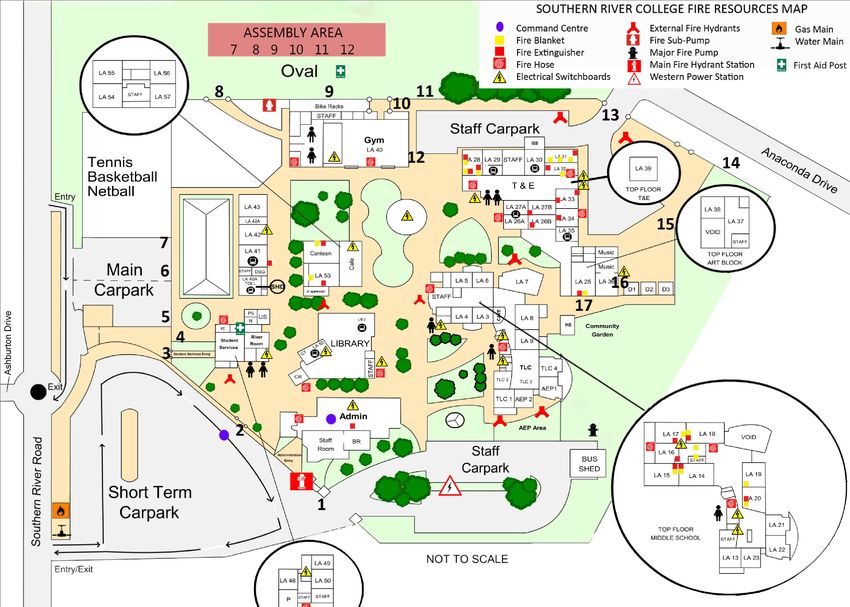
APPENDIX C: FIRE RESOURCES MAP

   0
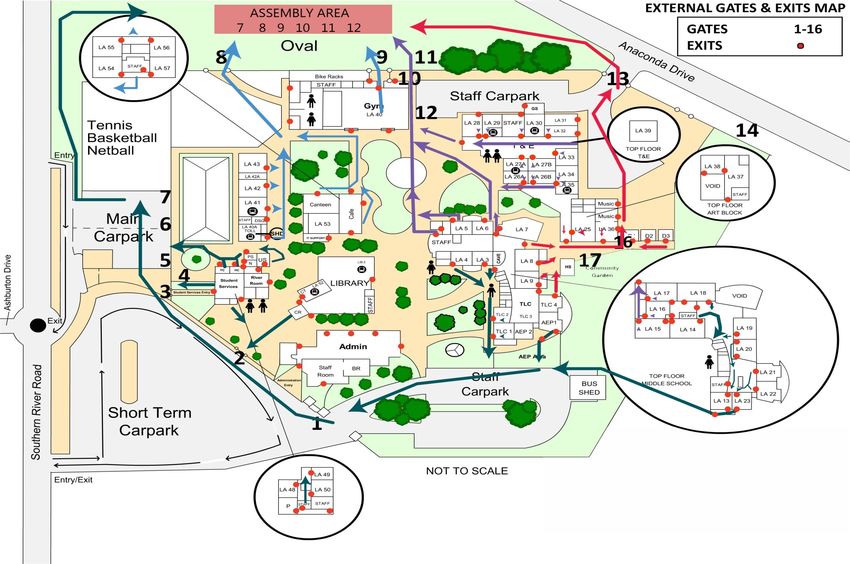
APPENDIX C: EVACUATION PATHWAY MAP

1

16
Appendix D: Communication Plan

17
Appendix E: Emergency Response Contact List

                             Assess    Evacuate       Inform   Organise    Undertake

 EMERGENCY CONTACT & PHONE NUMBERS                       ROLES AND RESPONSIBILITIES
 Police              Local:                              Evacuation: Principal  Siren/Pause x 3 or
                     GOSNELLS- 9398 0000                                        Continuous handbell
 000    131 444                                          Invacuation: Principal Continuous siren or short
                                                                                whistle blasts
 Hospital - Armadale       93912000                      Checking Rooms         Manager Corporate
                                                                                Services /Principal
 Local Ambulance           000 St Johns 93341234
 Fire 000                  Maddington Fire Station       Evacuation: on-site        Teachers
                           W: (08) 9459 2369             assembly point when
                                                         safe to evacuate off-
                           Community Emergency           site
                           Services Manager (or                                     Teachers
                           suitable local contact)       Invacuation:
                           94821711 94821721             classrooms
 Bus Contractors           Name: Buswest: 9395 4444      DEPARTMENT OF              1800 177 777 92221513
                           Path Transit 92209999         EDUCATION SECURITY

 Power Outage (Horizon     13 10 87                      Accredited First Aid       Staff member Name(s)
 Power or Western                                        Officers                   Kasia Schmidt extn 114; Kim
 Power)                                                                             Prescott Brown extn 227
 State Emergency           1325000     133337            Communication              Principal /Manager
 Service                                                                            Corporate Services

 Poisons Information       131 126                       Next of Kin Notification   Principal (Police if death)
 REGIONAL DIRECTOR         9336 9563
 Name: Susan CUNEO         mobile: 0422122809            Reporting and Review       Principal
       Gary Anderson
                           mobile: 0439967378
 PRINCIPAL                             Name Everal Eaton                    9495 3200 mobile: 0401497144

 MANAGER CORPORATE SERVICES            Name Karina Surmon                   9495 3200 mobile: 0427289003

                             In the case of an EMERGENCY
                                         Call 000
Appendix F: Sample Bushfire Response Telephone Tree
Coordinator Regional Operations School Board Chair P&C Regional Executive Director Police 000, 131 444 Gosnells 9398000 Ambulance 000 Hospital (Armadale) 93912000
Fire 000 SES 1325000; 133337 LEMC 94821711; 94821721
Will Davis Patricia Morris Karen Adams Sue Cuneo Local Government 1325000; 133337 DoE Security 1800 177 777; 92221513
9336 9545 9336 9563 Feeder Primaries AB 94901113; G 93982550; HD 9490944; S 93983388; SG 92347700
Path Transit 92209999
Principal Everal Eaton
Deputy Principal Deputy Principal Deputy Principal Operations manager Manager of Corporate Services Attendance &
Sharon Harry Frank DiFilippo Mike Erith Kirsten Dowd Karina Surmon Engagement Karen Jolly
M M M M M M
Cheryl Andrade Matthew Courtney Wilson Teresa Stoncius Brian Hand Roze Cole Robert Forte Stephen Daniel Grayce Brad Francis Dusty Ward Shiarne Felicity Weary Kim Pollock Terry Gemma
(Maths) George (LT & AEP) (VET) & EA’s (ICT Tech.) (Technologies) (Science) Meredith (HaSS) (HPE) (ARTS) Coole (Office Admin) O’Connell Woods
(English) (Student (Learning Delia Marwick (Canteen) (Participatio
Services) Communicati (G & C) n)
onCentre)
Shanae Alexander Emma Corke Rosie Walker Bernice Davies Keiran Erith Craig Roberts Cameron Tam Kelly Georgia Caine Caradoc Davies Marc Bikim Erin Smith Rachel Blundell Kim to Terry to Joy Arney
MacPherson contact other contact other
gardeners and canteen staff
workers on
site
Keegan Lane Phoebe Ellis Aiden Gustavino Jen Cleary Dylan Franklin Liesl De Vries Sandra Burns Kayla Allen Liberty Carter Crystal Diep Tessa Devenyns Tanika Bluett Faye Muncey Ellika
Carson
Grant Peters Kim Konisberry Tracey Hughes Michael De Kayla Di Toro Teale Gordon Lauren Dragon Richard Filer Duncan Finlay Kezia Grocott Kate Bonser Terry Walshe Brendon
Wind Cassey
Johannes Smeda Sione Murray Dana Jennifer Kirby Darren Harders Emma Leitner Nicola Hampton David Toothill Kamill Jinzarli Gayle Page Bev Cuthbert Hayley
Rajanayagam Cope
Argenes Siburian Annika Niha Kurt Winter Kim Prescott- Uma Pany Chandrika Susan Hawkins Selwyn Williams Blair Pasco Kira Pearce Cathy Kingsley
Brown Mannapperuma Hayward Hunter
Janet Yip Waseem Tina Smulders Helen Cameron Stephanie Clare Woulfe Kadiejayne Craig Wallace- Elli Nixon- Rebecca
Parkar Rozendaal Macpherson Howson Tirkot Gibb Smith Jane
Darcy Tam Symmans Jim Singleton Pheobe Siers Shaq Mckenzie Patrick Warr Jasmine Webber Debbie
Robinson Lambert
Nava Sabet Richard Ujma Lisa Scott- Emily McGuire Jamie Warman Chelsea
Hammer Mosedale
Nicole Todd Stacey Mourish Kyoko
Rounding
Leanne Ward Sharon Sale Jodee
Sontay
Julia Smit Jess
Stocker
Kasia Schmidt
Loren Welsh
20You can also read


