Standard Operating Procedure (SOP) Terminal Services - Version 1.0 - January 2020 - ECT
←
→
Page content transcription
If your browser does not render page correctly, please read the page content below
Standard Operating Procedure (SOP)
         Terminal Services
        Version 1.0 – January 2020
Introduction ............................................................................................................................................ 3
       General Information ............................................................................................................................... 4
            Contact details ................................................................................................................................ 4
            Working hours ................................................................................................................................ 5
            Terminal figures .............................................................................................................................. 6
       Truck handling......................................................................................................................................... 7
            Terminal Access .............................................................................................................................. 7
            Booking procedure (truck visit during Gate In opening hours) ...................................................... 7
            Booking procedure (truck visit outside Gate In opening hours)..................................................... 7
            Gate-in ............................................................................................................................................ 8
            Do it yourself desk (DIYD) ............................................................................................................... 8
            Counter ........................................................................................................................................... 8
            Gate-in barrier ................................................................................................................................ 9
            Container yard ................................................................................................................................ 9
            Gate-out barrier.............................................................................................................................. 9
       Barge handling ...................................................................................................................................... 10
       Rail handling.......................................................................................................................................... 11
       Storage .................................................................................................................................................. 12
            Full containers .............................................................................................................................. 12
       6.1.1.     Non-hazardous Cargo ........................................................................................................... 12
       6.1.2.          Hazardous Cargo (ADR/IMO)................................................................................................ 12
       6.1.3.          Waste ................................................................................................................................... 13
           Empty containers .......................................................................................................................... 13
           Interim Storage ............................................................................................................................. 13
       Depot, Container Maintenance & Repair ............................................................................................. 14
            Depot ............................................................................................................................................ 14
            Container Maintenance & Repair ................................................................................................. 14
       Local trucking ........................................................................................................................................ 15
       Auxiliary Terminal Services ................................................................................................................... 16
             Shifting of containers.................................................................................................................... 16
             Missing seals and labels ................................................................................................................ 16
             Off-standard handling................................................................................................................... 16
             Weighing of containers (VGM/SOLAS) ......................................................................................... 16
             Reefer containers ......................................................................................................................... 16
             Gas measurement......................................................................................................................... 16
             Removal or equipping of stowage material (e.g. GOH, flexi tank containers) ............................. 16
             Online services.............................................................................................................................. 17
             Electronic Data Interface (EDI) ..................................................................................................... 17
             Payment........................................................................................................................................ 17
           Additional Information ..................................................................................................................... 18
         General procedures and regulations ............................................................................................ 18
         Terminal Rules .............................................................................................................................. 18
         Claims ........................................................................................................................................... 18
         Privacy policy ................................................................................................................................ 18
Appendix A: Night-time truck handling application form ............................................................................. 19
Appendix B: List of UN-Numbers allowed in the DGA................................................................................... 20

                                                                                                                                                  2/20
Standard Operating Procedure Terminal Services                                                                               Hutchison Ports Duisburg
Version 1.0 – January 2020                                                                       DeCeTe Duisburger Container-Terminalgesellschaft mbH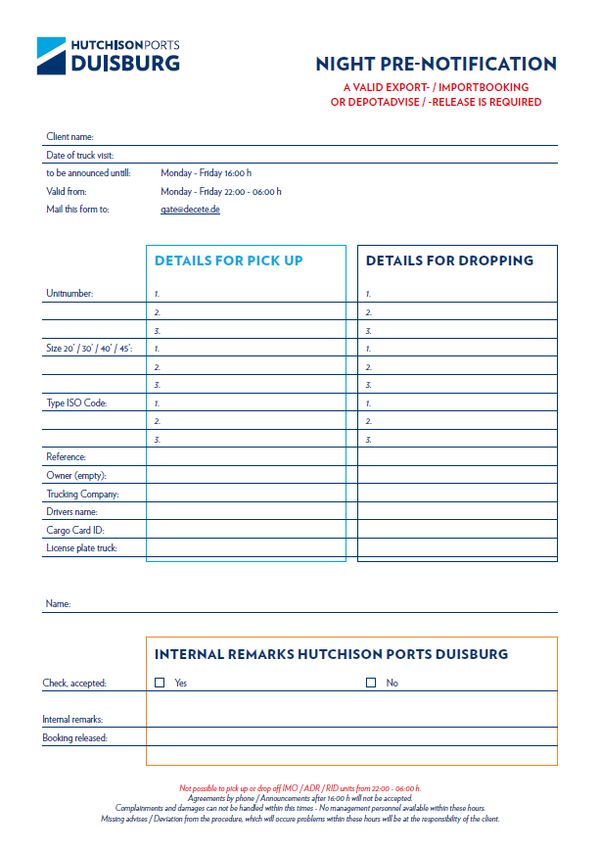
Introduction
Hutchison Ports Duisburg provides container terminal services as well as auxiliary services. This
document describes the Standard Operatiing Procedure (SOP) according to which the services are
offered.

This document provides insight to our operations , processes, procedures and contact details and is
updated and reviewed on regular basis. In case no deviations are agreed in written, this SOP is
applicable in its full extend.

This document should be read in conjunction with other relevant rules, conditions and regulations
that are applicable at Hutchison Ports Duisburg, i.e. (amongst others) the ISPS Code, AEO
Regulations, Hutchison Ports Duisburg Terminal Rules, Traffic Regulations and the Term & Conditions
EGS and Hutchison Ports Inland Terminals1.

1

https://www.ect.nl/sites/www.ect.nl/files/documenten/publicaties/terms_conditions_egs_and_hutchison_ports_inland_terminals_18618
513_1.pdf
                                                                                                                             3/20
Standard Operating Procedure Terminal Services                                                          Hutchison Ports Duisburg
Version 1.0 – January 2020                                                  DeCeTe Duisburger Container-Terminalgesellschaft mbH
General Information
Contact details
Trade name: Hutchison Ports Duisburg
Chamber of commerce: DeCeTe Duisburger Container-Terminalgesellschaft mbH
Phone: +49 (0)203 80 90 60 (during office hours)
+49 (0) 163 80 90 156 (during operational hours)
Email: tpc@decete.de (Terminal Planning & Control)
Websites: www.hutchisonportsduisburg.de
Visiting address: Office: Stahlinsel 9, 47138 Duisburg
Gate In: Alte Ruhrorterstrasse 20-22, 47119 Duisburg
ISPS: 22.07.01-DU17
AEO-F: DE/AEOF/115867
Public information according to §§ 8a and 11 Störfallverordnung (12.BImSchV) is available on our
website www.hutchisonportsduisburg.de.
Refer to the contact sheet on our website for a detailed telephone and email list:
www.hutchisonportsduisburg.de.
4/20
Standard Operating Procedure Terminal Services Hutchison Ports Duisburg
Version 1.0 – January 2020 DeCeTe Duisburger Container-Terminalgesellschaft mbHWorking hours
Barge handling 24/7
Rail handling 24/7
Truck handling Monday 06:00h – Saturday 06:00h 24h/day
Office hours Terminal Planning & Control Monday – Friday 05:30h – 18:30h
Gate Monday – Friday 05:00h – 21:45h
Gate (DIYD) Monday – Saturday 05:00h – 05:45h
Depot Monday – Friday 08:00h – 16:15h
Container Repair Monday – Friday 06:00h – 15:30h
Weekends and national holidays open on request
Others
and availability. Surcharges apply.
Request of barge/rail timeslot 2 days before day of arrival (ETA - 48hrs)
Confirmation of barge/rail timeslot 1 day before day of arrival (ETA – 24hrs)
Data closing – export containers (all
D-1 13:00h (16h prior to dispatch)
documents)
Cargo closing – export containers present at
D-1 17:00h (12h prior to dispatch)
terminal:
Terminal and office is closed during the following
national holidays.
- Christmas 24.12 14:00h until 27.12 06:00h
- New Year 31.12 14:00h until 02.01 06:00h
Terminal and office is closed during the following
national holidays. Rail and barge handling possible
only on request and availability. Surcharges apply.
Operations stop from 22:00h prior to the national
holiday and restart 06:00 h after the national
Openings hours during holidays
holiday. Gate closes 45 minutes before operation
stops.
National holidays are:
- Good Friday
- Eastern (1st and 2nd)
- Pentecost (1st and 2nd)
- 1st of May
- Ascension Day
- Corpus Christi
5/20
Standard Operating Procedure Terminal Services Hutchison Ports Duisburg
Version 1.0 – January 2020 DeCeTe Duisburger Container-Terminalgesellschaft mbHTerminal figures
Area: 17,9ha
Hafen: Rhine, Vinckekanal km 780,76
Quai length: 800m
Quai draught: Depending on actual water level of River Rhein, Pegel Ruhrort
Refer to www.elwis.de
Railtracks: 2 x 750m (accessible via DB Netz Station Duisburg Meiderich track 241)
Stack capacity: 16.600 TEU
Portal cranes: 3
Reachstacker: 4 + 1 backup
Empty handler: 4
Terminal trucks: 6
Max. SWL 41t
Sizes 20ft-30ft-40ft-45ft, off-standard on request only
6/20
Standard Operating Procedure Terminal Services Hutchison Ports Duisburg
Version 1.0 – January 2020 DeCeTe Duisburger Container-Terminalgesellschaft mbHTruck handling
Terminal Access
Access to and from the Hutchison Port Duisburg is controlled by the so-called Cargo Card (Supplier:
Secure Logistics). Drivers are required to show proof of identity with their Cargo Card and proper
documents to gain access to the terminal.
Terminal access consist of three checkpoints:
- The Gate In where drivers check in by Do-It-Yourself-Desk (DIYD) or report at the counter.
Terminal time starts at the moment the driver check himself in.
- At the gate-in barrier the TOS registers the gate in move of the container.
- At the gate-out barrier the TOS registers the gate out move of the container.
A Cargo Card can be requested online at:
https://www.secure-logistics.nl/en_GB/solutions/cargocard/apply-for-a-cargocard/
Cargo Cards that have been received from Secure Logistics can be activated at the pre-gate area.
Truck drivers who cannot present a valid Cargo Card at the Gate In are offered the option to buy a
single trip card at the counter, which is valid for one truck visit only. Payment only by valid
(European) credit- and debit cards.
Enquiries can be made via gate@decete.de
Booking procedure (truck visit during Gate In opening hours)
A valid and confirmed booking must be made in order to collect or drop a container by truck at our
terminal. This can be done by mail (tpc@decete.de) or by EDI. The information should at least
contain:
- Unit number
- Unit type (ISO code)
- Unit size
- Reference number
- IMO/ADR/RID class
- Nett weight of the unit
- Cargo
Please refer to our online container status service to check if the container is released for pickup.
Booking procedure (truck visit outside Gate In opening hours)
During night-time (22:00h – 06:00h), truck visits are possible only with a pre-notification, Cargo Card
and DIYD. At latest 16:00h prior to the night of the truck visit an application form should be filled out
and send to gate@decete.de (refer to appendix A).
Only after written confirmation of an order the truck driver can visit the terminal. Please refer to our
online container status service (see paragraph 9.8) to check if the container is released for pickup.
Please note that no hazardous cargo (ADR) can be dropped off or collected during night-time.
Containers containing waste on request only (documents must be issued electronically in advance).
7/20
Standard Operating Procedure Terminal Services Hutchison Ports Duisburg
Version 1.0 – January 2020 DeCeTe Duisburger Container-Terminalgesellschaft mbHGate-in
The truck driver enters the premises and parks the truck at the truck buffer. Please note the specific
lanes for empty and full containers.
All empty (depot) containers are checked by our checkers according to the IICL Standard (visual and
photographs). For this, on request, the driver has to open the doors of the container. Only the first
truck in the row will be checked because of safety matters.
For both full and empty tank containers a registration form needs be filled out by the driver and
checker that shall be presented at the counter.
Flat containers will be checked by the checker for handlings with twist locks and if the cargo is
secured properly. In case of doubt, the driver has to present a lashing document. If cargo is not
secured properly the container may be refused.
At the Gate In the truck driver can register himself at the DIYD or at the counter.
A valid reference has to be presented at the Gate In. Without a valid reference a container cannot be
dropped off, unless the trucking company has a valid “Temporary Storage”-facility at our terminal.
Please refer to our “reference check” service at our website to verify the container has been released
prior to the truck visit.
Containers and trucks are overlooked by CCTV at the Gate In.
Do it yourself desk (DIYD)
At the DIYD the truck driver can check and register the truck visit for:
Picking up or dropping an empty container
Picking up or dropping a full container
The DIYD will guide the truck driver through the process after which a route plan with driving
directions is printed. The truck driver proceeds to the gate-in barrier.
Containers containing ADR/IMO goods or waste cannot be processed at the DIYD and are processed
only at the counter. Also (empty or full) tank containers can only be processed at the counter.
No customs formalities are processed or checked at the DIYD. Customer and/or driver must at all
times take care of any and all import and export formalities and customs formalities with respect to
the container and is responsible to fulfil all obligations resulting out of these formalities.
Counter
The truck driver reports himself at the counter, handing over the information required (refer to the
booking procedure) and/or ADR/waste documents.
The gate employee will verify driver’s ADR-license, ADR-equipment and ADR-transport document.
Failing ADR/IMO stickers can be obtained at the counter.
No customs formalities are processed or checked at the counter. Customer and/or driver must at all
times take care of any and all import and export formalities and customs formalities with respect to
the container and is responsible to fulfil all obligations resulting out of these formalities.
8/20
Standard Operating Procedure Terminal Services Hutchison Ports Duisburg
Version 1.0 – January 2020 DeCeTe Duisburger Container-Terminalgesellschaft mbHGate-in barrier
Truck drivers can only physically enter the terminal if the Gate In process has been completed
successfully. The truck driver presents the Cargo Card to the pedestal and access is gained to the
premises.
Container yard
Arriving at the determined location on the yard, the truck is identified by the reach truck driver by
the truck license number. After the container is loaded or unloaded the truck driver can proceed to
its next location (showed at the route plan) or proceed to the gate out barrier.
Gate-out barrier
The truck driver presents the Cargo Card to the pedestal and can leave the terminal premises. A gate
out is registered in the TOS at the moment the Cargo Card is accepted.
An interchange is registered electronically in the TOS, that can be send by email upon request via
tpc@decete.de.
Containers and trucks are overlooked by CCTV at the gate out barrier.
9/20
Standard Operating Procedure Terminal Services Hutchison Ports Duisburg
Version 1.0 – January 2020 DeCeTe Duisburger Container-Terminalgesellschaft mbHBarge handling
The barge operator shall send a complete barge call request to tpc@decete.de at least 48 hours prior
to the estimated time of arrival (ETA) at Hutchison Port Duisburg.
The barge call request has to include the following information:
• Operator
• Barge name
• Barge contact details
• Call Sign
• ETA/ETD
• Move Count
• Complete list of container numbers including (per container):
o size-type (ISO)
o Full/empty
o Origin / destination
o total weight
o IMO / UN / ADR information
o Reefer connection required on terminal Y/N
o Damaged Y/N
Requests for barge calls during weekdays shall be send at latest 48 hours before desired timeslot.
Confirmation of timeslots at latest 24h before ETA barge.
Requests for barge calls during weekends (Saturday 06:00h until Monday 06:00h) shall be send at
latest 48 hours before desired timeslot or at latest Thursday 12:00h (earliest moment applies).
Request is based on availability and will be confirmed at latest Friday 12:00h.
Request for barge calls during national holidays shall be send at latest 7 days prior to the national
holiday. Request is based on availability.
A stowage plan must send per email during office hours and at latest ATA rail – 3h to
platzmeister@decete.de.
All empty containers will be checked according to the IICL standards (refer to Depot/Repa Section).
No customs formalities are processed or checked by our dispatchers. Customer and/or operator
must at all times take care of any and all import and export formalities and customs formalities with
respect to the container and is responsible to fulfil all obligations resulting out of these formalities.
10/20
Standard Operating Procedure Terminal Services Hutchison Ports Duisburg
Version 1.0 – January 2020 DeCeTe Duisburger Container-Terminalgesellschaft mbHRail handling
Please check our website for the latest procedure according to the European Regulation 2017/2177.
www.hutchisonportsduisburg.de
The rail operator shall send a complete train call request to tpc@decete.de at least 48 hours prior to
the estimated time of arrival (ETA) at Hutchison Port Duisburg.
The train call request has to include the following information:
• Operator
• Train contact details
• Train length
• Call Sign
• ETA/ETD
• Move Count
• Complete list of container numbers including (per container):
o size-type (ISO)
o total weight
o IMO / UN / ADR information
o Reefer that has to be connected
Requests for train calls during weekdays shall be send at latest 48 hours before desired timeslot.
Confirmation of timeslots at latest 24h before ETA train.
Requests for train calls during weekends (Saturday 06:00h until Monday 06:00h) shall be send at
latest 48 hours before desired timeslot or at latest Thursday 12:00h (earliest moment applies).
Request is based on availability and will be confirmed at latest Friday 12:00h.
Request for train calls during national holidays shall be send at latest 7 days prior to the national
holiday. Request is based on availability.
A stowage plan must send per email during office hours and at latest ATA rail – 3h to
platzmeister@decete.de.
All empty containers will be checked according to the IICL standards (refer to Depot/Repa Section).
No customs formalities are processed or checked by our dispatchers. Customer and/or operator
must at all times take care of any and all import and export formalities and customs formalities with
respect to the container and is responsible to fulfil all obligations resulting out of these formalities.
11/20
Standard Operating Procedure Terminal Services Hutchison Ports Duisburg
Version 1.0 – January 2020 DeCeTe Duisburger Container-Terminalgesellschaft mbHStorage
Storage of containers is overall coordinated by the Terminal Planning & Control department
(tpc@decete.de). Within this department, the following sub departments reside:
- Quay-, rail track- and stack planning (TPC)
- Depot
- Container Repair
Full containers
6.1.1. Non-hazardous Cargo
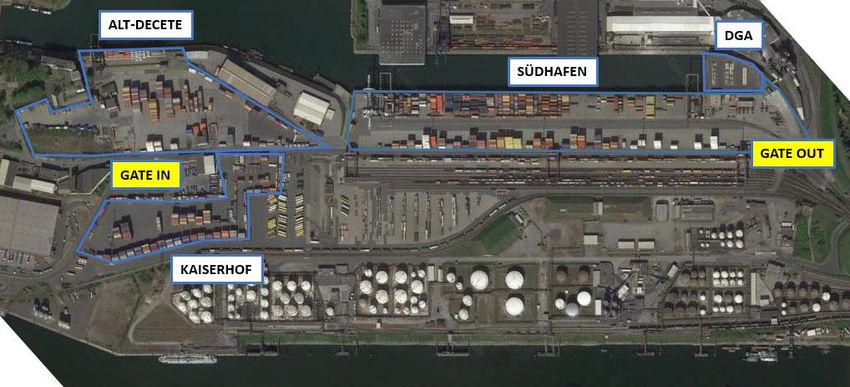
Full containers are stored at our yard in Südhafen according to the AEO and ISPS regulations. The
area is controlled by fences, CCTV and barriers.
6.1.2. Hazardous Cargo (ADR/IMO)
Hutchison Ports Duisburg can store hazardous goods containers in a dedicated depot on request. The
possibility to store hazardous goods containers needs to be checked and approved at latest 2 hours
before ETA (during office times TPC) .
The terminal will not accept the following hazardous good classes:
• Class 1, except for Subdivision 1.4
• Class 6.2
• Class 7
Hazardous goods labels can be purchased at the gate-in.
Intermodal containers
Transport bound containers can be handled and reside on the terminal up to a maximum of 24 hours.
Outbound containers shall be dropped off at earliest 24 hours before ETA barge or train. Inbound
containers have to be picked up at latest 24 hours after ATD barge or train.
Hutchison Ports Duisburg explicitly excludes liability for the timely pickup or drop off of containers.
Customers will be informed when containers reside longer than 24 hours on our terminal. For
containers that reside longer than 24 hours on our terminal, Hutchison Ports Duisburg reserves the
right to transfer the container to its Dangerous Goods Area (DGA) without prior notice. Surcharges
apply.
Allowed:
IMO Class 1.4 S (except Class 1) Not allowed:
IMO Class 2 IMO Class 1
IMO Class 3 IMO Class 6.2
IMO Class 4.1 IMO Class 7
IMO Class 4.2
IMO Class 4.3
IMO Class 5.1
IMO Class 5.2 (on request / limited, organic Peroxide)
IMO Class 6.1
IMO Class 8
IMO Class 9
12/20
Standard Operating Procedure Terminal Services Hutchison Ports Duisburg
Version 1.0 – January 2020 DeCeTe Duisburger Container-Terminalgesellschaft mbHDangerous Goods Area (DGA)
Within the DGA containers contain hazardous cargo can be stored (longer than 24 hours). Storage of
these containers is subject to availability and subject to limitations concerning UN-Number and
amount. Please contact Terminal Planning & Control for the latest availability. Storage within the
DGA is restricted to a maximum of 34 20ft slots and the UN list according to appendix B.
6.1.3. Waste
Containers containing waste with the following European Waste Codes (EWC) can be handled at
Hutchison Ports Duisburg.
15 01 02 Plastic packaging
19 12 10 combustible waste (refuse derived fuel)
19 12 12 other wastes (including mixtures of materials) from mechanical treatment of wastes other than those mentioned
in 19 12 11
07 02 13 Plastic waste
15 01 01 Packaging made from paper and cardboard
19 12 01 Paper and cardboard
20 01 01 Paper and cardboard
16 01 19 Plastic
17 02 03 Plastic
19 12 04 Plastic and rubber
20 01 39 Plastics
The following restrictions apply:
- Only transport bound storage of 24 hours maximum
- Maximum of 64 handlings in total per calendar day
- Handling of maximum of 1.600 tonnes per day
Please contact Terminal Planning & Control prior to shipping to verify the availability of waste
handling.
Empty containers
Transport bound empty containers are stored in our yard at Alt-DeCeTe or Südhafen. Inquiries
related to empty containers via tpc@decete.de.
Empty containers stored in a depot are stored in our yard in Alt-DeCeTe or Kaiserhof. These areas are
not entirely controlled by fences or barriers. Inquiries related to depot containers via
depot@decete.de.
Interim Storage
Hutchison Ports Duisburg offers the opportunity to customers to have a dedicated interim storage
facility. This enables (truck) operators to drop off containers although a booking has not been
verified completely (e.g. reference is missing) or (truck) operators need to have a container
temporarily stored for later pickup. Containers can be picked up again by truck or Hutchison Ports
Duisburg, by order of the (truck) operator, can facilitate the transfer to the appropriate stack
including the administrative process required.
The container remains under the supervision and control of the (truck) operator until all information
required has been handed over to Hutchison Ports Duisburg and the administrative process has been
completed. Hutchison Ports Duisburg accepts no liability whatsoever (e.g. detention). On request,
Hutchison Ports Duisburg can send a list of containers present in the temporary storage to the (truck)
operator.
13/20
Standard Operating Procedure Terminal Services Hutchison Ports Duisburg
Version 1.0 – January 2020 DeCeTe Duisburger Container-Terminalgesellschaft mbHDepot, Container Maintenance & Repair
Depot
Empty containers can be stored in depot at Hutchison Ports Duisburg. Our Terminal Planning &
Control employees are able to monitor stock levels and manage FIFO of containers.
Container Maintenance & Repair
Our M&R Department (repa@decete.de) at Hutchison Ports Duisburg offers a complete depot
service. The services include:
- Repair of box containers including the supply of materials required
- Sweeping of containers
- Cleaning of containers
- Labelling of containers
- Seal replacement
- Removal of equipment in GOH containers
- Equipping or removal of containers with flexi tanks including waste disposal
All inbound empty box containers coming in by truck, rail or barge are checked by skilled checkers
according to the IICL and ACEP standards (note: tank containers, reefers and flats are not checked for
M&R purposes). Containers are also checked for compliance to flexi tank standards but are not
checked for compliance to food grade standards.
After a container has been checked, a cost estimate of the repairs required is send to the customer
(per mail or EDI). After written approval of the estimate the container is repaired and then
transferred to the empty depot.
Also on request we can facilitate PTI and repair of reefers. Please contact our M&R Department for
further inquiries.
14/20
Standard Operating Procedure Terminal Services Hutchison Ports Duisburg
Version 1.0 – January 2020 DeCeTe Duisburger Container-Terminalgesellschaft mbHLocal trucking
Hutchison Port Duisburg can provide local trucking services for the transport of containers to or from
a location near the terminal (typically up to 10km). Services are offered 24/5 and during weekends
based on request and availability, either as a shuttle service or per single trip.
An order shall be placed at latest 24h before ETA chassis at warehouse at the Terminal Planning &
Control department with the following information:
- Address
- Container number
- Type/size
- Date and time of pickup/delivery
- Reference number if applicable
Our standard service includes:
- Docking of the chassis backwards at an (un)loading dock at the warehouse
- Doors closed and sealed
Upon request of the warehouse manager, doors can be opened (in presence of a warehouse
employee) prior to docking the chassis when the following criteria are met and accepted in written:
- The warehouse facilitates our driver to work according to the local labour conditions
legislation (e.g. drivers may not open doors of the container on a chassis when standing on
ground level)
- Prior to opening of the container the seal is checked by an employee of the warehouse
- The warehouse indemnifies Hutchison Ports Duisburg from all liability in case of damages to
container or cargo when driving backwards
- The warehouse indemnifies Hutchison Ports Duisburg from all liability that may result from
customs formalities
15/20
Standard Operating Procedure Terminal Services Hutchison Ports Duisburg
Version 1.0 – January 2020 DeCeTe Duisburger Container-Terminalgesellschaft mbHAuxiliary Terminal Services
Several auxiliary services are offered at Hutchison Port Duisburg. On request services can be tailor-
made; please contact the commercial department for inquiries (decete-sales@decete.de).
Shifting of containers
On request shifting of containers is possible on truck, barge or train. Shifting container means
repositioning of containers on the same truck, barge or rail wagon set.
Missing seals and labels
Hazardous goods labels and seals can be purchased at the gate-in.
Off-standard handling
On request, handling of off-standard containers is possible (rail, barge and truck). Inquiries via
tpc@decete.de.
Weighing of containers (VGM/SOLAS)
Containers can be weighed to determine the Verified Gross Mass (VGM) according to the SOLAS
regulation. A weighing order should be included in the booking. After weighing a certificate (PDF) is
sent per email to the customer.
It is not possible to weigh non-intermodal containers (e.g. truck in – truck out).
Reefer containers
Reefers slots are available on request to accommodate storage of live reefers and depending on
current availability (will be verified upon order). A request must at least contain the following
information:
- Number of reefers and container numbers
- Desired storage duration including ETA and ETD terminal
- Settings
Upon connection and disconnection of the reefer to the reefer slot the setting is checked to the
actual reading and logged by Hutchison Ports Duisburg. A report shall be send to the customer by
email. In case of a power outage the customer is informed promptly and Hutchison Ports Duisburg
will await further instructions. Monitoring of a connected reefer is not part of our standard service
and could be made available on request for which a customer specific SOP will be drafted.
Gas measurement
Hutchison Port Duisburg facilitates gas measurement. Fumigation services are not allowed on the
premises.
Removal or equipping of stowage material (e.g. GOH, flexi tank containers)
Hutchison Port Duisburg provides services for equipping or removal of stowage material from
containers (e.g. Garments On a Hanger, Flexitanks). A work order shall be placed at least 5 days in
advance to repa@decete.de.
16/20
Standard Operating Procedure Terminal Services Hutchison Ports Duisburg
Version 1.0 – January 2020 DeCeTe Duisburger Container-Terminalgesellschaft mbHOnline services
It is possible to check the status (e.g. release status) of a container prior to a visit to Hutchison Ports
Venlo in order to verify the container is available for pickup, through our online service:
https://status.hutchisonportsduisburg.de/
Electronic Data Interface (EDI)
Upon request a tailor-made EDI connection can be realized in multiple programming languages (e.g.
EDIFACT, XML/EDIFACT, JSON) to facilitate swift order processing and information exchange.
Amongst others, the following messages can be facilitated: APERAK, CODECO, COEDOR, CONTRL,
COPARN, COPINO, COREOR, DESTIM, GATEIN, GATOUT, IFTMIN, IFSTA, MERC+, WESTIM, XML.
Payment
Services booked prior to a visit to the terminal are invoiced digitally (PDF). Services requested during
a visit to the terminal shall be paid immediately by means of credit/debit card (no cash is accepted).
17/20
Standard Operating Procedure Terminal Services Hutchison Ports Duisburg
Version 1.0 – January 2020 DeCeTe Duisburger Container-Terminalgesellschaft mbHAdditional Information
General procedures and regulations
Procedures are in place to mitigate foreseen and unforeseen situations, such as:
• (Thunder)storms
• Flood calamity
• Emergencies / calamities
• ADR/IMO
• Port Facility Security Plan
In addition, Hutchison Ports Duisburg has to comply with the following regulations:
• AEO
• ISPS
• Störfallverordnung (12. BImSchV)
Please note that in case of (un)foreseen situations and to comply with the regulation, measures have
to be effected that may have an impact on terminal operations.
Terminal Rules
The Hutchison Ports Duisburg Terminal Rules, available through www.hutchisonportsduisburg.de2,
are applicable on the entire premises. Hutchison Ports Duisburg withholds the right to refuse access
to the terminal in case of failure to comply with these regulations and to update the regulations
periodically. The latest version is applicable at all times.
Claims
Claims are to be sent to claims-du@decete.de after which the claim will be reviewed. Only after
written confirmation of our claim department (including unique claim number) an invoice can be
sent to Accounts Payable. Invoices on which a claim number is missing will not be processed.
Privacy policy
Reference is made to www.hutchisonportsduisburg.de3 to obtain the latest version of our privacy
policy. Hutchison Ports Duisburg withholds the right to update this policy. The latest version is
applicable at all times.
2
https://www.ect.nl/sites/www.ect.nl/files/documenten/publicaties/ect_decete_veiligheidsfolder_terminalordnung_1j_eng_2.pdf
3
https://www.ect.nl/sites/www.ect.nl/files/documenten/publicaties/datenschutzerklarung_decete_def_0.pdf
18/20
Standard Operating Procedure Terminal Services Hutchison Ports Duisburg
Version 1.0 – January 2020 DeCeTe Duisburger Container-Terminalgesellschaft mbHAppendix A: Night-time truck handling application form
19/20
Standard Operating Procedure Terminal Services Hutchison Ports Duisburg
Version 1.0 – January 2020 DeCeTe Duisburger Container-Terminalgesellschaft mbHAppendix B: List of UN-Numbers allowed in the DGA
As of 11-10-2016
20/20
Standard Operating Procedure Terminal Services Hutchison Ports Duisburg
Version 1.0 – January 2020 DeCeTe Duisburger Container-Terminalgesellschaft mbHUN.-Nr. für Lfd. Nr. genehmigter Stoff / Systematische Beispielhafter Max. Lager- Anhang I Gefahren- WGK VCI-Lager- H- Sätze Einstufung Gefahrgut TRGS 510
Beispiel Zubereitung zur Bezeichnung für Handelsname menge int. zur merkmal klasse KAS Klasse Lagerklasse
Bezeichnung UN-
Lagerung gewähltes Beispiel (aus StörfaIIV 1b/Seveso ADR (Ersatz seit
Nummer
Ursprungsdatei) Nr. III 2010 für VCI-
Leitfaden)
1090 50 Aceton Aliphatische und Aceton Aceton 224 - Xi, F 1 3A 225, 319, P5c 3 LGK 3
cycloaliphatische Ketone 336
1093 10 Acrylnitril, stabilisiert Carbonsäurenitrile Acrylnitril Acrylnitril 198 7b, 2 F,T, N 3 3A 225, 350, P5c, H2, E2 3 LGK 3
331, 301,
361, 335,
315, 318,
317, 411
1105 30 Pentanole n-Amylalkohol n-Amylalkohol 224 - Xn 1 3A 226, 332, P5c 3 LGK 3
315, 319,
335
1106 6 Amylamin Aliphatische Amine Amylamin 224 - F, C* 1 3A 225, 302, P5c 3 LGK 3
312, 314
1114 11 Benzen Benzol Benzol Benzol 198 2 T, F 3 3A 225, 304, P5c 3 LGK 3
315, 319,
340, 350,
372, 412
1120 33 Butanole n-Butanol n-Butanol n-Butanol 224 - Xn 1 3A 226, 302, P5c 3 LGK 3
318, 315,
335, 336
1120 41 Butanole tert-Butylalkohol 2-Methyl-propanol-2 tert-Butylalkohol 224 - Xn 1 3A 226, 302, P5c 3 LGK 3
318, 315,
335, 336
1120 65 Butanole Butanol Butanol 224 - F, Xn 1 3A 226, 302, P5c 3 LGK 3
318, 315,
335, 336
1123 66 Butylacetate normal-Butyiacetat 224 - 1 3A 226, 336 P5c 3 LGK 3
normal-Butylacetat
1127 67 Chlorbutane 1-Chlorbutan 1-Chlorbutan 224 - F 2 3A 225 P5c 3 LGK 3
1135 76 Ethylenchlorhydrin Epichlorhydrin Epichlorhydrin 198 2 T 3 3A 226, 301, P5c, H2 3 LGK 3
311, 314,
317, 350
1148 90 Diacetonalkohol Diacetonalkohol Diacetonalkohol 224 - Xi 1 3B 226, 319 P5c 3 LGK 3
1157 51 Diisobutylketon Aliphatische und Diisobutylketon Diisobutylketon 224 - Xi 1 3A 226, 335 P5c 3 LGK 3
cycloaliphatische Ketone
1157 78 Diisobutylketon Diisobutylketon Diisobutylketon 224 - Xi 1 3A 226, 335 P5c 3 LGK 3
1159 58 Diisopropylether Diisopropylether Diisopropylether 224 - F 1 3A 225, 336 P5c 3 LGK 3
1170 21 Ethanol Ethanol Ethanol Ethanol Spiritus 224 - F 1 3A 225, 319 P5c 3 LGK 3
1173 63 Ethylacetat Ethylacetat Ethylacetat 224 - F, Xi 1 3A 225, 319, P5c 3 LGK 3
336
1193 52 Ethylmethylketon Aliphatische und Ethylmethylketon 224 - F, Xi 1 3A 225, 319, P5c 3 LGK 3
cycloaliphatische Ketone Ethylmethylketon 336
1198 106 Formaldehydlösung, Formaldehyd in flüssigen Formaldehyd Formaldehyd 198 2 T 2 6.1 A 301, 311, 14 3 LGK 3
entzündbar Zubereitungen, 331, 314,
insbesondere wässrigen, 317, 335,
mit Methanol stabilisierten 341, 350,
Lösungen 3701203 46 Benzin oder Ottokraftstoff Benzine Ottokraftstoff Ottokraftstoff 224 13 F+,T 3 3A 224, 304, 34 3 LGK 3
315, 336,
340, 350,
361, 411
1208 32 Hexane n-Hexan n-Hexan 224 - F, Xn, N 1 3A 225, 361f, P5c, E2 3 LGK 3
304, 373,
315, 336,
411
1219 48 Isopropylalkohol Aliphatische Alkohole Isopropanol 224 - Xi, F 1 3A 225, 319, P5c 3 LGK 3
außer Methanol 336
1221 5 Isopropylamin Aliphatische Amine Isopropylamin 224 8 F+, Xi 2 3A 224, 301, P5a, H2 3 LGK 3
311, 331,
314, 318
1223 75 Kerosin Düsenkraftstoff Düsenkraftstoff 224 - Xn 1 3A 226, 304, 34 3 LGK 3
315, 336,
411
1247 82 Methylmethacrylat Methylmethacrylat Methylmethacrylat 224 - F, Xi 1 3A 225, 315, P5c 3 LGK 3
monomer, stabilisiert monomer, 317, 335
stabilisiert
1261 68 Nitromethan Nitromethan Nitromethan 224 - Xn 2 3A 226, 302 P5c 3 LGK 3
1263 15 Farbe oder Butylacetat Lösemittelgemisch Leitlackverdünner 224 - - 2 3A 226, 336 P5c 3 LGK 3
Farbzubehörstoffe
1274 35 n-Propanol Aliphatische Alkohole n-Propanol 224 - 1 3A 225, 318, P5c 3 LGK 3
(außer Methanol) F, Xi, Xn 336
1280 9 Propylenoxid Propylenoxid Propylenoxid Propylenoxid 49 33 F+,T 3 3A 224, 350, 21 3 LGK 3
340, 331,
311, 302,
315, 319,
335,
1289 64 Natriummethylat, Lösung Natriummethylat Natriummethylat 224 10a F, C 1 3A 228, 251, O1 3 LGK 3
in Alkohol Lösungen in Alkohol Lösungen in 290, 302,
Alkohol 314
1294 42 Toluen Toluol Toluol Toluol 224 - F,Xn 2 3A 225, 361d, P5c 3 LGK 3
304, 373,
315, 336
1307 31 Xylene Monocyclische 224 - Xn 2 3A 226, 304, 3 LGK 3
aromatische 312, 332,
P5c
Kohlenwasserstoffe 315, 319,
(außer Benzol), Xylole 335, 412
1350 216 Schwefel Schwefel Schwefel 224 - F - 11 315 - 4.1 LGK 4.1 B
1408 100 Ferrosilicium mit Ferrosilicium mehr als Ferrosilicium mehr 448 - - 1 4.3 261, 302, - 4.3 LGK 4.3
mindestens 30 Masse-%, 30% aber weniger als als 30% aber 312, 332
aber weniger als 90 90% Silicium enthaltend weniger als 90%
Masse-% Silicium Silicium enthaltend
1564 125 Bariumverbindung, N.A.G. Bariumhydroxid Bariumhydroxid Bariumhydroxid 448 - Xn 1 6.1 B 302, 314, - 6.1 LGK 6.1 B
318
1578 107 Chlornitrobenzene, fest o-Nitrochlorbenzol o-Nitrochlorbenzol o-Nitrochlorbenzol 198 2 T, N 2 6.1 AL 351, 341, H2, E2 6.1 LGK 6.1 A
331, 311,
301, 373,
4111671 108 Phenol, fest Phenol Phenol Phenol 198 2 T 2 6.1A 331, 301, H2 6.1 LGK 6.1 A
311, 314,
341, 373
1690 124 Natriumfluorid, fest D Natriumfluorid Natriumfluorid 198 2 T 1 6.1 B 301, 315, H2 6.1 LGK 6.1 B
319
1708 85 Toluidine o-Toluidin o-Toluidin 198 2 T, N 3 3B 301, 311, E1, H2 6.1 LGK 6.1 D
331, 319,
373, 400,
410
1715 17 Essigsäureanhydrid Carbonsäureanhydride Essigsäurean- 198 - C 1 3A 226, 302, P5c, H2 8 LGK 3
hydrid 331, 314,
335
1717 8 Acetylchlorid Carbonsäurehalogenide Acetylchlorid 224 - F, C 1 3A 225, 302, P5c 3 LGK 3
314
1719 147 Ätzender alkalischer Calciumhydroxid, Calciumhydroxid, 448 - C 1 8B 314 - 8 LGK 8 B
flüssiger Stoff, N.A.G. Suspension in Wasser Suspension in
Wasser
1736 158 Benzoylchlorid Benzoylchlorid Benzoylchlorid 198 - C 2 8B 302, 330, H2 8 LGK 6.1 A
315, 318,
335, 350,
373
1738 233 Benzylchlorid Benzylchlorid rein Benzylchlorid 198 - 3 6.1 AL 302, 312, H2 6.1 LGK 6.1 A
331, 314,
317, 318
122 Chloressigsäure, fest Halogenierte aliphatische Chloressigsäure 198 2 T, N50 2 6.1 B 301, 311, H2, E1 6.1 LGK 6.1 D
Carbonsäuren 330, 314,
318, 335,
1751 400
1755 149 Chromiumsäure, Lösung Chromsäure, Lösung Chromsäure, 198 2 1 8B 271, 301, H2, P8, E1 8 LGK 5.1 A
Lösung 311, 330,
314, 317,
334, 335,
340, 350,
361f, 372,
T, N, C, O 400, 410
1759 53 Ätzender fester Stoff Tenside, quaternäre Tensid, quaternäres Arquad 2HTB-85 224 9a N 3 8B je nach Stoff E1/E2 8 LGK 8 B
Ammoniumsalze, teilweise Ammoniumsalz
mit Isopropylalkohol
1760 137 Ätzender flüssiger Stoff, Tetralkylammoniumhaloge Kokosbenzyl- Arquad MCB-50EP 448 9a C, N 2 8B je nach Stoff E1/E2 8 LGK 8 B
N.A.G. nide, fest und als wässrige dimethylammonium-
Lösung chlorid in Wasser
1779 159 Ameisensäure mit mehr Ameisensäure Ameisensäure 198 - C 1 8L 226, P5c, H2 8 LGK 6.1 C
als 85 Masse-% Säure 302,314, 331
1789 141 Chlorwasserstoffsäure Salzsäure Salzsäure Salzsäure 448 - C 1 8B 290, 314, - 8 LGK 8 B
335
1805 140 Phosphorsäure, Lösung Phosphorsäure Phosphorsäure Phosphorsäure 448 - C 1 8B 314, 290 - 8 LGK 8 B
1809 134 Phosphortrichlorid Phosphorhalogenide Phosphortri-chlorid 198 - C 1 8B 300, 330, H2 6.1 LGK 6.1 B
373, 314
1813 145 Kaliumhydroxid, fest Kaliumhydroxid Kaliumhydroxid Kaliumhydroxid 448 - C 1 8B 290, 302, - 8 LGK 8 B
3141814 144 Kaliumhydroxidlösung Kalilauge Kalilauge Kalilauge 448 - C 1 8BL 290, 302, - 8 LGK 8 B
(Kaliumhydroxidlösung) 314
1823 143 Natriumhydroxid Natriumhydroxid Natriumhydroxid Natriumhydroxid 448 - C 1 8B 290, 314 - 8 LGK 8 B
1824 146 Natriumhydroxidlösung Natronlauge Natronlauge 448 - C 1 8B 290, 314 - 8 LGK 8 B
1836 150 Thionylchlorid Thionylchlorid Thionylchlorid 198 10 a, b C 1 8B 302, 331, H2, O3 8 LGK 6.1 C
314, 334,
EUH014,
EUH029
1873 101 Perchlorsäure mit mehr Perchlorsäure Perchlorsäure Perchlorsäure 198 3 O, C 1 5.1 A P8 5.1 LGK 5.1 A
271, 290,
als 50 Masse-%, aber
302, 314,
höchstens 72 Masse-%
373
Säure
1918 19 Isopropylbenzen Isopropylbenzol Isopropylbenzol 224 - Xn, N 1 3A 226, 304, P5c, E2 3 LGK 3
Isopropylbenzo I 335, 411
1919 54 Methylacrylat Methylacrylat, stabilisiert Methylacrylat, 224 - F, Xn 2 3A 225, 302, 46 3 LGK 3
stabilisiert 312, 315,
319, 317,
331, 335,
412
1950 1 Aerosole Druckgaspackungen, nicht OKS 701 224 8 F+ 1 2B 220 P3 2 LGK 2B
giftig Feinpflegeöl
1993 23 Entzündbarer, flüssiger Entzündbarer, flüssiger Lösemittelgemisch Entfärber Gram i- 224 - F, Xi 1 3A 226 P5c 3 LGK 3
Stoff Stoff, N.A.G. Propanol
BYK-055,
1-Methoxy-2-
propylacetat
2014 103 Wasserstoffperoxid, Wasserstoffperoxid Wasserstoffperoxid Wasserstoffper- 198 - O, C 1 5.1 B 271, 302, P8 5.1 LGK 5.1 B
wässerige Lösung mit oxid 332, 314,
mindestens 20 %, aber 318, 335,
höchstens 60 % 412
Wasserstoffperoxid
2015 103 Wasserstoffperoxid, Wasserstoffperoxid Wasserstoffperoxid Wasserstoffper- 198 - O, C 1 5.1 B 271, 302, P8 5.1 LGK 5.1 B
wässerige Lösung, oxid 332, 314,
stabilisiert, mit mehr als 318, 335,
70 % Wasserstoffperoxid 412
2022 83 Cresylsäure Kresylsäure Kresylsäure 198 2 T 2 6.1 301, 311, H2 6.1 LGK 6.1 C
314
2045 55 Isobutyraldehyd Isobutyraldehyd Isobutyraldehyd 224 - F 1 3A 225 P5c 3 LGK 3
2051 148 2-Dimethylaminoethanol Dimethylethanolamin 198 - C 1 8A 226, 331, P5c, H2 8 LGK 6.1C
312, 302,
Dimethylethanol- 314, 318,
amin 335
2056 81 Tetrahydrofuran Tetrahydrofuran Tetrahydrofuran 224 - F, Xi 1 3A 225, 302, P5c 3 LGK 3
319, 335,
351
2058 80 Valeraldehyd Isovaleraldehyd Isovaleraldehyd 224 - F, Xi 2 3A 225, 315, P5c 3 LGK 3
319, 335
2076 92 Cresole, flüssig Kresole, flüssig oder fest o-Kresol 198 2 T 2 3B 301, 331, H2 6.1 LGK 6.1 D
3142078 104 Toluylendiisocyanat Toluylendiisocyanat 224 T+, N 2 6.1 A 26 6.1 LGK 6.1 A
Toluylendiiso- 351, 330,
Dl-/Poly-Isocyanat-
cyanat (TDI) 319, 335,
Komponenete zur
Desmodur VP PU 315, 334,
Herstellung von
60WF10 37 317, 412
Polyurethanen
2079 151 Diethylentriamin Diethylentriamin Diethylentriamin 198 - C 2 8A 330, 302, H2 8 LGK 6.1 A
312, 314,
318, 317,
335
2211 152 Schäumbare Polymer- Polystyrol, körnig Polystyrol, körnig 224 - - - 8A - 9 LGK 10-13
Kügelchen, entzündbare -
dämpfe abgebend
2215 163 Maleinsäureanhydrid Maleinsäureanhydrid Maleinsäure- 224 - C 1 8A 302, 314, - 8 LGK 8 A
anhydrid 317, 334,
372, 373
2218 164 Acrylsäure, stabilisiert Acrylsäure, stabilisiert Acrylsäure, 224 6, 9a C, N 1 8B 226, 332, P5c, E1 8 LGK 8 B
stabilisiert 312, 302,
314, 335,
400
2226 105 Benzotrichlorid Benzotrichlorid Benzotrichlorid 198 2 T 3 6.1 A 302, 330, 33 8 LGK 6.1 A
315, 317,
318, 335,
350
2251 34 Bicyclo-[2,2,1]-Hepta-2,5- Norborna-2,5-dien Norborna-2,5-dien Norborna-2,5-dien 224 - F,Xn 2 3A P5c 3 LGK 3
225
Dien
2253 89 N,N-Dimethylanilin Aromatische Amine Anilin, N, N- 198 9a, 2 T, N 2 3B 301, 311, H2, E1 6.1 LGK 6.1 A
Dimethylanilin 331,317,
318, 341,
Anilin, N, N- 351, 372,
Dimethylanilin 400
2259 153 Triethylentetramin Triethylentetramin Triethylentetramin 224 - C 2 8A 312, 314, - 8 LGK 8 A
317, 412
2276 72 2-Ethylhexylamin 2-Ethylhexylamin 2-Ethylhexylamin 224 - C* 2 3A 226, 302, P5c, H2 3 LGK 3
311, 330, (LGK 6.1.A)
314
2281 123 Hexamethylendiisocyanat organische Isocyanat- Hexamethylen- 198 2 T 3 6.1 B 330, 302, H2 6.1 LGK 6.1 A
Zubereitungen (außer diisocyanat 319, 335,
Methylenisocyanat und 315, 334,
TDI) 317
2289 154 Isophorondiamin Isophorondiamin Isophorondiamin 224 - C 1 8A 314, 302, - 8 LGK8
312, 317,
412
2291 97 Bleiverbindung Bleithiocyanat Bleithiocyanat 198 9a T, N 3 4.1B 302, 312, E1 6.1 LGK 6.1 B
332, 360Df,
373, 400,
410
2303 59 Isopropenylbenzen Isopropenylbenzol Isopropenyl-benzol 224 - Xi, N 2 3A 226, 319, P5c, E2 3 LGK 3
335, 411
2304 98 Naphthalen, geschmolzen Naphthalen, geschmolzen Naphthalen, 224 9a Xn, N 1 4.1B 228, 351, E1 4.1 LGK 4.1 B
geschmolzen 302, 400,
4102312 108 Phenol, geschmolzen Phenol Phenol Phenol 198 2 T 2 6.1A 331, 301, H2, E2 6.1 LGK 6.1 C
311, 314,
341, 373,
411
2323 60 Triethylphosphit Triethylphosphit Triethylphosphit 224 - Xi 2 3A 226, 302, P5c 3 LGK 3
317, 412
2325 37 1,3,5-Trimethylbenzen Mesitylen Mesitylen Mesitylen 224 - Xi, N 2 3A 226, 3365, P5c, E2 3 LGK 3
411
2348 71 Butylacrylate Butylacrylat, stabilisiert 224 - F, Xn 1 3A 225, 302, P5c, E2 3 LGK 3
312, 332,
Tert.-Butylacrylat, 335, 315,
stabilisiert 317, 411
2363 61 Ethylmercaptan Ethylmercaptan Ethylmercaptan 224 9a 3 3A 225, 332, P5c, E1 3 LGK 3
F, Xn, N 400, 410
2491 166 Ethanolamin oder 2-Ethanolamin 2-Ethanolamin 224 - C 1 8A 302, 312, - 8 LGK 8 A
Ethanolamin, Lösung 332, 314,
335, 412
2518 88 1,5,9-Cyclododecatrien 1,5,9-Cyclododecatrien 1,5,9- 224 - Xi* 2 3B 304, 400, E1 6.1 LGK 6.1 D
Cyclododecatrien 410
2520 62 Cyclooctadiene 1,5-Cyclooctadien 1,5-Cyclooctadien 224 - Xi 1 3A 226, 302, P5c 3 LGK 3
332, 315,
317, 319
2524 70 Ethylorthoformiat Ethylorthoformiat Ethylorthoformiat 224 - - 1 3A 226 P5c 3 LGK 3
2529 86 Isobuttersäure Carbonsäuren, gesättigt Isobuttersäure 224 - Xn 1 3B 226, 302, P5c 3 LGK 3
und ungesättigt, alle 311, 314,
Kettenlängen, ggf. C, N 318
2530 95 UN Nummer gibt es seit Carbonsäureanhydride Isobuttersäure- 198 - C 1 3B 301, 311, H2 3 LGK 6.1.C
(neu UN 2922) 2001 nicht mehr anhydrid 314
fällt aktuell unter
UN 2922 Ätzender
flüssiger Stoff, giftig,
n.a.g.
(Isobuttersäureanhydrid)
2531 91 Methacrylsäure Methacrylsäure stabilisiert 224 - C 1 3B 311, 302, - 8 LGK 6.1.C
Methacrylsäure 332, 314,
stabilisiert 335
2619 4 Benzyldimethylamin Aromatische Amine 198 - C, N 2 3A 226, 302, P5c, H2 8 LGK 3
Dimethylbenzy- 312, 331, (LGK 6.1.C)
lamin 314, 412
2672 138 Ammoniaklösung in Ammoniak (wässrige Ammoniaklösung Ammonium- 448 9a N, C 2 8B 290, 314, E1 8 LGK 8 B
Wasser, relative Dichte Lösung mit max. 35 m-% hydroxid 335, 400
zwischen 0,880 und 0,957 NH3)
bei 15°C, mit mehr als 10
%, aber höchstens 35 %
Ammoniak
2680 142 Lithiumhydroxid Alkalihydroxide Lithiumhydroxid Lithiumhydroxid 448 - C 1 8B 301, 314 - 8 LGK 8 B
2735 130 Amine, flüssig, ätzend, Oleyl(Pflanzenöl)bis(2- Oleyl(Pflanzen Berol 302 224 9a/b C, N 2 8A E1/E2 8 LGK 8 A
z.B. 302,
N.A.G. oder Polyamine, hydroxyethyl)amin öl)bis(2-
314, 400
flüssig, ätzend, N.A.G. hydroxyethyl)amin
2735 132 Amine, flüssig, ätzend, Oleyldimethylamin Armeen 2MOD 224 9a/b C, N 2 8A E1/E2 8 LGK 8 A
z.B. 302,
N.A.G. oder Polyamine,
Oieyldimethylamin 314, 400
flüssig, ätzend, N.A.G.2735 136 Amine, flüssig, ätzend, Dodecyldipropylentriamin Triameen Y12D 448 9a/b C, N 2 8A E1/E2 8 LGK 8 A
Dodecyldipro- z.B. 302,
N.A.G. oder Polyamine,
pylentriamin 314, 400
flüssig, ätzend, N.A.G.
2735 193 Amine, flüssig ätzend, Polyolkomponente zur BaydurVPPU 224 - C, N 2 10 - 8 LGK 8 B
302, 314,
N.A.G. oder Polyamine, Herstellung von 60IK20
317, 412
flüssig, ätzend, N.A.G. Polyurethanen
2790 167 Essigsäure, Lösung mit Essigsäure, Lösung mit Essigsäure, 224 - C 1 8 226, 290, P5c 8 LGK 8 B
mindestens 10 Masse-% mehr als 10% aber Lösung mit mehr 314
und höchstens 80 Masse- weniger als 80 Gew.-% als 10% aber
% Säure Säure weniger als 80
Gew.-% Säure
2794 156 Batterien 448 - 1 8B - - 8 LGK 8 B
-
(Akkumulatoren), nass,
gefüllt mit Säure, Akkus, nass, mit Säure
elektrische Sammler gefüllt
2796 127 Schwefelsäure mit Batterieflüssigkeit, Säure 448 - C 8B - - 8 LGK 8 B
höchstens 51 % Säure
oder Batterieflüssigkeit,
sauer
2842 57 Nitroethan Nitroethan Nitroethan 224 - Xn 2 3A 226, 332, P5c 3 LGK 3
302
2880 102 Calciumhypochlorit, Calciumhypochlorit, 198 3 O, C, N 2 5.1A 272, 302, P8, E1 5.1 LGK 5.1 B
hydratisiert oder wasserhaltig, oder 314, 400,
Calciumhypochlorit, Calciumhypochlorit, 410
hydratisierte Mischung mit wasserhaltige Mischungen
mindestens 5,5 %, aber mit nicht weniger als
höchstens 16 % Wasser 5,5%, jedoch nicht mehr
als 10% Wasser
2924 56 Entzündbarer, flüssiger 1-Chlor-2-buten 1-Chlor-2-buten 224 - F,C* 2 3A 225, 314, 3 LGK 3
P5c
Stoff 335
2927 109 Giftiger organischer 2-Ethylhexansäurechlorid 2-Ethylhexansäure- 198 2 T, C 1 6.1 A 290, 302, H2 6.1 LGK 6.1 A
VP II flüssiger Stoff, ätzend, und Isomere / Homologe chlorid 330, 314,
N.A.G. 317
2929 79 Giftiger, organischer, Propargylalkohol Propargylalkohol 198 2, 9b T, N 2 3A 226, H2, P5c,E2 6.1 LGK 6.1 A
VP II flüssiger Stoff, 301,311,331,
entzündbar, N.A.G. 314,317,411
2984 103 Wasserstoffperoxid, Wasserstoffperoxid Wasserstoffperoxid 198 - O,C 1 5.1 B 271, 302, P8 5.1 LGK 5.1 B
wässerige Lösung mit 332, 314,
mindestens 8 %, aber 318, 335,
weniger als 20 % 412
Wasserstoffperoxid
3028 155 Batterien Batterien Akkus, trocken Akkus, trocken 448 - 1 8B - - 8 LGK 8 B
-
(Akkumulatoren), trocken, (Akkulumatoren), trocken,
Kaliumhydroxid, fest, Kaliumhydroxid, fest,
enthaltend, elektrische enthaltend, elektrische
Sammler Sammler
3077 213 Umweltgefährdender Pflanzenschutzmittel Pflanzenschutzmittel Pradone Combi 224 - Xi 2 11/13 9 LGK 10-13
u.a. 410 E1
Stoff, fest, N.A.G.3250/ 122 Chloressigsäure, Halogenierte aliphatische Chloressigsäure 198 2 T, N50 2 6.1 B 301, 311, H2, E1 6.1 LGK 6.1 D
1751 geschmolzen/ fest Carbonsäuren 330, 314,
318, 335,
400
3264 139 Ätzender saurer Ätzender, saurer, Wässrige S-Act 448 - C 1 8B 314 - 8 LGK 8 B
anorganischer flüssiger anorganischer, flüssiger anorganische
Stoff, N.A.G. Stoff, N.A.G. Säurelösung
3265 135 Ätzender saurer Ätzender, saurer, p-Toluoylsäure-chlorid p-Toluoylsäure- 224 - C 2 8A 314, 335 - 8 LGK 8 A
organischer flüssiger organischer, flüssiger chlorid
Stoff, N.A.G. Stoff, N.A.G.
3267 128 Ätzender basischer Ätzender, basischer, N-Octyl-2- N-Octyl-2- 224 - C, N 3 8A 314, 411 E2 8 LGK 8 A
organischer flüssiger organischer, flüssiger phyrrolidinon phyrrolidinon
Stoff, N.A.G. Stoff, N.A.G.
3295 Kohlenwasserstoffe, Kohlenwasserstoffe, 224 13 2 3A z.B. 224 P5a, P5c, 3 LGK 3
flüssig, N.A.G. flüssig, N.A.G. oder 225/226 E1/E2
400/410/ 411
3453 160 Phosphorsäure, fest Orthophosphorsäure, fest Orthophosphor- 448 - C 1 8BL - 8 LGK 8 B
säure, fest 314, 290
1089 20 Acetaldehyd Aliphatische Aldehyde Acetaldehyd Acetaldehyd 49 8 F+, Xn 1 3A 224, 319, P5a 3 LGK 3
außer Formaldehyd 335, 351
1134 16 Chlorbenzen Chlorbenzol Chlorbenzol Chlorbenzol 224 - Xn, N 2 3A 226, 332, P5c, E2 3 LGK 3
315, 411
1230 12 Methanol Methanol Methanol Methanol 198 26 F, T 1 3A 225, 331, 22 3 LGK 3
311, 301, (LGK 6.1)
370
1405 99 Calciumsilicid Calciumsilicid Calciumsilicid 448 10a F 1 4.3S 261, 302, 4.3 LGK 4.3
-
312, 332
1593 121 Dichlormethan Dichlormethan Dichlormethan 448 - Xn, N 2 6.1B 315, 319, 6.1 LGK 6.1 D
335, 336, -
351, 373
1802 101 Perchlorsäure mit Perchlorsäure Perchlorsäure Perchlorsäure 198 3 0, C 1 5.1 A 271, 290, P8 8 LGK 5.1 A
höchstens 50 Masse-% 302, 314,
Säure 373
2209, 106 Formaldehydlösung mit Formaldehyd in flüssigen Formaldehyd Formaldehyd 198 2 T 2 6.1 A 301, 311, H2 8 LGK 6.1A
1198 mindestens 25 % Zubereitungen, 331, 314,
Formaldehyd insbesondere wässrigen, 317, 335,
mit Methanol stabilisierten 341, 350,
Lösungen 370
2735 126 Amine, flüssig, ätzend, Kokosamin Kokosamin Armeen CD 224 9a/b C, N 2 8A z.B. 302, E1/E2 8 LGK 8 A
N.A.G. oder Polyamine, 314, 400
flüssig, ätzend, N.A.G.
2788 119 Organische Hexabutyldistannoxan Hexabutyldist- 198 2,9a T, N 3 6.1A 301, 312, E1, H2 6.1 LGK 6.1 C
Zinnverbindung, flüssig, annoxan 315, 319,
N.A.G. 360 FD, 372,
410
2853 120 Magnesiumfluorosilicat Magnesiumfluorsilikat Magnesiumfluor- 198 - Xn 2 6.1B 301, 318, H2 6.1 LGK 6.1 D
silikat 412
3082 168 Umweltgefährdender Umweltgefährdender Emulgator Walloxen STA 150 224 - Xi, N 2 10 u.a. 400 oder E1/E2 9 LGK 3
Stoff, flüssig, N.A.G. Stoff, flüssig, N.A.G. 4103259 129 Amine, fest, ätzend, Amine, fest, ätzend, Duomeen CD 224 9a, 9b C, N 3 8A 302, 318, E1/E2 8 LGK 8 A
N.A.G. pder Polyamine, N.A.G. oder Polyamine, N-Kokos-1,3- 314, 317,
fest, ätzend, N.A.G. fest, ätzend, N.A.G. diaminopropan 400, 410
3272 Ester, N.A.G. Ester, n.a.g. 1-Methoxy-2- 224 - Xn, N 2 3A 3 LGK 3
226 P5c
(früher 1993) propylacetat
graue Felder beziehen sich auf eine Änderung gegenüber dem genehmigten Stoffen aus der UrsprungsdateiYou can also read


