Starting an E-Commerce Business in Austria - Bachelor's Programme in International Legal Studies Preparatory Materials for Admissions Procedure ...
←
→
Page content transcription
If your browser does not render page correctly, please read the page content below

Starting an E-Commerce Business
in Austria
Christiane C. Wendehorst
Professor of Law

Bachelor‘s Programme in International Legal Studies
Preparatory Materials for Admissions Procedure 2021
Published under the responsibility of:
                                         Directorate of Studies
                                             Faculty of Law
                                          University of Vienna

                                                Author:
                               Univ.-Prof. Dr. Christiane Wendehorst, LL.M.

                    Linguistic advice: Mag. Susan Ambler Smith, Legal Translations
                                        The author wishes to thank
      Univ.-Prof. Dr. Elisabeth Brameshuber, Univ.-Prof. Dr. Sabine Kirchmayr-Schliesselberger,
              Univ.-Prof. Dr. Dr. h.c. Paul Oberhammer, Univ.-Prof. Dr. Magdalena Pöschl,
        Univ.-Prof. Dr. Susanne Reindl-Krauskopf, Hon.-Prof. (The University of Queensland),
         Univ.-Prof. MMag. Dr. August Reinisch, LL.M., Univ.-Prof. Dr. Friedrich Rüffler, LL.M.
                                 and Univ.-Prof. Dr. Brigitta Zöchling-Jud
                for helpful comments and advice on a draft version of these materials.

                                             January 2021

                                               Disclaimer:
These materials are intended for admission candidates who have applied to the BA International
Legal Studies programme. The information provided in these materials has been simplified for
didactic purposes and is not sufficiently detailed or complete to be used as the basis of any kind of
business or legal decision. Neither the University of Vienna nor the author can accept any liability
whatsoever for any damage that may be caused to any party relying on the information. A party
wishing to start an e-commerce business is strongly advised to seek professional legal advice and to
consult official sources, such as the USP portal set up by the Austrian government with the support
of the European Commission, or the online information provided by the Austrian Chamber of
Commerce (in German).

© 2021, all rights reserved.
Photo front cover: © University of Vienna / Peter Wienerroither
I
Contents
The Case........................................................................................................................ 1
1. Where could legal requirements originate from? ......................................................... 2
1.1. Sources of the law in Austria .................................................................................................. 3
1.1.1. Austrian domestic law .................................................................................................... 3
1.1.2. European Union law ....................................................................................................... 4
1.1.3. International law ............................................................................................................ 5
1.2. How national is ‘national law’? .............................................................................................. 6
1.3. Cross-border situations .......................................................................................................... 7
2. Starting a business – registration and permission requirements ................................... 8
2.1. Trade regulation law (Gewerberecht) .................................................................................... 9
2.1.1. Who needs a trade licence? ............................................................................................ 9
2.1.2. How to obtain a trade licence in Austria? .................................................................... 12
2.1.3. Who is excluded from obtaining a trade licence?........................................................ 13
2.1.4. When is the appointment of a manager under the Trade Act required? .................... 16
2.2. Company law (Gesellschaftsrecht) ....................................................................................... 16
2.2.1. Sole proprietorship (Einzelunternehmen) .................................................................... 16
2.2.2. Business partnerships (Personengesellschaften) ........................................................ 16
2.2.3. Corporations (Kapitalgesellschaften) .......................................................................... 17
2.2.4. Cross-border situations ................................................................................................ 18
2.3. Trade name law and trademark law .................................................................................... 19
2.3.1. Trade name law (Firmenrecht) ..................................................................................... 19
2.3.2. Trademark law (Markenrecht) ...................................................................................... 20
2.4. Tax law (Steuerrecht) ............................................................................................................ 21
2.4.1. Types of taxes and taxable entities .............................................................................. 21
2.4.2. Income tax .................................................................................................................... 21
2.4.3. VAT................................................................................................................................. 22
2.5. Social security law (Sozialversicherungsrecht) .................................................................... 24
3. Starting a website and commercial communications ................................................. 26
3.1. Choosing a domain name..................................................................................................... 27
3.2. Dealing with content generated by others .......................................................................... 27
3.2.1. Content protected under copyright law (Urheberrecht) ............................................. 28
3.2.2. Activities requiring the rightholder’s consent ............................................................. 29
3.2.3. Consent of the rightholder ........................................................................................... 31
3.2.4. Similar restrictions ....................................................................................................... 31II
3.3. Imprint and disclosure requirements .................................................................................. 32
3.3.1. General provisions for traders...................................................................................... 32
3.3.2. Special provisions for websites .................................................................................... 32
3.3.3. Special provisions for electronic advertising and marketing ..................................... 33
3.4. Non-Discrimination Law ....................................................................................................... 33
3.4.1. General non-discrimination law .................................................................................. 33
3.4.2. Prohibition of geo-blocking ......................................................................................... 34
3.5. Alternative Dispute Resolution ............................................................................................ 35
3.5.1. Dispute resolution in general ...................................................................................... 35
3.5.2. Consumer ADR and ODR ............................................................................................... 36
4. Dealing with personal data ..................................................................................... 37
4.1. Which activities are affected by data protection law? ........................................................ 38
4.1.1. General data protection law ........................................................................................ 38
4.1.2. E-privacy law ................................................................................................................. 39
4.2. What can you do with data? ................................................................................................. 40
4.2.1. Requirement of a legal ground .................................................................................... 40
4.2.2. Purpose limitation ........................................................................................................ 41
4.2.3. Data subjects’ rights ..................................................................................................... 42
4.3. What to bear in mind when setting up a trading website ................................................... 43
4.3.1. Information duties (data protection notice) ............................................................... 43
4.3.2. Cookies .......................................................................................................................... 43
4.3.3. Privacy by design and by default ................................................................................. 44
4.4. Contracting with other businesses ...................................................................................... 44
4.4.1. Contracts with other controllers and processors ........................................................ 45
4.4.2. Data transfers to third countries .................................................................................. 45
4.5. Requirements for bigger players.......................................................................................... 46
5. Concluding contracts online ................................................................................... 47
5.1. Contract law .......................................................................................................................... 48
5.1.1. Formation of contracts ................................................................................................. 48
5.1.2. Consumer, general, and commercial contracts .......................................................... 48
5.1.3. Cross-border trading .................................................................................................... 49
5.2. Duties under e-commerce law ............................................................................................. 51
5.3. Duties under distance sales law (Fernabsatzrecht) ............................................................. 52
5.3.1. Steps towards online contract conclusion .................................................................. 52
5.3.2. Consumer’s right of withdrawal ................................................................................... 54
5.4. Warranty law (Gewährleistungsrecht) .................................................................................. 55
5.4.1. Consumer Warranty Act 2021 ....................................................................................... 55
5.4.2. General warranty regime.............................................................................................. 57III
5.5. Trading via a platform .......................................................................................................... 57
5.5.1. General duties of platform operators .......................................................................... 58
5.5.2. P2B Regulation ............................................................................................................. 59
5.5.3. Competition law (Wettbewerbsrecht) .......................................................................... 60
6. Enforcement of the law .......................................................................................... 61
6.1. Public enforcement .............................................................................................................. 62
6.2. Representative and competitor enforcement ..................................................................... 62
6.1. Private enforcement ............................................................................................................. 64
Appendix: Curricula BA and MA International Legal Studies .............................................. 67
Note that these boxes indicate where
in the curriculum a particular subject
matter will be addressed.
‘CM’ stands for ‘Compulsory Module’,
and the numbers refer to the numbers
of the relevant modules in either the
BA curriculum or the MA curriculum.
You find an overview of both curricula
on the inner side of the back cover.
These materials are intended for admission candidates who have applied to the BA International
Legal Studies programme and are required to answer knowledge questions based on these
materials in the 2021 entrance examination. Their aim is to give candidates an idea of the typical
legal issues that may arise in an everyday situation, such as the starting of a new e-commerce
business by two individuals.
Candidates are expected to study and understand the content in order to be able to answer
multiple-choice questions, but not to learn details (such as the §§ numbers in a legal instrument or
a list of requirements) by heart. Hyperlinked documents (such as the full text of legal instruments
provided by RIS or eurlex) are not an integral part of these materials and candidates are not
expected to study the hyperlinked documents and know their content.IV
List of Abbreviations
ABGB Allgemeines bürgerliches Gesetzbuch (Austrian General Civil Code)
ADR Alternative Dispute Resolution
AG Aktiengesellschaft (Public Limited Company)
AI Artificial Intelligence
AMD-G Audiovisuelle-Mediendienste-Gesetz (Audiovisual Media Services Act)
AMS Arbeitsmarktservice (Public Employment Service Austria)
ArbVG Arbeitsverfassungsgesetz (Labour Constitution Act)
AStG Alternative-Streitbeilegung-Gesetz (Alternative Dispute Resolution Act)
ASVG Allgmeines Sozialversicherungsgesetz (General Social Insurance Act )
AsylG Asylgesetz (Asylum Act)
AuslBG Ausländerbeschäftigungsgesetz (Employment of Foreign Nationals Act)
B2B business to business
B2C business to consumer
BG Bezirksgericht (district court)
B-VG Bundes-Verfassungsgesetz (Federal Constitutional Law)
BGStG Bundes-Behindertengleichstellungsgesetz (Disability Equality Act)
C2C consumer to consumer
c.f. confer/conferatur (compare)
CFREU Charter of Fundamental Rights of the European Union
CJEU Court of Justice of the European Union
COE Council of Europe
DE German
DSM digital single market
DLG Dienstleistungsgesetz (Services Act)
DTA double taxation agreements
DSG Datenschutzgesetz (Data Protection Act)
ECG E-Commerce-Gesetz (E-Commerce Act)
E-Commerce electronic commerce
ECHR European Convention on Human Rights
ECtHR European Court of Human Rights
EDPB European Data Protection Board
EEA European Economic Area
EFTA European Free Trade Agreement
e.g. exempli gratia (for example)
EN English
ESt Einkommensteuer (personal income tax)
e.U. eingetragener Unternehmer (registered sole proprietor)
EU European Union
EUIPO EU Intellectual Property Office
FAGG Fern- und Auswärtsgeschäftegesetz (Distance and Off-Premises Contracts Act)
FPG Fremdenpolizeigesetz (Aliens Police Act)
GAFAM Acronym for the big five tech companies (Google, Apple, Facebook, Amazon, and Microsoft)
GATS General Agreement on Trade in Services
GATT General Agreement on Tariffs and Trade
GDPR General Data Protection Regulation
GesbR Gesellschaft bürgerlichen Rechts (Civil law partnership)
GewO Gewerbeordnung (Austrian Trade Act)
GISA Gewerbeinformationssystem Austria (Austrian Business Licence Information System)
GlBG Gleichbehandlungsgesetz (Equal Treatment Act)
GmbH Gesellschaft mit beschränkter Haftung (private limited company)
GSVG Gewerbliches Sozialversicherungsgesetz (Social Insurance Act for Trade and Industry)
ICJ International Court of Justice
i.e. id est (that is)
IOSS Import One-Stop ShopV
IP intellectual property
LG Landesgericht (regional court)
KartG Kartellgesetz 2005 (Cartel Act)
KESt Kapitalertragsteuer (capital gains tax)
KG Kommanditgesellschaft (Limited Partnership)
KÖSt Körperschaftsteuer (corporate income tax)
KSchG Konsumentenschutzgesetz (Consumer Protection Act)
MedienG Medien-Gesetz (Media Act)
MSchG Markenschutzgesetz (Trademark Protection Act)
MSR Market Surveillance Regulation
MFN Most Favoured Nation Principle
NAG Niederlassungs- und Aufenthaltsgesetz (Settlement and Residence Act)
NATO North Atlantic Treaty Organization
ODR Online Dispute Resolution
OECD Organisation for Economic Co-operation and Development
OG Offene Gesellschaft (General Partnership)
OGH Oberster Gerichtshof (Supreme Court)
OLG Oberlandesgericht (Higher Regional Court)
OSS One-Stop Shop
P2B platform to business
PHG Produkthaftungsgesetz (Product Liability Act)
PrAG Preisauszeichnungsgesetz (Price Indication Act)
RCS reverse charge system
RIS Rechtsinformationssystem (Legal Information System of the Republic of Austria)
RTR Rundfunk und Telekom Regulierungs-GmbH (Regulatory Authority for Telecommunications
and Broadcasting)
SCC Standard Contractual Clauses
SCE Societas Cooperativa Europaea
SE Societas Europaea
StGB Strafgesetzbuch (Criminal Code)
TCA Trade and Cooperation Agreement between the EU and the UK
TEU Treaty on European Union
TFEU Treaty on the Functioning of the European Union
TKG Telekommunikationsgesetz (Telecommunications Act)
TRIPS Agreement on Trade-Related Aspects of Intellectual Property Rights
UCC Universal Copyright Convention
UGB Unternehmensgesetzbuch (Commercial Code)
UID Umsatzsetuer-Identifikationsnummer (VAT registration number)
UK United Kingdom
UN United Nations
UNCITRAL United Nations Commission on International Trade Law
UrhG Urheberrechtsgesetz (Copyright Act)
U.S. United States of America
USP Unternehmensserviceportal (Business Service Platform)
UWG Gesetz gegen unlauteren Wettbewerb (Act Against Unfair Competition)
VAT value added tax
VbVG Verbandsverantwortlichkeitsgesetz (Corporate Criminal Liability Act)
VCLT Vienna Convention on the Law of Treaties
VGG Verbrauchergewährleistungsgesetz (Consumer Warranty Act)
VKI Verein für Konsumenten Infromation (Consumer Information Association)
VStG Verwaltungsstrafgesetz (Administrative Offence Act)
WettbG Wettbewerbsgesetz (Competition Act)
WHO World Health Organization
WIPO World Intellectual Property Organization
WKÖ Wirtschaftskammer Österreich (Austrian Chamber of Commerce)
WTO World Trade Organization1 The Case Selma and Sebastian made it – both successfully passed admissions and are now enrolled in the new BA programme ‘International Legal Studies’ at the University of Vienna. They are very excited about what they are going to learn over the coming years, and also about the vibrant international student community they are going to be part of and the wealth of opportunities that is lying ahead of them. There is just one little problem: They will have to move to Vienna, and Vienna is an expensive place. So what they need is a business idea, ideally something digital as they are both IT-savvy. Other students purportedly started digital businesses in their student dorms and are now billionaires in Silicon Valley. Why not try the same? They are also inspired by their fellow student Zhang Xu from China, whose parents make their living by selling products to Europe via platforms such as Amazon or Alibaba, and by Matteo from Italy and John from the UK, who are making good money with similar businesses. Selma and Sebastian are determined to give it a try. They want to start by selling some really ‘cool’ clothing and accessories to young people, such as T-shirts with quotes and pictures referring to current trends or political developments, focussing on local communities. ‘Make a Statement with your Stuff’ is to be their core marketing slogan, and they hope that, if pictures with some of their products go viral on social media, they will be able to reach really large communities. They are wondering, however, whether there are any legal requirements or restrictions to consider in setting up their business …
2

    1. Where could legal
       requirements originate from?
Where could legal requirements originate from? 3
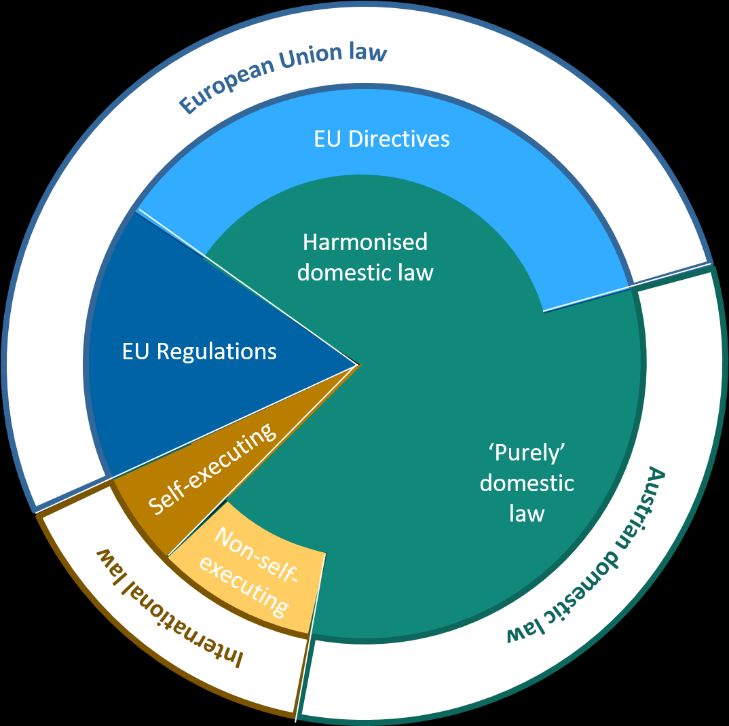
Such requirements or restrictions might arise from a variety of sources, including domestic law, EU
law, and international law.
1.1. Sources of the law in Austria
1.1.1. Austrian domestic law
Domestic law is law enacted by the Austrian national legislator. Austria being a federal legal
system, there is law both at federal and at state level, but the law relevant for doing business in
Austria and cross-border is almost exclusively federal law. The important policy decisions are taken
by democratically elected legislative bodies. For federal law, this is the National Council
(Nationalrat), in cooperation with the Federal Council (Bundesrat), a second Chamber consisting of
state parliament representatives. Given that the Federal Government can usually count on a
majority in the National Council and that the preparation of draft bills is often in the hands of Federal
Ministries, it has considerable influence on law-making.
Constitutional law is law of a very special nature, as it is higher in rank than all other law and lays
down the very foundations on which the whole State and its legal system are built. Federal
constitutional law (Bundesverfassungsrecht), also referred to as ‘the Constitution’, is not one
comprehensive document like in many other countries, but rather contained in a broad range of
different legal instruments.
These include, above all, the 1920 Federal
Constitutional Law as revised in 1929 (Bundes-
Verfassungsgesetz, B-VG), and inter alia the 1867 Basic You will study constitutional law
Law on the General Rights of Nationals and the role of state institutions
(Staatsgrundgesetz), the 1947 National Socialism in BA CM 12 (Constitutional Law).
Prohibition Act (Verbotsgesetz 1947), the 1955 State
Treaty for the Re-establishment of an Independent The history of constitutions and
and Democratic Austria (Staatsvertrag von Wien) and legal systems in general will be
the European Convention on Human Rights. For law discussed in BA CM 3 (European
to be enacted as constitutional law, special and Global Legal History).
procedures and majorities are required. The whole
legal order must comply with the Constitution. The Constitutional Court (Verfassungsgerichtshof) is in
charge of deciding whether or not a law is in conformity with the Constitution.
While only law enacted by the legislative bodies counts as law in a formal sense (Gesetz im formellen
Sinn) it would be much too cumbersome if all law had to go through parliamentary procedures. This
is why law passed by parliament often authorises the administration (at federal, state or lower
levels) to determine the details by way of administrative regulations (Verordnungen). Such
regulations also count as law in a broader sense. The legislator may also declare that instruments
issued by other bodies have legislative effect, such as collective bargaining agreements.
In addition to law in the sense of general standards of conduct directed at any person fulfilling the
requirements there are also legal sources that apply exclusively to the parties in an individual case,
such as court judgments (Gerichtsurteile), administrative decisions (Verwaltungsbescheide), and
contracts (Verträge). It is to be noted that ‘case law’ generated by Austrian courts is not a recognised
source of the law with effect beyond the individual case, e.g. a lower court is not strictly under an
obligation to follow the rulings even by the Supreme Court if the lower court is convinced these
rulings are incorrect (but in practice the lower court will normally follow the higher courts).4 Starting an E-Commerce Business in Austria
Austrian legal sources, including preparatory materials, can best be searched in the Legal Information
System of the Republic of Austria (Rechtsinformationssystem, RIS). For some sources there is an
English translation, but this is normally not kept up to date and therefore not reliable.
1.1.2. European Union law
Sources and scope of EU law
The European Union (EU) is a political and economic union of currently 27 Member States. Since the
2009 Lisbon Treaty, the most important sources of primary EU law (also referred to as ‘the
Treaties’), i.e. the instruments setting out the distribution of powers and responsibilities between
the EU and its Member States and between the EU institutions, are the Treaty on European
Union (TEU) and the Treaty on the Functioning of the
European Union (TFEU), accompanied by the Charter of
Fundamental Rights of the European Union (CFREU). You will study EU law in BA CM 2
The Charter applies to activities by the European (Introduction to International
institutions and by national institutions when they Law) and CM 5 (European Law).
implement EU law.
Law enacted by the competent EU institutions is referred to as secondary EU law. The most
important types of such secondary law are
EU Regulations, which take direct effect in the Member States, i.e. are directly binding on
natural and legal persons and are directly applied by courts and authorities; and
EU Directives, which are only addressed to the Member States and do not normally take
direct effect, i.e. need to be implemented by national legislators, and courts and authorities
will only apply the national implementing law.
Secondary law is made jointly by the three most central EU institutions, the European Commission,
the European Parliament and the Council of the EU (not to be confused with either the European
Council, which is the assembly of heads of government, or with the Council of Europe, which is a
separate international organisation). All three institutions together are often simply referred to as
‘the European legislator’. Their exact roles are complex and not identical with the roles of
institutions at national level. Very roughly speaking, the Commission is the executive power and
‘guardian of the treaties’. It takes the initiative by proposing draft new legislation (note that since
recently also the Parliament has the right of initiative), but the legislative process itself is
predominantly in the hands of the Parliament and of the Council.
EU legal sources (including preparatory materials) can easily be searched via the Eurlex portal, which
is available in all official languages of the EU.
A large part of EU secondary law applies also in the non-EU Member States of the European Economic
Area (EEA), which includes the EU Member States as well as Iceland, Liechtenstein and Norway.
Whether or not an EU legal instrument is relevant also for the EEA (and thus references to ‘Member
State’ or ‘Union’ must be read as including EEA countries) is indicated in the heading. Switzerland is
not part of the EEA, but only of the European Free Trade Agreement (EFTA). However, there is a series
of bilateral treaties through which Switzerland is associated with the EU and on the basis of which
Switzerland has adopted various provisions of EU law in order to participate in the Single Market
without joining either the EU or the EEA.
Since the United Kingdom left the EU it has a special relationship with the EU, in particular as laid
down in the Trade and Cooperation Agreement (TCA). This relationship is much looser than that with
Switzerland, and it is not based on EU law, but on international treaties.Where could legal requirements originate from? 5
The primacy of EU law
Although an EU Directive is not directly applicable and national institutions will only apply the
national implementing law, the fact that national law is based on a Directive has a huge impact on
the way this national law is interpreted and applied. In particular, national law must always be
applied in a manner that is in conformity with EU law. Where the Court of Justice of the European
Union (CJEU) has issued an authoritative interpretation of EU law (Regulation, Directive, or other)
this interpretation is binding also on Member States’ institutions. Where a national court of last
instance is confronted with a case whose decision depends on the correct interpretation of EU law,
and where that correct interpretation is not clear (i.e. is not a so-called acte claire), that court must
(and lower courts may) submit the issue for a preliminary ruling, i.e. refer the matter to the CJEU
to give binding guidance on the correct interpretation. Also, under certain circumstances, failure by
a Member State to implement a Directive may lead to that Directive taking (limited) direct effect.
The case law of the CJEU can best be searched on the Curia portal, which is available in all official
languages of the EU.
Where there is a conflict between a national legal provision and EU law, it is EU law that prevails
according to the principle of primacy or supremacy of EU law. The national provision is not annulled,
but set aside and must be disapplied by Member State institutions (Anwendungsvorrang). According
to the CJEU, European law even takes precedence over national constitutional law, which is,
however, a view not generally shared by the constitutional courts in the Member States. So far, open
clashes between national constitutional courts and the CJEU have largely been avoided.
1.1.3. International law
The term ‘(public) international law’ is usually reserved to legal relations with, in particular, other
states and entities that have historically acquired a similar status (such as the Holy See, the
International Committee of the Red Cross, or the Sovereign Military Order of Malta). Apart from
sources such as customary international law and universally recognised general principles of law,
the main sources of international law are treaties (international agreements, conventions).
Treaties can be bilateral or multilateral, depending on the
number of parties to a treaty. After the text of a treaty has You will study international law
been finalised by the states participating in negotiations, in BA CM 2 (Introduction to
it is usually signed by these states. However, a state is International Law) and CM 6
usually not bound before ratification, i.e. the formal act (International Law).
in which a state indicates its consent to be bound by a
treaty and its entry-into-force. In the case of multilateral treaties, the usual procedure is for a
designated depositary (e.g. an international organisation) to collect ratification documents, and
there is often an agreement that the treaty will enter into force only after a specified minimum
number of ratification documents have been received. For states that are not among the initial
signatory states, the formal act indicating that a state will be bound by a treaty is called ‘accession’.
The Vienna Convention on the Law of Treaties (VCLT) comprises comprehensive provisions on the
procedure for the conclusion of treaties, their entry into force and how treaties are defined,
amended and interpreted.
Some treaties contain provisions that are self-executing, i.e. that become directly applicable and
judicially enforceable in the national legal system. Often treaties are non-self-executing, i.e. they can
be relied upon by e.g. private parties only after the relevant Contracting State has implemented
them in its national law. This is similar to the difference between Regulations and Directives in EU
law (see p. 4).6 Starting an E-Commerce Business in Austria
By way of treaties between states and similar entities, international organisations and other
‘derivative’ new legal entities have been created, many of which have been granted the power to
enact and/or enforce further international law. The European Union is, strictly speaking, such a
derivative legal entity, and EU law is strictly speaking just a subset of international law, but it has
developed into a body of law very much of its own and is better characterised as ‘supranational law’.
The Council of Europe (CoE) is an international organisation founded in 1949 with the
aim to uphold human rights, democracy and the rule of law in Europe. It has currently
47 member states. Its headquarters are in Strasbourg (France). The CoE cannot make
binding laws, but has been afforded the power to enforce select international
agreements made by its member states. Most notably, the European Convention on Human Rights
(ECHR), which enjoys the status of constitutional law in Austria (see p. 1.1.13), is interpreted and
enforced by the European Court of Human Rights (ECtHR).
The World Trade Organization (WTO) is an international organisation
focussed on the regulation of cross-border trade by way of international trade
agreements and has currently 164 member states worldwide. The WTO's
dispute-settlement system involves case-specific panels, whose priority it is to settle disputes,
preferably through a mutually agreed solution. WTO member nations have accepted the WTO dispute
settlement procedure as exclusive and compulsory, but it cannot be used to resolve trade disputes
that arise from political disagreements.
The United Nations (UN) is an international organization that aims to maintain
international peace and security, develop friendly relations among nations and achieve
international cooperation. Founded in 1945, it currently boasts 193 Member States. Its
headquarters are in New York and it has offices in other cities, notably in Vienna. Its
organs include the International Court of Justice (ICJ) located in The Hague (Netherlands). The UN
has established a number of specialised agencies, such as the World Health Organization (WHO) or
the World Intellectual Property Organization (WIPO). Other sub-units include the United Nations
Commission on International Trade Law (UNCITRAL) whose Secretariat is located in Vienna.
In the State Treaty, Austria declared that it will maintain full neutrality, i.e. will not join any military
alliances and not permit the establishment of any foreign military bases on its territory. This is why
Austria has not joined NATO, but it is part of, e.g., UN-led peacekeeping and humanitarian missions.
1.2. How national is ‘national law’?
You will study these
interrelationships in BA CM 1
(Introduction to Law and its
International Aspects).
Meanwhile, a large part of Austrian national
law has either been derogated by EU
Regulations, or relies on EU Directives, or is
indirectly affected by EU or international
law. This means that even in purely
domestic cases (e.g. where all elements of
the case are located in Austria) other than
domestic legal sources must be taken into
account.Where could legal requirements originate from? 7
More or less all issues addressed by these preparatory materials are either fully harmonised or at
least heavily influenced by EU law and/or international law, even where this has not been specifically
mentioned.
1.3. Cross-border situations
The international dimension of law in Austria is even more apparent in cases with an international
element, e.g. where a party to a legal relationship has a foreign nationality or is located in a foreign
state. Generally speaking, laws (in the sense of specific sets of legislation, or whole areas of the law)
deal with such cross-border situations in one or more of the following four ways:
1. A law may directly and specifically regulate
cross-border situations (e.g. free trade
agreements p. 10, asylum law p. 12, UN Cross-border aspects will normally
Convention on the International Sale of Goods p. be taught as part of the course
51); dealing with the relevant subject
matter itself. In private law, where
2. Elements of a law may address the international foreign domestic law may become
dimension indirectly, such as by requiring a applicable, there is a separate
particular nationality, law of incorporation etc. course which is an integral part of
or, conversely, by recognising as equivalent BA CM 10 (Civil Law and Private
foreign nationalities, laws of incorporation etc. International Law).
(e.g. trade regulation law p. 9, social security law
p. 24); Differences and similarities
between legal systems worldwide
3. A law may set out rules for dealing with particular will be discussed in MA CM1
situations in a general manner and clarify in (Comparative Law).
separate sections the territorial reach of these
rules and under which conditions they apply to cross-
border situations (e.g. Austrian Criminal Code p. 14, General Data Protection Regulation p. 38);
4. A law may stay silent on cross-border situations in the first place, but have to be read together
with a separate body of law called ‘conflict-of-laws’ that tells a court or authority which out of
several different national laws governs the issue at hand (e.g. the law of contractual and extra-
contractual obligations, property law, family law, and the law of succession, see e.g. p. 50).
So while Austrian courts and other authorities generally only apply Austrian law (which includes
Austrian domestic law, directly applicable EU law, and self-executing international law applicable in
Austria) when they have international jurisdiction, the fourth of the four scenarios means that an
Austrian court or other authority may also have to apply foreign domestic law.8
2. Starting a business –
registration and permission
requirementsStarting a business – registration and permission requirements 9
As a first step, Selma and Sebastian have to become traders. They do not really know whether they can
just give themselves a trade name and start doing business or whether they need a permission or need
to meet any other formal requirements. It cannot be that difficult to start an online shop, can it?
Well … there are some legal steps that need to be taken...
2.1. Trade regulation law (Gewerberecht)
2.1.1. Who needs a trade licence?
Opening a business in Austria
Starting a business in Austria requires that all necessary permits are granted. For starting a trade
(Gewerbe), including a craft, the most relevant legal instrument is the Trade Act 1994
(Gewerbeordnung 1994, GewO). This instrument applies to any economic activity that is
self-employed;
at least potentially conducted on a regular or continuous basis or at a larger scale; and
for profit.
A range of economic activities that would, as such, satisfy the above criteria are nevertheless
excluded from all or most of the requirements of the Trade Act 1994. Some of these economic
activities are wholly or largely exempt because the legislator felt there was no need for regulation,
e.g. agriculture and forestry, the arts, and household activities (such as self-employed cleaning or
babysitting) or other very simple activities. Other economic activities are not governed by the Trade
Act 1994 because they are subject to more specific (and usually stricter) requirements under other
laws. This applies, e.g., for the regulated liberal professions (such as doctors, attorneys-at-law,
notaries or tax advisors).
Trade regulation law is part of special administrative
law (Besonderes Verwaltungsrecht), together with a You will study administrative
wide range of other areas, such as asylum law, planning law in BA CM 13 (Public Law).
and building law, energy law, waste management law
and genetic engineering law, to name but a few. Since Some aspects of economic
trade regulation law deals with economic activities it is administrative law will be dealt
specifically considered to be part of ‘economic with in BA CM 11 (Business Law).
administrative law’ (Wirtschaftsverwaltungsrecht).
In contrast, general administrative law (Allgemeines Verwaltungsrecht) deals with cross-cutting
issues, such as the structure and competence of administrative authorities, administrative procedure,
or remedies against administrative decisions. Together, they form the body of administrative law,
which is part of the wider area of public law (Öffentliches Recht).
E-commerce businesses targeting Austria from EU and EEA countries
Selma is wondering why she needs a trade licence in Austria while Matteo, who has been operating his
online shop from Rome for some time and makes good money with Austrian professional customers, is
only registered in Italy.
Traders established in other EU Member States may, without any restrictions, sell goods or provide
services into Austria from abroad. This is based on the very cornerstones of the European Single
Market, the ‘Four Freedoms’, as laid down in the Treaties. The same rules apply for the Member
States of the EEA and, due to bilateral agreements, for Switzerland (see p. 4).10 Starting an E-Commerce Business in Austria
These Freedoms are
Free movement of goods You will study EU law in BA CM 2
Free movement of capital (Introduction to International Law)
Freedom to establish and provide services and CM 5 (European Law).
Free movement of persons
The free movement of goods implies, inter alia, a prohibition between Member States of customs
duties on imports and exports with regard to products originating in Member States and to products
coming from third countries which are in free circulation in Member States, as well as of all charges
and other measures having equivalent effect (Article 28 TFEU). The freedom of establishment
includes the right to take up and pursue activities on a permanent basis as self-employed persons
and to set up and manage undertakings in another Member State (Article 49 TFEU), whereas the
freedom to provide services means the right to offer and provide services in other Member States on
a temporary basis while remaining in one’s country of origin (Article 56 TFEU).
With the emergence of e-commerce, the delineations between these freedoms have become
somewhat blurred because, for being an online retailer ‘in Austria’ on a permanent basis (i.e. targeting
Austrian customers in a similar way as a shop established in Austria) one does not have to be
physically present in Austria any more. A number of EU legal instruments address in a cross-cutting
manner the phenomenon of the ‘Digital Single Market’.
E-commerce businesses targeting Austria from third countries
Selma understands that Matteo from Italy may be a somewhat special case, but how can the parents
of her friend Xu from China sell goods to Austria on a regular basis, through big online platforms,
without having an Austrian trade licence? And what about John from the UK?
Other third countries, such as China, may be associated with the
EU and Austria through free trade agreements, notably the
rules of the World Trade Organization (WTO), of which both You will study international
Austria and China are member states. The three most trade law in
important ‘pillars’ of WTO law are the General Agreement on BA CM 2 (Introduction to
Tariffs and Trade (GATT), the General Agreement on Trade in International Law) and
Services (GATS) and the Agreement on Trade-Related Aspects CM 6 (International Law).
of Intellectual Property Rights (TRIPS). The fundamental
principles of the trading system include:
The Most Favoured Nation (MFN) rule, which requires a WTO member to grant the most
favourable conditions under which it allows trade in a certain product type with one other
WTO member to all other WTO members (in practice, this most importantly implies that
customs duties must be levied on a non-discriminatory basis, but the establishment of
specific free trade zones between particular WTO members, such as the EU, is still
permissible).
The National Treatment rule, which means that foreign goods, once they have entered the
WTO member’s market, should be treated no less favourably than domestically produced
goods.
A trader established in China is free to sell and deliver goods into Austria, but has to declare goods
at customs and possibly pay customs duties (tariffs) and taxes (on which see p. 24) when the goods
enter the EEA. Charging customs duties on import is considered to be compatible with the National
Treatment rule.Starting a business – registration and permission requirements 11
The amount of customs duties due depend on the product type and can easily be identified with the
help of the Access2Markets tool. Import of goods shipped in consignments with a value not exceeding
EUR 150 (low value goods) is exempt from customs duties, but not from VAT (see p. 24).
It is important to note that all goods imported from outside the EU/EEA must comply
with EU/EEA product safety standards. Compliance with such requirements is
indicated by the ‘CE’ marking. Responsibility for CE marking lies with whoever puts the
product on the market in the EU/EEA, i.e. an EU-based manufacturer, the importer or distributor of
a product made outside the EU/EEA, or an EU/EEA-based office of a third country manufacturer.
Duties are difficult to enforce against parties outside the EU/EEA who sell their products directly into
the EU/EEA by way of online marketplaces. Under the new Market Surveillance Regulation (MSR)
which will apply from July 2021, producers who want to make their products available on the EEA
market must appoint an authorised representative within the EEA. According to Article 6 MSR
products offered for sale online or through other means of distance sales shall be deemed to be made
available on the EEA market if the offer is targeted at end users in the EEA, i.e. if the seller directs, by
any means, its activities to a Member State. In a case of non-compliance with safety standards, the
authorities may take rigorous action and, as a means of last resort and in serious cases, also force the
operator of an online intermediary platform to remove content or even block access to the platform
for EEA users (Article 14(4)(k) MSR).
Strictly speaking, acting as a retailer is also a service, and the provision of services by traders
established in other WTO members into Austria is governed by GATS and is much less liberal than
the delivery of goods (e.g. a Chinese trader could not simply fly in from Beijing once a week, on the
basis of their Chinese trade licence, and provide services in Austria). However, although e-commerce
is not exactly a new phenomenon, the WTO is still struggling with how to deal with e-commerce.
Already in 1998, there was a ‘Work programme on electronic commerce’, which included a
moratorium in which WTO members agreed to continue the current practice of not imposing
customs duties or other restrictions on electronic transmissions. This moratorium has been renewed
several times so far. Since 2019, a ‘Joint Statement Initiative on E-Commerce’ is underway within
the WTO, which a fair number of States have joined, but potential results are still not clear.
When Selma asks her about this, Xu confirms that dealing with customs requirements has always been
a major obstacle for her parents. Since recently, they have outsourced this to a provider of global parcel
delivery services, which is working reasonably well. However, they are worried about this new Market
Surveillance Regulation.
John, who has overheard the conversation, complains that Brexit has made things really complicated
for him.
Since the United Kingdom left the EU, relationships between the EU and UK are governed by WTO
law and special international agreements, notably the Trade and Cooperation Agreement (TCA). As
far as goods are concerned, the Title on trade in goods provides, inter alia, freedom of transit (i.e.
traffic in transit to or from the territory of either EU or UK and any other third country) and prohibition
of customs duties on all goods ‘originating in the other Party’, and in some other cases. It is, in
particular, the requirement of ‘originating in’ that makes customs procedures necessary, and the
rules on ‘origin’ are complicated. The Title on trade in services facilitates the cross-border provision
of services, but provides for less liberal rules than the Title for goods.
Other than current WTO law, the TCA provides for a separate Title on ‘Digital Trade’, which includes
both trade in digital content or services (i.e. where the traded commodity is digital) and trade in
traditional goods or services by digital means (i.e. e-commerce in the proper sense). However, the TCA
has to use the WTO regime as a backbone, and this Title, while featuring a number of special
provisions, largely qualifies digital trade as the supply of services. The relevant Title on services does
not contain provisions that address e-commerce more specifically.12 Starting an E-Commerce Business in Austria
2.1.2. How to obtain a trade licence in Austria?
Selma and Sebastian accept that they cannot just start selling stuff but have to get a trade licence first.
They will have to file an application, accompanied by a range of documents, with the competent trade
authority (Gewerbebehörde). Normally, this can also be done electronically using the Austrian Business
Licence Information System (GISA).
They just hope that this is not going to be too difficult. They are both of age, but Selma is from Bosnia
and resident in Austria on the basis of her student visa, so she is worried whether there are any
restrictions.
General requirements
If an economic activity falls under the GewO, this may still mean very different things. The majority
of trades is ‘free’ in the sense that no special certificate of qualification is required. The only
requirement is the registration with the competent trade authority (Anmeldungsgewerbe). In order
to register, a natural person has to fulfil the following requirements (cf. §§ 8 to 15 GewO):
Full legal age and capacity;
Citizenship of an EU Member State, or another Member State of the European Economic Area
(EEA), or equivalent status under international law, or residence permit that includes self-
employed economic activities; and
No grounds for exclusion (on which see p. 13 further below).
Full legal age and capacity is very rarely a problem. What is usually more problematic is whether the
residence permit (Aufenthaltstitel) of a third-country national (i.e. a person who is not a citizen of
an EU/EEA Member State) allows self-employed commercial activities.
The most important provisions can be found in the Settlement and Residence Act (Niederlassungs-
und Aufenthaltsgesetz, NAG) and the Asylum Act 2005 (Asylgesetz 2005, AsylG), but there are also
specific provisions for diplomats, employees of international organisations etc., and special visa for
temporary activities under the Aliens Police Act (Fremdenpolizeigesetz, FPG).
§ 8 NAG lists 13 different types of residence permits, each of which has its own rules as to the
permissibility of employment or self-employed activities. For employment, many types of residence
permits require an additional employment permit (Beschäftigungsbewilligung) issued by the Public
Employment Service Austria (Arbeitsmarktservice, AMS) under the Employment of Foreign Nationals
Act (Ausländerbeschäftigungsgesetz, AuslBG).
The most important categories of individuals addressed
by the AsylG are: Asylum and migration law will
Recognised refugees (Asylberechtigte, § 3 AsylG); be addressed in
individuals with subsidiary protection status BA CM 6 (International Law)
(subsidiär Schutzberechtigte, § 8 AsylG); and CM 13 (Public Law)
Asylum seekers (Asylwerber) enjoying de facto
protection (§ 12 AsylG) and a temporary residence permit after the asylum procedure has
been admitted (§ 13 AsylG); and
Individuals with a residence permit for exceptional circumstances (§§ 54 to 57 AsylG).
Recognised refugees and individuals with subsidiary protection status may engage in the same
economic activities as Austrian nationals. Asylum seekers whose asylum procedure is admitted and
individuals with a residence permit for exceptional circumstances require an additional employment
permit under the AuslBG for employed activities, but may pursue a self-employed economic activity.
Selma holds a visa for third-country students (§ 64 NAG). If she were seeking employment, she would
need a separate employment permit, which would normally be issued for employment not exceedingStarting a business – registration and permission requirements 13
20 hours/week because her work may not seriously impair her studies (no such permit would, by the
way, be required if Selma sought employment in academic research and teaching, e.g. as a student
assistant at Vienna University). There is no explicit restriction for self-employed traders but, of course,
Selma must prove that she is actually and successfully pursuing her studies if she seeks an extension
for her student visa.
Specific requirements for regulated trades
An enumerative list of trades (§ 94 GewO) are regulated trades (reglementierte Gewerbe), which
require a specific qualification (§§ 16 et seq. GewO). Those among the regulated trades for which
the law requires particular ‘reliability’ are sometimes referred to as ‘reliability trades’
(Zuverlässigkeitsgewerbe, § 95 GewO).
Regulated trades are a subset of the wider notion of ‘regulated professions’, which can, for EU/EEA
Member States, be identified by way of a search in the EU Regulated Professions Database. Where a
professional qualification has been obtained in another EU/EEA country (or Switzerland), there are,
in general, three different types of recognition, depending on the type of profession concerned:
Recognition on the basis of coordination of minimum training conditions (e.g. for doctors)
Recognition of professional experience (e.g. for many crafts)
Recognition of an attestation of competence issued by the competent authorities of a
Member State (for all other regulated professions)
An attestation of competence does not preclude the host Member State from requiring the applicant
to complete an adaptation period of up to three years or to take an aptitude test (Eignungsprüfung),
e.g. if the training the applicant has received covers substantially different matters than those
required in the host Member State. This applies, inter alia, for lawyers who have obtained their law
degree in another Member State and wish to practice as attorneys in Austria.
For professional qualifications obtained in third states there exist a wide range of bilateral and
multilateral agreements on recognition. Practical guidance is provided by the Recognition Guide of
the Austrian Integration Fund.
Selma and Sebastian browse the list of regulated trades and note with a degree of relief that running
an online shop and platform is not among them, but is a ‘free’ trade. They later learn that it is in fact
an explicit requirement set out in the E-Commerce Act (E-Commerce-Gesetz, ECG) that no specific
procedures are imposed.
Nevertheless, they have to specify the type of trade in their application. They will primarily choose
‘Handelsgewerbe’. Depending on whether or not they plan to engage in further activities, such as
working more extensively with customer data and providing digital services, including marketing
services for third parties, they may also wish to add ‘Dienstleistungen in der automatischen
Datenverarbeitung und Informationstechnik’ and/or ‘Ankündigungsunternehmen’.
2.1.3. Who is excluded from obtaining a trade licence?
When filling in the relevant forms Selma and Sebastian have to tick a range of boxes concerning
possible exclusion criteria, mentioning criminal convictions and something about insolvency.
Suddenly, new worries emerge because of a criminal conviction for forgery of documents, which
Sebastian committed as a 19-year-old high school student. Moreover, he became a partner in his
father’s company when he was 18, and the company went insolvent during the Covid-19 crisis.
There are exclusion criteria both for natural persons and for companies (§ 13 GewO). It is immaterial
whether the facts giving rise to exclusion occurred in Austria or abroad. Where a natural person
would be excluded, a company on whose operations that natural person has a significant influence14 Starting an E-Commerce Business in Austria
is likewise excluded. In a similar vein, a natural person that had significant influence on the
operations of a company that would be excluded is also excluded.
Criminal convictions
For natural persons, exclusion criteria are the final conviction by a court of an enumerative list of
criminal offences (such as fraudulent withholding of employees’ social security contributions or
organised undeclared work, for persons seeking a licence for the catering trade also drug crimes); or
a final sentence for other criminal offences to more than three months imprisonment or to a fine of
more than 180 daily rates, unless the crime has already been expunged. There is also a list of financial
offences that serve as exclusion criteria where the financial authority has imposed a fine of more
than 726 EUR or imprisonment.
Criminal law (Strafrecht) is an independent part of
public law dealing with sanctions and other measures You will study criminal law in
imposed by the State for qualified unlawful and BA CM 8 (Criminal Law and
culpable behaviour (including for cases where the Procedure).
offender is not criminally responsible due to insanity).
Behaviour that is qualified as a crime must be clearly
defined as such in the law. In Austria, criminal law can be divided into two main areas: judicial criminal
law (Kriminalstrafrecht), and administrative criminal law (Verwaltungsstrafrecht). Criminal law
normally addresses only natural persons, but companies can be prosecuted if a decision-maker or
employee has committed a judicial crime that can be attributed to the company under the Corporate
Criminal Liability Act (Verbandsverantwortlichkeitsgesetz, VbVG).
Judicial criminal law is adjudicated exclusively by fully independent judges in the general (judicial)
courts (ordentliche Gerichte), including by lay judges where so provided (e.g. murder, political
offences). Jurisdiction in the first instance is either with the district courts (Bezirksgerichte, BG) or the
regional courts (Landesgerichte, LG), depending on the severity of the offence. Regional courts also
deal with appeals against decisions of district courts. Appeals against decisions of regional courts are
dealt with partly by one of the four higher regional courts (Oberlandesgerichte, OLG) and partly by the
Supreme Court (Oberster Gerichtshof, OGH), which is the highest instance of judicial courts in Austria.
Crimes are mostly defined in the Criminal Code (Strafgesetzbuch, StGB), but may also be defined in
other statutes. The main forms of punishment are fines (Geldstrafe) and imprisonment
(Freiheitsstrafe), but there is also a range of further measures (e.g. confiscation, forfeiture) that can be
imposed. Crimes are divided into felonies (Verbrechen) and misdemeanours (Vergehen), with felonies
being defined as serious intentional crimes punishable by a maximum term of imprisonment of more
than three years. Criminal convictions by courts, once they are final and can no longer be challenged
by way of appeal, are entered into the criminal records (Strafregister). This concerns all convictions
by Austrian courts and convictions by foreign courts where the convict is an Austrian citizen or has
their domicile or habitual residence in Austria. After the lapse of a certain period of time, which is
normally counted from the time when the sentence has been fully served or remitted, an entry in the
criminal records is expunged. The length of that period (Tilgungsfrist) depends on the nature of the
crime and the severity of the sentence imposed. Life-sentences and (at least in principle) sentences
of over five years imposed for sexual crimes cannot be expunged from the criminal records.
Administrative criminal law is applied by administrative authorities. Since 2014, appeals are,
however, dealt with by administrative courts (Verwaltungsgerichte) and not by the administration
itself. Administrative authorities in charge of the prosecution of administrative offences may also
impose both fines and imprisonment (generally limited to a maximum period of six weeks), but the
sentences are not entered into the criminal records. While administrative offences are listed in a broad
range of different statutes, cross-cutting issues are addressed in the Administrative Offence Act
(Verwaltungsstrafgesetz 1991, VStG).
To a large extent, it is within the discretion of the Austrian legislator whether a particular offence is
qualified as a crime under judicial criminal law or under administrative criminal law. Normally, theYou can also read


