Stormwater 131 - Infrastructure Report Card
←
→
Page content transcription
If your browser does not render page correctly, please read the page content below
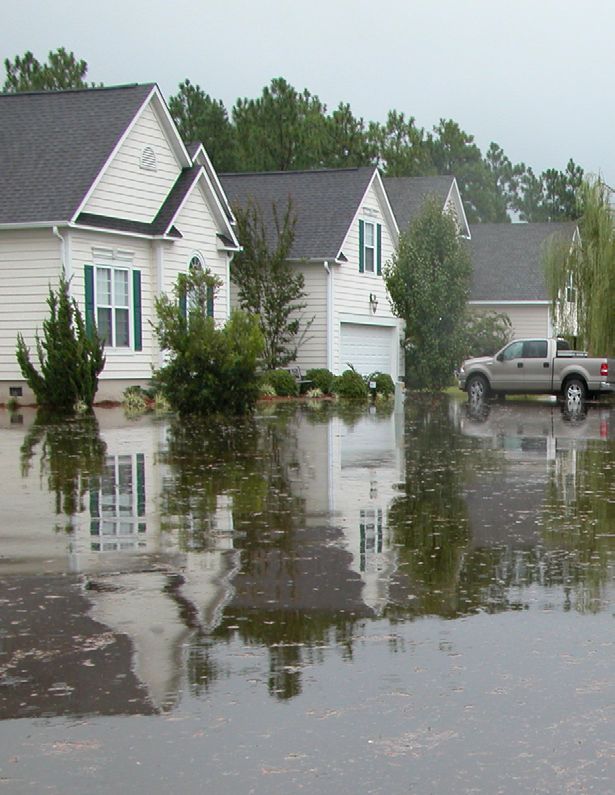
Stormwater

                 131
                ________

2021 INFRASTRUCTURE REPORT CARD
     www.infrastructurereportcard.org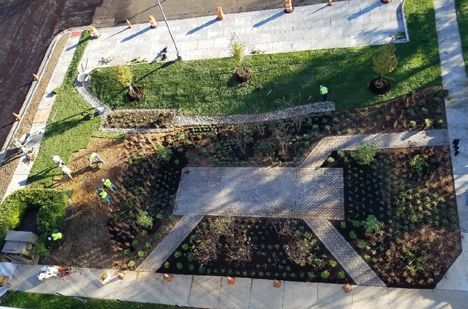
EXECUTIVE SUMMARY
                 Stormwater systems range from large concrete storm sewers, roadside
                 ditches, and flood control reservoirs, to rain gardens and natural riverine
                 systems. While stormwater utilities are on the rise, with more than 40 states
                 having at least one, the impervious surfaces in cities and suburbs are also
                 expanding, exacerbating urban flooding, which results in $9 billion in damages
                 annually.1 Stormwater also affects water quality as polluted runoff from
                 pavement enters water bodies. Nearly 600,000 miles of rivers and streams
                 and more than 13 million acres of lakes, reservoirs, and ponds are considered
                 impaired.2 Federal funding, though up in recent years, averages about $250
                 million annually, which leaves a growing annual funding gap of $8 billion just
                 to comply with current regulations. With few dedicated funding sources,
                 complicated governance and ownership structures, expansive networks of
                 aging assets, increasingly stringent water quality regulations, and concerning
                 climate change projections, the expected performance of stormwater systems
                 is declining. Many of the country’s legacy stormwater systems are struggling
                 with the high cost of retrofits needed to address urban flooding and climate
                 change. Upgrading large networks of aging systems underneath densely
                 populated areas carries significant costs and engineering challenges.

INTRODUCTION
Stormwater runoff is defined as rain or snow melt that                    natural filtration processes. Green infrastructure provides
travels over impervious surfaces such as roadways,                        benefits by reducing runoff, minimizing erosion, and
buildings, or parking lots, and landscaped or agricultural                contributing to water quality improvements; examples
areas and is then collected and conveyed into streams,                    include rain gardens, constructed wetlands, vegetative
rivers, lakes, bays, or oceans.3 As impervious surfaces                   roadway bioswales, and permeable pavements.6
in increasingly developed cities and suburbs expand, so
                                                                          The United States Environmental Protection Agency (EPA)
do the impacts of increased runoff from larger rainfall
                                                                          classifies stormwater systems as those that are publicly
events which can lead to urban flooding.4
                                                                          owned, discharge into waters of the U.S., and are not part
Nationally, stormwater infrastructure can take many forms,                of a sewage treatment plant such as Municipal Separate
including piped systems, detention basins, ditches, canals,               Storm Sewer Systems (MS4s). MS4s are regulated by
channels, and roadway conveyance systems.5 In recent                      the EPA under the National Pollution and Discharge
years, green stormwater infrastructure has been introduced                Elimination System (NPDES) program.7 Apart from EPA
in new developments and coupled with traditional “gray                    regulations, states, counties, and local governments may
infrastructure” to maximize the benefits from natural                     also require stormwater management practices through
hydrologic cycles using vegetation, soils, site grading, and              local ordinances, building codes, and development plans.

                                                                132
                                                               ________

                                             2021 INFRASTRUCTURE REPORT CARD
                                                  www.infrastructurereportcard.org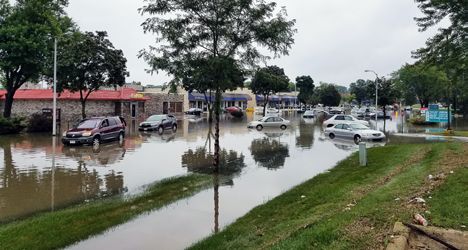
CAPACITY
While there is not yet a comprehensive national database
of assets, estimates suggest there are 3.5 million miles of
storm sewers, 270 million storm drains, and 2.5 million
stormwater treatment assets across the U.S.8 9 10 11 12 13 14
Under the NPDES MS4 program, municipalities are
required to map their stormwater systems and, as of 2018,
nearly 40% of stormwater utilities have taken this step.15

Stormwater infrastructure capacity is principally derived
from the design standards used for construction. Terms
like “10-year” and “100-year storms” (meaning those
with a 10% and 1% annual probability of occurrence,
respectively) are currently used to describe a system’s
capacity. However, such design standards have only
been used in recent decades, and the standards differ
within and between states.

While design standards govern a stormwater system’s
theoretical capacity, routine operation and maintenance
(O&M), age, and the changing frequency and intensity
of storm events, are the main drivers affecting a
stormwater system’s actual capacity. Given the recent
increase in rainfall trends and urbanization, the actual
capacity of a stormwater system is often less than
the design standard.16 Many of the country’s legacy
stormwater systems, such as those in Chicago and
Philadelphia, for example, are now struggling with the
high cost of retrofits that are needed to accommodate
these changes. Upgrading large networks of aging
systems that are now underneath densely populated
areas carries significant costs and engineering challenges.                                         Photo by Anna Denecke

                                                                                STORMWATER MANAGEMENT INFRASTRUCTURE IN
                                                                                                        WASHINGTON, D.C.

                                          Given the recent increase in rainfall
                                          trends and urbanization, the actual
                                            capacity of a stormwater system
                                           is oftentimes less than the design
                                                       standard.16

                                                                133
                                                                ________

                                              2021 INFRASTRUCTURE REPORT CARD
                                                   www.infrastructurereportcard.org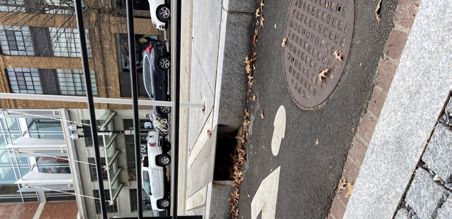
CONDITION
The condition of stormwater infrastructure is indicated,                     and are likely undersized given current stormwater
in part, by the system’s age. Without better stormwater                      management practices and climate change impacts.
asset records, the average age of the system cannot
                                                                             Another key indicator of stormwater infrastructure
be directly determined, so the lifespan of the primary
                                                                             condition is the system’s ability to reduce negative
construction material is used as a proxy. Stormwater
                                                                             impacts to local waterbodies. Under the NPDES
conveyance systems may be constructed of corrugated
                                                                             program, stormwater systems are required to meet the
metal, reinforced concrete, or plastic, and their lifespan is
                                                                             overarching goal of reducing the discharge of pollutants
projected to be 50 to 100 years. Storage and treatment
                                                                             from runoff.19 20 While water quality is a priority across
systems such as detention and retention ponds have
                                                                             the nation, from 2010 to 2018, the length of impaired
an average lifespan between 20 to 30 years.17 18 Based
                                                                             rivers and streams increased from about 424,000 miles
on this, systems constructed in the 1970s or prior have
                                                                             to more than 588,000 miles.21
exceeded or are nearing the end of their useful lives

   Photo by Jim Gade

                                                                                                     FLOODING IN MADISON, WISCONSIN

OPERATIONS & MAINTENANCE
Stormwater infrastructure may be owned and managed                           The MS4 NPDES permitting process has been an
by various public or private entities such as state or local                 effective regulatory lever influencing O&M practices
governments, individual or corporate property owners,                        and frequency due to the expectation of routine
or homeowners’ associations. All stormwater systems                          inspections. Under the NPDES program, all MS4s are
require some level of routine maintenance, but the ongoing                   required to have maintenance plans. However, private
management of stormwater systems can be complex                              entities, cooperatives, and individual homeowners
and expensive. Storm sewers require jetting and cleaning,                    responsible for O&M are often not routinely monitored
and stormwater detention basins, bio-retention facilities,                   and left to manage critical and sometimes expensive
permeable pavement, and bioswales all require unique                         components of the stormwater system on their own.
maintenance tasks with specialized knowledge. This can be a                  Deferred maintenance increases the likelihood of
challenge for all levels of government, private property owners              urban flooding and increases threats to water quality
such as shopping centers, or homeowners’ associations.                       protection.22 23

                                                                  134
                                                                  ________

                                               2021 INFRASTRUCTURE REPORT CARD
                                                    www.infrastructurereportcard.org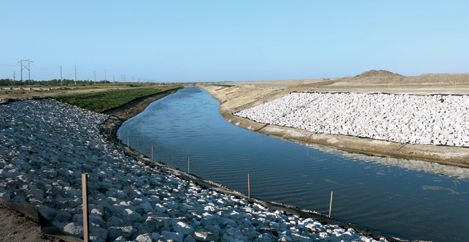
FUNDING
Funding for stormwater infrastructure across the country                          the CWSRF’s program funding for stormwater projects
is limited and comes from multiple sources — local                                has trended upward from more than $58 million in 2012
revenue, state and/or federal grants and financing, and                           to more than $387 million in 2019 with the portion
non-traditional funding streams. Because the financial                            of funding for green infrastructure also increasing.28
responsibility for managing stormwater systems can                                Though trends are improving, only 3% of all CWSRF
sometimes be unclear and draw from entities’ general                              funds have gone toward stormwater and similar types of
funds, hundreds of public entities in at least 40 states                          projects.29 Additionally, the EPA’s Water Infrastructure
have taken the initiative to create stormwater utilities to                       and Finance Innovation Act (WIFIA) is another federal
collect fees based on property size, impervious area, and                         funding mechanism. In 2019, at least three stormwater
other site-specific characteristics. Out of communities                           infrastructure projects applied for $673 million in WIFIA
with municipal MS4s, the percentage with stormwater                               loans out of the program’s $7.7 billion in overall support.30
utilities or fees has grown from approximately 19% in 2013
                                                                                  While there are limited and highly competitive grant
to upward of 26% in 2018.24 25 For a single family home,
                                                                                  programs at the local, state, and federal levels that cover
the average monthly stormwater fee in 2018 was $5.34.26
                                                                                  a very small portion of the overall need, non-traditional
For large capital improvements, state entities or                                 mechanisms for funding stormwater infrastructure have
municipalities may use general obligation bonds. They                             also emerged and include public-private partnerships;
may also seek federal resources like those from the EPA’s                         leveraged synergies among solid waste, transportation,
Clean Water State Revolving Fund (CWSRF) which                                    and/or wastewater sectors; and market-based solutions
has provided nearly $2.2 billion for more than 1,100                              that monetize permit requirements like nutrient and/or
stormwater projects since its inception.27 More recently,                         stormwater volume trading.31 32

                           Projects Awarded Clean Water SRF Funds Over Time
 70
                                                                                             Gray Infrastructure
                                                                                             Green Infrastructure
 60

 50

40

 30

 20

 10

  0
            2012              2013             2014             2015                2016            2017            2018              2019

Source: Clean Water SRF Program Information National Summary (2019) https://www.epa.gov/sites/production/files/2020-02/documents/us19.pdf

                                                                       135
                                                                       ________

                                                   2021 INFRASTRUCTURE REPORT CARD
                                                        www.infrastructurereportcard.org
FUTURE NEED
As water quality measures for MS4 permitting become The trajectory of urban flooding impacts will likely continue
more stringent, local governments and stormwater the upward trend as our older stormwater assets cannot
utilities having to update or expand their systems, accommodate the changing rainfall patterns and intensity.35
stretching their limited economic resources. In 2020,
Many utilities are behind in accounting for the condition
the Water Environment Federation’s National MS4
of their assets, planning, and funding for short- and long-
Needs Assessment estimated that the sector’s annual
term maintenance, and strategizing necessary capital
funding gap is $8 billion among MS4 permittees.33 34
improvements. A clear picture of the existing assets and
Separately, an economic analysis by ASCE shows a water-
their condition is needed to provide flood projection models
related infrastructure investment gap of $434 billion over
with data to identify areas of significant risk where limited,
10 years for drinking water, wastewater, and stormwater
available resources may be targeted for improvements.
combined.
Photo by ASCE
PERMEABLE PAVEMENT AND STORMWATER DETENTION IS BUILT INTO A PARKING LOT IN RESTON, VIRGINIA.
PUBLIC SAFETY
Flooding is one of the nation’s greatest natural hazards, throughout the community may include sinkholes, flash
carrying catastrophic public safety and economic tolls. floods, collapsed roadways, extensive property damage,
Annually, from 2004 to 2014, urban flooding alone cost inflow into sanitary systems which inundates wastewater
communities an average of $9 billion in direct damages treatment plants and pollutes waterways, and loss of life.
and 71 deaths.36 Over the last two decades, to buttress the impact of these
losses, the National Flood Insurance Program has more
When stormwater systems become overwhelmed, there are
than doubled its enacted policies while the number of
acute and long-term public safety implications that create
private insurance companies entering the market between
ripple effects to other infrastructure systems. Effects
2016 to 2019 has also more than doubled.37
136
________
2021 INFRASTRUCTURE REPORT CARD
www.infrastructurereportcard.orgPhoto courtesy of WSP
STORMWATER TREATMENT CHANNEL IN SOUTH FLORIDA
RESILIENCE & INNOVATION
Impacts from climate change will have variable effects Current innovations employed by utilities include the use
on the form and frequency of extreme events across of real-time control systems, complex modeling, cloud
the nation. To withstand these effects, stormwater computing, data storage, and predictive analysis.38 Large
infrastructure is increasingly implemented with a datasets can be used to optimize the capacity of stormwater
context-sensitive approach, that leverages a localized conveyance, storage and treatment systems, investments
understanding of flood risk, land use practices and in O&M activities, and other costs. The affordability of
regulatory expectations. This approach informs the sensors has also improved, expanding the potential for
types, designs, locations, and long-term sustainability system implementation of real time data and control.
of stormwater systems. Resilience for stormwater
Finally, some areas employ a regional approach to
infrastructure is reflected by a mix of optimized green,
stormwater management through volume and nutrient
gray, and natural infrastructure, land planning and urban
trading within watersheds. This can economically
growth, updated asset management and, in water-scarce
incentivize stormwater innovation.
areas, the productive reuse of stormwater.
Copyright: RoschetzkyPhotography
HURRICANE HARVEY SUMMER FLOODING IN TEXAS
137
________
2021 INFRASTRUCTURE REPORT CARD
www.infrastructurereportcard.orgRECOMMENDATIONS
TO RAISE THE GRADE
· Fully fund and disseminate information from the EPA’s Clean Watersheds Needs
Survey on a routine basis (every four years) and elicit more stormwater-related
Stormwater detail, including information about maintenance, repair, pollution prevention, and
urban flooding.
· Develop a stormwater-specific funding and financing program based upon the best
practices from the existing Clean Water State Revolving Fund.
· Stormwater infrastructure and design regulations are critical for protecting
communities from costly urban flooding and protecting water quality in our waterways.
Stormwater systems should be a combination of gray, green, and natural infrastructure
and should be mainstreamed in planning and development processes nationwide.
· Develop state-based peer-to-peer partnerships to build local government capacity
to create and manage stormwater utilities that sustainably fund, operate, maintain,
assess, and, when necessary, expand stormwater infrastructure.
· Establish a grant program for 21st century technical career training for “green
collar jobs” in the stormwater sector that recruit the next generation’s talent and
mainstream tools for data-driven decision-making, such as asset management
software, life-cycle cost analysis, and affordable rate structuring.
· Expand the inclusion of current and forecasted climate variability in codes and
standards for the design, operation, maintenance, and expansion of stormwater
infrastructure and routinely provide funding to NOAA to update the climate data.
· Ensure stormwater infrastructure is fully eligible and aggressively pursued via federal
funding and financing mechanisms that are supporting the nation’s drinking water
and wastewater systems.
· Develop a comprehensive education campaign on the true costs, savings, risks,
and avoided hazards associated with stormwater infrastructure investments, and
disseminate these details through broadly accessible platforms.
· Educate communities on best practices for creating stormwater utilities that
institute rates that reflect the true cost of treating and handling stormwater runoff.
· Point source and nonpoint source pollution should be addressed through a
watershed approach that encourages regional coordination to improve impacts from
stormwater-induced flooding.
138
________
2021 INFRASTRUCTURE REPORT CARD
www.infrastructurereportcard.orgSOURCES
1. The National Academies of Sciences, Engineering, and Medicine. “Framing the
Challenge of Urban Flooding in the United States,” 2019.
Stormwater 2. U.S. Environmental Protection Agency, “National Summary of State Information.”
3. U.S. Environmental Protection Agency, “Stormwater Management Practices at
EPA Facilities.”
4. National Academies of Sciences, Engineering, and Medicine, “Framing the
Challenge of Urban Flooding in the United States,” 2019.
5. Geosyntec Consultants and Wright Water Engineers, Inc., “Urban Stormwater
BMP Performance Monitoring,” October 2009.
6. The Water Environment & Reuse Foundation, “Stream Restoration BMP Database:
Version 1.0 Summary Report,” 2017.
7. U.S. Environmental Protection Agency, “Stormwater Discharges from Municipal
Sources.”
8. McPhillips LE and Matsler AM, Frontiers in Build Environment, “Temporal Evolution
of Green Stormwater Infrastructure Strategies in Three U.S. Cities,” May 15, 2018.
9. Woznicki SA, Hondula KL, and Jarnagin ST. Hydrological Processes, “Effectiveness
of Landscape-Based Green Infrastructure for Stormwater Management in
Suburban Catchments,” May 9, 2018.
10. https://www.fs.usda.gov/treesearch/pubs/46916,
11. https://pubs.usgs.gov/wri/wri014278/
12. https://ir.library.illinoisstate.edu/etd/399/
13. PALS – Partnership for Action Learning in Sustainability, “Community
Engagement for Vulnerable Communities: Flooding Impacts and Adaptation in East
Riverdale-Beacon Heights,” Fall 2019.
14. City of Duvall, Washington, “Surface and Stormwater Plan: SEPA Draft,” January
29, 2018.
15. Black & Veatch Management Consulting, LLC, “2018 Stormwater Utility Survey,” 2018.
16. Moglen GE and Vidal GER, Journal of Hydrologic Engineering, “Climate Change
and Storm Water Infrastructure in the Mid-Atlantic Region: Design Mismatch
Coming?” November 2014.
17. “A Handbook of Constructed Wetlands: A Guide to Creating Wetlands for
Agricultural Wastewater, Domestic Wastewater, Coal Mine Drainage, and
Stormwater in the Mid-Atlantic Region,” Volume 1: General Considerations.
18. Water Research Foundation, “Recommended Operation and Maintenance Activity
and Cost Reporting Parameters for Stormwater Best Management Practices
Database,” 2018.
139
________
2021 INFRASTRUCTURE REPORT CARD
www.infrastructurereportcard.orgSOURCES (Cont.)
19. Pitt R, Maestre A, and Clary J, “The National Stormwater Quality Database
(NSQD), Version 4.02,” February 17, 2018.
Stormwater 20. The National Association of Clean Water Agencies, “MS4 Stormwater Permitting
Guide,” 2018.
21. U.S. Environmental Protection Agency, “National Summary of State Information.”
22. National Academies of Sciences, Engineering, and Medicine, “Framing the Challenge
of Urban Flooding in the United States,” 2019.
23. Water Research Foundation, “Recommended Operation and Maintenance Activity
and Cost Reporting Parameters for Stormwater Best Management Practices
Database,” 2018.
24. Western Kentucky University, “Stormwater Utility Survey,” 2018.
25. Kane JW and Shivaram R, The Brookings Institute, “As Flood Risks Intensify,
Stormwater Utilities Offer a More Resilient Solution,” September 21, 2017.
26. Western Kentucky University, “Stormwater Utility Survey,” 2018.
27. U.S. Environmental Protection Agency, “Clean Water SRF Program Information
National Summary,” December 6, 2019.
28. U.S. Environmental Protection Agency, “Clean Water SRF Program Information
National Summary,” December 6, 2019.
29. U.S. Environmental Protection Agency, “EPA Water Finance Support to Nutrient
Credit Markets.”
30. U.S. Environmental Protection Agency, “Water Infrastructure Finance and
Innovation Act (WIFIA).”
31. Congressional Research Service Report, “Federally Supported Projects and Programs
for Wastewater, Drinking Water, and Water Supply Infrastructure,” July 30, 2020.
32. Environmental Financial Advisory Board, “Evaluating Stormwater Infrastructure
Funding and Financing,” March 30, 2020.
33. Water Environment Federation, WEF’s Stormwater Institute, “National Municipal
Separate Storm Sewer System (MS4) Needs Assessment Survey Results,” 2020.
34. U.S. Global Change Research Program, “Climate Science Special Report.”
35. The National Academies of Sciences, Engineering, and Medicine. “Framing the
Challenge of Urban Flooding in the United States,” 2019.
36. Insurance Information Institute, “Facts + Statistics: Flood Insurance.”
37. Optirtc, Inc., Website: https://optirtc.com/
38. Shishegar S, Duchesne S, and Pelletier G. “Predictive Real-Time Control
Optimization of a Stormwater Management System.” 2019.
140
________
2021 INFRASTRUCTURE REPORT CARD
www.infrastructurereportcard.orgYou can also read


