D Public-sector infrastructure update - Introduction - National Treasury
←
→
Page content transcription
If your browser does not render page correctly, please read the page content below
D
Public-sector infrastructure update
    Introduction
This annexure provides an update on the status of major infrastructure projects and reports on planned
public infrastructure spending. In line with government priorities and the medium-term strategic
framework, the 2020 Budget prioritises spending on social and economic infrastructure such as schools,
health facilities, roads and transport, energy, and water and sanitation. It also continues to fund
programmes to improve the quality of infrastructure spending, and the capacity of government to plan
and implement capital projects. The budgeting provisions are complemented by reforms to improve the
effectiveness of infrastructure spending.

    Trends in public infrastructure spending
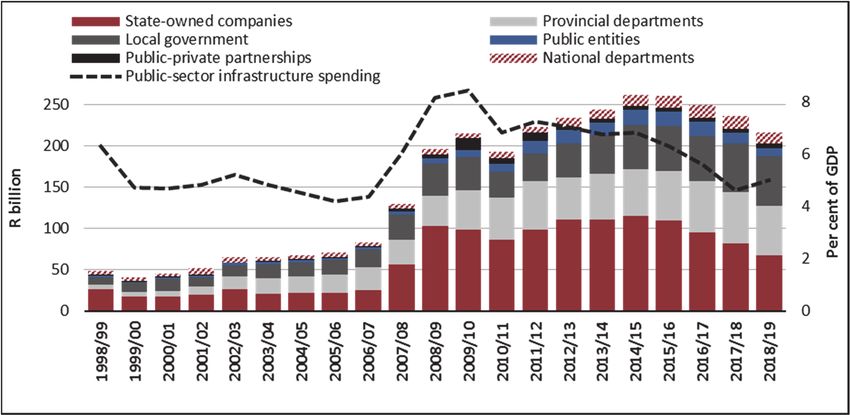
Between 1998/99 and 2018/19, the public sector spent R3.2 trillion on infrastructure (Figure D.1).
Expenditure increased from R48.8 billion in 1998/99 to R216.2 billion in 2018/19. The average real
growth in expenditure for the period 1998/99 to 2006/07 was 8 per cent. Spending then escalated on
construction projects related to the 2010 FIFA World Cup, resulting in an average real growth of
50 per cent over 2007/08 and 2008/09. Since then, expenditure growth has been declining with an
average real growth of 2 per cent.
This declining trend is largely due to municipalities and state-owned companies substantially reducing
their spending over the past few years. Several major state-owned companies have struggled to access
capital markets to finance infrastructure programmes. Most municipalities have underspent on
conditional grants and are not collecting sufficient revenue to finance their capital budgets. In addition,
national government has reduced infrastructure conditional grants to provinces and municipalities as the
budget deficit and debt have risen. The same trend is visible in infrastructure spending as a percentage
of GDP.

 Definitions of infrastructure spending
 The annexure presents estimates of infrastructure spending across the public sector, which includes national, provincial
 and local government, state-owned companies and other public entities, and public funds allocated to public-private
 partnerships.
 The data in this annexure may differ from infrastructure or capital expenditure estimates presented elsewhere in
 the 2020 Budget Review. Here, “infrastructure” is defined broadly, including spending on new assets; replacements;
 maintenance and repairs; upgrades and additions; and rehabilitation, renovation and refurbishment of assets. Capital
 and interest payments are also included in the definition. In contrast, “capital spending” typically excludes maintenance
 and finance charges.
 The annexure also includes expenditure on public housing as part of infrastructure spending. In accounting terms,
 housing subsidies are usually defined as transfers rather than capital spending.

                                                                                                                      143
2020 BUDGET REVIEW
Figure D.1 Public-sector infrastructure spending
Source: National Treasury
Public-sector infrastructure spending highlights
Table D.1 summarises government’s infrastructure spending plans for the next three years. The data
combines infrastructure financed at national, provincial and local government level with spending
estimates received from state-owned companies and other public entities.
Table D.1 Public-sector infrastructure expenditure and estimates
2016/17 2017/18 2018/19 2019/20 2020/21 2021/22 2022/23 MTEF
Outcomes Revised Medium-term estimates total
R billion estimate
Energy 67.0 55.1 39.9 49.7 52.4 52.4 45.3 150.0
Wa ter a nd s a ni ta ti on 30.8 26.8 27.1 33.5 37.0 39.6 40.6 117.1
Tra ns port a nd l ogi s ti cs 70.9 75.4 74.4 90.5 97.8 105.4 105.1 308.3
Other economi c s ervi ces 14.3 17.1 13.5 13.1 11.8 12.2 12.5 36.5
Hea l th 10.4 9.7 11.3 12.0 12.3 12.3 12.6 37.3
Educa ti on 17.8 17.6 17.2 19.5 18.7 19.7 20.7 59.1
1
Huma n s ettl ements 18.3 14.3 15.0 18.8 16.6 13.4 13.9 43.9
Other s oci a l s ervi ces 10.3 11.2 10.1 10.5 10.2 9.8 10.2 30.2
2
Admi ni s tra ti on s ervi ces 10.1 9.1 7.7 9.4 10.3 11.0 11.2 32.5
Total 249.9 236.3 216.2 257.0 267.1 275.9 272.0 815.0
Na ti ona l depa rtments 15.8 14.9 13.6 15.8 16.1 16.9 17.3 50.4
Provi nci a l depa rtments 62.6 62.3 59.5 60.8 59.9 57.1 59.9 177.0
Loca l government 54.4 58.8 61.0 61.7 62.3 65.7 68.7 196.8
3
Publ i c enti ti es 17.1 13.2 9.6 18.7 19.0 19.6 20.6 59.2
Publ i c-pri va te pa rtners hi ps 4.8 4.8 4.9 5.6 5.7 6.1 5.9 17.8
3
Sta te-owned compa ni es 95.2 82.2 67.5 94.2 104.0 110.5 99.5 314.0
Total 249.9 236.2 216.2 257.0 267.1 275.9 272.0 815.0
1. Human settlements includes public housing and bulk infrastructure amounting to R43.9 billion over the MTEF period
2. Administration services include infrastructure spending by the departments of International Relations
and Cooperation, Home Affairs, and Public Works and Infrastructure, Statistics South Africa and their entities
3. Public entities are financed by capital transfers from the fiscus and state-owned companies are financed from
a combination of own revenue, borrowings and private funding
Source: National Treasury
144ANNEXURE D: PUBLIC-SECTOR INFRASTRUCTURE UPDATE
Public-sector infrastructure spending over the medium-term expenditure framework (MTEF) period is
estimated at R815 billion. State-owned companies continue to be the largest contributor to capital
investment, spending a projected R314 billion over the next three years. Provinces are expected to spend
R177 billion on infrastructure over the same period, while municipalities are forecast to spend R196.8
billion. Public housing and bulk infrastructure built through the human settlements development grant in
provinces is expected to total R43.9 billion. Although these assets are transferred to homeowners, this
spending is a substantial government contribution to the built environment.
Spending on economic infrastructure, mainly by state-owned companies, accounts for 75.1 per cent of
the medium-term estimate. These funds are used to expand power-generation capacity, upgrade and
expand the transport network, and improve sanitation and water services. Social services infrastructure
accounts for 20.9 per cent of the total, of which health and education account for 4.6 per cent and
7.2 per cent respectively.
In 2019/20, the public sector is estimated to spend R257 billion on infrastructure, an increase of
19 per cent relative to 2018/19. This is mainly because of higher estimated spending by state-owned
companies including the Passenger Rail Agency of South Africa, Eskom, Transnet and Rand Water, which
are expected to resume or begin infrastructure projects that were deferred in previous years.
The value of infrastructure budgets, however, is eroded by insufficient capacity and skills to build a
sustainable pipeline of projects, as shown by infrastructure backlogs and the lack of business confidence.
Government is therefore adopting a multi-faceted approach by resourcing project preparation facilities,
reviewing regulations and policies, and introducing reforms. This approach is expected to improve the
effectiveness of infrastructure spending and develop a project pipeline for funding by government and
the private sector.
Sectoral updates
Energy
Energy expenditure is expected to total R150 billion over the next three years, accounting for
18.4 per cent of total infrastructure spending. Eskom accounts for R128 billion, or 85.3 per cent, of this
amount.
The Department of Mineral Resources and Energy will focus on increasing household access to electricity
over the medium term. A total of R16.4 billion has been allocated to support the Integrated National
Electrification Programme. The programme will fund an estimated 560 000 new connections to the
power grid over the MTEF period. An additional 15 000 households will be provided with non-grid (stand-
alone power system) connections per year. Over the medium term, government will transfer R6 billion
to municipalities and R9.7 billion to Eskom to fund this programme.
To help municipalities replace and upgrade municipal infrastructure with more energy-efficient
technology, R691.3 million has been allocated to the energy efficiency and demand-side management
grant over the medium term.
The Department of Mineral Resources and Energy continues to support the renewable energy market, in
line with the national commitment to transition to a low-carbon economy. Government has committed
to procuring 14 725 megawatts (MW) of power from renewable energy sources in terms of the Integrated
Resource Plan 2010 to 2030. Up to 2019, 6 422 MW has been procured from 112 renewable energy
independent power producer projects over seven bid windows, and 3 976 MW of electricity generation
capacity from 64 projects has been added to the national grid. Private-sector investment in the
programme amounts to R209.7 billion to date, of which R41.8 billion is from international investors and
funders.
1452020 BUDGET REVIEW
Water and sanitation
Government will spend R117.1 billion on water and sanitation over the next three years, accounting for
14.4 per cent of public-sector infrastructure expenditure.
The Water Infrastructure Development Programme is allocated R41.6 billion over the medium term. The
majority of this allocation, R24.5 billion, will be transferred to the Water Trading Entity, the regional bulk
infrastructure grant and the water services infrastructure grant.
The Water Trading Entity will receive transfers amounting to R6.6 billion over the medium term for new
and existing projects such as the acid mine drainage operations in Gauteng, phase 2D of the Olifants River
water resources development project, the Mokolo-Crocodile River water augmentation project, the
raising of Tzaneen Dam, the Mdloti River development project, and the raising of Hazelmere Dam.
Disbursements through the regional bulk infrastructure grant and the water services infrastructure grant
will amount to R17.2 billion over the medium term. The funding will be used to implement regional bulk
and water services infrastructure projects.
Transport and logistics
Public-sector infrastructure investment plans for transport and logistics total R308.3 billion over the
medium term. This accounts for 37.8 per cent of total infrastructure expenditure during this period.
These investments will improve the transport network, enhance the mobility of people and service
provision, reduce transport costs, and facilitate regional trade. Revenue from services provided by state-
owned companies will help fund infrastructure investment, complemented by national and provincial
allocations for road construction and maintenance of the non-toll network.
Over the MTEF period, major investments in roads and rail include the following:
• The South African National Roads Agency Limited has been allocated R64.6 billion over the medium
term. Of this amount, R35.4 billion will be used to improve and construct non-toll roads, R3.4 billion
to construct the N2 Wild Coast highway, R2.5 billion to upgrade the R573 (Moloto Road) and
R1.9 billion to compensate for reduced tariffs in the Gauteng Freeway Improvement Project.
• The provincial roads maintenance grant has been allocated R36 billion to maintain the provincial road
network by resealing a targeted 16 226 lane kilometres, rehabilitating 6 199 lane kilometres, and
patching 3.7 million square kilometres of potholes.
• The Passenger Rail Agency of South Africa has been allocated R32.4 billion in capital transfers to
modernise the rail network. In addition, R20.4 billion has been allocated to the public transport
network grant to fund the integrated public transport networks in 10 cities across the country.
Human settlements
The Department of Human Settlements has been allocated R95.9 billion over the medium term, which
will support delivery of 226 906 housing subsidies.
The department will facilitate the delivery of state-subsidised housing through implementing agents such
as provinces, metropolitan municipalities and related departmental entities. These implementing agents
are funded through the Housing Development Finance Programme in the form of conditional grants and
transfers.
The human settlements development grant has been allocated R43.9 billion over the medium term to
fund housing and human settlements programmes at a provincial level. Over the same period, the urban
settlements development grant has been allocated R26 billion to fund infrastructure provision for
broader urban development in metropolitan municipalities.
The National Housing Finance Corporation will increase access to affordable housing finance for low- to
middle-income households by facilitating private-sector lending for housing. Over the medium term, the
146ANNEXURE D: PUBLIC-SECTOR INFRASTRUCTURE UPDATE
corporation will focus on incremental housing finance; developer and emerging contractor finance;
affordable rental housing finance; and finance-linked individual subsidies for qualifying households. Over
the medium term, the corporation will receive an additional allocation of R1.3 billion for its finance-linked
individual subsidy programme.
Health
Over the medium term, the Department of Health plans to accelerate the delivery of infrastructure in the
health sector for the implementation of national health insurance. The direct health facility revitalisation
grant, which is transferred to provincial health departments, will receive R19.9 billion over the next three
years. Over the same period, R4.6 billion will be allocated to the health facility revitalisation component
of the national health insurance indirect grant. A portion of this allocation will fund the planning and
building of the Limpopo Central Hospital in Polokwane, which is expected to be completed in 2025/26.
Education
Government plans to spend R59.1 billion on infrastructure for the education sector over the MTEF period.
The Department of Basic Education plans to spend R41.4 billion on school infrastructure over the medium
term. The education infrastructure grant has been allocated R35 billion over this period to accelerate the
construction, maintenance, upgrading and rehabilitation of new and existing school infrastructure. The
school infrastructure backlogs grant will receive R6.5 billion to provide water, sanitation and electricity
to schools, and replace schools constructed with inappropriate materials. In 2020/21, R1.7 billion will be
used to build 31 new schools and to provide water and sanitation facilities to 125 and 691 schools
respectively.
The Department of Higher Education and Training will focus on increasing student access and improving
staff development in the university system by increasing allocations to universities with a high proportion
of students and staff from historically disadvantaged population groups. In 2020/21, the University
Capacity Development Programme will receive R1.1 billion, the Historically Disadvantaged Institutions
Development Programme will receive R536.3 million and the Infrastructure and Efficiency Programme
will receive R2.8 billion.
Infrastructure reforms
Infrastructure investments facilitate economic activities and thus enable economic growth, job creation
and poverty alleviation. The National Development Plan targets infrastructure investment of 30 per cent
as a percentage of GDP by 2030.
Figure D.2 Public and private capital investment as a share of GDP, 1960–2018
35
Public-sector investment
30
Private-sector investment
25
NDP target
Per cent of GDP
20
15
10
5
0
1960
1964
1968
1972
1976
1980
1984
1988
1992
1996
2000
2004
2008
2012
2016
Source: Reserve Bank
1472020 BUDGET REVIEW Bridging the infrastructure investment gap requires developing innovative approaches to leverage private-sector finance, making the necessary regulatory changes and improving infrastructure planning across government to build a pipeline of projects. To unlock this potential, government has initiated broad reforms in infrastructure provision. The reforms will ensure that infrastructure is built faster and that costs are controlled, with appropriate sharing of risks between the private and public sector. In addition, government is integrating climate-change considerations into existing tools to strengthen the climate resilience of infrastructure. The components of these reforms are summarised below. The Budget Facility for Infrastructure The Budget Facility for Infrastructure (BFI) was launched in 2016 to support the planning and execution of priority infrastructure projects and programmes. The facility evaluates proposals before committing fiscal resources to avoid funding poorly planned and inadequately prepared large-scale projects. The BFI creates a window for annual submissions for budgets of large infrastructure projects and programmes, assesses the submissions, and makes recommendations to budget authorities and political decision makers. Since 2017, there have been three annual BFI windows. In total, submissions were received for 169 projects worth R374.5 billion, and 26 projects worth R37.1 billion were recommended for funding. Most proposals submitted through the BFI are poorly planned and packaged, mainly because of insufficient technical expertise and institutional capacity to develop good projects. Appraisal and evaluation guideline With funding from the World Bank, the National Treasury is developing a government-wide project appraisal and evaluation guideline. The guideline will provide simple, uniform methodologies and criteria that will apply to all new proposals. It will guide practitioners on how to package projects and enable decision makers to select projects that offer value for money and maximise economic benefits for government. The guideline is expected to be drafted within the next six months. Infrastructure Fund Government has committed R100 billion to the Infrastructure Fund, including R10 billion over the next three years. This includes new funding, new guarantees and repackaging of existing projects. The fund focuses on blended-finance projects, most of which will be funded primarily by the private sector. The Infrastructure Fund will increase private-sector investment in public infrastructure and contribute to higher economic growth, productivity and employment creation. The fund’s implementation unit, housed within the Development Bank of Southern Africa (DBSA), aims to facilitate and speed up the development of projects and programmes. The unit aims to build a pipeline of potential projects worth over 700 billion over the next 10 years. Stringent criteria are applied when deciding which projects should be included in the Infrastructure Fund pipeline. To be accepted, projects must: • Be large, as the preparation costs for blended-finance projects are prohibitive for small projects and large-scale investment is being targeted. • Be suitable for blended financing, with clear and predictable cash flows, sufficiently attractive risk profiles for investors, and the need for some financial support from government. • Mobilise private-sector skills and resources. • Align with government’s infrastructure priorities. • Be scalable and replicable. Over the next three years, the DBSA will identify, plan and package at least five blended-finance mega projects (valued at over R200 billion), using the funds committed by government to close funding gaps and reduce risks for the private sector. Results from the first set of projects will be used to adapt and 148
ANNEXURE D: PUBLIC-SECTOR INFRASTRUCTURE UPDATE

strengthen the final design of the Infrastructure Fund. The DBSA is collaborating with private-sector
investment associations, the Banking Association South Africa, the Association for Savings and
Investment South Africa, and the Public Private Growth Initiative to build partnerships and attract
private-sector funding. Project proposals will be evaluated through the BFI.

Public-private partnership review
In 2019, the National Treasury began reviewing the public-private partnership (PPP) regulations and
guidelines. The review aims to identify and address challenges that have negatively affected PPP project
readiness and private-sector participation. Improvements stemming from the review are also expected
to enhance the Infrastructure Fund work on blended-finance projects. The review of the PPP framework
is a key reform as most of the blended projects will be partnerships between the public and private sector.
Key stakeholders in government and the private sector are providing input to the review. The
recommendations are expected in September 2020. Feasible recommendations will be incrementally
introduced to scale up the pipeline of PPP projects.

Municipal Investment Programme Project Preparation Facility
The Neighbourhood Development Programme helps municipalities improve the development and
management of their built environment. To expedite spatial transformation in cities, the focus has been
on planning well-located, mixed-use and mixed-income development programmes and projects as
required by built environment performance plans.
Metropolitan municipalities have growing infrastructure investment needs, established institutional
capacity, autonomous borrowing authority and generally healthy balance sheets that can be used to
leverage private finance. A dedicated grant will be created to support them to establish effective and
efficient programme management and project preparation facilities for their capital investment
programmes. They will be financed by reprioritising funds from the integrated city development grant
and neighbourhood development partnership grant. From 2020/21, the Cities Preparation Support Fund
will provide co-financing, which declines as these municipalities increase their capacity.

Cities Support Programme’s work on climate change and infrastructure
For many cities, strengthening the resilience of infrastructure and supporting low-carbon development
of capital projects is a large-scale undertaking that requires strong partnerships and new sources
of capital. Some cities lack technical expertise or access to the capital required. The National Treasury’s
Cities Support Programme helps cities increase their capital investments in climate resilience and low-
carbon development through targeted technical assistance to strengthen project design, packaging and
preparation.
The programme will also strengthen cities’ capability to manage climate-resilient assets by integrating
climate-change considerations into their planning tools, including the Infrastructure Delivery
Management System, guidelines for catalytic land development programmes and the BFI’s project
appraisal and evaluation guideline. Support on applying these tools will be provided at the national and
city level.

    Major infrastructure projects
Table D.2 provides a pipeline of projects that are at various stages of development. Some projects are
still in the early stages of project preparation while others are at advanced stages. These projects are not
yet approved for funding. Large projects have to go through a number of approval gates involving
successively more detailed planning before being considered for funding through the budgeting process.
Most of the proposed projects and programmes will be financed in partnership with government, the
private sector and development finance institutions. Health sector projects, however, are fully funded by
government.

                                                                                                           149
2020 BUDGET REVIEW
Table D.2 Major infrastructure projects per sector
Project name Implementing Project cost Project description Current status
agent (R billion)
Health
Limpopo Central Hospital Limpopo Department 4 Construction of a new 488-bed Procurement
of Health central hospital on a greenfield
site donated by the Polokwane
Local Municipality
Tygerberg Hospital Western Cape 4.3 Construction of a 550-bed Feasibility
Department of Health regional hospital completed
Klipfontein Hospital Western Cape 4.2 Construction of a 1 238-bed Feasibility
Department of Health hospital to replace the GF completed
Jooste Hospital
Education
Student Housing Infrastructure Department of Higher 96 Construction of student Various stages
Programme (SHIP) pilot phase Education and Training residences
Gauteng Schools Programme Gauteng Provincial 4.7 Construction, expansion, Feasibility
Government refurbishment and facilities
management of 64 schools in
Gauteng
Housing
Social Housing Programme Social Housing 10.3 Construction of social housing Implementation
Phase 1 Regulatory Authority in well-located areas for low- to
middle-income families
Social Housing Programme Social Housing 18.5 Social Housing Programme Pre-feasibility
Phase 2 Regulatory Authority Phase 2
Office accommodation
Kopanong Precinct Gauteng Department of 16 Construction of Gauteng Procurement
Infrastructure Provincial Government office to
Development consolidate administration
function of 19 buildings in the
Johannesburg CBD
Rural Development and Land Department of Rural 4 Construction of the head office Procurement
Reform head office accommodation Development and Land accommodation
Reform
Bhisho Office Precinct Eastern Cape 5 Construction of offices for Procurement
Department of Roads seven Eastern Cape
and Public departments in a single location
Infrastructure in Bhisho
Telecommunications
Broadband rollout (SA Connect) Department of 80 Broadband infrastructure in Feasibility
Telecommunications areas where pure private
and Postal Services provision thereof is not
commercially viable
150ANNEXURE D: PUBLIC-SECTOR INFRASTRUCTURE UPDATE
Table D.2 Major infrastructure projects per sector (continued)
Project name Implementing Project cost Project description Current status
agent (R billion)
Transport
Gauteng Rapid Rail Network Gauteng Department of 112 A two-phase extension of the Feasibility
Extension Phase 1 and 2 Roads and Transport existing Gautrain rail system
Gautrain: Acquisition of additional Gauteng Department of 2 Procurement of 48 additional Feasibility
rolling stock Roads and Transport coaches and expansion of
depot facility to accommodate
increased demand
National Roads Programme – South African National 22 Major upgrades to various Pre-feasibility
upgrades to existing non-concession Roads Agency sections of the N1, N2 and N3
national toll roads roads
Provincial roads concessions Provincial roads and 45 Provincial roads infrastructure Pre-feasibility
transport departments projects
Expansion of the MyCiTi Bus Rapid City of Cape Town 7.5 Expansion of the current MyCiTi Procurement
Transport System in Cape Town Bus Rapid
Transport System network
Small Harbours Programme Department of Public 8.2 Upgrading and refurbishment Feasibility
Works and of 12 proclaimed fishing
Infrastructure harbours in the Western Cape,
and nodal-based refurbishment
and development of new
harbours in the Northern Cape,
Eastern Cape and KwaZulu-
Natal
Transnet natural gas networks Transnet 10 Develop, design, finance, Pre-feasibility
project construct and operate liquefied
natural gas midstream
infrastructure to enable gas
import
One-stop border posts Department of Home 11 Upgrade, refurbishments and Procurement
Affairs facilities management for the
six busiest border posts
Energy
Approach to Distribution Asset Department of Mineral 30 Maintenance, refurbishment Pre-feasibility
Management Resources and Energy, and strengthening of municipal
Cooperative electricity distribution networks
Governance and
Municipal
Infrastructure Support
Agent
Research
SA Isotope Facility National Research 1.4 Construction of the South Procurement
Foundation African Isotope Facility
Solid waste
Mossel Bay regional landfill Garden Route District 0.8 Development of solid waste Procurement
facility Municipality and landfill
KwaDukuza waste services KwaDukuza Local 0.3 Collection and disposal of solid Procurement
Municipality waste from households
1512020 BUDGET REVIEW
Table D.2 Major infrastructure projects per sector (continued)
Project name Implementing Project cost Project description Current status
agent (R billion)
Water and sanitation
Water reuse Cooperative 50-75 Increasing bulk water supply, Pre-feasibility
Governance and through wastewater reuse or
Municipal putting in place new sources of
Infrastructure Support supply such as desalination
Agent
Water and sanitation private- Cooperative 100 Increasing private-sector Pre-feasibility
sector participation Governance and participation in the provision of
Municipal municipal water and sanitation
Infrastructure Support services
Agent
Non-revenue water (water Cooperative 35-50 Improving water infrastructure Pre-feasibility
conservation and water demand Governance and to reduce losses, and improving
management) Municipal metering, billing and collection
Infrastructure Support from non-indigent customers
Agent
Olifants River Water Resources Trans-Caledon Tunnel 20 Bulk water infrastructure Pre-feasibility
Development Project Authority development
Bulk infrastructure
Industrial Development Corporation Industrial Development 15 Industrial Development Feasibility
(IDC) infrastructure for industrial Corporation Corporation infrastructure for
projects programme industrial projects
Vumela - municipal bulk Cooperative 50-60 Development of municipal bulk Pre-feasibility
infrastructure financing Governance and infrastructure
Municipal
Infrastructure Support
Agent
Coega Special Economic Zone Return Coega Development 0.9 Construction of critical bulk Feasibility
Effluent Corporation infrastructure (water, return completed
Scheme effluent and sanitation) around
the development of a bulk
return effluent scheme
The establishment of basic Coega Development 0.5 The provision of bulk services, Feasibility
economic infrastructure in Zone Corporation including water, sanitation, completed
3, 5, 6 and 7 of the Coega Special electrical and energy
Economic Zone to unlock gas-to-
power, aquaculture
development and bulk water demand
Source: National Treasury
152You can also read


