STRATEGIC TRENDS 2018 - Key Developments in Global Affairs - CSS
←
→
Page content transcription
If your browser does not render page correctly, please read the page content below
Center for Security Studies

STRATEGIC
    TRENDS 2018
                    Key Developments in Global Affairs

Editors:            Oliver Thränert, Martin Zapfe

Series Editor:      Andreas Wenger
Authors:	Brian Carlson, Severin Fischer,
          Tim Prior, Jack Thompson

   CSS
   ETH Zurich
STRATEGIC TRENDS 2018 is also electronically available at: www.css.ethz.ch/publications/strategic-trends Editors STRATEGIC TRENDS 2018: Oliver Thränert, Martin Zapfe Series Editor STRATEGIC TRENDS: Andreas Wenger Contact: Center for Security Studies ETH Zurich Haldeneggsteig 4, IFW CH-8092 Zurich Switzerland This publication covers events up to 5 March 2018. © 2018, Center for Security Studies, ETH Zurich Images © by Reuters ISSN 1664-0667 ISBN 978-3-905696-62-2
CHAPTER 1

Superpower Constrained
Jack Thompson

The US’ longstanding role of international leadership is under threat. It is
struggling to manage external challenges, including great power competi-
tion and globalization, and domestic constraints, such as underfunding and
mismanagement of the military and diplomatic corps. Unfortunately, pros-
pects for reform are uncertain given the dysfunctionality of the US political
system. This should worry European policymakers and will hopefully hasten
their efforts to develop a more robust and independent Common Security
and Defense Policy.

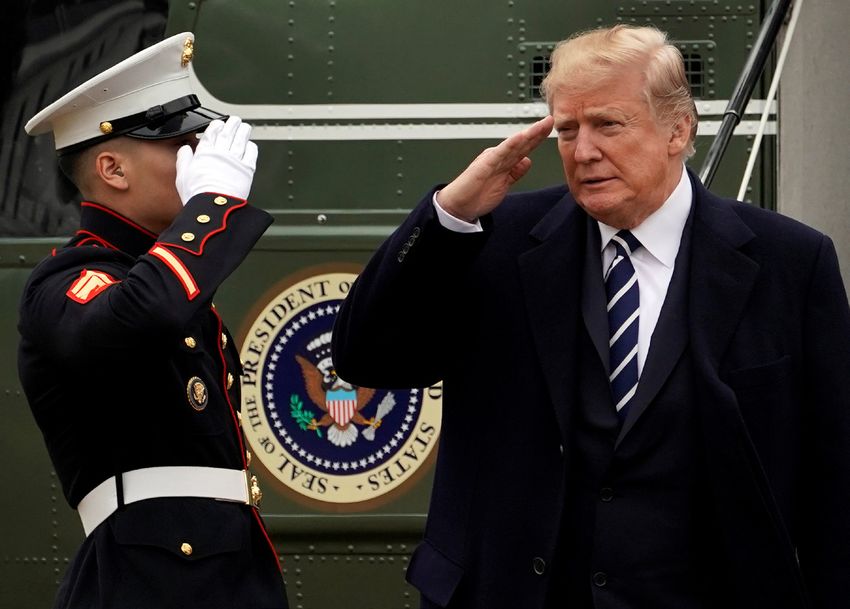
US President Donald Trump returns to the White House after addressing the Republican Congres-
sional Retreat, 1 February 2018. Yuri Gripas / Reuters

                                                                                          11
STRATEG I C TR EN DS 201 8
Introduction changes to the international system,
The United States enjoys an unrivaled but they have the power to deploy
ability to shape world affairs. Thanks US troops more carefully, to man-
in large part to its leadership of and age the military and diplomatic corps
participation in the liberal world or- more intelligently, and to address the
der (LWO), US military might is un- underlying causes of opposition to
equalled, its economy is the largest in international trade and declining at-
the world, and the US dollar’s status as tachment to democratic norms.
the most important reserve currency
provides enormous benefits. Soft pow- Unfortunately, a vigorous reasser-
er is another area of advantage, with tion of US leadership appears to be
US culture in particular commanding unlikely. Demanding deployments
global influence. and – in light of its many commit-
ments – inadequate budgets have left
However, this favorable state of affairs the military in a state of crisis. The
is under threat. Partly, this is due to diplomatic corps is also struggling
structural changes in the internation- under the weight of poor leadership,
al system. With the rise of persistent a sharp reduction in numbers, sinking
global and regional challengers, the morale, and the prospect of reduced
post-Cold War “unipolar moment” funding. Some of these problems are
has ended, and US military and eco- specific to Donald Trump’s presiden-
nomic predominance are no longer as- cy, but the problems go much deeper
sured. Globalization and technological than the current administration.
change have accelerated the process,
fragmenting power, diffusing informa- In other words, reform is unlikely.
tion, and weakening support for inter- There is little indication that the po-
national trade and democratic values. litical will exists, or that the system is
Even its soft power could be at risk, equipped to accommodate the sweep-
as political and economic dysfunction ing changes that would be necessary
undermine the US’ image abroad. to turn things around. Washington re-
mains hamstrung by gridlock, which
If the US is to reverse these trends, reflects the polarization that has di-
to retain a position of unquestioned vided society in recent decades. It
leadership in world affairs, and to pre- seems likely that the US will continue
serve the LWO, it will need to get its to face significant constraints for the
house in order. There is little policy- foreseeable future. In the meantime,
makers can do to reverse the structural its rivals are gaining ground, and the
12SU PER POWER CONSTRA I N E D
The Return of Geopolitics from a US Perspective
Russia
North
United States Syria Iran Afghanistan Korea
Iraq China
Niger
Yemen
Djibouti
Great power challengers
Regional challengers
Hotspots
Approximately 6,000 US troops stationed
throughout the continent (biggest deployment
in Djibouti (4,700) and Niger (800))
Sources: Kathryn Watson, “Where does the U.S. have troops in Africa, and why?”, in: CBS News (21.10.2017); International Institute
for Strategic Studies (IISS), The Military Balance 2018 (Routledge, 2018), 59.
world is becoming less conducive to Strategy acknowledges – “the primary
liberal internationalist values such as concern in U.S. national security”.
democracy, free trade, and the rule of
law. This state of affairs should worry Two nations, China and Russia, have
Europeans, as their foreign and secu- not reconciled themselves to the cur-
rity policy relies upon vigorous inter- rent international order and consti-
national engagement by the US. tute the foremost threat to US lead-
ership and the future of the LWO.
The Return of Geopolitics and the China resents US predominance and
Forever War is positioning itself as a rival super-
The apparent post-Cold War triumph power. Though Beijing is challenging
of the LWO has proven illusory. In- US interests across the globe, its prior-
stead, the US and its allies face a ity is to upend the status quo in East
fractured, multipolar system that is Asia, where the US has long served
rife with threats, especially from revi- as the fulcrum for the region’s power
sionist powers. What Walter Russell structure. Much as the US asserted
Mead dubbed the “return of geopoli- itself in the Western Hemisphere in
tics” represents – as the Department the early 20th century by forcing Eu-
of Defense’s 2018 National Defense ropean nations to acknowledge its
13STRATEG I C TR EN DS 201 8
preeminent role, China seeks to re- also serves the broader goal of but-
place the US as the leading power in tressing Beijing’s claim to sovereignty
its neighborhood. over most of the South China Sea,
the world’s most important shipping
Though the US position remains zone. The US contests this claim by
strong, recent political and economic regularly conducting freedom of navi-
developments have drawn attention gation exercises, but has been unable
to Beijing’s growing influence. Presi- to do anything to slow the reclama-
dent Trump’s decision to withdraw the tion and fortification project. China’s
US from the Trans-Pacific Partnership development of anti-ship ballistic
trade agreement – which excluded missiles, which are designed to de-
China, and which the administration stroy aircraft carriers, also threatens
of Barack Obama viewed as a way to the ability of the US to intervene in
reinforce its standing in East Asia – the region. China’s nuclear arsenal,
represented a setback. China quickly though still small when compared to
moved to fill the vacuum by redou- those of the US or Russia, is slowly
bling efforts to promote an alternative increasing in size and in terms of its
arrangement, the Regional Compre- capabilities.1
hensive Economic Partnership. This
dovetails with a desire to link Eurasia China has moved aggressively to close
under Chinese economic leadership, the gap with the US in the realm of
embodied in the Belt and Road Initia- advanced technology, with consider-
tive, and a long-term goal of establish- able success. When it comes to arti-
ing footholds in Europe, Latin Ameri- ficial intelligence, for instance, China
ca, and Africa. has announced a goal of becoming
the global leader by 2030, and is al-
Beijing is also challenging the US and ready closing in on the US. China is
its allies on military, strategic, and also a powerful player in the cyber
technological fronts. It is executing a domain and is using its influence to
steady campaign of pressing a long list shape the global development of the
of territorial claims in the region, in- internet in ways that are conducive to
cluding a dispute with Japan over the its own interests, but not necessarily
Senkaku Islands. Even more notewor- to those of the West.2
thy is China’s project of creating arti-
ficial islands in the South China Sea, Like China, Russia seeks to under-
several of which it is equipping for mine US leadership, which it views
military purposes. Their development as the foremost hurdle to its return
14SU PER POWER CONSTRA I N E D
to superpower status. Vladimir Putin’s The US is also confronted by regional
campaign to revivify Russian power powers that resent the status quo. The
has enjoyed considerable success, even speed with which North Korea has
if the economic resources at his dis- developed intercontinental ballistic
posal are more modest than China’s, missiles that might already be able to
and much of his progress has come reach the US mainland, and Pyong-
at the expense of the US and its al- yang’s unwillingness to trade its nu-
lies. Military interventions in Georgia clear weapons program for relief from
and Ukraine – nations that harbored economic sanctions, has left policy-
ambitions of drawing closer to the Eu- makers with a series of unappealing
ropean Union (EU) and/or the North choices. They could accept North
Atlantic Treaty Organization (NATO) Korea as a nuclear power and rely on
– elicited condemnation and econom- deterrence. However, Kim Jong-un’s
ic sanctions from the West. However, regime is particularly brutal and regu-
these have done nothing to impair larly transgresses international laws
Moscow’s aggressiveness, which in- and norms. It views a nuclear arsenal
cludes frequent violations of NATO as more than merely a defensive in-
airspace. Even Moscow’s interference vestment. Rather, it has a history of
in the 2016 US elections, the full ex- engaging in brinkmanship to extract
tent of which remains unclear, has yet concessions from the US and the rest
to elicit an effective US response. of the international community.
Russia’s intervention in the Syrian civ- One alternative to deterrence would
il war appears to have been a decisive be an attack designed to destroy most
factor in the resurgence of Bashir al- or all of the North Korean nuclear
Assad’s regime and should give Mos- arsenal. The Trump administration is
cow a foothold in the Middle East for currently considering such a “bloody
the foreseeable future. Meanwhile, in nose” strike. However, even if a mili-
spite of the virtual defeat of the Islam- tary raid achieved its objectives – and
ic State, the return on Washington’s the chances of success would be low
investment of money and troops in – Pyongyang also has extensive con-
Syria has been more modest. Never- ventional armaments at its disposal.
theless, former Secretary of State Rex These includes a large array of artil-
Tillerson recently announced that US lery that potentially could inflict cata-
forces will remain in Syria for the fore- strophic damage upon Seoul.3 A third
seeable future, thereby adding further option, relying on North Korea’s only
strain to an overstretched military. close ally, China, to force Pyongyang
15STRATEG I C TR EN DS 201 8
to denuclearize has also failed. There restart its nuclear weapons program.
are limits to Beijing’s ability to dictate The preferred alternative of some
to North Korea and it is unwilling to hawks – airstrikes on Iran’s nuclear fa-
impose conditions that would lead the cilities – would further destabilize the
Kim regime to collapse, as the most region. It would also be difficult to hit
likely outcome would be a united Ko- all of the targets, and even a successful
rea closely allied to the US. operation would only retard Tehran’s
nuclear program for a few years.5
Policymakers are also uncertain how
to handle the emergence of Iran as a The Trump administration’s attempt
regional power. The 2015 Joint Com- to balance Tehran by reinvigorating
prehensive Plan of Action (JCPOA) the long-standing alliance with Saudi
appears to have halted Iran’s nuclear Arabia and moving even closer to Is-
weapons program. However, the pres- rael also brings risks. By siding so de-
ident and some of his key advisors cisively with Riyadh and Tel Aviv, the
have taken initial steps to undermine US further undermines its previous
the JCPOA, and there are indications status as an honest broker and makes
that they will withdraw from it alto- a broader peace agreement in the re-
gether.4 Meanwhile, Iranian influ- gion between Israel and its neighbors
ence in the Middle East continues to more unlikely. This strategy also ties
increase. Tehran’s expansion has been the US more closely to Saudi Arabia’s
enabled, in large part, by ineffective disastrous intervention in Yemen,
US policy over the last 15 years, in- which will do nothing to improve the
cluding the invasion of Iraq in 2003 US’ image in the region.
and the indecisive response to the Syr-
ian civil war. US troops have been involved in com-
bat in the Middle East and South/
There are no appealing options when it Central Asia for more than 15 years,
comes to restraining Iran. The Trump and the recent announcement of the
administration complains that the Trump administration that it is plan-
JCPOA, by ignoring the non-nuclear ning for an open-ended commitment
aspects of Iranian expansionism, is of forces in Syria confirms that there
worse than no deal. However, with- is no end in sight to the “Forever War”
drawing from the JCPOA would al- against terrorism and hostile regimes.
ienate the other signatories – espe- The length of this conflict, which
cially the Europeans, who consider the constitutes the longest in US history,
deal to be effective – and allow Iran to does not indicate resolve. Instead, it
16SU PER POWER CONSTRA I N E D
underlines the inability of the US to The Downsides of Economic
obtain its political and military objec- Interdependence and Globalization
tives, or even to formulate a coherent In the decades following World War
strategy for doing so. The prosecution Two, the US did more than any other
of the Forever War has led to an unsus- nation to create the foundations of
tainable dynamic: The US is fighting the modern era. It encouraged free
on too many fronts and lacks the re- trade and the lowering of barriers
sources and political will to maintain to the flow of capital; US corpora-
the present situation. It is a textbook tions penetrated new markets, tak-
example of imperial overstretch. ing knowledge and technology with
them; and millions embraced US
If anything, the situation is worsen- popular culture. The results appeared
ing. Military involvement in Africa is to be unequivocally positive. Many
a case in point. It has notably escalated Americans attained unprecedent-
over the last 15 years and now affects ed standards of living as a result of
almost every nation on the continent. greater interdependence, and the US
Many soldiers – at least 6,000, accord- economy remains the world’s largest
ing to the Department of Defense – and arguably most dynamic.
are participating in ill-defined activi-
ties such as training or advising, which Nevertheless, in the years since the
often entangle them in combat. financial crisis of 2007 – 2008 the
downsides of globalization have be-
Obama was anxious to avoid worsen- come apparent. Indeed, even as the
ing the problem of overstretch, and US appears to be thriving, it is also
Trump, albeit inconsistently, has also increasingly constrained by many of
criticized the Bush administration’s the forces it was instrumental in un-
overuse of the military. Yet neither leashing. In spite of strong headline
has explained how to prevent it. This numbers – including an unemploy-
suggests that the US is caught in a vi- ment rate of approximately 4 per
cious cycle. Policymakers recognize cent and an economic expansion of
that they need to use force more in- 2.3 per cent in 2017 – there is ample
telligently in order to husband finite reason for concern. Partly, this can
resources and revitalize an exhausted be ascribed to ineffective policymak-
military, but struggle to extricate the ing at home. Inequality has reached
US from its existing obligations. Fur- historic levels, and legislators appear
thermore, the temptation to intervene to be more concerned with placating
in new hotspots is ever-present. wealthy donors than with the need
17STRATEG I C TR EN DS 201 8
to rebuild crumbling infrastructure The nature of the Chinese regime and
or make university education more its geopolitical ambitions also make
affordable.6 its status as an economic superpower
problematic. In spite of occasional
Changes in the structure of the glob- friction between the US and Germa-
al economy also present long-term ny or Japan over trade practices, the
obstacles. The rise of China – fa- fact that they are close allies that hold
cilitated in part by the interdepend- free elections and embrace the rule of
ence pursued by the US – is particu- law means that they pose no threat to
larly problematic. In and of itself, core US interests – a point that is lost
the emergence of a strong economic on President Trump. China, by con-
counterweight is not necessarily cause trast, has failed to democratize. This
for concern. The economic clout of has confounded many analysts, who
allies such as Germany, Japan, or the argued that accession to the World
EU – in spite of occasional alarmist Trade Organization in 2001 and a
headlines – does not generate wide- long-term program of economic lib-
spread alarm. However, the threat eralization would force Beijing to re-
posed by China is more profound: it form its political system. If anything,
is expected to surpass the US as the the opposite has occurred, and Presi-
world’s largest economy in the near dent Xi Jinping has redoubled the
future, and its ability to influence the grip of the Communist Party, as well
global system dwarfs that of other as his own, on the Chinese political
trade competitors. system.
The scale of China’s influence can be This combination of economic power
seen in the consequences of its rapid and resilient authoritarianism gives
growth. The “China Shock”7 – the in- Beijing considerable global sway.8
ability of labor markets to adjust to China is now Africa’s largest trading
competition from China – and other partner and, in spite of Beijing’s of-
manifestations of interdependence, ficial policy of “non-interference” in
such as the North American Free Trade the internal affairs of other countries,
Agreement (NAFTA), have led to the it has gradually expanded its influ-
loss of millions of jobs, the long-term ence throughout the continent. In
decline of regions most vulnerable to doing so, it has pursued strategic aims
increased competition, and an increase – such as garnering support for its
in political populism, including calls “One China” policy and its model of
for protectionism. non-democratic governance – as well
18SU PER POWER CONSTRA I N E D
as economic growth.9 Similar efforts infrastructure of adversaries such as
in Latin America pair economic and South Korea, and to undermine the
strategic objectives, such as counter- dissemination of what it views as hos-
balancing the strong position of the tile cultural products. The US has yet
US in East Asia.10 to develop an effective response.12 Be-
cause its economy is relatively primi-
Most worrying is China’s growing in- tive, retaliatory attacks are of limited
fluence in Europe. It has used prom- value, and until recently, the US has
ises of investment in the “16+1” group been reluctant to respond with con-
of Central and Eastern/Southeastern ventional military force for fear of
European countries to engender closer sparking a broader conflict.
ties and more sympathy on issues such
as human rights.11 While China’s in- Hostile powers and non-state actors
fluence is still modest in comparison alike have discovered that some of
to that of the US – and is generating the longstanding strengths of the US,
opposition in some corners of Europe such as its democratic form of govern-
– its efforts underscore the sweeping ment and the ability to develop and
scale of Beijing’s vision. Furthermore, integrate advanced technology into
China’s emergence as an alternative to its economy, render it vulnerable to
the US when it comes to leading the cyber attacks. Russia’s interference in
international community on pressing the 2016 election relied on a combi-
global challenges, such as trade liber- nation of cyber espionage and collab-
alization or combating global warm- oration with US citizens. WikiLeaks
ing, underscores the fact that the US has caused considerable damage by
can no longer take predominance for releasing a large number of sensitive
granted. government documents. These data
dumps, which have relied on leaks
Regional powers have also harnessed from inside the US national security
aspects of globalization to increase community and intelligence acquired
their ability to frustrate the US. North by state actors such as Russia, have
Korea and Iran have used technology angered allies and damaged US soft
first developed in the West in their power.
quest to attempt to develop nuclear
arsenals. North Korea has developed As the example of WikiLeaks indi-
sophisticated cyber capabilities and cates, globalization has enabled some
used them to carry out cybercrime, non-state actors to accrue dispro-
to infiltrate the political and military portionate influence. The ability of
19STRATEG I C TR EN DS 201 8
terrorist groups such as al-Qaida or working-class white voters feel that
the Islamic State to confront the US they have lost economic and political
would not have been possible in the status and power.15 This perception
era before modern international travel, has been amplified by the growing
mass immigration, and wider access to diversity in the US – at some point
information about weapons and mili- in the mid-21st century, whites will
tary tactics. The tendency of the US to no longer constitute of a majority
overreact, and to pay correspondingly of the population – and has fueled
less attention to more acute problems support for extremist political ideas
such as global warming, only com- and figures, with several notable
pounds the problem. consequences.
Domestic Constraints One is decreased enthusiasm for
Trade liberalization and advances in democratic politics and norms –
technology have had a profound im- which correlate closely with support
pact on US political culture. Politi- for internationalism. This phenom-
cal polarization, for instance, has in- enon is particularly notable among
creased in areas that are exposed to younger Americans, but can be seen
increased international trade. Over the throughout the US body politic.16
last 15 years, congressional districts The rise in authoritarian values – a
represented by moderates have tend- preference for order and conformity,
ed to replace them with more liberal especially in times of crisis – and the
Democrats or more conservative Re- growing tendency of authoritarians
publicans. In presidential races, these to vote for the GOP, is a manifesta-
areas have become more likely to vote tion of this tendency.17 Another is
for Republican candidates.13 The re- the radicalization of border politics,
sults at the national level are striking, as a majority of white Americans
as polarization has reached historically have come to view immigration as
high levels and the Republican Party a burden and/or threat.18 Opposi-
(GOP) is more conservative than at tion to free trade has become an im-
any point in its history.14 portant feature of US politics, espe-
cially among culturally conservative
Related to this increase in partisanship whites.19 Support for international
is the tendency of voters who have suf- alliances is shaky and notably weak
fered economically as a result of free among Republicans (though support
trade and/or technological change to for NATO remains strong). Even
embrace radical political views. Many when it comes to broad attitudes
20SU PER POWER CONSTRA I N E D
Public Attitudes Toward International Engagement
Maintaining existing alliances is a very effective way to achieve the
foreign policy goals of the US:
2015 37% Democrats
31%
55%
Republicans
2017 43% Core Trump Supporters
Free trade agreements have been a good thing for the US:
67%
2017 34%
Large numbers of immigrants and refugees entering the US represent a critical threat:
29%
2015 64%
20%
2017 61%
The US should be the dominant world leader:
21%
2015 38%
26%
2017 47%
53%
The US should play a shared leadership role in world affairs:
72%
2015 57%
68%
2017 49%
42%
0 10 20 30 40 50 60 70 80 90 100
Sources: Dina Smeltz et al., “What Americans Think about America First”, in: 2017 Chicago Council Survey, The Chicago Council on
Global Affairs (2017), p. 3, 5, 9; Dina Smeltz et al., “America Divided: Political Partisanship and US Foreign Policy”, in: 2015 Chicago
Council Survey, The Chicago Council on Global Affairs (2015), p. 12; Bradley Jones, “Support for free trade agreements rebounds
modestly, but wide partisan differences remain”, Pew Research Center (2017).
toward international engagement, his promise to renegotiate or with-
which a large majority of Republicans draw from NAFTA and to get tough
advocate, many in the party – and a on Chinese trade practices; his at-
majority of Trump supporters – pre- tempts to reduce the number of im-
fer a dominant position rather than a migrants, legal and undocumented
shared leadership role.20 alike; his ambivalence about NATO;
his enthusiasm for illiberal leaders;
When viewed in this light, the elec- and his reluctance to condemn white
tion of Donald Trump is not surpris- supremacists – all of these policies
ing. His withdrawal from the Trans- are acceptable to millions of Ameri-
Pacific Partnership trade agreement; cans, and in some instances enjoy the
21STRATEG I C TR EN DS 201 8
support of a majority of Republican deal that would increase funding for
voters. Many in the GOP political the military over the next two years
establishment have quickly embraced by 160 billion USD, this is unlikely
the Trumpification of Republican to include nuclear weapons. Further-
foreign policy. (It is also worth not- more, though the additional funding
ing that in regard to some aspects of is a necessary first step, it will still take
international engagement, such as free time to undo the damage wrought by
trade, a large minority of Democratic sequestration. For instance, in the
voters also express skepticism.) event of a conflict, the Army would
only be able to field an estimated
Overstretch, polarization, political three brigade combat teams out of
dysfunction, and skepticism about in- more than 50.22
ternationalist policies have contributed
to a crisis in funding and readiness for The diplomatic corps is also in a state
the military. The problem began with of crisis. At one per cent of the fed-
the conflicts in Afghanistan and Iraq, eral budget, funding for the Depart-
which led to frequent and lengthy de- ment of State and the Agency for
ployments for many soldiers and a cor- International Development is already
responding drop in morale. This prob- modest. To make matters worse, the
lem has been compounded by certain Trump administration has proposed
provisions in the Budget Control Act sweeping cuts to these departments
of 2011 – commonly referred to as se- – though Congress is unlikely to ap-
questration – which was opposed by prove these reductions in full. This in-
most members of Congress, but was difference to the importance of diplo-
nevertheless implemented because no macy and development, along with
agreement could be reached to fund mismanagement by former Secretary
the government. Sequestration has re- of State Tillerson, has resulted in a
quired substantial spending cuts and steep decline in morale and a mass
led to uncertainty about long-term exodus of senior diplomats. Mean-
funding streams.21 while, a hiring freeze by Tillerson has
dramatically lowered the number of
President Trump has called for a sus- incoming Foreign Service Officers.23
tained increase in military spending,
including an upgrade and expansion With the exception of the ongoing
of the nuclear arsenal that will cost at disaster at the State Department, it
least 1.2 trillion USD. Although Con- would be a mistake to blame Trump
gress recently agreed to a spending for these developments. Rather, the
22SU PER POWER CONSTRA I N E D
The US National Defense and International Affairs Budget
1990 – 2019 (in billion USD)
se or in State nse,
e
de all pt. of r Def
tan
et se
ses
c t of
dg ea
nis
De fo
Cri
bu cr
ffe ct
Tru s for eases
ha
s e ol A
ial
r
q
Wa
Afg
Ira
nc
ake ntr
fen s f
cu incr
old
na
of
of
11 t Co
l Fi
on
on
fC
of p c
big st
20 et
t
ba
asi
e
asi
do
dg
m
d
Glo
Mo
Inv
Inv
Bu
En
800
700 National Defense Budget
International Affairs Budget*
600
500
400
300
200
100
0
1990
1991
1992
1993
1994
1995
1996
1997
1998
1999
2000
2001
2002
2003
2004
2005
2006
2007
2008
2009
2010
2011
2012
2013
2014
2015
2016**
2017**
2018**
2019**
* International Affairs Budget consists of International Development and Humanitarian Assistance, International Security
Assistance, Conduct of Foreign Affairs, Foreign Information and Exchange Activities, International Financial Programs
** Estimate
Sources: U.S. Government Publishing Office; Paul Singer, “What’s in the senate budget deal? Billions for defense, infrastructure,
disasters and more”, in: USA Today (7.2.2018).
president embodies an evolving politi- The rest of the world has noticed.
cal culture in which actual or perceived Although there is still widespread
threats assume disproportionate im- admiration for some aspects of the
portance for many. This imposes ad- US, such as popular culture, there is
ditional constraints on foreign as well widespread unease about its political
as domestic policy making and makes system and opposition to the spread
it more difficult to sustain interna- of its ideas and customs. Partly, these
tionalist policies such as admitting attitudes can be linked to the election
immigrants, promoting trade deals, of Trump, who is unpopular in all but
maintaining alliances, and upholding a few countries.24 It is also evidence
democratic values. of a wider sense of disquiet about the
23STRATEG I C TR EN DS 201 8
US Soft Power Since 2012
Obama Presidency 2012
Favorable view of the US: Trump Presidency 2017
52%
- the German public 35%
52%
- the Russian public 41%
72%
- the Japanese public 57%
Confidence in the US President:
87%
- the German public 11%
36%
- the Russian public 53%
74%
- the Japanese public 24%
Global job performance approval rating:
41%
- US leadership 30%
41%
- German leadership 41%
23%
- Russian leadership 27%
29%
- Chinese leadership 31%
Favorable view of US music, movies and TV:
67%
- the German public 74%
48%
- the Russian public 56%
69%
- the Japanese public 73%
Favorable view of US ideas about democracy:
45%
- the German public 37%
26%
- the Russian public 30%
64%
- the Japanese public 63%
0 20 40 60 80 100
Sources: Andrew Kohut et al., “Global Opinion of Obama Slips, International Policies Faulted”, Pew Research Center (2012), p. 3, 5,
22 – 23; Richard Wike et al., “U.S. Image suffers as Public Around World Question Trumps Leadership”, Pew Research Center (2017),
p. 22, 28, 34, 93 – 94; Gallup (2018), Rating World Leaders: 2018, p.2.
future of US global engagement. Ap- prevailed during the Bush administra-
proval of US leadership worldwide tion. It now ranks on par with China,
rose between 2008 and 2016, but has a troubling omen for those who con-
since returned to the low levels that sider US soft power to be an advantage
24SU PER POWER CONSTRA I N E D
in its rivalry with Beijing. Also worry- Aspects of soft power, such as popular
ing is that only one-quarter of Europe- culture and the reputation of its lead-
ans approve of US leadership.25 ing universities, will continue to be
a strength, but the longer the US is
Conclusion: the Consequences of plagued by political dysfunction and
Constraint radicalization the more difficult it will
Policymakers face a different geopo- be to attract talented foreigners and
litical landscape than their post-World influence other nations. One worry-
War Two predecessors. The US remains ing sign is that after years of steady
the world’s most powerful nation, but growth, enrollments by international
its influence is undermined by foreign students at US universities declined in
and domestic constraints that are un- 2016 and 2017.26
likely to dissipate. Great power com-
petitors such as China and Russia will Meanwhile, the diffusion of informa-
remain antagonistic – though China, tion and technology will continue to
given its economic strength, has a empower regional competitors and
much better chance of sustaining its non-state actors. Here, too, policy-
challenge over the long term. makers remain at a loss as to how to
respond. The nature of the US eco-
The downsides of globalization will nomic and political system, with its
also endure. Economic interdepend- reliance on the rule of law, advanced
ence, a source of considerable strength technology, and the free flow of infor-
for the US economy, will also con- mation and people, leaves it uniquely
tinue to fuel inequality and – in com- vulnerable to asymmetric attacks
bination with cultural conservatism from weaker and authoritarian foes.
– political radicalization. There is lit- Partisanship further complicates mat-
tle reason to expect that the political ters by making it difficult to assess the
will exists to address this paradox, or impact of previous attacks and to im-
that the system is even capable of ac- plement effective countermeasures.
commodating the type of changes that
would be necessary. On the contrary, What does all of this mean for the
the situation appears set to worsen, as future of US foreign policy? Sweep-
key arms of the US foreign policy and ing predictions are unwise in the era
national security apparatus – its mili- of Trump, but the evidence suggests
tary and diplomatic corps – are in the several trends. Fears that the US will
midst of crises that could leave them embrace a form of neo-isolationism
hobbled for years. are unjustified. However, we can
25STRATEG I C TR EN DS 201 8
expect more extreme swings in behav- 2010 NPR called for modernizing
ior, based partly on which party holds the nation’s nuclear arsenal, but also
power. The GOP has fused comfort- sought to lead the way on arms con-
ably with Trumpism, leaving it more trol. In keeping with his skepticism
nationalist and unilateralist than was regarding the value of international
previously the case – a fact which is cooperation, Trump shows no such
highlighted by the administration’s interest.27
decision to continue using the unsa-
vory phrase “America First”, which ap- European policymakers are under-
pears numerous times in the recently standably concerned about the direc-
released National Security Strategy. tion of US foreign policy. It is more
This means it will be prone to bouts aggressive but less effective, and more
of protectionism, nativism, xenopho- demanding of its allies but unwilling
bia, and illiberalism. This will hamper to provide leadership. This state of af-
efforts to sustain an internationalist fairs presents potential opportunities
grand strategy in the coming years. and pitfalls. The return of geopolitics
The Democratic Party, meanwhile, will focus US attention on Africa, the
continues to be more committed to Middle East, and East Asia, leaving
engagement, multilateralism, and limited time and resources for as-
democratic values. However, a vocal sisting allies across the Atlantic. This
minority of the party firmly opposes could encourage Europe to accelerate
trade liberalization and favors further the development of a robust Com-
cuts in military spending – tendencies mon Security and Defense Policy
which bode poorly for revitalizing US (CSDP) and, in the best-case scenar-
leadership. io, lead to a more equal and fruitful
US-European relationship.
In the worst-case scenario, extremist
nationalism combined with an inabili- However, if the US continues to
ty to satisfactorily counter asymmetric struggle to adapt to the evolution of
threats could lead to a more danger- global politics and to address its most
ous, unpredictable foreign policy. One pressing domestic challenges, the
hint of this troubling possibility can transatlantic alliance will suffer ac-
be found in the 2018 Nuclear Posture cordingly. This would be dangerous
Review (NPR). It expands the category for both sides – and for the entire in-
of threats that could elicit a nuclear re- ternational system.
sponse and calls for placing more em-
phasis on low-yield devices. Obama’s
26SU PER POWER CONSTRA I N E D
1 Hans M. Kristensen/Robert S. Norris, “Chinese 13 David Autor et al., “Importing Political Polari-
Nuclear Forces, 2016”, in: Bulletin of the Atomic zation? The Electoral Consequences of Rising
Scientists 72 (2016), 205 – 211. Trade Exposure”, in: NBER Working Paper
no. 22637 (2017).
2 Nigel Inkster, China’s Cyber Power (London:
Routledge, 2017); Sophie-Charlotte Fischer, 14 Noland McCarty, “What we know and don’t
“Artificial Intelligence: China’s High-Tech know about our polarized politics”, in: The
Ambitions”, in: CSS Analyses in Security Policy, Washington Post, 08.01.2014.
no. 220 (2018).
15 Justin Gest, The New Minority: White Working
3 Uri Friedman, “What Are America’s Options on Class Politics in an Age of Immigration and
North Korea?”, in: The Atlantic, 07.04.2017. Inequality (New York: Oxford University Press,
2016).
4 Jack Thompson/Oliver Thränert, “Trump Pre-
paring to End Iran Nuke Deal”, in: CSS Policy 16 Yascha Mounk and Roberto Stefan Foa, “Yes,
Perspectives 5, no. 4 (2017). people really are turning away from democ-
racy”, in: The Washington Post, 08.12.2016.
5 The Iran Project, Weighing Benefits and Costs of
Military Action Against Iran, 2012. 17 Christopher Weber et al., “How authoritarian-
ism is shaping American politics (and it’s not
6 Maggie Severns, “Big Donors Ready to Re- just about Trump)”, in: The Washington Post,
ward Republicans for Tax Cuts”, in: Politico, 10.05.2017.
29.01.2018; Jack Thompson, “Looking Beyond
Trump”, in: Strategic Trends (2017), 35 – 54. 18 Marisa Abrajano and Zoltan Hajnal, White
Backlash: Immigration, Race, and American
7 David H. Autor et al., “The China Shock: Politics (Princeton: Princeton University Press,
Learning from Labor Market Adjustment to 2017).
Large Changes in Trade”, in: NBER Working
Paper, no. 21906 (2016). 19 Bradley Jones, “Support for free trade agree-
ments rebounds modestly, but wide partisan
8 Nadège Rolland, China’s Eurasian Century? differences remain”, Pew Research Center,
Political and Strategic Implications of the Belt and 25.04.2017.
Road Initiative (Seattle: The National Bureau of
Asian Research, 2017). 20 Dina Smeltz et al.,“What Americans Think
About America First”, Chicago Council on
9 Yun Sun, “Africa in China’s Foreign Policy”, Global Affairs Report, 10.2017.
Brookings Institution Report, 04.2014.
21 Grant A. Driessen/Marc Labonte, “The Budget
10 Thorsten Benner et al., “Authoritarian Advance: Control Act of 2011 as Amended: Budgetary
Responding to China’s Growing Political Influ- Effects”, Congressional Research Service Report,
ence in Europe”, Global Public Policy Institute 12.2015.
Report, 02.2018.
22 United States Government Accountability
11 Keith Johnson, “China’s New Silk Road into Office, Department of Defense: Actions Needed
Europe is about more than Money”, in: Foreign to Address Five Key Mission Challenges, 06.2017;
Policy, 01.06.2016; Lucrezia Poggetti, “China’s Katherine Blakely, “More Money on the Hori-
Charm Offensive in Eastern Europe Challenges zon? Analysis of the FY 2018 Defense Budget
EU Cohesion”, in: The Diplomat, 24.11.2017. Request”, Center for Strategic and Budgetary
Assessments Report, 12.2017; Dan Goure, “The
12 Jenny Jun et al., “North Korea’s Cyber Opera- U.S. Military Is Suffering A Crisis Of Strategy,
tions: Strategy and Responses”, Center for Strate- Not Just One Of Readiness”, in: The National
gic and International Studies Report, 11.2015. Interest, 30.05.2017; Statement by General
Daniel Allyn, Vice Chief of Staff of the United
States Army, Senate Armed Services Committee
Subcommittee on Readiness and Management
Support, 08.02.2017.
27STRATEG I C TR EN DS 201 8 23 Barbara Stephenson, “Time to Ask Why”, in: The Foreign Service Journal, 12.2017, 7; Robbie Gramer et al., “How the Trump Administration Broke the State Department”, in: Foreign Policy, 31.07.2017. 24 Pew Research Center, U.S. Image Suffers as Pub- lics Around World Question Trump’s Leadership, 06.2017. 25 Gallup, Rating World Leaders: 2018. 26 Elizabeth Redden, “International Student Num- bers Decline”, in: Inside Higher Ed, 18.01.2018. 27 Oliver Thränert, “President Trump’s Nuclear Posture Review”, in: CSS Analyses in Security Policy no. 223 (2018). 28
You can also read


