Student-Athlete
  Handbook
   2020-2021
←
→
Page content transcription
If your browser does not render page correctly, please read the page content below

Student-Athlete Handbook 2020-2021
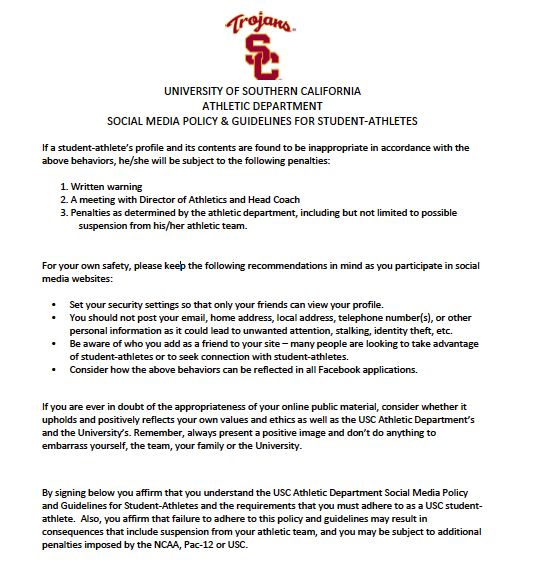
Table of Contents
3     Emergency Contacts                      31   Staff
5     Athletic Department Mission Statement   32   Strength & Conditioning Policies and
5     Student-Athlete Code of Conduct              Procedures
6     Trojan Family Code
                                              34   Media Relations
7      Athletic Department Policies           34   Staff
7      Hazing                                 35   The Media
8    Sexual Harassment                        35   Interviews
8    Student Conduct                          37   Social Media
9    Academic Integrity
9    Student Grievances                       40    Student Services
                                              40    Staff
10     Student Athlete Academic Services      40    Athletic Scholarships
10     Staff                                  44    University Aid/Outside Awards
10     Hours and Location                     44 Stipend Checks
11     SAAS Mission Statement                 45    Meal Plans
11     Commitment to Academic Excellence      46    Text Books
13     Commitment to Personal Development     46    Summer School
14     Student Recognition                    47    Former Athlete Degree Achievement
14     Awards                                 Program
15     Postgraduate Scholarships
16     Stevens Academic Center Policies       48   USC Academic Policies

19     Trojan Athletic Senate (TAS)

21      Athletic Medicine
21      Staff
21      Mission Statement
21      Insurance Coverage
22      Nutritional Supplements
22      NCAA Banned Drugs
24      Concussion Education

26      Counseling Services

28      Performance Nutrition
28      Staff
30      Grocery List

31      Strength and Conditioning

STUDENT-ATHLETE HANDBOOK 2020-2021                                                        2
Emergency Contacts

                                 University Park Campus

EMERGENCY (Police, Fire, Ambulance)                       213-740-4321

Public Safety (Non-emergencies)                           213-740-6000

University Park Health Center                             213-740-9355

Safety Office                                             213-740-6448

Facilities Customer Resource Center                       213-740-6833

                                Health Sciences Campus

EMERGENCY (Police, Fire, Ambulance)                       323-442-1000

Public Safety                                             323-442-1200

USC Student Health                                        323-442-5980

Safety Office                                             323-442-2200

Facilities Management Services                            323-224-7001

STUDENT-ATHLETE HANDBOOK 2020-2021                                       3
Mission Statement

To attract and develop student-athletes who will perform successfully in the classroom and
compete at the championship level in every sport while in compliance with the letter and spirit of
all NCAA and Pac-12 rules. To operate under an administrative structure managed in an open
and fiscally sound manner, supporting equitable opportunity for all students and staff, and
committed to the highest standards of ethical conduct. Decision-making of the Athletics
Department will follow four basic principles: promoting the well-being of student participants;
attaining and maintaining competitive excellence; administering clearly, openly and responsibly;
and supporting the overall goals of the USC community.
Specifically, the goals for USC Athletics are: to graduate every student-athlete who completes
athletic eligibility at USC; to compete successfully in every sport, striving to be in the top l0
nationally, with the ultimate goal of winning national championships; to provide an environment
conducive to positive growth and development of student-athletes and Athletics Department
staff; to encourage a real, complete and robust college experience, not just an athletic
experience; to provide adequate financial support within the department to ensure continuing
development of each sport program without university subsidization; and to do all the above
while complying fully with all NCAA and Pac-l2 regulations.

****

The central mission of the University of Southern California is the development of human beings
and society as a whole through the cultivation and enrichment of the human mind and spirit. The
principal means by which that mission is accomplished consists of teaching, research, artistic
creation, professional practice and selected forms of public service. The first priority of faculty
and staff is the education of students through a broad array of academic, professional,
extracurricular and athletic programs of the first rank. The university strives constantly for
excellence in teaching knowledge and skills, while at the same time helping students acquire
wisdom and insight, love of truth and beauty, moral discernment, understanding of self, and
respect and appreciation for others

STUDENT-ATHLETE HANDBOOK 2020-2021                                                               4

USC Student-Athlete Code of Conduct 2020-2021

                                       Mission Statement
              “It matters how I present myself when I represent more than myself”
When you become a USC student-athlete you become a member of a family that carries with it
an enormous amount of responsibility. As a student-athlete you and your behavior will be
watched and judged while you are both on campus (classroom, bookstore, dorms) and off-
campus (movies, mall, bank). It is important that you carry and conduct yourself with respect
to the University and the Athletic Department along with your parents and teammates.
I. Student policy concerning USC Athletics (adopted from University policy and governance)
USC student-athletes may be held responsible for the acts of other USC athletes. Acts include
but not limited to the following types of circumstances:
   1. when a member of a USC athletic team is violating state or university standards and
      you fail to indicate your disapproval, or your continued presence without objection
      condones the behavior;
   2. when the act grows out of a USC athletic activity or environment created by USC;
   3. when the acts are those of guests of yours or of USC athletics;
   4. when a USC athletic team imposes any hazing on new athletes

II. Policy concerning student-athlete conduct and behavior
As ambassadors of the university, USC student-athletes are expected to comply with the
following guidelines:
   1.   abide by all federal, state and local ordinances and university regulation
   2.   gambling, betting in any form on any athletic activity is prohibited.
   3.   cheating, plagiarism, submitting other’s work, and forging signatures is prohibited
   4.   alcohol consumption is not permitted on road trips
   5.   make positive contributions to their teams
   6.   make a commitment to support your team
   7.   respect USC property and facilities
   8.   never place yourself in a compromising position while under the influence of alcohol
   9.   attend all classes and complete all assignments on time

III. Policy regarding Facebook, Twitter, Badjocks.com and the Internet.
The profiles you create on Facebook, Twitter, etc. can be seen by anyone and everyone. Your
profiles are a representation of you, the Athletic Department and this University. You will be
held responsible for anything that appears under your profile, which includes things that you
write and photos that you post. The Athletic Department guidelines that govern your actions
while on and off-campus will also apply to your profiles on the Internet. You could be held
responsible for anything that is deemed improper or unacceptable according to University
policies governing student conduct and behavior.
STUDENT-ATHLETE HANDBOOK 2020-2021                                                             5
The Trojan Family Code

         As a TROJAN, I will always do WHAT IS RIGHT! I will act ethically, honestly, and fairly, and respect the
rights and dignity of all people, at all times.

As a TROJAN,

    •   I will not lie, cheat, or steal.

    •   I will not bully, haze, mistreat, harm or take unfair advantage of anyone.

    •   I will not harass anyone about their race, ethnicity, religion, physical condition or sexual orientation.

    •   I will not take sexual advantage of anyone, by any means or manner (including alcohol, drugs, force or
        coercion).

    •   I will not drive under the influence of alcohol or drugs, nor will I get in the vehicle of an impaired driver.

    •   I will not stand by and allow a Trojan to ignore the Trojan Family Code.

I WILL always protect the TROJAN Family and . . .

    •   DO what is RIGHT.

    •   STOP what is WRONG.

    •   TEACH fellow Trojans to follow the Trojan Family Code and RESPECT the Trojan Family.

    •   Responsibly REPORT any unethical, dishonest, disrespectful or wrongful behavior.

                             DOING THE RIGHT THING ISN’T ALWAYS EASY,
                                     BUT IT’S ALWAYS RIGHT.

STUDENT-ATHLETE HANDBOOK 2020-2021                                                                                   6
Athletic Department Policies
Hazing
University Policy against Hazing
The University of Southern California expects that all members of the university community
will observe and fully comply with the State of California Education Code requirements on
hazing. In addition, all students are expected to adhere to related regulations set forth by
their respective international, regional or local organizations and university policies
concerning practices commonly referred to as hazing. It is the responsibility of the officers of
organizations to be informed of all the above-mentioned regulations and to see that they are
brought to the attention of the rest of the membership.
USC Athletic Department Hazing Protocol
The athletics department procedures for hazing occurrences will be the following:
Ascertain all facts, sports, and specific student-athlete involvement in the hazing incident.
Student-athletes will be required to meet with his/her sport administrator to provide details
regarding the hazing incident. The student’s sport administrator will draft a report
explicating the information provided by the parties involved in the incident. Subsequently,
the respective head coach will be notified and provided pertinent details regarding the
hazing case. The USC Student Judicial Affairs and Community Standards Office (SJACS)
will also be contacted regarding the suspected hazing violation.
A meeting with the sport administrator, the head coach, and the involved student-athletes’
will be conducted to discuss appropriate consequences and punishments for the suspected
hazing violation (i.e. suspension from practice, competition, and organized team activities).
Pending the severity of the violation, Pat Haden (Director of Athletics) may be actively
involved in the punitive process.
After serving the determined penalty for the hazing infraction, a follow-up meeting with the
sport administrator will be conducted with the student-athletes’/team involved in the hazing
violation. In this meeting, the sport administrator will review the USC Anti-Hazing Policy, as
well as provide clear examples of acceptable initiation activities. A representative from
(SJACS) will also be in attendance.
State of California Education Code 32051
No student, or any other person in attendance at any public, private, parochial, or military
school, community college, college, or other educational institution, shall conspire to engage in
hazing, participate in hazing, or commit any act that causes or is likely to cause bodily danger,
physical harm, or personal degradation or disgrace resulting in physical or mental harm to any
fellow student or person attending the institution.
Procedures for Dealing with a Hazing Incident
Anyone with information about a hazing incident which violates university policy has a
responsibility to report it to the Office of Student Judicial Affairs and Community Standards, the
Greek Life staff, Campus Activities or the Office of the Vice President for Student Affairs.
For more information visit: http://www.usc.edu/dept/publications/SCAMPUS/governance/gov25.html
STUDENT-ATHLETE HANDBOOK 2020-2021 7Sexual Harassment
University Policy on Sexual Harassment
The University of Southern California is committed to maintaining an environment that is
conducive to learning and scholarship and free from sexual harassment. To this end, a
formal written policy has been developed that specifies certain behaviors by employees of
the university, acting under the aegis of the university, which fall within the definition of
sexual harassment and which are therefore subject to sanction. In addition, even though
students are not covered by the public laws on this subject, behavior by students that falls
within the definition of sexual harassment is also subject to sanction by the university. In
addition, the university president has issued statements on sexual harassment and on
tolerance, and USC has policies: (1) prohibiting sexual harassment by students, (2)
committing the university to equal opportunity and nondiscrimination, (3) providing for
resolution of grievances, and (4) manifesting the university’s commitment to academic
freedom, academic tenure and full academic due process.
Definition of Sexual Harassment
Conduct is sexual harassment if it is an unwelcome sexual advance; request for sexual
favors; or any other verbal, physical or visual behavior of a sexual nature.
Complaint Procedures
Copies of the detailed procedures followed by the university in the event of a complaint being
made against a faculty or staff member, or against a student, may be obtained from the Office
of Equity and Diversity, Figueroa Building 202, (213) 740-5086; or from the Center for Women
and Men, Student Union 202, (213) 740-4900.
For more in depth information visit:
http://www.usc.edu/dept/publications/SCAMPUS/governance/gov23.html
Student Conduct
University Policy on Student Conduct
Sanctions for violations of the University of Student Conduct Code are assessed appropriately
for the cited violation. Sanctions will be considered in light of students’ entire conduct records
at the university and will be designed to hold students accountable for their actions and the
resulting or potential consequences of such actions, to promote the educational well being of
students and to protect the educational environment of the university and the safety of its
community.
Sportsmanship
NCAA
USC adheres to the principles of sportsmanship as defined by both the NCAA and Pac-12
conference. In 1997, the NCAA’s member schools and conferences established a Committee
on Sportsmanship and Ethical Conduct, representing educational institutions from all three
Divisions. The committee’s mission is to improve the condition of sportsmanship and ethical
conduct in all aspects of intercollegiate athletics by developing and implementing strategies
that foster greater acceptance of the value of respect, fairness, civility, honesty and
responsibility.
STUDENT-ATHLETE HANDBOOK 2020-2021 8Pac-12 Conference
The Constitution of the Pacific-12 Conference cites as a purpose of the Conference that its
members shall participate in its athletics program on the basis of mutual trust and confidence
and based upon high standards, scholarship, and sportsmanship. It adds that the members
value quality competitive opportunities for student athletes, compliance with the rules of fair
play, and sportsmanship. Understanding that realization of those goals requires that opponents
respect each other and admire earnest effort made fairly in pursuit of victory, the Conference
shall require adherence to the standards it has adopted or which are set forth in the respective
playing rules. It will require ethical conduct worthy of the educational stature and the standards
of its member institutions. While victory shall be the expected goal of every competitor, defeat
is not a disgrace, and the prospect of defeat is never an excuse for unethical behavior or a lack
of sportsmanship. Adherence to these principles will maximize the benefits and enjoyment of
intercollegiate competition for all—participants, coaches, and spectators.
Academic Integrity
University Policy on Academic Integrity
General principles of academic honesty include and incorporate the concept of respect for the
intellectual property of others, the expectation that individual work will be submitted unless
otherwise allowed by an instructor, and the obligations both to protect one’s own academic
work from misuse by others as well as to avoid using another’s work as one’s own. All
students are expected to understand and abide by these principles.
Student Grievances
University Policy on Student Grievances
The University of Southern California is committed to treating all students equitably and
fairly. Consequently, in its interactions with students, the university does not differentiate
between students on the basis of race, color, religion, gender, gender identity, sexual
orientation, national origin, disability, medical condition or veteran status. Likewise, in
creating and maintaining a learning environment that promotes academic excellence, one
element of maintaining such an environment is ensuring that students are free from the
effects of misconduct by other members of the university community, including faculty
members.
Definition
A grievance arises when a student believes, based on established administrative policies and
procedures, that he or she has been treated in an arbitrary, capricious or discriminatory
manner by a university department or a representative of the university.
Formal Grievance Resolution
Should a situation arise in which a student is unable to resolve his or her grievance
informally, the university’s formal grievance process may be employed. This process,
outlined in SCampus, should also be initiated within 30 days of the failed informal
resolution if applicable. For more information visit:
http://www.usc.edu/dept/publications/SCAMPUS/governance/gov24.html
STUDENT-ATHLETE HANDBOOK 2020-2021 9Student-Athlete Academic Services
Dr. Denise Kwok Heather Bell Dr. Kevin Bolen Dr. Cory Buckner
Director of SAAS Director of Academic Asst. Director of Asst. Director of
dkwok@usc.edu Academic Advising Academic Support Academic Support
MBB, MFB bolen@usc.edu cbuckner@usc.edu
bellh@usc.edu
Mimi Butler Susie Cognetta Ricky Coles Howard Croom
Director of Academic Advisor Academic Advisor Academic Advisor
Academic Support WGO, WSO, MPO WCR, MVB, WVB MFB, WBV
miriambu@usc.edu scognetta@usc.edu rcoles@usc.edu hcroom@usc.edu
Kim Gross Dr. Martin Jauregui Monica Morita Angela Munger-Rivera
Academic Advisor Sr. Learning Specialist Director of ACT Programs Assoc. Director of
MFB, MSW, WSW jaregum@usc.edu mmorita@usc.edu Academic Advising
kimgross@usc.edu MFB, MTR, WTR
mungera@usc.edu
Kimberly Olson Dr. Nisha Parmar Whitney Rotrock Marisa Samaniego
Learning Specialist Learning Specialist Director of Sr. Learning Specialist
olsonk@usc.edu npparmar@usc.edu Personal Development msamanie@usc.edu
LAX, MTE, WTE
rotrock@usc.edu
Rosie Sese Toni VanEck Dr. Jonathon Young
Learning Specialist Eligibility and Data Director of Technical
sese@usc.edu Coordinator Operations youngjj@usc.edu
antoniaa@usc.edu
Location: Hours:
Stevens Academic Center Monday - 8:00am - 9:00pm
940 W. 35th
St. Tuesday - 8:00am - 9:00pm
Los Angeles, CA 90089 Wednesday - 8:00am - 9:00pm
Thursday - 8:00am - 9:00pm
Website: Friday - 8:00am - 5:00pm
www.usc.edu/saas Saturday - Closed
Sunday 4:00pm - 9:00pm
STUDENT-ATHLETE HANDBOOK 2020-2021 10Mission Statement
The USC Student-Athlete Academic Services (SAAS) Program is committed to providing the
necessary support to assist all student-athletes in reaching their full potential academically,
personally, and professionally. The SAAS Program is fully integrated with the University. Our
program includes academic advising, personal and career development, tutorial programs, and
learning specialists, which are all aimed at promoting a philosophy of individual responsibility
so as to encourage each student-athlete to value their educational experience. In providing
such services, student-athletes will be afforded the opportunity to develop the skills needed to
persist towards graduation, become leaders within the community, and lead successful and
productive lives.
Commitment to Academic Excellence
Degree Progress & Graduation Monitoring
SAAS Academic Counselors are responsible for monitoring the academic progress of each
student-athlete to promote effective communication between the student, academic counselor,
coaches, and faculty members. All information gathered encourages the student-athletes to
take ownership of their academic program and make appropriate decisions regarding their
future. Academic progress updates are also provided to the coaches on a regular basis to
ensure that the coaching staff is fully aware of how their students are progressing in their
courses and how their progress may affect their eligibility status.
Priority Scheduling
All student-athletes are given priority scheduling to allow them the opportunity to register for
courses they need at the times requested and enable them to stay on a steady graduation
plan. Students must be proactive about receiving advisement and clearing holds prior to the
priority registration date.
Academic Progress Reports
Throughout the semester, faculty submit midterm grade reports with detailed information on
academic performance including current grade, attitude, and attendance. In addition, emails
are sent to instructors seeking academic progress information on student-athletes as needed.
Tutorial Services
All student-athletes have access to free tutorial services provided by qualified undergraduate
and graduate students in a variety of subject areas, subject to tutor availability. Tutoring is
offered either on a one-to-one basis or in a group setting and all sessions take place inside
the Stevens Academic Center. Upon the completion of each tutorial session, the tutor fills
out a feedback form that evaluates the student's comprehension of the course material,
provides suggestions for learning strategies, and outlines new grade information. Although
tutoring services are free, student-athletes will be charged $10 for each unexcused miss of a
tutorial session. Debt may not exceed $30 or access to tutorial services will be subject to
suspension.
STUDENT-ATHLETE HANDBOOK 2020-2021 11Learning Specialists/Assistants These individuals work one-on-one with student-athletes to expand their academic skills and further develop essential college learning modalities. Some areas of focus include time management, reading, writing, note taking, test taking, and critical thinking strategies. In addition, special attention is paid to transitioning freshmen and student-athletes with Education-Impacting Disabilities. Travel Excuse Letters One week prior to each competition, academic counselors are responsible for providing each competing student-athlete with a competition excuse letter for the classes they will be missing while on the road. The purpose of the excuse letter is to make the instructor aware of any absences that may occur due to university-sponsored athletic events. The letter will include the following information provided by Compliance: 1) competitor(s), 2) competition site, 3) competition date(s), 4) excuse dates, and 5) a list of those student-athletes who will be traveling for the specific competition. It is the responsibility of the student-athlete to provide each instructor with the letter at least one week prior to the competition and arranging to make-up any missed assignments or exams. STUDENT-ATHLETE HANDBOOK 2020-2021 12
Commitment to Personal Development
New Student-Athlete & Parent Orientation
All freshman & transfer student-athletes are invited and mandated to attend an in-person
orientation program during Welcome Week. This program introduces student-athletes and
parents to athletic department and university resources and educates them on health and
wellness topics relevant to the student-athlete experience.

PHED 165a
During a student-athlete's first year at USC, he/she is required to take PHED 165, a
semester long course designed to address the current issues affecting the personal
development of the student-athlete. Discussion topics include study skills and strategies, test
taking and library research, health and wellness, interpersonal communication, financial
management, media relations, selecting a major, career development and campus
resources. This one unit course is facilitated by SAAS Staff with guest speakers from SAAS,
former student-athletes, and various student service departments across campus.

P.O.W.E.R. Programs
Each semester student-athletes attend various presentations featuring a well-known keynote
speaker, who will address personal development issues, such as alcohol and drug abuse,
sexual responsibility, diversity, leadership, life after sports, financial literacy and more.

USC Career Center
The Career Center is the one-stop resource for career services on the USC campus.
Whether students need assistance with selecting a major, looking for an internship, resume
development, mock interviews, or pursuing a professional position, the Career Center is an
excellent resource. Each semester, the Career Center hosts a variety of career fairs for
students in all majors and disciplines. The Career Center also maintains the “Trojan
Network”, an alumni database connecting students with alumni to gain information about
career fields, companies, and organizational cultures, and “ConnectSC”, a job database
containing listings for full-time, part-time as well as internship, summer, and work study
positions.

Career Month
Each year a month long series of events is planned to assist student-athletes prepare and
apply for internships and full time employment opportunities. Included in the month are
graduate school workshops, career readiness workshops, resume critiques, a career fair,
alumni panels, and more.

STUDENT-ATHLETE HANDBOOK 2020-2021                                                                13
Student Recognition & Awards

Student-Athlete of the Month
Each month during the regular academic year, the SAAS staff is responsible for selecting six
student-athletes (3 male and 3 female) who are believed to exemplify high academic
standards. This can be either through outstanding performance in the classroom or
dedication to study hall or tutorial sessions.

USC Senior Recognition
Each spring, the USC Student Recognition Award Committee organizes the Senior and
Graduate Award Recognition Ceremony to honor student leaders who have demonstrated a
noteworthy level of commitment to leadership, involvement, service, and scholarship at USC.

Marks Scholars
Each May, the Daniel X. Marks Foundation, in conjunction with the USC Athletics Department,
hosts the Marks Luncheon. The purpose of this luncheon is to honor those student-athletes
who have excelled in the classroom. Specifically, scholarship students (non-scholarship/walk-
ons do not qualify) are invited to the luncheon if they have at least a 3.0 cum GPA (or are in
the top 10% of their team and have a 2.75 cum GPA or better).

Athletic Department Senior Graduation Reception
At the conclusion of every school year, the athletic department recognizes the academic
pursuits of it graduating seniors by hosting a graduation ceremony and reception during
commencement week. Students and their families are encouraged to attend and celebrate
their achievements with the athletic department. During this reception, three annual awards will
be given out to the year’s most outstanding seniors.

These awards include:

Trojaneer Diamond Award recognizes the student-athlete who brought the most fame and
distinction to the university.

Gimbel Award recognizes the student-athlete who was deemed ‘most cooperative’.

Willis O’Hunter Award is awarded to the senior who has the highest cumulative grade point
average.

Stevens Scholars
Each May, graduating student-athletes who have achieved a 3.5 cumulative GPA or higher are
awards with a Stevens Scholar medallion during our Student-Athlete Graduation Celebration.

Varsity Award
A one-time only Varsity Award will be given to a student-athlete who fulfills the Varsity Letter
winner award criteria set forth by each sports Head Coach. This award could be given during
any of the years a student-athlete participates in their respective intercollegiate sport. Their
coach will inform a student-athlete that they have been awarded such an award and will then be
asked to choose from a Varsity Letter Jacket or Varsity Blanket. The athletic department will
also award watches to members of team conference champions and rings to NCAA National
STUDENT-ATHLETE HANDBOOK 2020-2021                                                             14
Champions.

Postgraduate Scholarships
Pac-12 Post Graduate Scholarships
Each spring, the Pac-12 awards two $9,000 scholarships per institution (one man and one
woman) to be used for graduate study. Academic and athletic achievements are weighed
equally. In order to qualify for the award, the student-athlete must have a 3.0 cumulative GPA,
have competed in their final year of athletic eligibility, and must have been admitted into a
graduate program.

NCAA Post Graduate Scholarships
The NCAA awards 174 scholarships to student-athletes who have excelled both academically
and athletically. The award is a one-time grant of $7,000 to be used toward graduate study
within three years. To qualify, the student-athlete must have a minimum of a 3.2 cumulative
GPA, competed in their final year of eligibility, performed with distinction on their varsity team,
and be seriously considering graduate study. Students must apply during their final season.

Walter Byers Postgraduate Scholarship
A $24,000 award given to one male and one female student-athlete nationally by the NCAA.
Applicants must have above 3.5 cumulative GPA and have competed in their final year of
athletic eligibility.

Jim McKay Scholarship
A $10,000 award given to one male and one female student-athlete or former student-athlete
annually by the NCAA. To be eligible the student-athlete shall have a cumulative
undergraduate GPA of 3.5 or better, be enrolled in a graduate study program or intend to enroll
within 5 years of receiving the award, demonstrate the potential to make a contribution to the
sports communication industry, and have an understanding and appreciation of Jim McKay
and his contributions to sports broadcasting.

Ethnic Minority and Women’s Enhancement Postgraduate Scholarship for Careers in
Athletics
The NCAA awards 13 scholarships to ethnic minorities and 13 scholarships to female college
graduates who will be entering their initial year of postgraduate studies. The applicant must be
seeking admission or have been accepted into a sports administration or other program that
will help the applicant obtain a career in intercollegiate athletics, such as athletics
administrator, coach, athletic trainer or other career that provides a direct service to
intercollegiate athletics.

International Fellowships
Competitive international and national fellowships can be an incredible way to enhance your
knowledge in your area of study, while also giving you a competitive edge on any graduate
programs you may apply to in the future. Fellowships are available to support research, study
at a foreign university, teach English, or take part in an internship abroad. Fellowships can be
for graduate and/or undergraduate students, and vary by location, length, and field of study.
To learn more about international fellowships such as the Rhodes, Marshall, Mitchell, and
Fulbright contact USC Academic Recognition Programs at (213) 740-9116 or go to
http://www.usc.edu/student-affairs/arp//fellowships.
STUDENT-ATHLETE HANDBOOK 2020-2021                                                                 15
SAAS Policies

                                        General Policies

Food

With the exception of bottled water, food and drinks are prohibited inside Stevens Academic
Center. Food and drink are permitted on the patio provided students are responsible for proper
disposal. No tobacco products are allowed in the facility.

Vehicles/Transportation

All forms of transportation outside of the approved list from the Athletic Medicine/Trainers are
strictly prohibited in the Stevens Academic Center. Examples of prohibited
vehicles/accessories/equipment include but not limited to: rollerblades, roller skates, scooters,
electric one-wheel scooters, two-wheel balancing scooters, skateboards, etc.
Phone Calls and Music

To ensure a quiet learning environment for all students, making or receiving calls on cell
phones is prohibited in all tutorial and study areas inside of the Stevens Academic Center.

If listening to music, headphones should be set to a volume so that only you can hear it.

Pets

Pets are prohibited from all areas inside and outside of the Stevens Academic Center. Service
or Assistance Animals may be required to show documentation from Disability Services and
Programs in order to be in facilities.

Student Dress Code

In order to maintain a professional and hygienic environment within the academic facilities
where student-athletes can focus and concentrate during their tutorial session, student-
athletes are expected to follow the below dress code while using the Stevens Academic
Center. In addition, Student-athletes are required to shower after practice or workouts before
entering Stevens Academic Center.

   •   No cleats
   •   No exposed midriffs, ‘crop tops’
   •   No spandex shorts
   •   No visible undergarments (pants/shorts around waist)
   •   No spaghetti straps
   •   No excessively short skirts or shorts

STUDENT-ATHLETE HANDBOOK 2020-2021                                                               16
• No excessively low or cut off top
Appointments
Student-athletes who are coming to speak with an SAAS staff member, should schedule an
appointment. If the SAAS staff member is unavailable, student-athletes should wait outside of
the staff member’s office and not interrupt any student-athlete in tutorial or studying.
Computer Labs
All student-athletes are welcome to utilize the two computer labs at JMC as long as it pertains
to their studies. The main lab features 10 DELL PCs and 22 Apple iMacs. In order to provide
students with the necessary computing resources and maintain an academic setting, the
following guidelines have been set.
Enforcement of the Computer Labs
The Lab Administrator, Staff and Student workers monitor all rules.
Rules of Conduct
Absolutely NO FOOD or DRINKS are allowed in the computer labs.
When using the lab please:
• Respect fellow student-athletes.
• Do not engage in any disruptive behavior.
• Set cell phones to vibrate or silent or turn them off.
• Use headphones and set the volume so that only you can hear it.
• Speak quietly.
• Refrain from using tobacco inside the building.
• Log out of the computer after finishing a session. SAAS is not responsible for any work
that was lost. Students who did not log out are also liable if others copy their work.
Technical Assistance
Student workers are available to assist students with the following:
• Navigating to find applications
• Opening of documents
• Force closing applications that aren’t responding
• Saving documents to flash drive
• Scanning of papers to be uploaded to Blackboard
Contact the Lab Administrator for further assistance.
STUDENT-ATHLETE HANDBOOK 2020-2021 17Printing procedures
The printing procedure is different for each lab.
Main Lab
• Select print.
• Paper will go into a printing queue located at the Print Release Station (PRS) and
will be appended to your USC Username.
• On the touch screen panel at the PRS, select your name and click print.
Small Lab
• Select print.
• Pick up your paper from the shared network printer in the lab.
Wireless Printing
1. Visit https://LabPrint.usc.edu
2. Click “Athletics (JMC)”
3. Select Printer A or B
4. Upload file and select amount of copies
5. Continue with print options
6. Wait for completion
7. Release print job from Print Station A or B
STUDENT-ATHLETE HANDBOOK 2020-2021 18Trojan Athletic Senate
Contacts
Whitney Rotrock – rotrock@usc.edu
Darcy Couch – dcouch@usc.edu
Denise Kwok – dkwok@usc.edu
Sam Adams – samantc@usc.edu
What is the Trojan Athletic Senate?
The USC Trojan Athletic Senate (TAS) is a committee made up of student-athletes assembled
to provide insight on the student-athlete experience. Members of the TAS have the opportunity
to address issues affecting student-athletes at USC and have the opportunity to offer input on
issues, at the campus, conference, and national level.
Purpose of TAS at USC
The USC Trojan Athletic Senate (TAS) was formed for the purpose of:
• Serving as a line of communication between the student-athletes and the USC Athletic
Department.
• Providing the student-athlete population with an opportunity to more effectively
communicate with USC athletic administrators and offer suggestions on programs
designed to serve student-athlete needs.
• Staying abreast of and acting on issues facing student-athletes, Athletics Department
policy, University rules and regulations, and NCAA rules to protect the interest of all
student-athletes.
• Designing programs that will encourage academic achievement, social responsibility,
health promotion, and general awareness.
• Encouraging student-athletes to become more involved in campus and community
projects.
• Build a sense of community and cohesion within the athletics program involving all
athletics teams.
• Promote a positive student-athlete image on campus and in the community.
Who can participate in TAS?
TAS is comprised of two senators from each athletic team. In order to be eligible to serve as a
senator, you must be listed as a current member on the official team roster and be in good
academic standing (2.0 cumulative GPA or higher). Each team will be responsible for choosing
its representatives and all representative appointments to TAS are for one year beginning in
the Fall semester.
Annual Events
Welcome Back BBQ - As a means of promoting better communication and cohesion between
teams, this event is held during the first week of Fall semester for all student-athletes and
athletics department staff. At the event, student-athletes have an opportunity to catch up with
friends, meet new student-athletes, participate in fun and interactive games and enjoy a BBQ
dinner.
STUDENT-ATHLETE HANDBOOK 2020-2021 19Trojan Scholars - Academic Excellence Celebration - TAS hosts a social to honor all those student-athletes who have consistently excelled in the classroom and gives an academic gift to all student-athletes who’ve achieved a 3.0 semester or cumulative GPA, or who have been honored as a Student-Athlete of the Month. Pac-12 Student-Athlete Advisory Committee - Each semester, TAS representatives have the opportunity to participate in the Pac-12 Student-Athlete Advisory Committee Meetings, which is a forum designed to address issues affecting student-athletes at the institutional, conference, and national levels. In addition to the in-person meetings, members of the Pac-12 SAAC participate in monthly conference calls to keep their institutions abreast on the conference and national office news. Community Service Programs and Events - By participating in community service projects, student-athletes can enhance their leadership and communication skills, while serving as role models and building positive relationships with community members. During the 2010-11 academic year, the athletic department exceeded their community Service goal of 3,000 hours. Faculty Appreciation Dinner – TAS & SAAS have arranged an annual Faculty Appreciation Dinner. This event offers USC student-athletes a chance to network with faculty while giving the professors a taste of what it’s like to be a student-athlete at USC. STUDENT-ATHLETE HANDBOOK 2020-2021 20
Athletic Medicine

Russ Romano                 Lauren Crawford             Paul Diaz                   Karin Dowen
Head Athletic Trainer       Asst. Athletic Trainer      Assoc. Athletic Trainer     Asst. Athletic Trainer
rromano@usc.edu             laurenc3usc.edu             pdiaz@usc.edu               kdowen@usc.edu

Catherine Hill              Shawn McMannes              Corey Newton                Lisa Noceti-DeWit Asst.
Assoc. Athletic Trainer     Asst. Athletic Trainer      Asst. Athletic Trainer      Rehab Coordinator
c.hill@usc.edu              mcmannes@usc.edu            coreynew@usc.edu            noceti@usc.edu

Sandra Olsen                Dunford Rodill              Jared Rosen                 Justin Shibel
Sr. Assoc. Athletic Trainer Asst. Athletic Trainer      Asst. Athletic Trainer      Asst. Athletic Trainer
solsen@usc.edu              rodill@usc.edu              jaredros@usc.edu            shibel@usc.edu

Andrew Tai                  Winnie Voong                Jon Yonamine
Rehab Coordinator           Asst. Athletic Trainer      Assoc. Athletic Trainer
andrew.tai@usc.edu          wvoong@usc.edu              jyonamin@usc.edu

                                                Mission Statement
         Our mission is to provide comprehensive, multidisciplinary, student-athlete centered care for
         the University of Southern California. Our objective is to deliver the best possible health care,
         both physiological and psychological, through prevention, education, evaluation, management,
         and rehabilitation. We utilize evidence-based practices to ensure student-athletes can perform
         safely and at their highest possible level.

                                           Insurance Coverage
         All USC Students must show proof of health insurance coverage at the beginning of the
         academic year. Students who are enrolled in a private health insurance plan may waive
         enrollment in the USC Student Insurance program by completing the waiver form and
         providing proof of insurance to the Student Health Insurance Office. A student who does not
         have health insurance or does not waive out of the USC Student Health Insurance Plan, will be
         automatically enrolled in that plan. All student athletes must provide their insurance information
         to the Department of Athletic Medicine prior to participation. This process is the responsibility
         of the student athletes.

         The USC Athletic Department will cover medical costs for injuries or illnesses in which the
         athletic medicine staff coordinates the necessary services, as determined by USC Team
         Physicians. The student athlete’s primary insurance policy will be billed first and all subsequent
         costs that are not covered by the primary insurance will be paid by the USC Athletic
         Department. Referrals to outside health care providers without prior approval from the USC
         athletic medicine staff may not be financially covered. Student athletes should not discontinue
         STUDENT-ATHLETE HANDBOOK 2020-2021                                                              21
their insurance coverage assuming that the USC Department of Athletics will assume financial
responsibility for all medical costs. The USC Athletic Department is only responsible for
medical costs associated with athletic related injuries or illnesses. The USC Athletic
Department is not financially responsible for non-athletic related injuries or illnesses.
***It is important to note that if you have outside health insurance and do not want the USC
Student Health Insurance you must fill out the online waiver form. If you do not waive the
university health insurance each year you will be charged for it. Your athletic scholarship WILL
NOT cover this.
Physical Examination
All student-athletes at USC must have a pre-participation physical examination to determine
their current state of health. No student-athlete can practice or compete without medical
clearance from the USC Department of Athletic Medicine. Physicals are scheduled prior to
or during the fall semester each year. Athletes who attempt to walk on must be invited by
the head coach and obtain a physical examination on their own and present documentation
prior to tryouts. Once they have made the team, they must obtain another physical
examination from the Department of Athletic Medicine.
Reporting Injuries and Illnesses
All athletic related injuries and illnesses are to be directed to a department of athletic medicine
staff member. When special medical services are required, the athletic medicine staff member
will coordinate the scheduling of all appointment(s) with the appropriate team physician and/or
consultants. Consultants are appointed according to their expertise and selected by the
Department of Athletic Medicine.
Nutritional Supplements
Due to the lack of federal regulation, nutritional supplements are potentially dangerous. With
there being no guarantee that what is on the label is acutely in the product the student-athlete
may be subject to a positive drug test, which could cause them to lose eligibility. For that
reason, the USC department of athletics does not endorse the use of nutritional supplements
other than Powerade and Collegiate Muscle Milk.
If a student-athlete has a question of whether or not a particular supplement is safe, they can
ask a member of the athletic medical staff or access the Resource Exchange Center (REC) for
more information free of charge at www.drugfreesport.com/rec/ (password: NCAA1). In
addition, all USC student-athletes will have access to the Aegis Shield database for
supplement research via the web or mobile phone app. Login and password is available from
each individual sports athletic trainer.
Ultimately, the student athlete is responsible for what they put into their body. Ignorance is not
an excuse.
NCAA Banned Drugs
The NCAA conducts random drug tests to ensure safety and fairness of competition. If there is
a concern of whether a medication could be banned, the student athlete should consult a
member of the athletic medicine staff immediately. A positive drug test could result in loss of
eligibility for one calendar year. A list of NCAA banned substances can be found on their
STUDENT-ATHLETE HANDBOOK 2020-2021 22website:http://www.ncaa.org/wps/wcm/connect/public/NCAA/Student- Athlete+Experience/NCAA+banned+drugs+list Attention Deficit Hyperactivity Disorder (ADHD) is treated with stimulant medication that may be banned. As with all medications, it should be documented in the student athlete’s medical chart. Additionally, the student athlete who is taking ADHD Medication is responsible for signing the Athletic Departments Stimulant Medication Policy and following the checklist provided. In the event of an NCAA positive drug test for that medication, a medical exception petition may be generated if the student athlete followed the departmental ADHD Policy. Having prescription medication, taking prescription medication without a prescription, or sharing prescription medication is illegal and dangerous. STUDENT-ATHLETE HANDBOOK 2020-2021 23
CONCUSSION EDUCATION—HANDOUT FOR USC STUDENT-ATHLETES
Concussions are traumatic brain injuries that range from mild (mTBI) to severe. You can have a concussion
without being knocked out and even a hit or jolt that does not seem severe can cause brain injury. Concussions
can happen during drills, practice, or games, and ones that occur during practice can be just as serious as those
that happen during games. The USC Medical staff treats seriously all concussions, and all signs and symptoms of
concussions.

Concussions come with many possible signs and symptoms; it is very important that you recognize these signs
and symptoms and report these immediately. Symptoms may be subtle and can last for days, weeks, or even
longer. The following are common symptoms caused by head injuries; while someone with a head injury
would not have all or even most of these symptoms, any of these symptoms could indicate a head injury, and
must be reported to the USC Medical staff:

Common Signs and Symptoms of Concussion
Loss of consciousness (LOC) Confusion
Disorientation
Delayed verbal and motor responses
Inability to focus Vacant stare Slurred/incoherent speech Headache
Nausea
Vomiting
Balance Problems/Dizziness
Fatigue
Trouble Falling Asleep Sleeping More Than Usual Drowsiness
Sensitivity to Light and Noise
Sadness Nervousness Numbness/Tingling Feeling Slowed Down Feeling Like in a “Fog” Difficulty Concentrating
Difficulty Remembering Stiff neck
Difficulty walking, speaking, or using your arms
Convulsions
Unusual or erratic behavior

 NCAA and USC rules require student athletes to report any of these signs and symptoms to their medical staff
immediately. It is extremely important that student athletes be truthful about their symptoms and follow the
treatment instructions of USC medical staff. Do not try to diagnose or treat your symptoms yourself and do
not continue athletic activity until authorized to do so by a team physician or their designee. If you notice
these signs or symptoms in other student athletes, tell the USC medical staff immediately.

Although you cannot completely eliminate the risk of concussion, you play an important role in reducing the risk
of concussion by using proper equipment, including personal protective equipment, at all times, by playing
within the rules of your game, by choosing a style of play that reduces the risk of impacts to your head, and by
immediately reporting signs and symptoms of concussion to USC Medical staff and following their treatment
instructions.

Even with all of these protective mechanisms in place, the risks of head injuries cannot be eliminated. These
risks can be short-term, such as bleeding in the brain and paralysis, and long-term, such as Alzheimer’s
disease, Parkinson’s disease, other brain disorders that become more prevalent with age, and death.
Concussions can also cause brain changes affecting physical abilities (such as extremity function and headaches),
thinking abilities (such as memory and reasoning), sensation abilities (such as touch, taste, and smell), language
skills (such as communications, expression, and understanding), and emotional traits (such as depression,
anxiety, personality changes, aggression, and social inappropriateness). Ongoing research is investigating
repeated brain injuries and the risks of depression, CTE, memory problems and early dementia.
STUDENT-ATHLETE HANDBOOK 2020-2021                                                                              24
If you have any questions or concerns at any time, contact your staff athletic trainer or team physician. As a
reminder, you need to be informed about the signs and symptoms of concussions, and you are required by the
NCAA and USC to report these immediately and follow the guidelines that the medical staff explains to you.

The undersigned USC student-athlete acknowledges that he/she has received and reviewed a copy of this
Concussion Education Handout for USC Student-Athletes.

        Student-Athlete Signature                                                       Date

        Printed Name                                                                    Sport

STUDENT-ATHLETE HANDBOOK 2020-2021                                                                               25
Counseling Services
USC Student-Athletes are the largest consumers of the counseling services at Counseling and
Mental Health (CMH) of any student group on USC’s campus. The athletic department has three
clinical sport psychologists, one postdoctoral fellow, and one part-time psychiatrist on staff to
accommodate the many reasons athletes may come in for counseling.
Locations: Counseling and Mental Health Sport Psychology Offices
Engemann Student Health Center Heritage Hall
3rd Floor Basement Rooms 111 & 113
Phone Number: 213-740-7711
When Calling CMH: First, identify yourself as a student-athlete, then ask to speak with
the clinical sport psychology team at USC who work exclusively
with the student-athletes:
Robin Scholefield Niki Sims Dylan Firsick
Robin.Scholefield@med.usc.edu Nichole.Sims@med.usc.edu Dylan.Firsick@med.usc.edu
Robby Rhodes KE’Marvin Pitts
Robert.Rhodes@med.usc.edu kemarvin@ sc.edu
Website: https://usctrojans.com/sports/2019/6/7/usc-athletics-sport-psychology.aspx
Student-athletes typically come in for the same reasons any university student would, such as:
• Anxiety • Identity Issues
• Depression • Academic Problems
• Self-Improvement • Substance Abuse
• Eating Problems • Loneliness
• Homesickness • Grief & Loss
• Relationship Concerns (roommate,
romantic partner, family, etc.)
Additionally, they also utilize services for issues specific to student-athletes, including:
• Performance Enhancement • Being a better teammate
• Performance Anxiety • Managing stress from managing a
• Improve Relationship with Coaches full academic and athletic schedule
• Managing Pressure/Expectations • Change in athletic status; Retirement
USC Sport Psychology Mission Statement
STUDENT-ATHLETE HANDBOOK 2020-2021 26The University of Southern California is a committed to providing student-athletes overall support
for their wellbeing. For the past 20 years USC’s Sport Psychology department has provided
programming, individual therapy, and educational training to help student-athletes become a
“whole healthy person.” It is our philosophy that the healthier you are as a whole person the
better you will perform.
Services
Individual, Couples, and Group counseling are offered to all student-athletes who are enrolled
in classes. Sport Psych also works with teams and provides consultation to coaches and
administration. Groups offered include the following: Injured Athlete group, Relationship Group,
Social Confidence Group, Mindful Well-Being, Living with Loss, New Choices (Substance Use).
During the summer, if a student athlete is not enrolled in summer school, they must pay a one-
time student health fee for counseling services.
*Student-athletes are offered unlimited number of weekly sessions during their time at USC.
*Student-athletes do not have a waiting list to get in to see a counselor, can often make same
day appointments, or can be seen within the same week (as long as they identify that they are
a student-athlete when calling to schedule an appointment).
*USC Counseling & Sport Psychology offers confidential services to student-athletes
on campus. Consistent with state law, counselors will not speak with anyone, including your
coach or parents (if you are 18 & older), for any reason without your written consent.
There are three exceptions to confidentiality: 1) if you are suicidal, 2) if you are homicidal, or
3) if you report child/elder abuse. Even in these instances, we are respectful of your privacy and
inform only those who need to know to help keep you and/or others safe.
Mental Health Emergency Card (**take a picture on your phone!)
STUDENT-ATHLETE HANDBOOK 2020-2021 27Performance Nutrition
Kristy Morrell Becci Twombley TBD Krysten McCaughey
Sports Dietitian Sports Dietitian Sports Dietitian Sports Dietitian
213 - 740-7647 213-740-3843 213 – 821 – 6085 213 – 821 - 8848
kristyma@usc.edu twombley@usc.edu TBD kmccaugh@usc.edu
Nutrition is a vital piece for optimizing a student athlete’s performance. Proper fueling before
and during competition can give you that competitive advantage needed to succeed. Learning
how to fuel your body correctly before and after workouts and throughout the day will enhance
your body's ability to recover from training and maximize your physical development.
A student-athlete’s schedule can be very busy between practices, classes, and schoolwork so
it can be challenging to figure out when and what to eat. Having a plan is crucial, which is why
making an appointment with the sports dietitian is important.
Performance Nutrition Program:
• Your team dietitian will work with you to give you a structured individualized meal plan
based on your sport and your goals. Your plan includes portion sizes, macronutrient
amounts and suggestions for fueling throughout the day using the resources provided.
• Body Composition and Bone Density analysis. Each team will assess body composition
via IDEXA or by an Ultrasound machine to determine how their cells are adapting to
training and how efficient they are at using the energy they are taking in.
• Provides a grocery list as well as easy inexpensive recipe ideas.
• Can schedule a grocery shopping tour with you and help educate you with what the best
products are to buy and which ones to avoid.
• Can help you with ideas on how to stay healthy when traveling and during holiday
breaks
• Presents to teams on a variety of topics and can even schedule a night of cooking with
your team as a team building exercise and can help you learn how to cook healthy and
tasty food
The NCAA allows us to provide two fueling opportunities throughout the day. These fueling
opportunities are intended to increase the athletes’ ability to recover throughout the day. If you
aren’t training, you’re recovering, therefore it is crucial that the resources provided are utilized
in a purposeful manner. Our goal is to provide you with everything that you need for recovery.
This does not mean that you have unlimited access to food. Receiving food is contingent on
receiving nutrition education. The department of athletics will provide you with necessities for
recovery, but it is not an all you can eat buffet.
**ALWAYS have fuel and a water bottle with you to avoid getting dehydrated and going long
hours without eating, which will absolutely affect your performance and energy level**
STUDENT-ATHLETE HANDBOOK 2020-2021 28You have to ask yourself “are you willing to do whatever it takes to be the best” and if you are,
you have to take what you are putting into your body seriously! There is a lot of research that
shows what you put into your body will give you an advantage over the rest. You are here at
USC because you are a gifted athlete, now you have to motivate yourself to train hard and
ensure you are getting the proper fuel to maximize your performance.
Fuel On!
All current student athletes, scholarship and non-scholarship will have an opportunity to
participate in an enhanced fueling program. Morning fueling will occur in the Galen Dining
Center and the Galen Arena from 7am – 11am Monday through Friday.
Outside of the morning fueling, athletes can use the fueling station in McKay for pretraining
and recovery nutrition during the hours the weight room is open.
The Galen Cafeteria will continue to operate as a retail operation during the lunch period.
Hours of operation will be 11:30am – 1:30pm open to the public.
To manage space and operational challenges in our facilities sports will be assigned a location
for their student athlete’s participation in the enhanced fueling program. Some sports will be
serviced out of the Little Galen Cafeteria, others will be serviced from the newly created
athletic dining station at the Galen Arena. The new athletic dining station is located in the
kitchen space of the previous media workroom. The team assignments are as follows:
Little Galen Cafeteria: M. Water Polo, W. Water Polo, M. Swim & Dive, W. Swim &
Dive, M. Tack & Field, W. Track & Field, Cross Country, M. Tennis, W. Tennis, W.
Soccer, W. Lacrosse, M. Golf, W. Golf, Baseball, Football, W. Rowing.
Galen Arena Athletic Dining Station: M. Basketball, W. Basketball, M. Volleyball, W.
Volleyball, Sand Volleyball.
Athletes may choose to take items to go OR to dine in, but cannot do both. Sports nutrition
staff is present ensure that athletes are making the choices necessary to attain their fueling
goals.
Student athletes will be required to dine in their assigned location and may only check in one
time during each enhanced snack period.
Student Athletes are responsible for cleaning up after themselves and for treating the staff and
resources with respect.
STUDENT-ATHLETE HANDBOOK 2020-2021 29You can also read


