Student Success: Everybody's Business - Summer Summit Student Affairs Ireland Gnóthaí Mac Léinn Éireann
←
→
Page content transcription
If your browser does not render page correctly, please read the page content below

Student Affairs Ireland
Gnóthaí Mac Léinn Éireann

Summer Summit
11th and 12th June 2019
University College Cork

Student
Success:
Everybody’s
Business
#SAISum19
University College Cork
Welcome to the
                              First Student Affairs
                              Ireland Summit
                              Mr Paul Moriarty
                              Chair, Student Affairs Ireland

It gives me great pleasure to welcome all          strong partnerships and actively collaborate
of you to our first Student Affairs Ireland        to ensure that students are challenged and
Summit. We are delighted to host you in            stimulated to achieve their educational goals.
University College Cork for the next two           We must focus on supporting students to take
days. I would like to give a special welcome       control of their own well-being and empower
to Dr Michael Murphy, President, European          them to develop skills that are vital to reach
University Association and to our key note         their full potential in life. In doing so, we must
speakers Professor Liz Thomas and Professor        ensure that student support professionals and
Tom Sperlinger. A warm welcome too to              academic staff feel empowered to engage
Dr Chris Flynn who has travelled from the          in innovative approaches to ensure that no
US to be with us for the next two days and         student is left behind.
to The Minister of State at the Department
of Education Mary Mitchell O’Connor who            The topic of Student Success is shared by
will formally launch Student Affairs Ireland.      many voices with different views on what it
This name change acknowledges the shift            means. This Summit will provide a platform
in emphasis from service provision to              for researchers and practitioners to present
participation in the education process in          new research and development in the area
partnership with academic colleagues and of        of Student Success. Many of your services
course students.                                   support the most vulnerable students and
                                                   you are committed to equality of opportunity
Student Affairs Ireland, formally known            and the promotion of an inclusive community
to most of you as the Confederation of             that meets the needs of our diverse student
Student Services in Ireland (CSSI) had its         body. Innovations such as online and
first inaugural conference in the University       blended learning and student pathways
of Ulster, Jordanstown, on the 23 June 1988        are transforming the landscape of Higher
- 31 years ago. The landscape in student           Education. We must continue to test new
affairs has changed since then, some topics,       ideas in a way that matches our institutional
however, remain a priority on the Student          goals and measurably impact student success.
Affairs Agenda. Recommendations arising
from the conference in 1988, for example,          You are uniquely positioned to help Higher
were to ‘recognize and confront racial and         Educational Institutions change and
sexual prejudices’ and to provide ‘workshops       transform amidst a shifting landscape. You
for students on sexuality, sexual responsibility   have a depth and breadth of expertise to help
and sexual health’. These topics will be           students achieve their goals. I hope that you
discussed again today - 31 years later!!           will take some new and innovative ideas back
                                                   to your institutions over the next two days
This Summit presents the best opportunity          and that you will continue to network and
for Student Affairs professionals to               to share best practice to enhance student
share knowledge, good practice and                 growth, development and success.
expertise. Strong relationships and shared
responsibilities between student support           Go raibh míle maith agaibh.
professionals and academic staff are also
powerful in planning to support students’
academic success and well-being. As
professionals, we must continue to build

                                                                                             1
Contents
        DAY 1:                                                   How prepared are we for a major incident/
        Student Success: Everybody’s Business                    emergency on campus?
                                                                 Mr Noel Reidy, Reidy Brophy Crisis Management
        Welcome                                                  Specialists
        Mr Paul Moriarty, Director of Student Experience,
        University College Cork.                                 Emergency Responses in University College
        Chair of Student Affairs Ireland                         Cork - Understanding & Co-operation
                                                                 Ms Nora Geary, Corporate Secretary. Chair of the UCC
        Opening Student Affairs Ireland Summit                   Emergency Management Team (EMT)
        Professor Michael Murphy, President of European
        University Association (EUA)                             Tragedy and Trauma at Virginia Tech: The Painful
                                                                 Price of Mass Shootings
        Keynote Address
                                                                 Dr Chris Flynn, Director of Student Counselling Services,
        Professor Liz Thomas                                     Virginia Tech, Blacksburg, Virginia, USA
        A whole institutional approach to improving student
        success                                                  Launch of Student Affairs Ireland
        Plenary Session                                          Mary Mitchell O’Connor, Minister of State at the
                                                                 Department of Education
        Professor Tom Sperlinger
        Are Universities for Everyone?                           Garda Emergency Planning and Emergency
                                                                 Response: Exercise Barracuda – Lessons Learned
        DAY 2:                                                   Inspector Eamon O’Loughlin, Garda National Emergency
                                                                 Management Office
        A day like any other until it’s not:                     Inspector Donal O’ Driscoll, Garda Special Tactics and
        Critical incidents and crisis management                 Operations Command
        Welcome                                                  Media & Communications: In the context of a
        Mr Paul Moriarty, Director of Student Experience, UCC.   major emergency in a third level institution
        Chair, Student Affairs Ireland                           Ms Mairéad Loughman, Risk Manager, University College
                                                                 Cork
        Opening Address                                          Ms Ann-Marie O’Sullivan, FPRII, Founder & Chief
        Professor Patrick G. O’Shea, President, University       Executive, AM O’Sullivan PR Ltd.
        College Cork                                             Dr Peter Daly, Director, Irish Centre for Emergency
                                                                 Management
        Introduction
        Ms Nora Geary, Corporate Secretary. Chair, UCC           Panel Discussion with all Presenters
        Emergency Management Team (EMT)                          Chair: Ms Linda Barry, Academic Administrator & Student
                                                                 Affairs Manager, Limerick Institute of Technology

                               Concurrent Session 1 (11:45 – 12:45)
Day 1

                      14       SESSION 1A: Theme: Student Resilience, Wellbeing and Mental Health
                               Paper 1:	Connecting the Dots: Supporting the Student Experience by
                                         using student wellbeing findings combined with resilience
                                         building strategies in partnership with academic programmes
                               Paper 2:  ‘A Problem Shared…’ a collaborative project addressing the
                                          increasing demand for mental health support in Irish HEIs
                      16       SESSION 1B: Theme: International Students
                               Paper 1:	Alone at Christmas? An innovative and collaborative approach
                                         to supporting International Students in a resource-constrained
                                         environment
                               Paper 2:	Internationalisation: How issues of culture impact an
                                         increasingly globalised postgraduate community
                      18       SESSION 1C: Theme: Developing professional standards
                               Workshop:	Reflecting on Competencies for Student Affairs Professionals
                                          in Ireland
                      19       SESSION 1D: Theme: Student Growth & Development
                               Paper 1:	The STLR Effect: Incentivising Student Participation in Health
                                         & Wellbeing Events
                               Paper 2:	Preparing first year students with disabilities for college: An
                                         evaluation of workshops on academic skills and perspectives

                               PLENARY:	Are Universities for Everyone?
                                         Professor Tom Sperlinger, University of Bristol
             2
Concurrent Session 2 (14:15 – 15:15)

                                                                                  Day 1
21   SESSION 2A: Theme: Access
     Paper 1:  The National Access Plan & Student Success
     Paper 2:	Trinity Access 21: Large-scale action research facilitating
               iterative change in Irish schools
23   SESSION 2B: Theme: Graduate Attributes
     Workshop:	Creating Significant Learning Experiences: An instructional
                design approach
24   SESSION 2C: Theme: Consent Matters: Training
     Paper 1:	First Responder (to sexual misconduct) training in a third
               level setting
     Paper2:	Consent Matters: Implementing online training to help
               students understand sexual consent and promote positive
               change in the university community
26   SESSION 2D: Theme: The Student Voice: Co-creating Services
     Paper 1:	Bringing A Community to Life: How UCD Student Centre
               empowers students to create their own sense of home
     Paper 2:	Working with Students to Get it Right: Co-creating Success
               through Student Participation

     Concurrent Session 3 (15:15 – 16:15)
28   SESSION 3A: Theme: Transitions

                                                                                  Day 1
     Paper 1:	Supporting students’ transition from first to second year:
               Resources, insights and tools to assist students as they
               begin their second year of study at Maynooth University
     Paper 2:  Betwix and Between: Exploring transition to university
30   SESSION 3B: Theme: Student Engagement
     Paper 1:	Structure, Organisation and Fun: Can they exist in tandem?
               A snapshot of the student experience through societies on
               a local and national level
     Paper 2:  www.studentvolunteering.ie is Everybody’s Business
32   SESSION 3C:	Theme: Exchanging Knowledge & Resources: Partnership &
                  Reciprocity
     Paper 1:	TAP Students Supports: The practicable and intangible
     Paper 2:	Enhanced preparation for Clinical Placement and Future
               Employability through Service Learning
34   SESSION 3D: Theme: Behaviour Change: Developing Interventions
     Paper 1:	Respect & Responsibility: Investigating practical solutions
               to anti-social behaviour, bullying and intimidation in a
               university
     Paper 2:	My Understanding of Substance-use Experiences (MiUSE):
               A digitalised harm-reduction intervention for illicit
               substance use in third-level students

36   Posters

                                                                              3
Opening
                                      Student Affairs Ireland
                                      Summit
                                      Professor Michael Murphy
                                      President of European University Association (EUA)

In February 2007, Professor Michael Murphy         Professor Murphy’s external leadership
became President of University College             roles have included membership of many
Cork. Professor Murphy, who is a graduate          international and domestic professional
of UCC’s Medical School, was appointed             organisations, including government
Professor of Clinical Pharmacology and Head        and industrial advisory panels. His board
of the Department of Pharmacology and              membership has included the Irish Health
Therapeutics at UCC in 1992. He became Dean        Service Executive and the Health Research
of the Faculty of Medicine and Health in 2000      Board of Ireland. Professor Murphy was the
and Head of the College of Medicine and            Irish Universities Association’s representative
Health in 2006.                                    on the European University Association (EUA)
                                                   for seven years, and was elected to the EUA
Professor Murphy previously held senior            Board in 2017. He also served as Chair of the
positions at the University of Chicago and         EUA Steering Group for Teaching and Learning.
at the Royal Postgraduate Medical School           In April 2019 he was appointed as the first ever
London, and worked at St Vincent’s University      Irish President of the EUA. He will serve in the
Hospital Dublin and St Finbarr’s Hospital Cork.    role for a four-year term until 2023.

                              Launch of
                              Student Affairs Ireland
                              Mary Mitchell O’Connor TD is Minister of State at the Department
                              of Education with special responsibility for Higher Education since
                              2017. Minister Mitchell O’Connor previously served as Minister of
                              Jobs, Enterprise and Innovation. During her tenure, she led on
                              the creation and maintenance of high quality and sustainable full
                              employment across all regions of the country. She worked very
                              closely with IDA Ireland, Enterprise Ireland, Science Foundation
                              Ireland and Local Enterprise Offices in promoting the jobs agenda.

                        Keynote Address
                        Professor Liz Thomas
                        Professor Liz Thomas is an independent researcher and consultant
                        for higher education, and Professor of Higher Education at Edge Hill
                        University, specialising in widening participation, student retention and
                        success and institutional approaches to improving the student experience
                        and outcomes. Liz led and managed the two What works? Student
                        retention and success programmes (2008-2017), and she has undertaken
                        research on commuter students for the National Union of Students and
                        London Higher. Liz is a widening participation expert member of the
                        Teaching Excellence and Student Outcomes Framework panel.

     4
Plenary Session
Tom Sperlinger
Tom Sperlinger is Professor of Literature and Engaged Pedagogy at
the University of Bristol, where he has set up a part-time degree and
a foundation year. He is currently academic lead for engagement
at Bristol’s new Temple Quarter campus, which is due to open in
2022. Tom is co-author of Who are universities for? (2018), co-editor
of Doris Lessing and the Forming of History (2016) and has also
published Romeo and Juliet in Palestine (2015), a memoir about a
semester he spent teaching at Al-Quds University in the West Bank.

Opening Address (Day 2)
Professor Patrick G. O’Shea
Professor Patrick G. O’Shea is a UCC Physics graduate and former
Vice President and Chief Research Officer at the University of
Maryland in the US. Professor O’Shea’s area of expertise is in
electromagnetics. He is best known for his pioneering work on
electronaccelerators and free-electron lasers. He has played a leading
role in several large research programs, and supervised the work
of over two dozen doctoral students. His other interests include
history, linguistics, athletics and cycling. Professor O’Shea attended
secondary school at Coláiste Chríost Rí in Cork, and holds an M.S. and
a Ph.D. in Physics from the University of Maryland. Professor O’Shea
was appointed President of University College Cork in 2017.

Keynote Address (Day 2)
Dr Chris Flynn
Dr Christopher Flynn is a licensed Psychologist and Director of Cook
Counseling Center, Virginia Tech, Blacksburg, Virginia, USA. Dr Flynn
has published extensively on mental health aspects of responding
to campus crises as well as interventions used by colleges to
respond to student mental health crises. Dr Flynn will discuss the
personal and psychological costs of dealing with trauma using the
shooting on Virginia Tech campus as an example. He will discuss the
widespread effects of trauma, some tools for working with trauma
after a major incident, and the recovery slope for those directly
affected, indirectly affected and the community recovery.

Dr Flynn has experienced the ‘terrorist’ attack while at Virginia Tech
as well as a natural disaster while working in New Orleans during
Hurricane Katrina – very different but the challenges and trauma
have some overlap. Dr Flynn will elaborate in treating widespread
trauma as well as the vicarious traumatization that comes with the
work. He will address the repercussions for the entire university
community from the President down.

                                                                 5
SAI International Connections

WHAT WE DO

Our Vision                         Our Mission
SAI’s vision is to lead the        To help realise SAIs vision and achieve its mission,
community of student affairs       SAI has set itself the following objectives:
professionals in Ireland and       •	Advocate for policy development and change on
support the holistic development     issues affecting students in higher education.
of students as part of their       •	Promote and improve student development
educational experience.              and support services for students entering and
www.saireland.ie                     participating in higher education in Ireland.
                                   •	Facilitate national and international networking
                                     and communication between individuals and
                                     associations concerned with student affairs in
                                     higher education.
                                   •	Facilitate research on matters of common interest.

                                   ANZSSA is an organisation for individuals
                                   interested in the role of student support
                                   services in post-secondary education. ANZSSA
                                   is focused on empowering students, the quality
                                   of the student experience, enhancing student
                                   wellbeing and development, fostering outreach
                                   to students at risk and improving retention.
                                   SAI collaborates with ANZSSA.
                                   www.anzssa.com
Delegates attending the
CSSI Conference in 2017.

AMOSSHE is a professional
membership association for
leaders of Student Services in
UK higher education. Student
Services departments in nearly
all publicly funded UK higher
education providers are members
of AMOSSHE, as well as several
overseas universities.
www.amosshe.org.uk

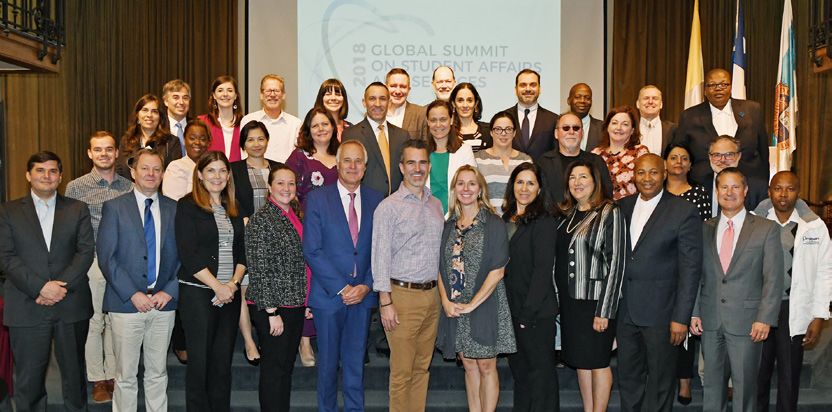
                                   2018 Global Summit for Student Affairs, Santiago, Chile.
      6
NASPA has been empowering the Student
                                              Affairs Community since 1918. NASPA is the
                                              leading association for the advancement,
                                              health, and sustainability of the student affairs
                                              profession. NASPA provides high-quality
                                              professional development, advocacy, and
                                              research for 14,000 members in 50 US states,
                                              25 countries, and 8 US territories. NASPA
                                              and SAI run an annual exchange programme
                                              which allows student support professionals
                                              to visit host institutions. If you would like
                                              to participate in the NASPA exchange
                                              programme, please keep in touch with SAI.
Mr Paul Moriarty, Dr Pat Morgan,
Professor Frank Furedi, Ms Nóirín Deady.
                                              www.naspa.org

        The European Council for
        Student Affairs (ECStA)
        is an independent and autonomous umbrella
        organization aiming to promote the social
        infrastructure at all higher education
        institutions of Europe. The ECStA is in
        particular promoting the cooperation
        between organizations responsible for this
        sector within Europe aiming to increase the
        understanding of the differences regarding
        the social infrastructure of higher education.   2017 CSSI Conference.
        The ECStA is also promoting the mobility
        of students in Europe within the area of
        the Bologna process. SAI collaborates with
        ECStA to foster learning and growth for
        staff and students in Higher Education.
        www.ecsta.org

                                                                                       7
Student Affairs Ireland Summer Summit
University College Cork, 11th & 12th June, 2019

DAY 1: Tuesday 11th June
Student Success: Everybody’s Business

 09:00 – 09:30    REGISTRATION

                  OPENING ADDRESS
 09:30 – 09:40
                  Mr Paul Moriarty, Chair SAI

                  WELCOME ADDRESS
 09:40 – 09:55    Professor Michael Murphy
                                                                                          Aula Maxima
                  President, European University Association

                  KEYNOTE ADDRESS
 10:00 – 11:00    Professor Liz Thomas
                  A whole institutional approach to improving student success

 11:00 – 11:45    Tea/Coffee + Poster Display

 CONCURRENT SESSION 1
 TIME: 11:45 – 12:45   TITLE                        PRESENTED BY                          VENUE

 SESSION 1A            PAPER 1
                       Connecting the Dots:         Dr Pádraig MacNeela, Senior           West Wing 9
 Theme:                Supporting the Student       Lecturer, School of Psychology
 Student               Experience by using          Mr James McCormack,
 Resilience/           student wellbeing findings   Counsellor, Student Counselling
 Wellbeing/Mental                                   & Wellbeing Mr John Hannon,
                       combined with resilience     Director, Student Services.
 Health                building strategies          Institution: National University of
 Format:               in partnership with          Ireland, Galway
 Presentations         academic programmes

                       PAPER 2
                       ‘A Problem Shared…’ a        Ms Ralph Armstrong-Astley,
                       collaborative project        Student 2 Student Coordinator
                       addressing the increasing    Institution: Trinity College Dublin
                                                    Ms Treasa Fox, Head of Student
                       demand for mental health     Counselling. Institution: Athlone
                       support in Irish HEIs        Institute of Technology

 SESSION 1B            PAPER 1
                       Alone at Christmas?          Mr Colum Cronin, International        West Wing 5
 Theme:                An innovative and            Student Adviser. Institution:
 International         collaborative approach to    University College Dublin
 Students              supporting International
 Format:               Students in a resource-
 Presentations         constrained environment
                       PAPER 2
                       Internationalisation: How    Ms Michelle Hogan, International
                       issues of culture impact     Student Liaison Officer and
                       an increasingly globalised   Global Room Manager
                       postgraduate community       Ms Abigail Odekeye, Global
                                                    Room Assistant Manager.
                                                    Institution: Trinity College Dublin

      8
SESSION 1C
Reflecting on Dr Colleen Doyle, West Wing 7
Theme: Competencies for Student Senior Global Partnership Officer.
Developing Affairs Professionals in Institution: University College
Professional Dublin
Ireland
Standards
Format:
Workshop
SESSION 1D PAPER 1
The STLR Effect: Ms Clodagh Ní Ghallachóir, West Wing 6
Theme: Incentivising Student Student Counsellor
Student Growth & Participation in Health & Ms Margaret Rushe,
Development College Nurse
Well-Being Events Dr Emmet Mallon,
Format: Student Counsellor
Presentations Institution: TU Dublin,
Blanchardstown Campus
PAPER 2
Preparing first year Ms Fiona Downey,
Learning Support Coordinator
students with disabilities
Institution: Cork Institute of
for college: An evaluation Technology
of workshops on
academic skills and
perspectives
PLENARY Are Universities for Everyone?
SESSION Professor Tom Sperlinger Aula Maxima
12:45 – 13:30 University of Bristol
13:30 – 14:15 Lunch
CONCURRENT SESSION 2
TIME: 14:15 – 15:15 TITLE PRESENTED BY VENUE
SESSION 2A PAPER 1
The National Access Plan Ms Caitríona Ryan, West Wing 5
Theme: and Student Success Head of Access Policy, HEA
Access
PAPER 2
Format: Trinity Access 21: Large- Dr Aibhín Bray, Trinity Access
Presentations scale action research Coordinator of Research
Dr Rónán Smyth, Trinity
facilitating iterative change
Access School and Community
in Irish schools Outreach Coordinator.
Institution: Trinity College Dublin
SESSION 2B
Creating Significant Ms Delecia Davids, West Wing 9
Theme: Learning Experiences: Programme Coordinator:
Graduate An instructional design Co-Curriculum. Institution:
Attributes Stellenbosch University,
approach South Africa
Format:
Workshop
9SESSION 2C PAPER 1
First Responder (to sexual Ms Trish Murphy, Coordinator, West Wing 6
Theme: misconduct) training in a Student Counselling Services.
Consent Matters: third level setting Ms Orla McLoughlin, Student
Training Counsellor. Institution: Trinity
College Dublin
Format: PAPER 2
Presentations Consent Matters: Ms Ain Bensenouci, Senior
Implementing online Academic Partnership Manager,
training to help students Epigeum, Oxford University
Press
understand sexual consent
and promote positive
change in the university
community
SESSION 2D PAPER 1
Bringing A Community to Mr Jason Masterson, Head of Aula Maxima
Theme: Life: How UCD Student Services, UCD Student Centre.
The Student Centre empowers students Mr Scott Evans, Chaplain, UCD.
Voice: Co- Institution: University College
to create their own sense Dublin
creating services of home
Format: PAPER 2
Presentations Working with Students to Ms Michelle Healy, Student Hub
Get it Right: Co-creating Project Manager.
Ms Michelle Nelson, Student
Success through Student Services Redesign Project
Participation Manager. Institution: University
College Cork
CONCURRENT SESSION 3
TIME: 15:15 – 16:15 TITLE PRESENTED BY VENUE
SESSION 3A PAPER 1
Supporting students’ Ms Caitriona McGrattan, West Wing 5
Theme: transition from first to Programme Advisor.
Transitions second year: Resources, Institution: Maynooth University
Format: insights and tools to assist
Presentations students as they begin their
second year of study at
Maynooth University
PAPER 2
Ms Caoilinn Shinners-Kennedy,
Betwix and Between: Student Support Officer,
Exploring transition to Disability Support Services.
university Institution: University of Limerick
SESSION 3B PAPER 1
Structure, Organisation Ms Michelle Whyte, Chairperson, West Wing 6
Theme: and Fun: Can they exist in Board of Irish College Societies
Student tandem? A snapshot of the (BICS) & Societies Officer, UCC.
Engagement Institution: University College
student experience through Cork.
Format: societies on a local and Mr Dave Cuddihy, Vice
Presentations national level Chairperson, BICS, & Clubs &
Societies Coordinator.
Institution: Mary Immaculate
College (Students’ Union)
PAPER 2
www.studentvolunteering.ie Ms Gabriella Hanrahan,
is Everybody’s Business Community Liaison Officer
Co-convenor, National Student
Volunteer Working Group,
Campus Engage.
Institution: University of
Limerick/Campus Engage
10SESSION 3C PAPER 1
TAP Students Supports: The Ms Kathleen Brennan O’Toole, West Wing 9
Theme: practicable and intangible Deputy Director, TAP.
Exchanging Ms Sarah Grimson, Foundation
Knowledge Course Coordinator TAP.
& Resources: PAPER 2 Institution: Trinity College Dublin
Partnership & Enhanced preparation
Reciprocity for Clinical Placement Dr Eithne Hunt, Dept.,
and Future Employability Occupational Science &
Format: through Service Learning Occupational Therapy
Presentations Mr Martin Flynn, UCC Plus+
Manager
Ms Maeve Minihan, UCC Plus+
Outreach Co-ordinator
Mr Paul Geeleher, UCC Plus+
Schools Outreach
Mr Shane Horan, UCC Works
Coordinator
Ms Eleanor Donoghue, Graduate
Attributes Programme Manager.
Institution: University College
Cork
SESSION 3D PAPER 1
Respect & Responsibility: Mr Gary Mulcahy, Campus West Wing 3
Theme: Investigating practical Watch / Student Residential
Behaviour solutions to anti-social Services & Community Relations
Change: Officer
behaviour, bullying and Mr David O’Sullivan, Campus
Developing intimidation in a university Watch / Student Residential
Interventions Services & Community Relations
Format: PAPER 2 Office. Institution: University
My Understanding College Cork
Presentations
of Substance-use
Experiences (MiUSE): A Dr Vasilis Vasiliou, School of
digitalised harm-reduction Applied Psychology.
Institution: University College
intervention for illicit
Cork
substance use in third-level
students
16:15 – 17:00 Tea/Coffee + AGM – All members welcome Aula Maxima
2018 Global Summit for Student Affairs, Santiago, Chile.
11POSTERS
TITLE NAMES INSTITUTION
The Go4IT Programme Ms Anna Murphy, Access Officer Limerick Institute of
Technology
‘Active Waiting’: Support, education Dr Aoife O’Sullivan, Student Health University College Cork
and interventions for Students with Doctor
Eating Disorders
TU Dublin – City Campus (Formally Ms Dolores Hill, Project Officer Technological University
DIT) Access Student Leadership Mr Emmet Jordan Kelly, Project Dublin – City Campus
Officer
Access Your Pathways Dr Holly Foley, Access Officer TU Dublin Tallaght
Marie Kielty, Careers Officer Campus
REACT Project Ms Kasturi Chakraborti, REACT RA University College Cork
/ Health Promotion Project Worker
The experience of using a user- Ms Samantha Dick, Research University College Cork
centred design approach in a third- Assistant School of Public Health
level setting Dr Vasilis Vasilious, Post-Doctoral
Researcher, School of Applied
Psychology
UCC International Office Swap Shop Ms Natalie O’Byrne, University College Cork
Student Support Team
Ms Suzanne Buckley,
Support Officer
Ms Manuela Kovacevic
Using Data to Support First-year Dr Niamh Nestor University College Dublin
Student Wellbeing: The Live Ms Diane Cashman
Engagement and Attendance Assoc. Professor Sue Rackard
Professor Jason Last
(LEAP) Project at the UCD School
of Veterinary Medicine
CLiC News – A platform for student Ms Riona Fitzgerald, TU Dublin City Campus
and community engagement Engagement Outreach Manager
Mr Ian Roller, Engagement
Outreach Coordinator
Bridging the gap: An international Ms Nadia Clarkin, University College Dublin
Student Mentor Programme for Student Adviser
PG Students on a One Year Taught Ms Jola Meagher, International
Student Liaison Officer
Masters Programme
Identification of the contexts and Dr Vasilis Vasiliou University College Cork
motivations associated with illicit Dr Samantha Dockray
substance use among third level Ms Samantha Dick
Dr Conor Linehan
students using a COM-B Model
Dr Martin P. Davoren
Dr Cira Heavin
Dr Michael Byrne
Factors influencing the take-up and Ms Susan Calnan, PhD student University College Cork
implementation of a pilot alcohol
programme in Irish Colleges: A
qualitative study using Rogers’
diffusion theory
12DAY 2: Wednesday 12th June
A day like any other until it’s not:
Critical incidents and crisis management
09:30 – 10:00 REGISTRATION
WELCOME
10:00 – 10:05 Mr Paul Moriarty, Director of Student Experience, UCC.
Chair of Student Affairs Ireland
OPENING ADDRESS
10:05 – 10:15
Professor Patrick G. O’Shea, President, University College Cork
INTRODUCTION
10:15 – 10:25 Ms Nora Geary, Corporate Secretary.
Chair of the UCC Emergency Management Team (EMT)
How prepared are we for a major incident/emergency on
10:25 – 11:00 campus?
Mr Noel Reidy, Reidy Brophy Crisis Management Specialists
Aula Maxima
Emergency Responses in University College Cork -
Understanding & Co-operation
11:00 – 11:30
Ms Nora Geary, Corporate Secretary.
Chair of the UCC Emergency Management Team (EMT)
Tragedy and Trauma at Virginia Tech: The Painful Price of
Mass Shootings
11:30 – 12:30
Dr Chris Flynn, Director of Student Counselling Services,
Virginia Tech, Blacksburg, Virginia, USA
Launch of Student Affairs Ireland
12:30 – 12:45 Mary Mitchell O’Connor, Minister of State at the Department of
Education
12:45 – 13:30 Lunch
Garda Emergency Planning and Emergency Response:
Exercise Barracuda – Lessons Learned
13:30 – 14:15 Inspector Eamon O’Loughlin,
Garda National Emergency Management Office
Inspector Donal O’Driscoll,
Garda Special Tactics and Operations Command
Media & Communications: In the context of a major
emergency in a third level institution
Aula Maxima
Ms Mairéad Loughman, Risk Manager, University College Cork
14:15 – 15:00
Ms Ann-Marie O’Sullivan, FPRII, Founder & Chief Executive, AM
O’Sullivan PR Ltd.
Dr Peter Daly, Director, Irish Centre for Emergency Management
Panel Discussion with all Presenters
15:15 – 15:45 Chair: Ms Linda Barry, Academic Administrator & Student
Affairs Manager, Limerick Institute of Technology
Supported by the SynthSCS Project: a project funded by the HEA Innovation and
Transformation Programme 2018 in collaboration with Student Affairs Ireland
13Concurrent Session 1
Time: 11:45hrs – 12:45hrs
Session 1A: Student Resilience/Wellbeing/Mental Health
Venue: West Wing 9
PAPER 1
Connecting the Dots: Supporting the Student
Experience by using student wellbeing findings
combined with resilience building strategies in
partnership with academic programmes
Dr Pádraig MacNeela, Senior Lecturer, School of Psychology
Mr James McCormack, Counsellor, Student Counselling & Wellbeing
Mr John Hannon, Director, Student Services
Institution: National University of Ireland, Galway
Student health and wellbeing are increasingly recognised as key factors in ensuring
that the experience of Higher Education is positive and successful. These factors
contribute to the success of the academic and professional development mission of
the Higher Education Institution, and present an opportunity for colleges to adopt
a holistic, student-centred stance in its relationship with and support for students.
This paper reports on two projects funded at NUI Galway to improve our capacity to
gather relevant information on student health and wellbeing and to act in support of
personal confidence and resilience.
The Student Information Project has collected survey data on over 3,000 students
since 2016 on a range of indicators including sleep, physical health, depression,
anxiety, stress, alcohol and drug use, academic engagement, perceptions of the
academic environment, usage of support services, and likelihood for successful
completion. The paper will present key findings from the profile of health and
wellbeing that has emerged from this study. The Student Resilience Project aims to act
in response to key student needs identified by the Student Information Project. Using
lectures and workshops, students are engaged on skills-based topics including stress
management, working successfully in groups, and mental health / alcohol awareness.
One important innovation in this project is the objective of working in partnership with
academic programmes and departments to embed health and wellbeing supports
within the academic curriculum. This helps to address the longstanding issue of
underutilisation of useful resources and workshops.
The paper will present initial findings from the Student Resilience Project – including
delivery format, partnership working arrangements, content and approach, and
student evaluations. These findings are based on implementing the Resilience Project
in a large First Year module with an enrolment of 350 students at NUI Galway.
Findings suggest that students found the addition of the Resilience Project to their
academic programme to be beneficial in supporting acquisition of relevant skills and
in promoting successful transition to college.
The paper describes the underlying strategic objective of the two projects, to
combine large scale, standardised data collection on student academic and wellbeing
experiences with active methods of engaging students on skills development relevant
to successful transition to and completion of HEI programmes.
14PAPER 2
‘A Problem Shared…’: a collaborative project addressing the
increasing demand for mental health support in Irish HEIs
Ms Ralph Armstrong-Astley, Student 2 Student Coordinator
Institution: Trinity College Dublin
Ms Treasa Fox, Head of Student Counselling
Institution: Athlone Institute of Technology
We are presenting a project at its onset, within institutions and cross agency/ cross
with the aim of inviting collaboration and department collaborations across 22 HEIs.
encouraging inclusion at every possible level, A specific focus will be suicide prevention/
in what we hope will form a transformative intervention/postvention, to inform HEA
national resource for student mental health national guidance.
interventions and preventative strategies.
2.2: The second part of this work package
In January 2019 the HEA Innovation and will develop and disseminate resources
Transformation fund approved a 3-pronged across all HEIs such as: self-help information
collaborative project between UCD, for students, specific workshop and training
AIT and TCD, designed to enhance our materials for staff and students. These
understanding of the significant increase materials will be customisable and shared
in mental health issues being presented by across the sector.
students, and to create communal resources
and replicable programmes targeted at Work package 3: Blanket peer-led
these issues. transition, retention and learning
development programme for entire
Headed by Dr. Deirdre Flynn, Director of first year undergraduate intake, led by
Trinity Counselling, Learning Development Ralph Armstrong-Astley in TCD
and Student 2 Student Services (TCD), the
three work packages to this project will This work package aims to research best
create new initiatives to improve the delivery practice nationally for peer-based transition,
and effectiveness of student services: social networking and peer assisted study
programmes, and to develop and pilot
Work package 1: National Student an integrated model for social mentoring
Counselling Research Group (NSCRG) combined with peer assisted study.
and dataset, led by Barbara Dooley in
UCD This programme should be embedded into
the orientation and academic timetabling
Work package 1 will create a research group of all first-year undergraduate students,
between the Psychological Counsellors in with course-by-course tailoring. The pilot’s
Higher Education Ireland (PCHEI) and the impact on retention and progression for the
Youth Mental Health Laboratory, University first-year students and for the volunteers
College Dublin (YMHL) to standardise the will be measured, as will the impact on the
national dataset on student mental health, development of generic skills (employability
using data from all student counselling attributes) in both first-year students &
services in Irish HEIs. The research aim is to programme volunteers.
provide a clear picture of student mental
health and propose a national framework We will present an overview of each of these
to examine the effectiveness of clinical projects, and how they can inform and be
interventions and preventive strategies. informed by each other, along with more
information about how interested colleagues
Work package 2: Scoping Review and can participate in each strand. We will also
policy development of student mental actively encourage proposals for further
health initiatives, led by Treasa Fox in collaboration, linking in with other existing or
AIT formulating strategies at a national level and
any suggestions for joining the dots across
2.1: The first part of this work package will the sector.
identify current practices and innovations
that support student mental health, both
15Session 1B: International Students
Venue: West Wing 5
PAPER 1
Alone at Christmas? An innovative and collaborative
approach to supporting International Students in a
resource-constrained environment
Mr Colum Cronin, International Student Adviser
Institution: University College Dublin
This presentation aims to demonstrate generate a sense of community. An online
that by supporting staff and students to handbook was produced outlining what
work in partnership, we can help students students should expect and providing
to become more engaged with their own contact details for off-campus support
learning, the university experience and the services available while the university was
wider community while simultaneously closed.
helping staff to develop an insight into the
student perspective. Theoretical underpinnings for the DiD
project came most particularly from the
How do you support students when your pioneering work of Elspeth Jones and
institution is closed? Betty Leask and Jude Carroll’s seminal
article Moving beyond ‘wishing and hoping’:
University College Dublin (UCD) has an internationalisation and student experiences
increasing number of international students. of inclusion and engagement. The project
The university closes for two weeks over looked to the University of Warwick and
Christmas and most Irish students return the Helen Spencer-Oatey and Daniel
to their families, however a significant Dauber’s paper How ‘Internationalised’ Is
number of international students remain on Your University? Moving beyond structural
campus for a variety of reasons (financial, indicators towards social integration. All the
immigration, personal). aforementioned have published extensively
on improving the Student Experience
With no access to support services there and the integration of international
existed a significant risk that students students. The UKCISA funded project at
would feel alone, and isolated. To combat Nottingham Trent University examining
this the Dublin in December (DiD) project what international students can bring to
was created. DiD was envisaged as an university life as well as what universities
opportunity for students to create solid can offer them provided additional
connections, generate community and inspiration.
organise activities. The hope was that
Dublin in December events would facilitate Jones’ paper Problematising and
students in forming new friendships; in turn Reimagining the Notion of ‘International
enhancing their UCD student experience, Student Experience’ demonstrates that it’s
alleviating homesickness and isolation. important that we not view international
students as a single homogeneous cohort
The project involved staff from across with exactly the same needs. While we
the university including members of know also from Betty Leask and Jude
the Advisers network, the Alumni and Carroll’s work that merely having large
Development Office, the International cohorts of international students on campus
Office. Student societies were also involved. does not lead to meaningful interactions
between students. Both factors were built
Events were held to allow students to into the design of the DiD project.
learn about holiday traditions in Ireland,
and to take part in task-based activities to
16PAPER 2
Internationalisation: How issues of culture impact an
increasingly globalised postgraduate community
Ms Michelle Hogan, International Student Liaison Officer and Global Room Manager
Ms Abigail Odekeye, Global Room Assistant Manager
Institution: Trinity College Dublin
Internationalisation is a driving force in different challenges. Part of this project involved
the changing face of higher education as collating data on these challenges and working
increasing numbers of international students extensively with student support services and
seek to undertake studies at postgraduate the Office of the Dean of Graduate Studies
level internationally. Internationalisation is throughout the University to help link up each
the “intentional process of integrating an team to collaborate together and better serve
international, intercultural or global dimension our postgraduate students. The Global Room
into the purpose, functions and delivery of has hired postgraduate students to work as
postsecondary education, in order to enhance Global Ambassadors this year in an effort to
the quality of education and research for all enhance this project.
students and staff, and to make a meaningful
contribution to society.”(De Wit & Hunter: 2015). The Global Room is a student support and event
space, with a focus on the international student
As such internationalisation provides scope for community. As well as connecting students to
the expansion of the student experience – for the wider college community, and it’s support
both domestic and international students – services and resources, the activities and events
which institutions can benefit from whether in this multi-functional space encourage and
that is through increased student numbers, facilitate students to meet and connect in a way
internationalized curricula, increasing student that contributes to positive integration of all
diversity, and growing mobility opportunities for students at Trinity.
all students.
This presentation will feature insights on the
While there is a large focus in research International post-graduate student experience
literature on the undergraduate international at an Irish institution, and will outline student
student experience, there is not as great a experiences, best practice, strategies and
focus on postgraduate international student recommendations to improve the PG student
experience. A postgraduate student’s cultural experience at this institution.
background influences their experiences at
higher education institutions in three key De Wit & Hunter (2015) Internationalisation of
categories: cultural adaptation, social adaptation Higher Education, European Parliament Study.
and academic adaptation. Institutions that
embrace and recognize these transitions for
their student body in the increasingly globalised
postgraduate market can contribute to the
overall improvement in institutional supports for
PG students.
The Global Room team at Trinity College
has initiated a project to deliver a series of
workshops, events and social gatherings with
a Postgraduate outlook. The needs of PG
students is vastly different to those of the
undergraduate community and comes with very
17Session 1C: Developing Professional Standards
Venue: West Wing 7
WORKSHOP
Reflecting on Competencies for Student
Affairs Professionals in Ireland
Dr Colleen Doyle, Senior Global Partnership Officer
Institution: University College Dublin
Over the last three decades, university those used by the academic advising
staff working in the broad area of student community (NACADA, 2017; UKAT,
support and services have begun to develop 2019); those focusing on multicultural
and improve professional standards, competencies (Pope, Reynolds & Mueller,
training and outcomes (Rybalkina, 2008). 2004, 2019) and global student affairs
As these efforts have gained momentum, competencies (Bardill Moscaritolo &
professional bodies aligned to these Roberts, 2016).
professions have developed statements of
professional competencies to benchmark Participants will then be given time to
their initiatives in staff development. With work in small groups on themes which
the recent re-branding exercise of CSSI to they determine relevant for Student Affairs
Student Affairs Ireland, now is a good time Ireland. Time will be given for each group to
to commence the conversation about which share their discussion points. The discussion
values/skills/knowledge SAI would like to will be manually recorded by the workshop
promote in its membership. leader and shared with the SAI executive
team following the conference.
The workshop will open with a presentation
by the workshop leader on some of the The workshop will be highly interactive
competency statements of student affairs and will hopefully be the first, of many,
professional bodies in other parts of the conversations that will commence
world. Common themes will be discussed. the drafting of SAI’s own professional
Models that will be reviewed will include competencies.
UCC uLink Peer Support
18Session 1D: Student Growth & Development
Venue: West Wing 6
PAPER 1
The STLR Effect: Incentivising Student Participation in
Health & Wellbeing Events
Ms Clodagh Ní Ghallachóir, Student Counsellor
Ms Margaret Rushe, College Nurse
Dr Emmet Mallon, Student Counsellor
Institution: TU Dublin, Blanchardstown Campus
Student Transformative Learning Record (STLR) is a second transcript capturing
students personal growth, development and transformative learning. Developed by
the University of Central Oklahoma (UCO) through the medium of Transformative
Learning, STLR builds beyond –disciplinary skills and expands students perspectives
of their relationships with self, others, community and environment. STLR has six
tenets; Discipline Knowledge, Global and Cultural Competencies, Health and Wellness,
Leadership, Research, Creative and Scholarly Activities and Service learning and Civic
Engagement. STRL is presently being piloted in TU Dublin Blanchardstown Campus.
This presentation describes how the numbers of students participating in health and
well- being events and initiatives can be increased due to building the Health and
Wellness part of the STLR e-portfolio. The presentation will last for twenty minutes
with ten minutes allocated for questions.
Mr Paul Moriarty with colleagues attending the 2018
Global Summit for Student Affairs, Santiago, Chile.
19PAPER 2
Preparing first year students with disabilities
for college: An evaluation of workshops on
academic skills and perspectives
Ms Fiona Downey, Learning Support Coordinator
Institution: Cork Institute of Technology
This paper documents the approach that the intensity of managing information and
the Disability Support Services undertook time. In contrast, by allowing students to
to better prepare first year students with attend workshops just before the academic
disabilities on some of the academic skills year commenced, students had the
essential for third level study and evaluate opportunity to concentrate on developing
their perspectives on how prepared they their new academic study skills necessary
felt for the demands of academic work. It at third level and were more inclined
was thought that students regardless of to participate and attend the College
their ability, should access the necessary Preparation Days.
study skills to support their learning needs
for their studies. To evaluate the level of success of the
workshops and how better prepared
Two College Preparation Days were students felt, feedback from online
allocated before the start of the Semester registration forms and questionnaires
1 term to deliver 3 themed workshops that were collated prior to and following these
students could choose from; ‘How to Take workshops respectively. The design of the
Good Notes’, ‘How to Start an Assignment’ questionnaires was based on qualitative
and ‘The 3 R’s (Reading, Research and and quantitative methods to ascertain
Referencing)’. The aim of these workshops the benefits of each of the techniques
was to inform students that with the in relation to preparing students for the
appropriate learning tools and choice of start of term and if efforts were made
strategies, that they could compete and to apply these skills during Semester 1.
achieve academic success and also become Overall, students who responded indicated
more independent learners. Bite-size they found that the College Preparation
learning support videos were created in workshops did prepare them for college,
line with the principles of Universal Design did address their expectations and reduce
Learning (UDL) and accompanied each levels of anxiety. Further qualitative and
of the workshops which were also made quantitative investigation in the form of
available to students as a study reference questionnaires and student interviews
point as they moved through the semester. will be carried out towards the end of
Semester 2 to determine the impact of
In recent years, it was found that when these skills and how prepared they felt as
study skills workshops were delivered a result. Moreover, it will examine whether
during the new academic term, that those students required additional learning
students were either too busy due to support or implemented an independent
timetable constraints or adjusting to the approach to their studies.
college workload or too overwhelmed with
20Concurrent Session 2
Time: 14:15hrs – 15:15hrs
Session 2A: Access
Venue: West Wing 5
PAPER 1
The National Access Plan and Student Success
Ms Caitríona Ryan, Head of Access Policy, HEA
This presentation will look at student success this engagement is regarded as essential to the
from the perspective of the National Access success of the Group’s work. The teaching and
Plan (NAP), 2015-2021. An objective in this plan learning experience is directly connected to
(1.4) is “To address the issue of non-completion student success. Caitríona will discuss the five
of programmes, particularly for those in under- work packages that this Working Group has
represented target groups”. The NAP vision agreed in addition to the findings and learnings
is concerned with ensuring that the student that are emerging from the work to date.
body in higher education reflects the diversity
and social mix of Ireland’s population. The NAP Central to these themes is the need for student
is not just about diversity in access to higher success to be “everybody’s business”. Everyone
education but equally as important is ensuring in a higher education institution contributes to
that the student experience and the teaching student success and therefore everybody needs
and learning environment is responsive to to understand the role that they play and take
diversity and engages the whole student ownership for it.
cohort. This is at the core of universal design
principles in higher education – the ability Clarity in understanding what constitutes
to cater for diversity through integrated and student success is also essential. Student
inclusive higher education provision. success means different things for different
people. A diverse higher education system
The HEA chairs a Working Group on Student places the student at the centre of all provision,
Success which was established as part of embraces the diversity in students and
the implementation of the NAP. The Working recognises that a “one-size-fits-all” approach
Group has been supported in its work by the is not fit-for-purpose in an inclusive system of
National Forum for Teaching and Learning and higher education.
Attending the
CSSI Conference
in 2017.
21PAPER 2
Trinity Access 21: Large-scale action research
facilitating iterative change in Irish schools
Dr Aibhín Bray, Trinity Access Coordinator of Research
Dr Rónán Smyth, Trinity Access School and Community Outreach Coordinator
Institution: Trinity College Dublin
Trinity Access 21 (TA21) is a post-primary Follow up will be completed on an annual
outreach initiative that offers a range basis in each participating school, providing
of programmes for students, teachers longitudinal tracking at whole-school level
and schools. It is targeted at schools in in 20 schools.
areas of socio-economic disadvantage
with low progression rates to higher Results from phase 1 indicate that the
education. The overarching aim of the TA21 programme has a positive effect on
programme is to help students to develop participants’ aspirations to continue in
the knowledge, networks and skills needed education after completing post-primary
to make informed decisions about future school. This talk will introduce the TA21
educational opportunities. TA21 provides programme and will present some of the
students with opportunities to take part in phase one results as well as the design
widening participation activities that aim to and some initial findings of the second
build social and cultural capital, while also phase. In this way, we hope to illustrate
supporting teachers and schools through the potential for this research to deliver
the provision of professional development important insights into factors that lead
opportunities and an iterative cycle of data to educational inequalities, as well as
collection, feedback and consultation with evidence for an outreach programme that
each individual school. can reduce differentials between social
groups. Our goal is to share our processes,
The first phase of TA21 involved a three- instruments, and ultimately our data, with
year, quasi-experimental, intervention-style a wider audience, in order to increase the
study, which ran until 2017 and followed positive impact of the work at national and
a cohort of 1,100 second year students potentially international levels.
from 11 treatment and 4 control schools.
Phase 2 of the project began in 2018 and
is currently following an observational
study design within an overarching action
research methodology, in which all students
(~12,000) and teachers (~500) in 20
participating schools will be requested to
engage with the study. This, in combination
with the collection of school-level data will
enable the researchers to reliably establish
students’ levels of exposure/non-exposure
to the programme, variations in school
culture and management, and to identify
correlations with desired behaviours and
developing attributes and aspirations.
Delegates attending the 2017 CSSI
Conference in University College Cork.
22Session 2B: Graduate Attributes
Venue: West Wing 9
WORKSHOP
Creating Significant Learning Experiences:
An instructional design approach
Ms Delecia Davids
Programme Coordinator: Co-Curriculum,
Institution: Stellenbosch University
In the United States, the perspective of learning-centered higher education
has become more accepted since the early 2000’s, which holds the belief that
institutions should not only focus on offering courses and granting degrees, but
should also generate valuable kinds of learning and that it should be certified
that those types of learning has been achieved (Fink, 2013:viii). This learning
goes beyond content-knowledge and focuses on the individual becoming an
engaged and responsible citizen, that is “learning the skills, developing the habits
and identities, and acquiring the knowledge to contribute to the general welfare
on campus, in communities and in the world” (Campus Compact, 1998). This
perspective lead many higher education professionals to ask questions around
what students should be learning, how this learning can best be achieved and even
more importantly, where this learning takes place.
When fully integrated, the co-curriculum mirrors the institutional academic
project’s principles of Teaching and Learning. Both contribute and restrict the
development of co-curriculum programmes. Models which have guided teaching
and learning decisions such as Bloom’s Taxonomy (1956) do not give us the
language necessary to communicate learning outcomes and goals in line with
the competencies and graduate attributes amongst fellow practitioners and to
students. The co-curriculum therefore requires an innovative approach which calls
for active learning and educative assessment.
Fink (2013:34) provides us with some of this new language in which to frame our
co-curricular pursuits, calling for significant learning experiences, which is defined
as “learning [that] requires there be some kind of lasting change that is important
in terms of the learner’s life” (Fink, 2013:34). Fink’s taxonomy and instructional
design principles provide us with the tools to design these significant types of
learning within Student Affairs.
This interactive workshop will give a short overview of significant learning, giving
examples of how this has been applied within the SU Leadership Development
programme for student leaders involved in residential education. Participants will
have the opportunity to collaboratively begin designing an activity for student
learning, using tools of instructional design as described by Fink such as the
taxonomy of SLE, Educative Assessment and Active learning.
23You can also read


