Suicide Prevention Action Plan for Leeds 2018-2021
←
→
Page content transcription
If your browser does not render page correctly, please read the page content below
Suicide Prevention Action Plan for Leeds 2018-2021
Leeds Strategic Suicide Prevention Group – Refresh January 2020
Authors:
Catherine Ward – Health Improvement Principal
Vineeta Sehmbi – Health Improvement Specialist
Victoria Eaton – Consultant in Public Health

                                                                  1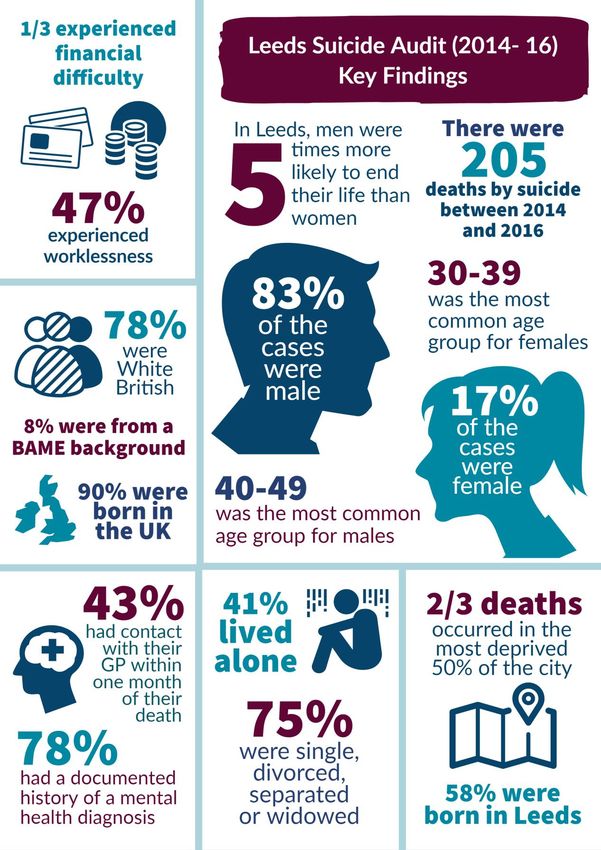
Suicide Prevention Action Plan for Leeds 2018 - 2021

Purpose
The Suicide Prevention Action Plan for Leeds sets out the direction and priorities for the city’s suicide prevention agenda for the
period 2018-2020. This is a working document, used as a framework to guide local action and activity. This action plan also
demonstrates citywide investment matched to key areas of action in line with national policy, intelligence and the most recent Leeds
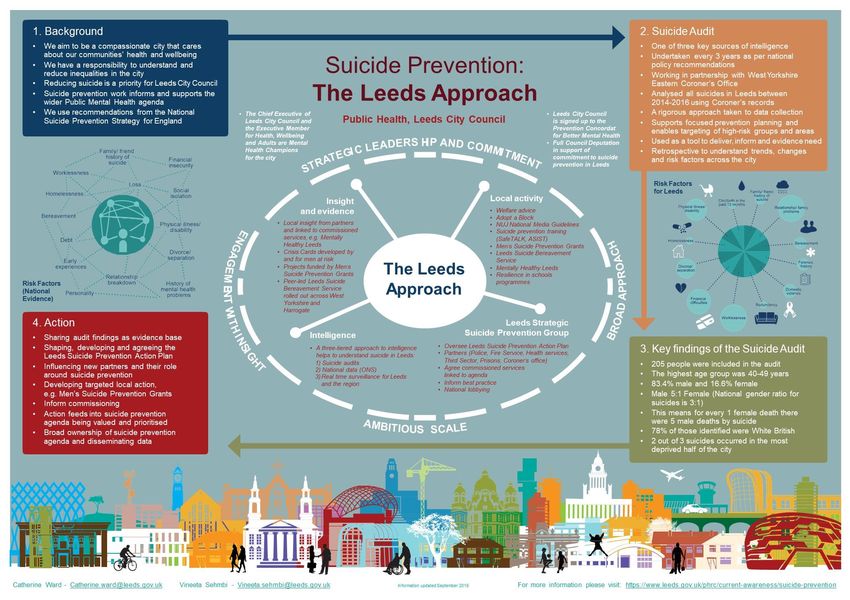
Suicide Audit (2014-2016). This direction then reflects “The Leeds Approach” to suicide prevention across the city (see Appendix 1).
The Suicide Prevention Action Plan is overseen by the Leeds Strategic Suicide Prevention Group (LSSPG). This is a citywide multi-
agency group chaired by Public Health, Leeds City Council (PH LCC). The terms of reference (TOR) are reviewed annually to reflect
the current work of the action plan (Appendix 2).

Scope
The Suicide Prevention Action Plan for Leeds sits within the context of our wider Public Mental Health programme, of which reducing
suicide and self-harm is a key priority area. Other priorities of this programme include population mental health promotion and
wellbeing; reducing stigma and discrimination; and effective, equitable mental healthcare services.
The scope of this action plan is informed by priorities relating to local needs, national policy and the evidence-base for suicide
prevention, including the recommendations from both the Leeds Suicide Audit (2014-2016) and the national strategy refresh
Preventing Suicide in England: Fourth progress report of the cross-government outcomes strategy to save lives (January 2019). This
includes interventions commissioned locally by the partners of the LSSPG. The plan takes a life course approach and ensures
continuous links with children and families’ and older people’s work streams.
Reducing the risk of suicide in high-risk groups, including those with a history of self-harm is a key focus of the action plan. Broader
work on reducing self-harm, including reducing stigma and strengthening resilience in key groups (for example in children and young
people) is not included within this plan. Instead, this work is captured as part of the wider Public Mental Health programme that aims
to improve mental health and wellbeing across the life course at a population level, focusing on the protective factors for positive
mental health and reducing the risk factors for poor mental health. The Leeds Approach (Appendix 1) to suicide prevention continues

                                                                                                                                       2
to bring strategic partners together, using the local evidence of the audit, and commit to local effective action. This addresses a wider
need to strengthen suicide prevention activity in healthcare settings, support joined-up approaches and will ensure the best use of
limited resources.

Background
Her Majesty’s Government / Department of Health (DH) published a national suicide prevention strategy in 2012: Preventing Suicide
in England: A cross-government outcomes strategy to save lives. This highlighted six key areas for action:
   1.   Reduce the risk of suicide in key high-risk groups.
   2.   Tailor approaches to improve mental health in specific groups.
   3.   Reduce access to the means of suicide.
   4.   Provide better information and support to those bereaved or affected by suicide.
   5.   Support the media in delivering sensitive approaches to suicide and suicidal behaviour.
   6.   Support research, data collection and monitoring.
   7.   These areas for action, where relevant, formed the basis of the previous Suicide Prevention Action Plan alongside the findings
        from the Leeds Suicide Audit published in 2019.

National updates
In January 2019 the national suicide prevention strategy was refreshed in the form of the Fourth Annual Progress Report. Alongside
this, the first Cross-Government Suicide Prevention Workplan was published, which aims to drive progress across all sectors of
national and local government to continue to reduce suicides. In May 2019, the Samaritans produced an independent progress report
on Local Suicide Prevention Planning in England, where the Leeds Suicide Prevention Action Plan was included as a case study and
rated ‘outstanding’.
Alongside the key areas for action, the refreshed strategy (2019) has also prioritised:

   1. Working in partnership with local government to embed their local suicide prevention plans in every community;

                                                                                                                                        3
2. Delivering our ambition for zero suicide in mental health inpatients and improving safety across mental health wards and
extending this to whole community approaches;
3. Addressing the highest risk groups including middle-aged men and other vulnerable groups such as people with autism and
learning disabilities, and people who have experienced trauma by sexual assault and abuse;
4. Tackling the societal drivers of suicide such as indebtedness, gambling addiction and substance misuse and the impact of
harmful suicide and self-harm content online;
5. Addressing increasing suicides and self-harming in young people; and
6. Improving support for those bereaved by suicide
The following key documents inform the content of the current action plan:
Preventing suicide in public places (Public Health England, 2015).
Identifying and responding to suicide clusters and contagion (Public Health England, 2015).
Suicide Prevention (House of Commons Health Committee, 2016).
Local suicide prevention planning guide (Public Health England, 2016).
Government response to the Health Select Committee’s Inquiry into Suicide Prevention (Department of Health, 2017).
National Confidential Inquiry into Suicide and Homicide by People with Mental Illness (University of Manchester, 2017).
Prevention concordat for better mental health (Public Health England, 2017).
Support after a suicide: A guide to providing local services (Public Health England, 2017).
West Yorkshire and Harrogate Suicide Prevention Plan (STP) (2017) (West Yorkshire and Harrogate Partnership, 2017).
Suicide prevention: A guide for local authorities (Local Government Association, 2017).
Five Year Forward View for Mental Health – One year on (NHS England, 2017).
Local Suicide Prevention Resources: Case Studies & Information sheets (National Suicide Prevention Alliance in association
with Public Health England, 2017).
Nobody Left Behind: Good Health and a Strong Economy (Leeds City Council, Director of Public Health, 2018).
Preventing Suicide in England: Fourth Progress Report of the Cross-Government Outcomes Strategy to Save Lives (Public
Health England, 2019).
4 Cross-Government Suicide Prevention Workplan (Public Health England, 2019).
The NHS Long Term Plan (NHS, 2019).
Suicide Prevention – Quality Standard (NICE, 2019).
Local picture
The three main drivers of this action plan are the national strategy, the findings from the Leeds Suicide Audits and real time
surveillance. The plan focuses on local priorities and needs that align within the approaches set out in the refreshed national strategy.
A visual was developed to demonstrate the Leeds Approach to suicide prevention (Appendix 1).
Leeds Suicide Audit (2014-2016)
The latest Leeds Suicide Audit was published in September 2019. This audit looked at deaths that occurred over the three year
period 2014 - 2016. The key findings from the Leeds Suicide Audit (2014–2016) can be found in Appendix 3.
The Leeds Suicide Audit (2014–2016) recommended 12 areas of priority for suicide prevention in Leeds:
1. Engage partners from a wide range of organisations, ensuring key suicide prevention work is undertaken by skilled people
who have access to the groups identified as most at risk. Support partners to embed effective actions within their own action
plans across the city that link to the Leeds Strategic Suicide Prevention Plan.
2. Target interventions towards those identified as most at risk. Every agency working to prevent suicide should consider how
their work promotes resilience and good mental health, whilst reflecting the needs of the local population.
3. Actions to reduce risk for people in contact with the criminal justice system to include points of transition, first contact, early
days of custody and the pre- and post-release period. Link the suicide prevention agenda to other plans in the city where
criminal justice work is being prioritised.
4. Work with primary care to increase the recognition of those at risk of suicide. This audit shows that half of the people had
contact with primary care within three months of their death. Clinical Commissioning Group partners to work collaboratively
with Leeds City Council, frontline services and the voluntary sector, ensuring acute and community services are better joined
up, avoiding gaps in support during transitions and improving access for those that need it most.
5. Appropriate management of poor mental health at an early stage, including swift access to care, with family and friends
involved in care planning where appropriate. Research shows that those with depression and other mental illnesses can
5benefit from a range of interventions both pharmacological (Zalsman, et al., 2016; Reinstatler & Nagy, 2015; Cipriani, Hawton,
Stockton, & Geddes, 2013) and psychosocial (Zalsman, et al., 2016; Donker, et al., 2013) and these can reduce the risk of
suicide. Ensure healthcare strategies are aligned and embed relevant recommendations from the latest Leeds Suicide
Prevention Action Plan.
6. Continue to develop real time surveillance including data from partners to tailor specific activity around reducing the means of
suicide. Partners should include West Yorkshire Police along with the transport and rail sector to inform future local action.
7. Continue to work with the local media to dispel myths around any high-frequency locations (should they arise) as an effective
means of suicide prevention.
8. Continue to prioritise postvention interventions that are aimed towards those who are bereaved by suicide, and ensure that the
Leeds Suicide Bereavement Service receives timely referrals from local organisations.
9. Engage with partners who are most likely to be in early contact with those who are bereaved by suicide (e.g. Accident and
Emergency departments, West Yorkshire Police, Coroner’s office) to ensure early access to appropriate services.
10. Continue to work with colleagues in the media and promote the use of the national guidelines developed in Leeds in
partnership with the National Union of Journalists.
11. Continue to undertake a suicide audit at regular intervals to gather detailed knowledge about the epidemiology and risk factors
of those taking their own life in the city.
12. Continue to inform partners on suicide intelligence using the audit, real time surveillance and Office for National Statistics
mortality statistics, so that relevant organisations can develop coordinated responses to both emerging risks and clusters
should they arise.
These recommendations are embedded in the following overarching priority work streams for the Leeds Suicide Prevention Action
Plan:
1. Citywide leadership for suicide prevention;
2. Reduce the risk of suicide in high-risk groups;
3. Develop and support effective suicide prevention activity in local primary care services;
4. Provide better information and support to those bereaved or affected by suicide;
5. Support the media in delivering sensitive approaches to suicide and suicidal behaviour; and
6. Improve local intelligence on suicide in Leeds to inform suicide prevention activity.
6Suicide Prevention Action Plan for Leeds (2018-2021)
Priority Action / Intervention Lead Organisation Progress Timeline
(Outcomes / Milestones)
1. Leadership Chair and support an effective LCC PH Evidence of strategic leadership and Ongoing
for Suicide citywide multi-agency influence; progress on activities relating to
Prevention strategic suicide prevention the action plan.
group overseeing the delivery
The content of the action plan will reflect Ongoing
of the action plan.
activity across the group from all partners.
Quarterly meetings with minutes and Quarterly
actions from activity of LSSPG and task
groups (e.g. Primary Care Group).
Review of the Suicide Prevention Action Annual
Plan for Leeds.
Submitted both the Leeds Suicide
Prevention Action Plan and our self- 2019
assessment of the Suicide Prevention
Action Plan to the DH/ LGA/ PHE.
Ensure Local Authority Mental Health
Quarterly
Champions (Cllr Charlwood, Executive
Member for Health, Wellbeing and Adults
– Chair of the Health and Wellbeing
Board, and Tom Riordan, Chief Executive
of LCC) are kept informed of progress
and are active suicide prevention
champions.
7Priority Action / Intervention Lead Organisation Progress Timeline
(Outcomes / Milestones)
City Wide Identify funding, LSSPG The content of the action plan to reflect a Annual review
commissioning resources and range of funding sources and partners (with a final
opportunities for related involved. review in 2020)
suicide prevention activity and
insight.
Co-ordinate awareness and annual Completed by
Ensure that LSSPG members LCC PH
NHS Commissioners activity for citywide World Suicide the end of
advocate on behalf of suicide
Prevention Day (10th September) and September
prevention approach and
links to the action plan. every year
have targeted activity in their
local work plans including
world suicide prevention day.
Maintain strong links to the LCC PH This ensures all suicide prevention work Ongoing
Leeds Mental Health is undertaken with full collaboration and
Partnership Board, Health and understanding of the broad agenda as set
Wellbeing Board (HWBB), out in the Leeds Approach. This will
CCG Boards, Health Care demonstrate a joined up and coordinated
strategic meetings and approach across the life course.
relevant Children and Young
People’s strategic groups.
The Leeds Suicide Prevention LCC PH The Leeds Suicide Prevention Action To be reviewed
Action Plan underpins the Plan is fully included in the Leeds Mental in 2020
Mental Health Prevention Health Prevention Concordat.
Concordat
Regional Contribute and influence LCC PH To demonstrate collaboration and links Ongoing
regional strategic groups with regional networks, partners and
particularly the following: colleagues to share best practice in
o PHE Communities of suicide prevention work.
Interest (COI)
8Priority Action / Intervention Lead Organisation Progress Timeline
(Outcomes / Milestones)
o Harrogate and West LCC PH To engage and influence peer-led activity Ongoing
Yorkshire Suicide LYPFT
Prevention Advisory LSBS
Network (SPAN)
o PHE cluster work
National Proactively contribute towards LSSPG Attendance at the All Party Political Group Quarterly
national policy and national (APPG) from members of the LSSPG as
debate on suicide prevention. required (topic related).
LCC PH Ensure the Leeds work is linked to the Annual
National Suicide Prevention Strategy
Advisory Group and local best practice
work is recognised.
Leeds Mind Ensure the LSBS and our work streams Quarterly
LSLCS are linked to the national postvention contract
LCC PH work and share best practice. monitoring of
the service
2. Reduce the a) 30 – 50 year old men with
risk of suicide identified risk factors for
in key high suicide
risk groups
Establish and maintain strong LCC PH Ongoing activity fed back and captured Ongoing –
links between services that Touchstone through the LSSPG and the learning is annual review
work with men at risk of shared across the city.
suicide and their families i.e.
One Stop Centres, council
services and third sector.
9Priority Action / Intervention Lead Organisation Progress Timeline
(Outcomes / Milestones)
Offer bespoke support for LCC PH Creation of a shared local database to Ongoing –
local agencies wanting to Touchstone support new partners engaging with work annual review
engage and develop Leeds Mind around men at risk of suicide. This will
interventions in relation to help demonstrate how we share
working with vulnerable men knowledge and activity in Leeds e.g.
at risk of suicide: establishing strong links with local
Including specific groups employers, construction industry and
identified from the Leeds communities.
Suicide Audit (2014-2016) as
being high risk, such as those
with a history of drug/ alcohol Identify and engage with potential Ongoing
abuse, adverse childhood partners working with vulnerable men at
experiences, contact with the risk of suicide (i.e. debt advice, housing,
criminal justice system, building industry, gambling industry)
experience of domestic
violence (both victims and
perpetrators), those in poor
physical and mental health
Provide relevant and targeted LCC PH Commissioning of community based Quarterly
suicide prevention training to Health Care suicide prevention and awareness contact
front line staff working with Services training (SafeTALK, ASIST) to be monitoring of
men at risk of suicide and CCG delivered to targeted communities and the service
their communities / families. Police Services local workforce in line with Leeds Suicide
Audit findings (including understanding
evidence-base around LGBTQ+ risk and
targeted promotion of training).
Bespoke training commissioned for Review every 6
healthcare wider workforce. months
10Priority Action / Intervention Lead Organisation Progress Timeline
(Outcomes / Milestones)
Bespoke suicide prevention training for Review every 6
the local police workforce. months
Engagement with regional suicide Review every 6
prevention activity and partners around months
developing wider workforce support
(including training and resources) with
men at risk of suicide.
Ensure commissioned LCC PH Demonstration of increased activity of Quarterly
community health suicide prevention work with men at risk monitoring of
Touchstone
development services target of suicide e.g. local men’s groups contract and
men at risk of suicide and with third sector including Orion Partnership, MenFM, New KPIs
develop partners Wortley Wellbeing Centre, Andy’s Man
evidence-based work (MHL, club, The James Burke Foundation and
green gyms, men’s groups, private sector initiatives, Forward Leeds
walking groups e.g. Better (Drug and Alcohol service).
Together).
Suicide prevention work with LCC PH MHL Service launched with priority areas Annual reports
men at risk continues to be an Touchstone of work identified to include links to at
effective and key focus within men at risk of suicide in local
MHL, LSBS and Your Space. communities.
Leeds Mind / LSLCS MHL, LSBS and Your Space continue to Quarterly
demonstrate how they have worked in monitoring of
collaboration targeting men at risk of contract and
suicide/ within their communities. They KPIs
will also demonstrate how they have
linked with broader work streams e.g.
social prescribing providers, Drug and
Alcohol services where appropriate,
11Priority Action / Intervention Lead Organisation Progress Timeline
(Outcomes / Milestones)
Better Together, the third sector, West
Yorkshire Fire and Rescue Service
(WYFR) and West Yorkshire Police.
Investment of the recurrent LCC PH
suicide prevention budget is LCF Award of grants to local community Annual
spent effectively and targets groups to deliver suicide prevention
men at risk of suicide in Leeds activity in targeted areas in the city
in the form of local community through asset based commissioning;
grants and programme continuing the funding and sustaining
managed by Leeds best practice in grants projects
Community Foundation (LCF).
Shared evaluation and learning from local Annual reports
grant work; findings disseminated via
LSSPG partners.
Evidence of work undertaken towards Ongoing
match funding for the grants from local (Grant-led)
businesses.
Build on successful work the men’s
suicide prevention grants programme Ongoing
through sharing the learning from the
workshop and ensuring these findings are
disseminated locally, regionally and
nationally through a best practice toolkit/
handbook.
To promote findings of any Forum Central Delivery of citywide and locality Annual
insight work or new ways to LSSPG members workshops/ forums held and
12Priority Action / Intervention Lead Organisation Progress Timeline
(Outcomes / Milestones)
engage with men at risk of dissemination of new / refreshed
suicide in partnership with the prevention work with men at risk of
third sector, for example suicide in areas where the risk is higher
sharing best practice from the e.g. Adopt a Block, High Rise Housing
men’s suicide prevention interventions (Clyde’s and Wortley) and
grants learning workshop address work that reflects risk factors/
environmental influences.
Review progress of Adopt a WYFR Recommendations shared with LSSPG Annual
Block with recommendations and wider partners.
for next steps.
Review progress of the High LCC PH Recommendations shared with LSSPG Annual
Rise Housing work targeting LCC Housing / and wider partners.
men at risk of suicide in areas Localities teams
identified in the Leeds Suicide
Audit ensuring links to local
debt advice e.g. Clydes and
New Wortley areas in the city.
Co-ordinate promotion of LCC PH / PHRC Review use and distribution of Crisis Annual
Crisis Cards to men at risk of Cards in Leeds in order to identify gaps in
suicide and those who work provision and how the cards are used.
with high-risk groups via local
organisations, GP practices, Disseminate findings and Ongoing
frontline workers as well as recommendations from the Crisis Cards
other resources developed by evaluation to share learning and good
men’s peer groups. practice.
MindWell Leeds
Refresh information annually with Annual
CCG Primary Care
partners.
13Priority Action / Intervention Lead Organisation Progress Timeline
(Outcomes / Milestones)
Engage new local partners e.g. Andy’s Annual
Man Club, The James Burke Foundation,
and Ground Up.
Identify opportunities for Leeds CCG Securing of external funding for suicide Ongoing
external funding for local Healthcare providers prevention activity specifically targeting
men’s groups / foundations / Third sector men at risk of suicide/ their communities.
health care / shaped by local
intelligence and Leeds
Suicide Audit findings.
Ensure close links to CCG LCC PH Commissioned social prescribing services Annual
commissioned work including Leeds CCG with staff trained to identify and support
social prescribing and digital Healthcare providers men at risk, promote resilience and early
platforms (MindMate and signposting
MindWell).
Close working with MindWell and Annual
MindMate colleagues to ensure suicide
prevention content reflects key
messages.
b) Those at risk of/ with a
history of self-harm
Promote effective use of the Primary Care Increased use of the resource by workers Ongoing
“Supporting young people LCC PH / PHRC engaging with people who have a history
who self-harm or feel suicidal: Healthcare of self-harm and understand the risk of
A guide for professionals in LCBS suicide in this group.
14Priority Action / Intervention Lead Organisation Progress Timeline
(Outcomes / Milestones)
Leeds working with young
Continue to promote and distribute the Ongoing
people aged 25 and under”
resource in an effective and targeted way
resource to frontline workers
alongside the Calm Harm self-harm
who work directly with people
prevention app for young people.
with a history of self-harm e.g.
youth workers, primary care
Wider workforce will have a greater Ongoing
staff, education.
understanding when working with people
who have a history of self-harm in relation
to suicide risk – evidenced through
training, use of resources and challenging
stigma associated with this group.
Commissioning of Mental LCC PH Evidence that a wide range of frontline Annual
Health First Aid (MHFA) and Leeds CCG staff have received targeted training
self-harm training for wider LYPFT around the risk of suicide associated with
workforce who work with LCH individuals who have a history of self-
those who have a history of harm.
self-harm. This will reduce the
risk of suicide within the target Ensure good links with Forward Leeds Annual
group. drug and alcohol services as appropriate.
Ensure suicide prevention LCC PH Evidence life course work with partners Annual
work is included in any LSSPG e.g. Children and Family services,
specific self-harm reduction LYPFT Universities and Further Education
work within the scope of the LCH Colleges.
MHL service / healthcare
services with those who have Demonstrate any work undertaken in
Quarterly
a history of self-harming quarterly monitoring and reports.
monitoring of
behaviour.
contract and
Demonstrate in healthcare local plan/
KPIs
strategy, e.g. Future in Mind.
15Priority Action / Intervention Lead Organisation Progress Timeline
(Outcomes / Milestones)
Activities planned and delivered to reduce
suicide risk in this population group.
c) People in care of mental
health services
Suicide prevention plan LCC PH Suicide prevention strategy for LYPFT Ongoing
developed and in place with LYPFT updated and shared, links with regional
Leeds and York Partnership plans, local crisis and urgent care group,
Foundation Trust (LYPFT). targeting those in care of mental health
services. This includes providing support
for the workforce.
Continue to work with PH and West Yorkshire Identified contribution of police Annual
other blue light services on Police partnership collaborative work within
the suicide prevention WYFR mental health settings (i.e. Crisis and
agenda. Urgent Care Group).
Continue commissioning LCC PH / C&C Newly recommissioned Welfare Advice Quarterly
targeted welfare advice LYPFT service delivering on KPIs in quarterly monitoring of
service with a focus on mental Leeds CCG monitoring. contract and
health outreach for people in KPIs
care of mental health services
The Leeds Approach to LCC PG The Leeds Approach is embedded in Annual
suicide prevention will align LYPFT local crisis activity and mental healthcare
with local strategies and Leeds CCG plans linked to local Crisis and Urgent
frameworks (e.g. Crisis and Care Group, in relation to suicide
Urgent Care Group, 136 prevention for people in care of mental
meeting, Leeds Safeguarding health services.
16Priority Action / Intervention Lead Organisation Progress Timeline
(Outcomes / Milestones)
Children Partnership (LSCP)
mental health strategy, SPAN,
and in line with Leeds Suicide
Audit findings.
4. Develop Establish suicide prevention in LCC PH Agreed work plan and TOR with key roles Review
and support Primary Care Task and Finish Primary Care and responsibilities focusing on primary progress
effective Group with relevant partners Leeds CCG care activity. annually
suicide identified LCH
prevention Development of action plan for suicide Review
activity in prevention in primary care. progress
local primary annually
care
Increase recognition of those LCC PH Identified opportunities and approach for Annual
at risk of suicide in primary Primary Care suicide awareness training for non-
care settings (e.g. patients Leeds CCG clinical/ practice reception staff (frontline,
with long-term physical health LCH active signposting role) and awareness of
conditions, untreated and/ or those at risk of suicide in the city.
undiagnosed depression and
referrals to the Leeds Mental Ensure links are made with MHL Quarterly
Wellbeing Service). commissioned training resource to deliver monitoring of
effective targeted training. contract and
KPIs
Identify practices best placed Primary Care Audit of GP practice mental health Ongoing
to pilot embedding suicide Leeds CCG displays in priority areas (LS9, 10, 11, 12,
prevention activity. LCH 13) undertaken to identify gaps and share
good practice.
17Priority Action / Intervention Lead Organisation Progress Timeline
(Outcomes / Milestones)
Identified effective communications Annual
opportunities to promote key messages to
primary care staff.
Evidence of local website use (MindWell Annual
and MindMate) as well as Crisis Cards
and other mental health resources
(through links with PHRC).
Agree suicide prevention approach in line Annual
with existing mental health-focused work
streams e.g. primary care MH liaison
pilots within Local Care Partnerships
(LCPs).
Ensure primary care focused work is Ongoing
joined up with wider services e.g. financial
inclusion, social prescribing and gambling
awareness.
Demonstrate primary care activity links Annual
and how it has influenced local suicide
prevention plans and healthcare services.
Ensure good links continue with the Ongoing
Leeds Mental Wellbeing service.
5. Provide Effective provision of support
better to those bereaved and / or
information affected by suicide though
and support
18Priority Action / Intervention Lead Organisation Progress Timeline
(Outcomes / Milestones)
to those Leeds Suicide Bereavement
bereaved or Service.
affected by
suicide
Continue to prioritise funding LCC PH Recurrent funding confirmed and contract Ongoing
for postvention services by awarded (June 2018) and effective
commissioning a peer led mobilisation/ contract management in
suicide bereavement service place.
for the people of Leeds.
Continue providing an
effective postvention service
for the people of Leeds.
Contribute towards the LCC PH Ensure efficient contract monitoring and Quarterly
national evidence-base and Leeds Mind quarterly reporting has been met.
identify opportunities to LSBS
promote Leeds postvention Touchstone Evidence of delivering workshops/ Annual
activity on a regional and WY Police speaking at national events or work citied
national level. in national guidance on postvention.
Ensure citywide partners are LCC PH Increased referrals made by a wide range Annual
aware of the risk factors Leeds Mind of services including the Coroner’s office,
associated with suicide LSLCS primary care, police and the third sector.
bereavement and advocate Police
for early postvention New clients referred into service and Annual
interventions. receiving targeted support earlier.
Use and distribution of local and national Annual
resources e.g. “Help is at Hand”/ Crisis
Cards sourced from the PHRC.
19Priority Action / Intervention Lead Organisation Progress Timeline
(Outcomes / Milestones)
Support the identification of LSBS Intelligence from LSBS/ police and all Ongoing
potential contagion and Touchstone partners to be shared in a timely manner,
suicide clusters within the BTP ensuring local communities are supported
Leeds population and act Network Rail accordingly e.g. Community Action Plan
accordingly. Forward Leeds (CAP) developed at a community level.
Work closely partners (e.g. BTP To identify potential clusters of suicide/ Ongoing
BTP, Network Rail, Forward Network Rail contagion.
Leeds and LYPFT) regarding Forward Leeds
shared intelligence and early
information sharing of
potential deaths by suicide.
6. Support the Promote responsible reporting LCC PH Evidence of sensitive reporting of suicides Ongoing
local media in in the media of suicide and Communications in the media by staff who use the media
delivering suicidal behaviour, using the guidelines.
sensitive locally developed national
approaches Contribute at APPG sessions on media On going
reporting guidelines.
to suicide and guidelines and the work undertaken in
suicidal Leeds.
behaviour
Work with local and regional LCC Demonstrate appropriate and targeted Annual
newspapers and other media Communications messages aimed at young people.
outlets to encourage them to Demonstrate links with universities and Ongoing
LYPFT
provide information about Communications colleges who provide media / journalism
sources of support and training.
helplines when reporting
suicide and suicidal
behaviour.
20Priority Action / Intervention Lead Organisation Progress Timeline
(Outcomes / Milestones)
Link in with local anti-stigma LCC Yorkshire Evening Post Ongoing
activity (CLASP citywide Communications #SpeakYourMind campaign coverage
partnership). Touchstone and wider links to communication leads
across the city particularly around shared
messages and approaches to
challenging, stigmatising media/
reporting.
Support national activity PHRC Demonstrate links with national/ local Ongoing
around digital media LCC campaigns, e.g. Samaritans and Every
messages. Communications Mind Matters.
Explore opportunities to LCC Demonstrate sensitive reporting locally Ongoing
promote sensitive approaches Communications and use of guidelines.
to reporting suicides with local MindMate
universities and taught
journalism / media /
communications courses.
7. Improve Promote findings of most LCC PH Current audit findings disseminated to Ongoing
local recent Leeds Suicide Audit relevant partners across the city.
intelligence (2014-2016) and any relevant
on suicide in data for Leeds. Ensure delivery of findings are Ongoing
Leeds to appropriate for audience.
inform
suicide
prevention
activity
21Priority Action / Intervention Lead Organisation Progress Timeline
(Outcomes / Milestones)
Establish a Leeds real time LCC PH Development of real time surveillance Ongoing
surveillance group with PHE systems both for the city and at a regional
relevant partners. Police level ensuring appropriate intelligence is
shared in a timely/ sensitive manner.
Expand and improve the LSSPG Gather detailed knowledge about the Annual
systematic collection of and Police / BTP epidemiology and risk factors of those
access to data on suicides Network Rail taking their own life in the city.
through working with local and Samaritans
regional partners (e.g. BTP, Partners are able to articulate suicide Quarterly
Children and Young People’s rates in Leeds in comparison to regional
Services, Coroner’s office, and national rates whilst understanding
Network Rail and their role in suicide prevention through the
Samaritans). Leeds Approach; e.g. despite having a
low number of deaths overall, national
rates among the under 25s have
generally increased in recent years.
Sharing of best practice with national and Quarterly
regional partners e.g. BTP, West
Yorkshire Police and Network Rail.
Acknowledgements
The contents of this action plan have been led by Catherine Ward, Victoria Eaton and Vineeta Sehmbi, Public Health, Leeds City
Council in collaboration with members of the LSSPG. We would also like to thank Emily Chisholm for editing and formatting this
document.
22Key terms/ Glossary
LSSPG – Leeds Strategic Suicide Prevention Group SafeTALK – Safe Tell, Ask, Listen and Keep safe
LCC – Leeds City Council KPIs – Key Performance Indicators
TOR – Terms of Reference MHL – Mentally Healthy Leeds
PHE – Public Health England LCF – Leeds Community Foundation
LCC PH – Leeds City Council Public Health PHRC – Public Health Resource Centre
DH – Department of Health IAPT – Improving Access to Psychological Therapies
LGA – Local Government Associations MHFA – Mental Health First Aid
CCG – Clinical Commissioning Group LCH – Leeds Community Healthcare
HWBB – Health and Wellbeing Board C&C – Citizens and Communities
LYPFT – Leeds and York Partnership Foundation Trust CAB – Citizens Advice Bureau
SPAN – Suicide Prevention Advisory Network CAP – Community Action Plan
LSBS – Leeds Suicide Bereavement Service WY – West Yorkshire
APPG – All Party Political Group BTP – British Transport Police
LSLCS – Leeds Survivor Led Crisis Service ICS – Integrated Care System
ASIST – Applied Suicide Intervention Skills Training LSCP – Leeds Safeguarding Children Partnership
23Appendix 1: The Leeds Approach
24Appendix 2: Leeds Strategic Suicide Prevention Group Terms of Reference
Leeds Strategic Suicide Prevention Group
The Leeds city strategic suicide prevention group brings together key strategic stakeholders from the city of Leeds to
strategically oversee the delivery of a suicide prevention strategy for Leeds.
In delivering this function, the key tasks of the group are to:
Develop a citywide suicide prevention action plan and support the delivery of suicide prevention initiatives at a local level.
Oversee delivery of the content of the suicide prevention action plan ensuring that the objectives of the plan correspond with existing
local and national strategies and policies and meet the need of our city.
Ensure that ‘high risk’ groups for Leeds are identified and receive special focus in all activities.
Influence appropriate commissioning of services and interventions for people in relation to suicide prevention across Leeds that will
deliver the action plan and identify resources in a needs led process.
Use local established needs assessments, audits, procedures and support processes (including Joint Strategic Needs Assessments)
to drive forward agenda.
Make recommendations on the development of suicide prevention services and advise on the prioritisation of such developments to
appropriate strategic partnerships.
Draw on the experience and expertise of suicide prevention group and other national and regional policy streams to inform and
influence the suicide prevention agenda in Leeds. This will entail reviewing the Terms of Reference and reporting mechanisms
annually.
Task and finish groups are to be set up to complete specific and timely tasks. We will review how task Groups are working effectively
and feed into the Suicide action plan.
Support the suicide audit process by acting on findings from local Suicide audit, sharing and benchmark findings.
25In addition, the Chair of the Steering Group will:
Ensure a strategic fit between the objectives of the steering group and regional / national strategy and policy.
Ensure that organisational representatives are aware of their responsibilities regarding communication within their own organisation
and networks and the benefit of building these Terms of Reference into their organisational governance systems.
Allocate responsibilities to each member of the steering group.
Co-opt representatives from other organisations/agencies/groups, on invitation.
Members of the Steering Group will:
Represent agencies likely to have the greatest impact on reducing the suicide rate within the city.
Ensure that, when identified, work is actioned with clear responsibilities.
Report back to their existing networks about progress of the steering group, whilst representing and contributing on behalf of their
organisation, operate as independent advisers and commit to working towards the maximisation of benefits for the city as a whole.
Accountability
The Steering group will report to the Health and Wellbeing Board.
Meeting Arrangements
The group will meet quarterly. Task groups will need to meet more frequently than this and report into quarterly meetings.
26Membership
The membership comprises of identified individuals across key agencies within the city. Membership will include the following:
Chair: Deputy Director of Public Health and Public Health West Yorkshire Police
Lead for Suicide Prevention lead British Transport Police
Leeds Suicide Bereavement Service HM Coroner, Coroner’s Office West Yorkshire
Leeds Mind Network Rail
Leeds Survivor Lead Crisis Private Sector Partners who are part of Mindful Employer
Forum Central * People with lived experience of being bereaved by suicide
Mentally Healthy Leeds are also members of this group within the above agencies
Touchstone
Leeds Community Foundation
Leeds City Council including;
Adult Social Care
Children and Families
Citizens and Communities
Highways and Transportation
Leeds and York Partnership Foundation Trust (LYPFT)
Leeds Teaching Hospital Trust (LTHT)
Leeds Community Health Care (LCH)
Clinical Commissioning Group
Primary Care Clinical Lead
CAMHS
Children’s and Young People’s Services
Education – Schools and FE / Universities
Offender Health
Prisons
West Yorkshire Fire and Rescue Service
27Appendix 3: Summary of Findings
28You can also read


