Supporting Working Families in Their Full Diversity - Patrick T. Brown - Niskanen Center
←
→
Page content transcription
If your browser does not render page correctly, please read the page content below

C H I L D
     C A R E
P L U ra L I Sm
  Supporting Working Families
     in Their Full Diversity

        Patrick T. Brown
The Niskanen Center is a nonpartisan 501(c)(3)
think tank that works to promote an open society.

               Niskanen Center
          820 1st Street NE, Suite 675
           Washington, D.C. 20002
              NiskanenCenter.org
Child Care Pluralism:

Supporting Working Families
   in Their Full Diversity

        Patrick T. Brown
            June 2021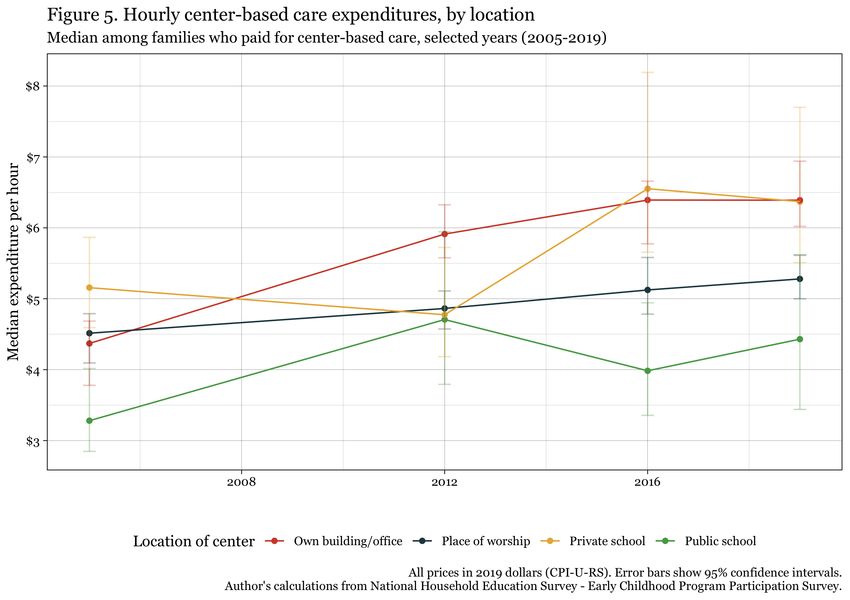
About the Author

Patrick T. Brown
FELLOW, ETHICS AND PUBLIC POLICY CENTER
Patrick T. Brown is a fellow at the Ethics and Public Policy Center, where his work
focuses on developing a robust pro-family economic agenda. Prior to joining EPPC,
Brown served as a Senior Policy Advisor to Congress’ Joint Economic Committee
(JEC). He holds a master’s in public affairs from Princeton University, and has been
published in The Washington Post, National Review, Newsweek, National Affairs, and
elsewhere.

Acknowledgements
Appreciative thanks to Chris Herbst, Elaine Maag, Jessica Brown, Katherine Stevens,
and Lyman Stone for comments on prior versions of this report. Thanks also to the
staff of the Joint Economic Committee, who provided initial feedback and collaboration
during the drafting stages. The views expressed in this paper are the author’s own.
Layout and design by Samuel Hammond.
Contents

Introduction                              6

Understanding the Child Care Landscape    7

Is Child Care in Crisis?                 10

Market Failures in Child Care            13

Current Policy Approaches                17

Policy Recommendations                   22

Conclusion                               27
Introduction

A
           s the pandemic has thrust into sharp relief, families across America rely on
           child care to meet the demands of both the workplace and the home front.
           A single mom trying to make rent; newly-married young professionals
           just starting a family; two working-class parents needing to cover a couple
extra hours while dealing with unpredictable scheduling — all at some point depend
on a child care arrangement of some kind. Expanding the array of options available
to American families, whether it be care by a relative or parent, or a daycare or child
care center, should be a prime focus of public policy.
   Yet at the same time, polling consistently shows a plurality of mothers say they
wish they could work part-time or even stay at home with their children.1 Two-thirds
of women told Pew in 2019 that the ideal situation for a woman with young children
was working part-time or not at all.2 Many families say they wish it was easier for
one parent to stay home with their children. These survey results are important, as
any policy agenda aimed at making family life easier for parents should, ultimately,
be informed by parents’ actual preferences.
   There has been no shortage of recent conversations about how to make family life
more affordable through certain tax provisions and benefits.3 But family policy is not
limited to the tax code. In addition to improving how the tax code treats families, a
pro-family agenda should aim to make the market for child care work better.

1 Lydia Saad, “Children a Key Factor in Women’s Desire to Work Outside the Home,” Oct. 7, 2015, Gallup, https://news.
   gallup.com/poll/186050/children-key-factor-women-desire-work-outside-home.aspx
2 Juliana Menasce Horowitz, “Despite challenges at home and work, most working moms and dads say being employed
   is what’s best for them,” Sept. 12. 2019, Pew Research Center, https://www.pewresearch.org/fact-tank/2019/09/12/
   despite-challenges-at-home-and-work-most-working-moms-and-dads-say-being-employed-is-whats-best-
   for-them/
3 Samuel Hammond and Robert Orr, “The Conservative Case for a Child Allowance,” Niskanen Center, Feb. 4, 2021,
   https://www.niskanencenter.org/report-the-conservative-case-for-a-child-allowance/

                                            NISKANEN CENTER
                                                   6
Patrick T. Brown Child Care Pluralism
This report outlines options for improving child care availability and affordability in
light of the immense pluralism of American family life. At a high-level, a commitment
to “child care pluralism” means policymakers should seek to:
• Dedicate funding to non-profit child care providers through grants, loans,
and technical assistance, prioritizing care options embedded in a community
context and meeting parents’ stated desires;
• Resist the temptation to pile quality-improvement mandates that bear an
ambiguous relationship to long-term outcomes onto federal grants, and;
• Improve the functioning of the market for child care by creating incentives
to increase supply, develop innovative funding models, and make careers in
the sector more appealing.
Instead of adopting a model of family life that gives primacy to productivity and
economic growth, or breathlessly reciting numbers suggesting a “crisis” in child care
that is not what it seems, policymakers should pursue a pluralistic approach to child
care. That means increasing the options available to parents based on their own vision
of the good life, rather than imposing a particular model of child care as superior to
all others, whether directly or indirectly through reforms meant to influence the
tradeoffs parents face. Instead of a heavily-regulated, top-down approach to child
care provision, Congress and state legislatures should empower community provision
in a way that celebrates the kaleidoscopic diversity of America’s ethnic, racial, and
religious traditions and scripts around family life.
In particular, policymakers who recognize the importance of intermediary
institutions should seek to empower those organizations to be necessary and vital
sources of caregiving at the community level. Indeed, reforming our child care
infrastructure to make those care options more available and affordable is the most
compelling path forward.
Understanding the Child Care Landscape
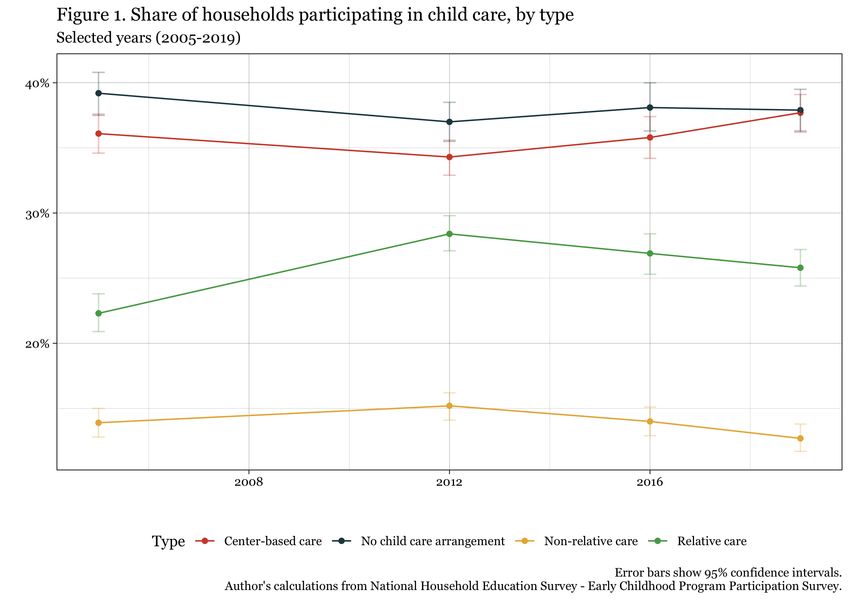
When their parents are at work, young children need some kind of care. In 2019, about
half of both married and single moms with a child under 5 worked full-time, while
another 15 percent worked part-time (among those not working, single moms are
more likely to report being unemployed and looking for work, rather than out of the
labor force, than married ones).4 That same year, 62 percent of households had their
child participating in any kind of regular child care arrangement, according to the
4 Author’s calculations from Current Population Survey, accessed via Integrated Public Use Microdata Series (IPUMS-
CPS). https://cps.ipums.org/cps/
NISKANEN CENTER
7Child Care Pluralism Patrick T. Brown
most recent Early Childhood Program Participation survey (fielded pre-pandemic).5
Child care options are usually grouped into three general categories:
• Relative care, provided by a sibling, grandparent, aunt or uncle, or other
non-parental family members, often in the child’s or the relative’s home;
• Non-relative care, which can include small home-based day cares, nannies,
au pairs, or other care provided by adults unrelated to a child; and
• Center-based care, including for-profit and non-profit centers, often
operated as stand-alone businesses or located at churches or schools,
including Head Start and other pre-K programs.
Not all parents use child care, and not all who use it pay for it. The share of working
moms who pay for child care has remained largely stable in recent decades and is
generally estimated at around 40 percent, depending on the survey instrument.6 There
5 Author’s calculations from National Household Education Survey — Early Childhood Program Participation (2019),
https://nces.ed.gov/nhes/dataproducts.asp
6 Brian Knop and Abinash Mohanty, “Child Care Costs in the Redesigned Survey of Income and Program Participation
NISKANEN CENTER
8Patrick T. Brown Child Care Pluralism
are significant differences in who pays for care — working mothers with college
degrees, for example, are much more likely to pay than those without. And because
cities tend to be home to both the better-off and the less fortunate, child care tends
to be more necessary, and more expensive, in high-rent urban areas.7
The distribution of care arrangements varies slightly across racial groups, but also
has a large educational gradient. In 2019, 63 percent of white children participated
in a regular child care arrangement, compared to 69 percent of Black, 58 percent of
Hispanic, and 58 percent of Asian American children.
The opportunity cost for a parent with high earnings potential who chooses to stay
at home is larger than those who would be working in a low-wage industry. A parent
who would barely break even in a low-wage job after paying for child care may
rationally prefer to stay home on economic grounds alone, not to mention cultural
(SIPP): A Comparison to the Current Population Survey Annual Social and Economic Supplement (CPS ASEC),” Social
and Economic Housing Statistics Division, Working Paper #2018-21, U.S. Census Bureau. https://www.census.gov/
content/dam/Census/library/working-papers/2018/demo/Child%20Care%20Cost%20Paper.pdf
7 Luke P. Rodgers, “Give credit where? The incidence of child care tax credits,” Journal of Urban Economics, (Nov.
2018), 108; 51-71, https://doi.org/10.1016/j.jue.2018.10.002
NISKANEN CENTER
9Child Care Pluralism Patrick T. Brown
dynamics and preferences for household structure. Half of white children whose
parents do not have a four-year degree spend most of their hours per week with
their parent, while only 30 percent of their peers with college-educated parents do.
These dynamics may help explains why public opinion polls show larger support for
subsidized child care among college-educated respondents, while parents without a
college degree tend to prioritize other forms of support for families.8
Is Child Care In Crisis?
Media narratives and think tank reports often paint a picture of crushing child care
costs. An influential Census Bureau publication found the average weekly child care
expenditures of families with a working mother rose by 71 percent between 1985
and 2011.9 Another widely cited report found that “in 33 states and the District of
Columbia, infant care costs exceed the average cost of in-state college tuition.”10 And
the Center for American Progress claims that “in no state does the cost of center-
based infant or toddler child care meet the federal definition of affordable.”11
Each of these statements has the merit of being technically accurate. But the actual
story is more nuanced than the top-line claims would make it seem.
Have child care costs skyrocketed?
It is true that the average amount spent on child care has risen in past decades. Yet
the average amount paid for care as a percentage of family income among families that
pay for it has remained remarkably constant at about 7 percent.12 Increases in the
average cost can be misleading, especially in a sector in which a small number of
families are statistical outliers in how much they spend on high-quality child care.
As Arizona State University’s Chris Herbst has pointed out, the median weekly child
care expenditure — that is, the value at the statistical midpoint of the distribution
— rose only 16 percent from 1990 to 2011, rather than the larger increase seen in the
mathematical average (mean).13
8 2021 Home Building Survey, American Compass, Feb. 2021, https://americancompass.org/wp-content/
uploads/2021/03/American-Compass_2021-Home-Building-Survey_Final.pdf
9 Lynda Laughlin, “Who’s Minding the Kids? Child Care Arrangements: Spring 2011,” Household Economic Studies,
Publication 70-135, U.S. Census Bureau, https://www.census.gov/prod/2013pubs/p70-135.pdf
10 Elise Gould And Tanyell Cooke, “High Quality Child Care is out of Reach for Working Families,” Economic Policy
Institute, Issue Brief #404, Oct. 6, 2015, https://www.epi.org/files/2015/child-care-is-out-of-reach.pdf
11 Simon Workman and Steven Jessen-Howard, “Understanding the True Cost of Child Care for Infants and Toddlers,”
Center for American Progress, Nov. 15, 2018, https://www.americanprogress.org/issues/early-childhood/
reports/2018/11/15/460970/understanding-true-cost-child-care-infants-toddlers/
12 “Figure 4. Percent Who Make Payments and Percent of Monthly Family Income Spent on Child Care for Families
with Employed Mothers: 1986-2011,” in Laughlin, “Who’s Minding the Kids?”
13 Chris M. Herbst, “The Rising Cost of Child Care in the United States: A Reassessment of the Evidence,” Economics
of Education Review (2018), 64:13-30, https://doi.org/10.1016/j.econedurev.2018.03.005
NISKANEN CENTER
10Patrick T. Brown Child Care Pluralism
The biggest cost increases were felt by parents who were married, college-educated,
and in upper income brackets. As Herbst notes, “Hourly expenditures on center-based
arrangements by families with low-education mothers declined 18 percent between
1990 and 2011. In contrast, expenses among their high-education counterparts
increased 23 percent.”14 Examining the cost per hour or per week is a better unit of
comparison, as the increased amount spent on child care can be a function of more
care being used, care becoming more expensive, or both.
In 2014, the Survey of Income and Program Participation (SIPP) reported an average
weekly expenditure of $207 on child care by families with a working mother, with a
median of $104. Meanwhile, the Current Population Survey (CPS) reports a mean of
$138 and a median of $83 per week. Researchers at the Census Bureau suggest the
SIPP systematically overestimates cost burdens due to higher rates of data imputation
and its choice of reference month.15
It should be noted that more recent data drawn from a different dataset does
14 Herbst 2018.
15 Knop and Mohanty 2018.
NISKANEN CENTER
11Child Care Pluralism Patrick T. Brown
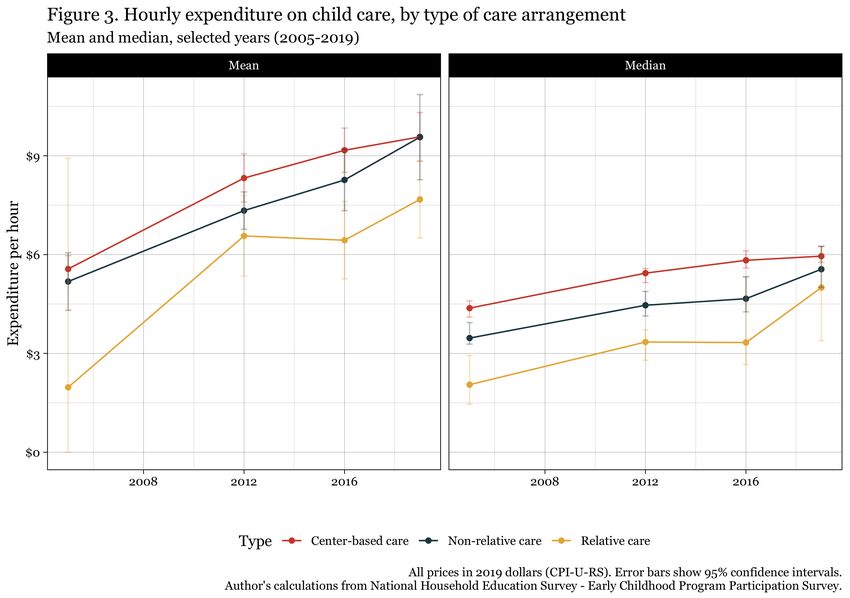
show an increase in the amount spent per hour on three different categories of child
care, as shown in Figure 3. Yet again the difference between the mean and median
increase is essential to note. In my calculations using the Early Childhood Program
Participation, the mean amount spent per hour of center-based child care rose by 72
percent from 2005 to 2019. But the median per-hour expenditure rose from $4.37 in
2005 to $5.56 in 2019 (adjusted for inflation), only a 36 percent increase.16 To be sure,
that rise may indeed merit a policy response, but relying on the mean amount paid
overstates the increase felt for the median family who pays for child care.
Does child care cost more than college?
The best pricing data comes from the advocacy organization Child Care Aware of
America, although their survey of state-based child care resource and referral (CC&R)
agencies is far from perfect.17 The sticker price for full-time infant care can indeed
be eye-popping. But the price that gets reported assumes parents are paying the
full, unsubsidized price for full-time center-based care. This abstracts away from
the fact that many parents may receive financial aid, or assistance through federal
or state programs, and may only be paying for part-time care or non-center-based
care. And as the federal Administration for Children and Families has noted, CC&R
survey methodologies vary widely in quality.18 So just as very few families pay the full
sticker price for college, looking only at the sticker price of full-time, center-based
child care is likewise misleading.
Is child care increasingly unaffordable?
In the waning months of the Obama administration, the Administration for Children
and Families lowered the benchmark of “affordable” co-payments in federal child
care programs from ten to seven percent of a family’s income.19 They based that
threshold on the monthly average spent on care by families with children under age
15, which, as mentioned, has hovered around seven percent since the mid-1980s. But
school-age children are much less expensive to care for than infants and toddlers.
As the Census Bureau report shows, the average spent on all forms of child care
for children below five is already 3.5 percentage points above that seven percent. So
the choice of threshold means that the average household paying for care for young
children is already well above the new threshold. Whether or not 10.5 percent of
16 Author’s calculations, National Household Education Survey - Early Childhood Program Participation Survey (NHES-
ECPP)
17 “The US and the High Price of Child Care: An Examination of a Broken System,” Child Care Aware of America, 2019,
https://www.childcareaware.org/our-issues/research/the-us-and-the-high-price-of-child-care-2019/
18 “Market Rate Surveys,” National Center on Subsidy Innovation and Accountability, April 2018, https://childcareta.
acf.hhs.gov/sites/default/files/public/designing_market_rate_surveys_brief_2.pdf
19 Final Rule, Child Care and Development Fund (CCDF) Program, Administration for Children and Families, Department
of Health and Human Services, 45 CFR Part 98, (Sept. 30, 2016), https://www.govinfo.gov/content/pkg/FR-2016-
09-30/pdf/2016-22986.pdf
NISKANEN CENTER
12Patrick T. Brown Child Care Pluralism
family income is itself too high for a time-limited investment during the early years
of life may be worth debating. But the seven percent definition of “affordability”
should be treated as what it is — a selected threshold without any adjustment for
cost of living, family structure, or household income, instead of a reliable indicator of
“relentless” child care costs.20
Market Failures In Child Care
Breathless headlines about unaffordable child care are not wrong, per se, but they are
misleading. The failures in the child care market are in large part due to supply failing
to meet demand, and the opaque (and expensive) tradeoffs around quality. This is
why policymakers need to do more than merely increase the size and refundability
of the Child and Dependent Care Tax Credit, as was done on a one-year basis in the
American Rescue Plan.21 They should attack the root of the problem.
Shortfalls in supply
In the mid-1980s, young children with working parents were most likely to be in
non-relative care, often in a home environment.22 Home-based care tends to be
offered by a sole proprietor, offering a more casual, flexible, and affordable option
compared to center-based care, which tends to involve larger facilities with more
staff and a more standardized operation. Over time, non-parental care of children
has become more professionalized and home-based child care facilities have become
less popular, falling from caring for about one in every four preschool-aged children
in 1988 to under one in 10 in 2019.23 Almost 100,000 licensed home-based child care
providers closed between 2005 and 2017, a report from the federal National Center
on Early Childhood Quality Assurance found, attributing the decline to increased
competition, rising regulatory burdens, and demographic factors.24
Meanwhile, data from the quinquennial Economic Census show that from 1987 to
2017, for-profit care centers have doubled in number, providing the bulk of growth in
the child care market.25 Non-profit child care providers, who made up a third of day
20 Rasheed Malik, “Working Families Are Spending Big Money on Child Care,” Center for American Progress, June 20,
2019, https://cdn.americanprogress.org/content/uploads/2019/06/19074131/Working-Families-SpendingBRIEF.pdf
21 Katie Conner, “How to get thousands back from child and dependent care expenses with this tax credit,” Cnet.
com, May 25, 2021, https://www.cnet.com/personal-finance/how-to-get-thousands-back-from-child-and-
dependent-care-expenses-with-this-tax-credit/
22 Laughlin 2013.
23 Laughlin 2013 and author’s calculations from 2019 ECPP
24 “Addressing the Decreasing Number of Family Child Care Providers in the United States,” National Center on
Early Childhood Quality Assurance, (Oct. 2019 (rev.)), https://childcareta.acf.hhs.gov/sites/default/files/public/
addressing_decreasing_fcc_providers_revised_final.pdf
25 Authors calculations from Census Bureau’s Economic Census and ChildStats.gov (Table Pop-1). These numbers do
not include sole-proprietor establishments that provide child care, such as home-based care providers.
NISKANEN CENTER
13Child Care Pluralism Patrick T. Brown
care establishments in the late 1980s, now comprise about a quarter of establishments
in the industry and have failed to keep up with population growth since their peak in
2002. According to the Early Childhood Program Participation survey, the number of
children participating in a church-based day care program in 2005 was 1.8 million, or
about one-quarter of children participating in center-based child care. By 2019, that
number was 1.6 million, or one out of every five participating in center-based care..26
The shift towards for-profit care may be helping to drive the perceived affordability
crisis in child care. Labor costs can account for three-quarters of firm expenses,
according to two leading estimates.27 Firms’ other major costs include rent, facilities
maintenance, and insurance, all of which can be artificially inflated as a percentage
of the budget by regulatory mandates.
The shift into higher-cost forms of care has not created wage growth for child
care workers; they continue to earn well below the median wage, without much
growth over the past two decades.28 One explanation is that the industry’s low wages
lead to high turnover, with workers and home care providers highly sensitive to
26 Author’s calculations from 2019 ECPP.
27 Herbst 2018, also citing David M. Blau, The Child Care Problem: An Economic Analysis (2001), New York: Russell
Sage Foundation.
28 Herbst 2018.
NISKANEN CENTER
14Patrick T. Brown Child Care Pluralism
the attractiveness of other, higher-paying options. Empirical estimates suggest child
care workers exhibit a relatively high elasticity in their labor supply, suggesting that
they readily switch out of child care work into other industries when demand in other
fields increases.29 When the economy grows, workers leave for better jobs, and firms
appear to fill their spots with less qualified (and cheaper) workers.30
“Quality” control
Another change in the child care landscape is the increased demand for “quality” by
high-income parents. Whether driven by an increased recognition of early childhood
investments, decreased fertility, or an overall wealth effect, wealthy parents seem
more likely to express a desire for high-quality, developmentally enriching child
care, helping drive the observed increase in price.31 While informal or home-based
29 Rodgers 2018, also citing Blau 2001.
30 In fact, a recent working paper found evidence that the child care industry recovers more slowly than the rest of the
economy (Jessica Brown and Chris Herbst, “Child Care over the Business Cycle,” IZA Institute of Labor Economics,
Discussion Paper No. 14048 (Jan, 2021), http://ftp.iza.org/dp14048.pdf)
31 For a discussion of diverging parental preferences in child development along educational lines, see Evrim Altintas,
NISKANEN CENTER
15Child Care Pluralism Patrick T. Brown
care arrangements offer a safe place for children during the day, they tend not to
be explicitly oriented around school readiness or human capital enrichment the way
many center-based facilities are. For example, one study found that two-year-olds
in formal care centers watched, on average, 12 minutes of television per day, while
those in informal care watched one hour and 22 minutes.32
This leads to income segregation in the
“...the concept of ‘quality’ market. As Herbst notes, “Advantaged
in early childhood settings is children are increasingly exposed to
notoriously elusive.” high-quality early care and education
experiences — both in absolute terms and
relative to their low-income counterparts.”33 Troublingly, gaps in early childhood
investments have been correlated with children’s cognitive and socio-emotional
outcomes, and, more speculatively, may be tied to long-term outcomes like college
graduation rates and earnings.34
Yet it is important to note that the concept of “quality” in early childhood settings
is notoriously elusive. Assessments and accreditation tend to focus on observable and
quantifiable metrics, such as group size and child-teacher ratios. But these visible
indicators may not necessarily be picking up holistic dynamics that are more essential
for growth and flourishing, and may force centers to invest in nonessential aspects of
care that score well on assessments but do not lead to better outcomes.
Every state but Alabama utilizes tiered rating standards, known as Quality Rating
and Improvement Systems, or QRIS, to some degree.35 Forty-four states use their
federal CCDF funds to implement these ratings, which are often based on diagnostic
criteria that do not show a significant relationship with long-term child outcomes.
The Early Childhood Environment Rating Scale-Revised (ECERS-R), originally
developed as a guideline for facility self-improvement, has now become one of the
most commonly-used measures of quality in child care.36 But the evidence that
“The Widening Education Gap in Developmental Child Care Activities in the United States, 1965—2013,” Journal of
Marriage and Family 78 (Feb. 2016): 26—42, https://doi.org/10.1111/jomf.12254
32 Daphna Bassok, Maria Fitzpatrick, Erica Greenberg, and Susanna Loeb, “Within- and Between-Sector Quality
Differences in Early Childhood Education and Care,” Child Development, 87:5, (Sept.-Oct. 2016), p. 1627-1645,
https://srcd.onlinelibrary.wiley.com/doi/abs/10.1111/cdev.12551
33 Herbst 2018.
34 The most well-known proponent for the importance of investment in early childhood human capital development
is likely James Heckman and his series of papers, most notably “Skill formation and the economics of investing in
disadvantaged children,” Science 312 (5782): 1900—1902. (June 2006), http://dx.doi.org/10.1126/science.1128898.
His approach is not without its critics; see David Rea and Tony Burton, “New Evidence on the Heckman Curve,”
Journal of Economic Surveys, 34:2, 241-262, (April 2020), https://doi.org/10.1111/joes.12353 (“While many
interventions targeted at young children generate high returns, the average benefit cost ratios for interventions
targeted at young children are not higher than those targeting older age groups.”)
35 QRIS National Learning Network, “QRIS State Contacts and Map, Current Status of QRIS in States,” Jan. 2017,
http://qrisnetwork.org/qris-state-contacts-map
36 Jean I. Layzer and Barbara D. Goodson, “The ‘Quality’ of Early Care and Education Settings: Definitional and
Measurement Issues,“ Evaluation Review, 30:5 (Oct. 2006), 556-576 http://welfareacademy.org/pubs/childcare_
NISKANEN CENTER
16Patrick T. Brown Child Care Pluralism
scores on these assessments correspond in any meaningful way with child outcomes
is surprisingly weak.
A seminal Science paper found that “on most measures of children’s learning,
programs rated high by QRIS produce outcomes that are not significantly better than
those of low-rated programs.” The only aspect of conventional QRIS ratings that had
an impact on child development is the rather nebulous metric of quality of student-
teacher interactions.37 A meta-analysis in 2017 found only a very weak link between
ECERS-R total scores and language and positive behavioral outcomes for students.
The conventional method of scoring the ECERS-R leads to penalties for facilities on
metrics that are at best tangentially related to social or intellectual development.38 A
newer evaluation system, the Classroom Assessment Scoring System, has also failed
to demonstrate anything beyond small associations between observed metrics and
long-term outcomes.39 Yet in the push for “quality” in early childhood education,
the flawed ratings systems that make up QRIS continue to serve as the benchmark.
Current Policy Approaches
The Child Care Development Block Grant (CCDBG) was established in 1990 to subsidize
the child care costs of low-income families. It became a key provision to support the
work requirements included in the welfare reform of 1996. If single parents were
required to work as a condition of getting Temporary Assistance to Needy Families
(TANF) funds, the logic held, they should be supported in doing so. Three in 10
preschoolers whose parent received TANF in 2011 also received subsidies for child
care, compared with one in 20 of those whose parents who did not receive TANF
funds.40 In addition to using the CCDBG, states can also spend TANF dollars on child
care services to enable compliance with work requirements.41
The CCDBG funds the Child Care Development Fund (CCDF), which offers states a
combination of mandatory and discretionary spending, allocated by a formula that
incorporates a state’s mid-1990’s welfare spending on child care and the fraction of
edu/rethinkingchildcare/rethinkingchildcare-layzer.pdf
37 T. J. Sabol, S. L. Soliday Hong, R. C. Pianta, M. R. Burchinal, “Can Rating Pre-K Programs Predict Children’s
Learning?, Science, (Aug. 23, 2013), 845-846, https://science.sciencemag.org/content/341/6148/845.summary
38 Ken A. Fujimoto, Rachel A. Gordon, Fang Peng, and Kerry G. Hofer, “Examining the Category Functioning of
the ECERS-R Across Eight Data Sets,” AERA Open, 4:1 (Jan-March 2018), 1-16, https://journals.sagepub.com/doi/
full/10.1177/2332858418758299
39 Michal Perlman, Olesya Falenchuk, Brooke Fletcher, Evelyn McMullen, Joseph Beyene, and Prakesh S. Shah, “A
Systematic Review and Meta-Analysis of a Measure of Staff/Child Interaction Quality (the Classroom Assessment
Scoring System) in Early Childhood Education and Care Settings and Child Outcomes,” PLoS ONE, 11(12), (Dec. 30,
2016), https://doi.org/10.1371/journal.pone.0167660
40 Laughlin 2013.
41 Karen E. Lynch, “Trends in Child Care Spending from the CCDF and TANF,” Congressional Research Service, Report
44528, (June 16, 2016), https://fas.org/sgp/crs/misc/R44528.pdf
NISKANEN CENTER
17Child Care Pluralism Patrick T. Brown
its population under 13 years old. Eligibility for CCDF funds is established by states,
which can set thresholds at or below the federal limit of 85 percent of state median
income.42 In a typical month, about 872,000 children under age 6 receive child care
through CCDF funds, and three-quarters of them are served in center-based care
facilities.43
Thirty-three states serve virtually all of the children in their CCDF program
through vouchers or cash, while others offer a mix of vouchers to individuals and
use contracts or grants with child care providers. Importantly, parents can use their
CCDF vouchers to pay for child care services provided in a church facility, even when
the program includes religious instruction.44
The 2014 reauthorization of the CCDBG required states to establish health and
safety standards, annual unannounced inspections, and age-specific child-to-staff
ratios.45 The reauthorization also required agencies to increase the percentage of their
CCDF awards for activities to “improve the quality of child care” from 4 to 9 percent
(and an additional 3 percent for infants and toddlers), leaving less money available to
subsidize the cost of care.46 This has limited the degrees of freedom available to states
in how they design their programs.
On a day-to-day basis, child care regulations are largely driven by states, often
grounded in a well-intentioned desire to protect young children. No one wants
children to be in situations where they are at risk of abuse or neglect, and regulation
can be understood as a way of trying to address the unavoidable difficulties parents
face in trying to navigate the many dimensions of child care in a position of limited
information.47
One favored story is that the piling on of even well-meaning regulations can
ultimately drive up the cost of care. While intuitively appealing, the evidence backing
up this story is nuanced. One widely-cited estimate by the Mercatus Center suggested
a “one-infant increase in the child—staff ratio requirement for infants is associated
with a decrease … in the annual cost of child care of between $850 and $1,890 for the
42 Karen E. Lynch, “Child Care Entitlement to States,” Congressional Research Service, In Focus 10511, (July 18, 2019),
https://crsreports.congress.gov/product/pdf/IF/IF10511
43 “FY 2018 CCDF Data Tables (Preliminary),” Office of Child Care, Administration for Children and Families, U.S.
Department of Health and Human Services, Dev. 4. 2019, https://www.acf.hhs.gov/occ/data/fy-2018-ccdf-data-
tables-preliminary
44 “Fundamentals of CCDF Administration,” Early Childhood Training and Technical Assistance System, Office of Child
Care, Administration for Children & Families, U.S. Department of Health & Human Services, https://childcareta.acf.
hhs.gov/ccdf-fundamentals/key-provisions-ccdf
45 “Fundamentals of CCDF Administration.”
46 Final Rule, Child Care and Development Fund (CCDF) Program, Sept. 2016.
47 Herbst 2018.
NISKANEN CENTER
18Patrick T. Brown Child Care Pluralism
average cost of care across states.”48 But the key regression used to come up with that
estimate only controlled for state income, leaving out a number of other exogenous
factors that could be correlated with both the price of child care and the level of
regulations at the state level, making the estimate unreliable.49
Other papers suggest that regulation leads facilities to spend less on inputs that
are regulated, like labor, as well as pass the increased expenses along to workers
in the form of lower pay.50 College degree requirements and child-to-staff ratios
for younger children have been found to lead to reductions in supply, perhaps by
making it harder for new firms to enter the market.51 Another 2011 paper found the
effect of regulations on the margin was to reduce the quantity of child care facilities,
pushing children from disadvantaged backgrounds out of the market. The net result
was higher measured “quality” in child care centers, but accruing to the benefit of
families who tend to live in high-income areas.52
Part of the reason why state regulations may not play as big a role in affordability
as might otherwise be expected is because providers are, in many cases, voluntarily
surpassing regulatory standards to meet parent demands. For instance, even in states
that do not require child care providers to have work experience, “approximately 88
percent of teacher job advertisements required applicants to have at least one year
of experience.”53 State-administered QRIS combine a customer-facing rating system
of quality with financial incentives for “quality improvement,” which can result in
“quality investments” that often exceed the states’ standards, even though they are
not strictly mandatory.54 So simply rolling back on state regulations will on its own
not be enough to make child care more affordable.
48 Diana Thomas and Devon Gorry, “Regulation and the Cost of Child Care,” Mercatus Center at George Mason
University, Working Paper (Aug. 2015), https://www.mercatus.org/system/files/Thomas-Regulation-Child-Care.
pdf
49 “For example, suppose some states may have a high proportion of parents who prefer to provide their children with
high quality child care—and are willing to pay for it—while the parents in other states do not. Furthermore, suppose
that parents vote their preferences and either support or oppose the imposition and stringency of regulations as
a way to promote higher quality child care. Then failure to control for the potentially unobserved differences in
the distribution of tastes across states—as well as other differences across states and over time—will result in
biased estimates of the effects of policy on the outcomes of interest.” V. Joseph Hotz and Mo Xiao, “The Impact
of Regulations on the Supply and Quality of Care in Child Care Markets,” American Economic Review, 101:5 (Aug.
2011), 1775-1805
50 David M. Blau, “Unintended Consequences of Child Care Regulations,” Labour Economics, 14:3 (June 2007), 513-538,
https://doi.org/10.1016/j.labeco.2006.01.003
51 Herbst 2018.
52 Hotz & Xiao 2011.
53 Casey Boyd-Swan and Chris M. Herbst, “The demand for teacher characteristics in the market for child care:
Evidence from a field experiment,” Journal of Public Economics, 159 (March 2018), 183-202, https://doi.org/10.1016/j.
jpubeco.2018.02.006
54 “QRIS Resource Guide,” National Center on Early Childhood Quality Assurance, Office of Child Care, Administration
for Children & Families, U.S. Department of Health & Human Services, https://ecquality.acf.hhs.gov/sites/default/
files/QRIS_Resource_Guide_2018.pdf
NISKANEN CENTER
19Child Care Pluralism Patrick T. Brown
With all of these factors at play, it becomes difficult to argue the child care market
is a perfectly competitive one in the classical sense. Geographically-constrained
markets mean that one center or network could influence the market price; there
is a wide range of heterogeneous products that are difficult to directly compare;
regulatory barriers such as zoning make it more difficult for upstart firms; firm and
household mobility is very sticky in the short run; and the opacity of prices, while
strategically advantageous for firms, leads to information asymmetries that make it
difficult for consumers to achieve full knowledge of their options.55 As such, there is
a compelling interest for the state to act in making the market work more effectively.
Proposals to boost parents’ spending power through the tax code are welcome, but
demand-side subsidies alone will not address the failures in the child care market.
Should child care be a “public good”?
For parents, long-term outcomes are obviously unknowable, and they may measure
quality on observables that make sense to them but have little bearing on their child’s
development. For example, parents are often fairly inelastic on location, giving heavy
preference on facilities that less than 15 miles away from home or work, regardless of
quality.56 Additionally, most firms tend to strategically conceal their prices, making
it difficult for parents to easily evaluate the price-quality tradeoff.
Some believe these market failures are fatal, and that child care should become a
public good. One example of this is Senator Elizabeth Warren’s recently reintroduced
Universal Child Care and Early Learning Act, which would essentially make child
care a federally funded universal program. Families making below 200 percent of
the federal poverty line would pay nothing for these services, while no family would
pay more than seven percent of income. (Moody’s Analytics scores the bill as costing
the federal government $1.07 trillion over 10 years, before the dynamic effects of
increased labor force participation are accounted for.57) The focus in the legislation
is on getting federal dollars to cities, schools, and counties to run child care centers,
with nonprofit organizations a distinct afterthought.
The federal government’s lone experiment with providing child care came during
World War II, when the Lanham Act instituted care for women entering the workforce
due to the war. The approach seen in the Warren bill would seek to recreate that level
of commitment, in the pursuit of making sure every family “can access high-quality,
55 Naci Mocan, “Can consumers detect lemons? An empirical analysis of information asymmetry in the market for
child care,” Journal of Population Economics, 20 (2007), 743—780, https://doi.org/10.1007/s00148-006-0087-6
56 Hotz & Xiao 2011.
57 Mark Zandi and Sophia Koropeckyj, “Universal Child Care and Early Learning Act: Helping Families and the
Economy,” Moody’s Analytics (Feb. 2019), https://www.warren.senate.gov/imo/media/doc/Moody’s%20Analysis_
Child_Care_Act.pdf
NISKANEN CENTER
20Patrick T. Brown Child Care Pluralism
affordable child care.”58 But those two demands are inherently in tension with each
other, and presuming the federal government can optimize that tradeoff better than
parents is folly.
Practical considerations abound: How much of GDP would we be willing to dedicate
to guaranteeing affordable access, knowing that there is a natural ceiling on how
efficient child care will ever be? (Without advances in babysitting technology, wages
for child care workers will rise commensurate with those of the general population
without increasing productivity, a phenomenon known as Baumol’s cost disease.)
What would happen to child care options not deemed worthy of inclusion in the
national scheme? Should we extend the framework of public education all the way
down to infancy, at the risk of crowding out home-based and religious child care
providers?
“...it is important not to lose sight of parents’ stated
preferences in favor of a single-minded focus on
boosting economic growth.”
And while the practical considerations are challenging, the biggest reason to oppose
a federal network of child care providers would be the ratification of an implicit
expectation that would be set by guaranteeing child care to all families. In a world in
which every family had access to free or low-cost child care provided by the federal
government, families who chose to have a parent watch children at home would
inevitably be seen as drags on social welfare, unwilling to outsource the demands
of parenting to increase economic efficiency and weighing down macroeconomic
growth. In both popular culture and public policy, staying home with children would
no longer be one choice among many, but a fallback to be pitied or discouraged.
While it may be countercultural to argue against the dominant mindset that
prioritizes labor force participation, it is important not to lose sight of parents’ stated
preferences in favor of a single-minded focus on boosting economic growth. Given
the uncertain tradeoffs and inadequate measurements of long-term quality, the best
thing we can do is broaden the choice set of parents and let them pursue the care
situation that is best for them. Our current approach to child care policy fails to do
that.
58 Office of Sen. Elizbeth Warren, “Warren, Jones and Colleagues Reintroduce Universal Child Care and Early Learning
Act and Call for President Biden to Invest $700 Billion in Child Care,” (April 27, 2021), https://www.warren.senate.
gov/newsroom/press-releases/warren-jones-and-colleagues-reintroduce-universal-child-care-and-early-
learning-act-and-call-for-president-biden-to-invest-700-billion-in-child-care
NISKANEN CENTER
21Child Care Pluralism Patrick T. Brown
Policy Recommendations
The American Family Plan, recently introduced by the Biden administration, takes
a demand-side approach to making child care more affordable, proposing a $225
billion partnership with states to fully cover child care expenses for the lowest-
income workers, and capping expenses at 7 percent of income for those making
150 percent or less of their state median income. It also proposes $200 billion for a
universal pre-kindergarten program for all three- and four-year-olds. There are two
major ways in which this approach could drive the cost of child care even higher:
• The 7 percent cap means that neither the families nor the care providers will
have any incentive to curb costs, leading to even higher growth in the sticker
price of child care for families not eligible for subsidies and a larger-than-
expected federal price tag.
• The introduction of universal pre-K, grounded in specious long-term returns
on investment based on limited experiments,59 will also cause regular child care
providers to have to raise costs, as three- and four-year-olds typically cross-
subsidize the provision of care for younger children.60
On the demand side of the equation, there is no reason to restrict support for
families just to child care expenses. Proposals to expand parents’ child care choices
through the tax code have been developed elsewhere, including my own for the Joint
Economic Committee.61
In this spring’s American Rescue Plan, Congress and the Biden administration
quadrupled the size of the Child and Dependent Care Tax Credit (CDCTC) and made it
refundable, ameliorating some of its distributional flaws while still favoring parents
who pay for formal care over those who rely on relatives or friends. Senator Mitt
Romney’s Family Security Act, which would fold the CDCTC into a broader child
allowance, would be a smarter and fairer way to treat child care expenses in the tax
code.62
But in addition to helping put more money in the pockets of parents, a constructive
59 Samuel Hammond, “The False Promise of Universal Child Care,” Institute for Family Studies blog, (Feb. 28, 2019),
https://ifstudies.org/blog/the-false-promise-of-universal-child-care
60 Kendra Hurley, “How Universal Pre-K Drives Up Families’ Infant-Care Costs,” Bloomberg CityLab, (Dec. 13, 2019),
https://www.bloomberg.com/news/articles/2019-12-13/how-universal-pre-k-affects-infant-daycare-costs
61 Patrick T. Brown, “Expanding Child Care Choices: Reforming the Child and Dependent Care Tax Credit to Improve
Family Affordability,” Social Capital Project, Joint Economic Committee, United States Congress, SCP Report 2-21
(Feb. 2021), https://www.jec.senate.gov/public/index.cfm/republicans/analysis?id=0A45EA4E-15A1-4EAA-A97E-
9F649A53DF84
62 Office of Sen. Mitt Romney, “The Family Security Act,” (Feb. 2021), https://www.romney.senate.gov/sites/default/
files/2021-02/family%20security%20act_one%20pager.pdf
NISKANEN CENTER
22Patrick T. Brown Child Care Pluralism
family policy agenda should make it easier for new firms to enter the market, with
a specific focus on making it easier for faith-based and neighborhood organizations
to provide care. Child care advocacy groups, the accreditation industry, and
well-networked for-profit providers often favor increased quality requirements and
licensing requirements for self-interested reasons, ostensibly grounded in child
well-being. But as we have seen, there is little policy rationale for favoring heavily
regulated and professionalized child care over informal or semi-professional care,
such as that provided in a church or home setting. States should avoid imposing quality
requirements above and beyond a certain baseline of health and safety. Non-profit
and home-based care providers are the most likely to be adversely impacted by costly
regulations and are often heard from least in policy conversations, yet they provide
an essential and cherished role for many parents.
The Bipartisan Policy Center conducted
“Church-operated child care a poll of parents’ preferences both before
is cheaper than center-based and after the onset of COVID-19. They
found that parents’ ideal child care
care and is often woven into arrangement would be to provide care
community life.” for their own children. Their second-best
option? A child care center affiliated with
a faith-based organization, ahead of secular centers, home-based providers, pre-K,
or other options.63 One-third of parents participating in center-based care said the
religious orientation of the facility was “somewhat” or “very” important in their
decision, according to the 2019 Early Childhood Program Participation survey.64 A
policy push that makes it easier for parents who wish to stay home to do so, and for
others to have easy and affordable access to faith-based day care providers, would
be responding to parents’ desires while strengthening families and intermediary
institutions, two core institutions of society.
As noted, church-operated child care is cheaper than center-based care and is often
woven into community life.65 Many places of worship already have a hall or building
on site, and additional grants to help them get a program off the ground or technical
assistance to ensure compliance with regulations and requirements could help them
build out enough capacity to break even. For denominations grappling with empty
pews and an exodus of young people, opening a child care center could provide a new
63 Bipartisan Policy Center, “Parent Child Care Preferences: Are They Changing?” (Jan 2021), https://bipartisanpolicy.
org/event/parent-child-care-preferences-are-they-changing/
64 Author’s calculations from NHES-ECPP (2019).
65 For more about the importance of intergenerational “closure” in the lives of young people, see Patrick T. Brown,
“Multiple Choice: Increasing Pluralism in the American Education System,” Social Capital Project, Joint Economic
Committee, United States Congress, SCP Report 7-19 (Dec. 2019), https://www.jec.senate.gov/public/index.cfm/
republicans/analysis?ID=BFFED882-7A9E-4462-AC0B-69ED4E67D663
NISKANEN CENTER
23Child Care Pluralism Patrick T. Brown
sense of purpose and way of serving families. Inner-city Catholic schools struggling
to cover the budget could open a pre-K classroom and use the influx of child care
dollars to help keep the doors open.
Churches would not have to be the only targets for a social capital-infused approach
to increasing child care supply. Civic organizations, such as Goodwill and the United
Way, already sponsor child care centers, and other groups might consider starting
one if the grant application process was sufficiently advertised and user-friendly.
The appeal of a nonprofit-centric approach to child care makes it easier for local
organizations to spring up in response to community needs and interests, whether
that’s a church-based strategy in Salt Lake City that celebrates the nuclear family or
a collaborative space that affirms a diverse array of family structures in Brooklyn.
The Child Care Development Block Grant’s laudable emphasis on parental choice
makes it ill-suited for a supply-side intervention of this kind. Instead, stabilization
funds set up in the Biden administration’s American Rescue Plan might serve as a
model for this kind of approach. A plan to increase the supply of non-profit child care
could direct state agencies to set up an application process available solely to faith-
based, neighborhood, and other non-profit organizations, with forgivable loans to
cover start-up or expansion costs or recurring grants to provide a wage subsidy to
workers.
There is a sound rationale for prioritizing non-profit child care centers in public
policy. The power of competition to hold costs in check may be essential to long-term
fiscal sustainability, yet can lead to a race to the bottom without appropriate safeguards
(for example, one recent National Bureau of Economic Research working paper found
that when nursing homes are taken over by private equity firms, care goes down and
profits go up.66) Non-profit firms are certainly not exempt from committing abuses,
but being responsible to a broader community, rather than shareholders, holds them
accountable to a different set of pressures. And an approach to public policy that
seeks to strengthen the capacity of intermediary organizations, like churches and
civic groups, should recognize that a preference for making nonprofit organizations
an integral part of family life is a feature, not a bug.
CCDF vouchers are considered assistance to parents, and thus are statutorily
permitted to be able to be used at religiously affiliated day cares, even those that
provide sectarian instruction. Similar logic could be applied to non-profit capacitation
grants.67 Policymakers could also explore federally subsidized reinsurance programs
66 Atul Gupta, Sabrina T. Howell, Constantine Yannelis & Abhinav Gupta, “Does Private Equity Investment in
Healthcare Benefit Patients? Evidence from Nursing Homes,” NBER Working Paper No. 28474 (Feb. 2021), https://
www.nber.org/papers/w28474
67 Child Care and Development Fund, 45 C.F.R. § 98.30 (c, 4-5).
NISKANEN CENTER
24Patrick T. Brown Child Care Pluralism
for non-profit child care providers.
States would not necessarily have to wait for Congress to take steps along this
road. One study found 16 states offer religiously affiliated day cares waivers from
certain regulatory mandates (though such waivers should, of course, not be taken as
permission to ignore basic health and safety regulations.)68 Reducing or subsidizing
filing fees for licensing and background checks could help ensure children are
protected without placing an unnecessary burden on providers. The state of Michigan
is launching a pilot project to split the cost of child care between employees making
between 150 and 250 percent of the federal poverty line, their employers, and a state
agency, a model that could be adapted elsewhere to specifically subsidize costs at
non-profit centers.69
In addition, the next authorization of the Child Care Development Block Grant
should roll back the new requirement that states spend nine percent of funds on
“quality improvement” (plus an additional three percent on quality of care for infants
and toddlers), giving states more financial flexibility and resisting the allure of an
outcome that, as we have seen, is opaque and non-guaranteeable. And the seven
percent threshold for “affordability” in co-payments set by the Obama administration
should be restored to the prior benchmark of 10 percent of family income, in line
with the average amount of family
income spent on care for young “Reducing or subsidizing filing
children, rather than children of
any age.
fees for licensing and background
checks could help ensure children
While regulations may not be a
major cost driver, they can prevent
are protected without placing an
new firms from entering the market unnecessary burden on providers.”
and push marginal ones out of
business. A vivid recent case of regulatory overreach was the decision of Washington,
D.C.’s Office of the State Superintendent of Education to require all lead teachers,
even those of infants, to have an associate’s degree.70 Congress could consider ways
to incentivize states to scale back regulations so that the only ones with any teeth are
those with a direct relationship to the health and safety of young children.
In the interest of increasing transparency in the marketplace, states could require
68 Robin Fretwell Wilson, The Contested Place of Religion in Family Law, (2018) Cambridge: Cambridge University
Press, p. 327.
69 Office of Gov. Gretchen Whitmer, “Child care more affordable through innovative, bipartisan cost-sharing
program,” (March 18, 2021), https://www.michigan.gov/coronavirus/0,9753,7-406-98163-554799--,00.html
70 “New Education Requirements for Child Development Staff,” Office of the State Superintendent of Education, District
of Columbia (Feb. 12, 2020), https://osse.dc.gov/publication/new-education-requirements-child-development-
staff-frequently-asked-questions-faqs-early
NISKANEN CENTER
25Child Care Pluralism Patrick T. Brown
providers to disclose their prices online. State child care resource agencies could be
given funding to operate real-time databases of price and capacity information at day
care providers, allowing entrepreneurs to develop innovative technology solutions
that better match parents to care options and potential subsidies, including nanny
sharing and informal co-ops.
One pathway to better wages for child care workers could be by increasing the
attractiveness of careers in child care. The Bureau of Labor Statistics reports the
median child care worker made $24,320 in 2019.71 Some older empirical work
suggests that child care workers at non-profit establishments are able to work more
flexible hours and may find their careers more rewarding.72 Other avenues to a more
stable and remunerative career in child care provision could be an early childhood
Registered Apprenticeship program, which at least eight states currently offer. That
could conflict with a state’s interest in reducing the certification process needed
to work in the child care sector.73 But due to child care workers’ relatively high
labor supply elasticity, certification programs could also lead to child care workers
persisting further into their career, decreasing turnover and leading to wage gains.74
And while child care workers have not traditionally been unionized, 12 states have
collective bargaining rights for home-based child care providers, allowing them to
accrue sick leave and pursue other benefits.75
Policymakers and firms should also think creatively about attracting nontraditional
workers. Co-locating child care centers with age-restricted senior communities, or a
national campaign to facilitate interest in and availability of classroom aide positions
for empty-nest seniors, could matchmake between those with a desire to interact
with children and locations that need more adults able to monitor children safely.
A database operated by the advocacy group Generations United lists over a hundred
programs that offer child care in an intergenerational context.76
71 “Occupational Outlook Handbook: Childcare Workers,” Bureau of Labor Statistics, U.S. Department of Labor
(accessed May 11, 2021), https://www.bls.gov/ooh/personal-care-and-service/childcare-workers.htm
72 H. Naci Mocan and Erdal Tekin, “Nonprofit Sector and Part-Time Work: An Analysis of Employer—Employee
Matched Data on Child Care Workers,” Review of Economics and Statistics, 85:1, (Feb. 2003), 38—50, http://www.
mitpressjournals.org/doi/pdfplus/10.1162/003465303762687695
73 Emily Workman, “Earning While Learning with Early Educator Apprenticeship Programs,” New America Foundation
(Feb. 21, 2019), https://www.newamerica.org/education-policy/reports/earning-while-learning-with-early-
educator-apprenticeship-programs/
74 Abt Associates, “Career Pathways in Early Care and Education,” prepared for U.S. Department of Labor (Feb. 2018),
https://www.dol.gov/sites/dolgov/files/OASP/legacy/files/4-Career-Pathways-in-Early-Care-and-Education-
Report.pdf
75 “Early Childhood Workforce Index 2020,” Center for the Study of Child Care Employment, Univerity of California,
Berkeley, Feb. 2021, https://cscce.berkeley.edu/workforce-index-2020/wp-content/uploads/sites/2/2021/02/
Introduction_2020-Index.pdf
76 Intergenerational Program Database, Generations United (accessed May 11, 2021), https://www.gu.org/ig-program-
database/
NISKANEN CENTER
26You can also read


