Surrealism - Year 8 Homework 1 - Turton School
←
→
Page content transcription
If your browser does not render page correctly, please read the page content below
Surrealism

Name______________________________ Form_________________

Teacher_____________________________Art Group______________

Homework hand in day______________________________________

                        Year 8
                      Homework 1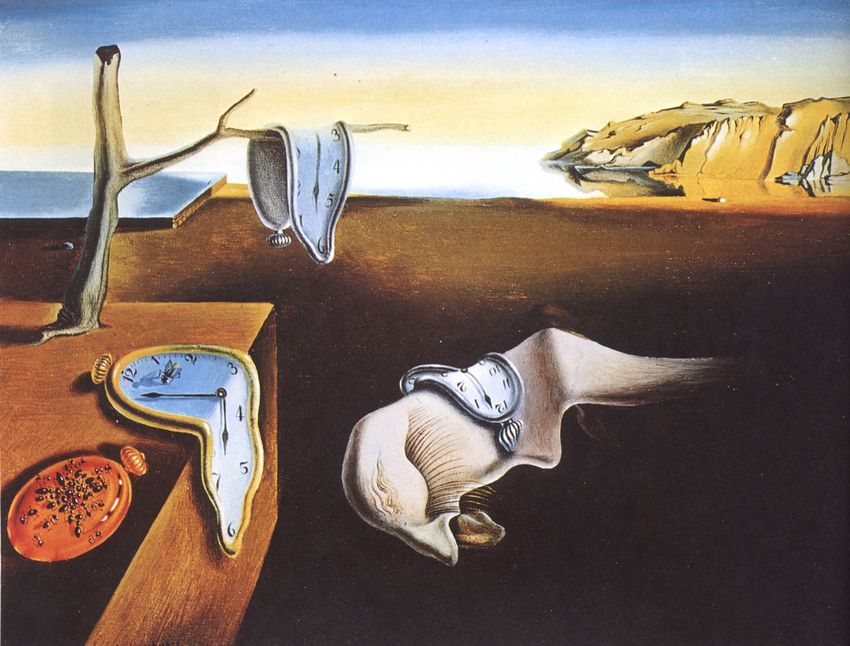
About Surrealism

Read the following information about the art movement
Surrealism then answer the questions:

Surrealism was a 20th century art movement that tried to represent the
subconscious mind. The word surreal means ‘beyond real’ and refers to
dreamlike imagery that cannot possibly be real. The movement began in the
mid-1920s in France.

Surrealism began as a philosophical movement that said the way to find truth in
the world was through the subconscious mind and dreams, rather than through
logical thought. The movement included many artists, poets, and writers who
expressed their theories in their work.

 Surrealism images explored the subconscious areas of the mind. The artwork
often made little sense as it was usually trying to represent a dream or random
thoughts.

Writers began the Surrealist movement. In 1924, a writer and poet Andre
Breton explained Surrealism in his Surrealist Manifesto (a document that
explains the intentions of Surrealism), and a few years later artists began to
paint in the style he described. Surrealists wanted to free their minds of rational
thought, to write or paint the ideas that were buried deep in their minds. These
artists did not wish their work to make simple, logical sense. Salvador Dali is the
most recognized of all Surrealist artists.
This is why many of the paintings look like scenes from a dream (or nightmare).
Many Surrealist paintings include imaginary creatures or real-life creatures
shown in unnatural ways. Some paintings, include several seemingly unrelated
objects. Others twist realistic images by using strange colours. The two most
famous surrealist artists are Salvador Dali and Rene Magritte. You can see by
searching their names online that in any Surrealist painting, there is a lot to look
at.
Surrealist artists were influenced by a famous psychoanalyst called Sigmund
Freud. A psychoanalyst is a doctor who studies the human mind and tries to
understand it. Freud believed our mind was divided into two parts: the
conscious part and the subconscious part. The conscious mind is what we use to
make decisions every day, like whether we walk or ride a bike to school. The
subconscious mind is where our memories are stored and where our dreams
come from. Most of the time we are not aware of our subconscious mind, but
sometimes the memories stored there get mixed up in our dreams and this is
what Dalí tried to paint.

The Surrealism art movement had a great impact in art, literature, culture and
even extending to politics. Surrealism liberates the imagination. Surrealism is
still alive and growing until today. Many artists around the world are influenced
by Surrealism styles, ideas & techniques.

Surrealism taught the world to see art not merely visually and literally; but to
appreciate it in a subconscious level as well. Today, surrealism is a familiar form
of art that continues to grow globally. It’s easy for artists to show their creativity
through Surrealism, because the style provides them more freedom to convey
their feelings and thoughts through the canvas. Surreal art can be dreamy or
gritty; or it can be optimistic or depressing. Next time you watch TV take a look
at the adverts, how many can you spot that have a surreal element to them?

Watch the following video to understand more about Surrealism:
https://www.tate.org.uk/kids/explore/what-is/surrealism

Answer the following questions about Surrealism:
1. What does the word ‘surreal’ mean?
  _____________________________________________________________
2. In which decade did Surrealism begin?
  ____________________________________________________________
3. What is the name of the French writer and poet who started Surrealism?
  _____________________________________________________________
4. What is a surrealism manifesto?
  _____________________________________________________________
5. What is the name of the psychoanalyst doctor who inspired the surrealist
  movement?
  _____________________________________________________________
6. What does a psychoanalyst study?
  ____________________________________________________________
7. What is the subconscious mind?
  _____________________________________________________________
8. Name the two most famous surrealist artists
  _____________________________________________________________

                           My score       /8
     8 = Excellent    7-6 = Good    5-4 = Inconsistent    3-0 = Poor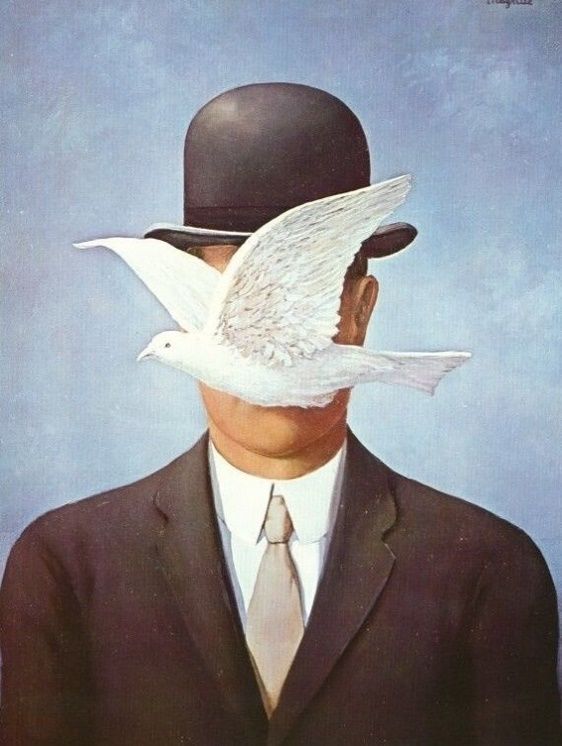
Homework 2
                     The Surreal Devices
  Draw lines to match the correct definition and image with each of the
  surreal devices

                         Morphing one object
1. Juxtaposition         into another or changing
                         its shape

                         Objects that are too
2. Metamorphosis         small or too large for
                         their surroundings

                         Floating objects that
3. Transparency          don’t normally float

                         Placing a familiar
4. Dislocation           object in an unfamiliar
                         setting

5. Change of Scale       Making objects see
                         through

                         Two objects that don’t
6. Levitation            normally go together
                         in the same image

                         My score         /6

     6 = Excellent   5 = Good       4/3 = Inconsistent   2-0 = Poor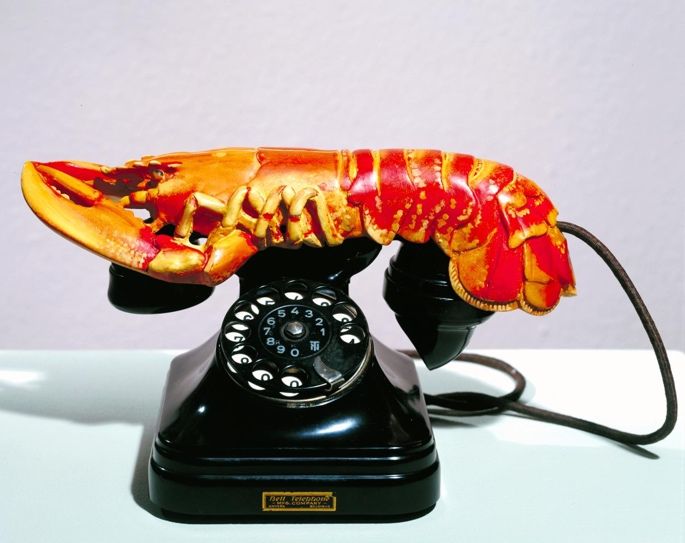
Homework 3
                             Salvador Dali

Read the following information about the artist Salvador Dali
then answer the questions:

                                                     Salvador Dali was born in
                                                     1904 in a place called
                                                     Catalonia, Spain. He was one
                                                     of the greatest of the
                                                     Surrealist group of Artists.
                                                     He was best known for his
                                                     ability to translate dreams
                                                     into artwork. He described
                                                     his work as ' hand-painted
                                                     dream photographs '.
                                                     Salvador was also a sculptor,
filmmaker, writer, jewelry designer, book illustrator and worked in theatre.
From 1939 to 1948 he lived in the United States and became well known for
being eccentric. Salvador always acted strangely, and some people thought he
was insane but he might have just wanted them to believe that he was.
You can always recognise him because he has a funny moustache. He liked to
dress in crazy clothes and have long hair which people found very shocking at
the time.

Dalí was even expelled from art school just before his final exams because he
said that none of the teachers were qualified to examine him. Cheeky!
Salvador Dalí went to Paris after leaving art
school, which was where he met the
surrealists. The surrealists appealed to his
wild sense of humor, they invented surrealist
games and enjoyed putting different objects
together to make something playful and
disturbing at the same time. Here is Dalí's
version of a surrealist sculpture. It is called
Lobster Telephone. You couldn't call anything
on that!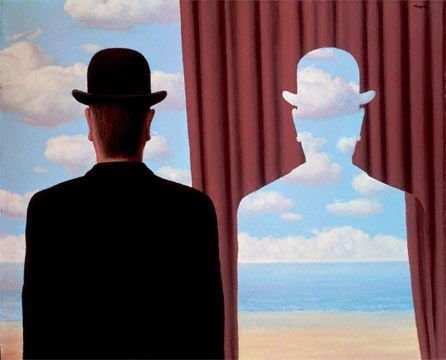
Perhaps his best-known painting is ‘The Persistence of Memory’ painted in
1931 and shows soft, melting pocket watches/clocks.

                                                          The general
                                                         interpretation of the
                                                         work is that the soft
                                                         watches are a rejection
                                                         of the assumption that
                                                         time is rigid. This idea is
                                                         supported by other
                                                         images in the work, such
                                                         as the wide expanding
                                                         landscape, and other
                                                         limp watches shown
                                                         being devoured by ants.

Dali’s melting clocks are an iconic image of Surrealism. Surrealist artists often
painted objects that changed form or morphed into something else. This
technique is called metamorphosis. Metamorphosis is one of the devices
Surrealists used to make their images look dreamlike or beyond real.
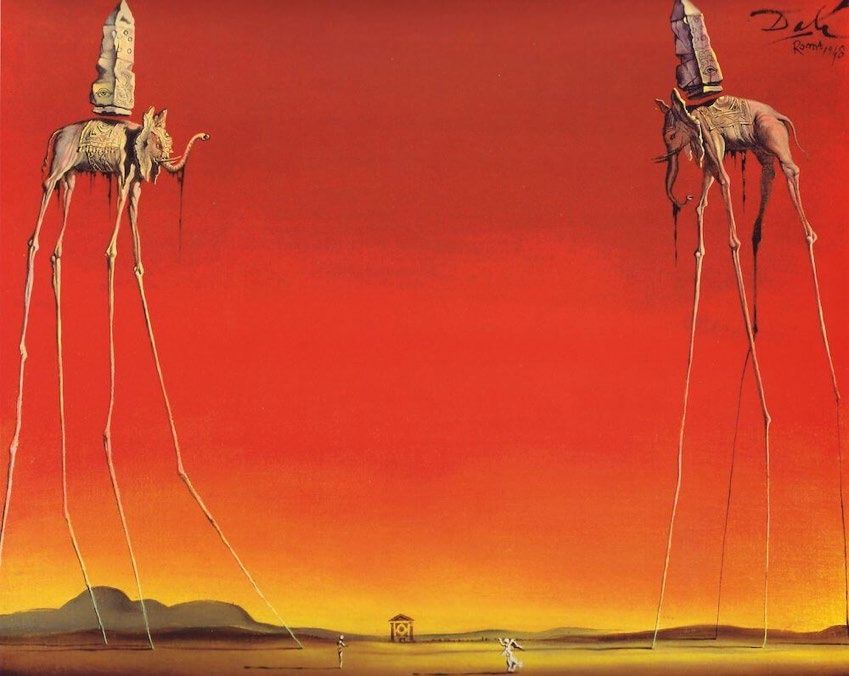
Dali would often include surreal animals or strange creatures in his paintings.

Here in ‘Los Elefantes’ he paints
the elephants with long spindly
legs which contrast the heavy
weight of their bodies. Do you
think legs like that would actually
hold the weight of a real elephant?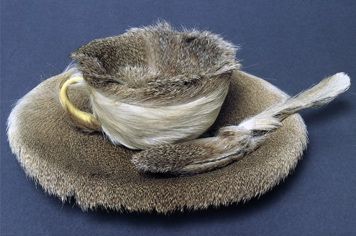
Answer the following questions about Salvador Dali:

  1. Where was Salvador Dali from?
  ________________________________________________________
  2. What distinguishing facial feature is he well recognised for?
  ________________________________________________________
  3. Salvador Dali was well known for being an eccentric character. What does
    the word eccentric mean?
  ________________________________________________________
  4. Name the title of Dali’s infamous painting with the melting clocks.
  ________________________________________________________
  5. How did Dali describe his own work?
  ________________________________________________________
  6. What is unusual about the elephants in Dali’s painting ‘Los Elefantes’?
  ________________________________________________________
  7. Which of the surreal devices has Dali used in his lobster telephone
    sculpture?
  ________________________________________________________
  8. Dali often uses the surreal device ‘metamorphosis’ in his paintings, what is
    the definition of metamorphosis?
  ________________________________________________________

                              My score       /8
       8 = Excellent     7-6 = Good    5-4 = Inconsistent      3-0 = Poor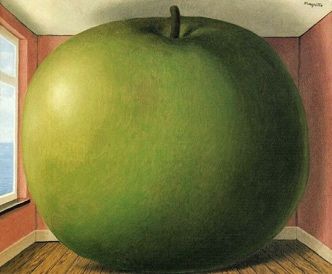
Homework 4
                            Rene Magritte

Read the following information about the artist Rene Magritte
then answer the questions:

                              Rene Magritte was a Surrealist painter who was
                             born in Belgium in 1898. He wanted people to look
                             at ordinary things in different ways. He sometimes
                             painted objects in places were they didn’t usually
                             belong, like in ‘Time Transfixed’ in which a train is
                             coming out of a fireplace. Other times, Magritte
                             confused the foreground (the things at the front of
                             the painting) with the background.

                             Magritte did not enjoy school, and he knew he
                             wanted to paint, so he went to Brussels to study
                             art. During this time, he worked to find his own
                             style. He tried cubism and futurism but neither
                             would become his style. Instead, he painted in the
                             Surrealist style.

1924 he began work as a freelance graphic designer in his home town of
Brussels. and later set up his own advertising agency ‘Studio Dongo’ with his
brother. In a tumbledown shack in his garden,
Magritte created posters, music covers and
advertisements right up until the 1950s, long after
he had become internationally acknowledged as an
important artist. He never abandoned the
commercial world, but went on appropriating its
advertising strategies into much of his art.
Magritte’s work is still an inspiration for many
advertisements today.

Magritte is well-known for including men in bowler
hats in his paintings. He often wore a bowler hat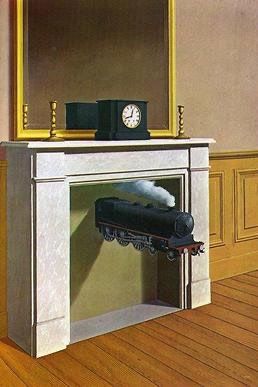
himself and, though you usually can’t see the men’s faces, these paintings are
commonly thought of as self-portraits.

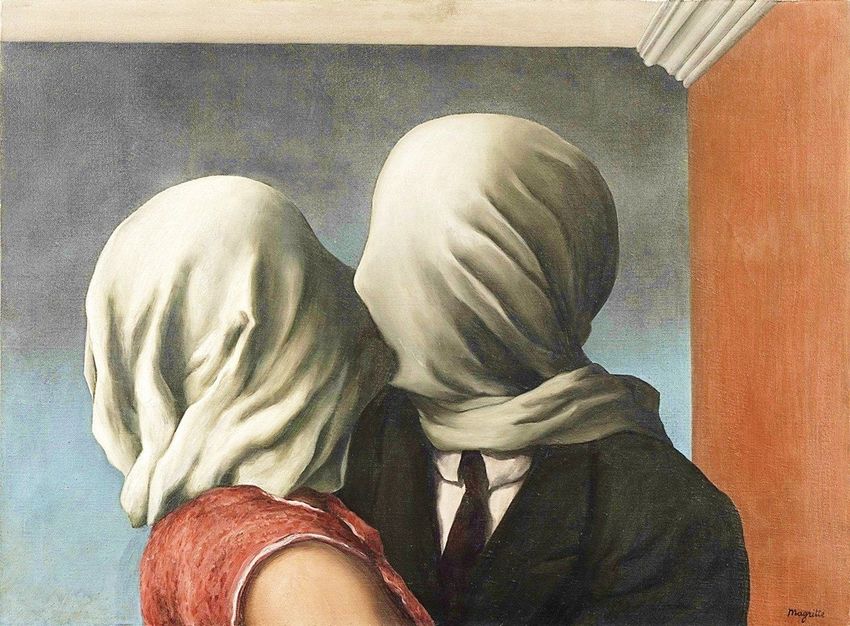
                                                   When Magritte was 13, his
                                                   mother Régina committed
                                                   suicide by drowning herself in
                                                   the Sambre River. When his
                                                   mother was found, her dress
                                                   was covering her face, an
                                                   image that has been
                                                   suggested as the source of
                                                   several oil paintings Magritte
                                                   painted in 1927-1928 of
                                                   people with cloth obscuring
                                                   their faces, including Les
                                                   Amants.

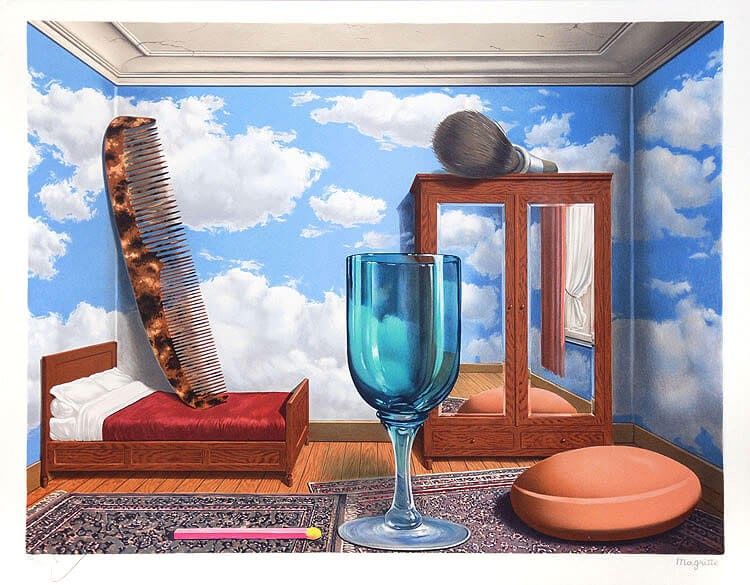
In ‘Personal
Values,’ Magritte
shows a bedroom
filled with objects in
blown up
proportions. These
everyday objects
include a comb, a
matchstick, a
wineglass, a bar of
soap and a shaving
brush. Magritte
painted the walls
with the color of the
sky which is meant to represent that the room was free from its limit of human
imagination. It suggests that the image of any individual viewer was up-to their
own and they could interpret their own meaning of the painting Personal
Values.
Answer the following questions about Rene Magritte:
1. Where and when was Rene Magritte born?
Date:____________________________Place:_______________________
2. What item of clothing is he famous for wearing and including in many of
his paintings?
_____________________________________________________________
3. Which object features in Magritte’s painting ‘Treachery of Images’?
_____________________________________________________________
4. What did Magritte mean by writing ‘This is not a pipe’ underneath the
painting?
_____________________________________________________________
5. Which of the surreal devices has Magritte used in his painting of a
bedroom titled ‘Personal Values’?
_____________________________________________________________
6. What job did Magritte do prior to becoming an artist?
______________________________________________________________
7. What kind of company did he set up with his brother?
_____________________________________________________________
8. What event inspired Magritte's paintings with cloth covered faces like Les
Amants?
_____________________________________________________________
My score /8
8 = Excellent 7-6 = Good 5-4 = Inconsistent 3-0 = PoorHomework 5
Revision
Use this booklet and your knowledge organiser to revise everything you have
learnt about Impressionism and Post Impressionism. You will have a short quiz
to test your knowledge from this term in the next lesson.
You may be tested on your knowledge of:
Where Surrealism sits within the timeline
What/who influenced the development of Surrealism?
Key features of surrealism
The Surreal Devices
Salvador Dali
Rene Magritte
Notable artworks
Key terminologyMini Test
Surrealism
Circle the correct answer
1. a b c d
2. a b c d
3. a b c d
4. a b c d
5. a b c d
6. a b c d
7. a b c d
8. a b c d
9. a b c d
10. a b c d
My score /10
10-9 = Excellent 8-7 = Good 6-5 = Inconsistent 4-0 = PoorMy Homework Record
Tick your result for each homework this half term
Task Excellent Good Inconsistent Poor
1. About Surrealism
2. The Surreal Devices
3. Salvador Dali
4. Rene Magritte
5. End of Unit Test
Work ethic
How much effort did you put in to your homework this half term? Tick which
statement applies to you.
O EXCELLENT
My best effort is applied to every homework. My homework is always
completed on time and to the best possible standard. I have done my own
reading on the subject to ensure I understand it fully.
O GOOD
I work hard to complete my homework by spending at least 20 minutes
per week ensuring it is completed to a pleasing standard.
O INCONSISTENT
I sometimes complete my homework on time and to an acceptable
standard, but not always. I do not always spend the time required to do
my homework well.
O POOR
I rarely complete my homework on time or to an acceptable standard.You can also read


