TAX TRANSPARENCY REPORT - "Supporting the socio-economic development of the communities in which we operate is both part of our core philosophy ...
←
→
Page content transcription
If your browser does not render page correctly, please read the page content below
TAX TRANSPARENCY
REPORT

       “Supporting the socio-economic
       development of the communities
       in which we operate is both part of
       our core philosophy and fundamental
       to our future Growth”.

       Anastassis G. David,
       Chairman of the Board

                               August, 2021
AUG UST, 2021

            SCOPE OF TAX
    TRANSPARENCY REPORT
                                           This document contains Coca-Cola HBC’s (CCH or Group)
                                           non-financial tax disclosures and provides clarity and transparency
                                           to our stakeholders with regard to our approach to tax treatment
                                           and payment. Further analysis about CCH’ s financial tax
                                           disclosures can be found in our 2020 Integrated Annual Report1.

                     WHO WE ARE

                                           CCH is a growth-focused Consumer Packaged Goods (CPG)
                                           business and strategic bottling partner of The Coca-Cola
                                           Company. Together, we and our customers serve more than
                                           600 million consumers across a broad geographic footprint of
                                           28 countries on 3 continents. Our portfolio is one of the
                                           strongest, broadest and most flexible in the beverage industry,
                                           offering consumer-leading partner brands in the sparkling, juice,
                                           water, sport, energy, plant-based, ready-to-drink tea, coffee,
                                           adult sparkling and premium spirits categories.

                                           We are committed to creating value for all our stakeholders by
                                           supporting the socio-economic development of the communities
                                           in which we operate. Our contribution is both direct, by creating
                                           economic wealth and indirect through our effect in the supply
                                           chain and by paying our fair share of taxes. In 2020, CCH entities
                                           employed approximately 28 thousand full time employees across
                                           all our jurisdictions and - along with our trading partners and
                                           suppliers - have created €11.8bn in added value via our value
                                           chain2.

                                           In short, our approach to tax is simple: we believe paying taxes is
                                           a key pillar in our commitment to be a value-adding partner for
                                           every community in which we operate. We pay all taxes
                                           transparently where they arise. We do not utilize tax havens or
                                           offshore frameworks as means to avoid tax.

1
    2020 Integrated Annual report, https://www.coca-colahellenic.com/en/investor-relations/results-reports-presentations
2
    Numbers presented are aggregated based on the local socio-economic studies from Coca-Cola HBC markets published
    between 2017 and 2020 and represent annual impact. We do not conduct socio-economic studies for all of our markets
    every year; studies are conducted for each market on a rolling basis
AUG UST, 2021
ABBREVIATIONS
CbCR Country-by-Country Reporting
CCH Coca-Cola Hellenic Bottling Company
CFO Chief Financial Officer
CPG Consumer Packaged Goods
DAC6 Fifth amendment of the Directive on Administrative
Cooperation in the field of taxation
DJSI Dow Jones Sustainability Index
EBTF European Business Tax Forum
EFTA European Free Trade Association
EU European Union
EUR Euro
GM General Manager
GRI Global Reporting Initiative
Group Coca-Cola Hellenic Bottling Company
MNE Multinational Enterprise
NGO Non-Governmental Organisation
OECD Organisation for Economic Co-operation and
Development
SDGs UN Sustainable Development Goals
S&P Standard and Poor’s
UN United Nations
VAT Value-added taxAUG UST, 2021
INTRODUCTION BY
CCH CHIEF FINANCIAL OFFICER
Dear Stakeholder,
I am pleased to introduce CCH’s first tax transparency report. It is
an important milestone in our commitment to be a value-adding
partner for every community and jurisdiction in which we operate.
This philosophy is at the core of our growth strategy and our tax
payments are a key element in our ability to deliver that
commitment.
Our aim in publishing this report is to present our overall approach
to tax governance and our tax policy, provide information on our
tax related sustainability footprint, and share data regarding total
taxes paid globally by CCH operations. It is also clearly designed
to show that our relationships with governments are conducted
on an open and constructive basis.
The report also responds to the increasing demands for a more
transparent tax environment from different corners of the
economic ecosystem following recent financial crises and the
Covid 19 pandemic which has created an economic crisis of
unforeseen proportions. Corporations in particular have rightly
been confronted with close media and political scrutiny over their
tax practices and despite the additional reporting requirements
that have been established over the last decade, we believe there
is more we can do to increase our transparency and ensure we
always act as responsible taxpayers. For this reason, we work in
partnership with our tax advisors, statutory auditors, and tax
authorities to ensure that the right amount of taxes is being paid
in the right place at the right time and we endorse best practice
initiatives that aim to deliver a fairer and more transparent tax
environment – this report being a clear example.AUG UST, 2021 The taxes we disclose include corporate income tax calculated on each country’s taxable profit, payroll taxes and social security contributions, irrecoverable VAT, environmental taxes, product taxes and other categories of taxes including also taxes realized in specific jurisdictions based on local regulations applying. In 2020 we paid a total of EUR 1.48 billion in taxes across all our jurisdictions. Out of that amount, EUR 604 million reflect taxes borne by CCH operations (see also below ‘2020 CCH Tax Payments highlights’ section). We recognize of course that there will be areas where we can improve our disclosures or make things more easily understood. We welcome feedback and constructive challenge from our stakeholders and are happy to address all questions that you may have. Sincerely Ben Almanzar Chief Financial Officer
AUG UST, 2021

    A. TAX STRATEGY AND
GOVERNANCE FRAMEWORK

          (a) Tax Policy and
            Commitments

                               Our commitment to be a value-adding partner for every
                               community and jurisdiction in which we operate is at the core of
                               our growth strategy and our tax payments are a key element in
                               our ability to deliver that commitment.

                               CCH’ s overall approach to tax is outlined and interpreted in our
                               Tax Policy. The Tax Policy defines our strategic goals and
                               objectives and specifies the governance role played by the
                               CCH Group tax team in their delivery. It also sets out the
                               principles that define how we deliver these goals and
                               objectives and defines tax accountabilities, responsibilities, and
                               delegations of authority.

                               Our tax policy is based around a series of core commitments to:

                                  •   observe all applicable laws, rules and regulations in
                                      meeting our tax compliance and reporting
                                      responsibilities everywhere we operate,
                                  •   comply with the OECD transfer pricing guidelines and
                                      ensure that the arm’s length principle is always
                                      observed in transactions between Group companies,
                                  •   ensure that tax strategy is aligned with business and
                                      commercial strategy and tax planning opportunities
                                      are evaluated within clear risk parameters,
                                  •   pay taxes on our activities in the country where the
                                      value is created,
                                  •   avoid any tax structure or tax planning initiative that
                                      would potentially exploit gaps in the architecture of
                                      the international tax system to artificially shift
                                      profits to places where there is low or no taxation
                                  •   work positively, pro-actively and transparently with tax
                                      authorities,
                                  •   apply diligent professional care and judgement to
                                      ensure all decisions are well-considered and
                                      documented,
                                  •   ensure that due consideration is given to the Group’s
                                      corporate and social responsibilities and the value it
                                      places on earning community trust.
AUG UST, 2021
Tax Governance principles
Our Tax Policy is underpinned by our Tax Governance
principles. Tax governance principles define how tax
accountabilities, responsibilities and delegations of authority
are allocated within the Group:
• The tax organizational model for CCH is global. This
ensures that tax activities and behaviors are globally
consistent and standardized wherever possible.
• Accountability for all taxes lies with Group Tax, unless
accountability is clearly devolved and accepted
elsewhere.
• All tax reporting lines for members of the CCH Tax
Team are reflected in the Group Tax structure.
The Group Tax Director is responsible for the implementation
of the Tax Policy, which is relevant to all entities and employees
within CCH. Tax Policy is subject to approval by CCH Audit
Committee, Group Chief Financial Officer (CFO), and the
Group Tax Director. Upon approval, the Tax Policy document is
then distributed to the Operating Committee, the country
General Managers (GMs) and Country CFOs.
All delegations and segregation of authorities set out in Tax
Policy, align with the CCH Chart of Authority. As regards
specifically accountabilities and responsibilities for tax
activities, these are allocated to all stakeholders (Group Tax,
Local tax, Group Finance, Country CFO, Business units,
external stakeholders) following the Group and Country Chart
of Authority as applying from time to time.
(b) Tax risk management
The CCH Tax Team supports the business in creating, building
and protecting shareholder value within the tax risk parameters
set out and accepted by the Group. In this respect, our Tax
strategy is aligned with business and commercial strategy and
tax decisions are evaluated within clear risk parameters.
We avoid any tax structure or tax planning initiative that
would potentially exploit gaps in the architecture of the
international tax system to artificially shift profits to
places where there is low or no taxation.AUG UST, 2021
Therefore, our commitment to pay taxes in the countries
where the value is created is combined with a strong
commitment not to proceed with any transactions or enter
into arrangements where the primary purpose appears in our
view to be the avoidance of tax or tax disclosure requirements,
especially involving ‘tax haven’3 jurisdictions.
We recognize that the volume and complexity of transactions,
coupled with recent developments in the external
environment, have resulted in an increased level of scrutiny
from tax authorities and other stakeholders. Group Tax has
developed a standardized risk management process to ensure
that tax risk is identified, assessed and controlled on a global
basis. To achieve that, Group Tax continuously evaluates tax
capabilities at a country level and ensures that all personnel
with tax responsibilities, or whose business activities may have
a tax impact, have a consistent understanding of how tax risk is
identified, assessed, reported, and managed.
(c) Relationship with
tax authorities
We consider tax authorities as one of our main stakeholders.
Our approach towards tax authorities is shaped by the
following principles:
• Ensure compliance with all relevant legal disclosure
requirements.
• Full transparency in all dealings with tax authorities in
relation to the Group’s tax affairs and disclosure of all
relevant information to enable tax authorities to carry
out their review.
• Work pro-actively with tax authorities to minimize the
extent of disputes, to achieve early agreement on
disputed issues when they arise and achieve certainty,
wherever possible.
Group Tax is ultimately accountable for how relationships with
tax authorities are managed. Local Finance teams and country
tax leads adhere to the principles outlined above.
3
“Tax havens” jurisdictions are defined following reference to international standards (e.g., EU list of non-cooperative jurisdictions)AUG UST, 2021
B. SUSTAINABILITY POLICY
We are committed to creating value for all our stakeholders by
supporting the socio-economic development of the
communities in which we operate. Our contribution is both
direct, by creating economic wealth and indirect through our
effect in the supply chain and by paying our fair share of taxes. It
is our belief that this approach is fundamental to our future
growth.
We support hundreds of thousands of jobs in our markets via
direct and indirect employment. We have a wide ecosystem of
suppliers and our demand helps to sustain their businesses
whilst in parallel, we work with them to improve the sustainability
of their supply chains. We invest in the markets in which we
operate, and we work with our customers to create shared value.
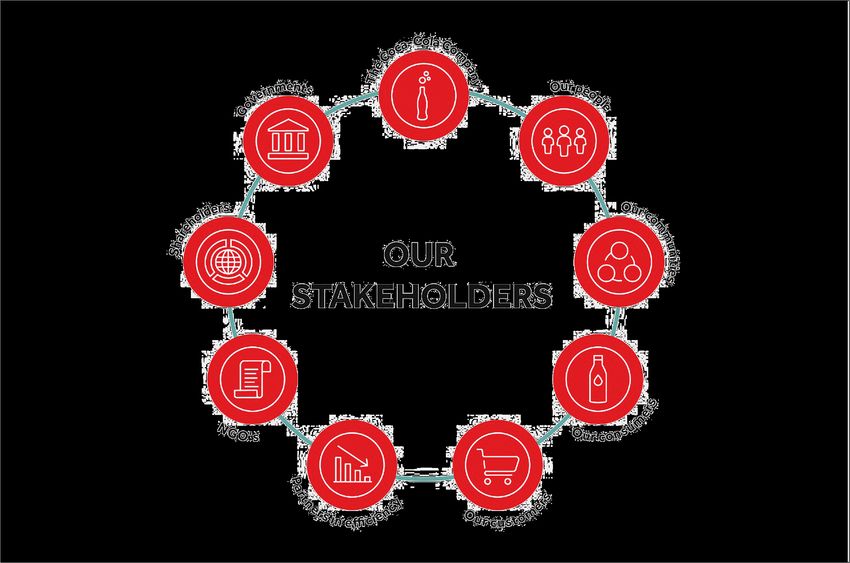
Source of image: https://www.coca-colahellenic.com/en/a-more-sustainable-future
/performance/socio-economic-impact-study
Maintaining our reputation and the trust of our stakeholders is
essential to the growth and successful operation of our
business. We integrate sustainability into every aspect of our
strategy and operations in order to deliver our commitments and
to make a more positive environmental impact.
Our main sustainability commitments (“Mission 2025”) directly
support the UN Sustainable Development Goals (SDGs) and are
outlined in a dedicated section in the Group’s Integrated Annual
Report along with details on the implementation process andAUG UST, 2021
performance status1. In addition, the Integrated Annual Report
contains clear references to our key achievements as well as
priorities for our way ahead including the summary of the Board
of Directors actions and priorities and the report of the Social
Responsibility Committee.
In recognition of our sustainability leadership, in 2021 we were
named the most sustainable beverage company in the World
and Europe by the Dow Jones Sustainability Indices (DJSI). This is
the 5th time in the last 7 years that we have been ranked as the
global beverage industry leader and the 10th year in a row that
we have been rated as one of the top three companies. It is
further acknowledgement of the dedication of all our teams and
reflects our core belief that creating mutual value is fundamental
to our future growth.
As a reflection of our commitment to financial transparency, we
are signatories to the (as yet voluntary) UK based Task Force on
Climate-related Financial Disclosures (TCFD) and report our
response in our Annual Report. In 2020 we participated for the
first time to the Total Tax Contribution survey developed by
European Business Tax Forum (EBTF). EBTF is a not-for-profit
initiative of some of the largest European based MNEs and was
formed in 2017 in response to the public debate around taxes
paid by large companies. Member companies are based in the
European Union (EU) and the European Free Trade Association
(EFTA) and share a common belief in responsible tax practices
and tax transparency. The aim of this survey is to foster the public
tax debate around how and how much companies contribute to
the societies in which they operate through taxes.
More information regarding our overall sustainability policy can
be found into our 2020 UN Global Compact Communication
on Progress report and our 2020 GRI Content Index
( https://www.coca-colahellenic.com/en/investor-relations/
results-reports-presentations )
1
2020 Integrated Annual report, https://www.coca-colahellenic.com/en/investor-relations/results-reports-presentationsAUG UST, 2021
C. 2020 CCH TAX
PAYMENTS HIGHLIGHTS
In the countries where we operate, CCH is both a taxpayer and
a tax collector. In 2020, we administered taxes of EUR 1.48
billion. This number includes all payments to governments that
CCH has borne itself and are reflected as operating expenses
or income tax expenses as well as all payments that CCH
collected from its providers, customers or other third parties
and remitted to governments.
In all the jurisdictions where CCH is active in, our Group entities
paid a total of EUR 604 million of taxes. In addition, CCH entities
collected an amount of EUR 876 million in taxes that were then
remitted to local governments. An analysis of these payments
is provided below:
(amounts in EUR million)
Taxes borne 603.9
Taxes collected 876.1
Total 1,480.0
Analysis of each category of taxes Total Taxes borne Taxes collected
Profit 15% 31% 3%
Property 1% 2% 0%
People 24% 26% 23%
Product 57% 35% 72%
Planet 4% 6% 3%
Other 0% 1% 0%
Total taxes (% are rounded) 100% 100% 100%AUG UST, 2021
Below we provide an analysis of the tax administered in
2020 by segment4. More specifically, CCH is divided into
three segments, as follows:
Established Austria, Cyprus, Greece, Italy, Northern Ireland,
Republic of Ireland, Switzerland
Developing Croatia, Czech, Estonia, Hungary, Latvia,
Lithuania, Poland, Slovakia, Slovenia
Emerging Armenia, Belarus, Bosnia, Bulgaria, Moldova,
Nigeria, Romania, Russia,
Serbia and Montenegro, Ukraine
Analysis by market segment
(taxes borne) Total Profit(c) Property People Product Planet Other
Established 214 52 2 84 72 3 1
Developing 116 42 2 24 24 24 1
Emerging 271 94 6 47 111 7 5
Corporate (a) 2 0 0 1 2 0 0
Total taxes (b) 604 188 10 155 209 34 7
Analysis by market segment
(taxes collected) Total Profit(c) Property People Product Planet Other(d)
Established 329 0 0 113 206 12 -3
Developing 200 0 0 28 162 10 -1
Emerging 333 18 0 61 254 0 0
Corporate (a) 14 8 0 2 5 0 0
Total taxes (b) 876 26 0 204 628 22 -4
Notes to the tables:
(a)
Corporate refers to holding, finance and other non-operating subsidiaries of the Group
(b)
Numbers might not add up due to rounding
(c)
Profit taxes include taxes borne/ collected by Joint Ventures (JVs)
(d)
'Other' reflects Grants, subsidies, rebates and other contributions received from the respective
Governments and that is why is presented as deduction form the taxes collected
4
Market segments are defined as per CCH Annual report (https://www.coca-colahellenic.com/content/dam/cch/us/documents
/oar2020/2020-Integrated-Annual-Report-18Mar2021.pdf.downloadasset.pdf)You can also read


