The 2020 Washington University in St. Louis Pow Wow Committee COVID-19 Report and Resource Guide - CDN
←
→
Page content transcription
If your browser does not render page correctly, please read the page content below

The 2020 Washington University in St. Louis
Pow Wow Committee COVID-19 Report and
            Resource Guide

  Authors and Committee Members: Rachel Baxter, Shandiin Begay,
   Adria Brown, Chase Bryer, Sunny Clifford, Jordon Connell, Aquira
  Foster, Alejandra Gonzalez, Jaisah Lee, Mariah May, Kelley McCall,
  Ashton Megli, Natalie Moyer, Patricia Pena, Ray Phillips, Eric Pinto,
Katelynn Pipestem, Hazel Rogers, Angelica Santiago Gonzalez, Heather
                               Sindelar
Prepared by Kellie Thompson, MSW, Director, Kathryn M. Buder Center for American Indian Studies
              Contact information: kellie.thompson@wustl.edu or bcais@wustl.edu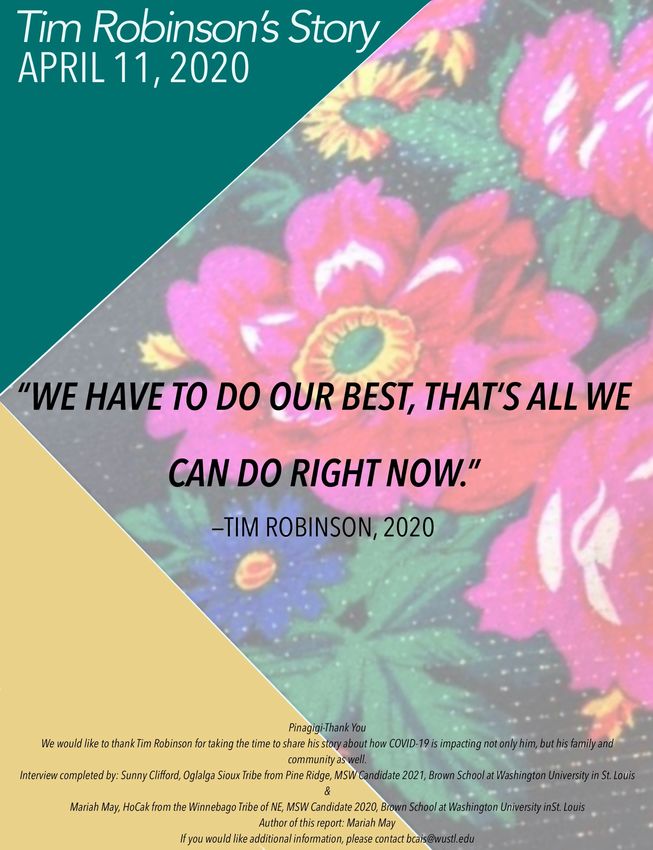
Every year since 1990, Brown School at Washington University in St. Louis students and the
          Kathryn M. Buder Center for American Indian Studies organizes an annual Pow Wow. A Pow
          Wow is an event where both Native American and non‐Native American people meet to dance,
          sing, socialize, and honor American Indian history and culture. The 30th annual event was
          scheduled to occur on April 11, 2020 with the theme of “Steps to Sovereignty: Decolonize,
          Indigenize, Revitalize.” The Washington University Pow Wow is critical in bringing the St. Louis
          community together to honor and celebrate Native traditions.

          As coronavirus spread in early 2020, Washington University in St. Louis was closely monitoring
          the global outbreak of this disease. In commitment to the health and safety of our community,
          the Buder Center and Washington University made the difficult decision on March 11, 2020 to
          cancel the Washington University Pow Wow. The decision was made with the health and safety
          of our relatives, elders and attendees in mind.

          To honor our commitment to our communities, the Pow Wow Committee acted fast and they
          interviewed each Head Staff member plus one vendor. Interviewees were generous with their
          time, stories and knowledge. Students conducted interviews on April 11 and April 15 and
          created the following stories and resources to share.

          Resources appear in this order and reflect the creative ways the Pow Wow Committee
          summarized stories and collected resources.
            Student Name                  Committee Position   Interviewee Name         Head Staff Position
            Jaisah Lee                    Co‐Chair             Laura Rice               Head Woman
            Kelley McCall                 Co‐Chair             Edmund Blackthunder      Head Man
            Natalie Moyer                 Assessment           Young Buffalo Horse &    Host Northern & Host
            Ray Phillips                                       Otter Trail Singers      Southern Drum Groups
            Eric Pinto
            Chase Bryer                   Media                Craig Cleveland Jr.      MC
            Aquira Foster
            Patricia Pena
            Shandiin Begay                Volunteer            Ron Brave                Arena Director
            Adria Brown
            Sunny Clifford                Children’s Booth     Tim Robinson             Head Gourd
            Mariah May
            Rachel Baxter                 Children’s Booth     Oneida Nation Color      Color Guard
            Heather Sindelar                                   Guard
            Ashton Megli                  Contesting           Isaiah Stewart           Head Judge
            Katelynn Pipestem
            Hazel Rogers
            Jordon Connell                Vendor Committee     Sherry Echo‐Hawk Taluc   Vendor
            Alejandra Gonzalez
            Angelica Santiago
            Gonzalez

Kathryn M. Buder Center for American Indian Studies
Brown School at Washington University in St. Louis                                                             2
Laura Rice's Story about
          Education during COVID-19
                        By: Jaisah Lee 4/24/20
 MSW Candidate 21', Brown School at Washington University in St. Louis

Jaisah Lee (Oneida Nation), interviewed Laura Rice (Prairie Band
Potawatomi, Kickapoo, Sac & Fox, Yurok, and Wintun) on 4/11/20.
Laura Rice works for Haskell Indian Nations University and now
   works from home helping her students virtually. When the
Haskell campus evacuated many students did not have a place to
   go and remained on campus. Not wanting her students to be
lonely, Laura has arts and craft zoom nights with her students on
a weekly basis. This is a time for students and Laura to catch up
 and enjoy each other's company. Additionally, Laura identified
many of her students are from the Navajo Nation where internet
 access is extremely limited. It also does not help that students
are losing the value of in person teaching and struggle engaging
 with their online classes. Laura highlighted the importance of
being flexible in education and to understand the many situations
                  students are having to deal with.

  How to support AI/AN students while
         they learn from home:
  We Are Teachers online is highlighting the limited research
  surrounding the impact of COVID-19 on students, but
  according to one researcher anxiety is seeing a steady
  increase. We can work with students to combat this issue
  by:
     facing the fear we feel with facts about the COVID-19
     Work to diminish the transition of virtual learning that
     might add to a students anxiety
     Encourage Virtual Connections
  The National Association of School Psychologists has also
  offered the following approaches to help student's learning
  from home:
     Practice mindfulness with students
        mindful breathing, yoga, meditation, etc.
     create a daily routine
  NDN Collective has offered additonal strategies:
     staying grounded through praper and smudging
     connect with traditional medicines & knowledge
     build a healthy community online
 Around 1.6 billion children and young people are out of school
 world wide. Not only are countries adjusting to school closures
   but many families in the U.S. are adapting to the daily life
    changes caused by COVID-19. We must remain flexible ,
  understanding, and supportive to students as they navigate
                       learning virtually.
                             ACKNOWLEDGMENT

         We would like to thank Laura Rice for sharing her story about
           how COVID-19 has affected the educational systems and
                              students learning.

        IF YOU WOULD LIKE ADDITIONAL INFORMATION PLEASE CONTACT
                              BCAIS@WUSTL.EDU
Policy Brief: Indian Country and COVID-19
Background Impact on Indian Country
COVID-19 is a respiratory illness which originated in Wuhan, Hubei Province, COVID-19 has the potential to be devastating to Indian Country in
China in December of 2019. Since it first appeared on the public health radar, it terms of lives lost, but also in terms of suffering inflicted on those
has proved to be easily transmissible and particularly deadly to older adults and who survive. The disease’s potential to cause harm is due to five
those with underlying medical conditions. main factors:
This has profound implications for Indian Country, necessitating a robust federal Lack of access to preventative care resources such as
response which thus far has not materialized. clean, running water
Multigenerational households
Many tribal governments are based out of Oklahoma and the members of drum Preexisting conditions caused by poor healthcare
groups Otter Trail and Young Buffalo Horse that participated in the interview also services and inadequate sources of high-quality nutrition
live in Oklahoma. For this reason, this brief focuses on information related to the Loss of opportunities to engage in sustaining cultural
COVID-19 outbreak in that state and the tribal governments operating out of that traditions
state. Poverty
Already, people from Indigenous communities are dying at higher
1
rates than those from non-Indigenous communities. Quick action is
necessary in order to save lives.
Potential Solutions
There needs to be systems in place to make sure community members’ basic
needs are met. This should be undertaken by tribal governments and states and
should consist of delivering weekly packages of food, purified water if none is
available, disinfecting wipes, hand sanitizer, and masks. Registration for this
service should be linked on both the state government website and the tribal
government website where those exist.
States must open lines of communication with tribal governments and
COVID-19 in Oklahoma coordinate a system of care to assist rural residents who fall ill in getting to
the nearest hospital with intensive care capacity. This could include
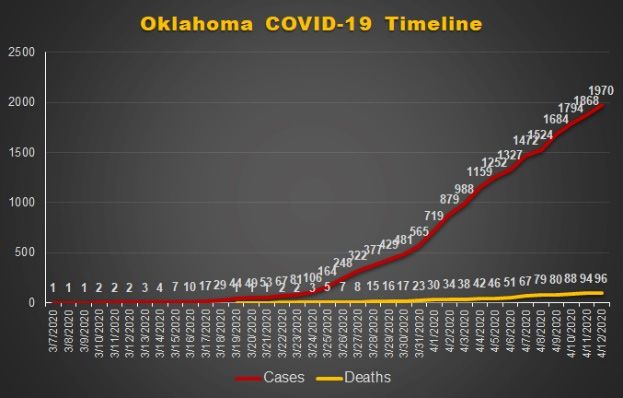
First person tested positive for COVID-19 on March 7th, 2020 distributing cell phones without sim cards, as these can be used to dial 911 in
emergencies.
First death was recorded on March 18th, 2020
Currently has 1,970 cases and 96 deaths Tribal governments must assist their members in finding new ways to engage
Governor of Oklahoma declared a state of emergency on in cultural traditions such as drumming, singing, and dancing, as these
March 24th, 2020, which included issuing stay-at-home orders traditions contribute significantly to a sense of community and the spiritual
and closing all non-essential businesses health of the people.
Photo credit: Oklahoma State Department of Health; Finally, Indigenous activists and allies across the country need to be proactive
https://coronavirus.health.ok.gov/ ; governor’s actions are accessible via: about voicing their concerns to their state representatives to ensure that any
https://coronavirus.health.ok.gov/governors-actions aid packages that are passed address the specific and unique needs of Indian
Country.
First-hand Experiences Author of this report:
Natalie Moyer, MSW
Candidate 2021
Members of Young Buffalo Horse
o Stillwater Oklahoma is really quiet now Interviews completed
o They were “essential employees” and so still had some income coming in by Natalie Moyer, Eric
o They said that their experience overall as citizens of Oklahoma has been okay but wished there was more Pinto, and Ray Phillips
communication between tribal governments and the state government to make sure tribal citizens were
getting what they needed For additional
o They expressed concerns about elders receiving the care and support they needed information, please
Members of Otter Trail contact
o Noticed less cooperation with social distancing in their community (Norman, Oklahoma) bcais@wustl.edu
o Also expressed concerns about elders getting care and support
o Expressed concern with lack of access to financial resources
o Drew explicit connections to historic oppression and lack of resources (lack of access to clean water, health
disparities, etc.)
1
Additional source: Givens, M. (2020). The coronavirus is exacerbating vulnerabilities Native communities already face. Vox. Retrieved from:
https://www.vox.com/2020/3/25/21192669/coronavirus-native-americans-indians
Policy Brief: COVID-19 affects the
Pow Wow Well-Being
The Issue:
Pow Wows are social gatherings for Native people and communities to connect with and share their culture. They
provide numerous benefits to support the mental, physical, emotional, and spiritual well-being of Native people.
Due to the outbreak of COVID-19, U.S. federal, state, and local governments, CDC, and WHO have issued policies
to prohibit mass gatherings in an attempt to reduce the spread of the virus. Pow Wows fall into this category of
mass gatherings as they attract large crowds of both Native and non-Native people to honor Native culture. This
public health issue has negatively impacted Native people and communities as event venues close and Pow Wows
cancel across the nation. Currently, Pow Wow participants, vendors, and attendees are unable to socialize, connect
with their culture, and lose out on economic opportunities.
Experiences of Pow Wow Drum Groups:
Northern Drum Group: Southern Drum Group:
Young Buffalo Horse Otter Trail Singers
Drum group members are disappointed Members enjoy the signing and
Pow Wows are cancelled because they dancing aspects of Pow Wows.
look forward to singing and interacting They appreciate how Pow Wows
with other Pow Wow participants and create family and community.
families. Members enjoy learning other tribal
The drum group produces CD’s to sell cultures while traveling in the Pow
at Pow Wows to provide financial Wow circuit.
support to travel and participate in the Pow Wows provide economic
Pow Wow circuit. opportunities to support members
Drumming and signing helps them
connect with the drum and experience.
They lose themselves while singing.
Solutions:
The experiences shared from the drum groups have common themes of dancing and singing, socializing,
and economic opportunity. To achieve the above benefits while following the COVID-19 quarantine protocols
requires the use of an alternative plan. Many organizations and people have utilized virtual platforms and social
media sites to reach their audience. Facebook groups such as Social Distancing Pow Wow has provided a space for
Natives to share recorded songs and dances, and communication with others. Live video streaming through social
media sites (i.e., Facebook, Instagram, etc.) and video conferencing sites (i.e., Zoom, Miscrosoft Teams, etc.)
provides a means for Natives to connect. Existing consumer sites, creating a business page through social media
sites, and music sites/apps (i.e., Apple iTunes, etc.) can provide an economic opportunity to sell CD’s, songs, and
albums. Lastly, Pow Wow hosts and particpants need to begin collaboration with tribes, venues, and the Pow Wow
community to create plans for future Pow Wows when the quarantine orders are lifted.
The Future:
Paul G from Powwows.com focused on three areas for future Pow Wow planning that Natives will need to
consider: 1) Health Screenings, 2) Increased Sanitation, and 3) Dancers, Singers, and Spectator Protection. Within
this planning process, different state and local jusridictions will need to be acknowledged. Heightened health
screenings, sanitation supplies and protocols, and personal protective equipment requirements will have be
considered. 1 Outdoor venues should also be considered with new findings of UV light and humidity effects on
reducing spread of the virus.2
Author of this report: Eric Pinto (Choctaw and Zuni), MSW Candidate 2020, Brown School at Washington University in St. Louis
Interviews conducted on April 11, 2020 by Eric Pinto, Ray Phillips and Natalie Moyer
For additional information contact bcais@wustl.edu
1
G., P. (2020, April 16). How Will Pow Wows Be Different When They Resume?. Powwows.com. https://www.powwows.com/how‐will‐pow‐
wows‐be‐different‐when‐they‐resume/
2
Fredericks, B. (2020, April 23). Top DHS scientists says heat, humidity slow coronavirus. New York Post. https://nypost.com/2020/04/23/top‐
dhs‐scientists‐says‐heat‐humidity‐slow‐coronavirus/
QUALITATIVE INTERVIEW ~ APRIL 11, 2020

 INTERVIEW
 W/ CRAIG
 CLEVELAND,
 JR.
 PATRICIA PENA (KICKAPOO OF KANSAS), MSW
 CANDIDATE 2020, BROWN SCHOOL AT
 WASHINGTON UNIVERSITY IN ST. LOUIS

   -POW WOW MC

   -WINNEBAGO
   TRIBE OF
   NEBRASKA, 26

 CRAIG'S ADVICE DURING COVID-19 PANDEMIC:

  "WOGIXETE WIRE"
 LOVE ONE ANOTHER

              CHASE BRYER, MSW 2021
             PATRICIA PENA, MSW 2020
             AQUIRA FOSTER, MSW 2020

FOR MORE INFORMATION, PLEASE EMAIL BCAIS@WUSTL.EDU
Indigenous
practices as
positive
Public Health Report for mechanisms
for
Indigenous Nations in the maintaining
United States a healthy
community
during
Covid-19
Author of this report: Aquira Foster, MSW Candidate 2020, Brown
School at Washington University in St. Louis
Interview completed by Aquira Foster, Patricia Pena, Chase Bryer
For more information, please email bcais@wustl.eduWinnebago Tribe of Nebraska Covid-19 Update
As of April 11, 2020, the Winnebago Tribe of Nebraska had no known cases of Covid-19 within
their tribal area. The Winnebago Tribe had been following the CDC's best practice recommendations
even before an official shelter in place order came to Nebraska. They began making changes and closing
non-essential businesses on March 14th, one day after the President issued a national state of
emergency. Additionally, to further prevent contraction and infection, the Tribal government issued a
mandatory curfew to be observed between the hours of 7:00pm and 5:00am that would take effect on
April 15th and continue until deemed appropriate. This will be regulated by local police authorities
who are authorized to issues citations up to $500 based on the number of offenses and documentation
presented.
Indigenized Programming for Community Support and Elder Engagement
It has been widely established that the elderly and immunocompromised individuals are at greatest
risk for contracting Corvid-19. This could present a uniquely serious problem for Indigenous communities
whose elders are keepers of knowledge that physically avail themselves to others. This could drastically
increase their chances of contracting and spreading Covid-19. One method of mitigating such risk could be
the implementation and use of Zoom or other online virtual platforms by elders and members of the Tribal
council. Native meditations and self-care strategies taught by elders and other community members may
be best practices for utilizing online platforms in Indian Country. Similarly, the council together with
community organizations could coordinate meeting times for spiritual and religious ceremonies to be held
via Zoom. This would provide a key opportunity to coordinate distance prayers, songs, and spiritual
dances, that could be taught virtually and enacted outdoors so that neighbors can hear and join.
The following recommendations for socially distant indigenized programming are based on
information gained from Craig Cleveland of the Winnebago Tribe:
• Talk with and support elders safely; coordinate home delivery of food and medicines
• Make traditional medicines and share them safely with elders and community members
• Start seedlings
• Reconnect with your traditional language, stories, and songs (especially those calling for
protection and health
• Learn a traditional craft or skill
• Support fellow Indigenous artists, craftspeople, and knowledge keepers whose livelihood
might be impacted by the pandemic
• Learn about Indigenous rights, self-determination, and sovereignty
• Check out the United Nation Declaration of Indigenous Peoples
• Read e-books by Indigenous authors
• Create or attend a virtual Pow Wow, drum circle, or dance for healing
• Spend time connecting with the Earth sourced from NDN collective
The Ho-chunk saying, "Wogixete Wire", seamlessly represents their values, actions, and
recommendations on how to lead during this pandemic: Love one another. Love when practiced in
ways like the aforementioned, is transformational and shifts the pandemic paradigm from fearful
selfishness and isolation, to intentional connectedness and rebirth.Policy Recommendations for Tribal Service Organizations and Governments
In congruence with recommendations from the International Indian Treaty Council (IITC), the
National Indigenous Women's Resource Center (NIWRC), and the Centers for Disease Control, the
following procedures are considered best practice and should be considered for current and future
preparedness efforts.
• Assign a staff member(s) to check the WHO and CDC for the newest
guidelines every day
• Set up strict social distancing practices in all public spaces
• Consider setting a rotating schedule for using shared spaces for staff and
clients
• Coordinate food, medicine, and urgent needs, delivery for elders and the
vulnerable
• Create a task force to survey internet and virtual service capabilities within
the community
• Create alternative programming based on survey
• Due to shortages, Tribal programs and other advocates will likely need to
work with state entities to access Personal Protective Equipment (PPE)
and appropriate sanitation materials
• If operating in a nation that opted for “self-determination” (which enables
greater financial flexibility and clinical autonomy), coordinate clinical
teams to staff mobile testing centers as soon as possible
Moving forward, it is important that Tribal governments hold state and federal authorities
accountable for involving indigenous peoples in the policy making process. It is the right of
Indigenous nations to take decisive action concerning their people; that sovereignty includes the
maintenance and protection of Tribal lands and waters that some governments have been trying
steal amidst the fallout of the pandemic. This sovereignty includes the right to environmental and
community health that is self determined, informed consent, and the power to build sustainable,
resilient and just post-Covid-19 solutions. Moreover, Tribal governments can utilize this time to
create extensive preparedness plans for their people so organizations and individuals have
immediate access to best practice procedures in the event of another pandemic. This might involve
creating a shared online de-identified data receptacle, so that every tribe has access to health data
relating to the pandemic, as well as information on tools and strategies found most effective.References
Carmen, A. (2020). Covid-19 and the Rights of Indigenous Peoples. International Treaty Council.
Retrieved April 23, 2020, from https://www.un.org/development/desa/indigenouspeoples/wp-
content/uploads/sites/19/2020/04/FINAL-IITC-COVID-PR-ENGLISH.pdf
COVID-19: Guidance for Tribal Programs. National Indigenous Women's Resource Center.
Retrieved April 23, 2020, from https://www.niwrc.org/sites/default/files/niwrc-covid19-
guidance-for-tribal-programs.pdf
COVID-19 Information for Tribal Communities. (2020, April 14). Retrieved April 23, 2020, from
https://www.cdc.gov/coronavirus/2019-ncov/community/tribal/index.html
Lakhani, N. (2020, March 18). Native American tribe takes trailblazing steps to fight Covid-19
outbreak. Retrieved April 23, 2020, from https://www.theguardian.com/us-
news/2020/mar/18/covidcoronavirus-native-american-lummi-nation-trailblazing-stepsCOVID-19 & LANGUAGE
REVITALIZATION IN
INDIAN COUNTRY
The COVID-19 pandemic has created additional barriers for
language revitalization and preservation efforts across
Indian Country. Tribal language teachers such as Craig
Cleveland Jr. (Winnebago) understand the importance of
tribal languages, and have been tasked with finding
creative efforts to further the spread of Native languages
for future generations. Find below a resource for tribal
language teachers that includes best practices and tips for
language revitalization while social-distancing.
COORDINATE VIRTUAL
ZOOM CLASSES
Zoom offers a full-featured Basic Plan for free with unlimited
meetings. Just visit www.zoom.us to get started.
GO LIVE ON SOCIAL MEDIA
Engage with students and fellow tribal members by going
live on Facebook or Instagram.
CREATE INTERACTIVE
FLASHCARDS AND GAMES
Create Quizlets for students and utilize free gaming-based
learning softwares such as "Kahoot!" to create fun,
interactive games for your students.
CALL YOUR ELDERS
Be sure to maintain and enhance your own language fluency
by talking regularly with other fluent speakers such as elders
and your colleagues.
BRAINSTORM OTHER
CREATIVE WAYS FOR
LEARNERS
Some ideas include: having students label household items in their
Native language and/or encouraging parent engagement in the
learning process.
Chase Bryer (Chickasaw), MSW Candidate 2021,
Brown School at Washington University in St. Louis
For more information, please email bcais@wustl.eduRON BRAVE Arena Director
Biography
"The Best Seat in the House"
Around 1979, Ron first volunteered to be the arena director at a Pow
Wow in Pine City. Since 1979, Ron has accepted invitations as an arena
director and recalls traveling to many Pow Wows. Currently, Ron describes
his experience as an arena director as "the best seat in the house." From
shaking hands to watching who's coming into the arena and being aware
of his surroundings, are familiar duties he fulfills as an arena director.
Behind the scenes, Ron studies the dance categories prior to attending a
Pow Wow. Ron is continuously learning from his experiences, including
cultures, languages and meeting new people
COVID-19 Community
To cope with the impact from Buiilding
COVID-19 Ron has utilized During the difficulty of the
speaking to his relatives and pandemic, Ron suggest places of
friends as a coping strategy and to improvements to consider
continue staying positive. Ron throughout Indian Country.
remains hopeful for the future and
Reconsidering approaches in
patiently awaits until we are able
Indian Centers, ensuring solid
to gather again. However, as a
directors are working and
result of COVID-19, there will be
resources are readily available to
many memorial songs and
community members. Additional
mourning specials during future
funding and adequate hiring
Pow Wow's. Positively, Ron awaits
process in workplaces. Lastly,
to see new dance categories and
ensuring Native homeless relatives
songs at the next Pow Wow. In the
are well and their needs are met.
meantime, Ron will continue to
study the steps, songs and beat.
Listen, Observe & Be
Patient
Listen, observe and be patient are the first three words of advice Ron
gave to our future Native leaders. Overall, Ron encourages Native
leaders to get to know the people you meet, the culture of others and
practice picking up their native language. Refer to our elders in our
communities, utilize sage, cedar, sweetgrass, any other traditional
medicine you pray with and continue to think about your community.
Credits
Shandiin Begay, Navajo Nation, MSW Candidate 2021, Brown School at Washington University in St. Louis
Adria Brown, Chickasaw, MSW Candidate 2020, Brown School at Washington University in St. Louis
Ron Brave, Interviewee, From Pine Ridge, SD, Haskell Indian Nations University
Permission Received by Ron Brave.
For more information, please email: bcais@wustl.edu
Interviewed by: Shandiin Begay, MSW'21 & Adria Brown,
MSW' 20 Created by Shandiin Begay on April 30, 2020Tim Robin on
I an hono o
e e en o
famil o ibe
Tim He ha been in he
o o ci cle ince
Comm ni
A membe of he Omaha T ibe Se ed in Ha kell
f om Neb a ka and a Ha kell commi ee fo he
Al mni ho c en l e ide in G ad a ion Po o
La ence Kan a
Singe
Ad ice Fo
Tim Role
O he
Head Go d Dance
S a home and main ain
ocial di ancing
Thank o
Ackno ledgemen o Tim Robin on Da e com le ed
Famil In e ie Com iled b S nn Cliffo d Oglala
Sio T ibe MSW and Ma iah Ma
Winnebago MSW
A ho of hi e o S nn Cliffo dTim Robinson is from the Omaha Nation and currently resides in Lawrence, KS. Tim was nominated
as the Head Gourd Dancer for the 30th Annual Washington University in St. Louis pow wow. Tim was
gracious enough to share his story on how COVID-19 is impacting his communities with us.
While this is the first time that all of us are experiencing a global pandemic
for the first time in our life, it is important now more than ever, that we do what we
can to support and take care of our children. While speaking with Tim, he mentioned
that it is important that we keep our children fed and provide resources
for students of all ages––K-college. There are things individuals, communities, and
tribal communities are doing to make sure that our future leaders
are cared for. See below what others are doing and what you can do to help
support the children and students of our communities.
What communities are doing to support students: For more resources to see how
• Schools are providing meals for students
• Teachers are providing homework packets tribes are responding to COVID-
for students 19, please visit:
• Online resources
• Family fun-pack https://sites.google.com/g.harvard
• Teachers recording story time .edu/covid-19-
• Providing a safe place to stay for college
students
resources/home?authuser=0INTERVIEW WITH JOHN AND ART OF THE
ONEIDA VETERANS' COMMITTEE COLOR GUARD
On April 11, in lieu of the 2020 Pow Wow, Washington University students Heather Sindelar and
Rachel Baxter interviewed Oneida Veterans Affairs Committee members John Breuninger and
Arthur Cornelius on their Pow Wow knowledge and community effects of COVID-19
YEARS OF EXPERIENCE CANCELING THE COLORS COPING WITH COVID
Both veterans served in the John explains the Veterans' Affairs "Social distancing is not one of
Vietnam War and John served typically present the colors at 2-3 my claims to fame. I've been
28 years in the Indian Health events per month, all of which have very active," says John.
Service. They've participated been canceled due to COVID. "It's "Spirituality is extremely
in so many Pow Wows over one of the things we have to deal important right now. It's very
their lives, John describes the with," he says. "[But] we're honored important to maintain that
number as "Scientifically...too to provide support and assistance." relationship [with God or
numerous to count...30, 40, They've been delivering groceries Higher Power.]" Referring to
maybe 50 Pow Wows." John and medications to elders as well as the importance of health, Art
says he has attended Pow helping at funerals of those who says, "At this point I'm thankful
Wows "ever since childhood." have passed away due to COVID. my wife and I are very healthy."
FINAL THOUGHTS
"As a leader...if you become aware of a need, you should step forward and not even hesitate, just step
forward and let them know you're here for that need," says Art, regarding leadership in the time of
COVID. John agrees, "I think its incumbent on us as elders to practice what we preach. It's important for
us as role models to...walk the walk and talk the talk." Both elders were thankful to give their advice and
talked about the importance of honesty and candor as leaders in their community. "You've done a very,
very significant thing here in asking people for their opinions," says John. "We speak about the
[Oneida] Nation, but not for it--we speak for ourselves.... I am speaking from my heart."
This presentation was created on April 24, 2020 by Heather Sindelar, MSW Candidate 2020, Brown School at Washington University in
St. Louis. Interview was conducted by Heather Sindelar and Rachel Baxter, MSW Candidate 2019, Brown School at Washington
University in St. Louis. For more information, please email bcais@wustl.eduCOVID-19 ~ INDIAN
COUNTRY
RACHEL BAXTER
Washington University MSW students Rachel Baxter
and Heather Sindelar spoke with Art Cornelius and
John Breuninger, Oneida Nation, regarding COVID-19's
impact in their community and the rest of Indian
Country. This report covers current resources and
possible solutions:
Oneida Nation
Impact
~ The biggest impact has been on
the economy. Approximately 1900
employees have been laid off
Importance of
Stewardship Importance of
Spirituality
~ Having compassion
for our communities,
our relationships for ~ Being able to
our elders, being connect with
inclusive of those who
ourselves, those
aren't able bodied, and
mindful of those who around us, the
can't "afford" a earth, within all of
pandemic creation can
John~
provide strength
Importance of "Spirituality is when it comes to
extremely
Leadership important right well-being during
~ Leadership is now. It's these times
important to
displayed from maintain that
how we react and relationship in
these times"
respond when
guidance is needed
and decisions need
to be made ~ Possible Solutions:
Expand WIC products,
Art ~ "As a snap benefits to
leader if you CSA's, base pay for
become aware
of a need, you mothers and
should step caregivers, expand
forward, and
not even resources to rural
hesitate, just companies through
step forward broadband internet
and let them
know you're access
here for what
they need"
Author of this report, Rachel Baxter, MSW Candidate 2021. Rachel and
Heather Sindelar, MSW candidate 2020 conducted the interview. Brown
School at Washington University in St. Louis
We extend our thanks to John and Art for their
time. For more information please contact
bcais@wustl.eduA GLIMPSE AT ISAIAH
STEWART AND HIS WORLD
ARTIST, FATHER, HUSBAND, &
POWWOW ENTHUSIAST
ISAIAH'S BIOGRAPHY
Tribal Affiliation: Lakota (Oglala-Sioux) & Mohawk
Career: Gifted in the arts - painting, ledger-art, & drawing
Community: Lives in Lawrence, Kansas with his wife
Melissa and 6-year-old daughter, Phoenix
Education: Bachelor of Fine Arts from Kansas University
HIS POWWOW EXPERIENCE
His Identities Within the Powwow Circuit
Prairie-Chicken Dancer
MC
Vendor
Wisdom Gained From the Powwow Lifestyle
Sense of faith
Artwork reflects his movement in dancing, and
spirituality
Observing the elements of the world guides him
in life
HIS LESSONS OF RESILIENCY DURING THE COVID-19
PANDEMIC
Leadership Advice
Use this time to learn more about yourself
Improve relationships with others
You're a speckle of dust within the wind; humility
Never take anything personal
Designed by Katelynn Pipestem (Osage/Southern Cheyenne of Oklahoma) on April 28th, 2020
Interview conducted Katelynn Pipestem (MSW Candidate '21), Ashton Megli (Choctaw Nation of
Oklahoma; MSW Candidate '21), & Hazel Rogers (MSW Candidate '20)
Brown School Washington University in St. Louis
For more information, please email bcais@wustl.eduADVICE FROM ISAIAH STEWART,
LAKOTA (OGLALA-SIOUX) / MOHAWK
KEEPING POSITIVE
DURING A PANDEMIC
Washington University 2020 Pow Wow Head Judge
isaiahstewart.com
LEARN
"As far as the way I live, if I
want to learn something, I'm
just like a child, I don't care if
I look stupid doing it or fall
and bump... those types of
things just help me grow that
much more. I'm just trying to
hit my bucket list.".
RHYTHM
Just like a child, you gotta create
wonder in everything that you do.
You gotta create excitement and
you gotta kinda have a rhythm....
when I paint I try to create a
rhythm through the brushwork,
and so far as a daily routine, you
need to have a rhythm as well.
ACCEPTANCE
"It's taking a step back.
That's just the way things
are, and I don't have any
quarrels with it."
Prepared by Hazel Rogers ~ 4.28.2020
Interview conducted by Katelynn Pipestem (Osage/Southern Cheyenne of
Oklahoma) MSW Candidate 2021, Ashton Megli (Chocktaw Nation of Oklahoma)
MSW Candidate 2021, and Hazel Rogers MSW Candidate 2020
Brown School Washington University in St. Louis
For more information, please email bcais@wustl.eduCOVID-19 AND INDIGENOUS COMMUNITIES
Native Leadership in
a Global Crisis
Leveraging Sovereignty
Sovereign indigenous communities around the world are
using decision-making power to take action in ways that
protect us all: travel bans and restrictions, instituting new
social support programs, and practicing isolation. The Ponca
Tribe of Nebraska, for example, instituted travel restrictions
in March, 15 days before the state of Nebraska instituted any
measures to slow disease spread.
https://www.un.org/development/desa/indigenouspeoples/covid-19.html
https://www.poncatribe-ne.org/covid-19-travel-ban/
Demonstrating Indigenous Values
Native communities around the country are building
community resources and coming together around
their shared values, particularly in protecting their
elders and those most vulnerable in their
communities, and in finding indigenous approaches
to stopping the disease, such as using traditional
medicines.
https://ndncollective.org/indigenizing-and-decolonizing-community-care-in-response-to-covid-19/
Acknowledge Historical Trauma
Indigenous leaders recognize that, due to historical
trauma and current context, indigenous
populations are affected differently by the
pandemic and that their response must differ, too.
They are speaking out about the trauma endured
by native communities and the particular needs of
those communities as a consequence.
https://nativegov.org/native-governance-center-and-covid-19/
"Now is a good time to get to know yourself... When you get to know yourself, you
can really come to understand others and what they go through and what they deal
with... what challenges they may face... The spirit is different, your soul. I try to be
guided by and live through, that as best I can... You have to look at the spiritual
aspect as well."
"This really makes you realize how much you need to depend on one another and how
much you need your faith as well... you gotta instill yourself with a driving force that
will keep you grounded...We are guided by what we are connected with."
-Isaiah Stewart, Lakota (Oglala-Sioux) / Mohawk
Washington University 2020 Pow Wow Head Judge
Prepared by Hazel Rogers ~ 4.28.2020
Interview conducted by Katelynn Pipestem (Osage/Southern Cheyenne of Oklahoma)
MSW Candidate 2021, Ashton Megli (Chocktaw Nation of Oklahoma) MSW Candidate
2021, and Hazel Rogers MSW Candidate 2020
Brown School Washington University in St. Louis
For more information, please email bcais@wustl.eduIMPACT OF COVID-19 ON
INDIGENOUS COMMUNITIES
An Interview with Sherry Echo-Hawk Taluc (Pawnee & Otoe Missouri)
Brought to you by the 30th Annual WashU Pow Wow Vendor Committee: Angelica Santiago
Gonzalez, Alejandra Gonzalez (Yankton Sioux), & Jordan Connell (Cherokee Nation)
Created on April 22nd, 2020
1 LIVELIHOOD
As a pow wow vendor, Sherry talked about
the impact the Covid-19 quarantine has had
on herself and others. For many, vending at
pow wows is a primary source of income.
Now that many pow wows have been
cancelled, these individuals are unable to
sell their products and earn a living
COMMUNITY 2
Pow wows are a time for people to come together
and be with one another. For many, this may be the
only time they see friends and relatives throughout the
year. Sherry remarked that missing out on pow wow
season was hard to cope with because it meant she
wouldn't be able to see many of the people she
looked forward to seeing every year
3 NDN COUNTRY
Covid-19 has the potential to have
disastrous affects on Indian Country.
Losing community members means
losing culture and spiritual health.
Already, the effects of this disease
have been felt by many tribes and
continue to test the strength of our
communities
SOLUTIONS 4
Sherry highlighted the ways in which
technology can play a role in mitigating the
effects of Covid-19 while allowing Indigenous
communities to maintain connectedness.
Social distance pow wows, virtual talking
circles, and online trading posts are all great
ways to support the emotional and economic
wellbeing of our relatives
Authored by Jordan Connell (Cherokee Nation, MSW Candidate 2021, Brown School at
Washington University in St. Louis)
For more information, please email bcais@wustl.eduWASHINGTON UNIVERSITY, BROWN SCHOOL OF SOCIAL WORK, BUDER CENTER
Impacts of Covid-19
on Indigenous Urban
Residents
An interview with Sherry Echo Hawk -Taluc (Pawnee, Oto Missouri)
"Online
support is very helpful for tribal communities and powwow
communities"
Brought to you by: Alejandra Gonzalez, Angelica Santiago Gonzalez, Jordan Connell , Vendor
Committee members .
4/15/2020
THE IMPORTANCE
OF FAMILY
"We don’t get to see each other
anymore, [covid-19] this is out of our control"
Sherry explained how the use of technology
has helped her keep in touch with family during
the covid-19 pandemic. This is a time to reconnect
with family, friends, and other relatives who all
consist of our communitites.
SOCIAL DISTANCING &
SELF-QUARANTINE
Sherry and family are currently following all
CDC guidelines, which is challenging for Sherry
who used to a busy life style. After the Bird Flu
pandemic, Sherry realized the importance of
pandemic preparedness.
NO AMERICAN INDIAN
CENTER = LOSS SENSE
OF COMMUNITY
In the winter of 2005, the American Indian
Center of Mid-America located in St. Louis,MO
closed. With this organization non-operational
went the sense of community for urban
Indigenous residents, along with access to
possible resources. Sherry looks forward to
Washington University's Annual Pow-Wow every
year.
INDIGENOUS VALUES
CREATE QUALITY
LEADERS
Sherry expressed the importance of keeping in
mind our traditional teachings during this
pandemic. She noted how these teaching will
young Indigenous professional become the next
leaders in Indian Country..
For additional information please contact bias@wustl.edu
DISCOVER MORE AT:
HTTPS://WWW.CDC.GOV/FEATURES/AIANHERITAGEMONTH/INDEX.HTML
Special thank you to Sherry Echo-Hawk Tulac for taking her time to share her story and perspective
with us!
Interviewer:Alejandra Gonzalez (Yankton Sioux) MSW Candidate 2021, Brown School at
Washington University in St. LouisThe 2020 Washington University in St. Louis Pow
Wow Committee and the Kathryn M. Buder Center
for American Indian Studies would like to sincerely
thank all individuals who participated in the
interviews.
Please contact Kellie Thompson at kellie.thompson@wustl.edu or bcais@wustl.edu for
more information.
Campus Box 1196, One Brookings Drive, St. Louis, Missouri 63130‐4899
314.935.4510 | buder.wustl.eduYou can also read


