The 'Fab Lab' The Ariens Co. breaks new ground with Brillion High's exemplary technology and engineering program
←
→
Page content transcription
If your browser does not render page correctly, please read the page content below
The ‘Fab Lab’

The ‘Fab Lab’
The Ariens Co. breaks new ground with
Brillion High’s exemplary technology
and engineering program
BY CHRISTIAN SCHNEIDER

   At first blush, Brillion seems like just another                coordinator Steve Meyer, Ariens gave Brillion High a
pleasant Wisconsin small town. Yet this city of                    $1.5 million gift to double its STEM classroom space
3,000, 25 miles south of Green Bay, is a unique                    from 5,000 to 10,000 square feet.
manufacturing powerhouse, housing four large                          Thus began a relationship that Ariens calls a
machine plants: Ariens Co., Endries                                              national model for business-education
International Inc., Professional Plating                                         partnerships.
Inc., and Brillion Iron Works. On
any given day, more people work in                                               Ariens Co. was founded in Brillion
Brillion’s four factories than live in the                                       in 1933 by Henry Ariens and his three
town itself.                                                                     sons, who created the first American-
   Yet the plants aren’t the only places                                         made rototiller. By 1950, the company
where Brillion residents are hard at                                             was manufacturing riding lawn mowers.
work. Most days, Brillion’s high school                                          The 1960s saw the company add snow
students are toiling away in their                                               blowers to its product line. In 1998, Dan
school’s “Fab Lab,” fabricating frames                                           Ariens, Henry’s great-grandson, took
for prototype high-mileage vehicles                                              over the company; Ariens now employs
as a part of a statewide gas mileage                                             more than 1,200 people in Wisconsin,
                                              Dan Ariens sees the high school as
competition. These students, enrolled his pipeline for quality employees. including 200 new hires in 2011.
in the school’s capstone engineering                                                  Ariens’ investment in local education
class, are building a “supermileage” vehicle. Last year’s has paid off for both the school and the factory.
entrant was a hybrid that racked up 260 miles per                  Before the gift, about 60 Brillion High students took
gallon. This year’s team is shooting for 300 mpg.                  technology classes. Since 2007, STEM enrollment
   Brillion High School’s Science, Technology,                     has exploded. The program typically has about
Engineering and Mathematics (STEM) program                         200 students in a school of 330 students. Ariens
is largely the product of an innovative partnership                provides both instruction and materials, and the high
with the Ariens Co. In 2007, at the behest of school               school reciprocates by producing potential workers
principal Paul Nistler and technology education                    experienced in manufacturing and engineering the

Photos by Al Fredrickson
                                                                                                                              19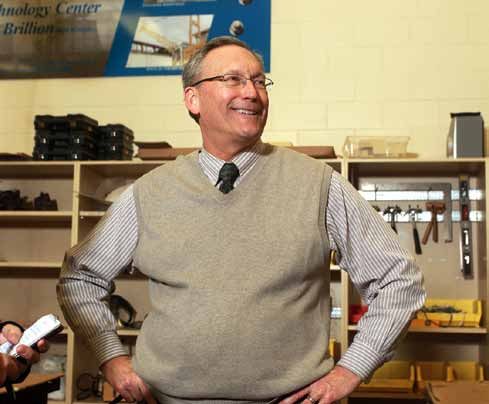
The ‘Fab Lab’

  day they receive their diplomas.                                  This success couldn’t come at a better time.
    “Before 2007, I was thinking about how I keep                   While manufacturing jobs in Wisconsin have started
  Ariens Co. staffed with quality people, whether                   coming back, there are about 22% fewer factory jobs
                                                                    in the state than the high point of 600,000 in early
                                                                    2000. The national unemployment rate for workers
                                                                    under 20 years old stands at 21%, and the wage gap
                                                                    between workers with a college degree and those
                                                                    without is at a 48-year high.
                                                                       Dan Ariens, who chairs the governing board of the
                                                                    powerful business group Wisconsin Manufacturers
                                                                    & Commerce, looks to reset the usual conversation
                                                                    about manufacturing. “A really good manufacturing
                                                                    job — tool and die, machinists, good assembler — is
                                                                    still a very good middle-class wage. And when you
                                                                    take those numbers nationally and look at what it is in
                                                                    Calumet Country versus Milwaukee, New York and
                                                                    Chicago, there isn’t that [wage] gap.”
  Principal Paul Nistler estimates that at least half of the STEM
  students have relatives working at Ariens.                            Meyer points to the program’s greater purpose.
                                                                    “We don’t create just the noun ‘engineer,’ we create
  they’re technicians on the floor, or engineers, or                the verb ‘engineer,’” he says, emphasizing that the
  manufacturing leaders, and my feeder is really Brillion           program’s focus is on teaching kids to be creative, to
  High School,” says Dan Ariens. “So it was really                  solve problems, and to apply math in real life.
  coincidental that Steve and Paul brought me this
  proposal at the time they did.
     “Paul was very engaged and had a vision of what                      Ariens’ investment in
  he wanted to do, and Steve is an infectious teacher,”
  notes Ariens. “He had an energy that convinced me it                  local education has paid
  was going to be a really cool program.”
     The school doesn’t see its role as merely providing
                                                                         off for both the school
  workers for the factory. “Ariens didn’t give money                         and the factory
  with the expectation that the school was going to
  create workers for them,” says Meyer.
     But Meyer says that it is no coincidence that                  Nistler notes that Ariens also provides internships
  Brillion’s companies have remained successful during              in accounting and marketing, so the opportunities
  the economic downturn while so many others have                   aren’t just on the factory floor. Meyer adds: “Our real
  not. It is unique for such a small town to have such              philosophy is to provide kids with the tools to end
  large manufacturers, and Meyer believes the quality               up wherever they want to end up. We don’t want to
  workforce produced by the STEM program has                        track kids in a certain direction. We don’t promote
  something to do with it.                                          four-year universities for every kid. We do promote

 20    Wisconsin Interest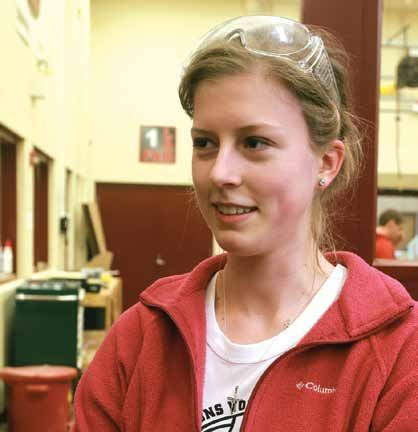
The ‘Fab Lab’

future training, which can come from apprenticeship       The school’s “Fab Lab” is flanked by a 58-seat
programs, technical diplomas, and associate degrees.”     lecture hall and a design room with 24 computer
   Aside from that initial Ariens grant, the program      stations where students can create three-dimensional
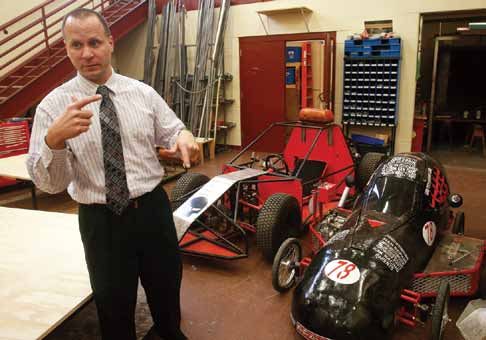
is entirely funded by the Brillion School District. The   graphical models. Two Ariens-labeled vehicles built in
company does help out with materials to make car          previous years by students hang above the lab. There
frames and other student projects. And in a new           are five other rooms where students work on design
initiative, Ariens engineers visit the school daily to    projects. Meyer says that some student-inspired
work with students.                                       designs have even been patented by Ariens and sold
   “Fifty percent of that program is so our kids can      to the public. (More on that shortly.)
learn from the engineers,” says Meyer, “but the other       Inside the fabrication room, a handful of students
half is so those engineers can learn from our students,   are staying after school to design a supermileage
because kids are innovative and have different ways
of looking at problems.”

Meyer is aware that for decades, “shop” class has
carried with it the image of disaffected young men
— definitely not college material — hiding out in a
corner of the school where females dare not venture.
“If you look at a traditional shop class, would that be
a place that would be attractive to a young female
engineer?” Meyer asks, answering his own question
with a “No.”
   But Brillion’s STEM program breaks the
stereotype that girls aren’t inclined towards math and    Tech ed coordinator Steve Meyer says his program has disrupted the
                                                          usual high school cliques.
engineering: Typically around 30% of the program’s
participants are female. And Meyer notes that while       entry. The project takes students through all phases
females may go into engineering careers at a lower        of building the car, from engineering to fabricating,
rate than males, they learn skills they can take with     modeling, prototyping, testing and building — all
them into other jobs.                                     while learning to work as a team.
   Meyer offers nursing as a “great example”                  (Other lab inventions created include a duck
because health care workers need a very technical         decoy system, a parallel-parking vehicle, a can
background. “To be honest, I want nurses to know          crusher, a vehicle-lighting system, a guitar trainer, and
more about engineering than the guy making my             a livestock feeding system.)
snow blower,” jokes Meyer.                                   Breaking up the usual high school cliques is an
   Outside educators have taken note of Brillion          important byproduct of the program, says Meyer. “It
High’s success. The school gives about 60 tours a         may be stereotyping, but we want everyone in, from
year to visiting teachers who want to see what they       the valedictorian to the kids struggling to find what
can replicate in their own districts. What they find at   they’re really good at. If you get those kids together,
Brillion High is impressive.                              which we do, the bar is raised for both. They learn

                                                                                                                               21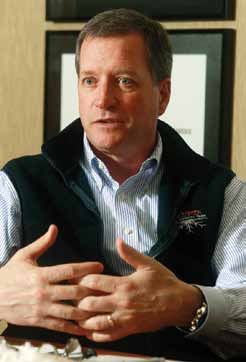
The ‘Fab Lab’

  from each other, and that’s exactly how it works in the   guesses that at least 50% of the kids in the STEM
  real world.”                                              program have family members working at Ariens.
     In 2013, the school’s competitive team, consisting       Dan Ariens says the company hires only a few
  of four girls and one boy, won second place at            students every year who move straight from high
  the Fox Valley Technical College competition              school to a full-time job. However, according to
  and first place at the Road America supermileage
  competition. The team’s one-seat hybrid car
  averaged 260 miles per gallon over three runs. Six
  years ago, an all-female team built a pink-trimmed
  car, took pledges for each mile per gallon and raised
  $1,500 for the Susan G. Komen Breast Cancer
  Foundation.
      Senior Rebecca Phipps, a member of last year’s
  award-winning team, says she caught the engineering
  bug early. “Mr. Meyer told me about an engineering
  camp in seventh grade, and I never really thought
  about a STEM career before that. I really liked it,
  and I started taking a lot of classes right away in my
  freshman year,” she says. Having other girls in the
  program is a plus, she adds.
                                                            Senior Rebecca Phipps caught the engineering bug in seventh grade.
     Phipps wants to go to Michigan Technological
  University and major in chemical engineering.             Meyer, his kids go work at Ariens “in the hundreds”
  Working with chemicals, of course, is different from      during the summer, helping out during snow blower
  studying engineering. But both are STEM fields            assembly season. (Conversely, lawn mowers are
  where women are historically underrepresented.            made during the winter.)
                                                              “A lot of those kids have had our classes and
                                                            probably make some of the best employees over
          Wisconsin has about                               there because they have a general understanding of
                                                            what happens at the plant.”
      22% fewer factory jobs than
       the high point of 600,000                            Meyer wants to promote a culture where
                                                            engineering is cool; he calls it being “Stemmy.” He
             in early 2000.                                 says he tries to keep community members excited
                                                            about technical education in the same way they get
                                                            excited for Friday night football.
    According to Nistler, around 30% of Brillion’s            His dream to extend STEM education to kids as
  graduates go to technical college while from 50%          early as kindergarten was recently fulfilled when the
  to 60% enroll in four-year colleges. Others go into       Brillion School Board mandated STEM instruction
  apprenticeships or straight into the workforce. Nistler   for K-5 classes, including rudimentary engineering

 22   Wisconsin Interest
The ‘Fab Lab’
projects for 5-year-olds. new Environmental Protection Agency regulations
“Fourth-graders are learning about industrial aimed at reducing leaks of gas fumes. One of the
engineering. Third-graders are doing biomedical high school’s working groups designed a leak-proof
engineering, making human prosthetics and wind tank, created a computer model and produced a
turbines. Kids can tell you about Newton’s third law of prototype. The tank quickly went to tooling and soon
motion at age 5, because they’re making parachutes was featured on the company’s new line of riding
and throwing them off the steps,” says Meyer, who lawn mowers.
has installed a modified version of the elementary “If you want to give your kids an experience they
school curriculum created by the Boston Museum of will carry the rest of their lives, then they need to
Science. go through a program like STEM,” says Ariens. “It’s
So far, K-5 STEM has been a big hit: “I would bet, if
I asked 95% of the kids in our elementary school right
now what their favorite class was, they’d say STEM,” The tech program will
says Meyer.
Yet some have reservations about the Ariens give kids ‘an experience they
initiative. “Having individual businesses cutting will carry the rest of their
their own partnership deals with public high schools
creates a competitive disadvantage for other lives,’ says Dan Ariens. ‘It’s
business owners who do not have the same political
influence or financial resources,” says Lori Compas of
learning, it’s experimenting,
the liberal Wisconsin Business Alliance. She adds that it’s problem-solving.’
such arrangements might seem too politically “cozy”
without a system in place requiring transparency.
Compas said that while the Brillion-Ariens learning, it’s experimenting, it’s problem-solving, it’s
partnership appears to be a successful model, she integrating with adults in a work environment.… It’s
believes such programs are better implemented really a holistic experience for 16- and 17-year-olds.”
through increased funding for public schools and the Paul Nistler agrees. He says Dan Ariens sees the
Wisconsin Technical College System. big picture, while still tending to the needs of his
Brillion’s families are certainly willing to step company: “He obviously wants people to come over
up to the plate. On April 1, voters approved, by a and work for him, but he wants people to come out
convincing 59% - 41% margin, a referendum to spend of this program who can work anywhere, too. It’s not
$2.95 million to convert an old elementary school just ‘Send me your kids or else!’ He understands how
gymnasium into a STEM lab. This will add around important it is to manufacturing in Wisconsin, or
$20 the property tax bill of a $100,000 parcel of anywhere else, that we are producing those thinkers,
property. those innovators.” n
To Dan Ariens, there is no question how valuable
a STEM education is. During a tour of Ariens’
main factory, he points to a gas tank the students Christian Schneider writes for The Milwaukee Journal Sentinel,
engineered a year and a half ago in response to National Review and other national outlets.
23You can also read


