THE CHINESE CRESTED With an explanation of Teeth and Coat by
←
→
Page content transcription
If your browser does not render page correctly, please read the page content below
THE CHINESE CRESTED
                                  Illustrated Standard
                             With an explanation of Teeth and Coat by
                                Lorraine Chippindale – Chinaroad
         Article prepared by Judy Horton - (All Breeds judge) for the VicJudge's website Australia

HISTORY OF THE BREED
The Chinese Crested is believed to have evolved from the African hairless dogs. These dogs were traded
among merchants and sailors thereby making their way to ancient port cities around the world. The Chinese,
who seemed to favor dogs of smaller size, selectively bred the African hairless to a smaller size and
continued an active trade. Explorers, as early as the 1500s, found these dogs in ports throughout Central and
South America as well as African and Asian cities.
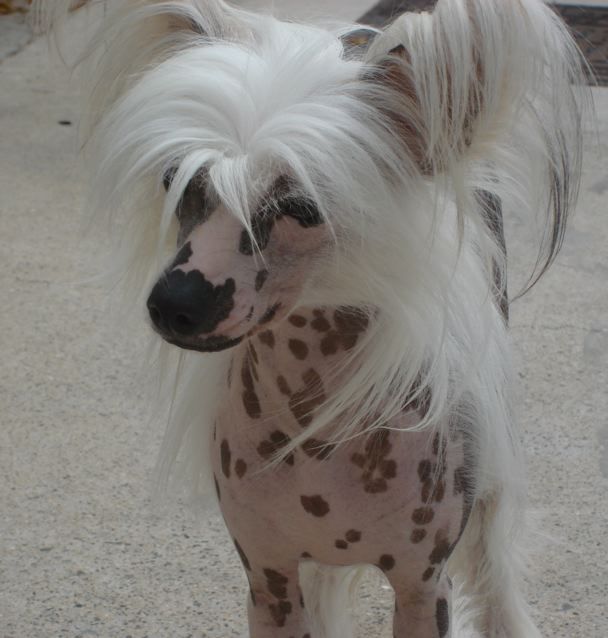
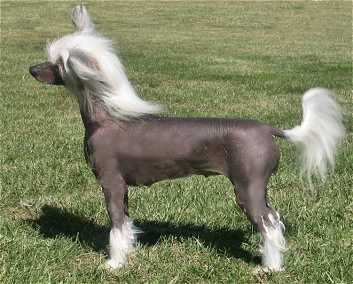
GENERAL APPEARANCE - A small, active and graceful dog; medium to fine boned, smooth hairless
body, with hair on feet, head and tail only; or covered with a soft veil of hair.
Explanation:
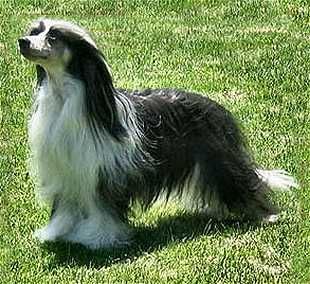
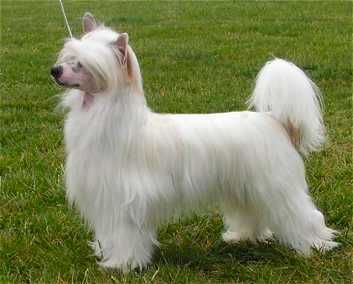
The Chinese Crested is found in two varieties, Hairless and Powderpuff, and both types can be found in the
same litter. The main difference between the two varieties is the hair coat, of course, but the Powderpuffs
can also have a drop ear, which is not permitted in the hairless variety. The Powderpuffs are not subject
to as many genetic defects as their hairless siblings and need to be retained in the breeding pool to maintain
the health of the hairless Cresteds.

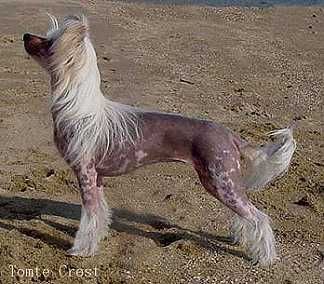
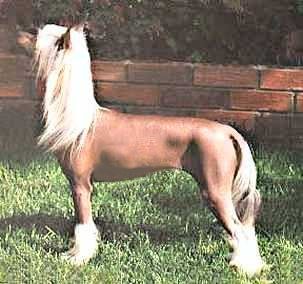
CHARACTERISTICS - Two distinct types of this breed; Deer type, racy and fine boned, and Cobby type,
heavier in body and bone.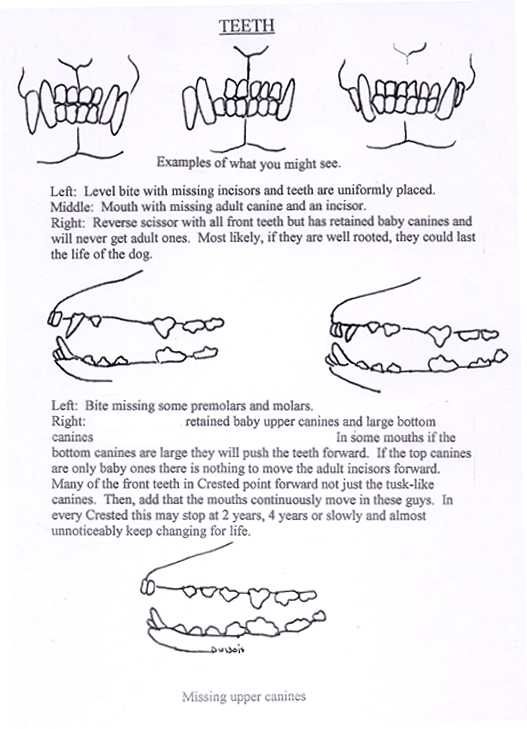
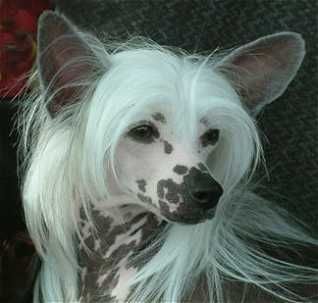
HEAD AND SKULL - Slightly rounded and elongated skull. Cheeks cleanly chiselled, lean and flat,
tapering into muzzle. Stop slightly pronounced but not extreme. Head smooth, without excess wrinkles.
Distance from base of skull to stop equal to distance from stop to tip of nose. Muzzle tapering slightly but
never pointed, lean without flews. Nose a prominent feature, narrow in keeping with muzzle. Any colour
nose acceptable. Head presenting graceful appearance, with alert expression. Lips tight and thin; An ideal
crest begins at the stop and tapers off down neck. Long and flowing crest preferred, but sparse acceptable.

Explanation:
The head is wedge shaped when viewed from above. The skull itself is gently arched across the occiput from
ear to ear. The stop is slight but distinct. The head is clean and free from wrinkle.

EARS - Set low: highest point of base of ear level with outside corner of eye. Large and erect, with or
without fringe, except in Powder Puffs where drop ears are permissible.

EYES - So dark as to appear black. Little or no white showing. Medium size, almond in shape. Set wide
apart.

Explanation:
Eyes are dark in darker coloured dogs, but may be a little lighter in lighter coloured dogs, but blue, green,
grey or yellow eyes are not acceptable.
EARS -‐ Set low: highest point of base of ear level with outside corner of eye. Large and erect, with or without fringe, except in Powder Puffs where drop ears are permissible. MOUTH -‐ Jaws strong, with perfect, regular scissor bite, i.e. the upper teeth closely overlapping the lower teeth and set square to the jaws.
Explanation:
Scissors or level in both varieties. Missing teeth in the Powderpuff are to be faulted. The Hairless variety is
not to be penalized for absence of full dentition.
Due to the hairless gene, the teeth in the Hairless may be smaller and the tiny "tusks" will extend forward,
but the Powderpuff should have a regular canine mouth. These tusk-like teeth in the Hairless may be due
to a gene that often is seen with other mostly hairless mammals, such as the wild boar and the elephant.
Selective breeding may help lessen the tooth problems of the hairless.
Hairless: The Hairless mouth is different from that of a Powderpuff. The teeth of the Hairless variety differ
in shape from those in a normal mouth. The canines are conical and point forward; they are referred to as
tusks. This is a characteristic which applies to both good and bad "Hairless" mouths.
The shape of the incisors can vary considerably. Some are no more than little pegs protruding from the
gums. Others are almost normal. Sometimes a full complement of narrow "pegs" can look as though they
have been thrown in haphazardly. The number of teeth present can also vary. In the worst example, many may be missing, having never been present at all. Occasionally, milk teeth which showed great promise are not replaced with adult teeth; and where milk teeth have been missing, adult teeth can appear! The teeth that are present can be poorly rooted. For example, incisors may point forward like tusks, but they will certainly fall out at an early age. Pre-molars will be missing from the Hairless variety - one, two, or maybe all of them. Even a good Hairless mouth may be without first and second pre-molars, and this should be accepted as normal. Tusks and missing pre-molars are not mentioned in the Standard, but these characteristics should be acknowledged as typical of the Hairless mouth. A successful breeding program to improve dentition will result in a mouth where all the incisors are evenly placed in each jaw. One or two pre-molars may be missing. The forward-pointing tusks will still remain, but the teeth will be of better quality, and they will not fall out in eighteen months time. An extremely "hairy" Hairless can look almost like a lightly-coated Powderpuff! They have even been referred to as "semi-coats", which makes things even more complicated for a newcomer to the breed. In order to check whether such a dog is genetically Hairless or Powderpuff, simply look in the mouth. If the dog is genetically Hairless it will have forward-pointing tusks; if it is a Powderpuff it will have a normal mouth. Puff: The Powderpuff carries no Hairless genes, therefore it has a normal canine mouth, and their mouths are not affected by the Hairless gene mutation. At the front there are six incisors top and bottom. The canine teeth are strong and slightly curved. Behind the canine teeth are four pre-molars and two molars, in both upper and lower jaws. This makes forty-two teeth in all, in a tight scissor bite. FOREQUARTERS -‐ Shoulders clean, narrow and well laid back. Legs long and slender, set well under body. Elbows held close to body. Pasterns fine, strong, nearly vertical. Toes turned neither in nor out.
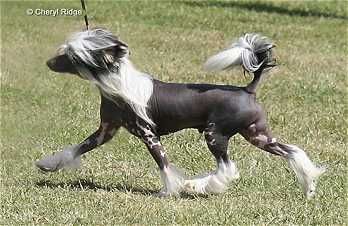
BODY - Medium to long. Supple. Chest rather broad and deep, not barrel-ribbed. Breast bone not
prominent. Brisket extending to elbows; moderate tuck-up.
Explanation:
The body is rectagular, measured from the withers to the base of tail slightly is longer than the height at the
withers. The topline is "table top" level from behind the withers to the set-on of tail without the pin bones
showing.
TAIL
-‐
Set
high,
carried
up
or
out
when
in
motion.
Long
and
tapering,
fairly
straight,
not
curled
or
twisted
to
either
side,
falling
naturally
when
at
rest.
Plume
long
and
flowing,
confined
to
lower
two-thirds
of
tail.
Sparse
plume
acceptable
Explanation:
The
tail
may
point
forward
towards
the
head
when
on
the
move.
The
tip
of
the
tail
must
never
turn
down
towards
the
back,
or
touch
the
topline.
(
Do
not
confuse
the
foward
falling
plume,
as
part
of
the
loop
)
The
tail
itself
must
not
curl
over
the
back
or
form
a
ring
(teapot
tail).
HINDQUARTERS
-‐
Rump
well
-
rounded
and
muscular,
loins
taut,
stifles
firm
and
long,
sweeping
smoothly
into
the
well
let-down
hock.
Angulation
of
the
rear
limb
must
be
such
as
to
produce
a
level
back.
Hind-legs
set
wide
apart.
FEET
-‐
Extreme
hare
foot,
narrow
and
very
long,
with
unique
elongation
of
small
bones
between
joints,
especially
in
forefeet,
which
almost
appear
to
possess
an
extra
joint.
Nails
any
colour,
moderately
long.
Socks
ideally
confined
to
toes,
but
not
extending
above
top
of
pastern.
Feet
turning
neither
in
nor
out.
Drawings
adapted
from
the
book
Canine
Terminology
by
Harry
Spira
Cat
foot
Hare
foot
Elongated
hare
foot
Unacceptable
Acceptlable
but
not
desired
Desired
Explanation:
This is a characteristic of the Chinese Crested and is fast disappearing from the breed. To ensure it remains it
must be checked. Like many dogs the Chinese Crested hates to have its feet touched, so to examine them
without upsetting the dog, just pick it up as you would a horse's foot and bend it backwards. You can soon
see the distance from the foot pad to the toe pads from underneath.
• A cat foot will have the foot pad and the toe pad relatively close together. (See above illustration)
• A hare foot will have the toe pads a longer distance from the main foot pad. (See above illustration)
• An elongated hare foot will have even more distance from the main foot pad. (See above illustration)
COLOUR - Any colour or combination of colours.
Explanation:
All colour including parti-coloured, solids,spotted and tri-coloured are permitted. The shades can range from
pale to very rich. Don't let colour sway your judgment - judge for conformation first and foremost!
COAT - No large patches of hair anywhere on body. Skin fine grained, smooth, warm to the touch. In
Powder Puffs coat consists of an undercoat with soft veil of long hair, veil coat a feature.


Explanation:
Due to the variable expressivity of the hairless gene, it is almost impossible to eliminate sparse hair in the
Crested. Selective breeding can help, but it is a feature we have to live with.
(Editor's note: The coat texture on both varieties is soft, silky and straight of moderate density and length.
Thick, heavy, curly or kinky coats are not acceptable. Hair on the face and ears of both varieties may be
trimmed for neatness. Additional grooming to be kept at a minimum, and only to present a clean and neat
appearance.)
Puff: The coat of the Powderpuff causes confusion. The Standard calls for an undercoat with a soft veil of
long hair. It is only in recent years that a Powderpuff coat has been given real coat care, so we are only just
seeing the beauty of the mature coat. The length of the coat will vary: if the Hairless in the line have long
crests, the coat will be long; if they are sparsely crested, the coat will be thinner and shorter. The coat is
made up of long, soft hairs with coarser guard hairs. When the dog is young these hairs are short and look
like an undercoat, but by the time the dog is eighteen months old, they grow through to create the so-called
veil. In reality, this is not a very good description and it causes much confusion among judges and breeders.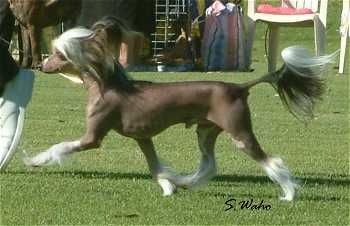
On a well-groomed dog the guard hairs will mingle with the main coat and they will only show if they are a
darker colour, which gives a very attractive appearance.
Hairless: An extremely hairy Hairless will fit the Standard, which has also led to confusion! There is
another coat-type, which is seen occasionally. It is shorter and quite coarse. The ears are also smaller than
normal and are erect. These types are probably the result of mixed parentage, way back in the evolution of
the breed. It is NOT a Powderpuff though, it is a HAIRY HAIRLESS and will not have a normal mouth, but
rather forward-pointing tusks.


GAIT/MOVEMENT - Long, flowing and elegant with good reach and plenty of drive.

Explanation:
Movement is quick and lively without a hackney or mincing gait. Topline remains level.
SIZE -
   • Ideal height: Dogs 28-33 cm (11-13 ins) at withers
   • Bitches 23-30 cm (9-12 ins) at withers
   • Weight varies considerably, but should not be over 5.5 kg (12 lbs).

                  For more photographs of Chinese Cresteds visit the Chinese Crested Database
       Editors note: Many of the photographs above were taken off this website as examples of excellent type
You can also read


