The Chinese Tourist Boom - November 20, 2015 - Goldman Sachs
←
→
Page content transcription
If your browser does not render page correctly, please read the page content below
November 20, 2015

   5IF"TJBO$POTVNFS

   The Chinese Tourist Boom
                         China’s outbound tourism is set to bloom over the
Where Now, Where Next?

                         next 10 years and leave its mark on a wider range
                         of destinations. Fueled by experience-hungry
                         millennials and a growing middle class, the number
                         of Chinese passport holders is forecast to swell by
                         100 million over the decade – equal to almost 1.5x
                         all US outbound tourists today. While Hong Kong
                         and Macau will remain important destinations, the
                         surge will lead to dramatic increases in visitors to
                         destinationT across Asia, Europe and beyond.

                         4IP,BXBOP                      +PTIVB-V

                         TIPLBXBOP!HTDPN              KPTIVBMV!HTDPN
                         (PMENBO4BDIT+BQBO$P -UE   (PMENBO4BDIT "TJB --$

                         3JDLZ5TBOH $'"                +JOHZVBO-JV

                         SJDLZUTBOH!HTDPN             KJOHZVBOMJV!HTDPN
                         (PMENBO4BDIT "TJB --$    (PMENBO4BDIT+BQBO$P -UE

   Goldman Sachs does and seeks to do business with companies covered in its research reports. As a result, investors should be aware
   that the firm may have a conflict of interest that could affect the objectivity of this report. Investors should consider this report as only a
   single factor in making their investment decision. For Reg AC certification and other important disclosures, see the Disclosure Appendix,
   or go to www.gs.com/research/hedge.html. Analysts employed by non-US affiliates are not registered/qualified as research analysts with
   FINRA in the U.S.
                                                                                                             The Goldman Sachs Group, Inc.
November 20, 2015                                                                                                                                                      Asia Pacific: Retail

Table of contents
Chinese tourism in eight charts                                                                                                                                                         4
Overview: Six key questions                                                                                                                                                             6
Chinese tourism by numbers                                                                                                                                                              8
Q1: How many could travel?                                                                                                                                                             11
Q2: Who are they?                                                                                                                                                                      14
Q3: Why do they travel?                                                                                                                                                                21
Q4: Where do they go?                                                                                                                                                                  25
Q5: Is capacity an issue?                                                                                                                                                              41
Q6: What could slow the tide?                                                                                                                                                          52
Appendix                                                                                                                                                                               64
Disclosure Appendix                                                                                                                                                                    66

This is an abridged version of “The Chinese Tourist Boom: Where Now, Where Next?” originally published November 20, 2015.

Analyst team contributors
           Analyst                  Telephone            Email                                     Analyst                  Telephone            Email
Japan Retail                                                                          Hong Kong Retail
           Sho Kawano               +81 (3) 6437 9905    sho.kawano@gs.com                       Joshua Lu                  +852 2978 1024       joshua.lu@gs.com
           Jingyuan Liu             +81 (3) 6437 9858    jingyuan.liu@gs.com                     Ricky Tsang                +852 2978 6631       ricky.tsang@gs.com
                                                                                                 Alan Lee                   +852 2978 0953       alan.lee@gs.com
Japan Hotel/REIT                                                                      Hong Kong Conglomarates
           Sachiko Okada            +81 (3) 6437 9937    sachiko.okada@gs.com                    Simon Cheung               +852 2978 6102       simon.cheung@gs.com
           Akira Watanabe           +81 (3) 6437 9819    akira.watanabe@gs.com                   Alex Ye                    +852 2978 6666       alex.ye@gs.com
Japan Transportation                                                                  Hong Kong Transportation
           Kenya Moriuchi           +852 2978 1255       kenya.moriuchi@gs.com                   Ronald Keung               +852-2978-0856       ronald.keung@gs.com
           Taiki Okada              +81 (3) 6437 9917    taiki.okada@gs.com
Korea Retail                                                                          EU Retail
           Christine Cho            +82 (2) 3788 1773    christine.cho@gs.com                      William Hutchings        +44 (20) 7051 3017   william.hutchings@gs.com
           Jean Lee                 +82 (2) 3788 1729    jean.x.lee@gs.com                         Isabel Zhang Zhang       +44 (20) 7552 4644   isabel.zhangzhang@gs.com
Taiwan Retail                                                                         US Retail
           Michelle Cheng           +866 (2) 2730 4181   michelle.cheng@gs.com                     Matt Fassler             +1 (212) 902 6740    matt.fassler@gs.com
           Goldie Chang             +65 6654 5154        goldie.chang@gs.com                       Lindsay Drucker Mann     +1 (212) 357 4993    lindsay.druckermann@gs.com
ASEAN Retail                                                                          US Leisure
           June Zhu                 +65 6889 2466        june.zhu@gs.com                           Steven Kent              +1 (212) 902 6752    steven.kent@gs.com
                                                                                                   Afua Ahwoi               +1 (212) 902 1760    afua.ahwoi@gs.com
Hong Kong Internet/Media
         David Jin                  +852-2978-1466       david.jin@gs.com

Goldman Sachs Global Investment Research                                                                                                                                                 2
November 20, 2015 Asia Pacific: Retail
The Chinese Tourism Boom: By the Numbers
PASSPORT POTENTIAL MIDDLE-CLASS MOBILITY
The passport-owning population in China (vs. 35% The percentage of outbound Chinese tourists from
4% in the US). We expect this figure to reach 12%
within 10 years. (Page 16) 28% the “urban middle” class, compared to just 3%
from the “urban mass.” (Page 17)
THE 10-YEAR TRAVEL OUTLOOK GRADUATE AND GO
The number of travel-ready millennials who will
220 mn
The number of Chinese residents who will travel
overseas in 2025, up from 120 mn this year.
(Page 13)
74 mn graduate from Chinese universities in the next 10
years. (Page 18)
HEADED TO HONG KONG AND MACAU…FOR NOW NEXT STOP(S): JAPAN AND BEYOND
The number of Chinese residents who will visit
The number of Chinese travelers who will visit
70 mn Hong Kong and Macau in 2015—two destinations
that don’t require a passport. (Page 27)
16 mn Japan in 2025, up from 5mn in 2015. We also
expect Korea, Australia and Europe to become
tourist hot spots. (Page 26)
“HAVING FUN” BUDGET VACATION COSTS
The average amount that Chinese residents spend
The average cost of a package tour to Japan,
$230/yr on “having more fun.” This is less than 10% of the
per capita amount in the US, Japan and Korea, but
poised to grow as China spends more on leisure.
$2,000 including money spent on shopping ($1,000). (Page
21)
(Page 24)
THE ACCOMPANYING RETAIL BOOM BARGAIN HUNTING
The amount Chinese tourists will spend on travel The discount Chinese tourists can expect when
$450 bn overseas in 2025, an increase of $250 bn from
today’s figures. (Page 35)
20-30% shopping in Japan, Korea and Hong Kong, adding
to these locations’ appeal. (Page 39)
VISA RESTRICTIONS LIMIT TRAVEL UP IN THE AIR
The number of countries that offer Chinese tourists
The flight time from Shanghai to Tokyo. Chinese
45 visas upon arrival. In contrast, 172 countries offer
visas on arrival for Japanese and Korean tourists.
(Page 60)
3 hours tourists can fly to most Asian countries in four
hours or less. (Page 29)
Goldman Sachs Global Investment Research 3November 20, 2015 Asia Pacific: Retail
Chinese tourism in eight charts
Exhibit 1: We estimate only 4% of the Chinese population owns a passport… Exhibit 2: …as such, we expect Chinese tourist numbers to keep growing…
Passport ownership by country Chinese tourist growth outlook by destination (GSe)
160 150 40% (mn) 2015E 2025E
140 35% HK/Macau 68.0 → 86.4 1.3X
Assuming the 35%
120
run rate
30%
Korea 5.9 → 14.1 2.4X
continues at 109
10mn Taiwan 4.1 → 9.2 2.2X
100 passports p.a. 25%
25% Japan 5.0 → 16.0 3.2X
80 20%
ASEAN 12.0 → 35.0 2.9X
60 55 15% Thailand 2.5 → 6.0 2.4X
40 12% 32 10% Australia 1.0 → 2.0 2.0X
US 2.2 → 5.0 2.3X
20 5%
4% Europe 10.0 → 22.5 2.3X
0 0%
China (2014E) China (2025E) US (2012) Japan (2014) Other 11.8 → 29.8 2.5X
Total passport holders (mn) as % of population (RHS) Total 120.0 → 220.0 1.8X
Source: CEIC, Goldman Sachs Global Investment Research. Source: Goldman Sachs Global Investment Research.
Exhibit 3: …potentially to 130 mn vs. 50 mn in 2015 (ex. Hong Kong/Macau) Exhibit 4: “Fun” related spending is under-indexed in China…
Chinese tourist volume to Hong Kong/Macau, and other regions Comparison of per-capita spending on “having fun” (FY2013, US$)
250 45%
Aggregate outbound tourists over time (mn)
20%
220 18%
40%
18% 17%
16%
200
35% 16%
90
30%
14%
150
12%
25%
1.3X
120 2.5%
CAGR 10% 9%
20%
100 8%
70 15%
59
69 6%
130
52
50 44 2.6X
10%
4%
36 10%
29
23
28
28
50
CAGR
5% 2%
20 21 39 40
13 26 31
10 19 21
0
5
4
5
5
6
6 7 7 9 10 11 13 17
0%
0%
1999 2000 2001 2002 2003 2004 2005 2006 2007 2008 2009 2010 2011 2012 2013 2014 2015E ... 2025E
Passport Destinations (lhs) HK & Macau (lhs) Growth of Total (rhs)
China Japan US Korea
Source: CEIC, Goldman Sachs Global Investment Research Source: Euromonitor
Goldman Sachs Global Investment Research 4November 20, 2015 Asia Pacific: Retail
Exhibit 5: …74 mn millennial college grads in next 10 years is a key driver Exhibit 6: Various countries are relaxing visa requirements
Breakdown of Chinese overseas tourists by generation (2014)
Countries relaxing requirments for Chinese tourists
Post 60s
Japan, Korea, Taiwan, Thailand, Indonesia, Singapore,
and born Asia Pacific
Australia
before 60s, Post 90s, Europe UK, France, Germany
6% 11% America US
74mn of college‐grads
Post 70s,
26%
in the coming decade
Post 80s,
56%
Source: World Tourism Cities Federation Source: Goldman Sachs Global Investment Research.
Exhibit 7: Japan: Passport issuance is a more important driver of outbound Exhibit 8: Key risks to passenger growth mainly surround pricing and
travel growth than the economy potential visa changes
Japan: No. of overseas tourists and no. of passports issued
No. of passport issued (lhs, mn)
20.0 50% Risk factors
Outbound (lhs, mn)
18.0 45% May impact the pricing advantage of key destinations (e.g.
Passport holder % population (GSE, rhs, %)
HK, Japan Korea), although the relationship between visitor
16.0 40% FX rates
numbers and FX may be more limited in the fast-growth
14.0 35% stage
12.0 30% HK and Macau saw significant declines in Chinese tourist
10.0 25%
Visa policies numbers on visa tightening and are typical examples of the
risk
8.0 20%
Brands cutting Would impact the selling prices of products in China, hence
6.0 15% prices affecting the attractiveness of buying goods in other
4.0 10% Tariff/tax cuts countries
2.0 5%
0.0 0%
1985
1986
1987
1988
1989
1990
1991
1992
1993
1994
1995
1996
1997
1998
1999
2000
2001
2002
2003
2004
2005
2006
2007
2008
2009
2010
2011
2012
2013
2014
Source: Goldman Sachs Global Investment Research. Source: Goldman Sachs Global Investment Research.
Goldman Sachs Global Investment Research 5November 20, 2015 Asia Pacific: Retail
Overview: Six key questions
Q1: How many could travel?
We estimate 120 mn Chinese tourists will travel overseas in 2015, with c.70 mn traveling to Hong Kong/Macau, around 5 mn
to Japan, Korea, and Taiwan, 12 mn to ASEAN, and 2 mn to the US.
We expect the number of outbound passengers to almost double to 220 mn in 2025. If we exclude Hong Kong and Macau,
we expect Chinese tourist numbers to increase c.2.5 times to 130 mn in 2025 from 50 mn in 2015.
Q2: Who are they?
They are somewhat affluent: We estimate 28% of the “urban middle” cohort has a passport vs only 3% for the “urban
mass”. Per head spending on travel is US$1,400 – equal to 1-2 month’s salary for a typical middle-class worker.
They are young: Two thirds of current outbound travelers are millennials (15-35 years old). We expect the 74 mn college
students graduating over the next decade to further boost passport ownership.
Q3: Why do they travel?
To have fun: Millennials are aspirational, leading to structural upside in fun related experience based spending. This includes
sports, travel, online gaming, media and eating out. “Fun” related spending is under-indexed in China, at 9% of per capita
expenditure vs 16-17% in the US and Japan.
To shop: In the short-term, we still see shopping as a one of the key drivers for Chinese tourists when selecting travel
destinations. Chinese tourists spent US$200 bn (US$ 450 bn in 2025) in overseas spending in 2015 and 30% was on shopping.
The number of travelers should increase on three key drivers: (1) a passport ownership rate of just 4%, (2) a growing urban
middle class which is increasingly willing to spend more on fun, and (3) the boost from millennials’ travel.
Q4: Where do they go?
Today’s HK is tomorrow’s Japan/Korea: We expect high outbound traveler growth to Japan, considering multiple factors such as
the relatively short travel distance from China, price differentials, relaxing visa conditions, and tourism assets.
Distance: Many Asian countries are just a three to four hour flight from China, much closer than European and North American
countries. However, many countries require visas for travel from China, making them seem even further away.
Relaxation of visas: A number of key countries have already relaxed (or are in the process of relaxing) visa requirements for
Chinese tourists over the past 18 months, which could help boost tourist numbers. The addressable market of Chinese tourists
to Japan has increased to c.50 mn Chinese residents fromNovember 20, 2015 Asia Pacific: Retail
Price differentials: Our proprietary GS tourist price tracker suggests that prices of merchandise in China are c.20-30% more
expensive than HK, Japan and Korea on average. The greatest differences are mostly for goods, not services—a Zojirushi rice
cooker is more than 2X expensive in Shanghai vs Tokyo, but a taxi ride is 80% cheaper.
Tourism assets: This is becoming an increasingly important driver of tourism, as millennial travelers crave fun. Japan has the
second highest number of world heritage sites in Asia after China, making it an attractive destination for Chinese tourists. Hong
Kong, on the other hand has had limited additional attractions since Disneyland.
Q5: Is capacity an issue?
Countries set to experience high inbound tourist growth from China have sufficient capex plans for both hotels and airports but
Japan is lacking sufficient hotels. We do not anticipate any major capacity issues in HK, and Korea’s airport/hotel expansion
plans are enough to support double-digit Chinese inbound growth CAGR, in our view.
Q6: What could slow the tide?
China economic slowdown? Looking at past experiences in Japan, the UK, Korea, and others, suggests overseas travel has a
higher correlation with passport growth than the economy. Given only 4% of China’s population has a passport at present, we
think it is far too early to say there will be a change in the overall upward trend, even if the economic slowdown has more than
a slight impact.
We think FX rates and visa policies are two major swing factors to look at, while brands cutting prices in China and the
government lowering the tariff/tax would be another two risks.
Exhibit 9: We estimate millennials account for the majority of Chinese Exhibit 10: Chinese tourists spend far more than other tourists on shopping
overseas tourists in Japan
Breakdown of Chinese overseas tourists by generation (2014) Shopping outlays by foreign tourists in Japan (April-June 2015)
(JPY)
Post 60s 180,000
and born
before 60s, 160,000
Post 90s,
6% 11% 140,000
120,000
74mn of college‐grads 100,000
Post 70s,
26%
in the coming decade 80,000
Post 80s, 60,000
56% 40,000
20,000
0
Total China Korea Taiwan HK Thiland US UK
average
Source: World Tourism Cities Federation Source: Japan Tourism Agency
Goldman Sachs Global Investment Research 7November 20, 2015 Asia Pacific: Retail
Chinese tourism by numbers
4%→12%: Chinese passport ownership (2014 vs. 2025E)
We calculate the passport ownership rate in China is 4%, much lower than 25% in Japan and c.35% in the US. We expect the
number of Chinese passports to almost triple from 55 mn (2014) to 150 mn in 2025E (12% ownership) versus a c25% increase in the
number of passports globally (we estimate there are 400 mn passports on issue).
74 mn: Total number of college-grads in the coming decade
We see Chinese millennials as the key driver of our projected 100 mn increase in Chinese passport holders over the next 10 years.
Over the next decade, 74 mn millennials at Chinese universities are set to graduate; we think they will look to travel overseas in
large numbers given they are well informed and do not consider language barriers to be prohibitive.
US$33 vs. US$500: Household spending on travel (China vs. Japan/US, FY2013)
Chinese travelers spend less than 10% of what Japanese and Americans spend on travel. We expect them to increase spending on
having more fun.
120 mn→220 mn: Number of Chinese tourists (2015E vs. 2025E)
We expect 120 mn Chinese will travel overseas by the end of 2015, less than 10% of the 1.3 bn population. We forecast this number
to nearly double to 220 mn by 2025E.
70 mn vs. 4-6 mn: Chinese tourists to HK/Macau vs. Korea/Japan/Taiwan (2015E)
Of the 120 mn Chinese traveling overseas in 2015, we assume that around 70 mn will visit Hong Kong/Macau. By comparison, visitor
numbers to Korea, Japan, and Taiwan will likely be in the 4-6 mn range. As per-capita GDP increases and appetite for travel outside
Chinese-speaking regions grows, we expect a significant increase in outbound visitors to Japan and Korea.
US$200 bn→US$450 bn: Overseas spending by Chinese tourists (2015E vs. 2025E)
In 2015, Chinese tourists spent roughly US$60 bn on shopping overseas. We see this figure doubling to US$130 bn by 2025, in line
with the growth in tourist numbers (we assume flat spending per head).
Goldman Sachs Global Investment Research 8November 20, 2015 Asia Pacific: Retail
US$2,000: The avg cost of a package tour to Japan and money spent on shopping (2014)
A package tour from China to Japan costs around US$1,000 on average; after adding in local spending on shopping and other
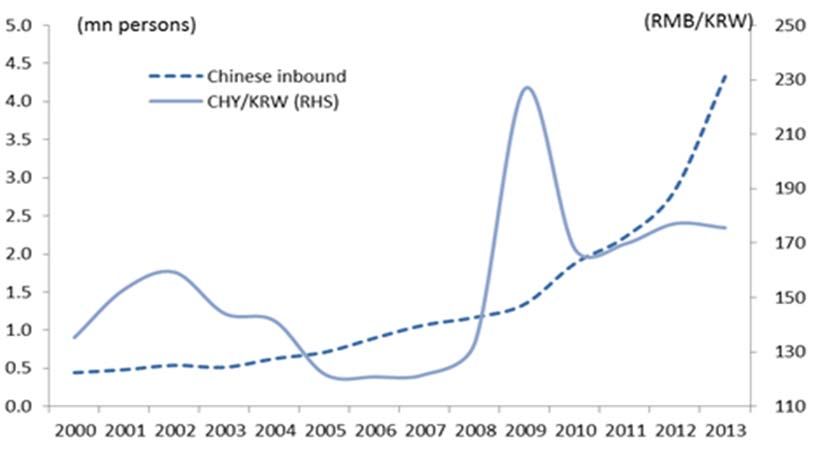
goods and services, Chinese tourists spend an average of roughly ¥250,000 (US$2,000) on trips to Japan.
20-30%: The price differential between items bought in China vs. Japan/Korea/HK
Our proprietary GS tourist price surveys in Tokyo, Seoul, Shanghai, and Hong Kong found an average price differential of c20-30%
for the same item (as of Aug 2015). Some items sold in China are more than double overseas prices.
45 vs.172: No. of countries that don’t require visas for tourists (China vs. Japan/Korea)
Around 60% of Chinese travelers regard visa applications as the greatest impediment to traveling overseas. This is not surprising as
Chinese passport holders require a visa to visit most destinations abroad (North America, Europe, Japan, Korea, Hong Kong, etc.).
Obtaining a visa upon arrival is only possible for a few destinations, including Thailand, Indonesia, Korea’s Cheju Island, and the
Maldives, and most other countries that do not require a visa are in Africa. By contrast, Korean and Japanese passport holders can
travel visa-free to 170 or more countries out of a total 195 countries. (Source: The Henley & Partners Visa Restrictions Index).
Goldman Sachs Global Investment Research 9November 20, 2015 Asia Pacific: Retail
Chinese tourist boom: Six key questions
Goldman Sachs Global Investment Research 10November 20, 2015 Asia Pacific: Retail
Q1: How many could travel?
We estimate Chinese tourists will total 120 mn in 2015, with 70 mn traveling to Hong Kong/Macau, around 5 mn each to Japan,
Korea, and Taiwan, 12 mn to ASEAN, and 2 mn to the US (see Exhibit 13: for a breakdown).
Exhibit 11: We expect outbound tourists in China to rise to 220 mn in 2025 from 120 mn in 2015 (130 mn from 50 mn ex-HK/Macau).
The incremental size is more than the total number of US outbound tourists (68 mn) in 2015.
Outbound tourist numbers (mn, 2015E)
250
220
200
150
120
100
68
50
18 16 13
0
China China US Japan Korea Taiwan
(2015E) (2025E)
Source: Goldman Sachs Global Investment Research.
Goldman Sachs Global Investment Research 11November 20, 2015 Asia Pacific: Retail
Exhibit 12: Outbound tourists (other than to Hong Kong/Macau) to rise c2.5X to 130 mn in 2025 from around 50 mn in 2015
Breakdown of Chinese tourists visiting Hong Kong/Macau and other destinations
250 45%
Aggregate outbound tourists over time (mn)
220
40%
200
35%
90
30%
150
25%
1.3X
120 2.5%
CAGR
20%
100
70 15%
69
59
130
52 10%
50 44 2.6X
36 10%
28 29 CAGR
28 5%
23 50
20 21 39 40
13 26 31
6 10 19 21
5 5 13 17
6 7 7 9 10 11
0 4 5 0%
1999 2000 2001 2002 2003 2004 2005 2006 2007 2008 2009 2010 2011 2012 2013 2014 2015E ... 2025E
Passport Destinations (lhs) HK & Macau (lhs) Growth of Total (rhs)
Source: CEIC, Goldman Sachs Global Investment Research.
Goldman Sachs Global Investment Research 12November 20, 2015 Asia Pacific: Retail
Exhibit 13: Where do Chinese tourists go?
Main travel destinations for Chinese tourists (current forecast for 2015, extended forecast for 2025
US
China 2 mn 5 mn
Europe
120 mn in 2015
10 mn 22.5 mn 220 mn in 2025E
Japan
5 mn 16 mn
Korea
6 mn 14 mn
HK/Macau Taiwan
68 mn 86 mn 4 mn 9 mn
Destination location by 2025E (mn) ASEAN
Other, Europe, 12 mn 35 mn
30.5 22.5
US, 5
Aus- Japan,
tralia, 2 16
ASEAN Korea,
, 35 HK and 14
Macau,
Taiwan Australia
86
,9
1 mn 2 mn
Source: Goldman Sachs Global Investment Research.
Goldman Sachs Global Investment Research 13November 20, 2015 Asia Pacific: Retail
Q2: Who are they?
They are somewhat affluent: We estimate that 28% of the “urban middle” cohort has a passport, vs only 3% for the “urban
mass”. Per head spending on travel is US$1,400, which is equal to 10-15% of a typical middle class’ annual salary.
They are young: Two thirds of current outbound travelers are millennials (15-35 years old). With 74 mn college grads in the next
decade, we expect this to further boost passport ownership.
Exhibit 14: Only 4% of China’s population hold a passport, far lower than 25% Exhibit 15: We expect the number of Chinese passports to increase by 10 mn
for Japan and 35% for the US a year and for the passport ownership rate to increase to 12% in 2025
Number of passports and passport ownership ratios Number of Chinese passports
160 40% 160
150 150
Assuming 10mn new
140 35% 140 passports p.a (10%
Assuming the 35%
run rate CAGR)
120 continues at 30% 120
109
10mn
100 passports p.a. 25%
25% 100
80 20%
80
60 55 15% 20% CAGR
60 55
40 12% 32 10% 11% CAGR
40 38
20 5%
20
4% 20
0 0%
China (2014E) China (2025E) US (2012) Japan (2014)
0
Total passport holders (mn) as % of population (RHS) 2006 2012 2014E 2025E
Source: CEIC, Goldman Sachs Global Investment Research. Source: CEIC, Goldman Sachs Global Investment Research.
Goldman Sachs Global Investment Research 14November 20, 2015 Asia Pacific: Retail
Exhibit 16: We estimate passport ownership rates are 28% for the “urban Exhibit 17: We forecast around 40% of China's urban middle + mass cohort
middle” and 3% for the “urban mass” will hold passport in 2025
Passport ownership rates by population segment Passport ownership rate with “urban mass” and “urban middle” as the
denominator
mn 450 45%
250 39%
3% of Mass Urban
400 40%
8
is passport holder
350 35%
200
300 30%
Mass
150 250 236mn 25%
28% of Mass Middle
42 is passport holder 200 20%
228 14% 150mn
100 150 15%
100 10%
Middle 55mn
50 104
50 146mn 5%
0 0%
0 Urban middle + mass Passport holders Passport holders
Urban middle Urban mass cohort (2014E) (2014E) (2025E)
Source: Goldman Sachs Global Investment Research. Source: Goldman Sachs Global Investment Research.
Exhibit 18: We assume the “urban middle” are the main overseas travelers, but we think more households in the “urban mass”
will be able to travel overseas as their incomes grow
The Chinese population divided into six segments
Working Average income (% of working (% of private Aggregate
Population: per capita in 2013 (US$): population) consumption income in 2013
Movers and expenditure) (US$bn):
1.4mn 500,000 shakers (0.2%) (10%) 691
Government
69mn 12,245 (9%) (20%) 845
28% own /SOE staff “URBAN MIDDLE”
passport
77mn 11,184
Urban white (10%) (20%) 859
collar/SME owners
70mn 6,830 Urban blue collar workers (9%) (11%) 476
4% own “URBAN MASS”
passport
166mn 5,448 Migrant workers (22%) (22%) 905
387mn 2,000 Rural (50%) (17%) 774
Total : US$5,909 Working population avg per capita income
770mn
US$3,362 China overall avg per capita income
US$6,993 China GDP per capita
Source: Goldman Sachs Global Investment Research.
Goldman Sachs Global Investment Research 15November 20, 2015 Asia Pacific: Retail
Exhibit 19: The Central Government targets a doubling of average income per capita from 2010-2020, implying a doubling of the size of the working population
with an average income of US$10,000+ p.a.
Population and income forecasts for six Chinese consumer segments
2013 Cohort size 2013 Income 2020E Cohort 2020E Income per Income per
Government target to double 2010 average real per capita per size capita per annum capita per
income per capita by 2020=> 7% real income annum annum CAGR
per capita CAGR mn US$ mn US$ %
Movers and Shakers 1.4 500,000 => 2 636,000 - 680,000 3.5-4.5%
Government/SOE employees 69 12,245 => 74 17,230 - 18,400 5.0-6.0%
Urban white collar/SME owner 77 11,184 => 84 16,800 - 18,000 6.0-7.0%
7% real income per capita CAGR + 2% inflation = Urban blue collar 70 6,830 => 77 9,940 - 10,600 5.5-6.5%
9% nominal income per capita CAGR Migrant workers 166 5,448 => 197 8,750 - 9,340 7.0-8.0%
Rural workers 387 2,000 => 361 3,108 - 3,300 6.5-7.5%
Overall working population 770 5,909 => 796 9,140 - 9,760 6.4-7.4%
14% CAGR from
2010 to 2013
Nominal income per capita should deliver 6.9% Size of the working population with Urban working population will earnNovember 20, 2015 Asia Pacific: Retail
Exhibit 21: Assuming half of the 74 mn students set to graduate from Exhibit 22: The significance of the additional 26 mn is clear given the number
Chinese universities over the next decade obtain a passport and 70% of them of overseas trips by Chinese tourists was c. 50 mn (excl. HK/Macau) in 2014
travel overseas, the number of overseas trips would rise by 26 mn Comparison of outbound trips
Simulation of the number of overseas graduates and overseas travel
Total number of college graduates in China (2015-25, mn) 74 45
% which will apply for passports (GSE) 50% 40
Total incremental passport count from college grads 37 40
% conversion to addtiional annual trips (based on 2012-14 actual) 70%
35
Total annual incremental trips for year 2025 26
30
26
25
20
15 13
10
5
0
Total yearly Total outbound trips Total trips to US, EU,
incremental trip by (ex-HK/Macau, 2014) KR, KP (2014)
2025
Source: CEIC, Goldman Sachs Global Investment Research. Source: CEIC, Goldman Sachs Global Investment Research.
What is their travel budget?: Survey respondents planned to spend around US$1,000 (Rmb6000) on package tours to Asia. Per
data from the Japan Tourism agency, Chinese tourists spent more than US$1,000 in Japan on average (Jan-June 2015). However,
the amount spent on shopping locally differs by destination.
What are the challenges they face traveling overseas?: Most Chinese travelers cited visa applications as the greatest impediment
to overseas travel, followed by language, budget, and other factors (per a survey by sojump.com).
Goldman Sachs Global Investment Research 17November 20, 2015 Asia Pacific: Retail
Exhibit 23: Millennials (aged 35 or below) account for the majority of Exhibit 24: Japan and Korea are the preferred destinations
respondents Survey question on the next intended overseas travel destination
Age breakdown for 1,000 survey respondents
40% 60% 57%
34%
35% 50%
30% 28% 28% 40% 31% 30%
30% 26% 24%
25% 22%
20%
20%
10%
15% 0%
10% 0%
10%
Hainan island
Japan/Korea
EU
Thailand
New Zealand
other
US
5%
0%
~22 23‐28 29‐35 36~
How old are you? Where would you like to go in your next trip?
Source: Sojump.com survey. Source: Sojump.com survey.
Exhibit 25: A majority indicated that they plan to spend around Rmb6,000 Exhibit 26: Visa application was cited as the greatest impediment to overseas
(=US$1,000) travel
Survey question on overseas travel budget Survey questions on the largest impediment to overseas travel
35% 29% 29% 70%
30% 58%
23% 60%
25% 50%
20% 16% 50% 42%
15% 39%
40% 35% 34%
10%
3% 30%
5%
0% 20%
~2000RMB
2000‐4000RMB
4000‐6000RMB
6000‐8000RMB
8000RMB~
10%
0%
Visa Lauguage Price Planning Quality How to
(expensive) book
Budget What is the biggest difficulty for you to travel?
Source: Sojump.com survey. Source: Sojump.com survey.
Goldman Sachs Global Investment Research 18November 20, 2015 Asia Pacific: Retail
Exhibit 27: A flight from a major Chinese city to an Asian destination costs Rmb2,000-3,000 (about ¥50,000/US$500)
Ticket prices from major Chinese cities to overseas destinations
RMB Round Trip (3D2N / 1x Adult)
Country From Beijing From Shanghai From Guangzhou
Hong Kong ¥ 2,768 ¥ 1,670 ¥ 2,222
Macau ¥ 1,928 ¥ 1,544 ¥ 2,758
Korea ¥ 2,544 ¥ 2,115 ¥ 2,757
Thailand ¥ 2,223 ¥ 2,482 ¥ 1,322
Taiwan ¥ 1,834 ¥ 1,586 ¥ 1,744
Japan ¥ 4,513 ¥ 3,308 ¥ 5,019
Vietnam ¥ 1,866 ¥ 2,322 ¥ 1,732
Singapore ¥ 2,499 ¥ 2,290 ¥ 1,677
Malaysia ¥ 2,198 ¥ 2,821 ¥ 2,255
Philippines ¥ 1,767 ¥ 2,271 ¥ 1,702
US ¥ 10,385 ¥ 10,949 ¥ 12,829
UK ¥ 13,556 ¥ 13,401 ¥ 11,805
Source: Ctrip (as of end of August 2015)
Goldman Sachs Global Investment Research 19November 20, 2015 Asia Pacific: Retail
Exhibit 28: Besides tour packages, Chinese tourists spend a lot of money on shopping, spending close to ¥200,000 on average in Japan, but we expect spending
levels to decline to similar level as other developed countries (¥100,000)
Breakdown of spending by Chinese tourists in Japan (January-June 2015)
Other
Australia
Canada
US
Russia
Spein
Italy
France
Germany Hotel
UK Foods
India
Transportation
Vietnam
Service/Leisure
Phillipines
Shopping
Indonesia
Other
Malaysia
Singapore
Thailand
China
HK
Taiwan
Korea
Total
‐50000 0 50000 100000 150000 200000 250000 300000
Source: Japan Tourism Agency.
Goldman Sachs Global Investment Research 20November 20, 2015 Asia Pacific: Retail
Q3: Why do they travel?
To have fun: The young millennial customer (which makes up to two thirds of outbound travelers) is more prone to experience-
based consumption, which has resulted in a surge in “fun related” consumer spending. Fun related spending includes travel, eating
out, sports, media, and online gaming – all of these segments have held up well despite softer economic growth.
To shop: The fact that outbound markets offer cheaper goods is another key driver for tourists. In short, prices in China are too high,
especially for consumer goods relative to other destinations. Our checks suggest that Chinese goods for international brands are on
average 20-30% higher than the tourist destinations we surveyed. In the long term, we expect tourist motivation to gradually shift
away from “shopping for cheap goods” to “having more fun.
Looking ahead, the trend of Chinese outbound tourist growth should continue, and almost double by 2025, given:
1. A very underpenetrated market: passport ownership rate of just 4%
Only 4% of Chinese people hold a passport (55 mn passport holders), far lower than 25% of Japanese and 35% of Americans.
We forecast the number of passports will increase at the current run rate of roughly 10 mn per year from now to a total of 150
mn in 2025 (passport ownership rate of 12%). The number of people traveling overseas has risen along with a rise in the
passport ownership rate in the past in Japan, the UK, and Korea.
2. A boost from younger millennials
A change in tourism demographics is another point to watch. We believe the 74 mn students set to graduate from Chinese
universities over the next decade will have more opportunities to travel overseas before and after university. By and large this
generation (people born between 1980 and 2000) is familiar with the internet, has access to overseas information, has usually
studied a foreign language, and is not averse to overseas travel.
3. A growing middle-class population with higher incomes and a willingness to travel overseas; increased spending on
having fun
a. We believe per-capita GDP growth will be accompanied by an increase in the urban middle-class population who will have
the income to afford overseas travel. As incomes rise, we expect to see more people upgrading from domestic travel and e
their travel horizons from Hong Kong and Macau, for which they do not need a passport, to other Asian destinations, and
later to Europe and the US.
b. The percentage of household income devoted to leisure activities in China and many other Asian countries is low compared
with Japan, Europe, and the US. In absolute terms, average annual per-capita expenditure on travel in China is US$33,
which is less than 10% of the amount spent in Japan, the US, and Korea. We expect more households to travel as they
spend more on leisure activities.
Goldman Sachs Global Investment Research 21November 20, 2015 Asia Pacific: Retail
Exhibit 29: We expect Chinese to spend more on having more fun
Six categories of household expenditure by country (2013)
China Korea Japan US Thailand
0%
“衣” Clothes and footwear (ex- Clothes and footwear (ex- Clothes and footwear (ex-sportswear) Clothes and footwear (ex-sportswear) Clothes and footwear (ex-
(Looking sportswear) sportswear)
sportswear) Cosmetics and personal care
Cosmetics and personal care Cosmetics and personal care
more Jewelry
Jewelry
beautiful) Cosmetics and personal care Cosmetics and personal care Jewelry Packaged food
10% Jewelry
Packaged food
Spending on Packaged food Packaged food Fresh food
Jewelry (incl.50% as gold) Non-alcoholic beverage
clothing and Alcoholic drinks
Tobacco
food are over- Packaged food
indexed 20% Fresh food Fresh food Financial services
relative to Fresh food
other “食” Non-alcoholic beverage Non-alcoholic beverage Utilities
Alcoholic drinks Alcoholic drinks Household appliances
categories. (Eating Tobacco
Tobacco
Other household goods
beter) 30% Financial services
Fresh food Financial services
Automobiles Non-alcoholic beverage
Utilities Utilities Alcoholic drinks
Ground transportation incl. Tobacco
40% Household appliances Household appliances petro
Other household goods Financial services
Non-alcoholic beverage
Other household goods
Alcoholic drinks
Automobiles Handset and telecom services
Utilities
Automobiles
“住” Tobacco Household appliances
Ground transportation incl. Food services Other household goods
(Better 50% Financial services petro
home) Ground transportation incl. Out of town trips
Utilities petro Automobiles
Handset and telecom services
“行” Others (mainly
Household appliances
(Mobility
60% Handset and telecom servicesgames/gaming, media and
Other household goods Food services sports) Ground transportation incl.
and
Automobiles petro
connecti- Food services
Ground transportation incl. Out of town trips
vity) 70% Handset and telecom services
"Having more petro Out of town trips
Others (mainly
fun" is the “娱” Handset and telecom servicesgames/gaming, media and Others (mainly
largest (Having sports) games/gaming, media and Food services
growth area. Food services Healthcare
more fun) 80% sports)
Out of town trips Healthcare
Others (mainly games/gaming, media and
“康” sports) Healthcare Out of town trips
Others (mainly
(Well- Education games/gaming, media and
90% Education
being) Healthcare sports)
Education
Healthcare
Insurance and social protection Insurance and social protection
Education Insurance and social protection Education
Insurance and social protection Insurance and social protection
Others Others Others Others Others
100%
Source: Euromonitor, Goldman Sachs Global Investment Research.
Goldman Sachs Global Investment Research 22November 20, 2015 Asia Pacific: Retail
Exhibit 30: Spending on having more fun and travel in China is still low
Breakdown of personal consumption expenditure per capita (FY2013, US$)
PCE per capita by category, US$, 2013 China India Indonesia Thailand Korea Japan US As % of aggregate PCE per capita, 2013 China India Indonesia Thailand Korea Japan US
"Looking more beautiful" 339 113 107 283 1,134 1,539 2,014 "Looking more beautiful" 13.5% 12.7% 5.4% 8.3% 9.1% 6.7% 5.7%
Clothes and footwear (ex-sportswear) 195 62 58 143 680 669 937 Clothes and footwear (ex-sportswear) 7.8% 6.9% 3.0% 4.2% 5.5% 2.9% 2.6%
Color cosmetics and skincare 18 2 7 18 115 175 78 Color cosmetics and skincare 0.7% 0.2% 0.3% 0.5% 0.9% 0.8% 0.2%
Jewelry 67 29 5 67 75 77 189 Jewelry 2.7% 3.2% 0.3% 2.0% 0.6% 0.3% 0.5%
Others (mainly personal care) 59 21 37 55 265 618 810 Others (mainly personal care) 2.4% 2.3% 1.9% 1.6% 2.1% 2.7% 2.3%
"Eating better" 743 289 759 959 1,941 3,694 3,129 "Eating better" 29.7% 32.4% 38.6% 28.1% 15.6% 16.1% 8.8%
Food 590 251 609 734 1,546 2,858 2,118 Food 23.5% 28.1% 31.0% 21.5% 12.4% 12.5% 6.0%
Packaged food 152 27 98 157 488 1,514 1,118 Packaged food 6.0% 3.0% 5.0% 4.6% 3.9% 6.6% 3.1%
Fresh food 438 224 510 577 1,058 1,344 1,000 Fresh food 17.5% 25.2% 25.9% 16.9% 8.5% 5.9% 2.8%
Non-alcoholic beverage 64 13 44 117 120 248 272 Non-alcoholic beverage 2.6% 1.4% 2.2% 3.4% 1.0% 1.1% 0.8%
Alcoholic drinks 25 10 2 75 128 404 401 Alcoholic drinks 1.0% 1.1% 0.1% 2.2% 1.0% 1.8% 1.1%
Tobacco 65 15 104 33 147 184 338 Tobacco 2.6% 1.7% 5.3% 1.0% 1.2% 0.8% 0.9%
"Better home" 646 194 426 582 3,089 7,497 9,779 "Better home" 25.8% 21.8% 21.7% 17.1% 24.8% 32.8% 27.5%
Housing 282 75 229 166 1,657 4,810 5,582 Housing 11.2% 8.4% 11.7% 4.9% 13.3% 21.0% 15.7%
Utility 140 41 116 109 655 1,029 1,071 Utilities 5.6% 4.5% 5.9% 3.2% 5.3% 4.5% 3.0%
Household appliances 45 8 20 51 149 245 158 Household appliances 1.8% 0.9% 1.0% 1.5% 1.2% 1.1% 0.4%
Financial services 70 45 10 161 431 771 1,621 Financial services 2.8% 5.0% 0.5% 4.7% 3.5% 3.4% 4.6%
Other household goods and services 110 27 51 96 199 643 1,348 Other household goods and services 4.4% 3.0% 2.6% 2.8% 1.6% 2.8% 3.8%
"Mobility/connectivity" 268 156 257 661 1,744 3,399 4,271 "Mobility/connectivity" 10.7% 17.4% 13.1% 19.4% 14.0% 14.9% 12.0%
Automobiles 28 15 59 253 445 683 1,142 Automobiles 1.1% 1.6% 3.0% 7.4% 3.6% 3.0% 3.2%
Ground transportation/services, incl. petro 145 129 136 339 838 2,012 2,265 Ground transportation/services, incl. petro 5.8% 14.5% 6.9% 9.9% 6.7% 8.8% 6.4%
Telecom equipment 21 3 7 7 72 18 43 Telecom equipment incl. handsets 0.8% 0.4% 0.3% 0.2% 0.6% 0.1% 0.1%
Telecom services 74 7 55 60 386 662 789 Telecom services 3.0% 0.7% 2.8% 1.7% 3.1% 2.9% 2.2%
Postal services 1 2 0 2 4 24 32 Postal services 0.0% 0.2% 0.0% 0.1% 0.0% 0.1% 0.1%
"Having more fun" 230 37 286 640 2,284 3,559 6,151 "Having more fun" 9.2% 4.1% 14.6% 18.8% 18.4% 15.6% 17.3%
Food services 85 22 174 382 916 1,331 2,001 Food services 3.4% 2.4% 8.9% 11.2% 7.4% 5.8% 5.6%
Out-of-town trips 33 3 19 102 333 507 525 Out-of-town trips 1.3% 0.3% 1.0% 3.0% 2.7% 2.2% 1.5%
Media 19 7 63 72 327 644 849 Media 0.7% 0.8% 3.2% 2.1% 2.6% 2.8% 2.4%
Sports 28 3 4 16 194 284 665 Sports 1.1% 0.3% 0.2% 0.5% 1.6% 1.2% 1.9%
Other recreational goods and services 66 3 26 68 515 793 2,112 Other recreational goods and services 2.6% 0.3% 1.3% 2.0% 4.1% 3.5% 5.9%
Gaming and online games 42 n/a n/a n/a n/a n/a 450 Gaming and online games 1.7% n/a n/a n/a n/a n/a 1.3%
"Well-being" 267 65 128 231 1,973 2,733 9,883 "Well-being" 10.7% 7.3% 6.5% 6.8% 15.9% 11.9% 27.8%
Healthcare 166 31 52 150 586 1,071 7,480 Healthcare 6.6% 3.5% 2.6% 4.4% 4.7% 4.7% 21.0%
Education 53 11 68 37 736 498 872 Education 2.1% 1.2% 3.5% 1.1% 5.9% 2.2% 2.5%
Insurance and social protection 49 23 8 44 651 1,165 1,531 Insurance and social protection 2.0% 2.6% 0.4% 1.3% 5.2% 5.1% 4.3%
Others 12 39 3 54 275 455 349 Others 0.5% 4.4% 0.1% 1.6% 2.2% 2.0% 1.0%
Total 2,506 892 1,967 3,409 12,439 22,876 35,576 Total 100.0% 100.0% 100.0% 100.0% 100.0% 100.0% 100.0%
Source: Euromonitor.
Goldman Sachs Global Investment Research 23November 20, 2015 Asia Pacific: Retail
Exhibit 31: Travel spend in China and ASEAN countries is still low in absolute terms
Comparison of per-capita spending on travel (FY2013, US$)
600
525
507
500
400
333
300
200
102
100
33
19
3
0
China India Indonesia Thailand Korea Japan US
Source: Euromonitor
Goldman Sachs Global Investment Research 24November 20, 2015 Asia Pacific: Retail
Q4: Where do they go?
We believe Chinese tourists’ travel destination preferences are driven by three main factors: (1) distance and visa
regulations (2) shopping and pricing differentials, and (3) sightseeing.
Over half of China’s outbound tourists travel to HK/Macau and while we think most tourists will continue to visit Hong Kong/Macau,
we expect the strongest visitor growth in Asia to be to Japan and Korea; we also anticipate sharp growth in travel to Europe and
Australia.
We have come up with rough forecasts for inbound/outbound travel numbers on a global basis, taking into account numerous
qualitative and quantitative factors including physical distance and price of travel between countries, visa regulations, tourist
attractions, and merchandise prices (see Exhibit 35).
Exhibit 32: We see outbound travelers from China reaching 220 mn in 2025 and anticipate Exhibit 33: We expect all countries/regions to see
increased Chinese inbound demand in Asia/Europe substantial growth in inbound tourism
Inbound/outbound travel outlook for each country/region Forecast change in inbound tourism to each country/region
250
(mn) 2015E 2025E
Inbound (mn)
Outbound (mn) HK/Macau 68.0 → 86.4 1.3X
200
Korea 5.9 → 14.1 2.4X
150 Taiwan 4.1 → 9.2 2.2X
120
220 101 Japan 5.0 → 16.0 3.2X
100 89
ASEAN 12.0 → 35.0 2.9X
58
120 Thailand 2.5 → 6.0 2.4X
50
23
18 16 21 13 19 Australia 1.0 → 2.0 2.0X
‐
2015E 2025E 2015E 2025E 2015E 2025E 2015E 2025E 2015E 2025E 2015E 2025E US 2.2 → 5.0 2.3X
(13) (10) Taiwan (18)
China (19) Japan (35) Korea (25) HK ASEAN
(50)
Europe 10.0 → 22.5 2.3X
(135) (60)
(160) Other 11.8 → 29.8 2.5X
(74)
(100)
(100) Total 120.0 → 220.0 1.8X
(150)
(160)
(200)
Source: Goldman Sachs Global Investment Research. Source: Goldman Sachs Global Investment Research.
Goldman Sachs Global Investment Research 25November 20, 2015 Asia Pacific: Retail
Exhibit 34: Growth in Chinese tourist numbers will not only impact Asian countries but also Western countries, albeit to a lesser degree
Global inbound/outbound model (GSE, 000’)
Current (2015E) To
China Japan Korea Taiwan HK ASEAN US EU Macau Other Total
China NA 5,000 5,893 4,106 46,925 12,000 2,200 10,000 21,040 12,836 120,000
Japan 2,888 NA 1,824 1,553 996 4,500 3,600 1,000 309 1,438 17,800
From
Korea 3,969 3,600 NA 644 1,276 4,500 1,000 500 610 11 15,500
Taiwan 3,431 3,960 611 NA 1,956 1,900 572 163 973 436 13,029
HK 70,861 1,320 570 1,458 NA 1,600 250 250 6,427 6,462 89,197
ASEAN 5,797 2,200 2,102 1,413 2,768 40,000 500 500 1,057 2,719 58,000
Total 135,000 19,000 13,222 10,156 60,066 100,000 ‐‐ ‐‐ 31,371 ‐‐ 313,526
2025E To
China Japan Korea Taiwan HK ASEAN US EU Macau Other Total
China NA 16,000 14,083 9,151 59,674 35,000 5,000 22,500 26,756 31,836 220,000
Japan 4,154 NA 2,000 1,961 1,113 5,815 4,652 1,292 345 2,014 23,000
From
Korea 5,237 4,000 NA 849 1,548 5,298 1,248 624 740 2,195 21,000
Taiwan 4,871 4,350 881 NA 2,284 2,762 789 245 1,136 2,318 18,500
HK 78,275 1,450 942 2,030 NA 2,227 348 332 7,099 15,241 100,843
ASEAN 11,994 7,500 4,575 2,773 3,656 75,000 1,088 1,088 1,396 12,327 120,000
Total 160,000 35,000 24,830 18,000 74,188 160,000 ‐‐ ‐‐ 38,998 ‐‐ 503,343
Source: Goldman Sachs Global Investment Research.
Exhibit 35: Japan is a relatively attractive travel destination; Hong Kong, Korea, and Europe are also highly regarded (for more details on the scoring, please refer
to the appendix)
Overseas travel index by country (larger numbers indicate countries with greater travel incentives for Chinese tourists; GSE)
Index To
China Japan Korea Taiwan HK ASEAN US EU
China X 9.0 8.0 6.0 8.5 6.0 6.8 7.8
Japan 6.7 X 7.7 5.7 6.3 5.7 6.7 7.0
Korea 6.7 8.3 X 6.0 6.0 6.0 6.7 7.0
From
Taiwan 6.0 7.3 6.7 X 7.7 6.0 6.7 7.0
HK 5.7 7.3 6.7 6.7 X 6.0 6.3 6.7
ASEAN 6.0 7.0 6.3 5.7 6.7 X 6.3 6.7
Average 6.2 7.8 7.1 6.0 7.0 5.9 6.6 7.0
Source: Goldman Sachs Global Investment Research.
Goldman Sachs Global Investment Research 26November 20, 2015 Asia Pacific: Retail
To help us calculate our regional tourist volume forecasts, we created a scoring system focused on the three areas (shopping, travel
distance and sightseeing destinations) based on the views of our consumer goods analysts in the respective regions. Our estimates
include roughly 10mn Chinese visitors to “other” destinations in 2015, the main destination is Africa at around 3-4 mn (was 2.7 mn
in 2014, 2X vs 2013), Australia with 1.5-2 mn visitors (1.1 mn in 2014, +20% vs 2013), south/middle America 1-2 mn, with the
remainder to other beach resort destinations (like the Maldives/Palau where there is no need for a visa). Many African countries are
very close to China in terms of economic relations (and many Chinese workers go to Africa too) and do not need visa. Our 2025E 32
mn 2.8X growth is in line with the pure outbound increase (ex HK/Macau, from 50 mn to 130 mn).
Japan is the most appealing destination for Chinese tourists but Korea still has room to increase
Japan ranks as the most appealing destination for Chinese travelers, based on our travel index analysis; it has the second highest
number of world heritage sites in Asia, abundant cultural assets, is only a three hour flight from mainland China, and has relatively
cheap product prices. The first time visitor ratio is still high at 75% (Exhibits 93 and 94), and we see expect the number of Chinese
tourists visiting Japan continuing to increase. On the other hand, we think Korea has a relative advantage over Japan in terms of: 1)
shorter flight time (less than 2 hours), and 2) more relaxed visa policy compared to Japan. The flight time to Korea is half Japan’s,
and there are many cruise lines, making Korea an appealing destination for weekend or shorter stay vacations. 2) Visa is a more
important driver of travel destination selection; Chinese tourists do not need a visa to visit Jeju island (and from this year will not
need a visa to visit mainland Korea if they have plans to transit to Jeju after the stay).While visa relaxation in Japan is ongoing,
Chinese tourists still face a complex visa application process, which involves the preparation of several documents and takes a few
weeks. Japan has many appealing places to visit but to obtaining a multi entry visa is still very difficult for most of the Chinese
citizens.
Goldman Sachs Global Investment Research 27November 20, 2015 Asia Pacific: Retail
1) Distance: Number of flight hours, Visa regulation
Exhibit 36: From Shanghai, most Asian countries can be reached in four hours or less
Flight times from Shanghai (within Asia)
NY ‐ 15 hours
LA ‐ 12 hours
London ‐ 12 hours
Paris ‐ 12 hours
Sapporo
Sydney ‐ 10 hours
Korea Tokyo
Beijing
Osaka
Shanghai Jeju
2 hours
Taiwan
3 hours
4 hours
HK
Thailand
Singapore
4.5 hours
Indonesia/Bali
7 hours
Source: Goldman Sachs Global Investment Research.
Goldman Sachs Global Investment Research 28November 20, 2015 Asia Pacific: Retail
Exhibit 37: But travel time to the US and Europe is over 10 hours
Flight times from Shanghai (global)
12 hours
London
12 hours
Roma
NY
Shanghai
15 hours
LA
12 hours
Maldives Hawaii
8 hours 10 hours
Sydney
10 hours
Source: Goldman Sachs Global Investment Research.
Goldman Sachs Global Investment Research 29November 20, 2015 Asia Pacific: Retail
Recent visa relaxation has increased the “power” of the Chinese passport
We believe the ease of obtaining a visa, along with pricing differences, are two of the key reasons why tourist numbers have and are
likely to continue to rise. Exhibit 38: -Exhibit 39: shows that a number of countries – from Japan, Korea to UK, Germany France and
US – are relaxing visa requirements for Chinese tourists, in order to boost the number of tourist arrivals. New measures include:
lengthening visa validity, granting multi-entry visas (not only single-entry), and lifting quotas, etc.
Looking at Japan as an example, in Jan 2015 it lowered the income threshold for PRC individual travelers’ multi-entry visa to
Rmb100k from Rmb250k. This means the addressable market has increased to c.50 mn Chinese residents fromNovember 20, 2015 Asia Pacific: Retail
Exhibit 38: Various countries are relaxing visa requirements for Chinese tourists
Summary of visa policies by countries
Total tourist Year when
Destination arrivals access was Current visa policy for Chinese tourists Recent changes Sources
(2014, mn) allowed
Asia/Australia
- Maximum length of stay is 15 days/trip - In Jan 2015 Japanese govt relaxed multi-entry visa requirements for
- For individuals traveling, annual salary of over Rmb100k is required Chinese tourists
- Multi-entry visa within one/three years is only open to travelers from - For individual Chinese tourists applying for a multi-entry visa,
Shanghai, Zhejiang, Jiangsu, Anhui, and Jiangxi. Also required to the annual salary requirement was lowered from 250,000 yuan to SCMP, ecns.cn,
Japan 2.4 2000 stay in one of four specified Japanese cities on the first day of the trip 100,000 yuan WSJ online,
- Air tickets and lodging facitilies should be booked by travel agencies - High-income Chinese tourists are eligible for new multi-entry China Daily
visas without a previous travel record and validity was extended to 5
years (from 3 years) with unrestricted travel throughout Japan
Group tourist
- Visa-free entry to Jeju up to 30 days
- When travelling to Jeju, can transfer via 7 designated airports
- Since Sep 2014, Chinese group tourists to Jeju can transit at 7 in-
(Incheon, Gimpo, Gimhae, Yangyang, Cheongju, Muan, and Daegu)
land airports and stay up to 120 hours visa-free
and stay up to 120 hours visa-free
- Since Jul 2015, Chinese group tourists to Japan can transit in Korea
- When travelling to Japan, can transit in Korea and stay up to 15
and stay up to 15 days visa-free Ministry of Justice
days visa-free
Korea 6.1 1998 - $15 visa fee waiver until Dec 2015
- Given MERS, validity of visas issued between March and June 2015 of Republic of
was automatically extended to 6 months from 3. Korea
Individual tourist
- Since Jul 2015 to Dec 2015, $15 group tour visa fee waived for
- Visa-free entry to Jeju up to 30 days
Chinese
- When travelling to Europe (30 countries), can transit in Korea and
stay up to 30 days visa-free
Teenage group tourists
- Visa-free entry if it is a school field trip
- For individual travel, visitors over 20 years old should meet certain - Starting Apr 2015, Taiwan plans to introduce a special visa for
conditions (annual salary of over Rmb125k, personal deposit of over bigger-spending Chinese tourist with a 5,000 quota per month
Taiwan 3.9 2008 Rmb50k etc). Parents are required to accompany visitors under 18 vs. its current 5,000 visas for group tours and 4,000 for solo SCMP, CAN
years old Chinese tourists. High-end tourists will be on tours that spend
- 36 cities are open to individuals traveling to Taiwan (by application) more than US$450 per person per day
- In Aug 2014, Thailand waived visa fees for Chinese tourists
for a period of 3 months. Despite the end of the fee-waiver period,
- Maximum length of stay is 15 days for each trip Chinese arrivals in Thailand rose 2.5% m-o-m in November CNBC,
Thailand 5.3 1988
- Visa can be registered upon arrival for Chinese tourists - New 6-month multiple entry visa introduced on Aug 2015 that Chinadaily, CNA
will cost slightly more than US$140, compared to single-entry visa
that costs about US$28
The Jakarta Post,
Indonesia 1.0 2002 - Visa-free travel currently - From Jun 2015, visa free status officially granted
Jakarta Globe
-From Jun 2015, 10 year Mutiple Journey Visas validity can be
- Maximum length of stay is 4-30 days for short trips, and over 3 extended
Singapore 1.7 1990 months for long trips to 10 years and applies to traveller's spouse and children below 21 ICA
- Varying requirements for different visa types years old as well
- There are no changes to fees or application processes
Australia
- Visitor visa required for tourism or business related activities up to 3
Embassy in
months
Australia 0.8 (2013) 1999 - New multiple-entry, 10-year visa granted on Jun 2015 China, Australia
- Organised tour groups can opt for Approval Destination Status
Trade
stream to ensure qualified guided tours.
Commission
Source: Various media reports (as shown in the table).
Goldman Sachs Global Investment Research 31November 20, 2015 Asia Pacific: Retail
Exhibit 39: Various countries are relaxing visa requirements for Chinese tourists (cont’d)
Summary of visa policies by countries
Total tourist Year when
Destination arrivals access was Current visa policy for Chinese tourists Recent changes Sources
(2014, mn) allowed
US/Europe
- In Nov 2014, US significantly ease the visa application process for
SCMP,
- Business and travel visas have lengths of stay up to 6 months Chinese tourists and increased visa validity limits to 10 years (from 1
Chinadaily,
- Visitors also have to provide evidence of their intentions to return to year), allowed duration of stay remains unchanged and is only known
US 2.2 2008 Forbes, US
China at point of arrival
Embassy in
- From Dec 2014 to Jan 2015, US issued 351,650 Chinese visas, up
Beijing
68% yoy
- From January 2016, the standard visitor visas will be extended from
6 months to 2 years multiple entry (with plans to introduce a new 10 UK Prime
- Standard visitor visa with 6 months validity (multiple entry allowed),
year multiple entry visit visa for the same price) Minister's Office,
UK 0.5 (2013) 2005 and long-term visa with 2/5/10 years validity
- Mobile fingerprinting service (which is needed to apply for the UK UK Visas and
- Visa is required for tourism or business-related activities
visa) will be extended to an additional 50 Chinese cities, making it Immigration
more convenient to apply for the visa
- Starting from Jan 2014, Chinese travelers can obtain a visa in 48
France
hours versus 10 working days previously
- Visa required for short stays lasting less than 90 days, or sucession Diplomatie,
France 0.4 (2013) 2004 - On Jul 2015, it was announced that more five-year multiple entry
of stays totalling less than 90 days in any period of 180 days CNTV, China
visas will be issued to Chinese nationals. More visa agencies will also
Daily
be opened in Chinese cities to facilitate the application process
- From May 2015, Chinese business travellers can get visas within 48
hours instead of 10 working days German Federal
Germany 0.4 (2013) 2003 - Similar to France as they are both in the Schengen area - Based on talks from Oct 2014, there are also plans in future to issue Foreign Office,
more long-term multiple entry visas with more relaxed document China Daily
requirements in future
- In Jul 2014, Chinese tourists requiring the Schengen visa for travel to
Tourism review,
26 European countries experienced an easier visa application
Independent
- Schengen visas allow stays up to 90 days process, shorter processing time, extended window between
Eurozone n/a n/a online, Reuters,
- This can now be applied together with a UK visa submission and travel to 6 months from 3 months, while the need for
Schengen Visa
mandatory travel medical insurance was eliminated; new one year
Info
tourist visa introduced
Source: Various media reports (as shown in the table).
Goldman Sachs Global Investment Research 32November 20, 2015 Asia Pacific: Retail
Exhibit 40: Hong Kong’s visa cycle has been in relaxation mode for close to 10 years
YoY
2004: IVS extended to whole Guangdong province and Inbound Chinese tourists to HK
60% other cities in nearby provinces (Fuzhou, Hangzhou,
Nanjing, etc.) Avg disposable income: Rmb 16,300
2006: IVS extended to 6 more cities
50% (Nanchang, Changsha, Nanning, Kunming,
etc.) Avg disposable income: Rmb 14,300
2015: Multi-entry IVS for
2007: IVS extended to 5 more cities Shenzhen limited to max. of
40% to a total of 49 cities (Wuhan, Hefei, one entry per week
Changchun, etc.) Avg disposable
income: Rmb 16,700
2014: Govt temporarily
freeze number of pilot cities
2009: Introduced one-year
30% multi-entry IVS for Shenzhen
20%
2003: IVS first introduced
in 4 Guangdong cities and
subsequently 6 other cities
10% by end 2003 (Beijing, SH,
2005: IVS extended to 6 more cities to a
SZ, etc.) Avg disposable
total of 38 cities (Tianjin, Chongqing,
income: Rmb 20,800
Chengdu, Jinan, etc.) Avg disposable
income: Rmb 15,100
0%
2002
2003
2004
2005
2006
2007
2008
2009
2010
2011
2012
2013
2014
2015
(Jan-
Aug)
Source: HK Tourism Board, CEIC, Goldman Sachs Global Investment Research.
Goldman Sachs Global Investment Research 33November 20, 2015 Asia Pacific: Retail
2) Shopping: Pricing differentials
Shopping the main driver of travel for now, but this is likely to change over the longer term
We estimate that Chinese tourists will spend US$200 bn by the end of 2015, with roughly 30% spent on shopping. While we expect
shopping to be a key driver of travel destination selection in the near-term, we would not be surprised to see it become less of a
driver in around five years, based on what the experience of Japanese/Hong Kong tourists historically. Japanese tourists embarked
on a collective shopping spree globally from the 1980s, but that came to an end after around 15 years when the collapse of the
economic bubble, shifting exchange rates, and a maturing economy led to less focus on shopping. Given the recent emergence of
cross-border e-commerce, we think Chinese tourists will likely reduce their shopping at a quicker rate than was the case in Japan.
We forecast per capita consumption by Chinese tourists will be roughly flat out to 2025E given the shift from Hong Kong/Macau to
long-haul destinations in Asia, Europe and the US suggests transportation/travel expenditure will account for a larger part of total
travel spending.
Exhibit 41: Chinese spending on travel to be US$450 bn in 2025E
Chinese spending on travel by country
China 2013 2014 2015 2025E 2025E vs 2015 (% change)
Outbound visits (mn) 98.2 109.0 120.0 220.0 83%
Total travel spend (US$bn) 128.3 160.0 200.0 450.0 125%
Travel spend per head (US$) 1,306 1,468 1,667 2,046 23%
To HK
Outbound visits (mn) 40.7 47.2 46.9 59.7 27%
Total travel spend (US$bn) 27.9 31.1 30.7 37.1 21%
Travel spend per head (US$) 685 659 655 622 ‐5%
To Japan
Outbound visits (mn) 1.3 2.4 5.0 16.0 220%
Total travel spend (US$bn) 2.0 4.7 10.0 32.0 220%
Travel spend per head (US$) 1,559 1,944 2,000 2,000 0%
To Korea
Outbound visits (mn) 4.3 6.1 5.8 14.0 141%
Total travel spend (US$bn) 9.8 12.8 12.2 29.4 141%
Travel spend per head (US$) 2,272 2,095 2,100 2,100 0%
To others
Outbound visits (mn) 51.8 53.3 62.3 130.3 109%
Total travel spend (US$bn) 88.5 111.4 147.1 351.5 139%
Travel spend per head (US$) 1,708 2,090 2,361 2,697 14%
Source: Euromonitor, Goldman Sachs Global Investment Research.
Goldman Sachs Global Investment Research 34You can also read


