The Doctor of Nursing Practice Program Handbook 2018-2019
←
→
Page content transcription
If your browser does not render page correctly, please read the page content below
The Doctor of Nursing Practice

     Program Handbook

         2018-2019

           Emory DNP Program 2018-2019   1
Dear Student,

Welcome to the Doctor of Nursing Practice program here at Emory University’s Nell
Hodgson Woodruff School of Nursing!

The DNP faculty is committed to cultivating doctoral-prepared nurse leaders who
transform health. Our program is designed to provide you with the skills and knowledge
required to provide transformational leadership, to create innovative solutions to
complex issues, and to construct strategic partnerships.

As you will see in the following descriptions, we have developed an infrastructure to
sharpen your skills and to guide your professional advancement – including scientific
writing, persuasive presentation, peer evaluation, and professional development. The
skills gained through collaborating with peers, leading initiatives with clinical practice
partners, and networking with preeminent thought leaders will propel your career and
empower you to influence health in ways you would have never imagined.

We are very excited to embark on this journey with you!

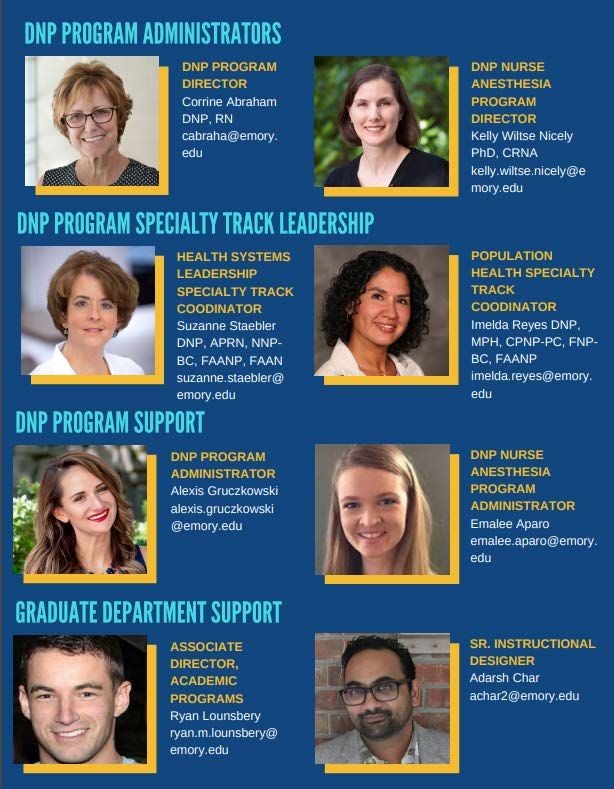
Corrine Abraham DNP, RN CABRAHA@emory.edu DNP Program Director

                             Emory DNP Program 2018-2019                                     2
TABLE OF CONTENTS
Emory University Nell Hodgson Woodruff School of Nursing 5
Description of the DNP Program 6
Mission, Vision, Values 6
Program Goals 7
Program Outcomes 8
DNP Program Administration 9
Program Requirements 11
Plan of Study 11
Changing DNP Specialty Tracks 11
DNP Coursework 12
Program Delivery 13
DNP Project Description 13
DNP Project Overview 13
Institutional Review Board 14
DNP Project Team Composition 14
Overview 14
DNP Project Team Roles & Responsibilities 15
Replacing DNP Project Team Members 16
Progression of the DNP Project 17
DNP Program Benchmarks 18
DNP Project Milestones 18
DNP Project Manuscript 18
Evaluating DNP Project Manuscript Include rubric 18
DNP Project Oral Presentation 18
Evaluating the DNP Project Oral Presentation 19
Portfolio 19
Completion of the DNP Portfolio 19
Clinicial Hour Requirements 20
Clinical Agency Requirements 20
Student Policies 21
Grading 22
Grade Requirements 22
On-Campus Session Requirement 22
Partnership Learning Model 22
Professional Practice 22
Late Assignments 22
Incompletes & Withdraws 23
Program Evaluations Include exit interview/survey 23
Emory DNP Program 2018-2019 3Clinical and Service Learning Requirements 23
Transfer Coursework 24
Appendix A 25
Appendix B 29
Appendix C 30
Emory DNP Program 2018-2019 4Emory University
Nell Hodgson Woodruff School of Nursing Doctor of Nursing Practice Program
INTRODUCTION
The Doctor of Nursing Practice (DNP) Handbook is designed to assist enrolled DNP Students in identifying key
characteristics of the DNP program and how the program links with the mission and vision of Emory University Nell
Hodgson Woodruff School of Nursing and the American Association of Colleges of Nurses (AACN) Essentials of DNP
Education. Also included are an overview of program outcomes, benchmarks, and processes for progression and
graduation. Forms are included at the Appendices and can be downloaded.
For School and University related policies and procedures, the student should refer to the 2018-2019 Nursing
Catalog and Student Handbook located at www.nursing.emory.edu/audience.guides/students.html and the
University website at http://policies.emory.edu/ . Post-BSN DNP students will find specific policies in the 2018-
2019 Graduate Student Handbook. Each student is responsible for reviewing and adhering to the academic and
clinical requirements for their program of study.
Due to the dynamic nature of education, it is likely that changes will occur. The program reserves the right to
revise handbook information at its discretion and to make reasonable changes in the requirements to enhance
the program or improve the quality of education. Changes will be communicated verbally and electronically to
students with updates noted in the appropriate handbook.
If you have any questions regarding the information in this DNP Program handbook, please contact the Program
Administration.
Emory DNP Program 2018-2019 5DESCRIPTION OF THE DNP PROGRAM
The American Association of Colleges of Nursing (AACN) stipulates that the practice-focused doctoral program of
nursing (DNP) is a distinct model of doctoral education that provides an additional option for attaining a terminal
degree in the discipline distinct from a PhD. Emory’s Nell Hodgson Woodruff School of Nursing DNP program
prepares graduates for the highest level of nursing practice beyond the initial preparation in the discipline. Nurses
can enter the DNP program after completing a master’s in nursing or after the completion of their bachelor’s pace
bet of science in nursing degrees. Emory University recognizes the need for nurse leaders in both hospital health
systems and in public health settings. The DNP prepares expert practitioners to implement and translate existing
knowledge into practice and to lead health and health care improvements within specific contexts such as health
systems, organizations, policy, clinics, or populations. This program is designed to allow the student to focus on
either a health systems track or a population health track. Core and track DNP curricular content follows the eight
DNP essentials outlined by the American Association of Colleges of Nursing (AACN) Essentials of Doctoral
Education for Advanced Nursing Practice AACN (2006).
Mission
The mission of the DNP program is to cultivate the next generation of nurse leaders to transform health by
seamlessly integrating analytic depth and breadth with contextual insights to create innovative solutions for the
world’s most complex health challenges.
Vision
Emory DNP graduates transform health
Values
In addition to our School core values, we as members of the Emory DNP learning community, value partnership,
innovation, and personalization. We live our values in the following ways.
Partnership
Build 3-way partnerships between students, clinical practice sites, and faculty to create health-
transforming doctoral projects.
Innovation
Create practical solutions for complex health challenges by incorporating person-, population-, and
health-system insights.
Design innovative strategies that join in-depth analysis with contextual awareness.
Personalization
Harmonize student goals-expertise with practical problem-based learning, peer collaboration, and faculty
mentorship.
Emory DNP Program 2018-2019 6Program Goals
The program goals contribute to achieving the mission and AACN Essentials by preparing graduates who:
• Achieve advanced practice mastery using the highest caliber of evidence based practice to enhance and
promote the quality of the health of individual, families, and communities;
• Lead delivery, design, and evaluation of health care that is data-based, sensitive and responsive to the
ethical, cultural, and psychosocial concerns of individuals, families, communities, and populations; and
Develop, implement, and evaluate the efficacy and effectiveness of innovative nursing practice models,
health policy, and health care systems.
Emory DNP Program 2018-2019 7Program Outcomes
Program outcomes address the role of leader, scholar, ethical clinician, critical thinker, innovative and
collaborative clinician, and effective communicator. Social responsibility is a key thread throughout the program
and congruent with the mission of the School of Nursing.
DNP Outcome
Competency The DNP Graduate will:
Lead interprofessional teams in the analysis of complex practice and organizational issues.
Lead delivery, design, and evaluation of health care that is data-based, sensitive and
Systems Leadership responsive to the ethical, cultural, and psychosocial concerns of individuals, families,
communities, and populations.
Develop, implement and evaluate new approaches to clinical practice and health care
Quality Improvement & delivery using principles of improvement science, business, finance, economics, and policy.
Safety
Scholarship & Evidence Translate research into practice and participate in collaborative research to improve health
Based Practice systems and patient outcomes.
Generate and disseminate evidence to guide practice.
Information Management Use information systems/technology resources to evaluate health care and systems
outcomes, guide quality improvement initiatives, and support practice and administrative
decision-making.
Improve the health care system and patient care outcomes through engagement in system
Health Policy, Finance & redesign and health care policy at all levels, including institutional, local, state, regional,
Advocacy federal, and international levels.
Analyze the effect of health policy on the organization, financing, and delivery of healthcare
and health outcomes.
Interprofessional Partner with members of the healthcare team and patients/families in the delivery, design,
Collaboration and evaluation of health care that is data-based.
Assess, plan and evaluate evidence for creation and evaluation of health promotion and
Clinical Prevention & prevention programs to optimize health outcomes for individuals, communities and
Population Health populations.
Professional Identity Exhibit the judgment and behaviors of the nurse leader and clinical scholar.
Practice using evidence based critical reasoning, systematic inquiry, and reflection to analyze
Nursing Practice health outcomes and health care delivery phenomena to improve health care systems and
patient outcomes.
Emory DNP Program 2018-2019 8Emory DNP Program 2018-2019 9
Emory DNP Program 2018-2019 10
Program Requirements

Plans of Study
All doctoral students in collaboration with their DNP Specialty Track Coordinator will complete and submit a Plan
of Study prior to enrolling in classes. Post Masters doctoral students may choose a full-time or part-time Plan of
Study. All Post-BSN doctoral students will have a full-time Plan of Study. The Plan of Study requires the approval of
the student’s Specialty Track Coordinator and/or the DNP Program Director before the student can register in
OPUS. Refer to the webpage for specialty-specific example plans of studies.

There are two tracks within the DNP Program, Health Systems Leadership and Population Health. A total of 38 hours
are required for students in the Health Systems Leadership track and 40 hours are required for students in the
population Health track. The course requirements consist of the DNP core courses that all students are required to
take and the Health Systems Leadership and Population Health specialty track courses.

Changing DNP Specialty Tracks
Students requesting a change in their DNP specialty track must first consult with their current Specialty Track
Coordinator. After consultation, the student may submit a request to change in the Plan of
Study with a “Change of Specialty Track” (see DNP Toolkit) form. The form has to be submitted to both Specialty
Coordinators, signed, and approved, and returned to the DNP Program Administrator. Approval is based off of
class size and clinical placement. Changes in specialty must be made prior to pre-registration registration for each
upcoming semester to allow for adjustments in **Please note: Specialty Track Change Requests are not
guaranteed.

                                            Emory DNP Program 2018-2019                                            11
DNP Coursework
*Note: Descriptions for all courses offered by the School of Nursing can be found in the Course Atlas at
http://nursing.emory.edu/audience-guides/students-audience-guide.html
Course Credits Semester(s) Required?
Offered HSL PH
NRSG 702D* Analyzing, Evaluating and Translating Health 3 Fall
X X
System Evidence
NRSG 707D Transforming Health Care: A Systems 3 Fall
X
Approach to Improve Quality & Safety
NRSG 712D* Analysis of Complex Health Systems for 2 Fall
X X
Populations and Organizations
NRSG 715D* DNP Project Development I 1-3† Fall X X
PRS 505D Integrated Communication Strategies 2 Fall X
NRSG 723D* Health Policy, Ethics and Law 3 Fall, Spring X X
NRSG 713D Analytic Tools for Evidence-Based Decision 3 Spring
X X
Making
NRSG 714D* Pathways to Practice 4 Spring X X
NRSG 703D Epidemiology for Advanced Nursing Practice 2 Spring X
NRSG 718D Population Adaptive Solutions 1 Summer X
NRSG 720D Collaboration and Transformation for 2 Summer
X
Population Health
NRSG 722D* Leadership for Health Profession 2 Summer X X
NRSG 724D Informatics: Leading with Data 3 Summer X
BSHE 504D Social Behavior in Public Health 2 Summer X
NRSG 716D* DNP Project Development II 1-6† All X X
NRSG 717D* DNP Project Development III 1-6† All X X
NRSG 721D* DNP Project 1-6† All X X
*indicates core DNP course Total Credits
†15 DNP Project credits are required for graduation 38 40
Emory DNP Program 2018-2019 12Program Delivery
The DNP Program uses a hybrid delivery model that features residential (on-campus) and on- line instruction. The
residential DNP sessions are held at the Emory School of Nursing campus up to 2 times each semester. Students
are notified by email and on the DNP webpage of the dates of the weekend sessions 8 weeks prior to the start of
each semester.
DNP On-Campus Sessions are an integral component of the DNP program providing a foundation for professional
development, strategic engagement, role socialization and course specific support. Students will summarize
outcomes on an individual learning plan (portfolio) reflecting how the integrated learning opportunities address
the DNP Essential Competencies and Program Outcomes. (5% credit) Attendance is required for all campus
sessions.
Completion of the DNP CANVAS Mini-Course training is a requirement for all new students entering the DNP
program before formal coursework begins. This course is designed to provide the opportunity to become familiar
with the CANVAS online learning environment and other technologies used to deliver the online portion of DNP
courses. Students will interact in the online learning environment to complete low-stakes (non-credit bearing)
assignments in order to gain first-hand experience and insight about the DNP program and the technologies they
will be asked to use. In this way, students learn about the tools by using them before being asked to use them in
coursework with the goal of mitigating any misgivings about the online learning environment before beginning the
first course.
DNP PROJECT DESCRIPTION
DNP Project Overview
The DNP project is the culmination of the synthesis of the student’s learning experiences from coursework and
experiential learning and serves as the foundation for future scholarly and practice transformation work. The
purpose of the project is to address issues related to implementation, evaluation, and sustainability of a particular
practice change focused on improving outcomes or health policy.
Since research informs practice and practice informs future discovery the doctoral dissertation and doctorate of
nursing practice projects are complimentary. Consequently, they represent ideal opportunities for partnership.
However, the purpose of the research dissertation and the DNP project are distinctive. The DNP advanced practice
nurses to implement and translate existing knowledge into practice and to lead care improvement within specific
contexts such as health systems, organizations, clinics, populations or policy arena. This process generates internal
evidence. Conversely, research-oriented doctorate programs prepare nurse scientists to generate new,
generalizable evidence.
The DNP Project will interface with the student’s professional or clinical practice, using knowledge and
competencies derived from coursework to guide focused inquiry related to improving and/or evaluating practice.
Students have primary responsibility for their leading the design, implementation and evaluation of the projects;
the DNP project team (faculty, and clinical partner) will assist the student with design of the scope and focus of the
project, and work together to ensure the project is exemplary, transformational, rigorous and relevant. The DNP
Project scope and team will be determined as early as possible in the DNP Project course sequence.
Emory DNP Program 2018-2019 13General areas of consideration for DNP Projects include:
• Quality Improvement Projects
• Evidence-based practice
• Policy analysis/development
• Financial analysis to compare models of care delivery
• Program development, implementation, or evaluation
• Translation of knowledge to clinical care
• Redesign of primary care models
• Scale-up and customization of existing programs or interventions in a new context
Institutional Review Board (IRB)
The DNP project involves a systematic investigation that according to Emory Institutional Review Board (IRB)
(http://www.irb.emory.edu) involves: “a methodical exploration of a question or theory; typically includes data
collection and analysis; and includes development, design, and testing phases.” The intent of the project, design,
access to PHI, and local ethical considerations will determine which regulatory agencies must review and approve
the project. Students must ensure their DNP Projects meet the Human Subjects Requirements of Emory University
IRB and their clinical site. In collaboration with their DNP project team the student will use the IRB Decision Tree,
complete the IRB Compliance Checklist and the Emory University IRB Request for Determination of IRB Review
form at http://www.irb.emory.edu/forms/review/request.html (see DNP Toolkit). “Does my project need IRB”, is
found in the DNP Toolkit. The student will work with the clinical partners to determine and comply with additional
human subject requirements of the clinical site where the project is conducted as needed. IRB approval by both
the healthcare agency and Emory University may be necessary. In some cases reciprocity of approval is possible.
The student has the responsibility to identify and follow the appropriate steps to obtain reciprocity.
Composition of the DNP Project Team
Overview
Each student’s DNP project team consists of at least three members. Two members must be faculty from the Nell
Hodgson Woodruff School of Nursing, and one member is a Clinical Partner working with the student as they
conduct their project. The DNP project team will be established by the student with guidance from the course
faculty in collaboration with the Director of the DNP program, DNP specialty track coordinator, and course faculty
in the DNP Project Development courses.
The DNP project team is designed to maximize the DNP Student’s ability to meaningfully transform practice
through the process of designing and implementing a practice-based project. The DNP project is constructed with a
3-way partnership that builds on student interests, faculty expertise, and clinical partner needs. Consequently, the
partnership is designed to meet each partner’s needs.
The DNP project team assists the student with successful design, implementation, and evaluation of the DNP
Project. The team members review expectations and sign an agreement to serve on the project team early in the
planning/design phase of the project. In addition the DNP project team conducts the written and oral DNP Project
evaluation.
Emory DNP Program 2018-2019 14DNP Project Team Roles and Responsibilities
DNP Student – It is the responsibility of the DNP Student to lead efforts in establishing and maintaining a project
team that leverages the expertise and priorities of team members in the development, implementation, and
evaluation of a project for transforming health. Specific responsibilities include:
1. In collaboration with project course faculty, specialty coordinator, and/or program director identify and
recruit faculty team and establish the relationship with the DNP Project faculty and DNP Project Chair.
2. Establish the clinical partnership in collaboration with the DNP Project faculty and DNP Project Chair.
3. Convene bi-monthly team meetings to discuss progress, communicate regularly with the project team
members and course faculty; clarify team roles, and develop project management timeline. Create and
revise as necessary manuscript authorship activities. Complete project status reports.
4. Obtain and submit documents required by NHWSN for clinical site partnership (e.g., affiliation agreement)
5. Review and abide by all policies and procedures required by DNP program and the practice partners at
clinical/project site (e.g., HIPAA training, proof of licensure, IRB). See DNP Toolkit
6. Submit project prospectus at each phase of development for review and approval by team members to
adhere to Project Milestones.
7. Conduct formative evaluation of the project and actively seek early resolution if goals are not being met.
(Step required before moving to next Project course.)
8. Maintain log to document clinical hours including time devoted to research, plan, implement, evaluate,
and disseminate project. See DNP Toolkit
9. Submit intention to graduate form (see DNP Toolkit) to specialty coordinator and team chair by the
midterm of the semester prior to anticipated graduation. Develop and obtain approval for timeline for
completing final manuscript and oral presentation to Project team.
10. Submit DNP project products for final evaluation to DNP project team AND DNP Program Administrator
for archiving in student file. Final products include manuscript prepared for publication, oral presentation,
executive summary, and portfolio.
DNP Project Chair – It is the responsibility of the DNP Project Chair to partner with the DNP Student and guide the
development, implementation, and evaluation of a project for transforming health. Specific responsibilities
include:
1. Assist the DNP Student with establishing the clinical partnership.
2. Participate in regular team meetings with the DNP Student and project team members.
3. Review and approve project proposal and final manuscript at each phase of development (i.e. at a
minimum of completion of each project course.)
4. Evaluate and provide feedback on the student’s proposal and final manuscript within 10 business days of
submission.
5. Approve intention to graduate form. see DNP Toolkit
6. Evaluate final DNP project products in collaboration with DNP project team. Final products include
manuscript prepared for publication, oral presentation, executive summary, and portfolio.
Emory DNP Program 2018-2019 15DNP Project Faculty member – It is the responsibility of the DNP Project Faculty member to support the DNP
Project Chair and DNP Student. Specific responsibilities include:
1. Review and provide feedback on drafts of both the written and oral presentation.
2. Provide support including technical, content, or methods expertise.
DNP Project Clinical Partner member – It is the responsibility of the DNP Project Clinical Partner member to serve
as a resource for the DNP Student as they develop, implement, and evaluate their project. Specific responsibilities
include:
1. Collaborate with the DNP Project team and the DNP Student to ensure the alignment of the DNP Project
goals and the strategic clinical initiatives of the Clinical Partner site/focus. Support the student’s
completion of project requirements according to the guidelines, including the selection of a clinical
partner for the DNP Project (outlined in the DNP Toolkit).
2. Direct and facilitate student affiliation and compliance with policies and procedures required at the
clinical practice site (e.g., HIPAA training, proof of licensure, IRB). see DNP Toolkit
3. Provide feedback assessing implantation of project and impact at practice site. Attend/participate in
evaluating student defense of scholarly project.
Replacing DNP Project Team Members
Students may change their DNP project team members as their interests or needs change in consultation with
their Chair and with the approval of the Director of the DNP Program and DNP specialty track coordinators.
Similarly, DNP project team members may also step down from the partnership and the DNP Student’s project as
interests or needs change. The student will submit all requested changes in the DNP project team in writing to the
Director of the DNP program or DNP specialty track coordinators and schedule a meeting with them to determine
the next steps for selecting a new member.
Emory DNP Program 2018-2019 16Progression of the DNP Project
The DNP Project will be developed over at least 4 semesters of academic study. The project’s design is supported
by the DNP Project Development course series and other DNP courses. Figure 1 provides an illustration of the full-
time student’s matriculation through the DNP program. Click here to review DNP Project Milestones. (Also found
on DNP Toolkit or see Appendix A)
DNP Degree Completion: Timeline & Project Steps
Emory DNP Program 2018-2019 17DNP Program Benchmarks
DNP Project – Manuscript
The DNP Project will be prepared as a manuscript suitable for publication following the author guidelines of the
selected journal. This manuscript will reflect integration of DNP Essentials and reference to the extant literature in the
field. Students will lead in the development of the manuscript with guidance from their DNP Project Team Chair and
Team members, and DNP Project course faculty. Attribution of authorship will be guided by the International
Committee of Medical Journal Editors (ICMJE) standards.
Using the format specified by the journal, students will write a manuscript suitable for publication. A complete
reference list is required. Appropriate target journals for submission should be identified by the student, the DNP
Project Team members, and DNP Project course faculty.
• If the student’s final semester occurs during Fall or Spring, the final products (manuscript, oral presentation,
executive summary, and portfolio) must be submitted to DNP Project Team no later than the Wednesday
during the 10th week.
• If the student’s final semester occurs during Summer, the final products (manuscript, oral presentation,
executive summary, and portfolio) must be submitted to DNP Project Team no later than the Wednesday
during the 6th week (4 weeks before the end of the semester).
Anti-plagiarism software may be used to review the final manuscript and executive summary.
Evaluating the final DNP Project Manuscript
Students will prepare for the DNP manuscript by using the author guidelines of the selected journal. The DNP Project
Team will evaluate and provide feedback on the student’s final manuscript to the DNP Project Chair within 10
business days. The DNP Project Chair will share the feedback with the student once all reviews are complete. Any
requested corrections, additions, or modifications must be made by the DNP Student within 10 business days and
resubmitted to the Chair and/or Project Team for approval. A grading rubric will guide evaluation of the manuscript.
Students must earn a minimum of 83% (B) to meet the requirement for approval as "Satisfactory". In situations where
additional time is needed to complete the manuscript the DNP Student will be required to enroll for additional DNP
Project credit hour for subsequent semesters until the manuscript is approved by the DNP Project Team.
See Appendix B
DNP Project Oral Presentation
The student in partnership with the DNP Project Team Chair and members will schedule the student presentation
based on available dates. Options for presentation dates will be selected by DNP faculty prior to the beginning of each
semester. The DNP project presentation will be conducted at completion of the DNP Project, either onsite or via
teleconferencing. All DNP project team members must be present, either in person or virtually, during the entire
presentation.
The DNP presentation will include a 20-30 minute presentation followed by questions first from the DNP Project
Team and then the audience as time permits. At the conclusion of the DNP Project presentation, each Project Team
Emory DNP Program 2018-2019 18member will evaluate the student’s performance. Following the deliberation, the student will be informed of the
Team’s decision. The scholarly project is broader in scope than the written manuscript, exemplifying how the student
achieved the program outcomes/DNP Essentials in completing the scholarly project. The presentation is evaluated
with a grading rubric; students must earn a minimum score of 83% to successfully pass the project defense.
Evaluating the DNP Project Oral Presentation
The DNP Project Team will discuss the student’s performance and form a majority decision regarding whether the
presentation was satisfactory. The student will integrate suggestions for modifications into the formal manuscript for
final approval. Manuscript revisions are expected following the presentation. If the students fails the DNP Oral
Presentation, the DNP Project Team has two options which need to be noted in the evaluation of the DNP Project
Results Presentation. The DNP project team may have the student 1) retake the oral presentation within 2-4 weeks;
or 2) retake NRSG 721D DNP Project Course. The Chair of the DNP Project Team will report the outcome of the DNP
Oral Presentation to the faculty coordinator for N721 DNP project course. In addition, the results of the DNP Project
Oral Presentation Evaluation are saved in the student’s permanent file.
See Appendix C
Portfolio
All students will be required to create and curate a web based portfolio throughout the program. The portfolio must
include current drafts of the DNP Project proposal, manuscript, and specific items from coursework as outlined in the
ePortfolio Requirements by Semester document. Additionally, personal and professional items should be included
that the student feels demonstrate mastery of AACN DNP Essentials, program, and/or course outcomes. All items
included should be accompanied by a brief reflective statement the student should use to connect the item with what
has been learned as well as specific connections with DNP essentials and/or program. Specialty Track Coordinators in
partnership with the student will review the portfolio each semester in order to provide individualized guidance for
learning and to determine adequate progression toward degree completion.
Completion of the DNP Portfolio
Students must complete the DNP Portfolio as required throughout the program. The DNP Portfolio is complete
when all required documents have been uploaded, including:
1. All DNP Milestones have been met (See Appendix A)
2. Course and practice-related artifacts as directed by the faculty
3. Log of clinical practicum hours
4. The final PDF copy of the student’s approved and revised DNP Project proposal, manuscript, and
presentation slides
5. The DNP Project Presentation evaluation results from project team
6. A two-page executive summary that is presented to the clinical partner
These steps must be completed in order to satisfy all Emory School of Nursing DNP degree requirements.
All required paper work is to be submitted to the DNP Program Coordinator in either digital (PDF) or hardcopy format
5 business days before the end of the semester to ensure graduation. Students are encouraged to submit all
documents prior to the deadline to prevent last-minute errors. Missed deadlines will result in the DNP degree not
being conferred until the next term.
Emory DNP Program 2018-2019 19Clinical Hour Requirements
All students are required to have a minimum of 1000 clinical hours post-baccalaureate by the end of program. Hours
must be supervised as part of an academic program in an advanced practice area (degree or certificate) and will
include practicum hours from the master’s degree program and DNP practicum hours.
On admission, students provide documentation of clinical hours earned for their advanced practice degree. For
students with a low number of practicum hours (< 500 hours), individualized plans will be developed in conjunction
with the Specialty Track Coordinator or DNP Program Director to ensure the post-baccalaureate practicum hour
requirement is fulfilled. (See DNP Toolkit for Verification of Master’s Clinical Hours Form)
Based on DNP course work/project requirements, all students must complete approximately 500 project/practicum
hours during the program. The student will be responsible for documenting and submitting to course faculty a log of
practicum hours earned each semester as well as for maintaining a record of total hours earned during the program
(See DNP Toolkit for Verification form for Master's program clinical hours and Practicum Hour requirements).
DNP practicum hours will enhance synthesis of the DNP Essentials in a focused area of practice and may include:
hours for proposal and project development, implementation, evaluation and dissemination; clinical contact hours;
hours based on participation in leadership activities and professional committees. The student will set goals and
objectives in concert with their faculty and preceptor for clinical practicum experiences. The faculty and/or Specialty
Track Coordinator may be contacted to provide further clarity of what constitutes a practicum hour.
Clinical Agency Requirements
The student is responsible for compliance with all rules and regulations of the healthcare agency. At the student’s
request, the School can provide assistance in compliance requirements for student verification, reporting of
immunizations, reporting of background checks, etc. through the Office of Graduate Clinical Placement at
graduateclinicalplacements@emory.edu. The student is financially responsible for meeting agency requirements.
Emory DNP Program 2018-2019 20Student Policies
For a complete list of policies, please refer to the 2018-2019 Nursing Catalog at
http://www.nursing.emory.edu/_includes/documents/2018-2019%20SON%20Student%20Catalog1.pdf
Grading
The academic standards and policies of the Nell Hodgson Woodruff School of Nursing reflect the level of intellectual
rigor required by both Emory University and the profession of nursing. As a professional school, the School of Nursing
must maintain the highest standards to ensure that the graduates of the program exhibit the level of knowledge,
clinical skill, and integrity expected by the public and the profession.
Please refer to the 2018-2019 Student Handbook for more information.
Grade Requirements
The letter grade of 83% is the minimum passing grade for each course in the DNP program of study. Students earning
less than an 83% in a course will be required to repeat the course at the next time the course is offered. A student
may not progress until the course is repeated. A second course grade below the grade of 83% in the same course or
any additional courses within the program will result in dismissal from the DNP Program.
A student who believes they may not be able to complete all course requirements by the end of the semester should
immediately seek the advice of their course faculty. The course faculty in conjunction with the DNP Program Director
will decide the course of action and notify the student via email or letter. Failure to complete the course by the
beginning of the next semester will result in a grade of “F”.
On-Campus Session Requirement
DNP On-Campus Sessions are MANDATORY. Students are required to attend unless prior approval is granted by the
DNP Program Director. Students must submit a Written Request for Excused Absence at least six weeks prior to the
on-campus session that includes clear rationale and a plan to make up missed content. Students will receive a “0” in
each course for unexcused absences from on-campus sessions. Through completion of assignments, students will
earn course credit for each on-campus session. (5% credit per course, per semester) (Form can be found in DNP
Toolbox)
Partnership Learning Model
DNP learners are the key members in a three-way learning partnership involving faculty-facilitators, DNP learners and
the clinical partner (Taylor-Ide & Taylor, 2002). For assignments, faculty provide the structured prompt and feedback
while learners customize and apply the course content to their self-identified learning topic area(s).
Customized Learning Plan
Learners are invited to review the course objectives, assignments and key deliverables. If they believe their
prior experience or skills enable them to meet course objectives using assignments-deliverables that are
higher on Bloom’s Learning Taxonomy than those provided in the course, learners should contact faculty by
the third day of the term to discuss a customized, learner-generated plan for the course. Faculty will review
Emory DNP Program 2018-2019 21proposed plans for goodness-of-fit with course objectives. Any formal, written custom assignment plan will
be finalized by the first day of week 2. The learner-written custom plan will then become the assignment
contract and submission calendar for the learner’s work.
Timing
Learners are invited to review course deadlines and map deadlines to their outside professional-personal
demands. If there are external circumstances that impact punctual assignment completion and
accommodations are desired, learners should contact faculty by the third day of the term to discuss a
customized, learner-written calendar for assignment submissions. Any formal, written custom assignment
plan will be finalized by the first day of week 2. The student-written custom plan will then become the
assignment contract and submission calendar for the learner’s work.
Professional Practice
As in all professional settings, several practices create the foundation for a professional, collaborative environment.
These include respect, punctuality and academic integrity.
Respect
When in the learning environment, focus your attention, energy and speech on course content, learning assignments,
your peers and facilitators. When interacting with peers and facilitators, use mutually respectful and professional
approaches to oral and written communication.
Punctuality
Arrive at virtual group meetings, faculty conferences or DNP team meetings on time. Submit assignments punctually.
Criteria for Satisfactory Engagement
The following behaviors align with expectations for DNP students:
Demonstrate accountability for own learning as demonstrated by regular communication with course faculty
when questions arise or needs for alternative assignments/deadlines
Respond to emails within 72 hours when contacted by DNP faculty or administration
Submit assignments on time > 85% of the time per semester except for excused delay
Engage consistently in course learning activities demonstrated by logging onto Canvas each week,
responding to VoiceThread/Discussion prompts by stated deadlines, responding to peer comments, and/or
providing peer feedback
Exhibit participation within peer and faculty evaluations, e.g., fall within the median and mean of the group
scores
Contribute meaningfully and thoughtfully to group assignments as assessed by evaluation criteria.
Attendance is required for Satisfactory Engagement
Late Assignments
As an expression of professional excellence, all assignments are expected on or before the due date and time posted in
course materials (or in learner’s custom learning plan if indicated). Except for extenuating circumstances, learners need
to contact course faculty in advance of the due date/time if you anticipate delays in submission. Delayed assignments
will be subject to the following guidelines:
1. An assignment may be submitted late without late penalty if documentation is provided for:
• Severe personal illness
Emory DNP Program 2018-2019 22• Severe illness or death of a family member (including significant other and their family)
• Unanticipated birth of child to learner, significant other, or a family member
2. Learned who believe there is a legitimate rationale for an accommodation that is requested after the first
week of the term should submit a formal request at least 3 days in advance of the assignment due date. The
formal request should be limited to 2 paragraphs and include the following:
• 1 table summarizing the original and proposed due dates
• Situation: summary of the situation that resulted in a delayed submission
• Rationale: rationale for an alternative deadline
• Proposal: concrete, plan summarizing original assignment due date and new requested due date
Scoring assignment with “full credit,” “no credit,” or “reduced credit” will be at the facilitator’s desicretion.
3. Assignments that are received after the deadline but do not meet criterion 1 or 2 will only be accepted for 3
days after the original due date. One letter grade may be deducted for each 24-hour period received after
the due date/time.
Incompletes & Withdraw
Refer to Student Handbook.
Program Evaluation
Student evaluation of courses is very important to the faculty of the School of Nursing. Students are in a position to
provide informed and useful feedback about the accessibility of the curriculum, the quality of the instruction, and the
overall educational experience they have received. Each student is encouraged to take the responsibility seriously.
Comments that students make on evaluation forms may be of assistance in the development of content and course
material for future classes.
Course evaluation in the School of Nursing is accomplished electronically and has appropriate safeguards for student
confidentiality. Orientation to the process for evaluation is provided to students prior to the end of each semester.
Data from student evaluations are provided to faculty as aggregate data.
All DNP Graduates are required to complete an Exit Survey upon program completion and an Exit Interview with DNP
Program Director.
Clinical and Service Learning Requirements for Students
NOTE: Students cannot participate in clinical or service learning experiences without completing the following
requirements:
Students and faculty in the School of Nursing must meet clinical agency requirements relative to health and
immunization status as well as complete site-specific orientation. Immunization requirements, criminal background
investigations and drug tests are subject to revision. This information is required by clinical agencies and students
may be asked to obtain newly updated information at their own expense at any time during their enrollment.
Emory DNP Program 2018-2019 23Verification of Licensure
Every student pursuing a DNP degree in the School of Nursing must have a current RN license. Students must
submit, a copy of their license and a picture ID via the clinical requirement credentialing system prior to
enrolling. Licenses must be submitted again at the regular renewal period. DNP students with expired
licenses will not be allowed to participate in clinical training or enroll in courses. Students are required to
report any change in the status of licensure (any encumbrances) immediately to the Office of Educational
Innovation.
Transfer Coursework
A maximum of nine semester hours of academic credit from an accredited school may be transferred, with faculty
approval, and will be credited toward meeting the DNP degree requirements. These nine semester hours may not
have been used to satisfy requirements for a previous degree. Refer to the Request for Course (Transfer) Credit form
located here.
Additional Policies and Procedures Located in the 2018-2019 Nursing Catalog and SON Student
Handbook
Students should refer to the 2018-2019 School of Nursing Catalog regarding policies for: ADA and Students with
Disability, Plagiarism and Academic Dishonesty, Diversity Statement, Academic Integrity, Communication with Faculty,
Inclement weather, Student Health Center, NHWSN Grading Policies, Transfer Credit, Medical Leave, Re- Enrollment
after Absence and more.
Emory DNP Program 2018-2019 24Appendix A
Course Project Milestones Hard STOP** (Check when
completed)
Pre-Project I • Affiliation agreement signed Must have to be registered
for Project I:
Affiliation Agreement
• Roadblocks for affiliations
o Many affiliates have agreements and Project Team
approvals for vetting projects Agreement
Specifics need to comes from
Clinical Partner
o Need to clarify what requirements are for
our affiliates (DNP Toolkit)
Students need point of contact for
affiliate
• Project team form signed
o Affiliate project sponsor
o Faculty project chair
• Timeline - June Semester Saturday Project Road
Show
o Feasible if Post-BSN’s are prepared
Project I • Chair committee/team formation Must have to be registered
715D: o Proof of meeting with committee – Project for Project II:
Project Status Report Project Status
Planning Report(s)
• Introduction Study Flow Diagram
o Problem statement/PICOT Evidence Table
• Background Draft of Proposal
• GAP analysis
Choose/define 1-2
o Key stakeholders
Framework(s)
o Policy & financial implications
• Evidence Table/ Review of literature
o Synthesis of evidence for problem
o Study flow diagram
• Explore Options for Theoretical framework
o List & define proposed frameworks
• Draft of proposal
o Begin evidence for intervention
o Synthesize review of literature
Emory DNP Program 2018-2019 25Course Project Milestones Hard STOP** (Check when
completed)
• Defend proposal – Project Team – Week 6 –NEED
Project II CRITERIA & PROCESS for passing
716D: Projec o Students defend to project committee with Must have to be registered
t course faculty present for Project III:
Managemen • Submit proposal to IRB/Determination – Week 6
t Plan • Evidence for the solution Project Status
o Evidence Table Report(s)
o Theoretical framework - Define and apply Successfully defend
Program theory &/or Concept proposal
mapping Submit proposal to
o Synthesis of the evidence IRB/Determination –
o Rationale/thesis statement Week 6
• Project Evaluation Plan Evidence for the
o Methods- aims, design, variables, data solution
collection tools Project Evaluation
Clear linkage to theoretical Plan
framework Project Management
o Plan for analytics - Going through committee Plan
chair: data scientist--look at data plan (be Dissemination Plan
more clear) work with data analyst through Target
practice partner (ideal situation) journal
o Data management Signed
• Project Management Plan authors
o Project work flow timeline (Work flow agreement
diagram or Gantt chart) Manuscript
o Project resources/budget (Logic Model) revision(s)
Identification of project team
members
• Dissemination Plan
o Select target journal
o Authors agreement & activity grid (Verify
requirements of affiliate)
Order and activity needs approval
from all collaborators
o Revise introduction, background, methods
according to authors guidelines
Track revisions
Emory DNP Program 2018-2019 26Course Project Milestones Hard STOP** (Check when
completed)
Project III • Project implementation/management & process Must have to be registered
717D: measures for Project IV:
Project o Work flow diagram &/or Gantt chart with Project Status
Implementa key milestones Report(s)
• Implementation Project
tion &
o Draft and finalize tools – marketing, implementation
Evaluation
communication, field notes, surveys, Materials
permissions created
o Track implementation (process measures,
Implementati
field notes)
on tracked
• Evaluation
o Data collection & management Project Evaluation
o Data analysis (consultation with ONR only Data
through chair) collection
o Demonstrate linkage to theory/approach to Data analysis
solving problem Dissemination
• Dissemination Manuscript
o Revise introduction, background, methods revisions
(track changes) Draft results
Timeline for next revision based on Outline
feedback discussion
o Draft Results
Create dummy tables (deliverable)
o Outline discussion points – think about it
early
Link to theoretical framework
Project IV • Evaluation- Finalize Results Must have to GRADUATE:
721D: o Analysis/Synthesis Project Status
Project o Reflection on DNP Essential & Program Report(s)
Evaluation Outcomes Dissemination (min
& • Manuscript (Final revision due NO LATER THAN 83% passing)
week ten Fa/Sp or week six Su term) Manuscript –
Disseminati
o Revise all sections of manuscript final revision
on
o Draft & finalize Discussion (Clinical/policy
Executive
implications)
summary –
o Draft & finalize Conclusions (Sustainment
plan & Next Steps) submitted to
o Draft & finalize Abstract clinical
• Appendices affiliate
o Study Flow diagram Scholarly
o Evidence Tables Presentation
Emory DNP Program 2018-2019 27Course Project Milestones Hard STOP** (Check when
completed)
o Literature synthesis Professional portfolio
o Work Flow diagram/Gantt Record of practicum
o Budget hours to total 1,000
o Theoretical Framework/Program post graduate hours
Theory/Logic model
Complete a minimum
o Data collection and Analysis Plan
of 15 project course
credits
Emory DNP Program 2018-2019 28Appendix B Emory DNP Program 2018-2019 29
Appendix C
                                                                                      DNP Project Presentation Rubric
                                                  Learner Name: _______________________________ Date: _____________
                                                  Project Title: ___________________________________________________
                                                                     *Note: A score 83% or greater is required to receive a passing score on the assignment.

                                                                          Excellen       Very       Satisfactor   Margina        Poor     Absen      Score
                                                                              t         Good         y (83%)         l          (40%)     t (0%)

                                  Criteria                                 (100%)       (90%)                      (70%)

            Problem: Defines local problem, population, &
            contributing factors
            Evidence: Succinct literature synthesis & evidence for
            solution
            Theory: Theoretical framework defined & linked to
            project
            Aim: Overall aim and specific objectives defined
            Design: Project design contextualized for practice
CONTENT

            setting
            Data: Methods are explicit & appropriate for problem
            Analysis: Method appropriate for problem, design &
            variables
            Significance: Relevance for practice defined
            Implications: Policy, Financial, Scalability/Sustainability
            issues addressed
            Reflections: Lessons from implementation (success,
            challenge); Lessons r/t DNP program outcomes & DNP
            Essentials
            Primary message is clear
            Delivery is engaging: Eye Contact, Clear Speech, Open
            Posture, Conversational delivery without reading
DELIVERY

            Credibility on topic established: Statistics, Examples,
            Quotations, Experiences support primary message of
            presentation
            Follow-up action is clear
            I am persuaded!!
            Bullets avoided
            Neutral space is embraced: Generally
The content criteria are based on the project manuscript rubric. The criteria for slide design are based on Duarte’s Slide*Ology principles.1 The
delivery items are based on communication principles from AACU,2 Conger,3 Cranmer4 and Crofts.5
1. Pimp my Slide. Northwest Center for Public Health Practice, 2009. (Accessed October 30, 2014, 2014, at
http://www.nwcphp.org/training/opportunities/webinars/using-slides-effectively-in-presentations.)
2. AACU. Oral Communication Value Rubric. 2009 ed: Association of American Colleges and Universities; 2009.
3. Conger J. The Necessary Art of Persuasion. Harvard Business Review 1998;76:84-95.
4. Cranmer J. Presentation rubric in: Introduction to Primary and Population-Based Care. Seattle, Washington: Seattle University; 2011,
2012.
5. Crofts AV. Persuasive Communication: Transforming Policy & Education. Seattle, Washington: University of Washington; 2010.
Emory DNP Program 2018-2019 31You can also read


