THE ROAD TO EPIC - 2016 State of the Program for Providers - Epic1.org
←
→
Page content transcription
If your browser does not render page correctly, please read the page content below

THE ROAD TO EPIC

2016 State of the Program for Providers

THE ROAD TO EPIC | 2016 STATE OF THE PROGRAM FOR PROVIDERS

                           EPIC FOR PROVIDERS: 2016
        During 2016, the Epic Program Team transitioned from building to testing our Epic system.
        Hours of designing, with future state workflows in mind, have transitioned into extensive
        testing to ensure large and small components of the system work as intended prior to use.
        The team has also begun focusing its efforts on the first two go-lives: BJC Medical Group
        (June 1, 2017) and Boone Hospital Center (Aug. 5, 2017). These go-lives will set the stage
        and provide lessons for the remaining hospitals and Washington University faculty in late
        2017 and 2018.

        The implementation is being governed by a set of guiding principles to ensure that we are
        standardizing processes, workflows, and content. We will make use of the Epic foundation
        system, a version that is pre-populated with settings, sample reports, and other content
        built upon the experiences of other organizations with similar characteristics. Ultimately,
        our Epic implementation will emphasize care coordination and continuity across the BJC-
        WUSM enterprise.

                       PROGRAM GUIDING PRINCIPLES
        Do what is best for our patients and their families…
            •   Focus on safety, clinical outcomes, and our commitment to quality
            •   Enhance the patient/family experience and increase patient satisfaction
            •   Design workflows in a patient-centered manner, emphasizing care coordination, and
                continuity

        Do what is best for our clinicians…
            •   Optimize clinician experience, prioritizing the best use of their time
            •   Engage practicing providers and frontline clinicians throughout the process to ensure
                operational success

        Do what is best for the enterprise…
            •   Standardize processes, workflows, and content to the fullest extent possible to
                reduce variations in care and ensure provision of evidence-based care at all times
            •   Leverage the Epic foundation system and focus on best practices
            •   Weigh decisions against scope, timeline, and budget

                                                                                                        2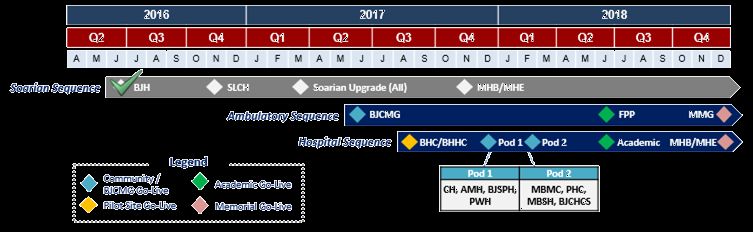
THE ROAD TO EPIC | 2016 STATE OF THE PROGRAM FOR PROVIDERS

   Projected Timeline

                  Hospital Rollout Dates                              Ambulatory Rollout Dates

                      Facility                   Target Date                 Facility                 Target Date
    BHC/BHHC (Pilot Site): Boone Hospital        08/05/2017    BJCMG: BJC Medical Group               06/01/2017
    Center and Boone Home Health Care will                     go-live for all practices
    go-live together
                                                               FPP: Faculty Practice Plan go-live -   06/02/2018
    Pod 1 (Community Hospitals): Christian       12/02/2017    all FPP sites
    Hospital (CH), Alton Memorial Hospital
    (AMH), Barnes-Jewish St. Peters Hospital                   MMG: Memorial Medical Group            Q4 2018
    (BJSPH), Progress West Hospital (PWH)

    Pod 2 (Community Hospitals): Missouri        02/03/2018
    Baptist Medical Center (MBMC), Parkland
    Health Center (PHC), Missouri Baptist
    Sullivan Hospital (MBSH) , BJC Home Care
    Services (BJCHCS)

    Academic: Single go-live for Barnes-Jewish   06/02/2018
    Hospital (BJH), Barnes- Jewish West County
    (BJWCH), and St. Louis Children’s Hospital
    (SLCH)

    MHB/MHE: Memorial Hospital Belleville        Q4 2018
    and Memorial Hospital East

                                                                                                                    3
THE ROAD TO EPIC | 2016 STATE OF THE PROGRAM FOR PROVIDERS
PROGRAM UPDATES
In 2016, the HIP team made significant progress against key areas of the Epic implementation.
Areas of significance to BJC providers include: the Clinical Content that will be incorporated into
the version of Epic customized for BJC and WUSM, training that will enable providers to work
efficiently on day one, and site engagement which focuses on how each hospital will
successfully implement the Epic system. These three areas are detailed in this section.
Clinical Content Build
The HIP team is building the tools needed for the daily care of patients by our providers. These
tools can include order sets in both the inpatient and ambulatory environments, documentation
tools (daily progress notes, procedural notes, etc.), and other templates to assist in admitting,
rounding on, and discharging patients in the inpatient setting or within an office visit in the
outpatient setting.
Inpatient Order Set Build
The inpatient order set team, in conjunction with a dedicated group of BJC and WUSM
physicians, has been working to develop the core inpatient order sets for use within Epic. The
team has held in-person review sessions for three out of five “waves” (or groupings by
specialty) of order sets and has been using an online platform called Induct
(https://BJCEpic.Induct.NO) to allow for synchronous review or self-review when providers
cannot attend an in-person review session. The inpatient order set team is responsible for
building order sets across 89 specialties and sub-specialties and completed 51 specialties in
the first three waves as well as all core order sets for both adult and pediatrics.
2016
• Number of Order Sets Reviewed: 296
• Number of Provider Attendees: 277
• Number of Comments through Induct: 692
Looking Ahead
The inpatient team has two more waves of order sets to build and review with BJC providers.
The review sessions will be scheduled for early 2017 and will cover approximately forty
additional specialties and 175 unique order sets. The team will also be focusing on the
development of a set of standardized discharge order sets.
4THE ROAD TO EPIC | 2016 STATE OF THE PROGRAM FOR PROVIDERS
Clinical Content Build, Cont.
Ambulatory Content Build
2016
The Epic Ambulatory team has been working across 2016 to build out the clinical content that
will be incorporated into Epic for use by ambulatory providers. The team kicked off ambulatory
content review sessions in October which will run through February 2017. These sessions
focus attention on writing notes and placing orders in the ambulatory setting, basic office
workflows, and other clinical content that is being incorporated into the outpatient module of
Epic. To-date the team has held 38 content review sessions and had approximately 430
attendees.
The schedule of content review sessions is maintained on the HIP program website –
www.HIPepicinfo.org.
Looking Ahead
As the ambulatory team continues its work, they will continue a focus on collaborating with
the inpatient build teams and working with BJCMG providers to have a successful go-live in
2017.
Inpatient Provider Documentation
2016
The Core Inpatient Provider Documentation team is a key part of the Epic Program, and
includes representatives, selected by their department/division chairs, from both the academic
and community hospitals. This team is responsible for building Inpatient Provider
Documentation and has been working to develop a core group of notes (H&P, Progress, Consult,
Procedure, and Discharge Summary notes) that will meet the diverse and complex needs of
patients, as well as billing and compliance requirements. To date, there have been 15 two-hour
core meetings. In addition, notes for 46 specialties are ready for go-live; 25 are in progress and
27 are not started (of 98 specialty areas). All are scheduled to be ready for go live by the end of
April 2017.
Looking Ahead
Inpatient Provider Documentation build continues with the primary focus of completing
services at Boone. Road Shows are scheduled for the remaining facilities across February and
April, and will highlight the clinical documentation process.
5THE ROAD TO EPIC | 2016 STATE OF THE PROGRAM FOR PROVIDERS
Epic Training
Training is critical to the successful implementation of Epic at BJC and WUSM. The HIP team
has a dedicated group of specialists working towards an efficient and effective training
program. A number of decisions were made in 2016 that impact Provider training:
1. Training will be a combination of eLearning segments and classroom sessions.
2. Providers who are currently using, or have used Epic at other organizations, will have
the opportunity to test out of the eLearnings with a score of at least 80% on the
eLearning assessments
3. Classroom training will be mandatory for all providers
4. After attending classroom training, providers will be required to attend a
Personalization Lab to complete the following activities:
1. An End User Proficiency Assessment, which requires a score of 80% to receive
formal logon credentials
2. Activation of logon credentials
3. Configuration of “Preference Lists” and Order Sets to each provider’s specific
needs
Provider Educators
BJC and WUSM are utilizing Epic’s “Specialists Training Specialists” model for the classroom
portion of the Epic Training. This model will mean:
• Providers will deliver training to other providers in their specialty or a related field
• Specialty experts will answer workflow questions more effectively during training
• Specialists will be referred to as Provider Educators and may consist of: attending
physicians, residents, fellows, mid-level clinicians, RNs, or non-clinicians with a deep
understanding of specialty workflows
• Provider Educators will be supported by credentialed Epic trainers in the classroom
The training team kicked of the Specialists Training Specialists program by successfully
recruiting 28 Provider Educators for BJCMG and 31 for Boone. Recruitment for Pod 1 Hospitals
will begin in early 2017.
Training in 2017
2017 will mean training and preparedness for go-live. The training team is currently developing
the content that will be used for BJCMG and Boone Provider training, which kicks off in April
and June, respectively.
6THE ROAD TO EPIC | 2016 STATE OF THE PROGRAM FOR PROVIDERS
Site Engagement
As Epic is implemented across all facilities, selected clinicians and departmental staff have
been brought together to form Site Engagement Teams (SETs) with the objective of
empowering a strong force of change for every go-live site.
Roles & Responsibilities
The SET is a group of individuals selected from across each facility who shoulder enhanced
responsibilities for the Epic Program implementation at their local site level. The SET is
designed to facilitate decision making for that site, ensure that communication and resources
filter throughout the facility, and participate in select adoption activities. Members also serve
as a sounding board back to the Epic Program if there are concerns or opportunities for
improvement in Epic Program engagement with the site.
The formation and launch of site engagement teams began in June 2016. Teams immediately
began supporting critical program activities and played important roles in coordinating and
supporting operational readiness activities including Roadshow Events and the Epic Super User
Program.
Site Engagement in 2017
Site Engagement Teams will continue to engage with system users and strengthen site
readiness throughout 2017. As the Epic go-live timeline approaches, Site Engagement Teams
will support and engage in the following activities:
• Upcoming Roadshows at Missouri • Selection of Super Users across all
Baptist Medical Center, Parkland facilities -- At go-live Super Users will
Health Center, Missouri Baptist be assigned various shifts within
Sullivan Hospital, and on the their floor or unit and help
Academic Campus colleagues troubleshoot any issues
• Operational Change Analysis: A that may arise
program to understand and validate • Specific preparation in the six
the operational changes that will months before go-live
occur with Epic future-state • Go-live support
workflows
Site Engagement Teams are tasked with regularly sharing feedback they receive from staff to
HIP leadership and act as the voice of the site.
7THE ROAD TO EPIC | 2016 STATE OF THE PROGRAM FOR PROVIDERS
Program Decisions
This section describes a few of the key program decisions that have been
made in 2016. Below is the governance structure that provides clinical
feedback as the program team develops the Epic software.
Decision Making: Governance Structure
Physicians and clinicians across BJC and WUSM are involved in every step of the decision
making process for the Epic program. Jim Crane, MD; Vicky Fraser, MD; Regis O’Keefe, MD; and
Clay Dunagan, MD; are members of the Health Information Partners (HIP) Board. Eleven
clinicians serve as Clinical Champions for the program. Additionally, there are 35 clinicians
currently serving on the Provider Advisory Council and a large number of specialists and
subspecialists involved in the clinical content build. To support efficient and effective decision-
making, decisions are triaged in the following way:
• Detailed decisions (~65%): Made at the project team or operations group level with
the input of specialty-specific physician content experts (SMEs)
• Mid-level decisions (~25%): Brought to the Provider Advisory Council, Clinical
Champions, and Executive Steering Committee
• High-level decisions (~10%): Brought to the HIP Board for final approval
Clinical Champions:
• Sam Bhayani, MD (Co-Chair) • Paul Hmiel, MD
• Terry Bryant • John Krettek, MD
• Rick Chole, MD • Kevin O’Bryan, MD
• Geoff Cislo, MD • Michele Thomas, MD
• Marianne Fournie • Keith Woeltje, MD (Co-Chair)
• Ann Hagedorn, MD
Provider Advisory Council Clinical Members: Sam Bhayani, Jeffery Blatnik, Robin Blount,
Mitch Botney, Terry Bryant, Rick Chole, Geoff Cislo, Jim Crane, Don Delwood, Clay Dunagan,
Marianne Fournie, Charles Goldfarb, Peggy Gordin, Richard Griffey, Ann Hagedorn, Dan
Helsten, Paul Hmiel, John Krettek, John Lynch, Tim Mislan, David Molter, Vamsi Narra, Kevin
O’Bryan, Regis O’Keefe, Felipe Orellana, Doug Pogue, Matt Powell, Sebastian Rueckert, Jill
Skyles, Michele Thomas, Stuart Sweet, Justin Vader, Anitha Vijayan, Chad Witt, Keith Woeltje,
Nadia Zia
8THE ROAD TO EPIC | 2016 STATE OF THE PROGRAM FOR PROVIDERS
Program Decisions (Cont.)
Category: Data Conversion
These data conversion decisions were made in 2015. As the project has refined the approach, the
decisions were revisited and confirmed, or modified as needed.
Sample decisions: Current legacy EMR systems will be accessible at least six months post
Epic go-live, with exception to certain specialty systems
Clinical Desktop will remain available at least through 2020 for
viewing
Historical data will be archived and accessible to clinicians and
physicians
Who will be impacted? All facilities
Tell me more about the The following chart outlines the data that will be converted from
decision… Touchworks, NextGen, ClinDesk, Horizon Clinicals and MPF into Epic:
Data Elements HIP (BJC/WUSM) Conversion Scope
Patient Info All
Encounter Starting 1/1/07
Lab Result Starting 1/1/13
Rad & Diagnostics Starting 1/1/13
Notes Starting 1/1/13
Allergies All active allergies
Problems All active NextGen problems
Meds Recent 18 months in NextGen
Vitals Starting 1/1/13 for Adults, All vitals for Pediatrics
Immunizations/Vaccinations All
History: Family, Medical, Social All Active
& Surgical
Provider Impacts
The project team’s main objective is to make Day 1 a smooth transition for providers.
The team is working to bring all relevant and necessary information into Epic, without
making the new system cumbersome. Historical data that is not brought forward will be
readily available to clinicians through the legacy system. Training will be provided on how
to view historical information.
9THE ROAD TO EPIC | 2016 STATE OF THE PROGRAM FOR PROVIDERS
Program Decisions (Cont.)
Category: Provider Documentation
Sample decisions: The structure for Provider Note Entry will follow the SOAP format –
Subjective, Objective, Assessment, and Plan.
SmartTools will be an option across all note types
NoteWriter will be an option for History & Physicals, Progress
Notes, Anesthesia Pre-op and Post-op, ED Notes, Procedure Notes,
and Ambulatory Note types
Providers will be responsible for maintaining the Problem List
Inpatient dictation will only be allowed where currently utilized in
the system with the goal of moving away from dictation in all areas
In the ambulatory setting, dictation will be available, and will be up
to physician employers on whether or not to continue utilization
Who will be impacted? All facilities
Tell me more about the The provider documentation team worked with the Clinical
decision… Champions, Provider Advisory Council, and Epic experts to design the
optimal note process for providers across BJC. The decisions that
were made will standardize the note process across the system.
Providers will have the opportunity to further customize their own
notes during the Personalization Labs that are a required part of
training.
Provider Impacts
Provider documentation will be new and improved throughout Epic. SmartTools,
NoteWriter, and other Epic features are designed to improve clinician workflows and
efficiency. The inpatient and ambulatory teams have been building out note templates
across all specialties, keeping them streamlined and standardized so that they can be
available to all practitioners. During training, providers will be taught how to use the
different Epic tools that are available and will be given the opportunity during
Personalization Labs to customize the note templates to their specific needs.
10THE ROAD TO EPIC | 2016 STATE OF THE PROGRAM FOR PROVIDERS
Program Decisions (Cont.)
Category: Allergies
Sample decisions: In the ambulatory setting, Epic will require allergies to be reviewed
every 6 months prior to ordering a medication
In the inpatient setting, Epic will require allergies to be reviewed
prior to ordering a medication. It will only be required once per
encounter
It will be required to document reaction and severity (reaction will
default to an appropriate base level of severity based on reaction
type). Reaction type will not be required
95% of allergens from the current system will be mapped and
imported discretely into Epic. The 5% of unmapped allergies will
require reconciliation by a clinician before they are added into Epic
Who will be impacted? All facilities
Tell me more about the The pharmacy team worked with the Clinical Champions and
decision… Provider Advisory Council to determine which allergy information is
most critical to patient safety while keeping in mind the time
commitment within the provider workflow. The goal of the team was
to standardize the required fields across the system.
Provider Impacts
Some initial upfront work will be required from providers to reconcile the allergy fields
from the old system into the new. This upfront work will be minimal and will result in a up-
to-date and accurate list of allergies for all current patients.
The timeframe decisions for ambulatory and inpatient allergy reviews were made after
consulting peer-facilities and understanding what made the most sense between factoring
in patient safety and minimizing the impact to provider workflows.
11THE ROAD TO EPIC | 2016 STATE OF THE PROGRAM FOR PROVIDERS
2016 Frequently Asked Questions
When will I get access to the system?
• You will receive access to Epic after completing all training requirements including the End
User Proficiency Assessment (EUPA) and Personalization Lab.
If I am already using Epic at another hospital do I still need to complete training?
• Yes. All providers must complete the in-person training and personalization labs before
being granted access to the system. Providers who have used Epic at other facilities will be
able to test out of the eLearning portion of training. Because Epic will be customized for
the BJC and WUSM environment, it is important to attend the in-person training and
personalization labs to understand the differences and become familiar with the BJC and
WUSM instance of Epic.
Where and when will training take place?
• Training will be held at or near the following facilities:
• Boone Hospital Center
• Missouri Baptist Sullivan Hospital
• Parkland Health Center (Farmington)
• St. Louis Metro area* training will be held at the following locations:
• BJC Learning Institute (Eager and Hanley Roads)
• Mid-Campus Center (Washington University Medical Center)
• Eric P. Newman Education Center (Washington University Medical Center)
• Washington University Medical Center Campus Bookstore (Washington University
Medical Center)
• Training decisions for Memorial East and Memorial Belleville Hospitals are still pending
*For purposes of the Epic training the St. Louis Metro area includes the following facilities:
• Alton Memorial Hospital • Barnes-Jewish West County
• Christian Hospital Hospital
• Barnes-Jewish St. Peters • St. Louis Children’s Hospital
Hospital • Barnes-Jewish Hospital
• Progress West Hospital • Washington University
• Missouri Baptist Medical Physicians
Center
12THE ROAD TO EPIC | 2016 STATE OF THE PROGRAM FOR PROVIDERS
2016 Frequently Asked Questions, Cont.
Now that we’re on Epic, will I be able to access patient information from SSM or
Mercy?
• No direct access to the Epic systems at SSM or Mercy will be available. The Epic system will
be specifically configured for BJC and WUSM. We will be utilizing Epic’s Care Everywhere
functionality, which allows doctors and nurses to electronically exchange patient medical
information between different institutions.
Will the infrastructure at BJC be able to support the new system?
• Yes. We are currently undergoing a complete infrastructure rebuild across BJC and WUSM.
The project is taking a phased approach to be prepared for each facilities’ go-live. The HIP
team is also working closely with the Epic Data Management services to ensure that the
new system will be supported.
Can I bring my SmartText over from what I am using today?
• No, we cannot bring it over automatically, but we can try to re-create it in SmartPhrases
during Personalization Labs.
Can I have my own templates?
• Yes, you can modify an existing template and save it as a SmartPhrase.
If you have questions about the Epic implementation please reach out to epicprogram@bjc.org.
13THE ROAD TO EPIC | 2016 STATE OF THE PROGRAM FOR PROVIDERS
Additional Information
Informational Videos
Provider Leadership was recently featured in video clips about the Epic implementation. The
three videos can be found here:
Provider Impact Epic Education Patient Impact
Program Website
The Epic Program team maintains a website with recent information on clinical content
updates, upcoming events, FAQs, and much more. Please take the time to look it over and
reach out to the program team with any questions.
Website: www.HIPepicinfo.org
Email: epicprogram@bjc.org
Induct Order Set Platform: https://BJCEpic.Induct.NO
Thank You
We Wouldn’t Be Here Without Your Support
Sincere thanks to everyone who has been involved in the HIP Epic Program. Whether as a
member of an Operations Group, serving as a Subject Matter Expert, attending a roadshow, or
simply reading the monthly provider newsletter we are encouraged by your support.
We are approaching our first go-live in 2017. We have a lot to undertake between now and
then and the next year will require continued focus on our program’s guiding principles and
continued engagement from our entire community. We greatly appreciate the efforts that
have been made and the candid feedback we have received. Your engagement is critical in
development and implementation of the Epic Program.
We look forward to adhering to our mission statement: Improving patient care through
exceptional technology.
Sincerely,
Keith Woeltje, MD, Vice President, Chief Medical Information Officer, BJC
Sam Bhayani, MD, Chief Medical Officer, WUSM Faculty Practice Plan
14You can also read


