The safer management of controlled drugs - Annual update 2017 Published July 2018 - CQC
←
→
Page content transcription
If your browser does not render page correctly, please read the page content below
The safer management
of controlled drugs
Annual update 2017

Published July 2018
The Care Quality Commission
     The Care Quality Commission is the independent regulator
     of health and adult social care in England.

     We make sure that health and social care services provide
     people with safe, effective, compassionate, high-quality care and
     we encourage care services to improve.

     Our role

     • We register health and adult social care providers.
     • We monitor and inspect services to see whether they are
          safe, effective, caring, responsive and well-led, and we
          publish what we find, including quality ratings.
     • We use our legal powers to take action where we identify
          poor care.
     • We speak independently, publishing regional and national
          views of the major quality issues in health and social care,
          and encouraging improvement by highlighting good practice.

     We also have a statutory duty to oversee the safe management
     arrangements for controlled drugs in England.

     Our values

      •   Excellence – being a high performing organisation.

      •   Caring – treating everyone with dignity and respect.

      •   Integrity – doing the right thing.

      •   Teamwork – learning from each other to be the best we can.

Care Quality Commission The safer management of controlled drugs: Update report for 2017   2
Contents Introduction .....................................................................................................4 Overview and recommendations ...................................................................4 Progress on recommendations from the 2016 report ..................................6 Activity in 2017 ................................................................................................7 Register of controlled drug accountable officers................................................7 Updates for providers ........................................................................................7 Controlled drug issues found on inspection .......................................................8 Issues identified when prescribing from multiple sources ............................12 NHS England’s area teams and controlled drug local intelligence networks ...12 Controlled Drugs National Group ....................................................................15 Sub-groups ..................................................................................................15 Cross-Border Group ........................................................................................15 National trends in the use and management of controlled drugs .............16 Primary care prescribing of controlled drugs ...................................................16 Schedule 1 controlled drugs.........................................................................16 Schedule 2 controlled drugs.........................................................................16 Schedule 3 controlled drugs.........................................................................18 Schedule 4 controlled drugs.........................................................................19 Schedule 5 controlled drugs.........................................................................20 Summary of controlled drug prescribing by Schedule .....................................21 Ten-year trends ...............................................................................................22 Non-medical prescribing ..................................................................................25 Controlled drug prescribing in the independent sector ....................................26 Schedule 2 controlled drugs prescribed privately.........................................26 Schedule 3 controlled drugs prescribed privately.........................................27 Controlled drug requisitions .............................................................................28 Next steps ......................................................................................................29 Care Quality Commission The safer management of controlled drugs: Update report for 2017 3
Introduction
The Care Quality Commission (CQC) is responsible for making sure that
health and adult social care providers, and other regulators, maintain a safe
environment for the management of controlled drugs in England. We do this
under the Controlled Drugs (Supervision of Management and Use)
Regulations 2013.

This is our annual report to Government, in which we make recommendations
to help ensure the continuing effectiveness of the arrangements for managing
controlled drugs in England. These are important for all controlled drugs
accountable officers (CDAOs) in England and their support teams, as well as
organisations that handle controlled drugs, healthcare professionals with an
interest in controlled drugs, commissioners of healthcare services and
professional healthcare and regulatory bodies.

Overview and recommendations
CQC chairs the National Group on Controlled Drugs and the four sub-groups.
This enables us to share information and discuss issues with other
organisations, with a focus on key areas such as thefts and frauds, patient
safety, policy and operational issues, and prescribing. We also met with cross-
border colleagues in Wales, Scotland, Northern Ireland, the Republic of
Ireland, the Channel Islands and the Isle of Man, to share good practice and
discuss strategic controlled drugs-related issues across our borders.

As part of our oversight activity, we monitor the effectiveness of controlled drug
local intelligence networks across England. NHS England’s CDAOs have
worked collaboratively in these networks and are using a newly-agreed
controlled drug occurrence reporting template. This improves consistency
when sharing both concerns and good practice, and has helped to build a
better national picture of issues related to controlled drugs. NHS England’s
electronic occurrence reporting tool was rolled out to all regions in late 2017.

Based on our learning from work in all these areas, we make four
recommendations.

Our first recommendation relates to prescribing controlled drugs outside of
NHS general practice, for example by independent healthcare professionals,
and the importance of informing a patient’s own GP when this happens. This
helps to ensure that patients are kept safe and that GPs maintain an overview
of all the medicines prescribed to their patients.

Care Quality Commission The safer management of controlled drugs: Update report for 2017   4
Because of the growing complexity of new and emerging models of care, our
second recommendation is relevant for commissioners of health and care. All
those involved in commissioning need to be aware of the responsibilities and
governance arrangements for controlled drugs as part of any new
commissioning arrangements.

The third recommendation highlights the importance of vigilance and security
for healthcare professionals and of reporting any losses of personal
identification mechanisms such as badges and passwords. This follows a rise
in personal identity theft, sometimes to fraudulently obtain controlled drugs.

We also highlight the importance of monitoring controlled drugs in the lower
schedules, such as Schedules 4 and 5, which comprise more than 67% of
controlled drugs prescribed in primary care. Regular monitoring will help to
identify diversion and to take swift action to reduce it.

 Recommendations

 1. Prescribers should ask patients about their existing prescriptions and
    current medicines when prescribing controlled drugs. Where possible,
    prescribers should also inform the patient’s GP to make them aware of
    treatment to minimise the risk of overprescribing that could lead to harm.
 2. Commissioners of health and care services should include the governance
    and reporting of concerns around controlled drugs as part of the
    commissioning and contracting arrangements so that these are not
    overlooked.
 3. Healthcare professionals should keep their personal identification badges
    and passwords secure and report any losses as soon as possible to
    enable organisations to take the necessary action.
4. Health and care staff should consider regular monitoring and auditing
   arrangements for controlled drugs in the lower schedules, such as
   Schedules 4 and 5, to identify and take swift action on diversion.

Care Quality Commission The safer management of controlled drugs: Update report for 2017   5
Progress on recommendations from
the 2016 report
In our report on activity during 2016, we made three recommendations to
improve the management of controlled drugs.
Recommendation Progress
NHS England controlled drugs NHS England controlled drugs
accountable officers should be accountable officers have continued
aware of new models of care to review and broaden the
across their area and, where membership of local intelligence
appropriate, include them in the networks. As part of this ongoing
controlled drugs local intelligence review, they are taking into
network meetings. consideration new models of care
and the subsequent new range of
healthcare services that have
responsibility for controlled drugs.
Controlled drugs accountable Feedback on this recommendation
officers should ensure that all has been positive, with many
staff in their organisation know organisations welcoming the
how to report concerns of recognition of this often difficult but
diversion and abuse of neglected part of a controlled drugs
medicines by fellow colleagues, accountable officer’s role. This
and that these issues are recommendation has helped to
handled sensitively and influence organisational processes.
appropriately.
Prescribers must make sure that they Most local intelligence networks
review patients regularly, depending have discussed high volume
on their clinical need. This is to ensure prescribing following this
that the prescribed controlled drugs recommendation. Many CCGs have
and length of treatment continues to commissioned local data studies
be the most appropriate for their and presented their findings at
condition and to reduce opportunities network meetings. In general, this
for over-prescribing and diversion. found that high volume prescribing
is associated with patients with
complex needs.
Care Quality Commission The safer management of controlled drugs: Update report for 2017 6Activity in 2017 Register of controlled drug accountable officers CQC maintains and publishes an online register of controlled drugs accountable officers (CDAOs) across England for those organisations that are registered with CQC and are required under the 2013 Regulations to have one. We update this register monthly. These organisations are defined as designated bodies under the regulations and are required to notify CQC of their CDAO appointment. A very small number of organisations are registered solely with the Human Fertilisation and Embryology Authority (HFEA), and not with CQC. Our website also provides a link to HFEA’s register of CDAOs. Throughout 2017, there was an average of 996 organisations on our CDAO register. Of these, 750 CDAOs were from independent healthcare organisations, 246 were from NHS organisations and the others from organisations such as social care providers that fall within the designated body status. To keep the CDAO register up to date, it is important that organisations tell us about any changes to their CDAOs’ details. If an organisation re-registers with CQC, it needs to submit a new CDAO notification. In 2017, we received approximately 30 notifications each month. Notifications can be made using the online webform. Changes to contact details such as email address or phone numbers can be emailed to CDAORegisterData@cqc.org.uk. We continued to grant exemptions for the need to have a CDAO where it is disproportionate to appoint one in independent healthcare organisations that have more than 10 employees but have a low use of controlled drugs. Organisations with fewer than 10 employees are automatically exempted. The uptake of the exemption by eligible organisations continues to remain low, and in 2017 we received and approved six CDAO notification exemptions. The controlled drugs section on CQC’s website now includes guidance about the exemptions, the criteria that must be met to be appointed as a CDAO, and how different types of organisations can notify us about changes. Revised self- assessment tools will also be available on our website. Updates for providers All information about CQC’s activity in relation to controlled drugs is available on our website: www.cqc.org.uk/controlleddrugs. This includes links to relevant legislation, information and tools for controlled drugs accountable officers, notifications forms, and information about the Controlled Drugs National Group. Care Quality Commission The safer management of controlled drugs: Update report for 2017 7
Controlled drug issues found on inspection
In response to feedback on our previous annual reports on safely managing
controlled drugs, we have summarised some of our findings from inspections
in relation to controlled drugs and the arrangements that we would expect to
see in place.

Our findings                                    Our expectations
GOVERNANCE ISSUES
CDAO notifications
We sometimes find that the details of           We expect a timely notification so that
the CDAO on the register do not match           the register is up to date to enable the
those of the CDAO in post – particularly        CDAO to be contacted as required.
when the CDAO has recently moved to
a new role.
Home Office licences for controlled drugs
There is often a lack of understanding of       Organisations must seek their own
when a Home Office licence is required          advice. We expect to see evidence on
and for what schedules.                         inspection to show that the Home Office
Also, there is a lack of awareness that         has been contacted where a licence
there are licences for both Home Office         might be required.
possession and Home Office supply,
which providers may need to appy for.
Lack of awareness of relevant guidance and safety alerts
Many queries to CQC can easily be               Organisations should be familiar with
answered by referencing the NICE                relevant guidance and ensure that they
guidance NG46, safety alerts and other          cascade it where required.
sources of information and evidence-            We would like to see on inspection how
based resources such as PresQIPP.               this has been implemented in wards or
                                                departments.
Reporting incidents and concerns
There is a general lack of awareness of         We expect organisations to have a
who to report incidents to (either to the       standard operating procedure in place
organisation’s CDAO, the MSO, the               that explains all ways to report and that
NHS England lead CDAO for the area,             encourages open reporting and a non-
CQC, other professional and regulatory          blame culture. We also expect to see
bodies, the police or the NRLS).                evidence of incidents and the learning
                                                from them.

Care Quality Commission The safer management of controlled drugs: Update report for 2017    8
Illicit substances
This issue is becoming more apparent Organisations need to have a clear
and we are aware of more frequent and procedure and maintain a robust audit
increasing quantities being brought onto trail with secure, sealed containment of
healthcare premises. unknown substances. A small amount
can be destroyed locally as an unknown
substance. Larger quantities (not for
personal use) will need to be notified to
the police.
We are aware of some emerging trends, If there is a particular trend, this should
such as patients bringing in their own be communicated to the NHS England
supply of cannabis containing products CDAO so they can share the issue and
such as CBD oil. any learning with the CDLIN.
ORDERING ISSUES
Controlled drug mandatory requisition form
There is a general lack of understanding Providers need to follow guidance on
of when to use the form. the NHS BSA website.
Services are also sometimes unaware We expect the organisation to be aware
that a doctor must sign the requisition if of the requirements set out in MDR
supply is from a separate legal entity. 2001.
RECORD KEEPING ISSUES
Records
These are generally completed well, There should only be one controlled
although there is sometimes confusion drug register at the premises.
between the controlled drug register
and controlled drug record books in
wards and departments.
Controlled drug record books
Not all theatres follow the good practice We expect organisations to adopt good
requirement to complete the amount practice initiatives.
used/amount wasted.
STORAGE ISSUES
We find that some organisations still We expect organisations named in The
store controlled drugs in wooden Safe Custody Regulations 1973 to comply
cupboards, which do not meet the with the regulations, and organisations
minimum standard. outside the scope to use the requirements
as a minimum standard.
Sometimes the contents of the cupboard All drugs stored in a controlled drugs
do not match what is in the register. This cupboard must be recorded
is not usually a stock issue but related to appropriately.
a patient’s own or ‘just in case’
medicines for end of life care.
Care Quality Commission The safer management of controlled drugs: Update report for 2017 9Not all organisations separate high and We expect organisations to carry out
low strength preparations or those their own risk assessment and
intended for different routes such as incorporate relevant guidance into their
epidurals and intravenous injections, processes.
which can increase the risk of selecting
and administering the wrong preparation.
Some organisations are unsure how to We expect a documented risk
manage situations where neither the assessment to be in place. Above all,
legislation nor guidance covers the controlled drugs must remain secure, for
exact situation they are dealing with, for example, a separate secure container
example, where controlled drugs are for controlled drugs that need
stored in a fridge or robot, or where refrigeration, or secure storage within a
there is no solid wall to affix the robot. An exemption certificate issued
cupboard. by the police may also be required.
Where there is no solid wall, other
measures should be considered, for
example, strengthening an internal wall
or reviewing the location of the
cupboard, and the decision recorded in
a risk assessment that is reviewed
regularly.
Access to controlled drugs
Access to keys and cupboards is We expect a standard operating
generally managed well. procedure to be in place that covers
access to keys, and staff to adhere to it.
We also expect to see monitoring in
place as we are aware that controlled
drugs are often diverted by those with
legitimate access.
PRESCRIBING ISSUES
Nationally, there is a general naivety It is important to minimise the quantity of
regarding diversion issues. a controlled drug prescribed and to
regularly review the patient’s ongoing
need. It is particularly important to
consider the quantity issued in an
emergency and for temporary residents
until checks are carried out.
Organisations do not always consider We expect this to be considered as part
the need for a reversal agent (a of the prescription where appropriate,
medicine that reverses the effect of the and it may need to form part of a clinical
medicine administered to the patient). protocol.
Care Quality Commission The safer management of controlled drugs: Update report for 2017 10ADMINISTRATION ISSUES
There is some uncertainty regarding A single nurse can administer a
administration of controlled drugs by a controlled drug unless the local policy
single nurse and the need for two says otherwise. If a second checker is
signatures, and some organisations are not a registered nurse, they must
unclear whether single nurse understand or be familiar with what they
administration is allowed. are being asked to check. We would
expect to see that a competency
assessment had been completed.
Dose calculations are a common cause It is important to have training and
of errors – particularly with new competency assessments for difficult
formulations or devices. calculations or unfamiliar devices.
Clinicians should be encouraged to ask
for a second check if they are unsure or
unfamiliar with the product or
formulation.
Body maps are not always in place Application and removal of transdermal
when applying transdermal patches. patches continues to cause concern,
There is also a lack of awareness of the and we expect to see appropriate
effect of heat, the importance of arrangements in place to ensure that
removing a previous patch and the need patches are managed safely.
to check the patch every day.
AUDITING AND MONITORING ISSUES
Some organisations are unaware of the We expect the standard operating
importance of recording and auditing all procedures to cover all aspects of
stages of the controlled drug journey, controlled drug management and for
and the need for standard operating these to be kept under review with
procedures and ongoing regular review. supporting audits.
We find insufficient monitoring and audit, We expect organisations to risk-assess
and are aware of thefts and diversion of their controlled drug arrangements, with
controlled drugs, particularly those in regular monitoring according to their
lower schedules where there is less organisational needs, to keep losses to
control, for example dihydrocodeine or a minimum.
morphine sulphate solution 10mg/5ml.
DESTRUCTION ISSUES
Some organisations are unaware of the Organisations that denature controlled
requirement to hold a T28 exemption drugs must obtain a T28 exemption form
form for denaturing controlled drugs. from the Environment Agency.
There is also uncertainty around Large volume controlled drugs should
disposing of large volume infusions (for be discarded using an absorbent
example, hospital PCAs etc). material to soak up the liquid.
Organisations are also not always clear These must be stored securely until
what to do with completed denaturing removed for incineration.
kits.
Care Quality Commission The safer management of controlled drugs: Update report for 2017 11Issues identified when prescribing from multiple sources In our last update we highlighted the increasing volumes of controlled drugs being prescribed for patients. There are also risks when patients obtain controlled drugs from more than one provider, which can enable them to stockpile controlled drugs. This increases the potential for diversion and misuse, risk of accidental death, and of suicide from overdose, which is particularly pertinent for patients with long-term pain, a group at high risk of suicide. All services should consider these risks, as well as the benefits of informing the patient’s GP when prescribing opiate-containing painkillers, to enable them to ensure that patients are kept safe and that GPs maintain an overview of all the medicines prescribed to their patients. This applies to independent providers as well as NHS providers, including GP out-of-hours, secondary care services and those offering online-only consultations with clinicians using video or questionnaire-based modalities. Safety measures should include prescribing a minimum supply according to the patient’s individual needs and enquiring whether the patient already has an existing stock at home. Recommendation 1 Prescribers should ask patients about their existing prescriptions and current medicines when prescribing controlled drugs. Where possible, prescribers should also inform the patient’s GP to make them aware of treatment to minimise the risk of overprescribing that could lead to harm. NHS England’s area teams and controlled drug local intelligence networks NHS England’s lead CDAOs currently run 39 controlled drugs local intelligence networks (CDLINs) across the 14 NHS England areas, with membership from a wide range of organisations. There were around 200 meetings of CDLINs during 2017 and membership continued to include a wide range of organisations. Meetings were held between two and four times a year, with many areas meeting three times a year. CQC continued to attend these, and contributed a written meeting update when unable to send a representative. Care Quality Commission The safer management of controlled drugs: Update report for 2017 12
There was good attendance during 2017, but we noted an over-reliance by
some organisations on sending different deputies to meetings, which led to a
lack of continuity and ability to contribute fully to the meeting. Some members
commented that they have found their CDLIN meetings too large and felt this
had also hampered discussion.

The range and depth of issues discussed during 2017 remained broadly
similar to previous years. The most commonly reported and discussed
incidents were reported thefts, amended or wrongly dispensed prescriptions
and general governance issues.

We summarise some of the ongoing concerns below.

Issues of concern                                     Solutions to consider
LACK OF CENTRALISED SYSTEMS
There is a risk that private prescriptions and An up-to-date national register of
requests for controlled drugs could be forged. CDPINs would be beneficial.
This is because community pharmacies do
not have access to a national register of
controlled drugs personal identification
numbers (CDPINs), which means they
cannot verify legitimacy of private
prescriptions and requisitions for Schedules 2
and 3 controlled drugs.
There is a risk of inappropriate use and theft        It is important that dentists have
of controlled drugs in dental practices. This is      their own unique identifier.
because dentists do not use a unique
identifier for requesting and prescribing them,
therefore NHS England CDAOs and
commissioners cannot monitor their
prescribing for outlying or potentially
dangerous practice.
There is a risk of inappropriate and                  A central patient database
duplicated prescribing of controlled drugs to         accessible to prescribers would be
temporary residents, as there is no central           welcome, so that patients who try
register of temporary residents for                   to access controlled drugs from
prescribers to check.                                 more than one service could be
                                                      easily identified and supported
                                                      where required.
Because of changes in primary care support            The governance arrangements for
services there are risks associated with lack         issuing prescription pads need to
of oversight and control of secure stationery         be strengthened to avoid over-
to private prescribers.                               ordering and potential misuse.

Care Quality Commission The safer management of controlled drugs: Update report for 2017   13
RESOURCES
In some areas there is a risk that NHS The inconsistency in resourcing
England CDAOs will not be able to fulfil their requires a national review.
statutory obligations and deliver
responsibilities effectively because of a
general lack of resource and small support
teams. This may mean less monitoring of
prescribing, leading to concerns being missed.
Similarly, some areas do not have access to This also requires a national
and support from a controlled drugs liaison review so that all areas are
officer. supported.
INFORMATION GOVERNANCE
There is a general lack of clarity on issuing NHS England CDAOs would
controlled drug alerts, particularly regarding welcome a national view on this,
the level of detail that should be included. particularly following new data
protection legislation. There is also
a need to consider sharing alerts
with cross-border colleagues.
Through our attendance at CDLINs we are aware of new organisations and
mergers of existing organisations. Ongoing changes to the ways in which
health and care are now being delivered have resulted in increasing
complexity of commissioning arrangements and consequently controlled drug
governance arrangements. It is important to include the oversight of controlled
drug governance and reporting arrangements when commissioning services.
Recommendation 2
Commissioners of health and care services should include the governance and
reporting of concerns around controlled drugs as part of the commissioning and
contracting arrangements, so that these are not overlooked.
With regard to thefts of controlled drugs, we have noted some increasingly
sophisticated methods, which include stealing identification badges from healthcare
professionals and impersonating them in order to obtain controlled drugs.
Recommendation 3
Healthcare professionals should keep their personal identification badges
and passwords secure and report any losses as soon as possible to enable
organisations to take the necessary action.
Care Quality Commission The safer management of controlled drugs: Update report for 2017 14Controlled Drugs National Group The CQC-led Controlled Drugs National Group comprises government departments, key regulators and agencies with a controlled drugs remit. The group met three times in 2017 to share and discuss emerging issues and identify ways of working together to reach solutions. Following positive feedback, we continued to share summarised meeting notes with NHS England’s CDAOs, to enable them to update members of CDLINs about developments and policy initiatives. In 2017, the National Group welcomed two new member organisations – the Nursing and Midwifery Council and the Human Fertilisation and Embryology Authority. We have published a separate summary of highlights from the past year showing how member organisations contribute to the overall safer management of controlled drugs. Sub-groups The sub groups met three times during 2017, either in person or by teleconference. Membership comprised relevant stakeholders, such as NHS England lead CDAOs, specialist pharmacists and medicine safety officers, other government bodies, NHS Business Services Authority, and chief pharmacists. Other healthcare professionals with relevant expertise were also invited as required. We introduced a new style joint newsletter of the sub-groups, which replaces the four separate newsletters previously produced by the Policy, Vigilance, Prescribing and Patient Safety sub-groups. This was developed using the new GovDelivery system and circulated in September and December to over 3,000 subscribers with an interest in controlled drugs. You can subscribe to newsletters on our website. Cross-Border Group The Cross-Border Group for safer management of controlled drugs in the devolved administrations met in March and September 2017. It included the Controlled Drugs Accountable Officers’ Network Scotland, the Health and Social Care Board of Northern Ireland, NHS Wales and the Health Products Regulatory Authority of Ireland. The group provided a forum to discuss controlled drug matters at a strategic level and we have published a separate summary alongside this update of their major activities during 2017. Care Quality Commission The safer management of controlled drugs: Update report for 2017 15
National trends in the use and
management of controlled drugs
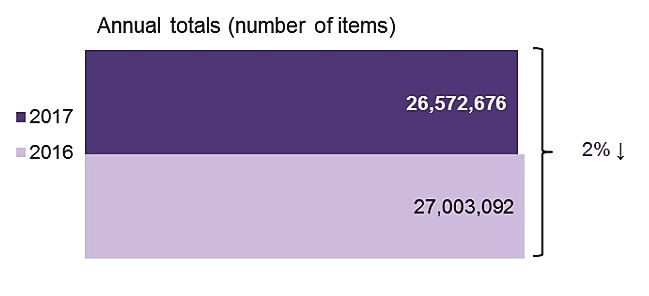
During 2017, NHS primary care services prescribed a total of 61,440,701
controlled drug items, which was a decrease of 2% compared with 2016. The cost
of this was £495,105,901.46, a decrease of 7% on the previous year.

Additionally, 1,045,052 controlled drug items across Schedules 2 to 5 were
prescribed in hospital using an FP10(HNC) or FP10SS form, to be dispensed in
the community during 2017. Hospital prescribing was broadly in line with that for
2016.

Please note: Data on prescribing is collected by an online application, which
provides analyses of prescribing data held by NHS Prescription Services to
authorised users. The previous ePACT system has now been replaced by
ePACT2, which has resulted in some differences in data. In this report we
provide year-on-year data comparisons for 2016 and 2017 by extracting both
years from ePACT2. This means that some data for 2016 is different to that
published in last year’s update, which was extracted from the legacy system
(ePACT). Any data referenced in this report that is before 2016 will be as
previously published, using the legacy ePACT system.

Primary care prescribing of controlled drugs

Schedule 1 controlled drugs
No controlled drugs in Schedule 1 are licensed for medicinal purposes.

Schedule 2 controlled drugs
This year, we have separated Schedules 2 and 3 so that we can look at the
trends more closely.

Although the pattern of prescribing of Schedule 2 controlled drugs was broadly
comparable with 2016, there was a 19% increase in prescribing of tapentadol.
Similarly, prescribing of morphine and oxycodone continued to increase.
However, prescribing of fentanyl decreased by 4% and pethidine prescribing
continued to decrease as in previous years.

Prescribing of all controlled drugs for the treatment of attention deficit
hyperactivity disorder (ADHD) increased compared with 2016:
methylphenidate prescribing increased by 4%, lisdexamphetamine prescribing
increased by 43%, and dexamfetamine prescribing increased by 4%.

Care Quality Commission The safer management of controlled drugs: Update report for 2017   16
Figure 1: Top 10 Schedule 2 controlled drugs prescribed in NHS
  primary care in 2016 and 2017 (by millions of items)

                                         2.80      3% ↑
              Morphine Sulfate
                                         2.73
                                     1.74
     Methadone Hydrochloride                   6% ↓
                                     1.85
                                     1.71      6% ↑
                   Oxycodone *
                                     1.60
                                    1.19
                     Fentanyl ∞                4% ↓
                                    1.24
                                        0.93
              Methylphenidate                  4% ↑
                                        0.89
                                     0.14
                    Tapentadol                 19% ↑
                                     0.11
                                     0.10
   Diamorphine Hydrochloride                    2% ↓
                                     0.10
                                     0.08
Lisdexamfetamine Dimesylate                   43% ↑
                                     0.05
                                     0.04
       Dexamfetamine Sulfate                   4% ↑
                                     0.04
                                     0.03     12% ↓
       Pethidine Hydrochloride
                                     0.03
                                     0.02      6% ↓
            All other Sch 2CDs
                                     0.02
                                  0                      5                     10                       15
                                                  Total items (millions)
* Oxycodone figures include the combination product Targinact (oxycodone and naloxone).
∞ Fentanyl figures include fentanyl transdermal patches and small amounts of other fentanyl products.

Although prescribing of opiates is broadly similar year on year, the trend when
reviewed over an eight-year period clearly shows a steady long-term increase
in the overall prescribing. Figure 2 shows the increase for controlled drugs
commonly prescribed for the management of chronic pain. The percentage
increase from 2010 to 2017 is 32%.

Care Quality Commission The safer management of controlled drugs: Update report for 2017                     17
Figure 2: Controlled drugs prescribed to manage chronic pain 2010 to
2017
25,000,000
20,000,000 21,440,548
Number of items
15,000,000 16,280,315
10,000,000
5,000,000
0
2010 2011 2012 2013 2014 2015 2016 2017
Schedule 3 controlled drugs
The pattern of prescribing of Schedule 3 controlled drugs was broadly
comparable with 2016 (figure 3). Tramadol and temazepam prescribing
continued to fall as in 2016, and buprenorphine and midazolam prescribing
continued to increase. We have not previously looked at some of the
barbiturate preparations such as amobarbital sodium, butobarbital and
phenobarbital sodium, but their use, as anticipated, is decreasing.
Meprobamate use is also declining.
Care Quality Commission The safer management of controlled drugs: Update report for 2017 18Figure 3: Top 10 Schedule 3 controlled drugs prescribed in NHS
primary care in 2016 and 2017 (by millions of items)
6.87 6% ↓
Tramadol
7.32
2.92
Buprenorphone ** 2% ↑
2.85
1.11
Temazepam 11% ↓
1.26
0.270 5% ↑
Midazolam ◊
0.258
0.205
Phenobarbital 5% ↓
0.217
Pentazocine 0.002 9% ↓
Hydrochloride 0.002
0.002 4% ↓
Amobarbital Sodium
0.002
0.001 31% ↓
Meprobamate
0.002
0.001 31% ↓
Butobarbital
0.001
0.0003
Phenobarbital Sodium 3% ↓
0.0003
0 5 10 15
Total items (millions)
** Buprenorphine figures include the combination buprenorphine/naloxone.
◊ Midazolam figures include oral and injectable midazolam, midazolam hydrochloride and midazolam
maleate.
Schedule 4 controlled drugs
The pattern of prescribing of Schedule 4 controlled drugs also remains broadly
comparable with 2016, with use of most of the benzodiazepines and zopiclone
and zolpidem decreasing (figure 4). Use of clonazepam and clobazam
continued to increase as in 2016, and both testosterone and testosterone
undecanoate use also increased compared with 2016.
Care Quality Commission The safer management of controlled drugs: Update report for 2017 19Figure 4: Top 10 Schedule 4 controlled drugs prescribed in NHS
primary care in 2016 and 2017 (by millions of items)
5.41 3% ↓
Zopiclone
5.57
5.08 2% ↓
Diazepam 5.19
1.07
Lorazepam 1% ↓
1.08
0.94
Clonazepam 2% ↑
0.92
0.69
Zolpidem Tartrate 4% ↓
0.72
0.53
Nitrazepam 11% ↓
0.59
0.29
Clobazam 4% ↑
0.28
Testosterone 0.24 7% ↑
0.23
0.12 8% ↑
Testosterone Undecanoate
0.11
Oxazepam 0.10 9% ↓
0.10
0.25 8% ↓
All other Sch 4 CDs
0.27
0 5 10 15
Total items (millions)
Schedule 5 controlled drugs
Although the general pattern of prescribing of Schedule 5 controlled drugs
remains broadly comparable with 2016, co-dydramol has now dropped to
fourth position and is replaced by morphine sulphate oral solution as the third
most prescribed Schedule 5 controlled drug. Similarly, analgesics with anti-
emetics (to treat the side-effect of nausea) have replaced pholcodeine in sixth
position. Use of co-proxamol and opium and morphine products continues to
fall, as expected.
Care Quality Commission The safer management of controlled drugs: Update report for 2017 20Figure 5: Top 10 Schedule 5 controlled drugs prescribed in NHS
primary care in 2016 and 2017 (by millions of items)
Co-Codamol (Codeine 15.37
2% ↓
Phos/Paracetamol) 15.63
4.93
Codeine Phosphate 2% ↑
4.83
2.14
Morphine Sulfate
2.03 5% ↑
Co-Dydramol 2.12
(Dihydrocodeine/Paracet) 2.34 9% ↓
1.67
Dihydrocodeine Tartrate 3% ↓
1.73
0.16 8% ↓
Analgesics with Anti-Emetics
0.18
0.14 34% ↓
Pholcodine
0.21
Co-Proxamol (Dextroprop 0.04
35% ↓
HCl/Paracet) 0.06
Paracetamol Combined 0.005
Preparations 0.005 2% ↓
0.003
Opium & Morphine 34% ↓
0.004
0.003
All other Sch 5 CDs 34% ↓
0.005
0 5 10 15
Total items (millions)
Summary of controlled drug prescribing by Schedule
Figure 6: Summary of controlled drug prescribing by schedule for 2017
(percentage and number of items)
43%
(26,572,676)
24%
19% (14,716,038)
14% (11,387,878)
(8,764,109)
Schedule 2 Schedule 3 Schedule 4 Schedule 5
Care Quality Commission The safer management of controlled drugs: Update report for 2017 21Discussions both in controlled drug local intelligence networks (CDLINs) and
our National Prescribing Sub-group have brought to light concerns regarding
misuse by health and care professionals across all settings of lower schedule
controlled drugs, such as codeine and dihydrocodeine.
Because the controls are less stringent, misuse can go unnoticed potentially
for a long period and can be difficult to trace. When we look at the breakdown
of prescribing in primary care by schedule, 67% of all the controlled drugs
prescribed are in Schedules 4 and 5. We therefore encourage health and care
providers to be vigilant and put in place monitoring arrangements for lower
schedule controlled drugs where required, particularly where previous audits
have identified unexplained losses.
Recommendation 4
Health and care staff should consider regular monitoring and auditing
arrangements for controlled drugs in the lower schedules, such as
Schedules 4 and 5, to identify and take swift action on diversion.
Ten-year trends
This year, we also take the opportunity to highlight prescribing trends over the
last 10 years for a few commonly-prescribed controlled drugs.
Figure 7: Methylphenidate prescribing 2008 to 2015
900,000
800,000 862,639
700,000
600,000
Number of items
500,000
400,000 459,600
300,000
200,000
100,000
0
2008 2009 2010 2011 2012 2013 2014 2015
Care Quality Commission The safer management of controlled drugs: Update report for 2017 22Please note, Figure 7 only shows data to 2015 because of a discrepancy in
2016 and 2017 data retrieved from the two different ePact systems. However,
we know that prescribing of methylphenidate continues its increasing trend
year on year.
Figure 8: Fentanyl prescribing 2008 to 2017
1,200,000
1,198,354
1,000,000
Number of items
800,000
791,520
600,000
400,000
200,000
0
2008 2009 2010 2011 2012 2013 2014 2015 2016 2017
Fentanyl prescribing has increased year on year, until a decrease of 4% in 2017.
Figure 9: Tramadol prescribing 2010 to 2017
8,000,000
7,000,000
6,638,743 6,889,086
6,000,000
Number of items
5,000,000
4,000,000
3,000,000
2,000,000
1,000,000
0
2010 2011 2012 2013 2014 2015 2016 2017
Tramadol prescribing increased year on year until it was classed as a
Schedule 3 controlled drug in 2014, after which we have seen a year-on-year
decrease in its prescribing.
Care Quality Commission The safer management of controlled drugs: Update report for 2017 23Figure 10: Temazepam prescribing 2008 to 2017
3,500,000
3,000,000
3,091,328
2,500,000
Number of items
2,000,000
1,500,000
1,000,000
1,121,546
500,000
0
2008 2009 2010 2011 2012 2013 2014 2015 2016 2017
Prescribing of Temazepam has continued to decrease.
Figure 11: Morphine sulphate oral solution 10mg/5ml prescribing 2010
to 2017
2,500,000
2,000,000 2,135,858
Number of items
1,500,000
1,000,000
940,330
500,000
0
2010 2011 2012 2013 2014 2015 2016 2017
Care Quality Commission The safer management of controlled drugs: Update report for 2017 24Figure 12: Dipipanone hydrochloride prescribing 2010 to 2015
30,000
25,000
26,187
Number of items
20,000
15,000
10,000
9,941
5,000
0
2010 2011 2012 2013 2014 2015
Our National Controlled Drug prescription monitoring sub-group has also been
looking at prescribing of the opioid analgesic dipipanone. NHS England lead
CDAOs have been following this up with GP practices to remind them to be
vigilant when prescribing it as abuse is well documented, and to only continue
prescribing it where clinically appropriate. The continuing decrease in
prescribing is a welcome finding.
Although the chart only shows data up to 2015 because of the discrepancy in
2016 and 2017 data retrieved from the two different ePact systems, we know
that dipipanone prescribing continues to decrease each year.
Non-medical prescribing
As in 2016, the volume of prescribing of controlled drugs by pharmacists in
2017 almost doubled from 259,394 to 487,036 items. The increase in nurse
prescribing was around 6%, which was in line with the increase in 2016, from
1,120,681 items to 1,184,802.
Physiotherapist and podiatrist prescribing of controlled drugs continued to be
at minimal levels, collectively amounting to just over 200 items.
Care Quality Commission The safer management of controlled drugs: Update report for 2017 25Controlled drug prescribing in the independent sector
Overall prescribing of controlled drugs by private or independent healthcare
providers continues to account for less than 0.1% of all controlled drug
prescribing, similar to 2016.
Schedule 2 controlled drugs prescribed privately
In 2017, the pattern of private prescribing of Schedule 2 controlled drugs stayed
broadly similar to 2016, with the exception of methadone, where prescribing
decreased by 44%, which moved it from first to third place. Methylphenidate and
lisdexamphetamine, both used in the treatment of ADHD are now the most
commonly privately prescribed Schedule 2 controlled drugs, with dexamfetamine,
also used to treat ADHD, being in fourth place.
The prescribing of oxycodone and fentanyl continued to increase as in 2016, but
morphine prescribing decreased by 34%. This is the first year that we have
separated Schedule 2 and 3 controlled drugs. Compared with 2016, the
prescribing of diamorphine increased by 94% although the overall quantity remains
small. The increase may be attributable to previous supply shortages. Alfentanil
also increased by 341%, some of which may be due to inappropriate prescribing
as it should be reserved for use in kidney injury. However, the quantity similarly
remains small. We will monitor both of these over the coming year.
Figure 13: Top 10 Schedule 2 controlled drugs prescribed in private
prescribing in 2016 and 2017 (number of items)
Methylphenidate 10,668 27% ↑
8,426
Lisdexamfetamine Dimesylate 6,745
36% ↑
4,954
Methadone Hydrochloride 5,378 44% ↓
9,527
Dexamfetamine Sulfate 3,437
4,389 22% ↓
Morphine Sulfate 2,722
4,115 34% ↓
Oxycodone * 2,314
1,793 29% ↑
881 11% ↑
Fentanyl ∞ 791
Tapentadol 315 1% ↑
312
Diamorphine Hydrochloride 105
94% ↑
54
Alfentanil Hydrochloride 75
17 341% ↑
All other Sch 2 CDs 205
141 45% ↑
0 2,000 4,000 6,000 8,000 10,000 12,000
Total Items
* Oxycodone figures include the combination product Targinact (oxycodone and naloxone).
∞ Fentanyl figures include fentanyl transdermal patches and small amounts of other fentanyl products.
Care Quality Commission The safer management of controlled drugs: Update report for 2017 26Schedule 3 controlled drugs prescribed privately
In both 2016 and 2017, there was a decrease in private prescribing of
methadone, and we therefore anticipated a corresponding increase in
buprenorphine prescribing, as in 2016. However, this has not been the case
and private prescribing of buprenorphine has instead decreased by 18%. The
reasons for this are not clear and we will monitor this over the next year.
Tramadol and temazepam prescribing have decreased in line with NHS
primary care prescribing. Similarly, while we have not previously looked at
private prescribing of some of the barbiturate preparations such as amobarbital
sodium, butobarbital and phenobarbital sodium, their use, and that of
meprobamate are decreasing as expected.
Figure 14: Top 10 Schedule 3 controlled drugs prescribed in private
prescribing in 2016 and 2017 (number of items)
2,694
Buprenorphine ** 18% ↓
3,266
1,758
Tramadol 19% ↓
2,181
1,367
Temazepam 18% ↓
1,668
627
Midazolam ◊ 34% ↑
468
92
Phenobarbital 31% ↓
134
19
Butobarbital 5% ↓
20
18 18% ↓
Flunitrazepam
22
9 47% ↓
Meprobamate
17
7 13% ↓
Amobarbital Sodium
8
3 ↑
Phenobarbital Sodium
-
0 1,000 2,000 3,000 4,000 5,000
Total Items
** Buprenorphine figures include the combination buprenorphine/naloxone.
◊ Midazolam figures include oral and injectable midazolam, midazolam hydrochloride and midazolam
maleate.
Care Quality Commission The safer management of controlled drugs: Update report for 2017 27Controlled drug requisitions
In 2017, the overall number of individual items on a requisition increased to
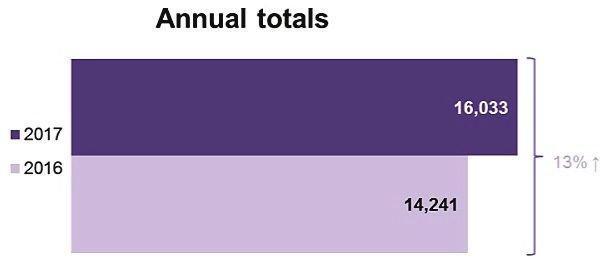
16,033 compared with 14,241 in 2016, an increase of 13%. The general
pattern is broadly similar to 2016.
Figure 15: Top 10 controlled drugs requisitioned in 2016 and 2017
(number of items)
3,669 20% ↑
Oxycodone * (Sch 2)
3,063
2,422
Morphine Sulfate (Sch 2 & 5) 3% ↓
2,495
2,057
Fentanyl ∞ (Sch 2) 23% ↑
1,678
1,559
Midazolam ◊ (Sch 3) 15% ↑
1,360
1,038
Buprenorphine ** (Sch 3) 6% ↓
1,102
888
Diamorphine Hydrochloride (Sch 2) 9% ↑
813
730
Tramadol (Sch 3) 24% ↓
959
600
Methadone Hydrochloride (Sch 2) 12% ↓
683
514 4% ↓
Methylphenidate (Sch 2)
533
403
Alfentanil Hydrochloride (Sch 2) 5% ↑
383
2,153
All other requistioned CDs 84% ↑
1,172
0 1000 2000 3000 4000
Total items
* Oxycodone figures include the combination product Targinact (oxycodone and naloxone).
∞ Fentanyl figures include fentanyl transdermal patches and small amounts of other fentanyl products.
** Buprenorphine figures include the combination buprenorphine/naloxone.
◊ Midazolam figures include oral and injectable midazolam, midazolam hydrochloride and midazolam
maleate.
Care Quality Commission The safer management of controlled drugs: Update report for 2017 28Next steps At the time of writing this report, we are particularly aware of the inquiry into the deaths of patients at Gosport War Memorial Hospital, which found that patients died through opioids prescribed "without medical justification". Although controlled drug governance arrangements are now strengthened compared with those in the 1980s and 1990s, there is no room for complacency. Services should think about incorporating self-assessment, monitoring and clinical audit into their controlled drug arrangements and review their reporting culture. There has also been widespread parliamentary and media interest in cannabis products being used for medicinal purposes. Work is currently underway to consider the rescheduling and licensing requirements for cannabis products to allow wider access for certain conditions. Moreover, health care is now being delivered across England in increasingly new and complex ways, and people are able to access services more easily across borders and through the internet. This adds additional challenges for health and care providers, and organisations need to build on the work carried out so far under the regulations, so that the arrangements for the safe management and use of controlled drugs are not overlooked in this changing landscape, and that patient safety is placed at the forefront of all decision making. The scale of diversion of controlled drugs during 2017 is also a concern and CQC is continuing to support the work of other agencies to address this. © Care Quality Commission 2018 Published July 2018 This document may be reproduced in whole or in part in any format or medium for non- commercial purposes, provided that it is reproduced accurately and not used in a derogatory manner or in a misleading context. The source should be acknowledged, by showing the document title and © Care Quality Commission 2018. Care Quality Commission The safer management of controlled drugs: Update report for 2017 29
Contact us
  Call us on: 03000 616161
  Email us at: enquiries@cqc.org.uk
  Look at our website: www.cqc.org.uk
  Write to us at:   Care Quality Commission
                    Citygate
                    Gallowgate
                    Newcastle upon Tyne
                    NE1 4PA

         Follow us on Twitter: @CareQualityComm

CQC-417-072018
You can also read


