The Turbulent Birth of Stars and Planets
←
→
Page content transcription
If your browser does not render page correctly, please read the page content below
PHYSICS & ASTRONOMY_Protoplanetary Disks

The Turbulent Birth
of Stars and Planets
Exoplanets – planets that orbit stars other than the Sun – used to be a matter of science fiction.
Some 15 years ago, with the first detection of an exoplanet, they became a matter of observational
astronomy. Since then, exoplanet observations have provided astronomers with intriguing clues as
to the formation of stars and planets. This is invaluable information for researchers interested in
planetary and star formation, such as the team led by Thomas Henning, Director at the Max Planck
Institute for Astronomy in Heidelberg.
TEXT THOMAS BÜHRKE

                          T
                                     he birth of planets and stars
                                     begins with clouds of gas and
                                     dust measuring many light-
                                     years in size. Such clouds can
                                     be found throughout our ga-
                          lactic home, the Milky Way, and for
                          billions of years, they have acted as
                          cosmic nurseries. In broad terms, what
                          happens next has been known for de-
                          cades: when a suitably large part of
                          such a cloud exceeds a certain density,
                          it begins to contract under its own grav-
                          ity. Typically, such a region will not be
                          perfectly motionless; instead, it is like-
                          ly to rotate, if only ever so slightly. That
                          is why, once contraction starts, there
                          are two significant physical effects:
                          contraction will reduce the cloud’s
                          overall size. But at the same time, the
                          rotation becomes faster and faster, due
                          to what physicists call the conservation
                          of angular momentum – think of a fig-
                          ure skater who pulls her arms close to
                          her body in order to execute a pirou-
                          ette. As the speed of rotation increases,
                          the interplay between gravity and the
                          centrifugal force pulls the collapsing
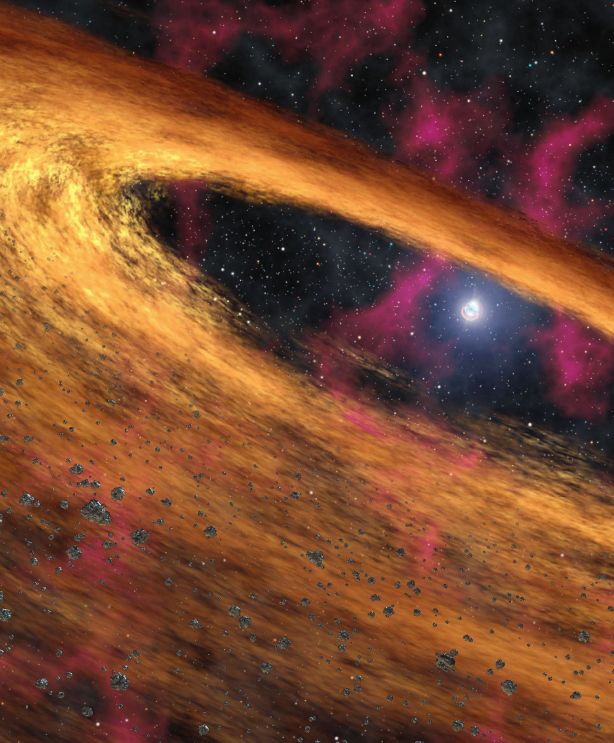
                          cloud into the shape of a disk.

                          THE BIRTH FOLLOWS A
                          PREDEFINED CHOREOGRAPHY

                          In the center of this protoplanetary
                          disk, the gas reaches sufficient density
                          and temperature for nuclear fusion to
                          commence: a star is born. In the outer
                          regions, gas and dust continues to
                          swirl, with dust particles repeatedly
                          colliding and sticking together, form-
                          ing objects of rock-like consistency
                          that grow continually in size. When
                          these objects have reached a few kilo-
                          meters in size, gravity takes over and
                          ensures ever further growth as objects
                          attract each other and coalesce. This is
                          how planets, such as our own Earth,
                          come into being.
Photo: NASA/JPL-Caltech

                              This general picture of planet for-
                          mation has been around for a number
                          of years. But the devil is in the details,
                          and there is as yet no physical model
                          that can explain planet formation from
                          beginning to end. In their search for

                                          4 | 11 MaxPlanckResearch   47
PHYSICS & ASTRONOMY_Protoplanetary Disks

answers, astronomers have turned to         The Spitzer Space Telescope, one of NASA’s         to Herschel’s predecessor, the ISO satel-
ever more refined observations. “The        Great Observatories, was launched in               lite. Incidentally, this expertise also
Spitzer and Herschel space telescopes       2003 and has been trailing the Earth in            gained the Heidelberg group generous
have supplied us with a wealth of ex-       its orbit around the Sun ever since.               access to Spitzer observational data,
cellent new data. It will take years to     Spitzer is an infrared telescope, sensitive        which is quite unusual for a European
evaluate and analyze what we have ob-       for radiation that is typically associated         research group and a strictly American
served – but when we are done, we           with warm objects. Just as Spitzer ran             project. “We were involved in a key
should have a much clearer picture of       out of the coolant it needs for proper             program for the observation of proto-
what happens,” says Thomas Henning,         operation, in May 2009, its European               planetary disks, for which we carried
a Director at the Max Planck Institute      successor Herschel was launched. With              out practically the entire analysis of the
for Astronomy in Heidelberg and head        a mirror measuring 3.5 meters in diam-             spectroscopic data,” says Henning.
of the institute’s Planet and Star Forma-   eter, Herschel is the largest space tele-
tion department.                            scope yet, and just like Spitzer, it special-      WITH INFRARED RADIATION
                                            izes in collecting and analyzing the               INTO THE HEART OF DARKNESS
                                                                                                                                               Photos: NASA/ESA (top); NASA / JPL-Caltech (bottom)

                                            infrared radiation emitted by objects
                                            such as planets and nebulae.                       When Herschel began its operations,
                                                The Max Planck Institute for As-               Henning and his colleagues found an
                                            tronomy played a significant role in               ideal opportunity to build on their ear-
                                            the construction of one of the three               lier Spitzer observations in the frame-
                                            Herschel instruments, the far-infrared             work of the Herschel program “Early
                                            camera PACS – building on a long his-              phases of star formation.” The astron-
                                            tory of expertise in infrared astronomy,           omers set their sights on a cloud of gas
                                            which also features key contributions              and dust with the name G011.11-0.12,

                                            A portrait of two generations: Older stars in the central region of the object RCW 34,
                                            at a distance of 8,000 light-years from Earth, and younger stars (white-edged box near the top).
                                            False-color image based on infrared data taken with the Spitzer Space Telescope.

48   MaxPlanckResearch 4 | 11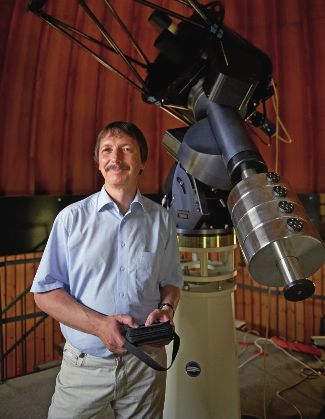
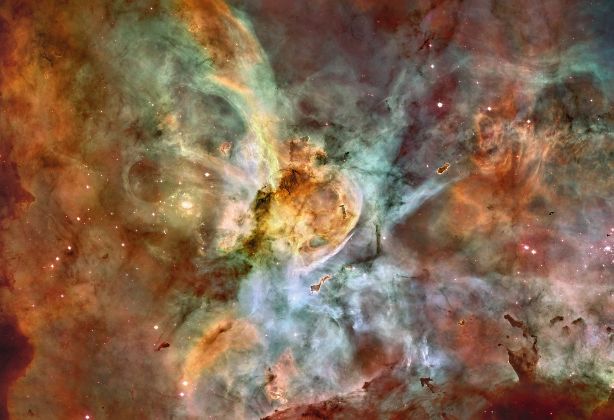
Heavenly glory: The Carina Nebula, at a distance of some 7,500 light-years from Earth, is one of the most beautiful star formation regions in
                              the Milky Way. It contains at least a dozen young stars, each of which is 50 to 100 times as massive as the Sun. Thomas Henning, Director at the
                              Max Planck Institute for Astronomy in Heidelberg, is investigating the early phases of star birth – although not with this telescope, which he
                              uses to share the fascination of astronomy with the public and, in particular, with students.

                              or G011 for short. Previous observa-               ing G011. Spitzer had already provided             tail the physical conditions at the very
                              tions had shown that G011 contains a               some images at relatively short wave-              beginning of gravitational collapse,”
                              number of newly born stars, making it              lengths: at 8 micrometers, the cloud               says Thomas Henning.
                              an ideal target for studying the early             still appears dark, but in observing at
                              phases of star formation.                          successively longer wavelengths, the as-           20 YOUNG STARS
                                  An ideal target, that is, for observa-         tronomers could peer ever more deep-               IN A HOT GAS BUBBLE
                              tions in the infrared: In visible light,           ly into the cloud. The unique images
                              clouds like this are completely opaque,            obtained with Herschel at wavelengths              Another interesting finding is that star
                              showing up as solid black against a star-          between 70 and 350 micrometers re-                 formation proceeds in a very economi-
                              ry background. Infrared radiation, on              vealed, hidden deep in the interior, 24            cal manner. Only around 10 percent of
                              the other hand, can penetrate gas and              regions of increased density, so-called            the available gas mass is turned into
                              dust. What you see of such a cloud de-             pre- or protostellar cores.                        stars, leaving plenty of raw material for
                              pends heavily on the wavelength.                        The temperatures of these cores, as           the formation of subsequent genera-
                                  Following a fundamental law of                 derived from the infrared data, varied             tions of stars.
                              physics, all bodies emit thermal radia-            between 16 and 26 Kelvin, only slight-                 While, in G011, a few regions have
                              tion, and at temperatures between abso-            ly warmer than their environment, at               already taken the first steps toward
Photo: Hardy Müller (right)

                              lute zero (0 Kelvin, which corresponds             12 Kelvin. The masses of these cores               collapsing under their own gravity, the
                              to minus 273 degrees Celsius) and                  ranged from 1 to 240 solar masses. Ev-             question remains whether such a col-
                              about room temperature, most of this               idently, within the next million or so             lapse will happen spontaneously or re-
                              radiation is emitted at infrared wave-             years, the cloud will transform into a             quires some external trigger.
                              lengths. Henning and his colleagues                star cluster, teeming with stars of var-               As to the possible nature of such an
                              made use of this principle when observ-            ious masses. “We can study in great de-            external trigger, consider the star forma-

                                                                                                                                                     4 | 11 MaxPlanckResearch    49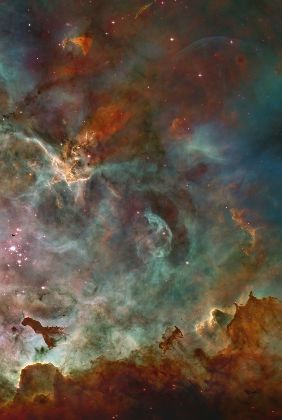
PHYSICS & ASTRONOMY_Protoplanetary Disks

   »      Since interstellar gas clouds can span up to several light-years, different regions within
          those clouds will move at different speeds, leading to turbulent flows of gas and dust.

tion region RCW 34, at a distance of           Using spectroscopy, the astronomers                    particles. Since the disks are heated by
some 8,000 light-years from Earth: a           were able to determine the age of the                  the central object, the temperature of
large, hot gas bubble containing some          stars and stars-to-be in RCW 34. Sur-                  the disk’s inner regions is significantly
20 young stars. In fact, the stars are like-   prisingly, there is a systematic trend,                higher than at the outer rim. By the
ly responsible for the existence of the        with objects inside the bubble being a                 fundamental laws of thermal radiation,
bubble, blowing away the surrounding           few million years older than those at                  this means that infrared radiation from
gas with their intense radiation and a         the edge. The researchers hypothesize                  the interior region will be emitted
steady stream of particles known as            that stars of the first generation in this             mostly at shorter wavelengths than is
“stellar wind”. Near the top of the bub-       nebula pushed matter outward, trigger-                 the case for the outer zones. In cases
ble is a cloud of gas and dust in which        ing the formation of a second genera-                  where emission at shorter infrared
additional stars are being born.               tion of stars near the edge of the cloud.              wavelengths was missing, astronomers
                                                                                                      concluded that the disks in question
                                               PROTOSTELLAR DONUTS                                    must feature a large central hole.
                                                                                                          Direct evidence for this model was,
                                               Are such external influences – candi-                  however, lacking – at least until last
                                               dates include not only young stars, but                year, when an international research
                                               also expanding clouds of matter result-                group headed by Christian Thalmann
                                               ing from so-called supernova explo-                    and Johan Olofsson from the Max
                                               sions, in which more massive stars end                 Planck Institute for Astronomy finally
                                               their lives – necessary in order for new               succeeded in producing a direct image
                                               stars to form? Thomas Henning is con-                  of such a disk. Thalmann and his col-
                                               vinced that external triggers play a sup-              leagues utilized a special camera on the
                                               porting role at best: “Turbulence in the               Japanese Subaru telescope in Hawaii to
                                               clouds is perfectly sufficient to cause                observe the young star LkCa 15. The
10,000 years                                   affected regions to contract and achieve               image showed a disk with a large cen-
                                               critical density.” But how does this tur-              tral gap. In fact, the gap is so large that
                                               bulence come about?                                    it could quite comfortably accommo-
                                                   Stars and nebula in our cosmic                     date the orbits of all the planets in our
                                               neighborhood orbit the center of our                   own solar system.
                                               home galaxy, the Milky Way, with ob-                       A second set of observations with
                                               jects closer to the center moving faster               Subaru, again involving the Heidelberg
                                               than their more distant cousins. Since                 astronomers, led to the discovery of a
                                               interstellar gas clouds can span up to                 smaller type of disk. The disk around
                                               several light-years, different regions                 the star AB Aurigae, at a distance of 470
                                               within those clouds will move at differ-               light-years from Earth, is about the size
                                               ent speeds, leading to turbulent flows                 of our solar system. It consists of nest-
                                               of gas and dust.                                       ed rings that are arranged somewhat
100,000 years                                      In fewer than one million years, the               asymmetrically around the star.
                                               protostellar cores of G011 will have con-                  Another discovery, again by Max
                                               densed sufficiently for protostellar disks             Planck researcher Olofsson and col-
                                               to form around nascent stars. These disks              leagues, involves the young star T
                                               are the birthplaces of planets. Many oth-              Chamaeleontis (T Cha), at a distance
                                               er young stars in the galaxy have already              of 330 light-years from Earth. Using
1 million years                                reached this stage, and have been re-                  the Very Large Telescope of the Europe-
                                               warding targets for observation.                       an Southern Observatory (ESO) in
                                                   In many cases, the existence of                    Chile, the astronomers found that a
                                               these disks can be deduced only indi-                  portion of the disk material has formed
                                               rectly from characteristic infrared radi-              a thin dust ring at a distance of just 20
10 million years
                                               ation emitted by their constituent dust                million kilometers from the star –
                                                                                                                                                    Graphic: Subaru

                                               Stages of stellar evolution: First, a nearly spherical cloud collapses. Since it rotates,
                                               centrifugal forces will pull it apart, resulting in a disk. In the center, matter collapses
100 million years                              further to form a star, while the disk becomes the birthplace of planets.

50   MaxPlanckResearch 4 | 11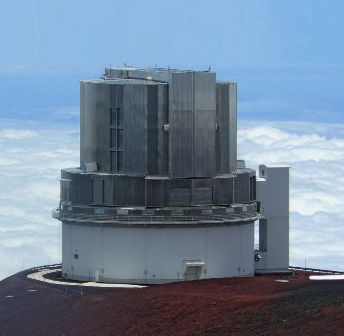
Insights: Using the Japanese Subaru telescope in Hawaii, Heidelberg-based Max Planck astronomers and their colleagues have
                     managed to capture astounding images of protoplanetary disks, such as the ring-shaped disk around LkCa 15 (above) and the smaller disk
                     around the star AB Aurigae with its much more complicated structure.

                     about one-third the orbital radius of             “That, of course, is the most interest-           carbon dioxide in their atmospheres.
                     Mercury, the planet closest to our Sun.           ing possibility,” says Thomas Henning.            But they have not yet succeeded in pin-
                     Behind this ring extends a wide, dust-                 Early this year, an international            ning down the evolutionary link – a
                     free region, up to about 1.1 billion ki-          team actually found evidence for this             young planet inside the disk that
                     lometers from the star. That is where             latter scenario. Near the outer edge of           served as its birthplace.
                     the outer part of the disk begins.                the large gap in the disk around T                    Until recently, the astronomers had
                                                                       Chamaeleontis, they found what could              observed only the dust component of
                     CLOSE TO THE                                      be an orbiting body. It is located about          protoplanetary disks. But this accounts
                     LIMITS OF OBSERVATION                             a billion kilometers away from its cen-           for only about a hundredth of the to-
                                                                       tral star, a distance comparable to that          tal mass. Most of the disk mass is in
                     Even before these direct sightings of             between Jupiter and the Sun. But these            the form of gas, which is very difficult
                     donut-shaped disks, astronomers had               observations are at the limits of what is         to observe, since the radiation emitted
                     discussed the possible causes for the             technically feasible for the astronomers.         by the atoms and molecules is so ex-
                     formation of such gaps. One possibili-            They were thus unable to determine be-            traordinarily weak.
                     ty involves the central star’s radiation          yond all doubt exactly what this object               Yet the gas plays a major role in the
                     causing the dust particles to evaporate:          is. It may be a newly formed planet.              development of the overall disk and in
                     Alternatively, a nearby (and as yet un-                That planets grow in protoplane-             the formation of planets. For instance, it
                     discovered) star could have swept up              tary disks is, by now, an undisputed              exerts friction on the tiny dust particles,
                     the dust. The most likely option, how-            fact. In the case of some older stars, sci-       slowing them down at different rates de-
Photos: Subaru (3)

                     ever, is that a planet has formed                 entists have managed to observe a few             pending on particle size. The resulting
                     around the star, sweeping up gas and              exoplanets directly. In a few cases, it           different speeds of the particles increase
                     dust and, in the end, incorporating               was even possible to detect substances            the likelihood of collisions, thus accel-
                     whatever material it has attracted.               such as water, sodium, methane and                erating the growth of the particles.      >

                                                                                                                                          4 | 11 MaxPlanckResearch   51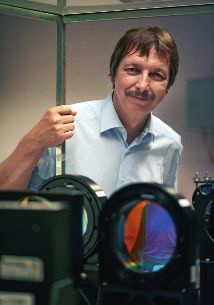
PHYSICS & ASTRONOMY_Protoplanetary Disks

                                                in, at most, 10 million years. “That puts            Detecting the more complex building
                                                very strict limits on the timescale of               blocks of life lies beyond the capabilities
                                                planet formation,” explains Henning.                 of today’s telescopes. However, using
                                                And, as all these statements should ap-              some sensitive radio telescopes, as well
                                                ply equally to the formation of our own              as Spitzer and Herschel, the researchers
                                                solar system, it imposes strict limits on            at the Max Planck Institute for Astrono-
                                                the timescale of our own planetary or-               my have at least been able to take some
                                                igins, as well.                                      baby steps toward that goal: they man-
                                                                                                     aged to observe simple molecules such
                                                150 TYPES OF MOLECULES IN                            as carbon monoxide and water in pro-
                                                INTERSTELLAR CLOUDS                                  toplanetary disks. Now they are putting
                                                                                                     their hope in the next generation of tele-
                                                Last but not least, there is an aspect of            scopes, notably the Atacama Large Mil-
                                                the analysis of the gaseous compo-                   limeter Array (ALMA). ALMA is a com-
                                                nents of disks that has a direct bearing             pound telescope consisting of nearly 70
                                                on questions about the origins of life               separate radio telescopes that can be
                                                on Earth and elsewhere. In large inter-              moved into different positions. ALMA is
                                                stellar clouds, astronomers have thus                currently under construction in Chile
                                                far found around 150 types of mole-                  and will gradually be put into operation
                                                cules, including complex organic sub-                in the coming years.
                                                stances. Not so in the protoplanetary                    Hubble’s successor, the James Webb
                                                disks, where, so far, no such chemical               Space Telescope, promises another
                                                compounds have been observed. This                   shift in cosmic perspective. The Hei-
                                                leaves highly interesting questions un-              delberg-based Max Planck researchers
                                                answered: Can the complex precursor                  are involved in this project, too, de-
                                                molecules of life survive the early phas-            veloping key components of the MIRI
                                                es of planet formation? Are they pres-               instrument, which will work in the
                                                ent in the circumstellar disks, and can              medium infrared range – and is ex-
                                                they possibly make it to the surfaces of             pected to be good for more than one
At the Max Planck Institute in Heidelberg,      the young planets unharmed?                          observational surprise.
astronomers and engineers are also involved
in developing and constructing new instru-
ments, including adaptive optics systems
that can mitigate the effects of atmospheric
turbulence, resulting in ground-based images      GLOSSARY
of unparalleled sharpness. Adaptive optics
plays a key role in the search for extrasolar     Galaxy                                              Protostellar cores
planets and disks.                                The collection of billions and billions of stars    Stars form inside interstellar clouds of
                                                  to which our own planetary system belongs.          gas and dust that collapse under their
                                                  The Milky Way Galaxy (from the Greek word           own gravity. Ultimately, a concentration
                                                  gala for milk) consists of 150 to 200 billion       of mass known as a protostellar core de-
Furthermore, gas is the key ingredient                                                                velops, which attracts additional matter
                                                  suns, as well as interstellar gas and dust
of giant planets, such as Jupiter and Sat-        clouds. It features several spiral arms and, if     and contracts ever further, transforming
urn, which gather significant amounts             viewed from the top, would look like a disk         gravitational energy into heat. The result
of gas when forming their enormous                with a diameter of about 100,000 light-             is a protostar that emits infrared radia-
                                                  years. Viewed from the side, the disk is only       tion. Around such a protostar, matter
atmospheres. For these reasons, as-
                                                  about 1,000 light-years thick. At the heart of      will typically contract to form what is
tronomers are very interested in learn-           the Milky Way sits a gigantic black hole. The       known as a protoplanetary disk: the
ing the typical lifetimes of such gas-            central bulge is surrounded by a spherical re-      birthplace of future planets.
eous disks. The result would impose a             gion (the so-called halo) that contains 150
                                                                                                      James Webb Space Telescope
strong constraint on the timescale of             globular clusters.
                                                                                                      The James Webb Space Telescope (JWST) is
planet formation.                                 Very Large Telescope (VLT)                          the intended successor to the Hubble
    The astronomers in Heidelberg dug             An array of four telescopes, each with a main       Space Telescope. With its 6.5-meter-mir-
                                                  mirror measuring 8 meters in diameter, com-         ror, it is set to peer much deeper into
deep into their bag of observational
                                                  plemented by several auxiliary telescopes.          space than its predecessor, receiving in-
tricks to address this question. In sever-        The VLT is designed for observations in visi-       frared light from planetary systems-in-
al star clusters with members aged be-            ble light up to the mid-infrared. Light collect-    the-making, as well as the most distant
tween about 1 million and 20 million              ed by these telescopes can be combined, in          galaxies. However, due to financial rea-
years, they determined the dust and gas           effect creating a single virtual telescope with     sons, the project was recently put on
                                                  ultra-high resolution – the Very Large Tele-        hold by the American space agency,
                                                                                                                                                   Photo: Hardy Müller

quantities in the disks. What they                scope Interferometer (VLTI). The observatory is     NASA. It is questionable whether the
found was surprising: the amounts of              situated atop the 2,635-meter-high Cerro Pa-        JWST can start as planned in 2018.
gas and dust decreased almost exactly             ranal in the Chilean Andes, and is operated
in parallel, and rather quickly at that:          by the European Southern Observatory (ESO).
disk matter largely disappeared with-

52   MaxPlanckResearch 4 | 11
You can also read


