The Yare Education Trust
            Admissions Policy
(Thorpe St Andrew School and Sixth Form)

   For admissions in September 2021
←
→
Page content transcription
If your browser does not render page correctly, please read the page content below
The Yare Education Trust
Admissions Policy
(Thorpe St Andrew School and Sixth Form)
For admissions in September 2021Contents
1. School Status ……………………………………………………………………………………………………………………........ 1
2. Introduction …………………………………………………………………………………………………………………………… 1
• Admissions to Year 7
• Oversubscription Criteria
• Named Feeder Schools
3. Information on Oversubscription Criteria…………………………………………………………………………………… 2
• Distance
• Looked After Children and Previously Looked After Children
• Siblings
• Education Health and Care Plans (EHCP) / Statements of Special Educational Needs
• Random Allocation
• Admission of Children Outside their Normal Age Group
• Sixth Form
4. The Right of Appeal ………………………………………………………………………………………………………………… 3
• Admission Appeals
5. Map………………………………………………………………………………………………………………………………………….. 41. School Status
Thorpe St Andrew School and Sixth Form
Published Admission Number: 300
Address: Laundry Lane
Thorpe St Andrew
Norwich
Norfolk
NR7 0XS
Telephone: 01603 497711
Website: www.thorpestandrewschool.org.uk
Admissions Enquiries: 01603 497739
office@thorpe-st-andrew.norfolk.sch.uk
Number on Roll July 2020: 1945
2. Introduction
The admission authority for the school is the Yare Education Trust. The Trust will admit children
with a Statement of Special Educational Needs or an Education, Health and Care Plan (EHCP) which
names the school.
Admissions to Year 7
Should the school receive more applications than the published admission number (300), the
following oversubscription criteria will be used:
Oversubscription Criteria
1. Looked after children and children in public care (see definition on page 3).
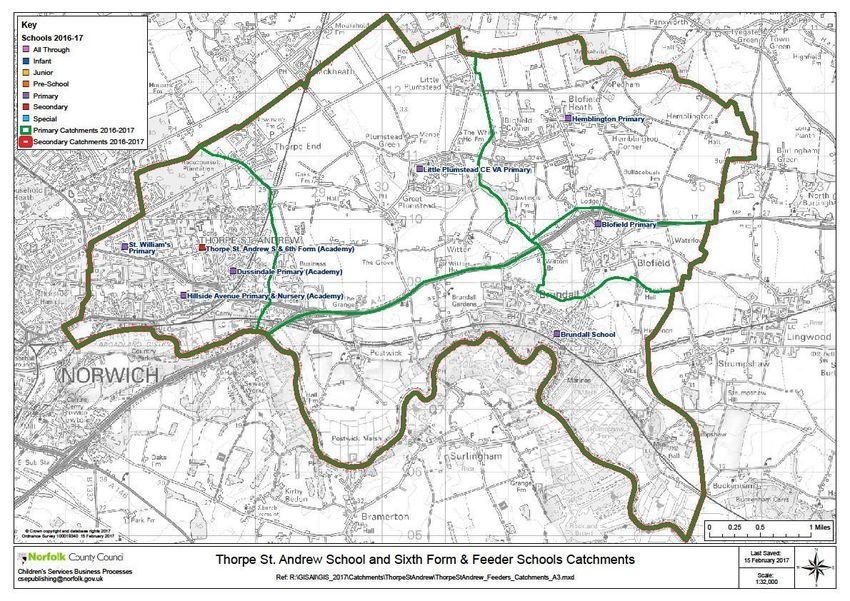
2. Children who live in the area served by the school (the Catchment Area – see below).
3. Children who live outside the area served by the school, who have an older sibling
attending the school at the time of admission (but not the Sixth Form). (See definition of
‘sibling’ on Page 3).
4. Children who attend a school which is a named feeder school.
5. Children who live outside the area served by the school.
If oversubscription occurs under any of the criteria, the highest priority will be given to children living
nearest to the school. To determine who lives nearest, distance will be measured on a straight line
‘crow-fly’ basis, using Ordnance Survey data. If following the application of admission rules and
distance two applicants cannot be separated for a final place at a school, the Trust will use random
allocation to determine the priority for the remaining place.
Late applications (those arriving after the published closing date) will only be considered after all
other applications have been processed.
1Named Feeder Schools (all are Yare Education Trust Partner Schools)
Dussindale Primary School
Hemblington Primary School
Hillside Avenue Primary and Nursery School
3. Information on Oversubscription Rules
The area served by the school - Blofield (including Blofield Corner and Blofield Heath), Brundall,
Hemblington (including Pedham), Great and Little Plumstead (including Thorpe End), Postwick
(including Witton), Thorpe St Andrew (including Dussindale) and part of the parish of Strumpshaw.
Advice on the catchment area can be found by:
• Viewing www.whereilive.norfolk.gov.uk and click on school catchment. This is the most
detailed information.
• Telephoning 0344 800 8020.
• There is a map of the catchment area attached to this policy.
• Please note, the catchments of the seven schools listed below are all contained within the
overall catchment area for Thorpe St Andrew School and Sixth Form:
Blofield Primary School
Brundall Primary School
Dussindale Primary School
Hemblington Primary School
Hillside Avenue Primary and Nursery School
Little Plumstead VA Primary School
St William’s Primary School
However, it should be noted that a family may not be living within the identified catchment
area, although they may be attending one of the catchment schools. Please check carefully
so that you are clear if you are living within the catchment area or not, as attendance at one
of the above schools only gives priority if it is one of the three named feeder schools.
The following information and definitions apply to all schools in The Yare Education Trust.
Distance
Distance will be measured on a straight line ‘crow-fly’ basis using Ordnance Survey data. The
measurement will be taken from the post office postcode address point on the child’s home to the
post office postcode address point on the school.
Looked After Children and Previously Looked After Children
A ‘looked after child’ is a child who is (a) in the care of a local authority, or (b) being provided with
accommodation by a local authority in the exercise of their social services functions (see the
definition in Section 22(1) of the Children Act 1989) at the time of making an application to a school.
‘Children in public care’ and ‘looked after children’ are defined as looked after children and previously
looked after children. Previously looked after children are children who were looked after and ceased
to be so because they were adopted or became subject to a Residence Order or Special Guardianship
Order.
Siblings
When we use the oversubscription rules, ‘siblings’ means; brothers or sisters living at the same
address including adopted children, step-brothers, step-sisters and children in foster care within a
family unit.
2Only siblings attending the school at the time of the child’s proposed admission will be given a higher
priority in the oversubscription rules.
Education Health and Care Plans (EHCP) / Statements of Special Educational Needs
Where a child’s EHCP or Statement of Special Educational Needs names a specific school, the school
must admit the child regardless of whether the school has a place available.
Random Allocation
Where random allocation is used to determine the allocation of school places, applicants will have
their names drawn by lots to see who should be offered the place(s). There will be an independent
scrutiny of the random allocation.
Admission of Children Outside their Normal Age Group
Parents may seek a place for their child outside of their normal age group, for example, if the child is
gifted and talented or has experienced problems such as ill health. The Trust will make decisions on
the basis of the circumstances of each case and in the best interests of the child concerned. This will
include taking account of the parents’ views; information about their medical history and the views
of a medical professional; whether they have previously been educated out of their normal age
group. Also taken into account will be the views of the Headteacher/Principal of the school. In order
to seek admission outside a child’s normal age group, parents should contact the school as soon as
possible. When informing a parent of the decision on the year group the child should be admitted to,
the Trust will set out clearly the reasons for the decision.
Where there is agreement to a parental request for their child to be admitted out of their normal age
group and, as a consequence of that decision, the child will be admitted to a relevant age group (for
example the age group to which students are normally admitted to the school) the Trust will process
the application as part of the main admissions round, unless the parental request is made too late
for this to be possible, and on the basis of their determined admission arrangements only, including
the application of oversubscription criteria where applicable. Parents have a statutory right to appeal
against the refusal of a place at a school for which they have applied. This right does not apply if they
are offered a place at the school but it is not in their preferred age group.
Sixth Form Admissions
The school is keen to encourage applications from students at Thorpe St Andrew School and Sixth
Form and from other schools and colleges. All applications will be considered and applicants offered
advice on course choices. Increasingly we are attracting applicants to the Sixth Form from other
schools. The school reserves the right to refuse entry to the Sixth Form.
4. The Right of Appeal
Admission Appeals
If the request is refused, parents have the right of appeal to an independent panel. Appeals are heard
by school admission appeals panels which act independently of the Trust. If the preference is
refused, information about how to appeal will be sent to parents with a refusal letter. Please refer to
Appendix 1.
Parents will be advised in reasonable time when and where the appeal will be heard. At least seven
working days before the appeal parents will be sent a written summary of the case for refusing their
child a place. Parents are encouraged to attend the appeal in person. The appeal will be heard in
private and if parents wish they may bring a friend, relative or representative. It is for the parent to
3decide if they would like to bring their child to the hearing. If parents do not attend the appeal
hearing, a written appeal case will still be considered by the panel.
At the hearing there will be three panel members who make the decision and a clerk who will record
the proceedings and advise on law and procedure. The Trust will also be represented and will give
the reasons for not meeting the preference. Parents will be given the opportunity to explain to the
panel the reasons why they wish for their child to attend the school.
The panel will firstly decide whether the admission authority has shown why it cannot admit more
children and if so, will go on to consider all the points parents have made. The panel’s decision is
based on balancing the needs of the child against the effect of admitting another child. Wherever
possible parents will be told the decision by telephone by the next working day and a letter will be
sent within seven days explaining the decision and reasons for it.
All admission appeals panels act independently and their decisions are binding on everyone. There
is no further right of appeal to the panel for a place in the same academic year unless there is a
significant change in circumstances. This would include a new medical problem or a house move
where this was not known about and considered at the original appeal hearing.
The Local Government Ombudsman can investigate complaints of maladministration. Parents will
be given further details about this if the appeal is unsuccessful. Parents should complain to the
Ombudsman within twelve months of when they first knew about the matter they wished to
complain about.
5. Map
4Appendix 1
FURTHER INFORMATION IN SUPPORT OF AN APPEAL
(PLEASE COMPLETE THE FIRST PART OF THIS FORM IN BLOCK CAPITAL LETTERS USING BLACK INK)
FULL NAME OF CHILD
DATE OF BIRTH
NAME OF PARENT(S)
ADDRESS
CONTACT TELEPHONE
CONTACT EMAIL
CURRENT SCHOOL
ALLOCATED SCHOOL
PREFERRED SCHOOL
I have given notice of my intention to appeal against the decision of the Governing Board not to
comply with my wish for my child to attend my preferred school stated above. The reasons for my
appeal are detailed below. I certify the details on this form are an accurate account of this child’s
current situation.
Signed: _________________________________________ Date: _________________
Please detail below your reasons for your appeal. You may use or attach separate sheets if
required.
My reasons for appeal are:
Continue overleaf as necessary(Please continue on separate sheets if necessary)
You can also read


