Tiny 'water bears' can teach us about survival - Phys.org
←
→
Page content transcription
If your browser does not render page correctly, please read the page content below
Tiny 'water bears' can teach us about
survival
20 March 2019, by Seth Borenstein

                                                            drought, better preserve blood and medicines, and
                                                            even make more effective sunscreen.

                                                            When the going gets tough for tardigrades, they
                                                            curl up, dry out and wait. Then, when the
                                                            environment gets better and they get water, they
                                                            spring back to life.

                                                            Scientists say they can stay dormant for decades
                                                            before reanimating.

                                                            In 2007, scientists put two species of tardigrades in
                                                            containers, launched them into orbit and opened
                                                            them up to cold, airless space full of punishing
                                                            radiation from the sun and stars.

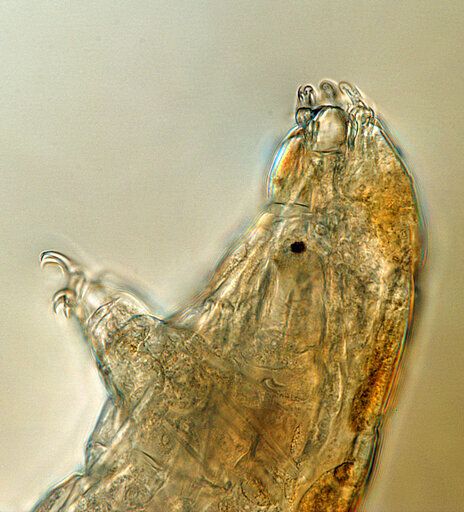
This undated electron microscope image provided by
William Miller of Baker University in March 2019 shows a
tardigrade of the class Heterotardigrada, also known as
a "water bear." The small animals, about the size of a
period, are able to survive extreme heat, cold, radiation
and even the vacuum of space. (William Miller via AP)

Earth's ultimate survivors can weather extreme
heat, cold, radiation and even the vacuum of
space. Now the U.S. military hopes these tiny
critters called tardigrades can teach us about true
toughness.

These animals are pipsqueaks, only about the size
of a period. Under a microscope they look like
some combination of chubby bear and single-eyed
alien. And they are the closest life gets to
indestructible.
                                                            This undated electron microscope image provided by
                                                            William Miller of Baker University in March 2019 shows a
No water? No worries. Tardigrades survive.
                                                            tardigrade of the class Heterotardigrada, also known as a
Antarctic cold, 300-degree heat (150 degrees                "water bear." The small animals, about the size of a
Celsius), a lack of oxygen, even punishing                  period, are able to survive extreme heat, cold, radiation
radiation doesn't stop these animals. They are so           and even the vacuum of space. (William Miller via AP)
resilient in the face of so many dangers that
scientists think their unique biology may hold clues "If you were put into that same thing, you would
to how we can make crops more resistant to

                                                                                                             1/4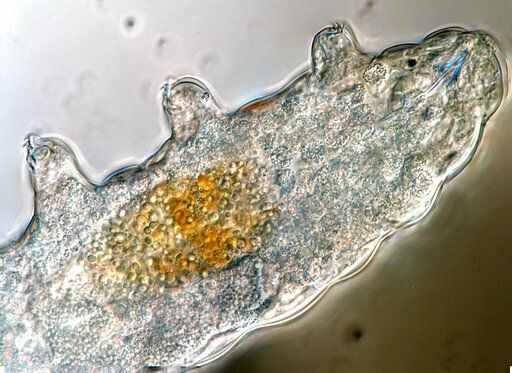
explode," said tardigrade expert Randy Miller, a    and can't go into survival mode, they die like other
biologist at Baker University in Kansas. They lived creatures. But they don't have a circulatory system
and later multiplied, and the offspring from those  or a skeleton, so that allows them to curl up in a
tardigrade astronauts are still alive, Miller said. hyper-survival mode called "cryptobiosis."

There are as many as 1,200 species of tardigrades, Not all the critters come back from suspended
and they live all over Earth, from mountain tops to animation, Miller said. But overall, they survive,
ocean depths to driveways. Not all have the ability even living through Earth's five mass extinctions.
to go dormant and come back to life.
                                                      University of North Carolina biologist Thomas
Speaking from McMurdo Station in Antarctica,          Boothby wanted to know how they manage to
Brigham Young University biologist Byron Adams survive in "environments we think of as being
said he can walk a few hundred yards outside and impossible to live in." So he isolated the genes that
find tardigrades. He called them the tigers of inland activate when tardigrades need to go into
Antarctica, near the top of the limited food chain,   cryptobiosis.
eating algae and aquatic plants.
                                                      Boothby engineered those genes into yeast and
Miller said tardigrades seem to be the first animals says their tolerance to drought increased 100-fold.
on Earth to have evolved legs, and, sure enough, He hopes the genes could also help crops better
they look like a first draft: The rear two legs face  survive drought.
backward while the front six face forward.

                                                            This undated microscope photo provided by Thomas
                                                            Boothby in March 2019 shows a tardigrade, also known
                                                            as a "water bear." The small animals, about the size of a
                                                            period, are able to survive extreme heat, cold, radiation
                                                            and even the vacuum of space. (Thomas Boothby via
                                                            AP)

This undated electron microscope image provided by
William Miller of Baker University in March 2019 shows a
tardigrade of the class Heterotardigrada, also known as a
                                                            In December, the Defense Department's long-term
"water bear." The small animals, about the size of a        research arm gave Boothby a nearly $5 million
period, are able to survive extreme heat, cold, radiation   grant to figure out what in tardigrade genes might
and even the vacuum of space. (William Miller via AP)       help human health.

                                                            The idea is to see if the tricks that tardigrades use
                                                            to protect themselves when they dry can be used to
If they are hurt when they are in an active phase           protect vaccines and human blood, Boothby said.

                                                                                                              2/4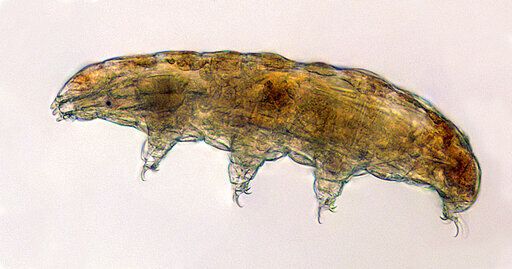
Japanese scientists are studying whether
                                                             tardigrade proteins could help them come up with a
                                                             better sunscreen to protect against ultraviolet rays
                                                             that cause skin cancer. A 2016 study showed that
                                                             human cells augmented with a DNA protein unique
                                                             to tardigrades reduced radiation damage in
                                                             preliminary lab tests.

                                                            This undated microscope photo provided by Thomas
This undated microscope photo provided by Thomas            Boothby in March 2019 shows a tardigrade, also known
Boothby in March 2019 shows a tardigrade, also known        as a "water bear." The small animals, about the size of a
as a "water bear." The small animals, about the size of a   period, are able to survive extreme heat, cold, radiation
period, are able to survive extreme heat, cold, radiation   and even the vacuum of space. (Thomas Boothby via
and even the vacuum of space. (Thomas Boothby via           AP)
AP)

                                                            Tardigrades are so otherworldly that some theorize
Boothby hopes to make bags of blood last longer             that they could easily exist on planets outside the
than the current six weeks and allow them to be             solar system. Harvard astronomer Avi Loeb said
stored in a dried state so soldiers can take their          "they could survive an impact by a rock and they
own blood supply to battle or ambulances can carry          could potentially be brought from another planet" to
more. Tardigrade tricks could possibly also help            Earth.
with preserving vaccines to help reduce the
enormous cost and complexity of trying to keep              Loeb and colleagues decided to see if life on Earth
vaccines cold. They could also potentially help             could survive some of the worst cosmic calamities.
preserve organs or damaged tissue.                          So they looked look at the hearty tardigrades,

                                                                                                              3/4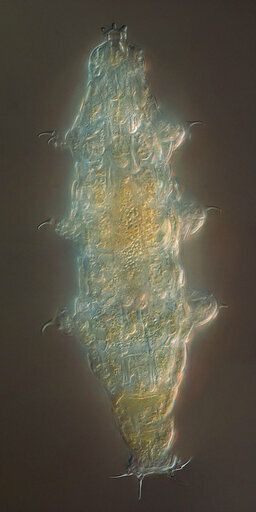
concluding that the water bears could survive most
                                    end-of-the-world scenarios, like a giant asteroid
                                    crash, cosmic ray burst or nearby
                                    supernova—everything short of our sun blinking out.

                                   This undated microscope photo provided by Thomas
                                   Boothby in March 2019 shows a tardigrade, also known
                                   as a "water bear." The small animals, about the size of a
                                   period, are able to survive extreme heat, cold, radiation
                                   and even the vacuum of space. (Thomas Boothby via
                                   AP)

                                   "It's good to know that at least one creature on
                                   Earth has a chance of surviving no matter what,"
                                   Loeb said.

                                   © 2019 The Associated Press. All rights reserved.
                                   APA citation: Tiny 'water bears' can teach us about survival (2019, March 20) retrieved 5 May 2019 from
                                   https://phys.org/news/2019-03-tiny-survival.html

                                   This document is subject to copyright. Apart from any fair dealing for the purpose of private study or research, no
                                   part may be reproduced without the written permission. The content is provided for information purposes only.

                                                                                                                                                4/4

Powered by TCPDF (www.tcpdf.org)
You can also read


