Toolkit for Investors - SPI4 ALINUS - WORKING DOCUMENT - Cerise
←
→
Page content transcription
If your browser does not render page correctly, please read the page content below
SPI4 ALINUS
Toolkit for Investors
FEBRUARY 2017

          WORKING DOCUMENT
TABLE OF CONTENTS
 5   Frequently asked questions
     Introduction to SPI4 ALINUS
     Benchmarking, data quality, and confidentiality
     Versioning and updates
     SPI4 and other data tools
     Investors who have adopted ALINUS
     ALINUS dashboard

16   Getting started with ALINUS

17   Sample messages
     Sample communication from investors to FSPs partners that have already conducted a SPI4
     Sample communication from investors to FSPs partners to announce adoption of ALINUS

18   Funding and TA resources for FSPs conducting a SPI4
     The Social Performance Fund (SP Fund)
     The Responsible Microfinance Facility (RMF)
     Technical Assistance (TA) provider database

19   Online Resources
Social investors in responsible inclusive finance have long tracked social indicators. Using proprietary tools, many
investors collect a range of data points that are largely similar, but different enough to weigh as a reporting
burden on FSPs and investors alike. Reducing this burden while improving comparability of social data is what has
driven a group of social investors to develop ALINUS: a common social data collection tool for due diligence
and monitoring based on the SPI4, the social audit tool to measure implementation of the Universal Standards
for Social Performance Management.

This toolkit is designed to help investors understand and adopt the SPI4 ALINUS. Please note this is a “living” document.
It will be updated based on new developments and user feedback. Please send your ideas and suggestions to CERISE
(spi4@cerise-microfinance.org) or SPTF (info@sptf.info).

This toolkit currently includes the following information and resources:

              INTRODUCTION to the SPI4 ALINUS and FAQs                       FUNDING AND TA RESOURCES for FSPs
                                                                             conducting a SPI4

              GETTING STARTED with ALINUS                                    RESOURCES ONLINE to get started, including
                                                                             a list of FSPs that have conducted a SPI4
                                                                             assesment, ALINUS newsletters, access to
                                                                             past webinars
              SAMPLE MESSAGES when communicating
              on the SPI4 ALINUS with partner FSPs,
              internal teams, and management

Also available:

              Trainings for investment managers, networks,                   Benchmarks for ALINUS results, based on the
              and FSPs on SPI4 and the social audit process                  SPI4 database – available upon request
              and tools (e.g., webinars with partners around
              the world to walk them through the SPI4 process
              and answer their questions, webinars tailored
              to investment managers, webinars for networks                  Coming soon: Guidelines for investment
              to help them on their role in supporting the                   officers on how to use SPI4 ALINUS during
              implementation of the SPI4 of their members, or                social due diligence and monitoring
              in person trainings) – available upon request                  (preparation, desk-review, integrating ALINUS
                                                                             questions in the field visits and interviews,
                                                                             quality check, etc.).
              Specific trainings for investment analyst teams
              on using ALINUS: on site trainings or webinars –
              available upon request.

4 SPI4 ALINUS | Toolkit for Investors
FREQUENTLY ASKED QUESTIONS
INTRODUCTION TO SPI4 ALINUS
DEFINE
AND MONITOR
SOCIAL GOALS
What is the SPI4 and SPI4 ALINUS? ENSURE BOARD,
BALANCE
MANAGEMENT,
FINANCIAL
AND EMPLOYEE
AND SOCIAL
COMMITMENT TO
PERFORMANCE
SOCIAL GOALS
UNIVERSAL
The SPI4 is a social audit tool for financial service providers (FSP) to STANDARDS
FOR SOCIAL
measure their social performance. A free Excel questionnaire in its current PERFORMANCE
MANAGEMENT
version, the SPI4 is a set of quantitative and process indicators for FSPs TREAT
DESIGN PRODUCTS,
SERVICES AND DELIVERY
EMPLOYEES CHANNELS THAT MEET
RESPONSIBLY CLIENTS' NEEDS AND
to evaluate their level of implementation of the Universal Standards for PREFERENCES
Social Performance Management, which include the Client Protection TREAT
CLIENTS
RESPONSIBLY
Certification Standards.
SPI4 helps FSP create their social statements and offers a coherent,
comprehensive and pragmatic way to strengthen client-focused
management practices.
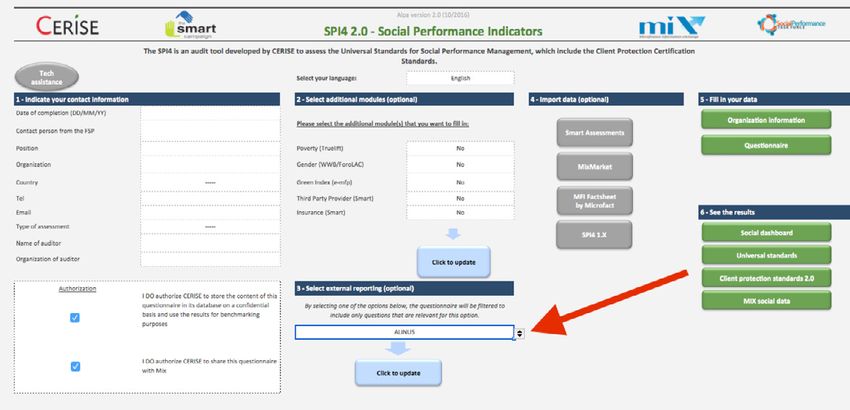
ALINUS is a social data collection tool for investor due diligence and Social Performance Management (SPM)
refers to the systems that organizations use
monitoring. It is a subset of SPI4 indicators that can be accessed by selecting
to achieve their stated social goals and put
the ALINUS option from the SPI4 Welcome Page. These indicators were customers at the center of strategy and
selected by the Social Performance Task Force investors working group operations. A provider’s social performance
refers to its effectiveness in achieving its stated
through a collaborative and iterative process. social goals and creating value for clients. If a
provider has strong SPM practices, it is more
likely to have an impact on clients.
The SPTF is a global non-profit membership
organization that develops and promotes
best practices and standards to help financial
service providers (FSPs) put clients at the
center of all strategic and operational decisions
and align their policies and procedures with
responsible business practices.
ALINUS can be accessed from the Welcome Page of the SPI4 v2.0
SPI4 ALINUS | Toolkit for Investors 5Why use ALINUS?
By using the same set of generally-accepted indicators to assess partners, investors can streamline social data
collection, reduce the reporting burden on FSPs, spend less time on gathering data and more time on analyzing
change and making improvements. The ALINUS questionnaire and dashboard can be used as a standalone
document or as the social performance evaluation of a due diligence report or an investment memo.
A standard set of indicators also means higher quality data: with many of different stakeholders asking for the
same data points, FSPs see the value in honing their systems to produce the information. And, because these
indicators are associated with technical resources and case studies, guiding FSP’s on improving client-focused
management practices is even easier.
Finally, standarized mesasures enable benchmarking and comparability within a portfolio across the sector.
BENEFITS OF STANDARDIZING SOCIAL PERFORMANCE MEASURES
VALUE TO INVESTORS VALUE TO FINANCIAL SERVICES INSTITUTIONS
• Improve reporting to asset owners • Reduces reporting burden
• Allows for aggregation within a portfolio • Enables clear articulation of the impact
• Enables benchmarking and comparability of the institution’s products and services
• Provides standard and valuable information • Facilitates tracking against the organization’s
for screening and investment decisions social performance goals
6 SPI4 ALINUS | Toolkit for InvestorsWho is using ALINUS?
As of February 2017, already over 300 FSPs had conducted a SPI4 - ALINUS,
which might include some of your partners. Click here to check the regularly
updated list of FSPs that have conducted a social audit. As an investor, you can
ask your partners to share their SPI4 with you (see sample message you can
send), so you can leverage this data. Visualize ALINUS indicators from a full
SPI4 in just one click of a button, compare results to benchmarks from an
ALINUS subset of the SPI4 database (tables available at cerise-spi4.org), and
use it as a basis for discussions with partners. The Smart Campaign is a
global platform to promote a
set of core principles for the
treatment of microfinance
clients, the Client Protection
Who developed ALINUS?
Principles. Housed in ACCION’s
Center for Financial Inclusion,
the Smart Campaign has
The SPI4 is the fourth version of the SPI, which stands for Social Performance
steering committee comprised
Indicators. Developed by CERISE in 2003, the SPI is one the most widely used microfinance industry leaders
social audit tool for microfinance. In 2014, CERISE joined forces with the SPTF, from around the world.
the Smart Campaign, as well as SPI users (FSPs, networks, TA providers, raters,
investors) to design the SPI4, aligned with the Universal Standards.
SPI4 ALINUS | Toolkit for Investors 7How was ALINUS developed?
The SPTF Investor Working
Group (SIWG) works to advance CERISE coordinated a selection process that took place in a series of online and
responsible investment in financial
in-person meetings in late 2014 and early 2015. Twelve investor organizations
inclusion. The group is led by
SPTF Board Chair Jurgen Hammer joined efforts to create a common subset of indicators, selecting 80 out of the
of Grameen Credit Agricole 200 SPI4 indicators in 2015: ADA, BlueOrchard, BNP Paribas, Cordaid, Deutsche
Foundation, SPTF board member
Margot Quaegebeur of Anthos Bank, Grameen Credit Agricole Microfinance Foundation, Grassroots Capital
Asset Management B.V., and SPTF Management/Caspian, Incofin, Oikocredit, Proparco, SIDI and Triple Jump. They
board member Christophe Bochatay
of Triple Jump. The working group have since been joined by a growing number of investors and fund managers
is open to all investors seeking who see the value of a standardized social evaluation format. ALINUS was
financial and social returns.
Currently, the SPTF has more than
updated in October 2016 (ALINUS 2.0) based on revisions to the Universal
300 investor members representing Standards and Client Protection Certification Standards. The tool will now
over 100 organizations.
remain stable until 2020, and a transparent and inclusive revision agenda and
committee have already been defined.
8 SPI4 ALINUS | Toolkit for InvestorsWhat is the difference between a full SPI4 and ALINUS?
The full SPI4 questionnaire includes 160 indicators from the
Universal Standards for SPM and 11 indicators from the Green
Index. The ALINUS option has 68 indicators, manageable for a due-
CERISE is non-profit service provider
diligence mission. Because ALINUS indicators are only a subset of based in Paris. Founded in 1998 by
SPI4 indicators, results of a full SPI4 naturally differ from an ALINUS five French organizations active in
responsible inclusive finance, today
assessment in terms of depth of analysis and focus. However, CERISE is registered as an association,
ALINUS indicators have shown to be a good proxy for results by with a 5 member Board of Directors.
CERISE takes a collaborative approach
Dimension. For example, in the December 2016 SPI4 database, to all its activities, coordinating with
the average score for full SPI4 was 66% while the average score for a range of actors to co-develop user-
friendly tools and resources like SPI4,
ALINUS was 69%. Averages by dimension are also similar.
SPI4-ALINUS and the Social Business
Scorecard, that are available for free
(registered under Creative Commons
Who can use the ALINUS?
licenses).
CERISE has four permanent staff,
Designed by investors and fund managers themselves, ALINUS can
and works with a robust consultant
be used by anyone interested in getting an overview of an FSP’s network. CERISE self-finances 60%
social performance. Because it analyzes all six dimensions of the of its budget through services.
The remaining 40% comes from
Universal Standards and Green Index from an investor’s risk and institutional partners. This allows us to
mission-oriented perspective, ALINUS is both comprehensive and innovate, create tools and uphold our
open-access approach.
selective. A great entry point to social performance, a FSP can move
seamlessly from ALINUS to a full SPI4, which then provides deeper
operational analysis and a practical roadmap for improvement.
SPI4 ALINUS | Toolkit for Investors 9BENCHMARKING, DATA QUALITY, AND CONFIDENTIALITY
How can I use ALINUS to compare my partners’ social performance to benchmarks?
CERISE publishes benchmark tables every 2 months on the SPI4 website. These
tables allow individual users to compare their SPI4 or ALINUS scores to those in
the CERISE database.
CERISE can also help investors benchmark their entire portfolio of ALINUS users
against peer groups by region, country, size, legal status or age of the organization,
among others. Benchmarking can help distill overall trends in performance,
SPI4 BENCHMARKS
identify performance profiles, and help inform investment and TA strategies.
Can I trust the quality of SPI4 and ALINUS benchmarks?
ALINUS benchmarks draw on the subset of SPI4 indicators. So the quality of ALINUS benchmarks depends on the
quality of the SPI4 database. SPI4 audits can be done as self-assessments or accompanied self-assessments, in
which an external auditor or MIV analyst accompanies the process. Over 70% of audits in the SPI4 database are
accompanied self-assessments, mostly done by SPI4 qualified auditors (more on that process here). CERISE reviews
incoming audits and gives each one a quality score based on the level of completion, quality of comments, and the
auditor’s experience.
Table 1: Description of quality scores for SPI4 audits in CERISE database
Quality Score Characteristics
0 Incomplete; mock data; beta version
1 Complete, but no or few comments; or, comments lack consistency; missing data on Org Info page
Complete with comments and conducted by an auditor known to CERISE. Maximum quality score
2
for a Self-Assessment
Complete with comments and conducted by a qualified auditor or an auditor with extensive
3
experience with SPI
Complete with comments and conducted by a rater or highly qualified auditor (auditor with
4
extensive SP audit/eval experience)
There is a difference between “high quality” audits and self-assessments, but for now it is not significant. Scores
for the full database (all audits minus quality 0) are, on average, about 6 points higher than those from the higher
quality database (audits 2+3+4), a difference roughly of 8%.
Benchmarks are generated from high quality audits—those conducted by qualified auditors or raters. For specific
requests (e.g. with data from self-assessments), benchmarks can come from the full database, including lower
quality self-reported audits.
10 SPI4 ALINUS | Toolkit for InvestorsHow does CERISE keep the FSP list and benchmarks up to date?
The SPI4 and ALINUS are available for free. In return users agree to keep CERISE informed of upcoming audits and
send completed SPI4 questionnaires to CERISE for entry in the SPI4 database. CERISE updates the list on its SPI4
website every 2 months. Users can also contact CERISE if they need an updated list for specific purpose (strategic
meeting with decisions on SPI4/ALINUS, planning of operations, etc.).
As an investor, we avoid sharing our pipeline publically. If we have to inform CERISE of upcoming
audits, won’t confidentiality be an issue?
CERISE understands the importance of confidentiality. CERISE does not publish the list of upcoming or
planned SPI4 audits or ALINUS assessments. In the interest of reducing the reporting burden on FSPs, Cerise
does ask the organization to inform of upcoming audits, in order to better coordinate efforts. If Cerise hears
that two different stakeholders plan to conduct a SPI4 audit or ALINUS assessment with the same FSP, Cerise
requests consent of each of the stakeholders to inform the other, to foster economies of scale and synergy in
the due diligence process.
As an investor, won’t we lose our competitive edge if other partners of the FSP can access the SPI4
report/data we verified with the FSP?
The objective of SPI4 and ALINUS is to reduce the reporting burden of both the FSP and investors. Collecting and
verifying social data from FSPs new to SPM and SPI4 may require additional efforts by investment officers initially.
But over time, investors will increasingly be able to leverage data collected by others.
Your competitive edge will remain in your analysis of the situation, specific strategic choices (rural vs. urban,
microenterprises vs. SME, regional or client targeting), a well-honed product mix and tailored support to your FSP
partners. With ALINUS, you will save time in data collection so you can focus on your real value-add.
SPI4 ALINUS | Toolkit for Investors 11VERSIONING AND UPDATES What is the difference between the original version of SPI4 ALINUS and the 2.0 version released in October 2016? The original version of SPI4 ALINUS had 80 indicators, selected from the SPI4 in 2015. This version did not have an integrated results dashboard. The SPI4 was updated to version 2.0 in July 2016 to align with revisions to the Universal Standards and Client Protection Standards. SPI4 2.0 has 20% fewer indicators. Because ALINUS indicators are a subset of SPI4 indicators, the SPI4-ALINUS was also updated, streamlined and reduced to 68 indicators based on investors’ feedback. Additional indicators have been added to take into account management of foreign exchange risks for clients and improved assessment of green microfinance. Members of the SPTF Social Investor Working Group validated this update. There are no substantial content changes to indicators in ALINUS 2.0. Language was clarified and repetition reduced. Further, ALINUS 2.0 now includes a generic social dashboard directly into the SPI4 Excel file. How long will this version be stable? The 68 indicators will remain stable until 2020. All other updates are purely technical, to address bugs or to integrate new languages or new functionalities, for example. Who pays for technical updates and SPI4 ALINUS maintenance? Founded in 1998, CERISE has four permanent staff whose functions include SPI4 development and maintenance. CERISE also works with an IT company specialized in Excel development. As an independent non-profit service provider, CERISE finances 60% of its budget through services. 40% of its budget draws on private and public sector support, which allows us to develop and maintain tools that are publically available at no cost. The development of SPI4 ALINUS was supported in 2015 by the members of the ALINUS group, through a MOU with CERISE. This cost-share basis proved to be an efficient way to create an innovative tool at low cost for each of the initial users. How to ensure continuity of SPI4/SPI4 ALINUS? The SPI4 and ALINUS will remain publicly available given that they have been developed as a public good, co-funded by public and private support, pro-bono services and extensive user feedback. 12 SPI4 ALINUS | Toolkit for Investors
SPI4 AND OTHER DATA TOOLS

What is the CERISE Social Business Scorecard? And how does it differ from the SPI4 and ALINUS?

The Social Business Scorecard is an assessment tool to analyze the profile of a social business. The result of a three-year
effort in collaboration with a multi-stakeholder working group, the Social Business Scorecard gives a structured overview
of business practices in seven areas fundamental to a socially driven enterprise. Both a management and audit tool, SBS
can be used by social businesses themselves for strategic and operational planning or by investors looking to identify a
social business. Unlike SPI4 and ALINUS, which are specific to responsible inclusive finance, SBS can be used to caracterize
a social business in any sector.

SPI4 and GIIRS/B Impact Assessment

The B Impact Assessment (BIA) is the performance standard used to certify B Corps and provide GIIRS ratings. SPTF
and B Lab, the non-pro t behind GIIRS and B Corp, have worked together for several years to harmonize the content
of their assessment tools. The BIA includes a responsible inclusive finance industry addendum, with 67 indicators.
88% of these match concepts assessed by the SPI4. To read a whitepaper published by the SPTF and B Analytics on
aligning indicators click here.

SPI4 and IRIS

IRIS is a catalog of standardized performance metrics generally accepted in impact investing to track social,
environmental, and financial performance. IRIS is managed by the GIIN. SPTF and IRIS shared their work and
coordinated for years. The metrics used by SPTF and the SPI4 are aligned with the IRIS metrics relevant for financial
inclusion. To read the whitepaper published in 2016 on SPI4 - IRIS compatibility, click here.

ALINUS and PIIF / PRI

The Principles for Investors in Inclusive Finance (PIIF) provide a framework for responsible investment in inclusive finance.
Investors or fund managers that sign the PIIF commit to adhering to and promoting the 7 principles, where the 7th
principle expects them to “Working together to develop common investor standards on inclusive finance.” ALINUS work
does exactly this.

SPI4 and Client Protection Certification (Smart Certification)

The Client Protection Certification Standards and Indicators are integrated into the Universal Standards and, by extension
the SPI4. When the Client Protection Certification Standards were updated in mid-2016, the Smart Campaign added
a new level of analysis after the indicator level, called “compliance criteria”. The SPI4 v2.0 includes all the principles,
standards and “level 1” indicators of the Client Protection Certification Standards 2.0. It does not include in its core version
most of the additional “level 2” compliance criteria required for a Certification mission. This means the Client Protection
scoring graphs generated in SPI4 v2.0 are “Smart Light”. They are the equivalent of a “level 1” Smart self-assessment.

                                                                                           SPI4 ALINUS | Toolkit for Investors 13
INVESTORS WHO HAVE ADOPTED ALINUS
• A number of investment funds/DFIs are already using ALINUS (see logos below).
• Others are actively testing and/or conducting revision and adaptation of their own scorecard directly from
ALINUS/SPI4 indicators.
ALINUS DASHBOARD
The ALINUS dashboard is a two-page overview of ALINUS results: social mission, social objectives, scores by
dimension, scores by client protection principle, mention of alignment with responsible finance initiatives, and most
recent social evaluations. The ALINUS dashboard can be used by the FSP to present to their board, investors, and
external audiences, and/or by investors to present in their investment memo or monitoring reports.
14 SPI4 ALINUS | Toolkit for InvestorsALINUS GENERIC SOCIAL DASHBOARD
HORIZON Guyana
NBFI Regulated Microfinance activities since 1998 Data as of: 31-Dec-15
Date of Due Diligence: 13-Sep-16
MISSION STATEMENT SOCIAL OBJECTIVES
Increased access to financial services
The social mission is to provide sustainable efficient financial services to all financial Poverty reduction
excluded population, specially micro entrepreneurs, and small farmers to contribute to Employment generation
poverty alleviation and to achieve decent life for themselves and their families. Development of start-up enterprises
Growth of existing businesses
ALINUS SCORES IN SOCIAL PERFORMANCE: 66% ALINUS SCORE IN CLIENT PROTECTION: 79%
1 - Define and monitor social goals 1 - Adapta`on of services (ALINUS) 50%
50%
(ALINUS)
2 - Commitment to social goals 2 - Preven`on of over-indebtedness
57% 88%
(ALINUS) (ALINUS)
3 - Design products that meet clients' 3 - Transparency on products (ALINUS) 63%
44%
needs (ALINUS)
4 - Treat clients responsibly (ALINUS) 86% 4 - Market-based pricing (ALINUS) 100%
5 - Treat employees responsibly 5 - Fair prac`ces with clients (ALINUS) 96%
85%
(ALINUS)
6 - Balance social and financial 6 - Confiden`ality of client data
83% 83%
performance (ALINUS) (ALINUS)
G - Green microfinance (ALINUS) 60% 7 - Complaints mechanism (ALINUS) 75%
Comments on ALINUS SOCIAL PERFORMANCE RESULTS Comments on ALINUS CLIENT PROTECTION RESULTS
Strong "responsible practices": client protection, decent work conditions, balanced financial and Horizon could better adapt services through collecting client feedback (satisfaction surveys) and better
social objectives. defined collateral policies. Also, pricing tranpsarency should be improved. Although the operating
"Client focused management" could be more clearly defined in the business plan. Efforts to environment does not promote transparency disclosure of prices, efforts could be made to discuss at
conduct market research and collect client feedback could be reinforced. national level with the Microfinance Association to lobby for better transparency on prices (see new
regulation).
RESPONSIBLE FINANCE INITIATIVES MOST RECENT SOCIAL EVALUATIONS
Endorser? Yes Agency Date Result
Certified? No Social Rating Planet Rating 30-juin-14 3+
Reporting of social data? Irregular reporting
Use of poverty assessment tool: No
ORGANIZATIONS THAT COOPERATED IN THE DEVELOPMENT OF ALINUS FRAMEWORK FOR SOCIAL PERFORMANCE REPORTING
SPI4 ALINUS | Toolkit for Investors 15GETTING STARTED WITH ALINUS
Ready to get started? Here are few steps to start the process of adopting ALINUS, based in part on Incofin’s
experience shifting from their proprietary tool to ALINUS.
Test and compare. Some investors might find it useful to conduct pilot tests to determine the cost and benefits of
switching from a proprietary tool to ALINUS. Incofin carried out assessments using both its proprietary tool ECHOS
and ALINUS on a portfolio sample and then compared results to understand consistency and divergence in scores.
Testing found consistent scoring between the two tools, and even identified advantages of ALINUS over ECHOS.
Present ALINUS to management. Familiarize management with ALINUS by giving a demonstration of the
SPI4 tool, the ALINUS option, SPI4 trends in the industry and the benefits of switching. Having an honest look
at the challenges related to integrating the tool into existing processes (due diligence procedures,
MIS, staff training) is also important to define a realistic roll out plan. Contact CERISE for
training materials
you can adapt to
Introduce ALINUS to investment managers. Investment managers are on the front lines with your organization.
FSP partners and will be the first to feel the effects of a switch. It is important to take the time
to familiarize investment managers with the tool and the benefits of switching. An introduction session—even
virtual—will give them the opportunity to provide feedback and allow you to gauge their acceptance of the tool.
Design a roll out plan. When designing an implementation plan, it is important to take into account any other
initiatives going on in your organization to avoid duplication and maximize synergies. Sequence activities carefully
to avoid overwhelming team members and to maximize appropriation. Some elements to include in a roll out plan:
• Establish an internal procedure for using ALINUS in due diligence: how will you leverage an existing SPI4 filled
in by the partner? If the partner does not have a SPI4, will you have them fill it in as a self-assessment, which
you will verify during the due diligence visit? Or will you do it as an “external” assessment during the due
diligence visit?
• Update current due diligence procedures to align with the ALINUS indicators: documents list, interview
guides, debriefing presentation or reporting format, etc.
• Ensure compatibility between ALINUS and your MIS. Determine how you want to process and benchmark
your ALINUS results, and leverage CERISE’S SPI4 benchmark data.
• Contact your partners to let them know you are adopting ALINUS.
• Train investment managers on updated due diligence procedures.
CERISE and SPTF will continue to work with investors throughout 2017 to develop more detailed guidance and
resources on how to adopt, use, and train investment teams on ALINUS.
16 SPI4 ALINUS | Toolkit for InvestorsSAMPLE MESSAGES
Sample communication from investors to FSPs partners that have already conducted a SPI4
Dear …
We have learned from the CERISE website that your organization has recently conducted a full SPI4 or SPI4 ALINUS assessment.
We congratulate you on this important step to measure and manage your social performance. At [NAME OF INVESTOR], we
believe that working with a globally adopted methodology like the Universal Standards and SPI4 is key to being a client-
centred organization.
At [NAME OF INVESTOR], we have recently made the decision to use the SPI4 ALINUS framework—which is a subset of SPI4
indicators—for social due diligence and monitoring. As such, we would be grateful if you would share with us your latest SPI4
evaluation, in order to inform our monitoring process and cut down on information we request of you.
Also, you may be interested in knowing about some funding opportunities to pursue social performance improvements (see
below).
Looking forward to hearing from you.
Sample communication from investors to FSPs partners to announce adoption of ALINUS
Dear …
We want to inform you that we are using / introducing the SPI4 ALINUS tool for our Social Performance due diligences and
reporting requirements.
The SPI4 is a social audit tool organized around the six dimensions of the Universal Standards for Social Performance
Management which include the Smart Campaign Client Protection Principles. It is designed to help financial service providers
measure and manage their social performance. The SPI4 ALINUS option is a subset of SPI4 indicators, selected by investors
to use in due diligence and monitoring. SPI4 ALINUS aims to make social reporting to investors quicker, more aligned with
essential practices of SPM, and easier.
Please let us know if you have recently conducted or are planning to conduct an SPI4 audit/ SPI4 ALINUS. We would be grateful
if you would share with us your latest evaluation, in order to inform our monitoring process and cut down on information we
request of you.
If you have not yet conducted an SPI4 audit and would like to learn more about it, we very much encourage you to do so. There
are several resources (including funding support and TA – See in particular: Responsible Microfinance Facility and the SP Fund)
to help you in this process and we would be happy to tell you more about these if you are interested.
CERISE (spi4@cerise-microfinance.org) can also be contacted for help with the SPI4.
Looking forward to hearing from you.
SPI4 ALINUS | Toolkit for Investors 17FUNDING AND TA RESOURCES
FOR FSPs CONDUCTING A SPI4
The Social Performance Fund (SP Fund)
A two and a half-year initiative, launched end of 2015, funded by the Ford Foundation, managed by the Microfinance
Centre, in collaboration with CERISE. The SP Fund offers:
• Opportunities for FSPs – includes co-financing of an SPI4 assessment, individual off-site SPM support, and
scolarship to attend the 2017 SPTF Annual Meeting. To find out if your organization is eligible, please check
the Guidelines available in English, Russian and Spanish. Applications are accepted on ongoing basis. For
question please contact Kinga Dabrowska
• Opportunities for national networks – includes grants for national networks to organize awareness raising
events about the SPI4, collect SP data from members, develop SP country reports, organize dissemination
events, among others; off-site SPM support; scholarship to attend the 2017 SPTF Annual Meeting. To find
out if your network is eligible, please check the Guidelines available in English, Russian and Spanish.
For more information please visit http://mfc.org.pl/sp-fund-opportunities-for-mfis-and-networks/
The Responsible Microfinance Facility (RMF)
A three-year initiative, launched in January 2015 and funded by the Agence Française de Développement (AFD)
managed by the SPTF, in collaboration with Smart Campaign. The RMF offers trainings and provides co-financing to
financial institutions in Africa and the Middle East for certain activities, including training SPI4 auditors, conducting
accompanied SPI4 assessment plus additional support.
To find more about the RMF please visit http://sptf.info/resources/responsible-microfinance-facility. Or send an
email to rmf@sptf.info
Technical Assistance (TA) provider database
The TA database, hosted by the SPTF, features professionals who can provide technical assistance in one or more
areas of responsible inclusive finance. Organizations can search the database by keywords (such as SPI4) by country,
languages spoken by the provider, or types of experience. Please note that all profiles are self-reported. SPTF cannot
verify the information in profiles, except for information in the “Verified Qualifications” category. In this category,
you can check for SPI4 qualified auditors. Each provider is required to provide a reference with contact information.
To access the TA database visit http://sptf.info/resources/find-a-ta-provider
18 SPI4 ALINUS | Toolkit for InvestorsONLINE RESOURCES
List of FSPs that have completed a SPI4 assessment
This list is helpful for investors from a strategic standpoint—to see who in their current portfolio has conducted SPI4—
and an operational standpoint, to prepare for due-diligence, leverage existing data and reduce the reporting burden.
The list is updated by CERISE every 2 months. Click here to access it.
Confidentiality template for investors to sign with partners
Use this agreement, if requested by your partner, to simplify sharing information with CERISE.
www.cerise-spi4.org/nda-alinus
Step-by-Step guides and auditor resources
Get familiar with SPI4 and ALINUS using dedicated Step-by-Step guides and access a range of resources for SPI4 auditors
under the conduct an audit section of the SPI4 website.
www.cerise-spi4.org/conduct-an-audit
ALINUS newsletters
Follow the development of ALINUS and the SPI4 by accessing past newsletters.
www.cerise-spi4.org/news-eng-1/
Access to past webinars
Listen to the recordings and download the PowerPoints of past SPI4 webinars:
Introduction to the SPI4 and SPI4 ALINUS, February 2016
Conducted by CERISE’s team
Recording | Powerpoint
Global Networks for FSPs: Promoting Best Practices for Social Performance Management, October 2016
Wth Calum Scott from Opportunity International, Christophe Bochatay from Triple Jump, Cécile Lapenu from CERISE
Recording | PowerPoint
Stay informed of upcoming ALINUS trainings by signing up here.
Upcoming events for social investors
SPTF Social Investor Working Group (SIWG) Meetings
The SIWG will meet twice in person in 2017
• March 15-16, at the University of Zurich, hosted by the Swiss Agency for Development and Cooperation (SDC), the
Swiss Capacity Building Facility (SCBF), and the University of Zürich’s Centre for Microfinance. Click here for details
• June 6-8, SPTF Annual Meeting at Krystal Grand Reforma Unom, Mexico City. Click here for details.
Contact leticiaemme@sptf.info for further details on these meetings.
Receive updates from CERISE
Get updates and news on SPI4, ALINUS and Social Business by signing up for our e-newsletter, e-Cerisier.
www.cerise-spi4.org/subscribe
SPI4 ALINUS | Toolkit for Investors 19You can also read


