Town of Beaumont Child Care Service Plan 2019 2022
←
→
Page content transcription
If your browser does not render page correctly, please read the page content below
SCHEDULE A

  Town of Beaumont
Child Care Service Plan

     2019 - 2022

                                   1
SCHEDULE A

                                  Table of Contents

1.0   Background                                           3

      -Vision                                              3

      -Mission                                             3

2.0   Objectives of the Plan                               4

      -Implementation of the Plan                          4-5

3.0   Management                                           5

4.0   Services                                             5-6

5.0   Demographics                                         6

      -Market Segmentation                                 6

      -Measuring Outcomes                                  7

6.0   Child Care Advisory Board                            7

7.0   Financial Analysis                                   7-8

8.0   Summary                                              8

9.0   Appendices                                           9-11

                                                                  2
SCHEDULE A
1.0 Background
The Town of Beaumont operates the Early Learning Child Care Centre (daycare for
children birth to kindergarten) and the School Age Site (before and after school
care for children attending grade 1 to age 12). The Early Learning Child Care
Centre (ELCC) has been in operation since 1980, and the School Age Site (SAS)
has been in operation since 1997. These two facilities make up the Town of
Beaumont Child Care Services and have a combined total of 138 municipally-
funded spaces (78 spaces at the ELCC and 60 spaces at the SAS); these 138
spaces have been capped since 2011.
The Town of Beaumont defines “quality child care” as comprising the following
attributes:
A safe, nurturing environment contributing to all areas of the child’s
development.
Licensed and accredited child care centres.
Competitive and reliable service delivery.
Trained and appropriately compensated staff trained in the field of early
learning and child care education.
With the Town of Beaumont’s reputation for providing quality child care with
market-average fees, the overall viability in the child care sector remains high.1
For every dollar that the municipality pays for its quality child care programs, it
recoups approximately 80 cents from three revenue streams, attempting to meet
the target set for the annual budget in the deficit funding policy. The three
revenue streams are:
Program fees,
Provincial accreditation funding, and
Canada Student Jobs program grants.
Vision
The Town of Beaumont Child Care Services meets the child care needs of the
community and provides and promotes quality child care.
Mission
The Town of Beaumont Child Care Services provides early learning programming,
resources, and support to children, families, Early Childhood Educators, and the
community through the understanding of best practice.
1
See Appendix A.
3SCHEDULE A
2.0 Objectives of the Plan
Develop a financially sustainable, cost effective child care program without
compromising the quality of the child care programs.
Meet the child care needs of the community by supporting other child care
options in the community.
Align Child Care Services’ Mission, Vision, and future plans with the Town of
Beaumont’s priorities as described in the Town of Beaumont’s Strategic Plan.
Implementation of the Plan
Initiative Target Objective Financial Impact Year
Partner with the local High Develop a financially Indirect savings on staff 2019
School/MacEwan sustainable, cost training, advertising, and
University/Norquest College effective child care retention.
program.
students enrolled in Early
Learning and Child Care will allow
these students to receive on the
job training and education at the
Town’s Early Learning and Child
Care Centre and School Age Site.
Research Grant opportunities, Develop a financially $2,000 - $10,000 2019
i.e. provincial, federal, corporate. sustainable, cost
effective child care
program.
Reduce staff training budget from Develop a financially $9,000 2019
$800 to $300 per staff annually. sustainable, cost
(Staff will continue to attend effective child care
program.
required training as per
accreditation standards.)
Review the Three Year Child Care Develop a financially Indirect savings on finding 2019
Service Plan. sustainable, cost efficiencies, being proactive
effective child care and creative with future
program. financial decisions.
Town of Beaumont research the Develop a financially Business case to be brought 2020
purchasing of its own bus and sustainable, cost forward at the 2018 budget
Child Care Services use this bus effective child care process.
program.
for the use of transporting the
children
4SCHEDULE A
Apply every three (3) years for Meet the 80/20 deficit Estimated $250,000 annual 2020
re-accreditation status. funding policy without grant for Child Care
compromising the Services.
quality of the child care
programs.
Review and update the Three Develop a financially Indirect savings on finding 2019
Year Child Care Service Plan. sustainable, cost efficiencies, being proactive
effective child care and creative with future
program. financial decisions.
3.0 Management
Two supervisors oversee the day to day operations of Child Care Services and a
variety of mostly fulltime Early Childhood Educators level III work directly with the
children. The staff is supported in their work by the Director of Family and
Community Support Services, the General Manager of Community of Protective
Services, the Chief Administrative Officer, other internal departments, and the
Child Care Advisory Board.
4.0 Services
The ELCC has 78 licensed spaces for children age birth to kindergarten age. The
hours of operation are Monday to Friday 7:00 a.m. to 5:30 p.m. with the
exception of statutory holidays. A variety of age programming activities are
offered to stimulate the child’s social, emotional, cognitive, and physical
development.
The SAS is licensed for 60 spaces for children attending grade 1 to age 12. The
hours of operation on regular school days are 7:00 a.m. to 8:30 a.m. and 3:00
p.m. to 6:00 p.m. The SAS accommodates early dismissal days and is closed on
statutory holidays. On non-school days including July and August, the program is
open from 7:00 a.m. to 6:00 p.m. A variety of programming activities are offered
to stimulate the child’s social, emotional, cognitive, and physical development.
Both programs offer an am and pm snack and accommodate for early dismissals
and professional development closure days according to each school’s annual
calendar.
Contracted transportation services to and from school has an objective of 100%
annual cost recovery. Annual fees will be based on the cost of the contract and the
amount of riders. Transportation is available for all children attending any of the
public schools (Bellevue, Champs-Vallee, Coloniale, Dansereau Meadows, Beau
Meadow) at the estimated rate of $95 per month. The Catholic School board
5SCHEDULE A
provides their own bus transportation to and from the school and to and from the
ELCC and SAS; this bussing contract is separate from Child Care Services.
Any member of the community between the ages of attending grade 1 to age 12
that requires bussing can access the Child Care Services bus at either the SAS or
ELCC location throughout the year at a monthly rate of an estimated $65 per
month. A limited amount of these community spaces (10-15) will available
throughout the year depending on space requirements.
5.0 Demographics
As one of the fastest growing communities in Canada, Beaumont is a young
community and Child Care Services will play an active role in being both a child
care option and offering support to other potential providers. According to the
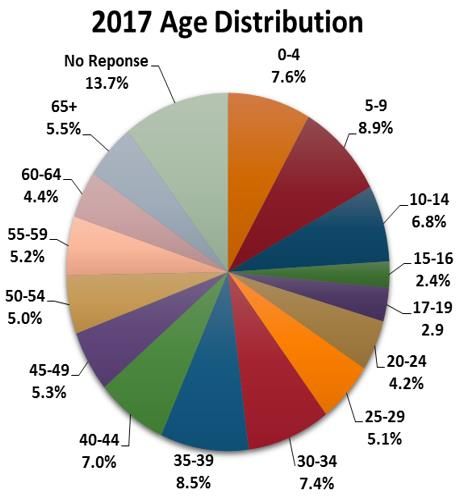
most recent 2017 census data, 16.34 per cent of the population is under age 10
and 16.67 per cent of people between the ages of 25 and 34 (the group most
likely to be having children in the near future), the need for quality child care
remains high today and in the future.2
Market Segmentation
Child Care Services will continue to provide services to:
One Parent Families
Two Parent Families
Blended Families
Families that require subsidy (provincial subsidized portion of fees)
In 2018, Child Care Services had 5% of families requiring provincial subsidy.
The primary clients, the children enrolled in the facility, need a safe, reliable,
convenient, and quality run facility that can support their early learning
development and prepare them adequately for school and to become young
adults.
The secondary client, the parents/guardians and siblings of the children enrolled,
need to have access to affordable and quality child care, confidence in the staff
and be continually supported in their child’s care, development, and education.
Measuring Outcomes
Child Care Services uses a Logic Model; as a planning tool to clarify and
graphically display the program’s intentions, accomplishments, and impact. 3 This
2
See Appendix B.
3
See Appendix C.
6SCHEDULE A
logic model is invaluable when applying for grants as it allows the potential funder
to adequately see the program’s desired outcomes and how the program’s intends
to meet them.
Child Care Services will concentrate on all four target groups through various
promotional initiatives, including: word of mouth advertising, spring and fall
awareness events, Town of Beaumont website, Communiqué newsletter, and the
Child Care Advisory Board.
During the course of the year, staff will continue to advocate the programs by
attending various conferences throughout the province, facilitating workshops,
maintaining partnerships with MacEwan University, Beaumont Composite High
School, and Norquest College. The goal is to expose other child care providers,
parents, and future early childhood educators to the opportunity to see the
benefits of the municipal model of governance.
6.0 Child Care Advisory Board (CCAB)
Having successfully met the CCAB’s objectives, CCAB Board members voted
unanimously to disband the CCAB. In January 2016, the Chair of the CCAB made a
recommendation to Council to dissolve the CCAB on the condition that a
representative from CCAB would have a seat on the newly created Family &
Community Services (FCSS) Advisory Committee. Council approved the
recommendation.
7.0 Financial Analysis
The current funding arrangement between the Town of Beaumont and Child Care
Services is established through Council Policy #24, which states:
“The annual cash contribution cost recovery target will be set at 80 per cent
of program expenses including direct costs.”
For clarification purposes, the definition of “direct costs” has been defined as:
The exclusion of internal departmental staffing allocations (Accounting,
Administrative, Management, Tech, HR, Communications, Director
support); Rental of the ELCC; and Amortization of School Age Site
building.
Child Care Services remains confident that with the initiatives to reduce costs and
continued proactive initiatives to find efficiencies, the 80/20 deficit funding policy
can be met in 2019-2022.
8.0 Summary
7SCHEDULE A
As the Town of Beaumont continues to experience growth, various child care
options in the community will continue to be needed. The Town providing quality
child care benefits the entire community through a three (3) fold process:
1) those who are directly using the programs,
2) the private sector and those accessing those programs which are influenced
by the Town’s quality programming, and
3) other community members benefitting from the long term positive effects of
its future adult citizens that have been provided with a quality early
childhood education. 4
4
Child Care: A Surefire Investment for Government. Marc Lalonde. 2012.
8SCHEDULE A
Appendix A. 2018 Child Care Fees in Beaumont.
2016 Monthly Fees Seeds and Sprouts Sunshine Patch Beaumont Provincial Average
6-12 months Not Offered $975 $1,052 $1,042
12-19 months $925 $925 $979 $943
19 months - 3 years $875 $885 $951 $901
3-4.5 years $825 $865 $891 $863
4.5 years and up $775 $795 $800 $825
Kindergarten $750 $765 $800 $780
School Age Sept - June $525 $535 $524 $483
School Age - Summer $750 $755 $744 UNKNOWN
Monthly Bussing Fee $75 $60 $95 UNKNOWN
Half Day Drop in Fee Not Offered $45 $35 UNKNOWN
Full Day Drop In Fee Not Offered $70 $53 UNKNOWN
Hourly Drop In Rate Not Offered $12/hour Not Offered UNKNOWN
Waitlist Fee $50 non-refundable $100 non-refundable $50 refundable UNKNOWN
2nd Child Credit Not Offered $50 Not Offered UNKNOWN
Additional Fees UNKNOWN *$50 Not Offered UNKNOWN
*Sunshine Patch charges an additional $50 per school age child attending during spring break.
Sunshine Patch and Seeds and Sprouts are closed for Christmas Break (10 days).
9SCHEDULE A
Appendix B. Data taken from the April 15, 2017 Census Report, Town of
Beaumont.
Age Distribution
Age Category Population Percentage
0-4 1397 7.6%
5-9 1627 8.9%
10 -14 1247 6.8%
15 - 19 991 5.4%
20 - 24 774 4.2%
25 - 29 927 5.1%
30 - 34 1350 7.4%
35 - 39 1566 8.5%
40 - 44 1274 7.0%
45 - 49 977 5.3%
50 - 54 912 5.0%
55 - 59 951 5.2%
60 - 64 801 4.4%
65 + 1015 5.5%
No response 2511 13.7%
TOTAL 18,320 100.0%
10SCHEDULE A
Appendix C. Town of Beaumont Child Care Services Logic Model 2019.
Inputs Activities Short Term Mid Term Long Term Indicators
Outputs Tools
(what (what Outcomes Outcomes Outcomes (An instrument
(what is (An instrument
activities the resources go (the changes (the changes (the changes or used to monitor
produced used to
program into the or benefits or benefits benefits that the operation)
through those measure the
undertakes) programs) that result that result result from the
activities) operation)
from the from the program)
program) program)
Early Providing age # of children Children have Children gain Children have 70% of the Year-end
Childhood appropriate attending the increased a positive developed sense participants evaluations
Educators activities for programs. knowledge of self-identity. of belonging and indicate that they
children birth positive social self-worth in have increased Participant
Child Care to age 12 # of field behaviours. Children their families and confidence in satisfaction
Services that stimulate trips offered. increase their community. his/her abilities. surveys
Supervisors their Children have positive social
cognitive, # of activities improved self- behaviors. 70% of the Verbal
General social, and provided that esteem and participants show feedback
Manager of emotional encourage confidence. Children an increase in
Community development. both parent increase their knowledge Staff
and and child Families awareness of regarding positive observations
Protective Creating participation. experience their social behaviors.
Services programming positive social community. Child Care
that meets # of children interactions Advisory Board
Children the diversity attending with their Children are 70% of the feedback
enrolled in of needs who children, staff, contributing participants
the represented participate in and other and engaged indicate they have
programs in the multi-cultural families. with their improved their
families activities. community. ability to interact
Families served. Children with others.
# of increase their
Internal Providing partnerships ability to 70% of the
supports multicultural created with problem solve participants
and activities for other independently indicate that they
Partnerships children birth organizations. and have increased
to age 12. successfully. knowledge about
External other cultures.
supports Developing Children
and partnerships increase their 70% of the
partnerships with other knowledge of participants
organizations. other cultures. actively involved
in community
activities.
11You can also read


