Trade-offs and synergies between human health and sustainability of Swiss dietary scenarios
←
→
Page content transcription
If your browser does not render page correctly, please read the page content below
Trade-offs and synergies between human health
and sustainability of Swiss dietary scenarios

Christian Schader,, Anita Frehner, Adrian Muller, Carsten Nathani, Birgit
Kopainsky, Alig Martina, Sabine Rohrmann, Christine Brombach, Julia Brandes,
Matthias Stucki, Matthias Stolze

LCAFood 2020, 14/10/2020
Aims of the project

1. Define and analyse scenarios for future healthy and
   sustainable dietary patterns in Switzerland

2. Analyse how healthy dietary patterns support and/or
   contradict sustainability in the Swiss food system

3. Derive target-group-specific recommendations for the
   realisation of sustainable and healthy dietary patterns

                                                22 January 2021   2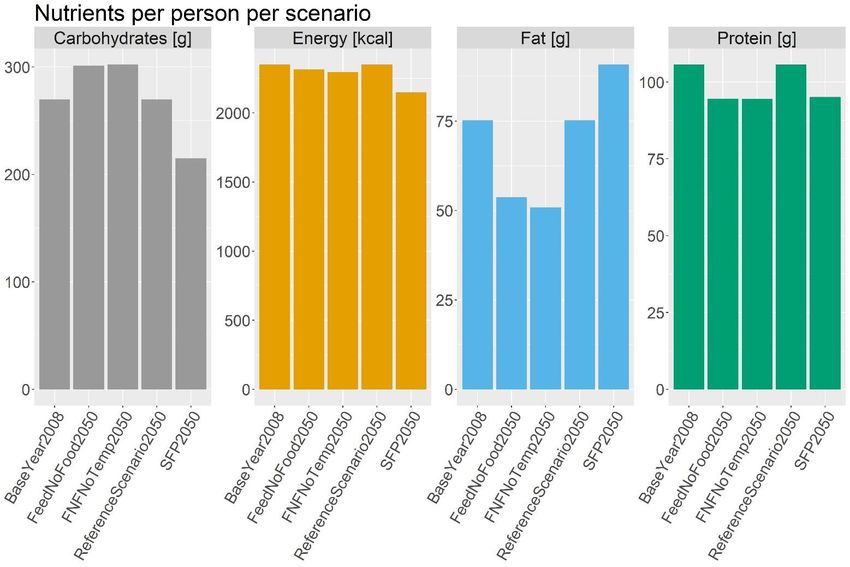
Project approach

                          WP2: Assessment of dietary                      WP3: Participatory definition
                          patterns and health impacts                     of interventions and scenarios
WP1: Project management

                                          WP4 / WP 5: Model-based integrated analysis
                                NFP69-Phase 1 Model                         Global mass-flow model
                                Dynamic simulation model   EE-IOM                   SOLm

                           WP5: Trade-offs and synergies of                  WP6: Dietary and policy
                           dietary patterns                                  recommendations

                                                                                  22 January 2021      3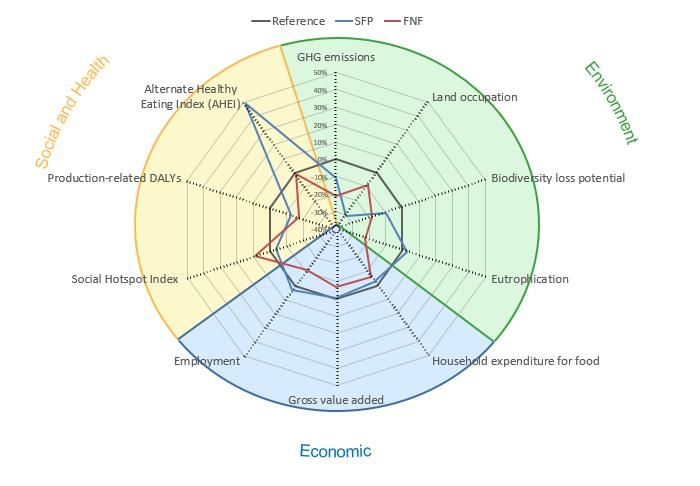
Identification of four dietary patterns in the Swiss
population on the basis of the menuCH study
                              Swiss traditional                                              Western 1 - soft drinks and meat
                                n=744 (36.2%)                                                            n=383 (18.6%)

                                Non-alcoholic                                                            Non-alcoholic
                                 beverages                                                                beverages
          Alcoholicbeverages                    Others1                             Alcoholicbeverages                    Others1
                                       1                                                                        1
      Cereals& starchy              0.5                Sauces& seasoning        Cereals& starchy                                 Sauces& seasoning
                                                                                                             0.5
  Red& processed                       0                                    Red& processed                      0
           meat                                             Savourysnacks            meat                                            Savourysnacks
                                   -0.5                                                                      -0.5
                                    -1                                                                          -1
     Whitemeat                                                Cakes            Whitemeat                                               Cakes

           Fish                                              Chocolate               Fish                                              Chocolate

       Fruits& nuts                                       Milk& dairy            Fruits& nuts                                       Milk& dairy

                 Vegetables                        Eggs                                    Vegetables                        Eggs
                               Soups       Addedfats                                                    Soups        Addedfats

               Western 2 - alcohol, meat and starchy                                                       Prudent
                               n=444 (21.6%)                                                             n=486 (23.6%)

                                Non-alcoholic                                                            Non-alcoholic
                                 beverages                                                                beverages
          Alcoholicbeverages                    Others1                             Alcoholicbeverages                    Others1
                                       1                                                                        1
      Cereals& starchy                                 Sauces& seasoning        Cereals& starchy             0.5                 Sauces& seasoning
                                    0.5
  Red& processed                       0                                    Red& processed                      0
           meat                                             Savourysnacks            meat                                            Savourysnacks
                                   -0.5                                                                     -0.5

                                    -1                                                                          -1
     Whitemeat                                                Cakes            Whitemeat                                               Cakes
                                                                                                                                                     Krieger et al.
           Fish                                              Chocolate               Fish                                              Chocolate
                                                                                                                                                         2019,
                                                                                                                                                      Nutrients
       Fruits& nuts                                       Milk& dairy            Fruits& nuts                                       Milk& dairy

                 Vegetables                        Eggs                                    Vegetables                        Eggs                            4
                               Soups       Addedfats            Krieger et al., in revision             Soups        Addedfats
Impacts of different food groups on health drivers and
disease promotors
Health Driver Disease Promoter
Decreases the risk to develop Chronic Diseases Increases the risk to develop Chronic Diseases
Food group CD Effect* Food group CD Effect*
T2DM + T2DM -
CVD + CVD -
Nuts & Seeds CHD + Processed Meat CHD -
Cancer + Stroke -
Cancer -
T2DM +
CVD + Alcohol
all 6 diseases -
Strong
Legumes & Beans
CHD + → heavy use
Cancer +
T2DM +
CVD +
Whole grains CHD +
Physical
Obesity + all 6 diseases -
Inactivity
Cancer +
Physical activity all 6 diseases +
T2DM -/0
CVD -/0
Fruits & CVD + Starches
CHD -
Vegetables Obesity + Refined Grains
Cancer -/0
Stroke -
T2DM -/0
Vegetable Oils CVD + CVD -/0
(depending on CHD + CHD -
SSB
processing Stroke + Cancer -/0
Medium
method; quality) Obesity + Stroke -
Cancer -
T2DM -
Fish
CVD + CVD -/0
(effects High-trans-fat
CHD + CHD -
depending on Food
Stroke + Cancer -/0
contamination)
Obesity -
CVD -/0
High-Sodium CHD -/0
Food Cancer -
Stroke -/0
5 diseases →
Weak
controversial
Dairy Products +/0/-
findings (except for
CHD)
22 January 2021 5Scenarios
Predefined consumption scenarios
• Reference scenario 2050
• Swiss Food Pyramid (SFP) 2050
• Sustainability / Feed No Food 2050
• Consumer preferences
Optimised consumption scenarios
• Aiming for the ideal: Minimise different environmental impacts
• Accounting for acceptability: Minimise the difference to the
reference scenario 2050 and to the SFP scenario 2050 while
fulfilling different environmental targets
22 January 2021 6Integrated Modelling Approach: Linking the three models
Predefined scenarios
• Input: explicit specifications for consumption patterns
• Output: economically motivated behaviour (according to decision structure in
SDM) of the agents leads to production structure of the agricultural sector
SDM
• Input: production structure of the agricultural sector (areas, animal numbers,
feeding rations, ...), explicit specifications for consumption patterns
• Output: environmental impacts from agricultural production in Switzerland and
SOLm in countries of origin of imported goods
• Input: production structure of the agricultural sector, detailed nutrient- and mass-
flows (to be aligned in detail), explicit specifications for consumption patterns
• Output: production structures of the other sectors, further environmental
EE-IOM impacts from agricultural production and the other sectors
22 January 2021 7Predefined consumption scenarios: nutrients
Minimum requirement for scenarios
DACH reference values (min(/max))
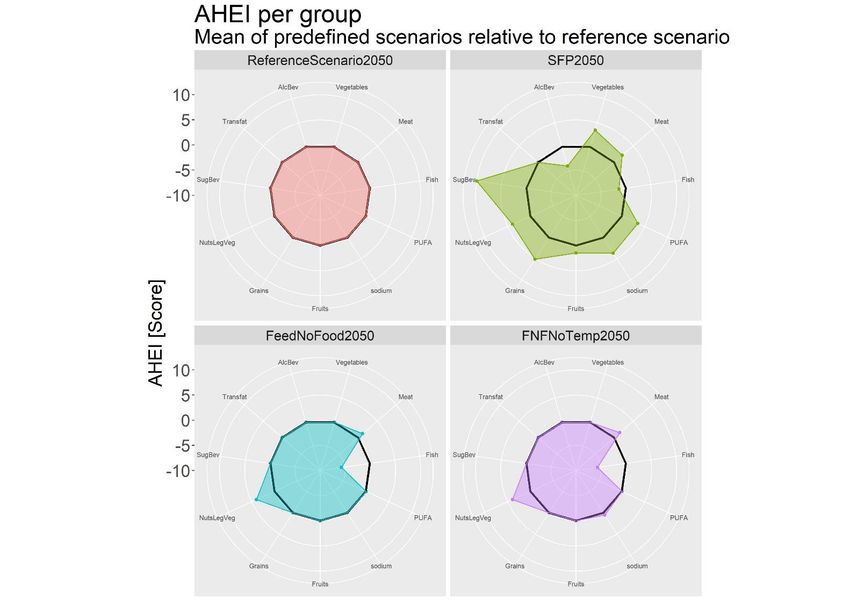
22 January 2021 8Health impacts (AHEI) of the predefined scenarios
22 January 2021 9GHG emissions compared to reference scenario
Swiss Food Pyramid (SFP) 2050 Sustainability / Feed No Food 2050
22 January 2021 10Household expenditure compared to reference scenario
Swiss Food Pyramid (SFP) 2050 Sustainability / Feed No Food 2050
22 January 2021 11Gross value added compared to reference scenario
Swiss Food Pyramid (SFP) 2050 Sustainability / Feed No Food 2050
22 January 2021 12Social hotspot index compared to reference scenario
Swiss Food Pyramid (SFP) 2050 Sustainability / Feed No Food 2050
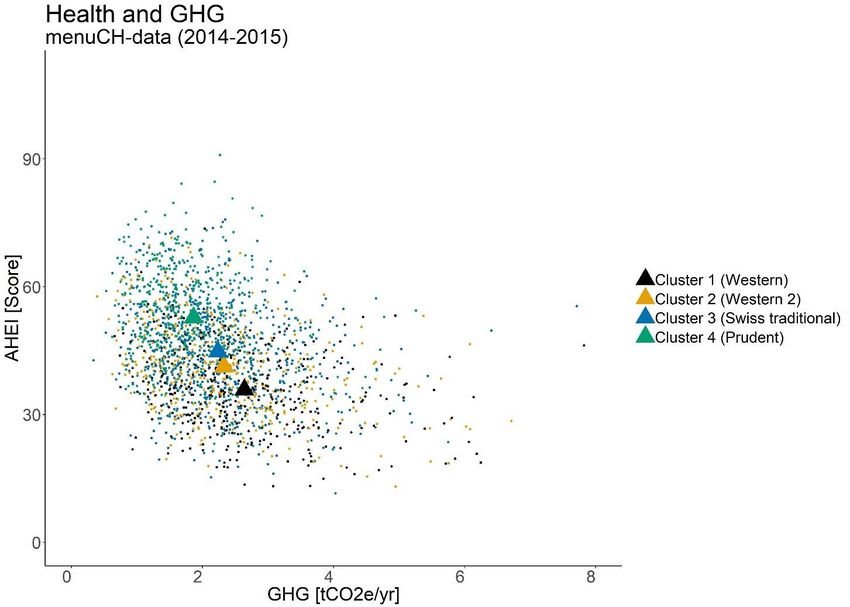
22 January 2021 13Health and environmental impacts of current
consumption (menuCH)
Health impacts (AHEI-2010)
and greenhouse gas
emissions per observation
Health + Health + of the menuCH-dataset
Environment + Environment -
(points)
Means of the four
clusters (Krieger et
al. 2018)
Health -
Interpretation:
Health -
Environment + Environment - - → poor performance
+ → good performance
22 January 2021 14Overview of trade-offs and synergies of the
SwissFoodPyramid and the FeedNoFood Scenario
22 January 2021 15Conclusions – Public Policy
• Potential to use synergies between health and sustainability compared to
the average Swiss diet
• At a certain point of optimisation, trade-offs become increasingly relevant
• Harmonize health policy and agricultural policy => Food policy:
• Reduce the incentives for sugar production
• Reduce incentives for meat production (especially for meat which is not a co-
product to dairy production)
• Adjust the level of recommended dairy products (i.e. reduce this level)
• Provide incentives for retailers to promote healthy/sustainable products
• Consider taxation of specific foods of which the consumption induces negative
externalities with respect to health. (e.g. high sugar contents). Also positive financial
incentives could be effective (e.g. adapted VAT levels).
• Consider taxation of specific inputs/practices to increase sustainability in
production (e.g. a tax on external nitrogen sources).
• Targeting at a Feed No Food Scenario would require a sophisticated policy mix (e.g.
to avoid expansion of temporary meadows, promote suitable breeds for changed
feeding rations, …).
22 January 2021 16You can also read


