Transforming Health and Social Care in Northern Ireland
←
→
Page content transcription
If your browser does not render page correctly, please read the page content below
Research and Information Service
                        Briefing Paper
Paper 40/16                                      24th June 2016                     NIAR 149-16

                                           Dr Janice Thompson

              Transforming Health and Social
                 Care in Northern Ireland –
                            Services and Governance

        This briefing paper aims to provide the new Health Committee with an overview of a
        number of issues from the 2011-16 Committee’s legacy report. It focuses on key
        aspects of health and social care reform in Northern Ireland over the past decade or
        so, including the 20-year strategy for primary care; ‘Transforming Your Care’ (TYC); the
        Donaldson Report; and the recently established expert panel, chaired by Professor
        Bengoa. The paper also includes key points from the previous Committee’s scrutiny of
        TYC, including workforce planning and care for older people.

  Providing research and information services to the Northern Ireland Assembly                1
NIAR 149-16 Briefing Paper
Executive Summary
In many countries, including Northern Ireland (NI), governments are striving to
transform health and social care services in the context of increasing demands placed
on services by ageing populations; increased numbers of people living with multi-
morbidities; constrained resources; technological advances and rising patient
expectations.
In NI, over the past decade at least, policy direction has aimed to shift service provision
away from hospitals and towards care in the community, as close to home as possible.
This paper focuses on key aspects of health and social care service and governance
reform in NI, over the past decade or so.
Primary care is recognised as central to health and social services in NI, acting as a
first point of contact and a ‘gateway’ to secondary care and a wider variety of services
within primary care itself.
In 2005, the former Department of Health, Social Services and Public Safety published
Caring for People Beyond Tomorrow - a 20-year strategic framework for primary care,
recognising the need for wider development of community-based alternatives to
hospital admission.
The key aspect was ‘integrated working’ and the introduction of Primary Care
Partnerships, with a new role for GPs in the development of these voluntary alliances
of health and care professionals and voluntary and community sector bodies working
together. The aim was to improve integration between primary and community care,
hospital specialists and social services.
The reform agenda gathered pace in June 2011, when the then Minister for Health,
Social Services and Public Safety, Edwin Poots MLA, announced a review of the
provision of health and social care services.
The Review, known as ‘Transforming Your Care’, focused on changes that would make
the greatest difference to outcomes. It proposed a new integrated model of health
and social care, with population-based planning of services.
The key drivers included care to be provided as close to home as practical, a shift of
resource from hospitals to enable investment in community health and social care
services and a changing role for general practice working in 17 Integrated Care
Partnerships (ICPs), building on the previous Primary Care Partnerships.
The ICPs have focused on improving how services are organised for frail older people
and those with specific long-term conditions, aiming to preventing hospital admissions.
The service model for primary care was a “Hub and Spoke” approach, with the hubs
providing services which do not require a hospital bed but are too specialised to be
provided in a local GP surgery.
Providing research and information services to the Northern Ireland Assembly 2NIAR 149-16 Briefing Paper
This direction of travel pre-dates TYC as the 2005 strategic framework for primary care,
had already described such ‘hubs’, for example, The Arches Health and Social Care
Centre was completed in 2005 and the Grove Wellbeing Centre opened in 2008.
In 2014 the focus of reform moved to ‘governance’, when Professor Sir Liam
Donaldson advised on governance arrangements across health and social care with
ten recommendations in his report The Right Time, The Right Place.
The reform process to date has been hampered by the financial situation of the
Department in recent years. HSC Trusts have fought to maintain existing services
while being required to make efficiencies. The Department has relied on Monitoring
Round monies to fund aspects of reform and as bids were not always successful, the
implementation of TYC has been slow.
His report recognised that TYC contained good ideas for developing alternatives to
hospital care and called for ‘action not words’ with a new costed, timetabled
implementation plan and an impartial international panel of experts to review the
configuration of HSC services, whose recommendations would be binding on
government in NI.
In 2016, the then Health Minister, Simon Hamilton MLA, stepped up reform by
appointing an expert, clinically-led panel (somewhat based on the Donaldson
recommendation) to consider, and lead debate on, the best configuration of services
for NI. The panel is a mix of local, national and international expertise and will report in
the summer of 2016.
He also announced the creation of a ring-fenced £30million Transformation Fund to be
invested in order to realise the vision set out in TYC.
In January 2016, the Public Accounts Committee (NI Assembly) noted a key challenge
for reform was to put the HSC Trusts on a sustainable financial footing, highlighting that
as the Trusts have no authority to move money from one year to the next, this impedes
their ability to undertake longer-term financial planning.
Since becoming Health Minister in May 2016, Michelle O’Neill has stated that she
intends to refocus efforts to reshape the HSC, with the report of the expert panel
leading the debate.
During the 2011-16 mandate monitoring the progress of reform and the implementation
of TYC was key for the Committee for HSSPS.
Its Workforce Planning Review (September 2015) provided the Committee with an
opportunity to engage with stakeholders regarding the overall progress of TYC as well
as the specific impact on HSC staff. A number of key issues emerged:
The status of TYC - the Committee became concerned that the Department were
not working to a measurable, costed plan and that this raised questions in terms of
monitoring, governance and funding.
Providing research and information services to the Northern Ireland Assembly 3NIAR 149-16 Briefing Paper
Tracking the planned shift of £83 million from hospital services to
primary/community services – It became clear that the Department’s financial
circumstances over the past number of years were delaying implementation of TYC,
by not permitting funding for new service developments. Although bids had been
made in the Monitoring Rounds to help achieve the £83 million they had not always
been successful.
New service models - The Committee concluded that there was a lack of clarity as
to who was responsible for developing new service models under TYC; and
Regional workforce planning - The Committee was concerned about the time taken
to produce the Regional Workforce Planning Framework, given its importance to
TYC. Its recommendations included that;
o the Regional Workforce Planning Group should take a wider approach to
workforce planning, making ‘strenuous efforts’ to avoid ‘silo-based’
approaches and focused instead on patient need; and
o The Department should consider how primary care services can be
reconfigured regarding staff to deal with the increasing demands for GP
appointments and also produce an estimation of the percentage increase or
decrease in the size of the workforce required to implement TYC.
The Health Committee understood that the ‘shift left’ of services outlined in TYC also
encompassed supported living options for older people as an alternative to residential
care. It was in this context, the Committee carried out its review into supported living
options for older people in 2014. The Committee’s recommendations included that the
relevant departments needed to work together in terms of developing housing options
for older people which will have the best health outcomes for older people, based on
the evidence available.
Glossary
HSCB: Health and Social Care Board
ICP: Integrated Care Partnership
PAC: Public Accounts Committee
PCP: Primary Care Partnership
PHA: Public Health Agency
LCG: Local Commissioning Group
TYC: Transforming Your Care
Providing research and information services to the Northern Ireland Assembly 4NIAR 149-16 Briefing Paper
Contents
Executive Summary ............................................................................................................... 2
Glossary ………………………………………………………………………………………………4
1 Context – Health and Social Care in Northern Ireland ......................................................... 6
2 Overview of the Drivers and Direction of Health and Social Care Reform ............................ 7
3 Transforming Service Delivery ............................................................................................. 9
3.1 A New Direction for Primary Care ..................................................................... 9
3.2 - Transforming Your Care (TYC) ..................................................................... 11
3.2.1 TYC Principles and Recommendations.................................................... 11
3.2.2 The Integrated Care Model ...................................................................... 12
3.2.3 The TYC Model for Primary Care ............................................................. 13
3.2.4 Consultation Process ............................................................................... 14
3.2.5 Focus of Integrated Care Partnerships .................................................... 15
3.3 Reform of Governance - The Donaldson Report ............................................. 16
4 Current Direction of Reform ............................................................................................... 18
4.1 Updates on Reform ....................................................................................... 18
4.2 The Expert Panel ........................................................................................... 19
4.2.1 The Panel Members ................................................................................ 19
4.2.2 The Working Principles ............................................................................ 20
5 Monitoring Progress of Service Reform – Health Committee ............................................. 23
5.1 Review of Workforce Planning – Overall Progress of TYC.............................. 23
5.1.1 The Status of TYC ................................................................................... 24
5.1.2 Shift of Funds from Hospital Based Services to Community Based
Services ............................................................................................................... 25
5.1.3 New Service Models ................................................................................ 27
5.1.4 Regional Workforce Planning .................................................................. 27
5.2 Review of Supported Living for Older People - in the context of TYC ............. 30
6 Concluding Comments ...................................................................................................... 32
Appendix 1 – The Basque Approach to Reform .................................................................... 35
Providing research and information services to the Northern Ireland Assembly 5NIAR 149-16 Briefing Paper
1 Context – Health and Social Care in Northern Ireland
The Department of Health sets the policy and legislative context for health and social
care in Northern Ireland (NI). An annual Commissioning Plan Direction sets out
Ministerial priorities, key outcomes and objectives and related performance indicators.
The Health and Social Care Board (HSCB), in conjunction with the Public Health
Agency (PHA) then produces a Commissioning Plan. The 2016/17 Commissioning
Plan is currently being drafted by the HSCB.
At its simplest, commissioning is about securing and monitoring health and social care
services for the population of NI. The diversity and complexity of the services delivered
is immense, with some local services being designed and secured for a population of a
few thousand, while for rare disorders, services need to be considered regionally or
even nationally.
Since the devolution of powers to the Northern Ireland Assembly in 1999, the NI health
and social care (HSC) system has remained organised around a formal functional split
between service commissioning (purchasing) and service provider functions. The
Health and Social Care (Reform) Act (Northern Ireland) 20091 provided the statutory
basis for the rationalisation of these bodies:
Commissioning – from four health and social care boards to the one regional
HSCB,2 working in conjunction with the PHA, to commission services to meet
assessed need and promote good health. The 2009 Act also established five local
commissioning groups (LCGs)3, which function as committees of the HSCB. Each
LCG is co-terminus with its respective HSC Trust area and is responsible for
assessing needs and commissioning health and social care for its local population.
Service Providers – from nineteen trusts4 to the present five health and social care
trusts and one ambulance trust.
Future Changes to Commissioning - On 4 November 2015 the then Minister,
Simon Hamilton, announced his intention to close the HSCB in order to reduce
bureaucracy and ensure the Department retains strategic control, with increased
focus on the financial and performance management of the Trusts5. This has not
yet happened and discussion is currently ongoing on the future structure of health
and social care in NI.
NI’s model of integrated governance for health and social care sets it apart from other
jurisdictions within the UK. In England, Scotland and Wales the provision of social care
1
Health and Social Care (Reform) Act (Northern Ireland) 2009, http://www.legislation.gov.uk/nia/2009/1/contents
2
Health and Social Care Board, http://www.hscboard.hscni.net/
3
Local Commissioning Groups, http://www.hscboard.hscni.net/LCG/index.html
4
Seven hospital trusts, 11 community and social services trusts plus one ambulance trust
5
Hamilton outlines ambitious vision for health and social care in Northern Ireland, DHSSPS Press Release, https://www.health-
ni.gov.uk/news/hamilton-outlines-ambitious-vision-health-and-social-care-northern-ireland
Providing research and information services to the Northern Ireland Assembly 6NIAR 149-16 Briefing Paper
is the responsibility of local authorities.6 Integration in the delivery of services in NI is
mainly achieved through the division of care into nine ‘programmes of care’ to which
resource procurement and finance are assigned - acute services; maternity and child
health; family and child care; elderly care; mental health; learning disability; physical
and sensory disability; health promotion and disease prevention; and primary health
and adult community.7
Health and social care services in NI are largely government funded and almost
entirely free at the point of care for primary, hospital, community care and prescription
pharmaceuticals. ‘Out of pocket’ expenses exist for dental care but these are capped
and exemptions exist for certain groups.8
General Practitioners (GPs) play a main role in primary care and operate as
independent contractors, funded by the Department of Health, through a combination
of capitation and fee for service.9
2 Overview of the Drivers and Direction of Health and
Social Care Reform
In many countries, governments are transforming how they deliver and manage health
and social care services fit for a modern context. That context includes the increasing
demands placed on these services by ageing populations, constrained resources,
technological advances and rising patient expectations.
As a result of dramatic improvements in healthcare over the second half of the 20th
century and continuing into the 21st century the number of people living with disease,
often multi-morbidities, and needing years of support from the health and care system,
has increased enormously.
Multimorbidities are often defined as the co-existence of two or more long term
conditions. Multimorbidity increases markedly with age, but it is also found in younger
people, especially in socially deprived areas where the co-existence of physical and
mental health problems is common. It is associated with poor quality of life, disability,
psychological problems and increased mortality. It is also associated with increased
frequency of health service use including emergency hospital admission.10
6
United Kingdom, Raising Standards, OECD Reviews of Health Care Quality, OECD, (2016), page 242,
http://www.oecd.org/health/health-systems/oecd-reviews-of-health-care-quality-united-kingdom-2016-9789264239487-
en.htm
7
Ham, C. et.al. (2013). Integrated care in Northern Ireland, Scotland and Wales, Lessons for England, The Kings Fund,
8
United Kingdom, Raising Standards, OECD Reviews of Health Care Quality, OECD, (2016), page 241,
http://www.oecd.org/health/health-systems/oecd-reviews-of-health-care-quality-united-kingdom-2016-9789264239487-
en.htm
9
As above
10 National Institute for Health and Care Excellence, Scope (2016), Guideline Title – Multimorbidity: assessment and
management, https://webcache.googleusercontent.com/search?q=cache:ZcgV_9n6xj0J:https://www.nice.org.uk/guidance/gid-
cgwave0704/resources/multimorbidity-final-scope2+&cd=3&hl=en&ct=clnk&gl=uk
Providing research and information services to the Northern Ireland Assembly 7NIAR 149-16 Briefing Paper
NI has not been immune to these factors and to the realisation of the need for real
strategic change in delivery and suitable governance of its health and social care
services.
A key theme for health and social care reform in NI over the past decade or so has
been the recognition of the over-reliance on the hospital sector and the aim of shifting
service provision away from hospitals and towards care in the community, closer to
home. Primary care is recognised as central to health and social services acting as a
first point of contact and a ‘gateway’ to secondary care and a wider variety of services
within primary care itself.
Over a decade ago it was already recognised that a clear sense of direction for primary
care was needed. Consequently, in 2005, the former Department of Health, Social
Services and Public Safety published a 20-year strategic framework for primary care,
Caring for People Beyond Tomorrow.11 The framework noted the need or a much wider
development of community-based alternatives to hospital admission.
This direction gathered pace in June 2011 when the then Minister for Health, Social
Services and Public Safety, Edwin Poots MLA, announced a review of the provision of
HSC services in NI and subsequently appointed the Review panel in August 2011.12 It
became known as ‘Transforming Your Care’ (TYC).
In recent years the HSC system has been subject to repeated scrutiny both formal and
by the media, regarding13:
the quality and safety of care provided, amidst sustained economic
pressures and ongoing concerns over adequate access to acute hospital
care.
This has ensured that latterly, the focus of reform has also included the governance
structures with the publication of Right Time Right Place in 2014 (the Donaldson
Report).14 Its subsequent out-workings, include the establishment of an expert panel
(chaired by Professor Rafael Bengoa)15 to lead debate on the best configuration of
health and social care in NI.
11
Caring for People Beyond Tomorrow, DHSSPS, October 2005, https://www.health-ni.gov.uk/publications/caring-people-
beyond-tomorrow-strategic-framework
12
Poots publishes details of Health and Social Care Review, HSC Review Press Release, 25th August 2011,
http://www.hscboard.hscni.net/hscreview/News/08-25-2011%20-
%20Poots%20publishes%20details%20of%20Health%20and%20Social%20Care%20Review.html#TopOfPage
13
United Kingdom, Raising Standards, OECD Reviews of Health Care Quality, OECD, (2016), page 240,
http://www.oecd.org/health/health-systems/oecd-reviews-of-health-care-quality-united-kingdom-2016-9789264239487-
en.htm
14
The Right Time, The Right Place, an expert examination of health and social care governance arrangements for ensuring the
quality of care provision in Northern Ireland, Review team – Sir L. Donaldson, Dr P Rutter and D r M Henderson,
December 2014, https://www.dhsspsni.gov.uk/sites/default/files/publications/dhssps/donaldsonreport270115_0.pdf
15
Hamilton appoints Expert Panel to lead debate on delivering world class Health and Social Care for Northern Ireland,
Department of Health, press release, 7/01/16, https://www.northernireland.gov.uk/news/hamilton-appoints-expert-panel-
lead-debate-delivering-world-class-health-and-social-care
Providing research and information services to the Northern Ireland Assembly 8NIAR 149-16 Briefing Paper
In January 2016, the NI Assembly Public Accounts Committee (PAC) noted that a key
challenge for reform was to put the HSC Trusts on a sustainable financial footing16:
the financial strength of HSC Trusts has continued to decline despite the
fact that they receive additional resources year-on-year to shore up their
financial position.
The PAC noted that HSC Trusts have no authority to move money from one year to the
next and this impedes their ability to undertake longer-term financial planning17:
The decline in the financial stability of HSC Trusts is mirrored in widespread
breaches of key waiting times targets for elective, emergency and
outpatient care… Transforming Your Care is heralded as the great
transformational saviour for health and social care, but the pace of change
has been at best mediocre.
The PAC recommended that the Department approach the Department of Finance to
explore the options for introducing three-year budgets for the Trusts to enhance longer-
term planning and also called on the Department to clarify the time period over which it
expects the benefits of TYC to be realised. The former Health Minister, Simon Hamilton
MLA, responded that the PAC report reaffirmed the need for “far reaching and radical
reform”.18
3 Transforming Service Delivery
3.1 A New Direction for Primary Care
In the 20-year strategic framework for primary care, Caring for People Beyond
Tomorrow (2005),19 the starting point was the recognition that demographic trends
towards a larger and older population combined with lifestyle factors would have a
large impact on the demand for primary care services20:
This will require the much wider development of community-based
alternatives to hospital admission…
16
Report on General Report on the Health and Social Care Sector 2012-13 and 2013-14, Public Accounts Committee, NI
Assembly, 33rd Report NIA 282/11-16, January 2016, http://www.niassembly.gov.uk/assembly-
business/committees/archive/public-accounts-committee/reports-2011-2016/
17
Report on General Report on the Health and Social Care Sector 2012-13 and 2013-14, Public Accounts Committee, NI
Assembly, 33rd Report NIA 282/11-16, January 2016, http://www.niassembly.gov.uk/assembly-
business/committees/archive/public-accounts-committee/reports-2011-2016/
18
PAC Report supports need for ambitious reform of health and social care, Department of Health, Press Release, 20/06/16,
https://www.health-ni.gov.uk/news/pac-report-supports-need-ambitious-reform-health-and-social-care
19
Caring for People Beyond Tomorrow, DHSSPS, October 2005, https://www.health-ni.gov.uk/publications/caring-people-
beyond-tomorrow-strategic-framework
20
Caring for People Beyond Tomorrow… DHSSPS, sections 2.10-2.11, https://www.health-ni.gov.uk/topics/health-
policy/primary-care-strategy#toc-0
Providing research and information services to the Northern Ireland Assembly 9NIAR 149-16 Briefing Paper
The outcomes envisaged from its implementation included21:
Making primary care services more responsive and accessible - by providing a wider
range of services in the community and by way of time to see practitioners in a
greater number of locations;
Developing more effective partnerships and team working across organisational and
professional boundaries;
More proactive engagement with service users about service planning, design and
delivery; and
Improved premises and infrastructure, harnessing new technologies and clinical
advancements.
In June 2006 the steering committee published an improvement programme for
commissioners to take forward with providers, including integrated working, nurse-led
discharge, intermediate care and non-medical prescribing22.
The most fundamental aspect was ‘integrated working’ – a new role for GPs in the
development of population-based primary care teams. Clinically-led pilot projects
known as Primary Care Partnerships (PCPs) were initiated in 2010 to promote new
approaches to commissioning care. The PCPs were established by the ‘parent’ LCG
and consisted of voluntary alliances of health and care professionals and voluntary and
community sector bodies working together to inform the commissioning decisions of
the LCGs.
There were 15 PCP pathfinder pilots addressing issues as diverse as dermatology,
ultrasound diagnostics, medicines management and mental health. The objectives
were to improve integration and co-ordination between primary and community care,
hospital specialists and social services and to identify alternative care pathways.23
The achievements of the PCPs have been described as ‘modest’ but they appear to
have provided a basis for future service developments regarding Integrated Care
Partnerships under TYC (see Section 3.2).24
21
Primary Care Strategy, Caring for People Beyond Tomorrow (2005), https://www.health-ni.gov.uk/topics/health-policy/primary-
care-strategy#toc-0
22
Reform programme for primary and community services (June 2006), https://www.health-ni.gov.uk/publications/reform-
programme-primary-and-community-care-services
23
Primary Care Partnerships, NI Assembly Official Report, Hansard, Committee for Health, Social Services and Public Safety,
November 2011, http://www.niassembly.gov.uk/assembly-business/official-report/committee-minutes-of-evidence/session-
2011-2012/november-2011/primary-care-partnerships/
24
United Kingdom, Raising Standards, OECD Reviews of Health Care Quality, OECD, (2016), page 250,
http://www.oecd.org/health/health-systems/oecd-reviews-of-health-care-quality-united-kingdom-2016-9789264239487-
en.htm
Providing research and information services to the Northern Ireland Assembly 10NIAR 149-16 Briefing Paper
3.2 - Transforming Your Care (TYC)
Despite positive local improvements in ‘integrated care’ being driven by the PCPs, the
reform agenda for primary care appeared to lose some momentum in the years
following the initial drive from Caring for People Beyond Tomorrow,25
Reform gathered pace again in June 2011, when the then Minister for Health, Social
Services and Public Safety, Edwin Poots MLA, announced a review of the provision of
HSC services in NI and subsequently appointed a Review panel in August 2011.26
The Review focused on what changes would make the greatest difference to outcomes
for patients, users and carers and it became known as ‘Transforming Your Care’
(TYC). It engaged with over 3000 members of the public, clinicians, providers and
interest groups and reviewed evidence within NI and internationally.
3.2.1 TYC Principles and Recommendations
A range of principles were identified to underpin a new integrated model of health and
social care, the main ones being:
To placing the individual at the centre of the model - a better outcome for the service
user, carer, and their family;
To provide the right care in the right place at the right time;
Integrated care – working together with population-based planning of services;
A focus on prevention and tackling inequalities;
Promoting independence and personalisation of care; and
Realising value for money;
TYC proposed a total of 99 recommendations, with the key drivers including27:
Care to be provided as close to home as practical.
Shifting resource from hospitals to enable investment in community health and
social care services.
A changing role for general practice working in 17 Integrated Care Partnerships
(ICPs) across NI.
Quality and outcomes to be the determining factors in shaping services; and
Prevention and enabling individual responsibility for health and wellbeing.
25
Caring for People Beyond Tomorrow, DHSSPS, October 2005, https://www.health-ni.gov.uk/publications/caring-people-
beyond-tomorrow-strategic-framework
26
Poots publishes details of Health and Social Care Review, HSC Review Press Release, 25th August 2011,
http://www.hscboard.hscni.net/hscreview/News/08-25-2011%20-
%20Poots%20publishes%20details%20of%20Health%20and%20Social%20Care%20Review.html#TopOfPage
27
Transforming your Care – A Review of Health and Social Care in Northern Ireland, December 2011, Executive Summary,
http://www.transformingyourcare.hscni.net/wp-content/uploads/2012/10/Transforming-Your-Care-Review-of-HSC-in-NI.pdf
Providing research and information services to the Northern Ireland Assembly 11NIAR 149-16 Briefing Paper
TYC did not refer specifically to the previous framework for primary care, Caring for
People Beyond Tomorrow. It simply referred to the fact that in recent years, an
emphasis had been placed on increasing the role of primary care and the community
supporting those with Long Term Conditions, and that this role could be expanded and
based around the principle of ‘home as the hub of care’.28
TYC further alluded to the previous framework in that the 353 GP practices (at that
time) would work within networks of the already established PCPs forming part of new
ICPs, along with representatives from other HSC bodies.29
TYC referred to NI’s historical over-reliance on hospital services and that following the
Review, and over time, there are likely to be 5-7 major ‘hospital networks’ each serving
a population of some 250,000 to 350,000. It acknowledged that ‘rurality’ has
historically influenced the number of hospitals and that this would be taken into
consideration.30
3.2.2 The Integrated Care Model
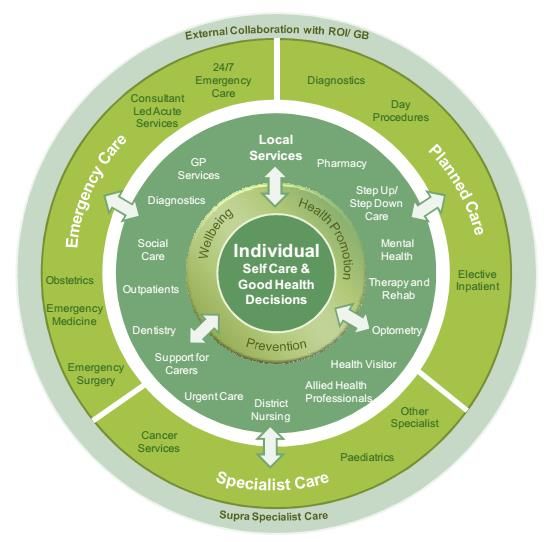
The Integrated Care Model was illustrated as follows:
Source: Figure 4 of Transforming Your Care31
The model was generally envisaged to operate as follows32:
28
Transforming your Care – A Review of Health and Social Care in Northern Ireland, December 2011, page 72
http://www.transformingyourcare.hscni.net/wp-content/uploads/2012/10/Transforming-Your-Care-Review-of-HSC-in-NI.pdf
29
As above, page 115
30
As above, pages 8 and 26
31
As above, Figure 4, page 6,
32
As above
Providing research and information services to the Northern Ireland Assembly 12NIAR 149-16 Briefing Paper
The HSC would provide the tools/support to allow individuals to maintain good
health and wellbeing;
Services would be enabled to regard home as the ‘hub’ of care to ensure people can
be cared for at home as far as possible, including at the end of life. Most services
will be provided locally, for example diagnostics, outpatients and urgent care, and
local services will be better joined up with specialist hospital services; and
HSC professionals would work together in a much more integrated way and if
specialist hospital care is required it will be available but would plan to discharge
patients into the care of local services as soon as their needs permit.
Case studies were developed to explain how the model would impact on ten major
areas of care33:
Population Health and Wellbeing - Older People - People with Long-Term Conditions -
People with a Physical Disability - Maternity and Child Health - Family and Child Care -
People using Mental Health Services - People with a Learning Disability - Acute Care -
Palliative End of Life Care
At the heart of the new model is the transition to local population based service
planning and integrated local service provision via the ICPs34:
The review sensibly places general practice central to this reform looking
for general practitioners to form geographical networks… and assume
critical leadership roles in Integrated Care partnerships (ICPs), the
successors to PCPs.
3.2.3 The TYC Model for Primary Care
The service model for primary care was to support the ‘shift-left’ based on a “Hub and
Spoke” approach - the hubs providing services which do not require a hospital bed but
are too specialised to be provided in a local GP surgery (a spoke), for example,
outpatient assessments for long term conditions, minor surgery and diagnostics such
as x-ray and ultrasound. 35
Local GP surgeries will include practitioners such as GPs, practice nurses and Trust
services where there is localised demand.36
33
Transforming your Care – A Review of Health and Social Care in Northern Ireland, December 2011, Executive Summary,
http://www.transformingyourcare.hscni.net/wp-content/uploads/2012/10/Transforming-Your-Care-Review-of-HSC-in-NI.pdf
34
United Kingdom, Raising Standards, OECD Reviews of Health Care Quality, OECD, (2016), page 251,
http://www.oecd.org/health/health-systems/oecd-reviews-of-health-care-quality-united-kingdom-2016-9789264239487-
en.htm
35
Health and Social Care Board, Transforming Your Care, Health and Care Centres,
http://www.transformingyourcare.hscni.net/tyc-in-action/delivering-services-closer-to-home/health-and-care-centres/
36
Providing research and information services to the Northern Ireland Assembly 13NIAR 149-16 Briefing Paper
In April 2013, two planned new ‘Health and Care Centres’ in Lisburn and Newry were
announced to be a “pivotal part of the reform of health and social care, as set out in
Transforming Your Care”.37 By then work was already underway on similar centres
across NI, for example in Omagh, Banbridge and Ballymena. The Banbridge Health
and Care Centre opened only recently at the end of January 2016.38
Belfast has seven such centres: Arches Centre (East Belfast), Beech Hall
Centre (West Belfast), Bradbury Centre (South Belfast), Carlisle Centre (North
Belfast), Grove Wellbeing Centre (North Belfast), Knockbreda Centre (Castlereagh)
and Shankill Centre (West Belfast). These are described by the Belfast Trust as
‘Health and Wellbeing Centres’ – ‘one stop shops’ for treatment, care and information,
which had previously been provided from a number of sites.39
This direction of travel for primary and community care is not new and pre-dates TYC.
For example, the Grove Wellbeing Centre opened in 2008 and the Arches Centre was
completed in 2005. The 2005 strategic framework for primary care, Caring for People
Beyond Tomorrow (already discussed in Section 3.1) had already envisaged such
centres:40
3.2.4 Consultation Process
In the years following 2011, the planning and a consultation process around TYC took
place (October 2012 to January 2013, Vision to Action41). The HSCB and the HSC
Trusts implementation plans and the Local Population Plans for each LCG were in
finalised form by October 2013.42 Five key overarching messages that emerged from
the consultation process on how TYC should be taken forward43:
1. Sufficient investment to make change happen with alternatives in place before
change occurs to current services;
2. A focus on support for carers as a key partner in care provision;
3. Support for staff who are the key enabler to implementing TYC;
37
Poots announces two new £40million health centres, DHSSPS News Release, 11th April 2013,
http://www.northernireland.gov.uk/news-dhssps-110413-poots-announces-two
38
Health Minister opens new £16million Banbridge Health & Care Centre, Department of Health, Press Release, 27th January
2016, https://www.health-ni.gov.uk/news/health-minister-opens-new-%C2%A316million-banbridge-health-care-centre
39
Belfast Health and Social Care Trust, Health and Wellbeing Centres,
http://www.belfasttrust.hscni.net/contact/WellbeingTreatmentCentres.htm
40
Caring for People Beyond Tomorrow, DHSSPS, October 2005, paragraph 2.14, https://www.health-
ni.gov.uk/publications/caring-people-beyond-tomorrow-strategic-framework
41
Transforming your Care, Vision to Action Consultation Document, http://www.transformingyourcare.hscni.net/wp-
content/uploads/2012/10/TYC-Vision-to-Action-Consultation-Document.pdf
42
Transforming Your Care, DHSSPS, Background to Transforming Your Care, https://www.dhsspsni.gov.uk/topics/health-
policy/transforming-your-care#toc-4
43
Transforming Your Care, Vision to Action Post Consultation Report, March 2013
http://www.transformingyourcare.hscni.net/wp-content/uploads/2013/03/Transforming-Your-Care-Vision-to-Action-Post-
Consultation-Report.pdf
Providing research and information services to the Northern Ireland Assembly 14NIAR 149-16 Briefing Paper
4. Engagement with the voluntary and community sector in designing services and in
developing their capacity to be key partners in the delivery of TYC; and
5. Need for greater cross governmental / agency working to address health
inequalities and implementation of TYC.
3.2.5 Focus of Integrated Care Partnerships
The types of services that were proposed to be delivered within the community,
through ICPs, were to include44:
GPs with enhanced services - 24/7 Urgent Care including GP, mental health crisis
response and minor procedures – Pharmacy – Outpatients – Diagnostics- Optometry -
Dentistry - Access to therapy and rehabilitation - Beds used for step-up/ step-down
from hospital managed by GPs - Reablement - Social support - Cross Departmental
working groups to support social needs - Links to Voluntary and community
organisations to support care - Support to carers - Advocacy services - Antenatal and
postnatal care - Health and Wellbeing Advice.
The initial focus of ICPs has been on improving the way services are organised for frail
older people and those with specific long-term conditions, with the aim of preventing
hospital admissions.45 For example:
In November 2015 an integrated Community Respiratory Team was launched in
the Western area. The multidisciplinary teams, based at Altnagelvin, Tyrone
County and South West Acute hospitals, have developed services to improve
care offering clinical support, monitoring, education and advice on self-
management to patients and their families. Patients can be seen in a range of
settings, including their own homes, healthy living centres, clinics and GP
practices46; and
The ‘Acute Care at Home’ team was launched in Belfast in October 2015 and is
a team of healthcare professionals, led by a Consultant Geriatrician, working to
help older people manage conditions such as chest infections, urinary tract
infections, cellulitis and dehydration without the need for attending the
emergency department, or hospital admission.47
44
Transforming your Care – A Review of Health and Social Care in Northern Ireland, December 2011, page 115,
http://www.transformingyourcare.hscni.net/wp-content/uploads/2012/10/Transforming-Your-Care-Review-of-HSC-in-NI.pdf
45
Ham, C. et.al. (2013). Integrated care in Northern Ireland, Scotland and Wales, Lessons for England, The Kings Fund,
http://www.kingsfund.org.uk/sites/files/kf/field/field_publication_file/integrated-care-in-northern-ireland-scotland-and-wales-
kingsfund-jul13.pdf
46
Health and Social Care Board (NI), ICP News, http://www.hscboard.hscni.net/new-community-respiratory-team-a-breath-of-
fresh-air-for-patients-in-the-west/
47
Health and Social Care Board (NI), ICP News, http://www.hscboard.hscni.net/new-1-7m-hospital-home-service-older-people-
belfast/
Providing research and information services to the Northern Ireland Assembly 15NIAR 149-16 Briefing Paper
3.3 Reform of Governance - The Donaldson Report
In April 2014 the focus of reform moved to ‘governance’, when the former Minister,
Edwin Poots MLA, commissioned the former Chief Medical Officer of England,
Professor Sir Liam Donaldson, to advise on the governance arrangements across the
HSC. His report The Right Time, The Right Place was published on 27 January
2014:48
The analysis in the report was based on extensive input from, scrutiny of,
and discussion with people across the health and social care system in NI.
The ten recommendations, although focused on governance, did include specific
reference to TYC, recognising that TYC contained many good ideas for developing
alternatives to hospital care but that now “few believe it will ever be implemented or
that necessary funding will flow to it”.49 The recommendations are extracted and
summarised from the report as follows:50
1. Coming together for world class health care - An impartial international panel of
experts to review the configuration of HSC services. (Controversially, the report
recommended that all politicians and the public accept ‘in advance’ the
recommendations of this panel) (see section 4.2 for more detail on the expert
panel);
2. Strengthened commissioning – the commissioning system in NI should be
redesigned to make it simpler and more capable of reshaping services.
3. TYC – action not words – a new costed, timetabled implementation plan for TYC
should be produced but with two projects to be immediately enabled as they have
the potential to reduce the demand on hospital beds - expanded roles for
pharmacists and paramedics in pre-hospital care;
4. Self-management of chronic disease - a programme should be established to
give people with long-term illnesses the skills to manage their own conditions –
piloted in one disease area first;
5. Better regulation - the regulatory function to be more fully developed by
exploration of options around expanding the role of the Regulation and Quality
Improvement Authority versus the outsourcing of this function;
6. Making incident reports really count – The report highlighted that the way the
system of incident reporting works within the HSC “is falling well below its potential”
48
The Right Time, The Right Place, an expert examination of health and social care governance arrangements for ensuring the
quality of care provision in Northern Ireland, Review team – Sir L. Donaldson, Dr P Rutter and D r M Henderson,
December 2014, Chapter 2,
https://www.dhsspsni.gov.uk/sites/default/files/publications/dhssps/donaldsonreport270115_0.pdf
49
As above, paragraph 4.2.4
50
As above, Chapter 6
Providing research and information services to the Northern Ireland Assembly 16NIAR 149-16 Briefing Paper
– the recommendation was that the system of Serious Adverse Incident and
Adverse Incident reporting should be retained with some modifications, including:
a. introduction of a clear policy and some re-shaping of the system of Adverse
Incident reporting so that the lessons emanating from cases of less serious
harm can be used for systemic strengthening;
b. a duty of candour should be introduced in NI consistent with similar
action in other parts of the UK;
c. a portal for patients to make incident reports should be created and
publicised; and
d. a limited list of Never Events should be created.
7. A beacon of excellence in patient safety – the report recommended the
establishment of a NI Institute for Patient Safety, after highlighting that:
there is currently a complex interweaving of responsibilities for patient
safety amongst the central bodies responsible for the health and social care
system in Northern Ireland. The Department of Health, Social Services and
Public Safety, the Health and Social Care Board, and the Regulation and
Quality Improvement Authority all play a part….
8. System-wide data and goals - the establishment of systems metrics that can be
aggregated/disaggregated from regional level to individual service level for the HSC
system – according to the report, the NI HSC system has no consistent method for
the regular assessment of its performance on quality and safety at regional-level,
Trust-level, clinical service-level, and individual doctor level - in contrast to the best
systems in the world.
9. Moving to the forefront of new technology – the establishment of a small
Technology Hub to identify the best technological innovations that are enhancing
the quality and safety of care internationally; and
10. A much stronger patient voice - a number of measures should be taken to
strengthen the patient voice, including:
a. more independence in the patient complaints process;
b. the Patient and Client Council should have a revised constitution making it
more independent and its Board should be reconstituted to include a higher
proportion of current or former patients or clients of the HSC system; and
c. the organisations representing patients and clients with chronic diseases
should be given a more formal role within the commissioning process.
Providing research and information services to the Northern Ireland Assembly 17NIAR 149-16 Briefing Paper
4 Current Direction of Reform
4.1 Updates on Reform
Simon Hamilton MLA became Health Minister in May 2015 until the end of the previous
mandate and initiated a series of reforms building on TYC and the Donaldson Report,
including:
4th November 2015 – Based on a Donaldson Report recommendation - the Minister
signalled the end to the current way healthcare is commissioned, by planning to close
the HSCB and creating a specific directorate within the Department with greater focus
on the financial and performance management of the Trusts. The plan was to retain
the PHA with renewed focus on early intervention and prevention.51 Work is currently
ongoing on the future commissioning structures.
7th January 2016 –- He appointed a clinically focused expert panel to lead debate on
the best configuration of HSC services for NI (see section 4.2). The panel is chaired by
Professor Rafael Bengoa.
2nd March 2016 – He announced the creation of a ring-fenced £30million
Transformation Fund to be invested in projects/initiatives focused on innovation,
prevention and collaboration within the sector, in order to realise the vision set out in
TYC.52
Since becoming Health Minister on 25th May 2016, Michelle O’Neill MLA has
highlighted that she intends to refocus the efforts to reshape the HSC. Among her
priorities are further development of all-island networks for cooperation on health and
social care; reducing health inequalities and mental health53:
we must have a firmer grip on the strategic direction of health care
delivery….Professor Bengoa’s report…will lead the debate on how we
deliver a world-class health service and will form a key part of any change
agenda.
On 14th June 2016, the Minister welcomed an extra £72million for health and social
care services through June Monitoring but said she remains focused on long-term
reform54:
51
Hamilton outlines ambitious vision for health and social care in Northern Ireland, DHSSPS Press Release, https://www.health-
ni.gov.uk/news/hamilton-outlines-ambitious-vision-health-and-social-care-northern-ireland
52
Hamilton launches £30million Transformation Fund, DHSSPS New Release, 2nd March, 2016,
https://www.dhsspsni.gov.uk/news/hamilton-launches-ps30million-transformation-fund
53
Reshaping services top priority for new Health Minister, Executive News Service, DoH News Release, 26 May 2016,
https://www.health-ni.gov.uk/news/reshaping-services-top-priority-new-health-minister
54
Extra funding welcome but reform is long-term priority: O’Neill, Executive News Service, DoH News Release, 14th June 2016,
https://www.northernireland.gov.uk/news/extra-funding-welcome-reform-long-term-priority-oneill
Providing research and information services to the Northern Ireland Assembly 18NIAR 149-16 Briefing Paper
it is only through longer-term structural reform that we will secure an
efficient and effective health and social care service.
4.2 The Expert Panel
4.2.1 The Panel Members
The expert panel is clinically-led and the focus is to draw on the experience of those
working in or using HSC services, but also to ensure there is an international
perspective. The panel comprises six members drawn from a range of specialties and
backgrounds:55
Chair - Professor Rafael Bengoa who has practiced as a doctor for seven years in both hospital and
primary care.
Key to his role in this panel - from 2009 to 2012 he was Minister for Health and Consumer Affairs in the
Basque Government in Spain and during that time “implemented a transformation of the region’s health
service during a period of even harsher austerity than we now face in Northern Ireland”. 56
Other panel members:
Mairead McAlinden - Chief Executive of Torbay and South Devon NHS Foundation Trust in England,
formerly Chief Executive of the Southern HSC Trust between 2010 and 2014;
Professor John Øvretveit - Director of Research and Professor of health care innovation implementation
and evaluation at the Medical Management Centre, The Karolinska Institute, Stockholm;
Bronagh Scott - deputy chief nurse for NHS England London region, having held a number of senior
management posts and executive directorships in health and social services in NI and London;
Dr Alan Stout - GP principal in East Belfast, based in the Arches Centre and deputy chairman of the NI
General Practitioners Committee and assistant secretary of Eastern Local Medical Committee (BMA); and
Mark Taylor - Consultant in General and Hepatobiliary Surgery and lead clinician at Belfast’s Mater
Hospital.
It has been noted that this is not what Professor Donaldson had envisaged when he
recommended an international panel whose findings would be binding on government:
because he believed that a combination of populist stances by local
politicians, and media coverage were preventing necessary reform. 57
55
Hamilton appoints Expert Panel to lead debate on delivering world class Health and Social Care for Northern Ireland,
https://www.northernireland.gov.uk/news/hamilton-appoints-expert-panel-lead-debate-delivering-world-class-health-and-
social-care
56
The former Basque Minister charged with sorting out our health service, Scope NI, NICVA Newsletter, 8 January 2016,
http://scopeni.nicva.org/article/the-former-basque-minister-charged-with-sorting-out-our-health-service
57
As above
Providing research and information services to the Northern Ireland Assembly 19NIAR 149-16 Briefing Paper
The then Health Minister instead opted for a panel comprised of both local clinicians,
national and international healthcare professionals. Dr Stout of the panel highlighted
that the panel will not be seeking to implement direct copies of other models, for
example the Basque initiatives that Professor Bengoa implemented in that region, but
that58:
elements of other programmes that have been successful will be
considered. We don’t need to completely discard what we have at
present….Many of the key principles of TYC are still very valid….The
problem with TYC wasn’t the principles, more implementation…
The panel’s recommendations are expected in the summer of 2016.59
4.2.2 The Working Principles
Within a month of its formation, the panel held a cross-party health summit and outlined
a set of draft principles. After feedback from local political parties, the agreed 13
working principles were published on 23rd March 201660:
The principles call for a planning-based health service focusing on patient
need, illness prevention and one that builds on the current integrated
nature of Northern Ireland’s health and social care system.
The principles are summarised below as taken directly from the Working Principles
document61:
Ethos
1. The system should be collaborative, not competitive – (i) organisations must
work together to provide high quality care, (ii) unwarranted variance in care across the
system should be minimised, (iii) the HSC should continue to work in partnership
across government, with industry, academia, the community and voluntary sector, staff
and patients to deliver new models of care.
2. The system should adopt a population health and well-being model with a
focus on prediction and prevention rather than reaction - this principle
acknowledges that HSC resources and service developments are often “locked into
reactive disease care” and there should be an increased emphasis on prevention and
health promotion, particularly for those experiencing inequalities.
58
The Big Interview: Dr Stout talks to VIEW about new NI health expert panel, by Brian Pelan, 11 April 2016,
http://viewdigital.org/2016/04/11/big-interview-dr-alan-stout-talks-view-new-ni-health-expert-panel/
59
Reshaping services top priority for new Health Minister, Executive News Service, DoH News Release, 26 May 2016,
https://www.health-ni.gov.uk/news/reshaping-services-top-priority-new-health-minister
60
Brinkley, G, The Bengoa Principles, BMA Northern Ireland Blog, 25th April 2016, https://www.bma.org.uk/connecting-
doctors/bma_northern_ireland_community/b/bma_northern_ireland_blog/posts/the-bengoa-principles
61
Working Principles for HSC Remodelling, Department of Health, https://www.health-ni.gov.uk/publications/working-principles-
hsc-remodelling
Providing research and information services to the Northern Ireland Assembly 20NIAR 149-16 Briefing Paper
3. Patients should be active participants in their own care, not passive
recipients - patients should be supported to take greater ownership of their own health
outcomes. The principle acknowledges that the:
public rightly expects access to safe, sustainable and high quality health
and social care services; however….the public should also be enabled to
take greater responsibility for their own health and well-being, and to use
services appropriately.
Delivery Model
4. Health and Social Care is already integrated in NI. Remodelling must build on
this strength and take a whole system perspective – building on the integration that
already exists to allow patients to be able to transition smoothly between social care,
community care and hospital care.
5. Only people who are acutely unwell need to be in a hospital – the principle is
backed by research showing that hospital use is affected by deprivation, with people in
poorer areas more reliant on emergency services, and making insufficient use of
planned elective services, and studies showing positive feedback from patients who
were treated in community settings.
6. Very specialist services can be based anywhere in Northern Ireland - it is
proposed that any acute hospital in NI has the potential to become a regional centre
and that the HSC should:
continue to explore and realise the mutual benefits of collaboration with
other jurisdictions in ensuring patients have access to high quality,
sustainable services.
7. The location and composition of resources should be based on meeting
patients’ needs and achieving the best outcomes - co-ordinated workforce and
service planning should be carried out on the basis of the population’s need rather
than to maintain services which are not sustainable in the long term.
8. The real value of Health and Social Care is in its people, not its buildings -
local initiatives should be encouraged and best practice should be shared across the
region with HSC staff given the freedom to innovate and deliver services in a way that
best meets people’s needs.
Providing research and information services to the Northern Ireland Assembly 21You can also read


