Trauma-Informed Toolkit - A Resource for Educators - OSU Extension Catalog
←
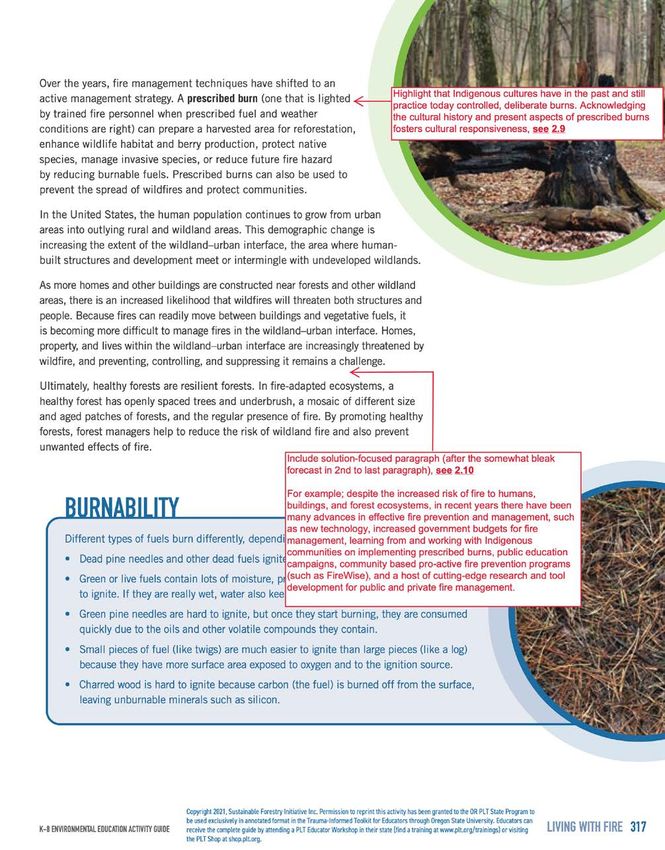
→
Page content transcription
If your browser does not render page correctly, please read the page content below
OREGON STATE UNIVERSIT Y EXTENSION SERVICE

              Trauma-Informed Toolkit
                                      A Resource for Educators

Photo: Yasmeen Hossain, © Oregon State University
                                                                 Yasmeen Hossain, Ph.D.
                                                                 Oregon Natural Resources Education
                                                                 Program Coordinator
                                                                 College of Forestry
                                                                 Oregon State University

                                                                                       E M 93 4 8
                                                                                    February 2022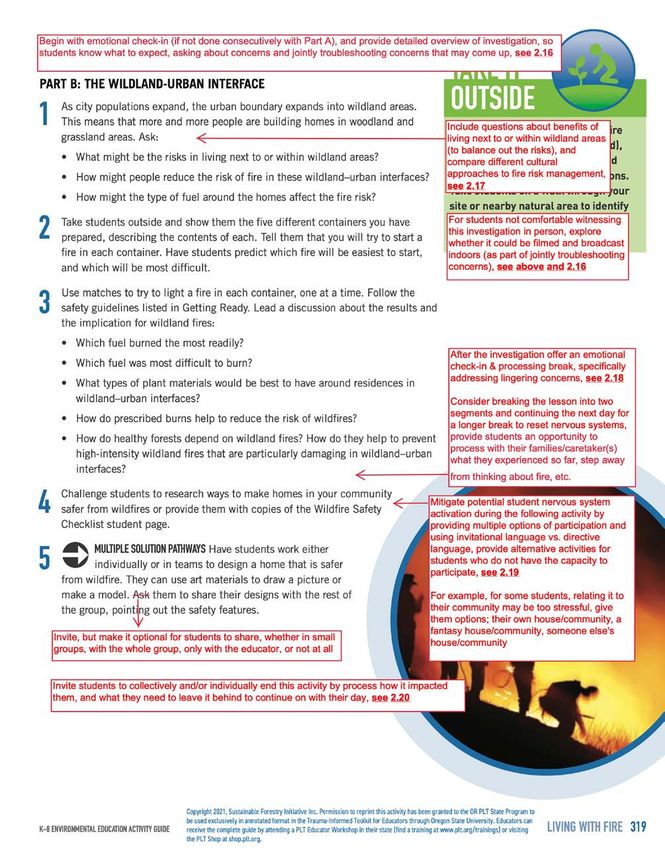
About this toolkit
Purpose of this toolkit
The purpose of this toolkit is to support and complement educators’ knowledge
and skillset in trauma-informed approaches in education. It is just one resource
in a wide variety of supports available to professionals in education as they
embed trauma-informed practices. Educators and education professionals are
highly encouraged to attend a corresponding workshop on trauma-informed
approaches in education. It is offered by the Oregon Natural Resources
Education Program (ONREP) throughout the year. This workshop provides
opportunities for discussion, processing the information with peers and
practicing hands-on approaches.
Please check ONREP’s website for information on when the workshops will be
offered.
This toolkit is not designed to be a substitute for seeking the guidance and
advice of mental health professionals.

Acknowledgements and disclaimers
You are invited to engage with this toolkit in whatever capacity is available to
you. This toolkit uses examples of traumatic stress and traumatic experiences
that may intersect with your personal experiences with trauma. As you explore
this topic, you are encouraged to tune into your own well-being and take care
of your needs. Please don’t hesitate to reach out to others for support with this
topic, such as colleagues, family members, friends, mental health professionals
or community groups - whichever type of support structure resonates closely
with you.
Trauma-informed practices in this toolkit are largely situated in the dominant
culture of the U.S. This is by no means the only or best cultural way to engage
with trauma-informed approaches, and for many it may be an inappropriate
cultural lens. Please consider modifying the approaches in this toolkit to be
culturally specific and appropriate for you, your learning setting and your
students.
The author of this toolkit has a background working in the alternative trauma
recovery and prevention field, utilizing creativity-based strategies to support
children and adults processing traumatic stress. She has been working in the
realm of PreK-12 education for many years as an educator, teacher-trainer,
researcher and mentor, including providing trauma-informed interventions for
students and professional development in trauma-informed care for educators
and other school staff. The author is not a licensed mental health care provider.
For support, guidance and advice please seek the counsel of a mental health
care professional. This toolkit was peer-reviewed by educators, licensed school
counselors and specialists in the field of educator professional development.

© 2022 Oregon State University. Extension work is a cooperative program of Oregon State University, the U.S. Department of
Agriculture, and Oregon counties. Oregon State University Extension Service offers educational programs, activities, and materials
without discrimination on the basis of race, color, national origin, religion, sex, gender identity (including gender expression), sexual
orientation, disability, age, marital status, familial/parental status, income derived from a public assistance program, political beliefs,
genetic information, veteran’s status, reprisal or retaliation for prior civil rights activity. (Not all prohibited bases apply to all programs.)
Oregon State University Extension Service is an AA/EOE/Veterans/Disabled.
Published February 2022
                                                                        2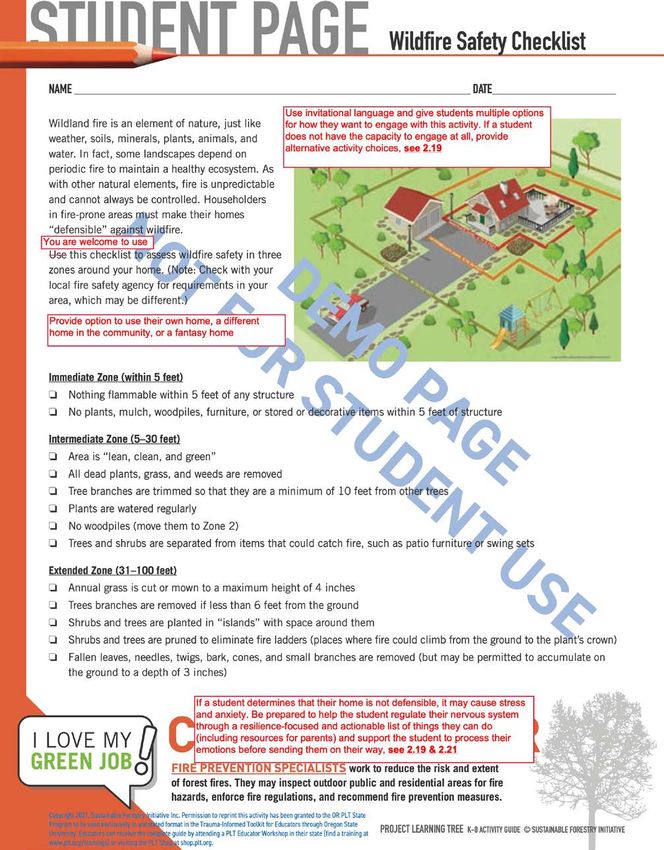
Table of contents
About this toolkit                                                                              2
   Purpose of this toolkit                                                                      2
   Acknowledgements and disclaimers                                                             2
Introduction                                                                                    4
What is trauma anyway?                                                                          5
   An attempt to define it                                                                      5
   What is traumatic stress?                                                                    5
   Trauma resilience                                                                            6
   Risk and protective factors                                                                  7
   Types of traumatic stress                                                                    8
   Symptoms of trauma                                                                          10
   Neurobiology of trauma explained                                                            11
   The how and why of nervous system regulation                                                13
The ins and outs of trauma-informed service delivery                                           16
   So many terms! Trauma-informed, trauma-sensitive, trauma-specific                           16
   Trauma-informed care in education                                                           16
   Who can provide trauma-informed care?                                                       18
   Core pillars of trauma-informed care                                                        18
Practical trauma-informed strategies and tools for educators                                   21
   Care for educators                                                                          21
   Co-regulation                                                                               22
   Social-emotional learning (SEL)                                                             24
   Setting up the educational space                                                            24
   Processing opportunities                                                                    27
Putting it into practice: Applying a trauma-informed lens to a lesson plan                     30
   Before the lesson                                                                           31
     Educators                                                                                 31
     Students, families/caregiver(s), relevant school staff                                    33
     Guest speakers/volunteers                                                                 34
   Day of the lesson                                                                           35
     Physical, mental and emotional space                                                      35
     Setting-up the lesson                                                                     35
   During the lesson                                                                           38
      Background                                                                               38
      Getting ready                                                                            41
      Part A: Fire triangle                                                                    42
      Part B: The wildland-urban interface                                                     44
      Lesson wrap-up                                                                           46
      Assessment                                                                               47
      Enrichment                                                                               48
   After the lesson                                                                            48
Next steps                                                                                     50
Glossary of terms                                                                              51
Appendix                                                                                       53
   Appendix I—Project Learning Tree activity Living with Fire including trauma-informed lens   53
   Appendix II—Letter template for families/caretaker(s)                                       63
   Appendix III—Letter template for school staff                                               64
Acknowledgements                                                                               65
References and resources                                                                       66
   Resources                                                                                   66
   References                                                                                  69

                                                           3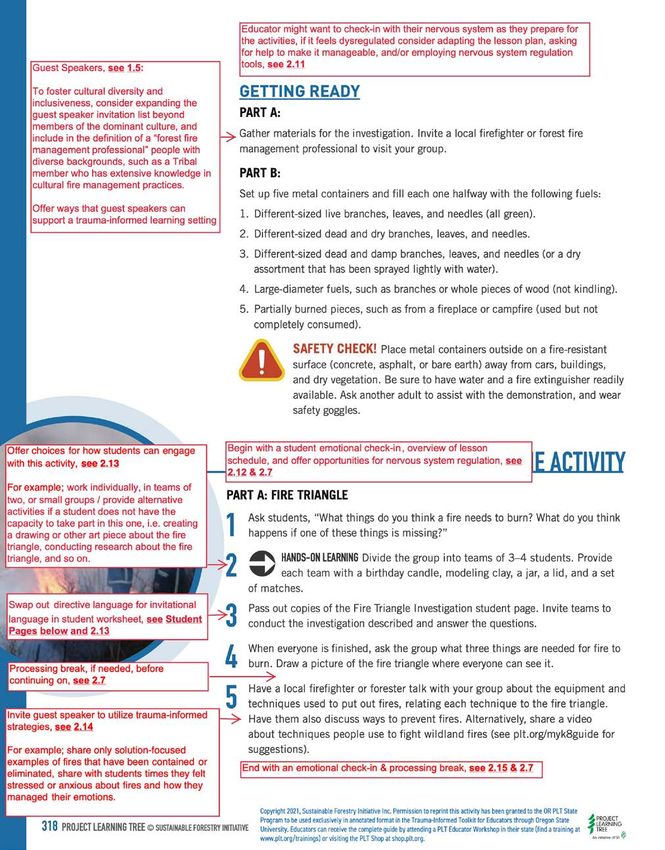
Introduction                                                                          Embedding trauma-
“Everyone in the classroom has a story that will lead to
misbehavior or defiance. Nine times out of 10, this story will not                    informed practices in
make you angry. It will break your heart.”
                                                                                      educational settings can
— Annette Breaux
                                                                                      not only increase positive
Childhood trauma knows no bounds. Children of all backgrounds and identities
                                                                                      academic outcomes
are exposed to adverse experiences that can overwhelm their nervous system            for students, it can
and ability to cope. For some children, this is a daily occurrence. Adults are also
regularly affected by traumatic stress. The invisible and pervasive nature of         also improve educator
trauma necessitates that we avoid making assumptions about anyone and apply
empathy, care, flexibility and a trauma-resilient approach with everyone.
                                                                                      retention, reduce staff
Recent events, including the COVID-19 pandemic, economic recession,                   burn-out, improve
increasingly severe impacts of climate change, political division and race-           relationships and foster
based social unrest (particularly caused by the continued killing of unarmed
Black people highlighting historical traumas and systemic racismi) has a high         resilience.
likelihood of causing traumatic stress for many. The stress can be compounded
by other factors, such as marginalization, oppression, violence, addiction, and
physical and mental disability, to name a few.
From a neurobiological aspect, the prevalence of traumatic stress affects
students’ abilities to engage in the learning process, self-regulate, be attentive,
retain information, and foster healthy relationships with their peers, educators,
and school staff. Students can experience traumatic stress from different angles:
   ¾ Their home environment, neighborhood, community, or as a reaction
     to information gleaned from social media and news outlets or personal
     stories.
   ¾ Lessons in school, such as the history of colonization of Indigenous
     peoples in the US, kidnapping and enslavement, wildfire or climate
     change.
   ¾ School experiences, such as being othered, excluded or bullied.
While this paints a rather bleak outlook, there is hope! Embedding trauma-
informed practices in educational settings can not only increase positive
academic outcomes for students, it can also improve educator retention,
reduce staff burn-out, improve relationships and foster resilience. Trauma-
informed approaches endeavor to understand how traumatic experiences may
have or still are impacting the lives of learners and use that understanding to
accommodate the learner’s needs, prevent new or retraumatization, and foster
resilience and growth. Trauma-informed education has a direct positive impact
on everyone, regardless of their background or trauma history.

                                                               4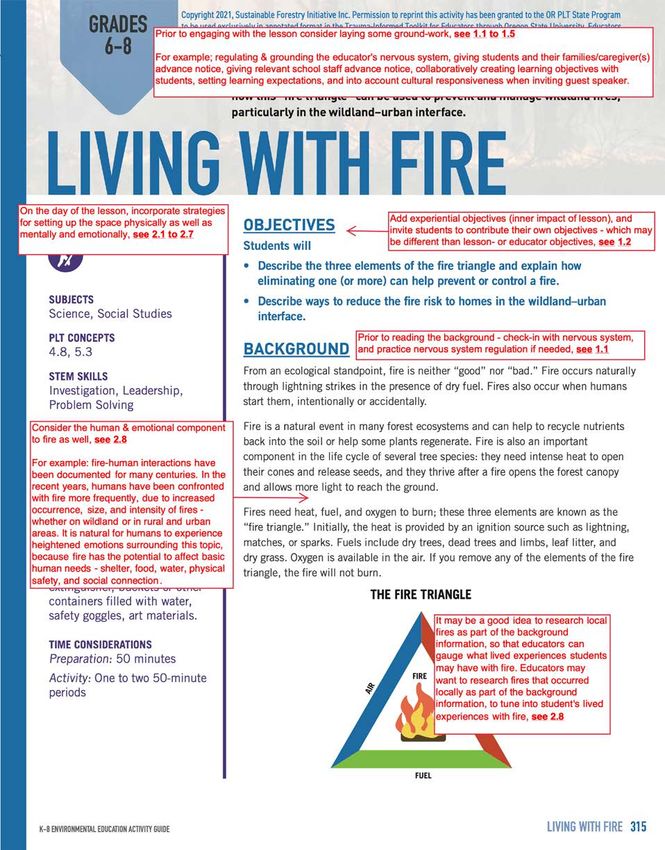
What is trauma anyway?
“Trauma is a fact of life. It does not, however, have to be a life
sentence.”
— Peter A. Levine

An attempt to define it
Most definitions describe trauma as a wound to body, mind, spirit, or a
combination of them, or all of them. The Substance Abuse and Mental Health
Services Administration (SAMHSA) defines trauma as the adverse effects on
a person’s mental, physical, social, emotional or spiritual well-being that often
results from experiencing a harmful event or set of circumstances.ii Trauma in
this context is not the event or circumstance itself (such as a car accident) but
rather the effects the event or circumstance has on the person (such as anxiety
or fear of driving).

What is traumatic stress?
Traumatic stress or a ‘trauma stress response’ refers to a normal neurobiological
response to adverse experiences or circumstances. This stress is experienced
somatically, emotionally, psychologically and spiritually. It is a necessary survival

Figure 1: Three Realms of ACEs, © PACEs Connection

                                                                     5
mechanism.iii Traumatic stress is commonly experienced as a result of a life-
threatening or otherwise overwhelming experienceiv that elicits the feeling of       Stress is always part of
helplessness, hopelessness, terror and a loss of control. This is an automatic,
neurological process unconscious to the individual. In a survival situation, we
                                                                                     a trauma response, but
don’t think cognitively about our reactions, we just react! Whether the event        not all stressors become
is actual or perceived, the trauma stress response elicits a nervous system
reaction regardless of a person’s awareness of the response or level of threat.      traumatic.
For example, thunderstorms often feel like a life-threatening event to small
children, even though their lives are most often not endangered. Their nervous
system makes no distinction between a perceived threat and an actual threat to
their physical wellbeing.
The Positive and Adverse Childhood Experiences (PACES) Connection groups
adverse childhood and community experiences (ACEs) into three primary
realms: Household, Environment and CommunityV (see Figure 1). The adverse
experiences have a large disposition to cause traumatic stress affecting children,
adults, organizations, systems and communities, and thus reducing resilience.
But stressful events or circumstances don’t always lead to long-term clinical
trauma responses.ii,iii Two children might experience the same event, like the
death of a grandparent, but experience it differently. One child could have a
significant trauma response while the other experiences stress but develop
symptoms consistent with a long-term trauma response. Stress is always part of
a trauma response, but not all stressors become traumatic.

Trauma resilience
Whether stress is experienced as traumatic depends on a variety of factors.          The faster someone
These factors include the perceived or actual threat level, ability to draw
on effective coping strategies, presence of supportive relationships,
                                                                                     bounces back, resumes
sociodemographics, trauma resilience and many others. Trauma resilience is the       daily functioning, and
ability of a child or adult to cope, process and adapt to a traumatic event.vi The
goal of trauma resilience is to help people experiencing adversity to either stay    engages with healthy
in a state of a regulated nervous system or return to a regulated state in a short
period of time with minimal distress or affect on daily functioning. While having
                                                                                     coping mechanisms for
a temporary trauma stress response to an adverse experience is normal (and in        everyday stressors, the
most cases promotes survival such as our instinct to run when we encounter a
bear), trauma resilience informs:                                                    higher the person’s trauma
   ¾ How long the temporary dip affects daily functioning.                           resilience.
   ¾ What areas of life are affected.
   ¾ The level to which the daily functioning is affected.
For example, a student’s response to a traumatic experience might affect school
performance for a few days or it might affect it for months or even years. It
might impact just school performance, or additionally peer relationships and
the student’s sleep cycle. As a very general rule of thumb, the faster someone
bounces back, resumes daily functioning, and engages with healthy coping
mechanisms for everyday stressors, the higher the person’s trauma resilience.
Fostering and strengthening individual and community resilience is a
component of trauma-informed strategies and tools. Resilience exists on
a spectrum; any amount of resilience helps us cope, adapt and function.
Resilience is coded into our DNA and is an innate part of all of us.vii

                                                             6
Risk and protective factors
There are external, internal, biological, historic and systemic factors that can
increase or decrease the likelihood of a person’s trauma stress response.vi, viii, ix
These factors influence how long the response will last and the degree to which
it will affect the person’s daily functioning. Some factors deteriorate their feeling
of security, ability to thrive and control over life choices. These are generally
considered risk factors. Some factors encourage stability, thriving, independence
and safety. These are considered protective factors. Protective factors foster
resilience. (See Figure 2 for examples of risk and protective factors. )

§ Pre-existing exposure to trauma                                                 § Physical and mental wellbeing
§ Mental health or physical challenges                                            § Well-practiced coping skills
§ Developmental factors                                      Self                 § Feeling a sense of belonging
§ Feeling different than everyone else                                            § Strength-focused mindset and
§ Deficit-focused mindset                                                           approach to challenges
§ Unstable family dynamics (e.g.,                                                 § Stable family dynamics (e.g.,
  incarceration, substance abuse, physical                                          employment, partnership, physical &
  and mental illness, unemployment,                        Home                     mental wellbeing, food and housing
  housing instability, food insecurity,                 Environment                 security)
  trauma history, abuse, neglect)                                                 § Secure attachment with primary
§ Modeling of unhealthy coping                                                      caretakers
  strategies by others                                                            § Modeling of healthy coping strategies
                                                                                    by others
§ Lack of healthy, trusting relationships
§ Community trauma, collective trauma                    Community                § Healthy, trusting relationships
§ High level of poverty, crime,                                                   § Social connection
  houselessness, etc.                                                             § Low level of poverty, crime,
§ Social isolation                                                                  houselessness, etc.
§ Historic and/or systemic oppression                                             § Access to robust cultural supports to
§ Marginalization                                       Culture, race,
                                                          ethnicity,                foster resilience (e.g., how to handle
§ Racial trauma                                                                     stress, who to turn to for advice)
§ Lack of access to cultural supports to                religion, etc.
                                                                                  § Solutions-focused, strengths-based
  foster resilience                                                                 belief system
§ Limited availability and access (e.g.,
  health care, education, library)                         Social                 § Availability and easy access (e.g., health
§ Negative experience with service                        supports                  care, education, library)
  providers                                                                       § Feeling welcomed and validated by
§ Social stigma with peers to seek out                                              service providers
  social supports

Figure 2: Trauma Risk & Protective Factors, author adapted from Rise Up Kansas.

                                                                    7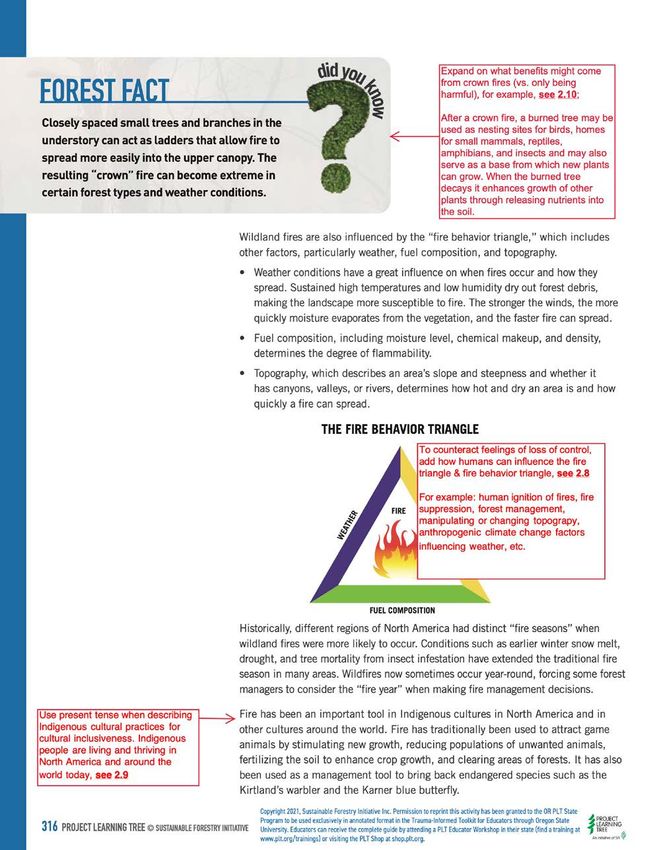
Types of traumatic stress
Traumatic stress is typically classified into three categories:                The context in which
   ¾ Acute trauma — resulting from a single event, such as having to           traumatic stress is
     evacuate due to fire threat.
                                                                               experienced can affect our
   ¾ Chronic trauma — resulting from a repeatedly occurring or
     prolonged event or circumstance, such as bullying or experiencing         response to it, the types of
     chronic poverty.                                                          support available, and our
   ¾ Complex trauma — resulting from multiple and often diverse events
     or circumstances, such as having to evacuate due to fire threat, in
                                                                               understanding of it.
     addition to being bullied and experiencing chronic poverty.
In what context the traumatic stress is experienced can affect the response
to it, the types of support available, and the understanding of it.x For
example, does the adverse event or circumstance primarily affect an
individual, or is it occurring in the context of a group or community? Does
it affect a certain culture, race or even an entire geographic region (for
example a natural disaster)?

Individual trauma
Individual trauma refers to an event or circumstance that causes a trauma
stress response that is experienced by an individual only. It can be acute,
chronic or complex.

Collective trauma
When more than one person or groups of people experience the same
event or circumstance — such as natural disasters, wars, systemic racism,
genocide — it can lead to a collective trauma response. According to Tulane
University School of Social Work, collective trauma is an event or series of
events that directly and negatively impacts the feeling of safety of a group
or multiple groups of people.xi The traumatic stress response is experienced
collectively and can affect and change the narrative, culture, and psyche
of a group. The effects are often so wide-reaching that even members of
the group who were not physically present for the overwhelming or life-
threatening event experience a trauma response — either because the
group they belong to was targeted and as such it affected their feeling of
safety (for example, Holocaust), or because they internalize the experience
of those who were physically present due to a sense of kinship and
belonging to that community or group (for example, wildfires happening in
someone’s hometown even if they were not living in the hometown at the
time).
Traumatic stress can leave behind a legacy for future generations.
Transgenerational trauma, also called intergenerational trauma or ancestral
trauma, affects younger generations in a few different ways:xii
   ¾ Storytelling: sharing lived stories with children, for example of
     war, enslavement, displacement of ancestors. The language used in
     telling these stories influences the impact on those hearing them. For
     example: how hope, grief, or devastation is expressed, how much and
     how often these feelings are discussed, and so on.
   ¾ Imprints on familial culture: traumatic experiences of grandparents
     or parents can influence familial culture and get passed down to
     children in a variety of ways: changes in family dynamics, parenting

                                                              8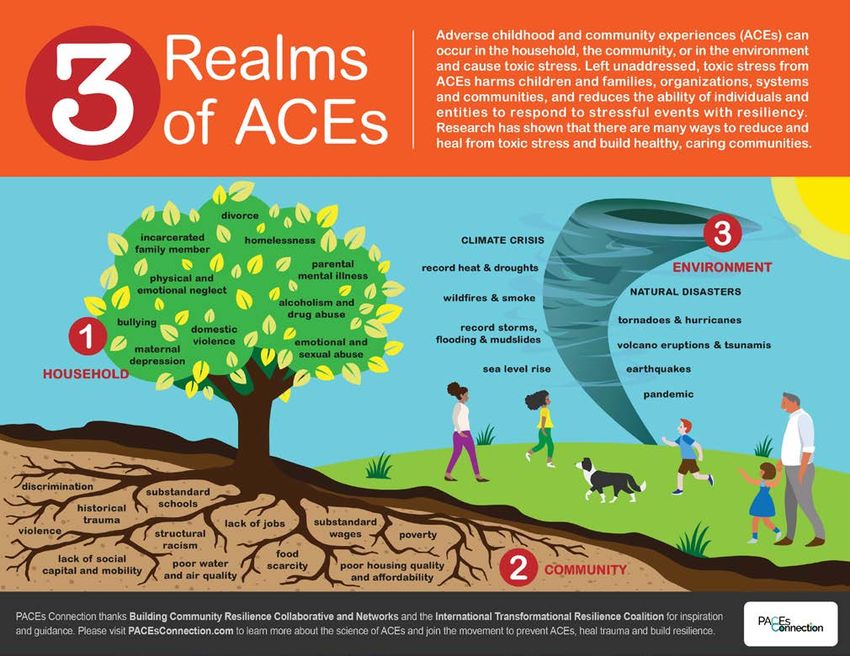
styles, added socioeconomic burden (if a parent becomes unemployed
     for example), long-term grief over losing a family member. Children can        Traumatic stress can
     also be imprinted with beliefs rooted in traumatic experiences such as not
     feeling welcome or safe in a community or country, or learned beliefs from
                                                                                    leave behind a legacy for
     surviving a traumatic experience such as “don’t draw attention to yourself,    future generations.
     it is dangerous” or “don’t waste food, tomorrow we might starve.”
  ¾ Societal culture: in the case of mass cultural and historical traumas,
    such as COVID-19, the entire culture of a society can be impacted and
    changed.
  ¾ Neurobiological: the traumatic stress the parent or grandparent
    experienced (and has not processed fully) may impact the way their
    nervous system responds to stress. They may have a much stronger
    reaction than would be expected to everyday stressors. This type of
    neurobiological response is modeled and passed on to children.
  ¾ Genetic: prolonged traumatic stress can leave a chemical mark on a
    person’s genes that alters the expression of the gene. This alteration can
    be passed down to genetic offspring. In other words, a person’s experience
    can alter the biology and behavior not only of themselves, but of the
    genetic make-up of their children, grandchildren and future generations.

Vicarious (secondary) traumaxii
Vicarious trauma, also known as secondary trauma, can affect anyone who
is closely connected to someone or multiple people experiencing a trauma
response. They can be affected by listening to trauma victims recount their
experience, reading reports, watching video footage or supporting the person.
The secondary observer could be anyone, but caretakers, educators, health-care
professionals, first responders or law enforcement officers are often exposed to
actual or vicarious trauma. The same trauma risk factors and protective factors
apply to vicarious trauma as to first-hand trauma; someone may have a higher
likelihood of experiencing vicarious trauma if they have a trauma history, social
isolation, lack of connection, unstable family dynamics, historic and/or systemic
oppression, marginalization, a lack of professional and organizational support or
a lack of professional training, and so on.

                                                           9
Symptoms of trauma
“Everyone’s internal alarm system is different. For some, it’s
tension headaches, for others, it’s back pain.
“For you, it could be a rapid heartbeat.
“For everyone, it’s painful and exhausting.”
— Dr. Mariel Buqué

Symptoms are a message for us that something isn’t right and requires our attention. A trauma response can lead to
a wide variety of symptoms — from mental or emotional distress to physical symptoms or a combination.ii They can
range from subtle to physically or mentally crippling. There are no fixed rules for when a symptom might appear or
how long it will last. Trauma is unique to every individual. Symptoms can appear immediately after an event or take
months or years to surface. Anecdotal stories from school districts impacted by the 2020 California wildfire season
reported that students often did not exhibit symptoms of trauma until six months after the fires.xiv
Some of the common trauma symptoms could have a number of other causes, such as illness not related to a
traumatic event. However, trauma symptoms typically do not resolve quickly or on their own — they are often
experienced long-term, requiring specific attention, reflection, and conscious processing to be resolved.
How trauma symptoms show up in a person’s body, behavior, thoughts and reactions varies widely based on
sociodemographics, historic experiences, genetic dispositions, learned behavior patterns, family dynamics, culture
and community, and many other factors.ii,iii,iv They are influenced by age, developmental level and prior experiences.
However, there is no hard and fast rules for this. A child or adult of any age could experience any of the following
common symptoms either in isolation, in combination, or experience symptoms not on this list.
Trauma symptoms can include but are not limited to:xv, xvi, xvii

 Preschool age                           Elementary school age                    Adolescence
 Sleep disturbances — nightmares,        Sleep disturbances — nightmares,         Changes/disturbances to sleep —
 difficulty falling asleep, fear of      difficulty falling asleep, fear of       too much sleep or lack of sleep,
 sleeping alone                          sleeping alone                           changes to sleep cycle
 Physical symptoms — chronic             Physical symptoms — chronic              Physical symptoms — chronic
 headache, stomachache, body pain        headache, stomachache, body pain         headaches, stomach aches, body
                                                                                  pain
 Behavior Regression — such as bed-      Persistent/excessive worry and           Increased strong emotions — a
 wetting, thumb-sucking, clinging to     concern over safety of self and          gitation, confrontation, depression,
 caretakers, new or increased fears/     others, engaging in unusually            anger, grief, fear, concern
 phobias (such as of the dark), etc.     reckless or aggressive behavior
                                         & experiencing unusually
                                         strong emotions — irritability,
                                         aggressiveness, sadness, fear
 Loss of appetite or other changes to Constant retelling of the traumatic         Changes to eating behavior (loss of
 eating behavior                      event or recreating it in play              appetite or excessive consumption)
 Fear of event (e.g., wildfire)          Lowered school performance —             School performance — decreased
 recurring — fear triggered by           higher detention and suspension          concentration, increased drop-
 reminders such as campfires,            rates, falling behind peers              out rates, falling behind peers
 BBQ, candles, smoke unrelated           developmentally, low academic            developmentally, delinquent
 to wildfires, fireworks, changes in     achievement, higher referrals to         behavior
 weather                                 special education services, difficulty
                                         with concentrating, memory or
                                         learning at school
 Excessive worry about safety of self    Experiencing guilt or shame for          Feeling guilt or shame over the
 or loved ones                           their behavior during the event —        traumatic event — can lead to self-
                                         what they did or didn’t do               destructive behavior
 Withdrawal from activities and          Withdrawal from activities and           Feeling vulnerable and afraid of
 people they used to enjoy               people they used to enjoy                being labeled ‘abnormal’ due to
                                                                                  their trauma symptoms

                                                                 10
Neurobiology of trauma explained
The human brain is a complex system. What follows is a simplification of trauma
neurobiology. For a deeper dive, please see the resource guide at the end of this
document.
There are a number of ways to break down the brain’s components and how they
function. For the purpose of talking about traumatic stress, it helps to divide the brain
into three main components:xviii,xix
1. Hindbrain, also known as the reptilian, primal or instinctual brain, is responsible
for our survival and daily maintenance. It controls our instinctive reactions and
involuntary responses, such breathing, heart rate and digestion). This part of the
brain reacts to external stimuli and determines whether we are physically safe. In
Figure 3, the hindbrain is red.
2. Midbrain, known as the mammalian, emotional or sensory brain, includes the
limbic system. It regulates feelings, memory, creativity, and relating to others. It
responds to stimuli and tells us whether we are loved. In Figure 3 the midbrain is
orange.
3. Forebrain, or human or primate brain, includes the neocortex. It is the thinking
and rational brain. It is responsible for higher mental functions, such as
reasoning, language, empathy, logic. This part of the brain wants to know what
can be learned from stimuli being experienced. In Figure 3 the forebrain is yellow.
Figure 3: Stress Response and the Brain, Yasmeen Hossain © Oregon State University
When our senses perceive threat, the information travels from the bottom up,
through the hindbrain first and the forebrain last (see Figure 3).xviii, xix, xx If the
hindbrain or the midbrain determine there is a threat present, the amygdala
sounds the alarm and our nervous system becomes dysregulated. In this context
a dysregulated nervous system refers to an imbalance between the sympathetic
nervous system (which activates our fight, flight, freeze or fawn response) and
the parasympathetic nervous system (which activates our rest, digest, and restore
response). See the next section “The how and why of nervous system regulation”
for more information.
The amygdala is made up of a bilateral cluster of almond-shaped cells that are part
of the limbic system (in the midbrain) that regulate emotions and help encode
memories. It serves as an internal alarm system that triggers a survival response
11when threat is perceived. In order to maximize our survival response — which
is an instinctual and involuntary reflex when our alarm system is triggered
— our brain disconnects access to our prefrontal cortex, including language
processing.xx This part of the forebrain involves decision-making, problem-
solving, self-control, language and higher reasoning (see Figure 4). This means
that we do not get a chance to analyze a threat or external stimuli in our
forebrain before the amygdala sounds the alarm and our survival response is
triggered. In part, this is why we respond in the same neurobiological way to
a perceived threat as we do to an actual threat.
As any good alarm system would, the amygdala wants to ensure we do
not repeat any threatening situations in the future.iv, xxi, xx So it imprints
a memory of the stimuli that triggered the alarm. However, this imprint
exists as fractured parts, not as a whole story. This means it will record the
sensations (such as a sound, smell, visual image), separately. This can lead to
a sort of hijacking effect of our amygdala if we come across one or more of
those stimuli memories without explicitly connecting it to a specific event by
putting together the whole story. For example, if a certain song was playing
on the radio at the time of a car accident, the amygdala might store the
sound of that song as it related to the survival threat. The next time we hear
that song, even if we are not in a car, the amygdala might sound the alarm
and we might experience a stress response even though there is no threat to
our survival present.
How traumatic stress affects the prefrontal cortex
Amygdala Prefrontal
cortex
Figure 4: Traumatic Stress Affects the Prefrontal Cortex, Yasmeen Hossain © Oregon State
University
Types of trauma responses
Experts in the trauma field are not always in agreement as to how many
trauma responses the human brain engages in or to what extent. Researchers
have identified four responses:xxii,xxiii
1. Fight — the brain prioritizes survival at any means, leading to anger,
aggression, outbursts of temper.
2. Flight — physical flight might look like distancing oneself from the
stress — leaving the area, making one’s body as small as possible,
folding arms tightly, etc. If physical flight is not available, this response
often triggers mental or emotional flight through being chronically
12busy, overthinking, dissociation, obsessive behavior or inability to be still
and relaxed. Bringing a dysregulated
3. Freeze/immobilization — feeling physically or mentally frozen and nervous system back into
inactive, unable to make meaningful connections, withdrawal and
isolation, difficulty making decisions. equilibrium or balance is a
4. Submit/fawn — people-pleasing, submitting to the wishes, demands or key component of trauma
requests of others with no regard for self, forfeiting personal needs to
accommodate others, unable to identify physical, emotional, mental needs recovery.
and preferences, apologizing for self, needs, or for taking up space.
The how and why of nervous system regulation
When a trauma response is activated, the nervous system becomes
dysregulated.xxiv It often follows either a state of:
¾ Hyperarousal or activation: The sympathetic nervous system controls
the fight, flight, freeze or fawn response. Hyperarousal occurs when the
sympathetic nervous system is overly active, leading to symptoms such as
rapid shallow breathing, tense muscles, increased heart rate, inability to
eat.
¾ Hypoarousal: The parasympathetic nervous system controls rest,
digestion and restoration. Hypoarousal occurs when the parasympathetic
nervous system is overly active, leading to symptoms such as depression,
lethargy, fainting, “checking out” mentally and emotionally, a combination
or all of these symptoms.
Both of these activations can lead to impaired wellness if prolonged. Bringing
a dysregulated nervous system back into equilibrium or balance is a key
component of trauma recovery.
Trauma is stored in multiple parts of the brain as well as in the form of somatic
memory or body memory.iv,xxi Effectively processing and releasing traumatic
stress must involve all parts of the brain — hindbrain, midbrain, forebrain — as
well as the physical body to be comprehensive and have no lingering long-
term effects. The way our nervous system can regain equilibrium after being
activated is through dispersing the energy of overwhelming emotional states
like fear or despair.xxv If this energy is not dispersed, it can remain trapped in our
nervous system, constantly cycling through the experience of fear, helplessness,
despair, etc. This can lead to post-traumatic stress disorder (PTSD).
Nonhuman animals have a built-in mechanism for dispersing tension and stress
from their nervous system after a life-threatening event. Their bodies tremble,
quake and shiver, and they take spontaneous deep breaths. This is a natural
response that returns their nervous system to homeostasis. The example that
Dr. Peter Levine, an expert in somatic trauma release, often uses is that of a
gazelle.xxv If a gazelle is being chased by a lioness, the gazelle’s nervous system
is activated for survival mode (for example flight). If the gazelle escapes the
lioness and is out of physical danger, it will begin a period of shaking and
quivering, often taking deep breaths until that energy is dispelled. This action
helps regulate its nervous system by literally shaking off the trauma stress
response immediately following the traumatic experience. In this manner, the
gazelle suffers no long-term impairment by its neurological stress response.
In general, animals do not develop PTSD because their instinctual behavior
releases the trauma response soon after the traumatic experience and it doesn’t
have a chance to get stuck.
13Humans have a comparable mechanism for releasing a stress response.iv,xxv
Instinctually, our bodies will shiver and quake after a stressful event, such as a
car accident or after hearing distressing news, until the energy is dispersed and
our nervous system is back in equilibrium. In Western culture, this dispersal
is often suppressed out of fear of judgement by others due to individual or
collective cultural conditioning about how someone ‘should’ react to stressful
occurrences. We frequently feel an urge to strive to be stoic and not exhibit
heightened emotions. Medical professionals may additionally perceive a need
to prevent any physical injury that might result from quaking and shaking.
However, if we allowed our bodies to shake off the stress, our nervous systems
would be better for it!
In addition to physically shaking off a stress response, several other methods can
be employed to help our bodies disperse energy from a trauma response and
coax our nervous system back to equilibrium. These methods are often applied
in complement to talk therapy — which engages the forebrain — to additionally
engage the hindbrain and midbrain.xxi Complementary methods can include:
¾ Connection with nature and the outdoors.
¾ Connection with animals, such as equine therapy.
¾ Conscious breathing and breathwork.
¾ Body-based/felt-sense modalities such as yoga, martial arts, qigong, any
mindful physical activity.
¾ Creative expression such as writing, acting, art and music.
¾Psychotherapy techniques, such as eye movement desensitization and
reprocessing (EMDR) and trauma-focused cognitive-behavioral therapy (CBT).
¾ Somatic therapy — a modality grounded in the mind-body connection.
¾ Mindfulness strategies.
Neuroplasticity
Luckily, our brains are not static and unchangeable. Part of our survival and Neuroplasticity explains
resilience gene coding is an ability for the malleable neurons in the brain to grow
and change, also called neuroplasticity.xxvi,xxvii, xxvi This plasticity (or changeability) how a trauma response
continues throughout life. This means if an activity is practiced over and over or
a memory is accessed many times, we can create a new pathway in our brain. becomes habitual but
In time, this becomes the default pathway and it becomes easier to follow each also how it can provide
time the activity is practiced or the memory called upon. The more frequently
the pathway is stimulated, the stronger and more efficient the pathway a roadmap for how
becomes. If the behavior changes or the memory is no longer recalled, the
pathway weakens and is eventually ‘deleted’ from the brain. to eliminate a neural
Neuroplasticity explains how a trauma response becomes habitual but also how pathway that no longer
it can provide a road map for how to eliminate a neural pathway that no longer
serves us. Our neurons don’t know ‘right’ from ‘wrong.’ They simply follow the
serves us.
most frequented path, whether it is helpful or not, which can entrench anxious,
obsessive or depressive patterns and thoughts.xxviii Neuroplasticity sets the
foundation for us to learn new pathways, helping us overcome depression,
addiction and other unhelpful patterns. An example of neuroplasticity is if a
student is frequently told by adults that they are stupid, don’t have any skills,
and won’t amount to anything in life, the student may create a neural pathway
leading to feelings of unworthiness and incompetence that they will continue
following for the rest of their life because it is a known and well-worn path. If
14an adult supports the student with an intervention, highlighting the student’s
strengths, supporting the student to engage in activities they are good at,
and telling the student they have a bright future ahead of them, this creates
new neural pathways in the student’s brain. The more often that pathway
is reinforced and chosen by the student, the more habitual it will become.
Eventually the old neural pathways of being told they won’t amount to anything
are deleted.
Through applying and repeating trauma-informed approaches, the brain creates
new neural pathways over time, releasing any lingering traumatic stress and
activated trauma responses.
Key trauma understandings
Trauma is pervasive: Exposure to traumatic experiences is common and
ubiquitous in societies worldwide. Trauma wounds are not commonly visible
(like a broken arm) but there is rarely an individual who has not experienced
traumatic stress in their life.
Trauma is unique to each individual: Everyone experiences events and
circumstances differently, whether and how it manifests as traumatic stress is
unique to each individual and there is a wide range in symptoms.
Adverse experiences do not always lead to a trauma response: Stress is
always part of a trauma response, but all stressors do not always lead to a
trauma response. It depends on a variety of factors, for example the ability to
draw on effective coping strategies, past trauma history, historic and/or systemic
oppression, marginalization, demographics, family culture, and other factors.
15The ins and outs of trauma-informed Trauma-informed care
service delivery is an approach or a
“Trauma is not what happens to you. Trauma is what happens
inside you as a result of what happens to you.” paradigm shift, not a
— Dr. Gabor Maté checklist.
So many terms! Trauma-informed, trauma-sensitive,
trauma-specific
There are a number of different trauma-related terms. It’s easy to confuse
them. Here is a primer on the three most common terms:xxix
¾ Trauma-sensitive
• Awareness of the pervasiveness and impact of trauma on individuals
and our society and how it might impact someone’s well-being.
• Being trauma-sensitive does not always include taking action.
• A trauma-sensitive approach differentiates between “what is wrong
with you?” (victim blaming) and instead focuses on a “what happened
to you?” (circumstances and events do not define you) approach.
• For example, you will likely be more trauma-sensitive after reading
through this toolkit and become more knowledgeable about trauma
and its causes and impacts.
¾ Trauma-informed
• Taking a trauma-sensitive approach to life and putting it into action.
• Using knowledge of the impact trauma has and applying it to:
» Change personal behavior
» Update professional policies and practices
» Inform interactions with others
» Change systems whether on the micro or macro scale
• For example, if after reading through this toolkit you become inspired
to put some or all of the strategies, tools and approaches into practice
in your personal and/or professional capacity, you are trauma-
informed.
¾ Trauma-specific
• Therapeutic interventions focused on reducing symptoms, promoting
trauma recovery and post-trauma growth.
• For example, mental health professionals utilize trauma-specific
approaches with their patients.
Trauma-informed care in education
Trauma-informed care (TIC) is an approach to providing care that is
accessible and appropriate for anyone who has experienced, or is currently
experiencing, traumatic stress.xxx The ‘trauma-sensitive’ term indicates that
there is a baseline level of knowledge and awareness of the nature of trauma
that must be present and a willingness to take action. Trauma-informed
care does not aim to treat symptoms related to trauma but rather provides
a framework that invites flexibility and empathy for those experiencing
16traumatic stress. Trauma-informed care is often associated with learning
environments and the educational field, though not exclusively. The Substance Trauma-informed care
Abuse and Mental Health Services Association defines trauma-informed
care as a strengths-based approach that is grounded in the understanding
does not aim to treat
of and responsiveness to the impacts of trauma, creating opportunities for symptoms related to
trauma survivors to rebuild a sense of control.xxxi Furthermore, it involves
vigilance of institutional, systemic and individual policies and behavior to avoid trauma but rather
retraumatization.
provides a framework
Educators who are embedding trauma-informed care in their professional
capacity are invited to take into account the entire experience of a student, not that invites flexibility
just one lesson or one learning experience. For example, a student’s entire day and empathy for those
may involve; waking up, eating breakfast, commuting, arriving in the learning
setting, being greeted, engaging in the lessons, recess and lunch activities, experiencing traumatic
engaging with peers, dismissal and commute home, afternoon activities, evening
meals, a variety of home routines and interactions, and bedtime. At any point stress.
during the student’s day their nervous system might become dysregulated. While
applying trauma-informed care in one or two of these segments of a student’s
day is significant and will make a difference, an approach that takes into account
the whole students’ day can have a higher potential to avoid retraumatization
and support long-term student well-being. For an example see the box to the left.
Trauma-informed care is an approach or a paradigm shift, not a checklist. It
is usually embedded in daily language, beliefs and attitudes. It recognizes the
prevalence of trauma in all learning environments and strives to understand
and create physically, emotionally, and mentally sound spaces for all learners
including educators. A trauma-informed care approach focuses on progress not
perfection. It’s an ongoing journey, not a destination.
Helping students regain their footing
Tasha had a terrible night. Her parents were fighting well into the evening. She
could hear them through her bedroom door. In the morning, her mother didn’t
get up to make her breakfast. To top it off, Tasha couldn’t find her math folder and
arrived at school late, hungry, tired, and stressed.
Tasha’s teacher recently attended a trauma-informed care seminar and decided
to implement some of the strategies she learned that take into account the whole
student experience, including what happens before students even arrive at school
and after they leave school.
On this morning Tasha very much appreciated the teacher starting the day with
open time to engage in quiet reading, finishing up homework, or anything else
students need to start their day off without feeling rushed. Tasha grabs a granola
bar that the teacher puts out for hungry students and one of the spare math
folders that are stocked in the classroom. During recess, Tasha retreats to the
quiet corner and listens to music while hugging one of the stuffed animals. Her
day continues with little supports built in, such as being guided through conscious
breathing exercises before lunch, and a sharing circle that involved drawing how
she felt. Tasha loves drawing!
By the time Tasha’s school day was over, she felt calmer, grounded, and ready
to go back home and face whatever fall-out there might be from her parents’
big fight. The way the teacher built tools into the classroom routine mitigated
both stress and trauma responses of students, even if the students, like Tasha,
experienced stress before even arriving at school.
17Equity and cultural responsiveness are crucial to trauma-informed care.xxxii,xxxiii “We had a lot of trouble with western
mental health workers who came
Experiences of inequity, exclusion, discrimination, racism, macro- and/
here immediately after the genocide
or microaggression can (and often do) cause traumatic stress. Applying and we had to ask some of them to
trauma-informed care without equity and cultural responsiveness can cause leave. They came and their practice
retraumatization and do more harm than good. If an educator applying did not involve being outside in the
principles of trauma-informed care assumes there are no cultural differences sun where you begin to feel better,
within a classroom or between individuals and the same approach is applied there was no music or drumming
to all, some students could feel excluded, or not seen or heard. They might to get your blood flowing again,
perceive that their unique culture is misunderstood, disregarded, dismissed, a there was no sense that everyone
combination or all of the above. had taken the day off so that the
entire community could come
Cultural responsiveness in this context refers to being aware of cultural together to try to lift you up and
factors that may inform a student’s goals, behaviors, language and outlook bring you back to joy, there was no
on life. It means responding to them in an appropriate manner by striving to acknowledgement of the depression
create meaningful and relevant connections between the educational content as something invasive and external
being taught and the student’s culture.xxxiv Cultural responsiveness tends to that could actually be cast out again.
the interpersonal connections between educator and students and student Instead they would take people one
peers with humility — deferring to the student as the expert and approaching at a time into these dingy little rooms
each student’s culture with a curiosity mindset. and have them sit around for an hour
or so and talk about bad things that
Given that events and circumstances can impact people differently, had happened to them. We had to ask
considering cultural contexts and different pathways to recovery and them to leave.”
healing is key for an effective trauma-informed approach. For example,
~Anonymous man of
offering trauma-informed care strategies and tools situated in the dominant Rwandan heritage
white culture to someone from a culture that has intergenerational trauma
stemming from white colonialism may cause retraumatization and have the (as told to (and paraphrased) by
opposite effect from what was intended. author Andrew Solomon)
Who can provide trauma-informed care?
Trauma-informed care differs from trauma treatment or trauma-specific
services, which (while often using a trauma-informed approach) refer to
clinical interventions by health care professionals or other professionals
working in the trauma recovery field.xxxv Trauma-informed care in this context
refers to being knowledgeable about trauma and its impacts and changing
policies, procedures, culture and behavior accordingly. Trauma-informed care
can be provided by anyone who has the ability and willingness to educate
themselves on this topic and apply it in their personal and professional lives.
Trauma-informed care uses a nonjudgmental, empathic lens to view and
interact with people experiencing traumatic stress. Since trauma is pervasive
and not always outwardly visible, it is a lens through which we interact with
anyone and everyone we come in contact with.
Since trauma is pervasive
Core pillars of trauma-informed care and not always outwardly
Trauma-informed practices, specifically trauma-informed care, rests on a set
of core pillars listed below in no particular order. ii, xxxv, xlii, x, xxxvi,xxxvii,xxxvii The list
visible, trauma-informed
is not inclusive of all possible pillars of trauma-informed care. In the following care is a lens through
section ‘Setting up the educational space’, examples are provided for how
these pillars can be translated to an educational setting. which we interact with
Acknowledgement anyone and everyone we
Trauma-informed care realizes the widespread impact of trauma. Trauma is come in contact with.
pervasive and unpredictable. Everyone experiences events and circumstances
18differently. There are likely few people who have not felt the effects of
traumatic stress in their life influenced by political divisiveness, impacts of
extreme weather, economic recession, racism, poverty, peer victimization,
community violence, neglect, abandonment, historical oppression, forced
suppression of identity, unrecognized or unaccommodated learning or
processing differences, chronic illness, death of a loved one (human or
animal) and so on.
Trauma-informed care recognizes signs and symptoms of trauma in self
and others, as well as the adverse impact the effects of trauma can have on
health and well-being. Signs and symptoms vary by setting, age, gender, race,
class, trauma risk factors and so on.
Relational trust
Supportive, trusting relationships are one of the cornerstones of trauma Supportive, trusting
recovery and trauma resilience. Trust in relationships can be built through
open, honest and authentic communication and action, keeping one’s word,
relationships are one of the
following through on any actions or promises made, showing up, checking-in, cornerstones of trauma
and being a regular presence in someone else’s life. Educators, peers, family
members, friends, professional colleagues and acquaintances all have the recovery and trauma
potential to be a trusting, supportive relationship for someone else.
resilience.
Voice, choice, agency
Since traumatic stress is a response to feeling out of control, this perception
can be counteracted by building in opportunities, language and actions to
signal to a person or group that they have agency over their learning, their
interaction with others, and their well-being; they have a choice, and their
voice matters and will be heard.
Strength-based/solution-focused approach
Trauma-informed care helps people focus on their strengths and solutions
instead of deficits, shortcomings and challenges. This relates back to the
neuroplasticity of our brain and creating new neural pathways for healing and
recovery (see ‘Neuroplasticity’).
Resistant to retraumatization
Retraumatization can occur if a person experiences a similar event,
circumstance or pattern to the initial traumatic event. For example, a student
who has experienced a traumatic separation from a loved one may be
retraumatized by an unexpected separation from a trusted teacher or mentor.
Recognizing common scenarios that might be retraumatizing and working
to mitigate their effects is critical. One way this can be accomplished is by
providing ample advance warning about a change to schedules or staffing
and offering many opportunities for closure and goodbye rituals to assist the
student in slowly processing the impending separation and giving the student
agency over how they want to engage in saying goodbye.
Collaboration
Connected to voice, choice, and agency — a collaborative environment
shares power among the whole group, values different perspectives, and
puts the group or person in charge of their own well-being. When addressing
challenges, cocreating solutions or action plans is key. In an educational
setting, making a learning plan collaboratively (including learning objectives)
between educator and students is one approach, giving opportunities for
19students to educate themselves and one-another, work in small groups, self-
direct their learning, etc. Traumatic stress is often
Empathy and compassionate resilience borne disproportionately
Empathy for self and others, validating other people’s experiences and by those who have
emotions, and normalizing individual responses to adversity are all important
trauma-informed care tools. Practicing compassionate resilience is a form of been systemically
self-care to avoid vicarious trauma, burn-out, and compassion fatigue. marginalized based on
Social justice their race, ethnicity,
Traumatic stress is often borne disproportionately by those who have been culture, socioeconomic
systemically marginalized based on their race, ethnicity, culture, socioeconomic
background, gender, sexuality, ability, neurofunction, immigration status or background, gender,
language. Disregarding these facts when utilizing a trauma-informed care
framework can cause new trauma or deepen existing traumatization.
sexuality, ability,
neurofunction,
Responsive care
immigration status or
Embedding a trauma-informed approach into organizational culture through
policies, procedures, and practices is essential to providing responsive care language.
for staff, volunteers, participants, students, visitors, etc. These tools are most
effective when all levels of an organization, school, or group have received
comprehensive training on trauma-informed care.
20Practical trauma-informed strategies and There are times when
tools for educators self-care is not accessible
“Avoiding your triggers isn’t healing. Healing happens when you’re
triggered and you’re able to move through the pain, the patterns, for educators due to
and the story — and walk your way to a different ending.”
burn-out, exhaustion,
— Vienna Pharaon
experiencing a trauma
There are many ways that educators can implement and embed trauma- response or physical illness.
informed care when working with their students, students’ families and Especially during these
caretakers, colleagues and the community. Below, some practical strategies
and tools are highlighted. This is not a comprehensive list. There is no limit circumstances, it is the
or boundary to the myriad ways that trauma-informed approaches can be
embedded in an educational setting and beyond. community’s responsibility
Care for educators to step in and support and
Care for educators is the most important component of a trauma-informed
provide care for educators.
approach in education. Similar to the guidance on airplanes that, in the event
of a change in cabin pressure, we should apply the oxygen mask to ourselves
first before helping others, the educators’ intersection with trauma must be
cared for before they will be able to successfully implement a trauma-informed
approach with their students. This can be educators applying the principles,
strategies and tools of trauma-informed care for themselves, as well as the
community applying a trauma-informed care approach in interactions with their
educators. There are times when self-care is not accessible for educators due
to burn-out, exhaustion, experiencing a trauma response or physical illness.
Especially during these circumstances, it is the community’s responsibility to
step in and support and provide care for educators. After all, educators spend
a large chunk of their waking hours with our younger generations, helping
raise them by modeling behavior and imparting values, ethics and codes of
conduct. Taking care of our educators is taking care of our future. Self-care and
community care go hand-in-hand to achieve the same outcome: educators who
experience well-being and have the resources and support they need to thrive
in their professional and personal lives. An educator’s behavior, skills and well-
being transfers directly to their students.
Educator self-care is subjective and based on the individual’s preferences,
capacity, ability, likes and dislikes. There is no right or wrong way to practice
self-care. What is important is the outcome of having a regulated nervous
system. It could take the shape of any number of approaches. A first step is for
educators to get to know their own nervous system — what causes activation,
what helps regulate it, what is soothing in the moment, and what builds long-
term resilience. With that knowledge, educators are better equipped to show
up fully for their students and their community. Supporting students can be
challenging if the educator’s nervous system is dysregulated — which could
happen in the most unforeseen ways. Establishing a healthy self-care routine in
one’s life can foster resilience by having an arsenal of tools and strategies to fall
back on when confronted with unusual or overwhelming stress professionally or
personally. Examples of trauma-informed care tools for educators:
¾ Conscious deep breathing, breath work, or meditation. These exercises or
techniques regulate the nervous system.
21You can also read


