Turn junk mail into an effective learning tool
←
→
Page content transcription
If your browser does not render page correctly, please read the page content below
Turn junk mail into an
effective learning tool
               Instead of throwing away the junk mail
               you receive, use it to help your child
               improve skills in geography, math, map
               reading and more.
                   Appoint your child the family
mail detective. Ask her to examine each piece of
mail to find where it came from. Help her search
for a postmark, publisher or return address.                               ocean or mountain range the mailer’s
    Once your child pinpoints the places of origin,                        address is closest to.
help her:                                                                • Measure how far away each place is from your
• Locate each place on a map. Get or print out a large                     hometown. Which mail pieces traveled the
   U.S. map and hang it up. Your child can use                             longest distance? The shortest?
   dots to mark where the mail came from. Have                           • Use a highway map to plan a pretend trip
   her keep track and see if more mail comes from                          between two cities where mail originated.
   certain areas.                                                          Measure the mileage between them. Go
• Sort the mail using different criteria. Sort by state or                 online to research interesting places to see
   regions of the country, by climate or by which                          or things to do on your imaginary trip.

                      Elementary School
                                            © 2021 The Parent Institute®, PaperClip Media, Inc. www.parent-institute.com
                                                 May be reproduced by Building Readers® newsletter subscribers.
Reading aloud improves
your child’s skills
                Reading aloud to children, even once
                they know how to read on their own,
                continues to strengthen family bonds.
                It’s also a great way to continue building
                your child’s reading skills.
   When you read aloud with your child, choose
books that are a bit harder than he can read on his
own. Leave some time at the end for your child                           • Periodically ask questions. These questions
to read to you. As he progresses, gradually increase                       should help him think about what he’s
the amount of time he reads aloud.                                         reading, and they don’t have to have a
   When your child reads to you, follow these tips:                        right answer. Say, “Why do you think the
• Let him choose the books he wants to read. You’ll                        main character did that?”
   both have more fun if you’re reading something                        • Don’t jump in right away. If he’s having
   he likes.                                                               trouble with a word, have him read to the
• Listen to see if he understands what he’s reading.                       end of the sentence. Can he figure out
   Clues will come in the tone of his voice. For                           the word then? If not, tell him the word
   example, does it rise for a question?                                   and let him move on.

                      Elementary School
                                            © 2021 The Parent Institute®, PaperClip Media, Inc. www.parent-institute.com
                                                 May be reproduced by Building Readers® newsletter subscribers.
Improve your child’s
reading comprehension
               The older your child gets, the more
               he will need strong reading compre-
               hension skills to do his best in school.
               Reading comprehension is more than
               just the ability to fully understand the
material. It can also include more advanced skills,
such as being able to draw conclusions based on
evidence in the reading.
  To help your child build reading comprehension:                        who are the main characters? What conflicts
• Encourage him to form pictures in his head of what                     do the characters face?
  he is reading. If he has trouble with this, have him                 • Practice critical thinking, a key skill for older
  actually draw the pictures at first.                                   elementary school students. Ask your child
• Have him name at least one thing in the material that                  to give you his thoughts about what he
  reminds him of something he already knows.                             has read. Does it make sense? Should the
• Ask him to tell you what he thinks are the most                        author have presented it in a different way?
  important parts of the story or text. What is the                      Did characters in the novel make good
  main idea? If he’s reading a short story or a novel,                   choices? Why or why not?

                     Elementary School
                                          © 2021 The Parent Institute®, PaperClip Media, Inc. www.parent-institute.com
                                               May be reproduced by Building Readers® newsletter subscribers.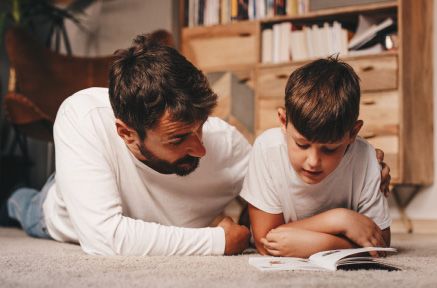
Brainstorming can inspire
your child’s writing
                Writing and reading go hand in hand,
                and if your child enjoys writing,
                chances are he’ll love reading, too!
                Help your child get excited about
                writing by thinking creatively.
                   If your child is having a hard time
thinking about what to write, try brainstorming
together to help him figure out a topic for a paper                      • Become a critic. Have your child write a few
or think of ideas for a story.                                             sentences about why he liked—or disliked—
   Here are some thinking strategies your child can                        a book or a movie he recently read or saw.
use to overcome writer’s block:                                          • Exaggerate. Ask silly What if? questions
• Make lists. Some examples are: Things I love. My                         to spark new ways to think about people,
   favorite animals, places, toys or food. Things I know                   events and scenes. What if my dog could
   a lot about. Scary characters. Silly things adults say.                 talk? What if people had four hands? What
• Be an observer. Encourage your child to take notes                       if I could breathe underwater?
   on what he sees around him. He can keep track                         • Use visual images for inspiration. Have him
   of his observations, what people are wearing or                         look at a picture and write down ideas it
   saying.                                                                 brings to mind.
                      Elementary School
                                            © 2021 The Parent Institute®, PaperClip Media, Inc. www.parent-institute.com
                                                 May be reproduced by Building Readers® newsletter subscribers.
Build vocabulary to
boost reading skills
                One of the best ways for your child
                to improve her reading and writing
                skills is to have a strong vocabulary.
                The more words she knows, the
                better her reading comprehension
                will be. Help your child learn new
words and develop her vocabulary by having her:
• Read, read, read! This is the easiest way to build                   • Learn the roots of words. See how many
  vocabulary. The more your child reads, the more                        words she can think of that contain the
  new words she’ll encounter.                                            same root—predict, verdict, dictionary and
• Play word games. Do crossword and other word puzzles.                  dictate, for example. What do these words
• Examine the context of new words. See if she can                       have in common? What might the root dict
  figure out what a new word means by reading                            indicate? (talk or speak)
  the text around it or looking at pictures.                           • Use a thesaurus. She can look up synonyms
• Keep a list of new words and their meanings in a                       (words with the same meaning) and
  special notebook. Have her look up definitions                         antonyms (words with opposite meanings)
  and review the list often.                                             for words she uses often.

                     Elementary School
                                          © 2021 The Parent Institute®, PaperClip Media, Inc. www.parent-institute.com
                                               May be reproduced by Building Readers® newsletter subscribers.
Find simple ways to make
reading enjoyable
               Support your child’s growing reading
               skills by helping her see that reading
               isn’t just useful—it’s also fun! Reading
               is a lifelong skill and hobby for your
               child to enjoy.
  To encourage her interest in reading:
• Establish a routine. For example, make the 30
  minutes before bedtime reading time. Your                               the kitchen, in the bathtub, or even in
  child can read by herself or you can read together.                     a blanket fort that she builds.
  Doing this daily will help your child develop a                       • Research extracurricular activities. Look for
  lifelong reading habit.                                                 activities that involve reading or critical
• Provide exciting reading material. Put interesting                      thinking, such as music or a book club.
  books, articles and poems where your child will                       • Encourage your child to write often. Reading
  see them. Find other things to read together,                           and writing are closely connected. Give
  such as signs, recipes and instructions.                                her a journal to write her thoughts in.
• Read in unusual places. Reading can take place                          Write your child little notes and ask her
  anywhere! Your child can read outside, in                               to write you back.

                      Elementary School
                                           © 2021 The Parent Institute®, PaperClip Media, Inc. www.parent-institute.com
                                                May be reproduced by Building Readers® newsletter subscribers.
You can also read


