Understanding Mental Health within the Context of Autism - York ...
←
→
Page content transcription
If your browser does not render page correctly, please read the page content below
Section 4

       Understanding Mental Health
       within the Context of Autism
                                    Snapshot
  • Mental health problems can look different in Autistic people.
  • Growing up in a society that is not understanding, accepting or supportive
    can affect how Autistic people see themselves, others and their lives.
  • Providing the wrong kind of support can affect how Autistic people feel
    about themselves and can contribute to mental health challenges.
  • Autistic people experience positive mental health.
  • Social, psychological and biological factors play an important role in
    mental health.

            Content warning: This section includes a discussion of difficulties
            that Autistic people can experience, including trauma, and that can be
            triggering for some people.

Specific factors that can contribute to mental health
Challenges with mental health are very common, including for non-Autistic
people. One in five people are estimated to experience a mental health problem
at some point in their life.

There are many possible reasons why people develop mental health problems.
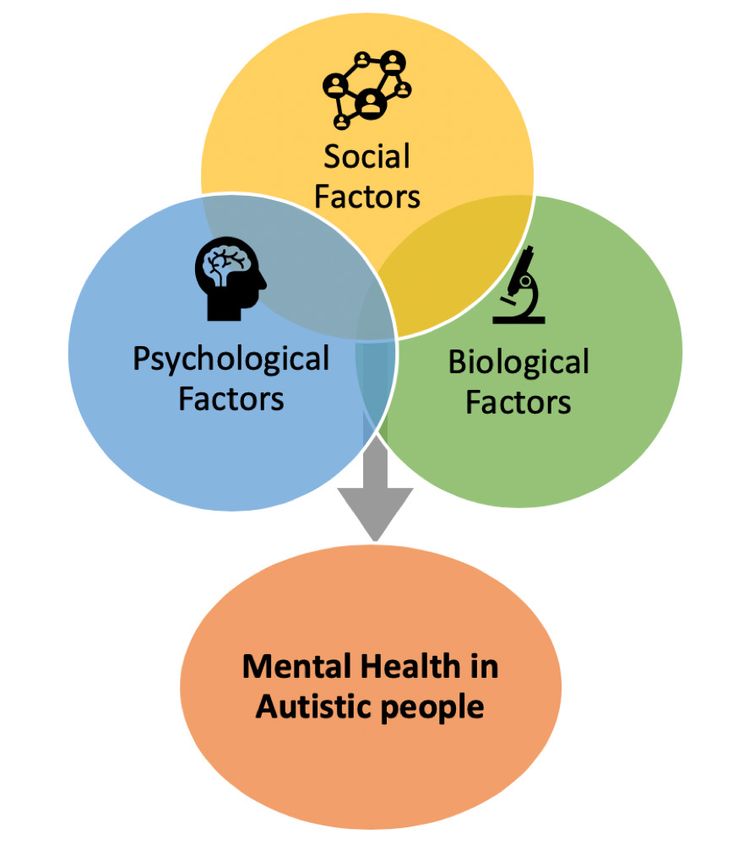
Mental health is influenced by social (one’s relationships or environments),
psychological (one’s mind) and biological (one’s body) factors. These factors can
also interact with each other.

                                                                                            35
Section 4
Social factors
The big picture: growing up Autistic in a non-Autistic society
Growing up in a non-Autistic society can lead Autistic people to feel isolated,
misunderstood and rejected because of who they are.1 They may even have
trauma from negative experiences of being bullied, excluded from society,
misunderstood or left out by their peers, families and services providers.1
36Section 4
Autistic people may differ from non-Autistic people in the way they relate to
or communicate with others, in their interests and in how they prefer to spend
their social time.1 The difficulties that can happen in interactions between an
Autistic person and another person are relationship difficulties—they are
difficulties that involve both people. It is not just because of the Autistic
person’s traits.
But sometimes, social pressures can influence Autistic people to change their
behaviour and act in a way to satisfy the non-Autistic people that are around
them. Some Autistic people refer to this as “masking,” or “camouflaging.”
Masking, or camouflaging, means that an
Autistic person hides or does not show their
preferences and sense of self, because of the Masking (also known as
needs of other people. They may not trust camouflaging) means to hide
their instincts and may change how they act aspects of oneself from others,
because of what is expected by non-Autistic to find ways to “pass” as typical
society. in everyday social interactions
in a way that prevents others
from seeing social differences,2
Masking is a very common experience for by pretending to be non-Autistic.
Autistic people trying to fit in to non-Autistic
society. When Autistic people mask, they find
ways to “pass” as non-Autistic in everyday social interactions. Autistic people
can do it to try to prevent others from seeing social differences,2 by pretending to
be non-Autistic. In masking, an Autistic person tries tremendously hard to make
things easier for non-Autistic people, so they can be understood, be accepted or
not stand out. For instance, some Autistic people may actively stop their stimming
when they are out in public.
Masking means that Autistic people end up accommodating non-Autistic
people. Since this takes a lot of effort, it can greatly affect their mental health.
Masking is associated with anxiety, depression, perfectionism and poor self-image.
It can be exhausting to mask, and people can even lose their identity because
they are trying to be someone they are not. Many Autistic people find that they
have been masking so hard and for so long that they have no idea who they are
underneath. Other times, Autistic people might not realize how much they are
masking, especially if they are not diagnosed until much later in life.
37Section 4
Autistic experiences with masking
“I feel really worn out and exhausted from masking and being social at work, to
the point where I get home and just pass out. I get frustrated because I don’t really
work that many hours and yet I’m so tired afterwards. It often means the rest of my
night is spent recuperating/sleeping off the workday, and I don’t have the energy to
do other things. Or I stay up very late trying to make up for that recuperation.
“I can get short-tempered, irritable and snap at people or cry easy after a long
day—especially if my parents then want to go out for dinner or something. I’m
completely burned out, and even just having to process other sounds hurts.
And I hate myself for being horrible to others when I get like that; they didn’t
do anything really wrong.
“Sometimes I’m not sure I know how to turn off the masking. I’ve been doing it for so
long . . . I rely on scripts and what I know people want me to say in a social situation.
Sometimes I don’t even understand the phrases or sentences I’m saying, I’m just
parroting back bits and pieces of what I’ve heard others say in small talk or whatever.”
“I’ve never consciously tried to mask. Yet the pressure to act ‘normal’ has caused me to
mask out of habit. My mask is a part of me. But masking is harmful. No one should
be robbed of the opportunity to forge their own identity because the social pressure
to fit in is so great that it unknowingly shapes who you are. I have no idea who I’d
be in the absence of ableism, and that’s both a common and serious problem.”
The need to mask or camouflage may lead
an Autistic person to believe that their “How can I not be able to do
normal things? Yet, at other
achievements are not authentic and that
times be able to do things,
they are an imposter. This may be because achieve some success, leave
others are seeing achievements or skills that my house (normal things), so
happened when the Autistic person was acting I must really be faking, and
in a way that they thought people wanted them nothing is wrong with me.”
to act.
Autistic people may accept that anything less than typical, or usual, is “less than.”
This internal battle can be distressing.
38Section 4
There are many social factors that are linked to mental health:
• Appropriate and inappropriate environments
An “environment” means the places that a person lives, works or engages
with their community. Being in healthy environments can help with positive
mental health. Environments need to be a good fit for us, and this fit is
unique to each of us. Some environments may be too isolating for a person,
or an Autistic person may be treated unfairly or taken advantage of. Some
environments do not give a person enough choice or control over their life.
Some environments may provide too little or too much activity or stimulation.
• Social networks
Some Autistic people can thrive when they are connected with healthy social
groups, such as having access to a network of Autistic peers who are
supportive and help them feel like they matter and belong (e.g., advocacy
groups or online communities). It can be very helpful in reaching goals and
in finding community.
Autistic people may struggle to access this kind of social network. Some
Autistic people may be involved in abusive relationships (e.g., bullying) or
become involved with inappropriate peers to fit in with social networks.
Online networks can be a very useful way to connect. But, similar to
in-person environments, interactions can be helpful or harmful.
Autistic experiences with social networks
“When I interact with most people, I am acutely aware of how I am different from
them. I often have to create elaborately constructed roles and personalities to even
communicate on the most basic of levels with another individual. This leads
to feelings of loneliness, even when I am among friends. Unless someone is
neurodivergent or Autistic like me, we simply do not speak the same language.”
“I have always been a very social extroverted person—an ‘extreme networker,’ I
call it. Many people on the spectrum have problems and get overwhelmed in large
crowds. Sometimes my anxiety will rise if I am in a crowd and I want to meet a lot of
people I don’t know.”
39Section 4
“I also often feel overwhelmed by travel, so events in many places are frequently
hard for me to attend. Additionally, many sorts of events are inherently difficult
for Autistic people to go to. For me, I like to attend games nights, but a lot of
these are held in noisy pubs, which can be a problem; even if I do go, I might
leave early because of the noise. Rock concerts are right out . . . I believe I have
never attended a rock concert without incident (such as covering my ears or
fleeing in panic). There are many events, in any given year, that I intended to go
to but am not ready to go to at the same time.”
• Family and friends
Family members and friends can be an important source of positive mental
health. These relationships can support, help, connect and bring joy to the
Autistic person. They can also be a source of stress and distress. Sometimes
family members or friends can be hostile, overprotective or have too many
demands, and they may not provide enough understanding and support or
the right kind of help.
What can be helpful at one point in time can be distressing at another. Autistic
people may not feel safe enough to unmask around family members. It can be
helpful to communicate about the kinds of support that is most useful. It is
also helpful to have a good understanding of one another.
Autistic experiences with family and friends
“I find that family members can be intolerant of requests related to my autism.
For example, a recent get-together was arranged with adult children and my
many grandchildren. There was a suggestion to take the children to a large
indoor arcade—a place I know I could not tolerate because of the crowds,
the noise, the lights and social demands of interacting with all my children,
in-law children and grandkids. I said that I did not do well with crowded, noisy
environments and asked if we could go to a fun family restaurant. I was told this
was about the kids, not about me, and that I would be just fine for a couple of
hours. I did my best but was on the verge of tears for the entire time. I held it
together until I got home, but it was extremely difficult and not at all enjoyable.
It makes me associate family gatherings with feelings of anxiety.”
40Section 4
“I’ve always been wary of talking about autism with my family or people I
know. Most non-Autistics I know treat it as a burden to have to put effort into
understanding me or effort into changing ableist behaviour—it’s always my
responsibility to fit in. When we talk about assimilation with respect to other
communities, such as Black or Indigenous communities, we recognize it as
discriminatory. Expecting Black or Indigenous people to fit in with white culture
is racist. But expecting Autistics to fit in is not only viewed as unproblematic,
the dominant ‘treatment’ for autism is behaviour modification. It’s also very
segregationist insofar as ‘experts’ say that as much as 30-plus hours a week
should be spent on these ‘treatments.’ I need my family and friends to accept
me and to be willing to put in the work to make that acceptance more than just
superficial, not tell me that I need to assimilate.”
• Lateral aggression
Lateral aggression (also known as “lateral
violence”) refers to harmful behaviours that
happen within minority groups in society. Lateral aggression (also
For example, when an Autistic person known as “lateral violence”)
experiences aggression or exclusion from refers to the harmful
others within the Autistic community. These behaviours that happen
aggressions can be verbal, social, emotional within minority groups.
or physical and negatively affect mental
health.
Lateral aggression occurs in interactions where there are disagreements and different
perspectives. In some Autistic groups, social and communication challenges
can make dealing with these types of interactions hard. Social communication
challenges? can make some people more vulnerable to these aggressions.
Autistic experience with lateral violence
“[Lateral violence] is certainly something that occurs among Autistics (lateral
harassment, lateral ableism). One thing that gives me a lot of trouble interacting with
non-Autistics is all the social rules about subtext and hidden meaning that are used
in interpreting communication. They use various social rules about ‘hidden meanings’ to
interpret things. As an Autistic who tends to be very literal, it can lead to a lot of problems.
41Section 4
“But I have the same problem with many Autistics as well. I see plenty of
Autistics in various groups doing the same thing. Being Autistic doesn’t mean
that we don’t pick up any allistic [non-Autistic] social norms at all. There are
other ableist social norms that some Autistics pick up (and I expect I’ve picked
up some as well). This is just one of the ones I often see, likely because it’s one
of the ones that affect me.”
• Negative life events
Autistic people can be exposed to abuse, trauma, loss, rejection, bullying,
harassment and exploitation in different environments (e.g., school, employment,
health care or in public spaces). Just as positive life events can contribute to
positive mental health, these harmful kinds of events can be a major cause of
mental health problems. Discrimination can leave Autistic people stigmatized
and affect their mental health.
• Economic and legal disadvantage
Autistic people often experience financial and social disadvantages, such
as high rates of unemployment, job insecurity, food insecurity, homelessness
and poverty. These disadvantages increase the chance of mental distress
and mental health problems. Many Autistic people live at or below the
poverty line.
Some Autistic people may not be aware of their rights or may be denied their
rights, making them more vulnerable. Autistic people may also not be taken
seriously when they advocate for themselves.
The ability to speak up for oneself and the
things that are important is c alled
self-advocacy. This can be hard to do,
and many Autistic people are not taught Self-advocacy is the ability
personal and community self-advocacy to speak-up for oneself and
skills (see Section 6). They may have to the things that are important
rely on others to be advocates for them. to them.
Sometimes even asking for help can be
difficult, and relying on other people can
be distressing, as other people may not be
willing to help.
42Section 4
Autistic experiences with legal rights
“Unfortunately, I was not yet aware of my legal rights within the Ontario Employment
Standards Act and, as such, did not request ‘reasonable accommodations’
nor disclose that my challenges were a result of an ‘invisible’ disability. Moreover,
I was often misunderstood as having a bad attitude, being lazy or even using my
learning disability as ‘an excuse’ upon trying to account for certain struggles which
inconvenienced a team member. Worse yet, I was even humiliated by a fellow server
while working at a diner, who right in front of me actually told a customer: ‘He’s been
working here for two weeks and still doesn’t know what he’s doing!’ Being stunned,
I regrettably said nothing, but looking back, I sure wish I told her off or got her fired!
“The turning point toward obtaining a sense of more empowerment in the workforce
emerged during my early 30s upon writing my master’s thesis on the subject of
autism and rewarding employment. Besides being more informed on employment
legislation outlined in the Ontario Human Rights Code on ‘reasonable accommodation,’
I sought job coaching and also made accommodation requests, leading to improved
outcomes! I later discovered that official accommodations do not address all
aspects of workplace hardships and that having a positive attitude and working
relationships is also crucial for employment satisfaction. For instance, during the
four years working at [autism services agency] as an autism consultant, I informed
my co-workers that I was on the spectrum, which was overwhelmingly received
positively and, in turn, increased their ability to more effectively approach concerns.
There were nonetheless times when I encountered personal conflicts and really
felt like quitting; however, I believe my overall experience within this role was
positive as a result of these proactive steps.”
• Housing
When housing is inadequate, noisy, overcrowded or unavailable, maintain
ing one’s well-being is more difficult. Having basic needs met—shelter, food
and clothing—is needed for good physical health and positive mental health.
Proper, accessible and affordable housing is important for physical and
emotional well-being. Feeling safe helps to reduce stress and can lead to
improved sleep and diet. Affordable independent housing is to a large
degree not possible for many Autistic people because of the cost.
43Section 4
• Transitions
There are many kinds of transitions.
There are transitions that occur within a
“I find transitions really
day or across situations. For example,
difficult because I don’t
school changes, going from one living
know what is happening
situation to another or from one kind of
next and it makes me
activity to another can be big transitions.
very confused.”
Transitions and changes can be highly
stressful and can bring feelings of
surprise and confusion. Changes are
more easily handled when there are
no surprises.
Distress can happen when the transition between supports is poorly managed.
For example, when there is poor communication and planning, or when
Autistic people feel they have little control over what happens to them during
transitions. Because many Autistic people can feel anxious when there is
uncertainty, poor planning and preparing for transitions can negatively affect
mental health.
• Disclosure: telling others about being Autistic or about mental health
The decision to tell other people about personal information can sometimes
be a positive experience, and sometimes it can be stressful or harmful.
At times, these decisions can affect relationships, academics, employment,
communities or opportunities. When an Autistic person decides to
share information about being Autistic or about their mental health,
it could be a positive or stressful experience. This can depend on when
and how they disclose and who they disclose to.
In some cases, sharing about being Autistic or about a mental health
diagnosis may help others understand them better. It may lead to them
receiving better support, having fewer misunderstandings and getting help
more easily.
If it is not received well, a person can be stigmatized. Stigma can happen if
people have limited knowledge about autism. They may not believe or accept
information about autism or mental health, or they may judge or place
stereotypes. It is hard not knowing how people will respond to disclosures
or what they will understand, and this can cause a lot of anxiety and doubt.
44Section 4
Autistic experiences with disclosure
“I find the phrase ‘But you don’t look Autistic’ to be incredibly demeaning and
gaslighting. It is often said as a compliment. It is also used as a weapon to divide
me from my fellow Autistics—a dig by implying I’m ‘high-functioning.’ Usually
said in response to my disclosure to an acquaintance or friend, this dismissal of
my experience makes me more cautious about disclosing. It puts me further in
the Autistic closet.”
“Even though I’m very much an open book about my mental health, I have
reservations about disclosing my autism to others. For instance, in school, if I
have to explain myself, I am more inclined to tell teachers or other students I
have anxiety rather than disclosing that I have autism. I fear the reaction, and
it’s a lot easier to explain away something as common as anxiety than to broadcast
something as stigmatized as autism, or something that people have their own
preconceived notions about. Disclosure feels like coming out. It feels too big.”
“Disclosure of autism is often met by disbelief and criticism because people
don’t understand what a social communication disorder is, or looks like, in an
adult. I think differently than neurotypical people, and that informs all aspects
of my life experience. Most people don’t know anyone who is an Autistic adult,
and gaslighting continues with: ‘You’re nothing like my cousin’s best friend’s
four-year-old son with severe autism!’”
“Despite having a diagnosis since age 15, I only shared my autism label with
family and service providers, due to deep shame of being different, a perspective
I now believe was shaped by prior experiences of bullying and ostracization.
In addition to not disclosing this fundamental aspect of me with close friends
and women I dated seriously, I even hid my diagnosis from co-workers for eight
years while working in the autism services field, due to fear of differential treatment.
Surprisingly, the reactions of those I disclosed to were predominantly positive,
although varied. Among the most noteworthy were ‘Suspected you had Asperger’s,’
‘Never suspected anything different’ and even ‘I don’t think you have it!’
exclaimed by an ex-girlfriend of mine who appeared convinced I was ‘normal,’
which I interpreted somewhat complementary!
45Section 4
“My outlook on being different changed during my late 20s after reading about
and meeting highly accomplished autism self-advocates, including Temple
Grandin and Stephen Shore, whom for me shed a light on the many positive
aspects of autism. As a result of this change in mindset, I embraced autism
through joining advisory committees, attending conferences, completing a master’s
thesis on barriers to rewarding employment, and delivery of presentations on my
lived experiences. More recently, I discovered the concept of neurodiversity
and have launched my own autism self-advocacy coaching practice specializing
in employment and post-secondary support—an achievement I’m incredibly
proud of!”
• Education
School settings are a major source of stress and have a long-lasting effect
on many Autistic people. Bullying and discrimination are big issues in
elementary, high school and post-secondary education. A person’s school
experience can be full of isolation and social confusion. At times, Autistic
people may have other conditions (such as learning or physical disabilities)
and economic factors that add to the stress of education and their mental health.
There are a lot of demands placed on students when they go through
elementary school to high school and from high school to post-secondary
education.3 For example, when students transition from one school situation
to another, there are often demands for socially interacting, being independent,
learning new material and planning. Some students may be excited about
the change in environment or meeting new people but may also struggle
with new situations, people and expectations at the same time. There can be
a possible “let down” when reality is quite different from what people expect
the changes to be like. Many Autistic people will struggle to graduate,4 and
this struggle can lead to mental health problems.5
Schools need to supply a supportive
environment to address these chal- “Providing needed academic
lenges. They may give services offering accommodations on paper
support for academic success, 6 such but not teaching an Autistic
as accommodations for learning and person how to access them
testing; however, it is not the same as demonstrates a lack of
having supports for mental health or for the understanding autism.”
non-academic parts of education (e.g.,
when students are distressed or in crisis).
46Section 4
Many universities and colleges have invested in mental health services
and supports on campus, but often the demand is much higher than what
they can serve. Depending on the institution, disability services may not
provide sufficient supports when the disability is mental health related.
Educational supports that are developed without Autistic students in mind, or
without consulting with Autistic students who will use them, may not address
Autistic students’ needs. This means the supports can fall short.
Autistic students may need one-on-one support for their executive functioning
needs (this will be discussed more under “Psychological factors” later in
this section). They may need to be shown how to access services or need
help understanding why or how supports can be useful. When there is no
support available or the past experience in education has been damaging,
some Autistic people may choose not to pursue post-secondary education—
there can be a stigma to this.
Autistic experiences with education
“I would have wanted more information and tools for how to politely stand up
for myself amongst other peers. I feel like I wouldn’t have to do the catching up
in the former category that I am doing right now, if there was a better balance
of that and I was taught about being open to other fun and safe activities, sudden
changes or road routes to get to the same place. Also, I would have wanted
more information as to how mainstream social dynamics change in high school.
Having a good locker space, attending all classes, doing one or two extracurricular
activities, wearing clean clothes and maintaining good personal hygiene does
not mean that you are immune from being on the receiving end of peer pressure.
Such as mean teasing or hearing slang words of private body areas that either
seem silly or strange.”
“When I was in Grade 9, my autism was very overlooked by a lot of teachers
and was not understood by many, including the bullying and the OCD. It took
my mom and family a while to straighten things out. The transition to high
school was very tough, certainly in the first half of Grade 9.”
47Section 4
“For me, co-occurring conditions such as dyslexia and dyspraxia, as well as
economic factors and physical disability (Ehlers-Danlos, scoliosis, and IBS),
played major roles in adding to my stress and mental health. Without proper or
late diagnosis, I had no support and was blamed for my perceived failures and
weaknesses.”
“While the teachers, EAs and other staff members are trained, students are not,
and as a result there is a knowledge disconnect, even though Autistic people
interact with both [students and school staff] during their time at school.
“The biggest source of isolation during my time in high school was sensing that
my peers would not understand if I tried to explain Asperger’s to them when
I committed a social faux pas (e.g., when a classmate flipped the hood of my
sweater over my head playfully, I angrily turned around and said ‘Geez, what
was that for?!,’ when I had never been taught that people may do things like
that because they are playfully teasing). Also, I looked able-bodied (still do),
so I felt that disclosing would have resulted in them thinking, ‘What is this girl
talking about?’ if not worse. So, I withdrew further and further into myself in
high school and was constantly hoping that I would get by and not get attention
from any more accidental faux pas.
“One time I asked a class how many of the students had heard about autism
and Asperger’s, and only one out of 30 raised their hand. That is a microcosm of
the knowledge disconnect that I’ve mentioned earlier. So, in this case, not being
able to explain or disclose to my peers and be sure that I would get a positive
reaction if I did so was the biggest social factor that I faced during high school.”
“The college I went to had a ‘Calm Down’ room they were very proud of, but it
was only accessible if you were registered with the Disability Office and wasn’t
largely known outside said office. The room was small, quiet, had a box of
tissues, a stuffed toy and dim lighting. Mostly it was for students in emotional
destress—though I used it one day when I was overstimulated from walking in
the noisy halls. One day an Autistic classmate had an emotional outburst and
went to sit in the hall. I followed him after a minute to sit quietly with him.
I asked if he wanted to use the Calm Down room. He didn’t even know it existed.”
48Section 4
“Starting at the age of five, I received a learning disability (LD) label and was
subsequently sent to a range of ‘special’ classes, with mixed outcomes and
levels of comfort for me. As a result of society’s failure to adequately educate
the masses on ways to respond and listen to people with unique challenges,
I experienced teasing, bullying and even very harsh responses from mean-
spirited teachers! Such experiences impacted my self-esteem and, consequently,
I became ‘selectively mute’ between the ages of eight and ten, [during] which I
only spoke to immediate family. I was sent to another ‘special’ school and after
a year ‘started talking,’ as everyone including my teacher and peers exclaimed
enthusiastically on April 12, 1989—a date forever locked into my soul! I later
attended high school and once again was bullied, teased, excluded and even
deliberately humiliated in front of peers I mistakenly thought were my friends.
I nonetheless received sufficient academic support and was on the honour roll!
“Despite my earlier struggles in educational institutions, I was determined to
attend post-secondary education and persevered with flying colours! Not only
was there virtually no bullying, but my years in college starting in the year 2000
was a very empowering experience for me. I registered with the necessary centres
for students with disabilities and received a range of accommodations including
extra time, tutoring and access to adaptive technologies. I went on to complete
my Bachelor of Arts with honours, followed by attending teachers’ college for two
months, which simply put, was not the right fit for me. I returned three years later
for a Master’s in critical disability studies, and completed four years later with a
straight ‘A’ average!”
• Employment
Many adults find employment to be
important for their lives: for money, social
connection and meaning. Having the right “Employment means I have
employment is linked to financial inde- somewhere to be during the
pendence, self-esteem, and autonomy day. I can take pride in my
(Autonomy means a person’s ability to work. I can get out of the
speak and act on their own.) Many house and be . . . outside.”
Autistic people are unemployed or
underemployed.7
49Section 4
Employment may not always be associated with improved mental health
for Autistic people. Autistic adults in the workforce can experience poor
mental health and low job satisfaction.8 Though some workplaces may be
accessible and supportive, other workplaces may not be accepting of,
or accommodating to, Autistic people. For instance, they may not give
accommodations that could reduce or prevent stress, such as by creating
and defining routines, allowing for flexibility, being aware of sensory needs
or finding ways to communicate effectively with Autistic employees.
Workplace bullying and complex social dynamics can be a barrier when
it comes to employment. Autistic people have a higher risk of workplace
bullying or not being recognized by their co-workers for their contributions.
These factors can play a role in how Autistic people experience work-related
distress. Due to discriminatory hiring practices, Autistic people often mask to get
a job. Continuing to mask once hired can be a health risk and not sustainable.
Some disabled people cannot work, and this is okay, too. There should
not be any shame about being on disability benefits. As a society, there
needs to be support for disabled people who cannot work to live full lives,
and support provided to create opportunities for disabled people who can
and do want to work, to do so.
Autistic experiences with employment
“I’ve had some very understanding employers, and I’ve also had some that were
not understanding as much. One employer I had that was not [understanding] was
focused on her own issues and not the issues of her employees but her own
self, as well as putting the management of the business at risk.”
“As I’ve gotten older, the need to feel safe and in control of my environment has
become more pronounced. I have learned from hard experience, time and time
and time again. I have had probably 20 different jobs, and every single one has
taught me that I cannot rely on my employer or co-workers to help me or to
understand. I know now that working from home is the only long-term employment
option where I will be safe. My stress response is heightened, and that leads to
adrenal depletion and the cascade of poor physical and mental health that that
eventually leads to.”
50Section 4
“Within employment there’s always the extra push to mask and do even more
than my best: Never ever complain. Only use positive language. Don’t slouch.
Smile. Never give your employer a reason to regret hiring you. The job you have
is likely the only job you have, and with the unemployment rates so high, it’s
not like you can just walk out and get a new one tomorrow. You have to show
them that hiring an Autistic person wasn’t a mistake.”
“I can’t provide employers with the documentation that they can ask for if I
make an accommodation request. I’m treated differently than Autistics with
documentation when I seek employment services. People make inferences
about the level of support that might be useful or necessary based on whether
you have documentation or not.”
“Even though I work in a social services agency, human resource personnel are
most often not autism-informed and lack true understanding. I have had a couple
of unpleasant experiences in spite of finding the strength to advocate for my
needs at work. I say ‘strength’ because it definitely feels like a risk to ask for
accommodations.
“One example: I was considering applying for a new position that opened up—
a position where the successful candidate would be primarily responsible for
educating the public about autism. My role already involved delivering workshops,
and I did well with them. Community agencies and outside professionals were
calling in to request me specifically for presentations.
“I made some inquiries to HR before applying, though it made me feel very
vulnerable to do so. I did not want to change their perception of me or for them
to feel that I was ‘too much work’ or ‘high maintenance.’ Since I had been with my
employer for many years, and my skill as a presenter was already known, I asked
if could I be considered based on my performance reviews, workshop feedback
from years of presenting, or by providing a demonstration task instead of
going through a lengthy panel-interview process that assessed my ability to
communicate under tremendous stress. Demonstration tasks are a reasonable
and relevant way to assess suitability of Autistic employees. The answer was:
‘No.’ All candidates had to go through the interview process.”
51Section 4
“During my mid to late teens, I obtained restaurant roles in food preparation
as well as CIT and camp counsellor jobs during summers. Despite facing significant
challenges with aspects of camp facilitation and getting fired for being ‘too
slow,’ in the food prep role, I remained determined to persevere. Besides roles
within my fields of study, including autism support, during my early 20s I
simultaneously held server and table-bussing roles in restaurants due to my
enjoyment of such lively and high-paced atmospheres. However, I struggled
with many aspects and was terminated for making ‘too many mistakes.’”
• Access to supports and services
Autistic people often report difficulties when accessing supports. Effective
and autism-informed mental health supports may not exist or may be
rare and hard to come by. If they do exist, they may be difficult to get
because of barriers to finding them, barriers to affording them or lengthy
wait-lists.9 There can also be stress in trying to access supports. The time
and effort related to finding, applying to and coordinating supports can add
up, making accessing supports feel overwhelming.
Most supports require phone contact or in-person appointments, both
of which can be hard to access for some Autistic people. Without other
ways to connect, they often go without them. The need to secure appointments
require people to have social-communication skills, the ability to resolve
conflict and the ability to respond appropriately to the unexpected. These
may be areas of relative weakness for an Autistic adult, leaving them at a
disadvantage to connect with relevant, autism-informed supports.
Autism is, at its core, a social-communication difference. This can mean
an Autistic person may not be able to speak up and ask for help or even
recognize that they need help. They may not have learned how to advocate
for themselves or how to respond to service providers who misunderstand
their needs.
It may be challenging to find Autistic-friendly and trauma-informed services
that take an Autistic person’s needs into account. Services may not have the
right kind of experiences, training and skills for working with Autistic people,10
and may not be willing to listen to Autistic people or may be dismissive.
52Section 4
Negative or traumatic experiences with past services can prevent or discourage
Autistic adults from finding or seeking services in fear of the same experience
happening again.
For some Autistic adults, difficulty getting a diagnosis can be a huge barrier
in accessing services and supports. At the same time, unfair policies may
exist whereby services exclude people with an autism diagnosis from
accessing care, claiming it is outside their clinical scope.
Autistic experiences with accessing mental health supports
“My new doctor helped my children and I (all of us are Autistic) get through the
onerous paperwork. As a result, all of us were provided access to support. Having
a doctor that believes you and supports you is a total game changer. And it really
helps your mental health to know that you are heard and supported.”
“Being denied augmentative and alternative communication (AAC) access is one
of the worst feelings in the world. It means that the person does not want to
listen to you. It means they would rather have you miscommunicate or be
silenced. It’s deeply traumatizing to have your voice taken away from you. People
who do not accommodate AAC are enacting a form of control over partially and
non-speaking Autistic people. They are saying: ‘Listen to me, and I do not care
about what you say.’
“My worst memories of mental health care wards are being expected to discuss
my care without any method of reliable communication available to me. The
psychiatrists demanded me to only talk with my mouthparts, which triggered
more stress and caused more trauma. It happens in schools, it happens in ABA
[Applied Behaviour Analysis] clinics (ACC access has been used as rewards), it
happens in hospitals. Similarly, deaf people have told me that they have had their
American Sign Language interpreters asked to leave in hospitals.”
“As I got older—and perhaps this has changed over the years—it was hard to find
people who would support me from a psych perspective because they didn’t ‘do’
autism. Like, I’d be coming in asking for help for my panic disorder and anxiety,
but because autism was on my file, they’d turn me away and say, ‘Well, we don’t
do autism supports”—despite that not really being what I was there for. Sure,
autism will factor in no matter what, but what I was really there for was anxiety.”
53Section 4
“When I have sought help for my mental illnesses, virtually all of the programs
that I have been referred to have been designed for non-Autistic people and
involve things like group therapy and meditation, both of which are distressing
to me. Even if I give them a try and find them unsuitable, I am often labelled
as ‘non-compliant’ and there are no alternatives made available to me. Even
though I recognize that I am mentally ill and I am asking for help, there simply
isn’t any help available for someone like me, and this has had devastating
effects on my mental health.”
“I have had the good side of being able to access certain services while living at
home as I am now. But certain services, such as regular mental health services,
are said [by service providers] to be unavailable to Autistic people.”
• Stigma
Stigma can have a major impact on a person’s mental health. Stigma is
when someone views you in a negative way because of a characteristic,
trait or label. Many Autistic people experience this regularly. For instance,
people may have negative attitudes or beliefs about Autistic people, such as
the myth that Autistic people do not care for others or that they are burdens.
This stigma affects Autistic well-being and can increase stress.
If not challenged, stigma can lead to discrimination. Discrimination is the
act of treating someone negatively because of one’s identity (e.g., gender,
ethnicity or disability). Many Autistic people report that a lack of understanding
and acceptance contributes to their isolation and anxiety.11
• Gaslighting
One social factor that can affect Autistic
adults’ mental health is gaslighting.
Gaslighting means making someone Gaslighting involves making
doubt their own experiences. It is a form of someone doubt their own
psychological or emotional abuse aimed experiences.
at making those who are vulnerable seem
or feel wrong or “insane,”12 or doubt their
own reality.
54Section 4
One adviser provided the following example: “For the non-Autistics,
sensory difficulties may not be a big deal. They may ridicule, minimize
and disregard Autistic people’s sensory needs and force them into
environments (like rooms with bright lights or crowded spaces) that could
be distressing. Then, they blame the Autistic individual for not responding well.
They may say, ‘It’s all in your head!’; ‘It’s just you, no one else feels this way’;
‘Everyone has trouble with ____ from time to time, you’re overreacting/you’re
a drama queen’; or ‘It’s not that bad!’” There can be a misunderstanding in
communication and the Autistic person could be blamed because they do
not communicate in a way that is expected by the non-Autistic person.
An Autistic person may take on being gaslighted as part of who they are as a
person and how they see themselves in society, doubting their own experiences
and beliefs. They may take on the negative views that other people have of
them and form a negative self-image.
Building trust within society and oneself
can be a long process. Greenlighting is an
approach to heal relationships and help Greenlighting involves
with building trust. It involves showing expressing compassion and
compassion and acceptance of people’s acceptance of one’s own or
lived experiences. For example, someone another person’s lived
saying, “Yes, tell me more about that.” experiences.
Psychological factors
There are many psychological factors that are linked to
mental health:
• Self-worth and self-image
How a person feels about themselves matters. When a person sees themselves
in positive ways—appreciated for their strengths and uniqueness, kind and
accepting of themselves—they can have a positive way of seeing who they
are. When a person negatively judges themselves, they can be ashamed,
distressed and more likely to have negative mental health.
Sometimes a person can develop a negative self-image because of how other
people judge and treat them. When Autistic people do not have opportunities to
achieve and feel success, they may have negative self-talk and can develop
low expectations of themselves. Many times, Autistic people’s gender, racial,
cultural and sexual identities may not be recognized, and this also can affect
how they see themselves and those around them.
55Section 4
Autistic experiences with self-worth and self-image
“As a result of the social isolation, my self-worth and image were at its lowest point
in high school. However, it has increased steadily since then. It’s still sometimes
a learning curve for me to remember that not everything that went wrong in
[an] interaction was my fault. However, as I said, my self-esteem and image has
increased steadily within the past nine years, much more than it did in the first
18 years of my life.”
“I know that being around open and proactive and accepting people helps my
mental health. I have been a victim of a lot of gaslighting and attempted forced
masking of who I am for a few years with an organization. Some of the forms of
attack come from mental abuse, bullying, the pressure to mask, and I have been
working to improve and build up my self-esteem since then.”
• Planning and organizing
It can feel good to have predictability, be organized and plan ways to have
needs met. When a person can plan, solve problems and access support,
they are more likely to have positive mental health and low levels of emotional
distress. This can reduce stress and contribute to a good mental state. If a
person finds it difficult to organize their thoughts and actions, then this can
add stress to their daily lives. There can be a constant fear of “messing up”
or missing something important.
Planning, remembering or focusing on
a series of tasks can be challenging for
some Autistic people. These kinds of skills
Executive functioning skills
are what is sometimes called “executive involve planning, remembering
functioning”. For some Autistic people, or focusing on a series of tasks.
using executive functioning skills use up a
lot of energy and stamina. If someone finds
it hard or tiring to use their executive functions, it does not mean that a person
is lazy or not motivated, although others may think this of them.
It is important to note that emotional distress can make executive functioning
difficulties worse. Executive function can also be affected in multiple ways
56Section 4
through social, psychological or biological
factors. When a person is experiencing “Sometimes I mistake
high levels of anxiety or other negative myself for thinking I’m lazy,
emotion, it can affect a person’s executive when I’m just processing
functioning skills. Reducing anxiety may things.”
improve executive functioning skills.
Autistic experiences with planning and organizing
“I find when my routine is thrown off, my executive function gets worse.
For instance, if my therapy appointments are always Fridays at 10:00 a.m. and
then we suddenly switch them up and now I don’t know when they are, my
brain tries to default to Fridays at 10:00 a.m.
“As I have gotten older, I notice that my executive function is getting worse.
Maybe because I have . . . more adult expectations now? Like a six-year-old
doesn’t have to worry about when their therapist appointment is or when to
reorder their meds—their parents deal with those things. I’m scared about
getting into my senior years and what my low executive function will mean.”
• Monitoring and expressing emotions
When a person has emotional distress, it can be helpful to communicate
about the source of the distress and what the distress feels like. This can
help to address the cause of the distress or just help the person to be better
understood.
Some Autistic people might find it difficult to identify, distinguish or feel
emotions. For example, an Autistic person may experience feelings as
body sensations but not make the connection between the two. Some
Autistic people may struggle to understand the connection between their
emotional states and what they are experiencing in their body. They may
not be aware of how the body feels different when “fine” (i.e., body is
relaxed, breathing is even and regular) versus a “crisis” state (i.e., muscles
are tense, heart is racing, breathing is quickened). In the absence of
this awareness, they may not take steps that could help them to cope with
any distress they are feeling. At the same time, it is important to note that
many Autistic people are extremely aware of their emotions and feel their
57Section 4
emotions intensely. Some Autistic people may show their emotions
differently than most people and therefore others may not recognize how
an Autistic person is feeling. They may find it difficult to express their
emotions or thoughts, and it can be hard for them to manage their feelings
or find support.
• Areas of focus and interest (passions)
Many Autistic people can focus very intently on specific passions, and this
can be a source of joy and positive mental health. This strong focus means
that Autistic people can be very passionate about their interest. The same
may be said for non-Autistic people; however, while society calls their
interests “hobbies” or “expertise,” interests can be pathologized in autism.
Autistic people’s interests have been called “fixations” and “obsessions.”
Interests can be very fulfilling and, at times, extremely productive. Interests
can provide a relief from the demands of society. Communicating with other
Autistic adults and sharing interests can be a very validating experience.
An Autistic person’s interests can also cause conflict with other people or
within themselves. At times, it can be difficult for some Autistic people to stop
and switch over to other topics. An Autistic person may benefit from accom-
modation for when they transition out of their preferred interest, and this
accommodation may not always be given. An intense focus can also look
like constant thinking about worries or uncertainties. It may be difficult to let
go of a situation that happened or a worry or concern. Some Autistic people
describe a feeling of not being able to “turn their thoughts off,” which can
make it hard to relax and sleep. When these thoughts are negative or
worrying, they can be very distressing and can lead to sadness or anxiety.
It can be very upsetting or painful when an Autistic person is prevented from
engaging in their interest or using their focus, or when an Autistic person
who is focused on a task is suddenly interrupted. It can also be distressing
when the object of intense focus or interest is taken away, or if a person is
told what they can or cannot do. Autistic people can also be judged because
others do not share that same interest, or if they do share interests, the
intensity is mismatched. This can be upsetting and can affect mental health
and well-being.
58Section 4
Autistic experiences with passions
“Our daughter danced for 20-plus hours a week. It was her obsession but also
her source of physical activity—her ‘safe’ place, where the work that she put
in was equivalent to what she got out. It was a world that she understood and
loved. Unfortunately, dance also caused her tremendous physical pain. She was
diagnosed with Ehlers-Danlos syndrome and was forced to cut down on the
frequency and intensity of her dancing.
“Our daughter is 150 per cent or nothing, and so she stopped dancing. Her grief
was unbearable and continues to this day (four years later). Anything related
to dance is a trigger. While she struggled with intense worry and rumination
while she was dancing, it mostly provided her with a productive passion and
goal. When that was gone, she was left with nothing. The forceful removal of an
intense focus can send one’s mental health plummeting.”
“As for intense focus and interests, having multiple interests and realizing how
they supplement each other was encouraged in the Montessori-based therapy
that I had. As a result, switching is generally easier for me. I can have several
conversations with someone ranging from Disney princesses to autism to Norval
Morrisseau to the latest book by Philippa Gregory, just to name a few examples.”
“My super interest in the military and military history is at the forefront, but I
also have other interests: working out, politics, martial arts, woodworking.”
Biological factors
There are many biological factors that are linked to
mental health:
• Genetics
Some mental health problems seem to be genetic or to run in families—
not just families with Autistic people. People can have a biological tendency
to develop mental health problems such as depression, anxiety or
psychosis. However, it does not mean that such problems will happen.
59Section 4
It means that if certain factors come together, a person has a higher
chance of developing a problem and a higher chance of the problem
being disruptive to their daily life. Understanding family medical history
may motivate a person to learn about mental health and seek out support early.
• Sensory differences
Many Autistic people tend to have different sensory profiles, and sensory
differences may contribute to certain behaviours or emotional states.12 Not
getting enough sensory input, or getting too much, can add to stress and
distress, which can lead to mental health problems. When an Autistic person
gets the right kinds of sensory input (information from seeing, hearing,
tasting, smelling or feeling, sensing), they can feel good. It can be calming
or enjoyable. For example, some Autistic people stim, and this is often a
calming tool used or a mode of expression. They may either seek sensations
or avoid them. Difficulties with sensing body cues (called interoception) and
body position, movement or placement (called proprioception) can also lead
to difficulties with sensing injury, illness or distress and seeking help.
Autistic experiences with sensory differences
“Sensory sensitivities and anxious rumination make it very difficult for me to
sleep. It is very hard to fall asleep when the slightest noise keeps you awake, the
texture of bedclothes is all wrong, the room temperature is too high or too low, the
light coming from the window is too bright, and so on. While I am stewing in this
physical discomfort, my mind likes to play a highlight reel of all my anxieties. It is a
miracle for me to fall asleep and to stay asleep. Many Autistic people have sleep
issues. Lack of sleep is incredibly detrimental to mood and overall health.”
“From a young age, me and my sisters had soymilk, rice pasta and wheat-free
bread as part of our diet, as per Mom and Dad following the advice of their
nutritionist. I’m glad that healthy alternatives to certain products (e.g., almond milk)
has expanded in the over 20 years I’ve been alive. Having almond milk in particular
has felt very grounding for me, and I’ve had the least amount of small momentary
blackouts in years. I can certainly affirm that healthy food impacts mental health.
When I had Montessori-based therapy sessions, I would go on outings with
my therapist which would gradually acclimate my bodily senses, so I wasn’t over-
whelmed all the time. That was also helped by art and music therapy sessions, too.”
60Section 4
“I experience sensory overload on a daily basis. Being an adult means that I
have a lot more control over my environment than I did as a child, but that
doesn’t mean that I am free of this issue.
“Anytime I leave my home (where I have total control over sensory input),
I run the risk of overload. That could trigger a meltdown or shutdown in public,
something that can be acutely embarrassing, especially with the stigma
attached to such ‘behaviours.’ Our society judges a parent harshly when their
child has a meltdown in public; it is far worse for adults when we meltdown/
shutdown. We are judged for ‘lack of self-control,’ and we can be profiled as
‘dangerously disturbed’ and be arrested, be assaulted or be committed. It’s very
stressful to walk outside my own front door and try to engage in everyday, normal
activities, because society doesn’t understand and is so judgmental.
“I hate seasonal displays in malls because of overstimulation. I am subjected to
noises and smells, bright lights and crowds, beyond my control. Online shopping
is so very attractive. It’s quiet and I can have a cup of tea at home while shopping.”
• Physical health problems
When a person is able to exercise, have good nutrition and be in generally
good physical health, they are also more likely to be in good mental health.
If they have physical health problems or poor physical health, like chronic pain,
digestion issues, irritable bowel syndrome or problems sleeping, this can
affect mental health. It is important that these problems are recognized and
treated. Treatments for physical health problems may have some side-effects
or may be stressful, and sometimes seeking help for physical health problems
can be distressing. One adviser shared that going to a walk-in clinic is not
accessible when someone has a long list of health problems, and it made
them feel “complicated, annoying or burdensome.”
Autistic experiences with physical health
“I keep very fit—work out four times a week or more. It helps physical health,
but also mental health as well and anxiety.”
61You can also read


