Using role-play to explore strategies for improving palm oil production and sustainability in Cameroon
←
→
Page content transcription
If your browser does not render page correctly, please read the page content below
Using role-play to explore strategies
for improving palm oil production
and sustainability in Cameroon

                                                 Micresse Kamto
                                                 Durrel Halleson
                                                 Emmanuel Ngom
                                                 Églantine Fauvelle
                                                 Alen Salihovic
                                                 Claude Garcia

     Paper submitted for inclusion in the forthcoming edition of ETFRN News 59 -
     Exploring inclusive oil palm production, due for release in early 2019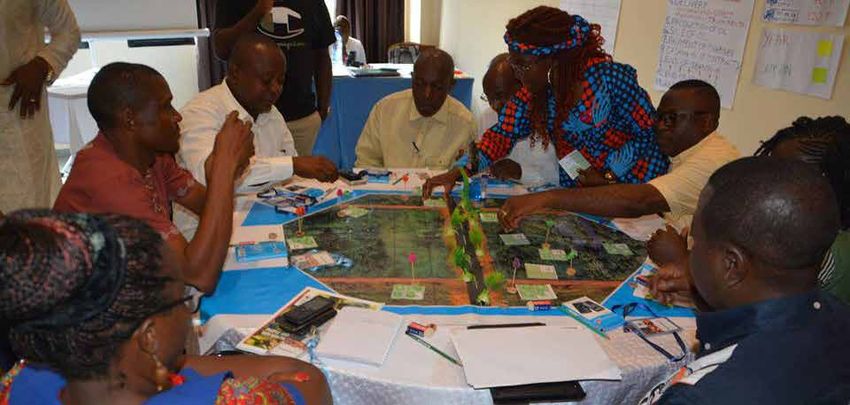
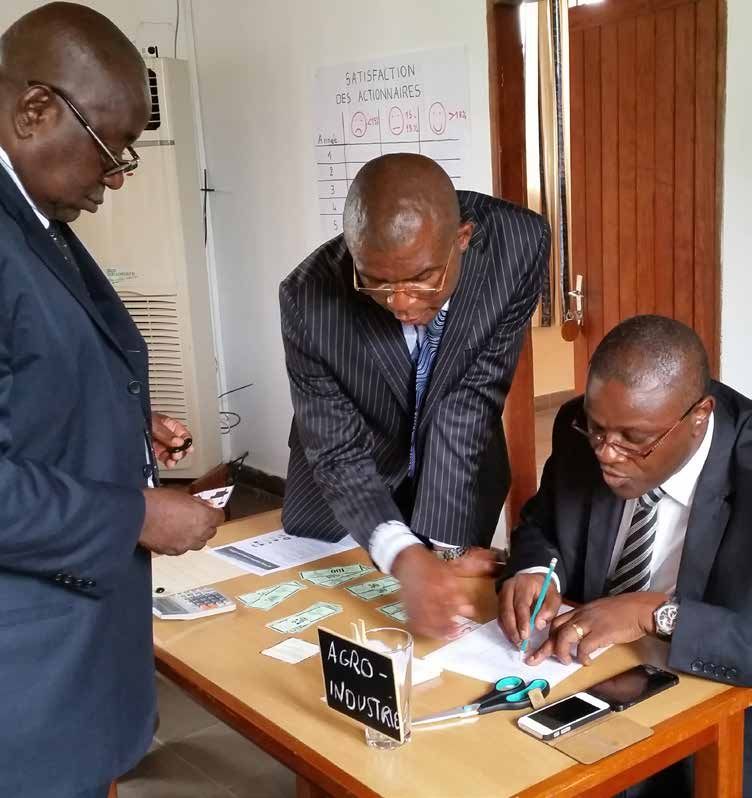
“The game has helped us understand many things…”

Introduction

Despite being one of Africa’s largest palm                        variables mediating social, economic and
oil producer with an estimated annual                             ecological processes.
production of 300,000 tonnes, Cameroon
also imports 130,000 tonnes per yr,                               To tackle complex issues in renewable
according to the national oil refiners                            resource and environment management,
association, mostly from Malaysia and more                        role playing games and simulation models
recently from Gabon. Cameroon has three                           are being increasingly used, some based on
main oil palm production areas, in the                            the participatory approach of companion
South West region (100,758 t/yr), Centre                          modelling (Etienne 2014). And in this
(57,584 t/yr) and Littoral (47,658t t/yr)                         context, this paper describes an approach
(INS 2015). Though the industry provides                          aimed at fostering dialogue between
significant revenues, yields per hectare                          value chain stakeholders, academics and
are relatively low, attributed to aging                           government, initiated by WWF and partners
plantations, and limited use of improved                          in Cameroon. The purpose was to help
seeds and technical knowledge, particularly                       national supply chain actors and policy
fertilizer use. Extraction rate of palm oil                       makers design trajectories for sustainable
from fresh fruit bunches in Cameroon is                           ‘green’ development, balancing development
21% in local industrial mills, and 14% in                         with social and conservation objectives.
artisanal mills (Ndjogui et al. 2014).                            Played with stakeholders for validation and
                                                                  to explore possible future scenarios and
To reduce imports, the government aims to                         levers of actions, analysis of different game
increase production and productivity, but                         sessions would illustrate the differences
there are concerns that such plans could                          between the assumptions behind policies,
negatively affect the country’s biodiversity                      and actual practices.
in its dense humid equatorial forests,
or play into existing power asymmetries
and disrupt local livelihoods. With the                           Introducing the process
development of such projects since 2003,
there was an urgent need to develop a                             A model describing the supply chain
national sustainable palm oil strategy, as a                      in Cameroon was developed through
framework for sustainable development of                          participatory modelling. This began in
the sector (Hoyle and Levang 2012).                               January 2015 at a WWF scoping workshop,
                                                                  when partners of the Oil Palm Adaptive
Can decision makers design strategies                             Landscape (OPAL) project noted the low
that will generate inclusive development                          productivity in Cameroon, and also that
and avoid negative environmental impacts?                         smallholders were delivering to low yielding
Ensuring increased oil palm production                            artisanal mills instead of more efficient
without negatively affecting smallholder                          industrial mills. At the workshop, local
livelihoods and the environment is a                              producers and processors described their
daunting challenge, and not just for                              needs, expectations and constraints. These
Cameroon. To develop strategies leading to                        were formulated into possible strategies
sustainable solutions, decision makers must                       that were presented to the Inter-ministerial
better understand the needs, constraints                          commission for palm oil pricing and to
and aspirations of all stakeholders in the                        other policy makers who drew insights and
supply chain, from smallholders to millers                        explored possible interventions. This was
and second-level processors, and pay                              followed with workshops and interviews in
greater attention to feedback loops and                           all three production areas, leading to a

2 —   Using role-play to explore strategies for improving palm oil production and sustainability in Cameroon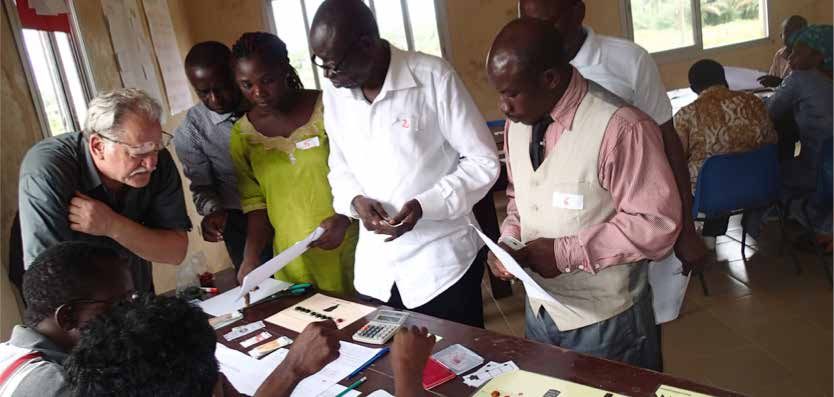
MINEPAT Local NGO UNEXPLAM
Plans production Strenghtens capacities protects rights, promotes well being
Promotes, supports FFB, agricultural Produce International
MINADER production Producers
products Promotes sustainability NGO
Used to produce FFB
Rent truck to
Deliver FFB
deliver FFB
Controls Agricultural National
MINDCAF Sells directly CPO
land tenure Land market
Artisanal
mill Buys CPO
Protects International
MINFOF forests Forest land Sells surplus of CPO
market
Sells finished products
Agroindustry Buys 2nd
Protects CPO Strengthens
MINEPDED transformation ASROC
environment capacities
Requests low
Fixes CPO prices import taxes
Controls activities (10%)
MINMIDT MINCOMMERCE MINFI
Controls
activities
FFB and others
Village level Indirect actors Direct actors Land resources agricultural resources
Induction relationship Trade exchanges
Figure 1. Interactions between actors of the oil palm supply chain in Cameroon.
first prototype of a game, co-developed trying to influence the evolution of the
with producers and industrial actors. It supply chain.
represents the current realities of oil palm
landscapes, because it is based on the real Game rules – a reflection of the
life of producers and processors, in the Cameroonian palm oil system
field. During the design of the game, great
care was taken not to influence specific In April 2016, the first CoPalCam
behaviour or what decisions were made by (‘cooperation in the palm oil supply chain
any of the players/roles, but to explore in Cameroon’) game was played by the
why certain decisions were taken. Committee for Palm oil Price Regulation
in Yaoundé, based on the conceptual
model (Fig 2). Each game begins with
One supply chain, multiple actors a short introduction by a trained ‘game
master’ who facilitates the role-play.
Local producers, industrial and artisanal During sessions, decisions of players and
mill owners, secondary processors, interactions between them are observed
local markets, domestic consumers, and and recorded, before a final ‘debriefing’
international markets, are the main direct that encourages players to draw lessons
actors. Important indirect ‘influencers’ are from their experiences (Garcia et al.
eight national ministries involved. Other 2016). The following presents experiences
indirect actors include the UNEXPALM from games played in Littoral (Douala)
producer organization, the national and South-West (Limbé) regions with
Association of Oil Refiners (ASROC), and 14 players from different backgrounds,
numerous local and international NGOs including producers, mill owners, secondary
who help strengthen the capacities of processors, decision makers and
producers and decision makers to adopt researchers, and one game played with
sustainable palm oil solutions. Figure 1 14 members of a national policy dialogue
shows the complex roles and interactions for sustainable palm oil organized by WWF
between these multiple direct and indirect Cameroon.
actors, and the high level of policy
fragmentation such as between the many Players can choose amongst four mains
ministries involved. In addition, it shows roles: smallholder producers, industrial
the potentially overlapping and conflicting or artisanal mill owners, or secondary
messages sent by indirect actors when processors (soap, vegetable and cosmetic
Using role-play to explore strategies for improving palm oil production and sustainability in Cameroon — 3Deliver directly Rent truck before deliver FFB
FBB
Smallholders
Process 7FFB Process 5FFB
into 1CPO Artisanal mill Se Agroindustry into 1CPO
ll
su
Sell directly rp
lus
Satisfied with Second Satisfied with
2CPO/year Local market transformation 10CPO/year
Buy CPO to complete
their satisfaction
International market
Figure 2. The CoPalCam conceptual model. Green boxes represent players; yellow boxes represent
counters whose decisions are scripted by the research team. Adapted from Fauvelle et al. 2016.
makers), all located in the same production their everyday life. Different issues were
area (Figure 2). Smallholders decide where raised, of which a few are described below
to deliver their harvest. Industrial mills are as examples.
more efficient, requiring only five units of
fresh fruit bunches to produce one unit of Price volatility, taxes and lack of
crude palm oil, whereas artisanal mills need transparency. The price that secondary
seven units for the same output. Delivery processor pay industrial mill owners for
to artisanal mills is direct, whereas delivery crude palm oil is regulated by the State.
to industrial mills requires the renting of a But this is not the case for fresh fruit
truck. Crude palm oil from industrial mills bunches delivered to artisanal mills nor
is sold directly to secondary processors at the price in local markets. As a result,
a government-fixed price. That produced differential treatments, unequal profit
by artisanal mills is sold on local markets, margin distribution and the lack of
satisfied with two units of crude palm oil transparency exposes smallholders who
per year, with surpluses eventually sold to lack bargaining power. Playing their own
secondary processors with a capacity for roles in one game, some complained.
up to ten units. If this is not satisfied from “The real problem is the unstable market
domestic production, processors will source price, and the government doesn’t want to
from international markets, but level of homogenize it so producers can benefit.
imports in turn influences market prices at Buyers impose their price”. However,
artisanal mills. The game is played in turns one consequence of power asymmetries
for a hypothetical ‘year’, with a high and between industry and producers is that
low season, with three and one harvest producers tend to prefer artisanal mills.
rounds in each, respectively. Tabe Robert Taku, who works at an
industrial mill in Dibombari, playing his
own role, confirmed that in reality, “Some
Challenges and bottlenecks people can never come to us because our
prices are too low”. The issue of taxes
The debriefings that followed each game is also mentioned by Tsewele John, a
were found to be crucial learning events, producer in Eseka: “VAT is imposed on
building on what was learnt while playing smallholders who supply to industry, so it’s
the game itself. During debriefings, players better to go to artisanal mills…”.
highlighted difficulties they faced in the
game, and linked these to the challenges The poor state of roads. Delivery to
and bottlenecks they were familiar with in industrial mills is tied to (low) availability
4 — Using role-play to explore strategies for improving palm oil production and sustainability in CameroonRole playing allows stakeholders in the oil palm supply chain to understand the needs
and issues of others
of expensive trucks, reflecting the logistic land is not watertight and a new layer of
constraints faced by smallholders. During regulation is unlikely to change matters.
one game, someone who played the role While changes on the board are slow to
of an industrial mill owner observed that happen, a sudden transition in the latter
“no farmer can rent a truck to bring fruit part of the game shows expansion by
to me in the low season, so they rather smallholders into public land is a possibility
sell at the same price to artisanal mills”. and is likely to happen if not adequately
Why would farmers incur transport costs prevented (Figure 3). One smallholder
when artisanal mills are nearby and offer confirmed this during a debriefing. “I find
the same price? Ebanda Ernest, a producer a forest. The first year I can cultivate 5-6
from Dibombari, lamented the poor roads, ha. I do not inform the administration and
particularly in the July low season when neither is the administration aware. After
rains made transport very difficult. New five years I have 90-100 ha. That’s why I
contracts between industrial mills and say [speaking to the Ministry of Forestry]
smallholder producers can be redesigned that the authorization you talk about is in
based on such observations. reality not applicable, if I deal directly with
elders and the village head.”
Silent expansion, and the fate of Total Forest Area Cleared
the forest
Plots
10
9
8
One strategy to increase production 7
is to expand the cultivated area, but 6
5
communities and conservationists alike are 4
concerned about impacts this will have 3
on biodiversity and alternative livelihood 2
1
options (Strona et al. 2018). Once raised, 0
a new possibility was added to the game 1 2 3 4 5 6 7 8 9 10 11
rules. This allowed players the possibility of Years
clearing forests and expanding production
area, provided they complied with a set Figure 3: Total forest cleared during a
of conditions imposed by formal and game in Douala.
customary tenure rights. But this in fact Source: Game session data, 02-06-2017,
much more complicated, as control over expansion scenario played
Using role-play to explore strategies for improving palm oil production and sustainability in Cameroon — 5Role playing allows stakeholders in the oil palm supply chain to understand the needs
and issues of others
Proposed smallholder probably be to increase productivity gains,
strategies for sustainable and a shallow strategic analysis could
palm oil production stop there and proceed to implementation.
But a more careful analysis may suggest
an increased capacity by smallholders
Many suggestions arose during and after to convert forest – the opportunity costs
games, providing valuable and often of conserving forest having increased,
innovative insights into ways forward. In precisely because fertilizers have increased
response to high costs of establishing and productivity. Instead of concentrating
maintaining plantations, players suggested production in existing areas and reducing
that the government should promote the pressure on the forests, this measure
creation of nurseries and training for could fuel a wave of silent expansion, as
smallholders in agricultural techniques. They farmers respond to new opportunities. But
requested fertilizer subsidies to increase to identify and integrate indirect and long
yields without expanding production area, term impacts into the analysis is not easy.
and discussed taxation and price control Such analytical depth requires a vantage
not only for crude palm oil but also for point, and the game offer this to the
fresh fruit bunches. They suggested support participants, making links obvious, even if it
was needed to improve the efficiency of takes a few games.
artisanal mills and to develop infrastructure,
to reduce costs of production. And to
prevent loss of critical forest habitats, Conclusions
participative local zoning was suggested for
each village. The role playing CoPalCam game creates
conditions for integrative dialogue, allowing
These issues deserve to be taken seriously stakeholders with different and sometimes
by decision makers, and different policy opposed objectives to better understand
options can also to be tested in the safe each other and negotiate joint strategies.
environment provided by the game. Several “The game has helped us understand
layers of complexity emerged from the many things, especially in face-to-face
messages that participants took home, discussions with the Socapalm mill”, says
also indicating different depths of strategic one smallholder Ebanda Ebanda Ernest.
thinking. For example, is it possible to They also highlight the many challenges
anticipate the impacts of fertilizer subsidies faced within the oil palm value chain
on the system? The immediate effect would in Cameroon, such as low productivity,
6 — Using role-play to explore strategies for improving palm oil production and sustainability in Camerooninfrastructure and transportation issues, Acknowledgments
lack of social cooperation and prices
volatility. Political will to improve the This article resulted from research, part of
production system, modernize the artisanal the Oil Palm Adaptive Landscapes (OPAL)
sector and to collaborate with civil project, funded by the r4d program of
societies is a move in the right direction. the Swiss National Science Foundation
(Grant no. 152019). Special are due to
However, the issue of sustainable the following for developing the model,
management of agricultural land remains the game, and fully participating in the
inadequately addressed and is as yet process, and in the preparation of this
unresolved. And the continuing but silent paper: Ludovic Miaro III, WWF Regional
expansion of smallholders into forested Office for Africa – Regional palm oil
areas has the potential to change the program coordinator; Fideline Mboringong,
landscape in the long run. The game WWF Cameroon – Business and industry
allowed all these issues to be highlighted assistant; Patrice Levang, IRD and CIFOR,
and discussed by all stakeholders in Yaoundé, Cameroon; and Anne Dray Swiss
a transparent, fair and dispassionate Federal Institute of Technology –Forest
manner. In game sessions, hard facts were Management and Development.
discussed and constructive ideas proposed,
with experiences leading to changes in
perceptions and attitudes, a critical first References
step towards behavioural changes. As
Ebanda concluded: “We noticed direct Fauvelle, E., P. Levang, E. Ngom, A. Dray,
engagement from Socapalm after the L. Miaro, N.H. Durrel and C. Garcia. 2016.
game, as they organized two sessions of CoPalCam: Exploring the complexities of
discussion with producers and promised the palm oil supply chain in Cameroon.
they would help us with fertilizers and help Participatory modelling, stakeholder
us to work together.” engagement and capacity building through
role playing games. In: International
The game has since been used again for Conference on Scenarios and Models of
education purposes in Cameroon, played Biodiversity and Ecosystem Services in
with national and international media Support of Decision Making, 24-26 August
for further diffusion of outcomes, and 2016, Montpellier, France.
in Switzerland, played with primary and
secondary school children. Most recently, Etienne, M. 2014: Companion Modelling.
the game was used to explore scenarios A participatory approach to support
regarding oil palm developments in a sustainable development. The Netherlands:
changing landscape in Uganda (Tropenbos Springer. XII, 403pp.
2018).
Etienne M., C. Le Page and M. Cohen.
Cameroon is moving toward sustainable 2003. “A step-by-step approach to building
palm oil production. The government land management scenarios based on
has taken up many initiatives to achieve multiple viewpoints on multi-agent system
this, including a commitment to adopt a simulations”. Journal of Artificial Societies
national strategy for this aim. And the and Social Simulation 6(2).
CoPalCam can help in the discussions to
follow. All stakeholders are keen on ways Garcia, C., A. Dray and P. Waeber. 2016.
to increase their incomes, but not if this “Learning begins when the game is over:
causes a loss for the environment. As one Using games to embrace complexity in
player said, after discovering the benefits natural resources management.” GAIA -
of smallholder cooperatives during the Ecological Perspectives for Science and
game: “We need to go back in the village Society 25(4): 289-291.
and practice the same cooperation as we
did in the game.” Hoyle, D. and P. Levang. 2012. Le
développement du palmier à huile au
Cameroun. WWF. p15.
Using role-play to explore strategies for improving palm oil production and sustainability in Cameroon — 7Institut National de la Statistique (INS). Strona G., S.D. Stringer, G. Vieilledent, Z.
2015. Annuaire statistique du Cameroun, Szantoi, J. Garcia-Ulloa and S. Wich. 2018.
édition 2015. Chapitre 14: Agriculture..pp “Small room for compromise between oil
232-255. palm cultivation and primate conservation
in Africa”. PNAS 115(35): 8811-8816.
Ndjogui T.E., R.N. Nkongho, S. Rafflegeau, L.
Feintrenie and P. Levang. 2014. Historique Tropenbos, 2018. New insights into
du secteur palmier à huile au Cameroun. oil palm impacts through role-playing.
Occassional Paper 109. Bogor, Indonesia: Stakeholder views from Buvuma Island,
CIFOR. Uganda. Infobrief. Tropenbos International,
Wageningen, the Netherlands. 2pp.
This paper was submitted for inclusion in the forthcoming edition of ETFRN News 59 - Exploring
inclusive oil palm production, due for release in early 2019. This will contain 20 papers plus
interviews, presenting examples of innovative and inclusive palm oil production systems. It will
assess what has not worked, but importantly, it will analyse what positive practices and policies
have worked for more inclusive palm oil production and why, as we strive towards more collective
and sustainable solutions to this apparently intractable problem.
This paper will undergo final editing prior to publication of the complete edition, and as such,
could differ from the version presented here.
The views expressed herein are the sole responsibility of the authors and can in no way be taken
to reflect the views of ETFRN or Tropenbos International.
Published by: Tropenbos International, Wageningen, the Netherlands
Copyright: © 2018 ETFRN and Tropenbos International, Wageningen, the Netherlands
Texts may be reproduced for non-commercial purposes, citing the source.
Issue date: November, 2018
Authors: Micresse Kamto, WWF Cameroon – Technical assistant. (MKamto@wwfcam.org)
Durrel Halleson, WWF Cameroon – Business and industry coordinator.
(dhalleson@wwfcam.org)
Emmanuel Ngom, Ministry of Agriculture and Rural Development –
Palm oil development. (emma.ngom@gmail.com)
Églantine Fauvelle, CIRAD Montpellier – umr system. (eglantine.fauvelle@cirad.fr)
Alen Salihovic, ETH Zurich –Environmental Sciences MSc student.
(alensa@student.ethz.ch)
Claude Garcia, ETH Zurich – Forest Management and Development Group.
(claude.garcia@usys.ethz.ch)
Editors: Rosalien Jezeer and Nick Pasiecznik
Cover photo: Players during the role game in
Cameroon
ETFRN
c/o Tropenbos International
P .O. Box 232,
6700 AE Wageningen,
the Netherlands
tel. +31 317 702020
etfrn@etfrn.org
www.etfrn.org
8 — Using role-play to explore strategies for improving palm oil production and sustainability in CameroonYou can also read


