VIRGINIA SENTENCING GUIDELINES - Sentencing Revocation Report and Probation Violation Guidelines - Virginia Criminal Sentencing ...
←
→
Page content transcription
If your browser does not render page correctly, please read the page content below
VIRGINIA
SENTENCING
G UIDELINES

                   Sentencing Revocation Report
              and Probation Violation Guidelines
                                 Effective July 1, 2020
                                           8th Edition
u Table of Contents
u Sentencing Revocation Report
Background..........................................................................................................4
Completion Responsibility....................................................................................4
Mailing Responsibility...........................................................................................5
Worksheet Supplies.............................................................................................5
Completing the Sentencing Revocation Report...................................................6
u Probation Violation Guidelines
Legislative Directive...........................................................................................11
Completion Responsibility..................................................................................11
Judicial Disagreement with Scoring Rules.........................................................11
Recording Departure Reasons...........................................................................11
Mailing Responsibility.........................................................................................12
Determining if Guidelines Apply.........................................................................12
Glossary of Terms..............................................................................................13
Absconding Factors...........................................................................................13
Arrest Factors.....................................................................................................13
Conditions Violated............................................................................................14
Current Supervision Period................................................................................15
Day Reporting....................................................................................................15
Detention Center................................................................................................15
Diversion Center................................................................................................15
Drug Tests or Signed Admission, Positive (not marijuana or alcohol)................15
Drug Treatment or Drug Education Program, Never Reported to......................15
Never Reported to/Unsuccessful Discharge from Programs.............................16
Noncompliant Incident, Months until First..........................................................16
Original Disposition was Incarceration...............................................................16
Original Felony Offense Type.............................................................................16
Prior Record.......................................................................................................17
Program Factors................................................................................................17
Revocation Events, Previous Adult Probation....................................................17
Sex Offender Restrictions, Violated...................................................................18
Total Score.........................................................................................................19
Unsuccessful Discharge from Detention Center................................................19
Worksheets Per Revocation/Sentencing/Hearing Event (Submit One)..............19
Instructions for Section A....................................................................................20
Section A............................................................................................................21
Instructions for Section C...................................................................................22
Section C............................................................................................................23
Section C Recommendation Table.....................................................................25
Continuedu Appendices, continued
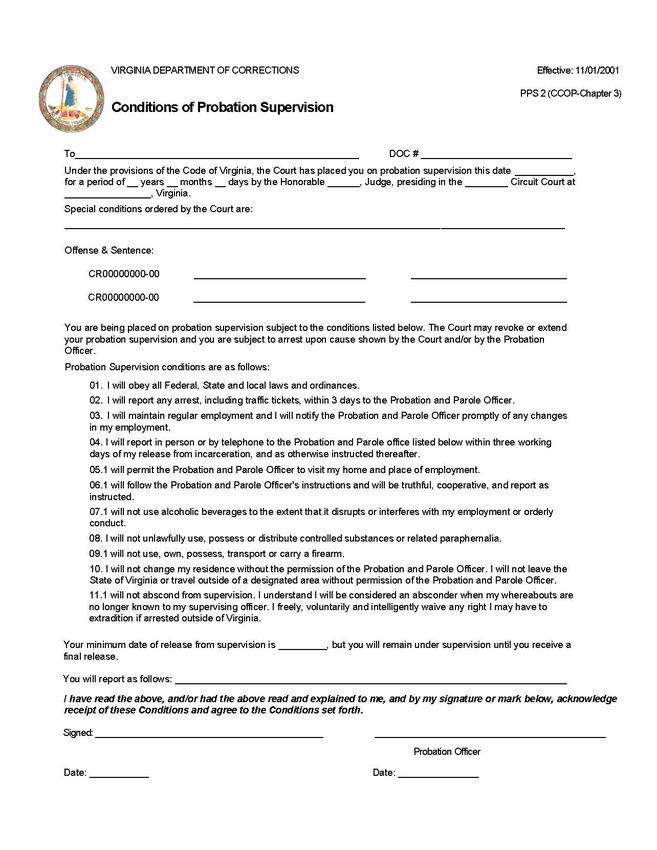
Appendix 1: Conditions of Probation/Post-Release Supervision ......................27
Appendix 1: Sex Offender Conditions Form.......................................................30
Appendix 2: Substance Abuse Admission Form................................................33
Appendix 3: Offense Types (See Appendix E in the Guidelines Manual
. for the most recent version ) ...................................................37
2 Virginia Sentencing Guidelinesu What’s New
CCAP Violation or Removal As of July 1,2020, only the Sentencing Revocation Report (SRR)
is to be completed for any violation of the Community Corrections
Community Corrections Altenative Program (CCAP)
Alternative Program (CCAP). The SRR is to be submitted for any
probationer removed from the CCAP program for medical reasons or
Per legislative mandate, the probation violation guidelines are to be
other administrative reasons, at no fault of his or her own. Also, only
based on historical judicial sanctioning practices in revocation hear-
the SRR is to be submitted for any probationer removed or terminat-
ings. However, CCAP is a relatively new DOC program and minimal
ed from the program for cause. On July 1, 2019, guidelines preparers
data are available regarding defendants removed from the program.
were instructed not to prepare probation violation guidelines for pro-
To accurately reflect historically-based sentence recommendations,
bationers removed from CCAP for administrative or medical reasons
the Commission must identify defendants who were removed from
only. As of July 1, 2020, the rule is extended for any termination from
CCAP and determine why they were terminated from the program.
CCAP. Probation violation guidelines are not to be prepared for any
Once sufficient information is available, the Commission will be able
violation of CCAP or removal from CCAP. There will be no recom-
to develop appropriate guidelines recommendations. Until then,
mendation for a specific sentence if a probationer is found in violation
CCAP failures are not scored on the probation violation guidelines;
of the CCAP conditions. The Sentencing Revocation Report must be
only detention and diversion removals are continued to be referenced
submitted in both instances. The Sentencing Revocation Report now
on the forms.
includes a check box to indicate if the probationer was removed from
CCAP.
When a probation violation procedure is initiated in order to bring an
individual removed from CCAP back to court for resentencing or for
violation, the CCAP revocation cases are scored as a prior revocation
on any future guidelines forms.
Probation Violation Guidelines 3u Sentencing Revocation Report
Background Completion Responsibility
Under § 17.1-803(7) of the Code of Virginia, it is the responsibility Revocations Etc., of Circuit Court
of the Commission to monitor sentencing practices in felony cases Felony Sentences
throughout the Commonwealth. While the Commonwealth maintains The Sentencing Revocation Report (SRR) is prepared for every ca-
a wide array of sentencing information on felons at the time they are pias, show cause or revocation request submitted to the court for an
initially sentenced in circuit court, information on the re-imposition of offender who has violated the conditions of a suspended sentence for
suspended prison time for felons returned to court for violation of the a felony offense. This includes violations of probation, post-release
conditions of community supervision was, until 1997, largely unavail- supervision administered by the court, good behavior terms, commu-
able and its impact difficult to assess. nity-based programs and suspended sentences.
In 1997, the Commission teamed with the Department of Corrections
(DOC) to implement a procedure for systematically gathering data on Prepared by Probation Officer or
the reasons for, and the outcome of, community supervision violation Commonwealth’s Attorney
proceedings in Virginia’s circuit courts. With DOC’s assistance, the The Commonwealth’s attorney, state probation officer or local proba-
Commission developed a simple one-page form (the Sentencing Re- tion officer, whoever initiates the capias or revocation request for a
vocation Report, or SRR) to capture this information. Following the felony violation, completes the front side of the SRR and forwards it
violation hearing, the completed form is submitted to the Commission. to the court, through locally-established procedures. The front side of
the SRR documents offender, court, and case information including
The Commission believes that the imposition of suspended time is a the reasons for capias, show cause or revocation requests. Condition
vital facet in the punishment of offenders. Together, the SRR and the 1 is cited, “Fail to obey all Federal, State and local laws and ordinanc-
Commission’s community corrections revocation data system serve es,” when there is a new conviction that violates the conditions of the
as an important link in our knowledge of the sanctioning of offenders suspended sentence (new law conviction). The court may determine
from initial sentencing through release from community supervision. that a deferred finding satisfies the requirements for a new law
conviction, a violation of Condition 1. If Condition 1 is cited, then the
In 2010 and in every year since, the General Assembly included SRR should be attached to the capias or revocation request.
the requirement to complete and review the Sentencing Revocation
Report in all suspended sentence, good behavior and probation vio- Within 30 Days of Hearing/Sentencing
lation cases and to review applicable Probation Violation Guidelines If Condition 1 is not cited, then the SRR should be prepared and
before sentencing. Below are the requirements included in the budget attached to the probation violation guidelines and submitted to the
language. court, through locally established procedures, no more than thirty (30)
days prior to the violation hearing. In this case, the SRR and proba-
tion guidelines cannot be prepared outside the 30 days. Any forms
prepared in advance are invalid and must be updated and completed
within the established time frames before being submitted to the
court. There is no timeframe for completing the SRR for a Condition
1, new law conviction.
One SRR/Guidelines Per Event
The judge must receive a SRR for every felony violation sentenc-
ing event and when appropriate, sentencing guidelines. One SRR
may cover multiple violations for an offender in one court. If none is
available in the case file, either the attorney for the Commonwealth or
probation officer must be prepared to provide a copy to the court.
4 Virginia Sentencing GuidelinesDecision of the Court Mailing Responsibility
Disposition - The sentencing judge or his designee is re- The Circuit Court Clerk is to forward the completed Sentencing
sponsible for completing the back side of the SRR. The back side Revocation Report (SRR) and a copy of the court order to the Virginia
of the SRR specifies the actual conditions violated, the decision Criminal Sentencing Commission within five days following the entry
of the court, and the sentence or other sanction imposed if the of a final order of conviction and sentence. When the Probation
offender is found in violation. The back page of the SRR is com- Violation Guidelines are completed, the guidelines forms must be
pleted even if the decision is to take the case under advisement attached to the completed SRR. Forms are then mailed to: Virginia
or defer any action for a specific amount of time. Criminal Sentencing Commission, 100 North Ninth Street, 5th Floor,
Richmond, VA 23219. When a court is fully automated and using the
Preparation Errors - If a preparation error is detected at SWIFT! (Sentencing Worksheets and Interactive File Transfer) appli-
sentencing, the Commission requests that the form be revised to cation, worksheets and court orders will be transferred electronically.
incorporate the changes. The ultimate responsibility for ensuring
that the form is completed accurately rests with the judge.
Worksheet Supplies
Probation Violation Not Scored as an Users may obtain a SWIFT! account to access, prepare and submit
Additional Offense
sentencing guidelines worksheets. Other electronic versions of the
worksheets are available at www.vcsc.virginia.gov or mobile.vcsc.
Probation violations are not to be scored as additional offenses on
virginia.gov, for use in emergencies or if access to SWIFT! is not
the sentencing guidelines for new offenses. The judge must receive
available.
guidelines for the new felony offense(s), if covered by the sentencing
guidelines, and a copy of the Sentencing Revocation Report (SRR).
The SRR must identify the alleged conditions of probation violated
and, when appropriate, include the VCC for the new law violation
conviction. Sentencing for new law violations and probation viola-
tions may occur on the same day in the same court, but the following
two forms are submitted to the court:
1. Sentencing guidelines for the new felony conviction and
2. SRR to identify the reasons for the probation, good behavior or
suspended sentence violation.
Probation
Sentencing Violation Guidelines
Revocation Report 5u Completing the Sentencing Revocation Report
Please Note: The probation violation is not to be scored as an
Enter the offender's first, middle and last name. additional offense on the sentencing guidelines for the new
offense. If sentenced together, both the sentencing guidelines for
Fill in the offender's date of birth. If unknown, leave blank. the new offense(s) and the SRR for a Condition 1 violation are to
be submitted to the court.
Fill in the offender's social security number. If unknown, leave blank.
17 Check the appropriate box indicating the Probation Violation
Fill in the offender's Central Criminal Records Exchange (CCRE) Guidelines recommendation and enter the recommended range,
number. If no Virginia number has been assigned, leave blank.
if applicable in the case.
Enter the CORIS Offender ID generated by DOC. The guidelines apply if the offender has violated the conditions
of probation (or post-release supervision, if administered by the
Enter the circuit number of the sentencing court. court) without a new conviction for violating a federal, state, or
local law or ordinance. Violations of Conditions 2 through 11 of
Enter the name of the city or county that the court serves. the state Conditions of Probation/Post-Release Supervision, and
violations of any special conditions set by the court, are cov-
Enter the FIPS Code that corresponds to the city or county where ered by the guidelines. A copy of the Conditions of Probation/
the sentencing court is located.
Post-Release Supervision used by the Department of Corrections
can be found in Appendix 1. There will be no recommendation for
Enter the name of the judge scheduled to hear the revocation case. violation of local probation, parole, a deferred finding or good be-
havior since probation violation guidelines do not apply in these cases.
Enter the docket number for the current probation violation. Do not
use the docket number for the original offense. 18 In some cases the guidelines recommendation may exceed the
total amount of time that can be revoked and re-imposed by the
11 Identify the sentencing event or events for which the offender’s
court. When this occurs, check the box for “Recommendation
suspended sentence is being revoked. Select the most serious
Exceeds Revocable Time” and enter the total amount of revoca-
original felony offense. The most serious offense is the conviction
ble time for all violations for which the offender will be sentenced
that has the highest statutory maximum penalty. If two or more
at the revocation hearing. This becomes the upper end of the
offenses in a sentencing event carry the same statutory maximum
guidelines recommended range. “Revocable time” refers to the
penalty, select the most serious felony based on the following
total amount of suspended time that could be revoked. For
order: person crime, property crime, victimless crime (i.e., perjury),
purposes of the SRR, jail credit is irrelevant unless the defendant
and drug crime.
previously was sentenced to time served. In these cases, the
local jail should have information on the amount of suspended
A. Record the offense description.
time remaining for a defendant.
B. Enter the VCC that corresponds to the offense description.
C. Enter the original sentencing date for that offense.
19 If the guidelines do not apply, check the appropriate box.The
12 If a Pre/Post-Sentence Investigation (PSI) report was completed guidelines do not apply under the following circumstances:
for the most serious felony offense using the Department of Cor-
A. The offender is found in violation of Condition 1 of the terms
rections automated PSI system, enter the system-generated report and conditions of Probation/Post-Release Supervision (i.e., the
number in the space provided. offender has a new conviction for a federal, state, or local law
or ordinance). The court may determine that a deferred finding
13 Check the appropriate box to indicate the type of sanction the satisfies the requirements for a new law conviction, a violation of
offender originally received. Jail or prison incarceration includes Condition 1.
sentences to jail, prison or time served for any offense in the
original sentencing event or events. Detention, Diversion Center B. The offender is in violation of § 18.2-251 or § 18.2-258.1(H)
Incarceration or CCAP should be checked only if the offender was (first offender status) or any deferred finding/sentence. For first
offender violation cases or any deferred case, please prepare the
ordered to complete one of these programs and did not receive
appropriate Sentencing Guidelines Worksheet.
any active jail or prison time.
SRRs and probation violation guidelines are not required when
14 Check the appropriate boxes indicating what types of revocations a case is being resentenced, not revoked. If the offender is
are being considered by the court. resentenced because of failure to qualify for an alternative (e.g.,
CCAP, substance abuse program, etc., because of health issues
15 Check the appropriate boxes indicating the conditions of state pro- or record), the court must communicate the new sentence to the
bation that the offender is accused of violating. (Local probation, Commission and a departure reason if not in concurrence with
good behavior and other suspended sentence violations may not the guidelines recommendation.
have the same conditions.)
C. The offender is on probation for a crime committed prior to
January 1, 1995 (Parole Eligible)
16 If the offender has been convicted for a new law or ordinance
violation, enter up to two Virginia Crime Codes (VCC) identifying D. The offender is revoked for something other than state
the crimes. For out-of-state convictions use an analogous offense probation (i.e., good behavior, local probation).
listed in the VCCs. If the arrest VCC is different from the convic-
tion VCC, use the VCC that identifies the offense at conviction. E. The offender is removed from CCAP for cause (disciplinary
In addition, indicate whether the conviction occurred in Virginia, reasons) or for administrative or medical reasons. The SRR is
outside of Virginia, or in violation of federal laws. (Do not enter any required.
VCCs if the offender has not been convicted of a new offense.)
6 Virginia Sentencing Guidelines
OFFENDER
Sentencing Revocation Report
Scheduled Sentencing Date:
NOTE: Required for SWIFT!
First: Middle:
Last: Suffix:
Date of Birth: / / Social Security Number:
Month Day Year
CORIS
SID/CCRE: Offender ID:
COURT
Judicial Circuit: City/County: FIPS Code:
Judge’s Name: Docket Number:
Office Use Only
11 MOST SERIOUS ORIGINAL FELONY OFFENSE INFORMATION
Primary Offense VCC Sentencing Date (Original)
/ /
Month Day Year
12 PSI NUMBER:
13 ORIGINAL DISPOSITION INFORMATION
No Incarceration Detention or Diversion Center Incarceration, CCAP (no active incarceration) Jail or Prison
14 TYPE OF REVOCATION (check all that apply)
Probation Post Release Good Behavior Suspended Sentence Community-Based Program
15 CONDITIONS CITED IN VIOLATION (check all that apply)
1. Fail to obey all Federal, State, and local laws and ordinances 16 Complete if there are any new law
or ordinance convictions:
2. Fail to report any arrests within 3 days to probation officer
VCCs for most serious convictions
3. Fail to maintain employment or to report changes in employment
4. Fail to report as instructed
5. Fail to allow probation officer to visit home or place of employment
6. Fail to follow instructions and be truthful and cooperative
7. Use alcoholic beverages
8. Use, possess, distribute controlled substances or paraphernalia
9. Use, own, possess, transport or carry firearm Location of Arrest:
10. Change residence or leave State of Virginia without permission Virginia Out of State or Federal
11. Abscond from supervision
Fail to follow special conditions (specify)__________________________________________________________
VIOLATION GUIDELINES RECOMMENDATION
17 Probation/No Incarceration 19 Probation Violation Guidelines
Do Not Apply (check reason)
Incarceration (Enter Range Below) Condition 1 Violation
Range to Deferred Finding/Sentence - Do not complete this form
Years Months Days Years Months Days (Complete original
18
Parole Eligible Case sentencing guidelines)
Recommendation Revocation Other Than State Probation
Exceeds Revocable Time of Years Months Days Violation/Removal from CCAP
Probation
Sentencing Violation Guidelines
Revocation Report 7u Final Decision/Disposition Fill In After Sentence Has Been Pronounced
This section of the SRR should be completed by the sentencing judge or the judge’s designee. All information should be
completed prior to being mailed or transmitted to the Virginia Criminal Sentencing Commission.
20 Check the appropriate box indicating the decision of the court. 22 Enter the length of active incarceration the defendant is to serve
for the violation(s) (i.e., the imposed sentence less any suspended
Found in Violation of Conditions Cited – The court determines time).
that the defendant violated all conditions cited in the capias, war-
rant or revocation request. Since the conditions cited on the front 23 If the period of supervised probation has changed, enter the
page are the same, the specific conditions violated do not need to amount of time the defendant will be under supervision from the
be identified on this page. date of the revocation sentencing. If the supervision period is indef-
inite, check the “Indefinite” box. If the defendant is continued on
Found in Violation of the Following Conditions Cited - If the the same period of supervision, do not enter the number of years,
court determines that the defendant violated selected conditions of months, or days in the box, but check the “Continued on Same
probation supervision other than listed on the first page, the court Period of Supervision” box.
is asked to identify which conditions were violated (check all that
apply). 24 If the court finds the defendant in violation and elects to continue
the defendant under the same conditions, check the box to indicate
Taken Under Advisement/Deferred – The court determines that this. The court is still responsible for entering the total amount of
no decision will be made at this point on the alleged violation. If revocable time in field 20.
the court takes the decision under advisement or defers the case
on the condition that the defendant complete a program or follow 25 If the court releases the defendant from supervision, check the
instructions and that a subsequent violation would require another “Released from Supervision” box. The court is still responsible for
request for capias or revocation, then submit the Sentencing entering the total amount of revocable time in field 20.
Revocation Report (and guidelines when appropriate) to the Com-
mission. If the court takes the decision under advisement or defers 26 Check the appropriate boxes indicating all other sanctions applica-
the case until appropriate counsel can be selected or appointed, ble in the sentencing event. If “Other” or “Community-Based Pro-
or for other court procedural issues, do not submit the Sentencing gram” is checked, please specify the type and name of program.
Revocation Report (with guidelines when appropriate) until after a
decision is made. 27 If the Probation Violation Guidelines apply and the judge sentences
above or below the recommendation, the judge is required by bud-
Not in Violation - The court finds that the defendant did not violate get language to provide a reason for departing. The judge can also
any of the conditions cited in the capias or revocation request. See use this space for judicial comments about the case.
the “Sentence for Revocation” section to record if the defendant is
continued under the same conditions or released from all supervi- 28 Enter the month, day and year of the revocation decision.
sion or restrictions.
29 The judge must sign each report after the decision has been com-
21 Enter the years, months and days for the amount of revocable time pleted. Electronic signatures are acceptable.
that the court could have imposed. This is the sum of all suspend-
ed time for the original offense(s) that the court could revoke in the
current hearing.
8 Virginia Sentencing Guidelines Final Decision/Disposition
To be completed by the sentencing judge or judge’s designee.
20 DECISION OF THE COURT
Found in Violation OR Found in Violation of the Following Conditions: (check all that apply)
of Conditions Cited Fail to obey all laws and ordinances
Use alcoholic beverages
Taken Under Advisement Fail to report any arrests within 3 days Use, possess, distribute drugs or paraphernalia
Fail to maintain employment/report changes Use, own, possess firearm
or Deferred
Fail to report as instructed Change residence/leave State without permission
Not in Violation Fail to allow probation officer to visit Abscond from supervision
Fail to follow instructions and be truthful Fail to follow special conditions ______________
________________________________________
________________________________________
SENTENCE FOR REVOCATION
Years Months Days
21 Amount of Revocable Time at Hearing/Sentencing... Life + Sentenced to
Time Served
22 Amount of Time to Serve for Violation........................ Life +
Continued on
Same Period of
23 Placed on Supervised Probation For:............................ Indefinite Supervision
24 Continued Under Same Conditions 25 Released from Supervision/Restrictions
Office Use Only
26 SANCTIONS IMPOSED FOR REVOCATION (Check all that apply)
Other CBP
Electronic Monitoring Drug Court
Day Reporting Intensive Probation Other_____________________________
Specify type or name of program
o CCAP Detention/Diversion Center Incarceration, 22-28 weeks
o CCAP Detention/Diversion Center Incarceration, 42-48 weeks
Community-Based Program_____________________________
Specify type or name of program
Office Use Only
27 REASON FOR DEPARTURE FROM GUIDELINES
________________________________________________________________________________________________________
________________________________________________________________________________________________________
________________________________________________________________________________________________________
________________________________________________________________________________________________________
________________________________________________________________________________________________________
________________________________________________________________________________________________________
28 DATE OF REVOCATION DECISION 29
Month
/
Day
/
Year
+ Judge’s Signature
Probation
Sentencing Violation Guidelines
Revocation Report 910 Virginia Sentencing Guidelines
u Probation Violation Guidelines
Legislative Directive Defense counsel must receive copies of the probation violation guide-
lines. Local procedures will dictate when the guidelines are distribut-
In 2003, the General Assembly directed the Commission to develop, ed to defense counsel. The recommendation is the same distribution
with due regard for public safety, discretionary sentencing guidelines timeframe for Pre-Sentence Investigation Reports.
for application in cases involving felony offenders who are determined
by the court to be in violation of probation or post-release supervision Preparation Errors - If a scoring error is detected prior to sen-
for reasons other than a new criminal conviction (Chapter 1042 of tencing, the Virginia Criminal Sentencing Commission requests that
the Acts of Assembly 2003). Often these offenders are referred to as the worksheet preparer be contacted so that an amended worksheet
“technical violators.” In determining the guidelines, the Commission can be prepared and circulated to all parties prior to sentencing or at
was to examine historical judicial sanctioning patterns in revocation sentencing.
hearings for such cases.
Changes at Sentencing - If a preparation error is detected at sen-
In 2010 and in every year since, the General Assembly included tencing or additional conditions are cited, the Commission requests
the requirement to complete and review the Sentencing Revocation that the worksheet be re‑scored in order to incorporate the changes.
Report in all suspended sentence, good behavior and probation vio- If a worksheet is re‑scored, the final worksheet presented to the
lation cases and to review applicable Probation Violation Guidelines judge for consideration is the version to be submitted to the Commis-
before sentencing. Below are the requirements included in the budget sion. The ultimate responsibility for ensuring that the worksheets are
language. completed accurately rests with the judge.
Completion Responsibility Judicial Disagreement with
Worksheet Scoring Rules
One Sentencing Revocation Report (SRR) is prepared for each hear-
ing event or sentencing event. A hearing event or sentencing event Guidelines worksheets must be scored according to the rules con-
consists of all probation or suspended sentence violations before tained in the manual. It is not appropriate to adjust the guidelines
the same judge, in the same court at the same time. The Common- scores to reflect judicial discretion. If a judge disagrees with the
wealth’s attorney or state probation officer who initiates the capias recommendation because of the inclusion of, or the weights assigned
or revocation request completes the front side of the SRR and the to, a factor on a particular worksheet, the Commission suggests that
Probation Violation Guidelines, if applicable. Local probation officers the judge depart from the recommended sentence and state the rea-
may only complete the SRR. Sentencing guidelines are not com- son(s) for departure on the reverse side of the Sentencing Revoca-
pleted for violations for which the defendant was being supervised by tion Report (SRR). The explanation should identify the specific factor
local probation or good behavior violations. In these cases, only the and the reason the factor is being questioned. This process will allow
SRR is submitted to the court. the Commission to adjust the guidelines to better reflect the decisions
Due to the time-sensitive nature of factors on the Probation Violation and philosophy of the judiciary.
Guidelines, the worksheets must be prepared within thirty (30) calen-
dar days prior to the violation hearing.
Recording Departure Reasons
If Condition 1, a new conviction, is not cited, the completed Probation
Violation Guidelines must be attached to the SRR and forwarded When the court imposes a sentence greater or less than the guide-
to the court, through locally-established procedures, no more than lines recommendation, the judge is required by budget language to
thirty (30) calendar days prior to the violation hearing. In “technical” provide a written departure explanation with the record of the case.
violations (other than Condition 1 violations), the SRR and proba- Space is provided on the back of the Sentencing Revocation Report
tion guidelines cannot be prepared outside the 30 days. Any forms (SRR) for entering reasons for departure. Reasons for departure
prepared in advance are invalid and must be updated and completed should be specific. Specific departure reasons provide useful feed-
within the established time frames before being submitted to the back to the Commission and will alert the Commission to concerns of
court. There is no timeframe for completing the SRR for a Condition the users.
1, new law conviction. The judge must receive probation violation
guidelines when required. When guidelines are not required, the
judge must receive a SRR. If any of the required documents are not
available in the case file, either the attorney for the Commonwealth or
probation officer must be prepared to provide the court a copy of the
missing document.
Probation Violation Guidelines 11Probation Violation Guidelines
Mailing Responsibility B. The offender is in violation of § 18.2-251 (first offender status) or
§ 18.2-258.1(H) (first offender prescription fraud), or any deferred
The Circuit Court Clerk is to forward the completed Sentencing finding/sentence. If an offender’s first offender status is being re-
Revocation Report (SRR) and a copy of the court order to the Virginia voked under §18.2-251, complete the Drug Schedule I/II worksheet
Criminal Sentencing Commission within five days following the entry and submit it to the court. If an offender’s first offender prescription
of a final order of conviction and sentence. When the Probation fraud status is being revoked under §18.2-258.1(H), complete the
Violation Guidelines are completed, the guidelines forms must be
Drug/ Other worksheet and submit it to the court.
attached to the completed SRR. Forms are then mailed to: Virginia
Criminal Sentencing Commission, 100 North Ninth Street, 5th Floor,
C. The offender is before the court on a deferred sentence for pos-
Richmond, VA 23219. When a court is fully automated and using the
sible revocation or resentencing for failure to abide by or complete
SWIFT! (Sentencing Worksheets and Interactive File Transfer) appli-
cation, worksheets and court orders will be transferred electronically. the conditions of the deferral. In this case, complete the guidelines
for the original primary offense. Do not complete an SRR in first
offender or deferred finding/sentencing violation cases. If the offender
Determining if is resentenced because of failure to qualify for an alternative (e.g.,
Probation Guidelines Apply CCAP, substance abuse program, etc., because of health issues or
criminal record), the court must communicate the new sentence to
The guidelines apply if the offender has violated the conditions of pro- the Commission and a departure reason if not in concurrence with
bation (or post-release supervision, if administered by the court) with the guidelines recommendation.
no federal, state or local law or ordinance conviction. Violations of
Conditions 2 through 11 of the Conditions of Probation/Post-Release D. The offender is on probation for a crime committed prior to Janu-
Supervision, and violations of any special conditions set by the court ary 1, 1995 or parole eligible.
and supervised by state probation, are covered by the guidelines.
A copy of the Conditions of Probation/Post-Release Supervision used E. The offender is on state probation for only misdemeanor offenses.
by the Department of Corrections can be found in Appendix 1.
F. The offender is on local probation for felonies or misdemeanor
The guidelines do not apply under the offenses.
following circumstances:
A. The offender is found in violation of Condition 1 of the Terms and
Conditions of Probation/Post-Release Supervision (i.e., the offender
has failed to obey all federal, state, and local laws and ordinances,
and has been convicted of a new offense). A probation violation is
not considered a new law violation for this factor.
Please note that probation violations are not to be scored as addition-
al offenses on the sentencing guidelines for new offenses. The judge
must receive guidelines for the new felony offense(s), if covered by
the sentencing guidelines, and a copy of the Sentencing Revocation
Report (SRR). The SRR must identify the alleged conditions of
probation violated and when appropriate, include the VCC for the
new law conviction. Sentencing for new law violations and probation
violations may occur on the same day in the same court, but the
following two forms are submitted to the court:
1. Sentencing guidelines for the new felony conviction and
2. SRR to identify the reasons for the probation, good behavior
or suspended sentence violation.
12 Virginia Sentencing GuidelinesGLOSSARY OF TERMS
Absconded 13 Months or More Arrest Factors
and Time Absconded
Arrest factors on the Probation Violation Guidelines refer to new
For these factors, assign points if the offender was cited for abscond- arrests incurred by the offender during the current supervision period.
ing from supervision in violation of Condition 11 of the Conditions Specific rules for scoring each factor are noted below.
of Probation/Post-Release Supervision. If the defendant signed
1. Arrests for offenses that occurred prior to the
conditions of probation prior to the enactment of Condition 11, the
defendant being placed on probation are also scored, as
defendant may still be scored for this factor as long as the capias/
long as the arrest occurred during the current supervision
revocation request informs the judge that the defendant did abscond
period.
from supervision.
2. Each count is equal to one arrest.
Time absconded is calculated from the date of last contact the
probation officer had with the defendant up to the date of sentencing 3. Arrests are scored regardless of the disposition (e.g., guilty,
for the current violation. Round down to the next lowest month. For not guilty, dismissed, nolle prosequi, etc.).
example, score 5 months 29 days as 5 months.
Contact may include verbal, written, or face-to-face communication 4. New arrests do not include arrests for probation
with the probation officer or court official at which time the officer/offi- violations.
cial knew the whereabouts of the defendant. The original date of last
5. Arrests for traffic infractions are not scored. Traffic infrac-
contact cited in the capias/revocation request should be used even if
tions are offenses that are neither felonies nor misdemean-
the probationer reappears in the probation office, jail, etc., at a later
ors and are not listed in the VCC book. Criminal traffic
date.
offenses are scored.
Example: A defendant last reported to his probation officer 6. Arrests that have been expunged are not scored.
on 3/1/00 and was arrested on the capias on
7/1/00. The sentencing takes place on 8/1/00; 7. Summons are counted as arrests.
therefore, the time absconded is 5 months between
3/1/00 and 8/1/00. Arrests for Crimes Against Person, New
For this factor, which appears on Section C, score the number of new
Score defendants who never report to sign their conditions of proba- felony and misdemeanor arrests for crimes against a person occur-
tion as absconding from supervision for Violation Guidelines purpos- ring during the current supervision period. The current supervision
es. Use the most recent date the defendant was ordered to report for period begins on the most recent date the defendant was placed, or
supervision as the date of last contact. continued, on supervision conditions by the court and ends on the
date of sentencing for the current violation.
Person offenses include the following: assault, child or adult neglect,
murder, homicide, kidnapping, robbery, rape, sexual assault, grand
larceny from a person, burglary with intent to commit assault, murder,
rape, or rob, and arson of an occupied building. This is not an ex-
haustive list. Refer to Appendix 3 of this manual for a list of offenses
by type/category (Updated lists may be found in Appendix E of the
Sentencing Guidelines manual or on the mobile website (mobile.vcsc.
virginia.gov)).
Probation Violation Guidelines 13Probation Violation Guidelines
Arrests for Nonperson Crimes, New Condition(s) Violated
On Section C, score the number of counts of felony and misdemean- On Section A, enter the score corresponding to the type of condition
or arrests for nonperson crimes during the current supervision period. violated. For this factor, score only one condition violated. When there
Nonperson crimes are all offenses not designated as person crimes are multiple conditions violated, score the condition that receives the
in Appendix 3 of this manual. (Updated lists may be found in Appen- highest number of points for the factor. The Conditions Violated refer
dix E of the Sentencing Guidelines manual or on the mobile website to the Conditions of Probation/Post- Release Supervision established
(mobile.vcsc.virginia.gov)). by the Department of Corrections (See Appendix 1 of this Manual):
They include criminal traffic offenses (i.e., offenses listed in the traffic Note: Score defendants who never report to sign their conditions of
section of the VCC Book), but not traffic infractions (e.g., speeding, probation as absconding from supervision, for guidelines purposes.
fail to stop at stop sign, etc.).
Condition 2: Fail to report any arrests within three days
Do not score arrest for probation, good behavior or suspended sen- to probation officer.
tence violations. Condition 3: Fail to maintain employment or report any
changes in employment.
Arrests, New Felony Condition 4: Fail to report as instructed.
On Section A, score the number of new felony arrests during the Condition 5: Fail to allow probation officer to visit home
current supervision period. The current supervision period begins on or place of employment.
the most recent date the defendant was placed, or continued, on su- Condition 6: Fail to follow instructions and be truthful
pervision conditions by the court and ends on the date of sentencing and cooperative.
for the current violation. Condition 7: Use alcoholic beverages to excess.
Condition 8: Use, possess, distribute controlled
Score new felony arrests regardless of disposition (e.g., guilty, not substances or paraphernalia.
guilty, dismissed, nolle prosequi, etc.). Each offense count is equal Condition 9: Use, own, or possess a firearm.
to one arrest. For example, if a defendant is arrested at the same Condition 10: Change residence/leave state without
time for three counts of unlawful wounding, the defendant has three permission.
felony arrests. Score out-of-state, federal, or military arrests based on Condition 11: Abscond from supervision.
Virginia’s penalty structure. If the offense is a felony in Virginia, score
the arrest as a felony. The felony designation or sentence received in Special Condition(s):
the other jurisdiction may be unrelated to its treatment under Virginia Fail to follow special conditions (sex offender).
law. (Also see rules under Arrest Factors).
This factor separates sex offender conditions/restrictions imposed or
Do not score arrest for probation, good behavior or suspended sen- authorized by the court from other types of conditions. Examples of
tence violations. sex offender restrictions/conditions include: unsuccessful discharge
from sex offender treatment, prohibited contact with a minor or victim,
Community Service access to computers or the internet, entrance into prohibited areas,
Any community service authorized by the court, probation officer or etc. This is not an exhaustive list.
supervising authority. (Also see Never Reported to/Unsuccessful
Discharge from Community Service, Day Reporting, etc.) Special Condition: Fail to follow special conditions (other than sex
offender conditions).
14 Virginia Sentencing GuidelinesCurrent Supervision Period Drug Tests or Signed Admission, Positive
Unless otherwise instructed, score factors for the current supervision (not marijuana or alcohol)
period only. The current supervision period begins on the most recent On Section C, assign points if the defendant tested positive (urine,
date the defendant was placed, or continued, on probation or post-re- blood, etc.) for any controlled substance other than marijuana or alco-
lease conditions by the court and ends on the date the court renders hol during the current supervision period. Do not score positive tests
its decision for the current alleged violation. If the defendant was for controlled substances prescribed for the defendant by a medical
previously found in violation of probation supervision (or post-release practitioner, unless part of a documented substance abuse issue.
supervision, if the violation was handled by the court), the current Score refusal to take a drug test as a positive test. Score a positive
period starts when the court placed the defendant back on supervi- test for synthetic marijuana or a cannabimimetic agent. Score failure
sion. The court need not find the offender in violation to start the next to report for a drug screen as a positive test. Also score signed
supervision period. admissions for a controlled substance other than marijuana or alcohol
during the current supervision period (see Appendix 2 of this Manual
Example: Defendant was placed on probation on 6/1/2018 for the DOC “Substance Abuse Admission Form”). This factor can
as a condition of a suspended sentence. He was later be scored even if the capias/revocation request did not specifically
found in violation of his probation on 2/1/2019, but was cite use of a controlled substance (Condition 8 of the Conditions of
continued on probation. Sentencing for a new probation vi- Probation/Post-Release Supervision) by the offender.
olation is set for 5/1/2019. The current period of supervision
is between 2/1/2019 (not the original start date of 6/1/2018) Drug Treatment or Drug Education
and a new violation sentence date of 5/1/2019. Program, Never Reported to
For this factor, found on Section C, score the number of times the de-
Day Reporting fendant never reported to a drug treatment/drug education program
Includes both local and state day reporting programs. (Also see after being ordered to do so during the current supervision period.
Never Reported to/Unsuccessful Discharge from Community Service, Drug treatment/drug education programs include inpatient and outpa-
Day Reporting, etc.) tient drug treatment, N.A., as well as group programs such as those
offered in-house at local probation and parole offices. Score A.A. as a
Detention Center drug education program if the offender is referred to the program for
Score only if the defendant was discharged for disciplinary reasons, the abuse of a drug other than alcohol.
not medical reasons. Score voluntary resignations from Detention as
unsuccessful discharges. Discharge from CCAP is not scored. Note: Assign points based on the number of times the defendant was
Probation violation guidelines do not apply if the current violation is instructed to report to different drug treatment programs and never
based on the removal from CCAP for medical or administrative rea- reported. Also, assign points if the defendant was given multiple
sons or for disciplinary reasons. Only the SRR is submitted. Also see chances to report to the same drug treatment program on several
Unsuccessful Discharge from Detention Center and Never Reported occasions and failed to ever attend. Score each time the defendant
to/Unsuccessful Discharge from Community Service, Day Reporting, failed to follow instructions and failed to attend at least one session.
etc.) Score this factor if the defendant failed to show up for intake or an
assessment. Also, score this factor if the defendant attended the
Diversion Center intake or assessment process, but failed to show up for the treatment
Score only if the defendant was discharged for disciplinary reasons, program.
not medical reasons. Score voluntary resignations from Diversion as
unsuccessful discharges. Discharge from CCAP is not scored. Note: Do not score:
Probation violation guidelines do not apply if the current violation is 1. Programs designed solely for alcohol treatment.
based on the removal from CCAP for medical or administrative rea-
sons or for disciplinary reasons. Only the SRR is submitted. Also see 2. This factor if the defendant started attending a program but
Never Reported to/Unsuccessful Discharge from Community Service, missed sessions or dropped out after attending at least one
Day Reporting, etc.) session.
3. Do not score this factor for drug treatment that is conducted
as a part of Day Reporting, Detention or Diversion, CCAP
or incarceration in jail or prison.
Probation Violation Guidelines 15Probation Violation Guidelines
current violation. If the defendant never reported for supervision, use
Months until First Noncompliant Incident the date the defendant was ordered to report for supervision. Round
See Noncompliant Incident, Months until First down to the next lowest month. For example, score 5 months 29 days
as 5 months.
Never Reported to Drug Treatment or
Drug Education Program Noncompliance includes any revocable act/behavior that violates
See Drug Treatment or Drug Education Program, Never Reported to supervision conditions authorized by the court or imposed by the
probation officer or supervising authority. The noncompliant incident
Never Reported to/Unsuccessful does not have to be reported to the court for it to be scored; however,
Discharge from Community Service, it needs to be documented in the probation officer’s case file. It is rec-
Day Reporting, etc. ommended that the court and attorneys be provided with the details
Assign points on Section A if the defendant never reported to, or in any communications with the court, but it is not a requirement.
was unsuccessfully discharged from, one or more of the following
programs: community service, day reporting, Detention or Diversion Offense Type
Center (not CCAP), employment and/or residential programs (not See Original Felony Offense Type
associated with treatment). Score unsuccessful discharge from De-
tention or Diversion Center (not CCAP) if the defendant resigned or Original Disposition was Incarceration
was discharged for disciplinary reasons, not medical reasons. Note: Points are assigned on Section A if the defendant was sentenced to
Probation violation guidelines do not apply if the current violation is incarceration for any of the original offense(s) at the time of the origi-
based on the removal from CCAP for medical or administrative rea- nal sentencing event. Incarceration includes sentences to jail, prison,
sons or for disciplinary reasons. Only the SRR is submitted. or time served for any offense in the original sentencing event(s).
Sentences to Detention and Diversion Centers, Bootcamp and CCAP
Score unsuccessful discharge if the defendant is before the court are also scored as periods of incarceration.
for violating conditions while enrolled in the Day Reporting Program.
Employment programs include job counseling or job corps training. Original Felony Offense Type
Failure to obtain or maintain employment is not scored for this factor. This factor appears on both Section A and Section C of the Probation
Residential programs not associated with treatment may include an Violation Guidelines. Identify the sentencing event or events that re-
adult home, halfway house, or homeless shelter from which the de- sulted in the offender’s supervision in a particular jurisdiction. Include
fendant was discharged or to which the defendant failed to report. Do only those sentencing events that served as the basis for the revoca-
not score treatment programs specifically designed for drug, alcohol, tion hearing. The offenses that comprise these sentencing events are
substance abuse, sex offender, or medical/mental health treatment. defined as the “original” offenses for the purposes of completing the
Probation Violation Guidelines.
New Arrests for Crimes Against Person Determine the most serious felony offense among these crimes.
See Arrests for Crimes Against Person, New Please note that the rules for selecting the most serious original
felony offense type on the Probation Violation Guidelines are different
New Arrests for Nonperson Crimes than the rules for selecting the primary offense on the traditional
See Arrests for Nonperson Crimes, New felony Sentencing Guidelines.
New Felony Arrests Use the following hierarchy to determine the most serious original
See Arrests, New Felony felony offense for the Probation Violation Guidelines:
Noncompliant Incident, Months until First 1) Highest Statutory Maximum
For Section C, determine the number of months between the start 2) Person Crimes
of the current supervision period and the date of the first noncom- 3) Property Crimes
pliant incident. The current supervision period begins on the most 4) Victimless/Other Crimes (e.g., Traffic and Weapons)
recent date the defendant was placed, or continued, on supervision 5) Drug Crimes
conditions by the court and ends on the date of sentencing for the 6) Highest Score for “Original Felony Offense Type”
factor on Section C (Highest Recommendation)
16 Virginia Sentencing GuidelinesThe most serious offense is the felony conviction that has the highest Positive Drug Test or Signed
statutory maximum penalty. If two or more felonies in a sentencing Admission (not marijuana or alcohol)
event carry the same statutory maximum penalty, select the most See Drug Tests or Signed Admission, Positive
serious felony based on the hierarchy mentioned above: person,
property, victimless/other, drug and then highest recommendation. Prior Record
Prior record factors on the Probation Violation Guidelines relate spe-
Example 1: An offender is on probation for an unlawful cifically to the offender’s original disposition and history of supervision
wounding (Penalty: 1-5 years) and a grand larceny (Pen- violations and revocations.
alty: 1-20 years). The grand larceny is the most serious
original felony offense because it has the highest statutory Previous Adult Probation
maximum penalty. Revocation Events Record
See Revocation Events, Previous Adult Probation
Example 2: An offender is on probation for malicious
wounding (Penalty: 1-20 years) and a grand larceny (Pen- Program Factors
alty: 1-20 years). Both offenses have the same maximum Program factors appear on both Section A and Section C of the
penalty (20 years). Therefore, malicious wounding is the Probation Violation Guidelines. These factors relate to the offender’s
most serious original felony offense because it is a person failure to report to, or unsuccessful discharge from, certain programs
crime, whereas grand larceny is a property offense. ordered by the court or probation officer, as part of the offender’s
probation.
If two or more offenses have the same maximum penalty and are
classified in the same crime category, choose as the most serious Employment Program
original felony offense the one that has the highest score under the Employment programs include job counseling or job corps training.
“Original Felony Offense Type” factor on Section C of the Probation Failure to obtain or maintain employment is not scored for this factor.
Violation Guidelines. This rule will result in the offense with the high- (Also see Never Reported to/Unsuccessful Discharge from Communi-
est recommendation as the most serious felony offense. ty Service, Day Reporting, etc.)
Example 3: An offender is on probation for DWI-3rd (Penal- Residential Program
ty: 1-5 years) and Possession of a Firearm by a Convicted Residential programs, not associated with treatment, may include an
Felon (Penalty: 1-5 years). Both have the same statutory adult home, halfway house, or homeless shelter from which the de-
maximum penalty and both are classified as other crimes. fendant was discharged or to which the defendant failed to report. Do
On Section C, however, Possession of a Firearm by a Con- not score treatment programs specifically designed for drug, alcohol,
victed Felon receives 16 points under the “Original Felony substance abuse, sex offender, or medical/mental health treatment.
Offense Type” factor, while DWI-3rd receives 3 points on (Also see Never Reported to/Unsuccessful Discharge from Communi-
that factor. Therefore, choose Possession of a Firearm by ty Service, Day Reporting, etc.)
a Convicted Felon as the most serious felony offense for
scoring the Probation Violation Guidelines. Revocation Events, Previous
Adult Probation
Refer to Appendix 3 of this manual for a list of offenses by type/cat- This factor appears on both Section A and Section C of the Proba-
egory (Updated lists may be found in Appendix E of the Sentencing tion Violation Guidelines. Previous adult probation revocation events
Guidelines manual or on the mobile website (mobile.vcsc.virginia. are all felony and misdemeanor violation events for federal, state
gov). If the most serious original offense does not fall into a specific or local probation periods in the defendant’s adult criminal history.
category, classify the offense as “Other.” Also included are similar probation violations from other countries.
Score each revocation event that occurred prior to sentencing for the
current violation case. Violations that occurred in other jurisdictions
or courts, but are part of the current supervision period are includ-
ed. Juveniles certified as an adult, but sentenced to Department
of Juvenile Justice are scored the same as adult probation. Include
previous post-release revocations handled by the court. Include only
Probation Violation Guidelines 17You can also read


