Visual Art 2019 v1.1 Supporting resource: Artist's statements - QCAA
←
→
Page content transcription
If your browser does not render page correctly, please read the page content below
Visual Art 2019 v1.1
Supporting resource: Artist’s statements
Artist’s statements in the Visual Art syllabus
Artist’s statements are required for Summative internal assessment 2 (IA2): Project — inquiry
phase 2 and Summative internal assessment 3 (IA3): Project — inquiry phase 3. Students may
be given opportunities to write artist’s statements in Units 1 and 2.
Syllabus conditions:
artist’s statement/s that assist/s audience understanding of body of work focus and critical
thinking
- one statement for a single artwork or a collection of artworks, or multiple statements for
individual artworks in a collection, as determined by the student focus
- maximum 150 words per statement (name, title, media and size are not included in word count)
Artist’s statement guide
Artist’s statement information includes:
not included in word Name of the artist
count Title of the work
Year of creation
Media
Dimensions
maximum 150 words a block of didactic (interpretive) text
didactic (interpretive) Students should:
text consider how the text will assist their audience to engage with their artwork
use active rather than passive voice
use present tense
use verbs and adjectives that are specific to their purpose and intention; use
language that matches the mood and qualities of the work that will both excite
and inform the audience
use a variety of sentence lengths, easy to read sentences are 15–20 words long
avoid an explanation of what they did — this is obvious when the audience
looks at the artwork — use the artist’s statement to share philosophy, intentions,
ideas, but not reveal everything (leave something for the audience to discover
on their own)
consider the relationship between artist and audience: Do they want to share
personal feelings, challenge assumptions, provoke a response?
ask questions or provide clues that encourage the audience to look closer at the
artwork and construct their own meaning, whether aesthetic, intellectual or
personal; avoid questions with obvious answers — these risk patronising the
audience
consider the word length. Students only have 150 words to capture everything
they need to say; avoid opening with ‘My work is…’; ‘In my work…’
use a hierarchy of information — concept, focus, message.
171719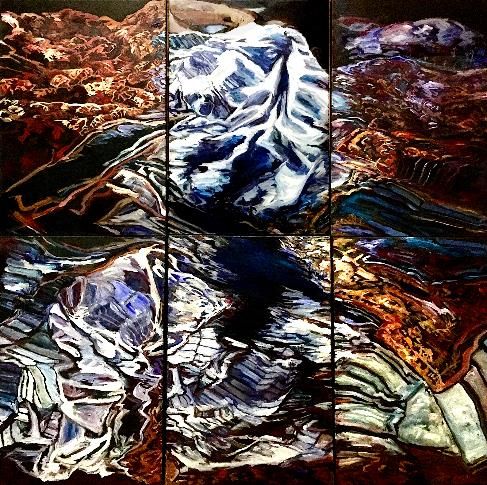
Artist’s statement samples

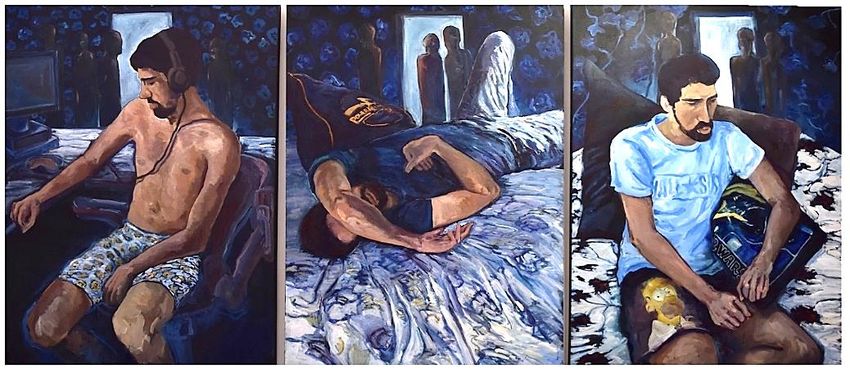
             IA2 Student sample — one statement for a collection of artworks:

             Student name
             Dweller on the threshold
             Year
             Acrylic on canvas
             3 panels, each 120cm x 90 cm

             Change is unavoidable in life. Yet, like everything unknown, it is inherently intertwined with fear and
             deeply ingrained within the psychological sphere of human culture and spirituality. The transition from
             childhood to adulthood is one of the most dramatic changes a human will experience and is riddled with
             fear. My paintings explore the sheltered world of adolescence and the anxiety of inevitably growing up.
             Each painting portrays candid scenes of my 19-year-old brother Adam in his bedroom. His thick beard
             serves as a jarring clash with the parental comfort of floral patterning and childish interests reflected in his
             surroundings. Beyond the security of the bedroom, silhouetted spectral figures pass by an open door — a
             metaphor for the undiscovered world beyond adolescence. The obscure background bestows an eerie
             ambiguity through its juxtaposition with the familiar, the limbo and fear between the known and unknown
             in both a physical and psychological context.

Visual Art 2019 v1.1                                                                      Queensland Curriculum & Assessment Authority
Supporting resource: Artist’s statements                                                                                     July 2018
                                                                 Page 2 of 5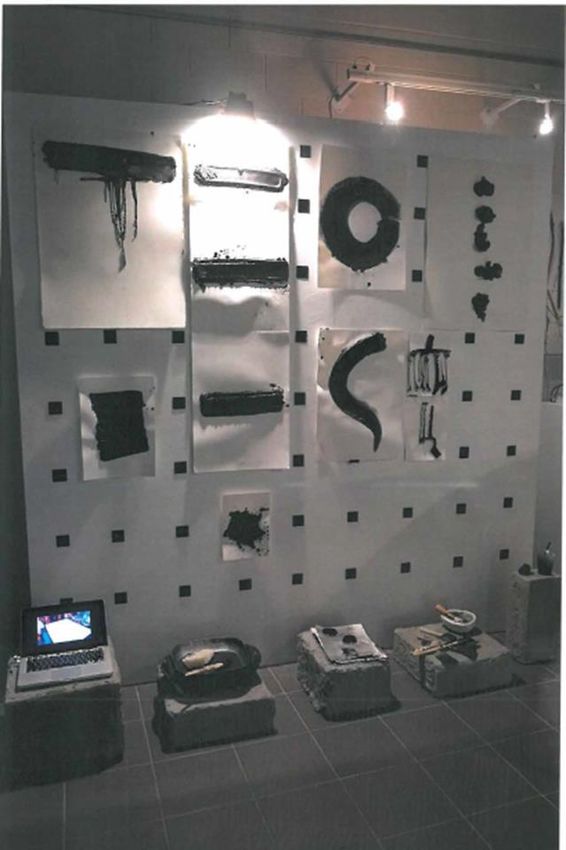
IA3 Student sample — one statement for a collection of artworks:

             Student name
             Riverbed
             Year
             Acrylic on canvas
             6 panels, each
             52 x 76 cm

             Riverbed explores the Jungian notion of water as the fundamental element in the alternative reality of the
             spiritual realm. Jung, a Swiss psychotherapist, held that all cultures share a collective spiritual experience
             and metaphorical language which lies within the subconscious and surfaces through dreams. The
             external and internal realties posed by this concept are embodied in the contrast between the personal
             safety and domesticity of a bed and a turbulent river landscape. The river symbolises the flow of life: the
             ‘teleology’, as Jungian therapy says, and embodies the powerful direction of that flow as one is cast into
             adulthood.

             The six panels of Riverbed form a hybridization of bedsheet folds and landscape. The brush marks and
             patterns encroach on each other, like dreams and fears. This melding of formalistic characteristics
             expresses the idea that, while external and internal reality are inherently opposing, they are also,
             ironically, inseparably intertwined.

Visual Art 2019 v1.1                                                                     Queensland Curriculum & Assessment Authority
Supporting resource: Artist’s statements                                                                                    July 2018
                                                                Page 3 of 5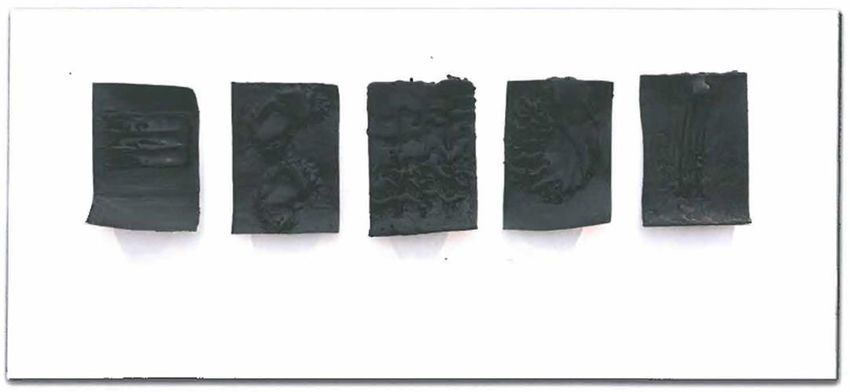
IA2 Student sample — multiple statements for individual artworks in a collection:

             Student name
             Becoming form
             Year
             Charcoal in encaustic on handmade paper
             Series of 5 x low relief drawings each 30 x 20 cm

             Becoming form is inspired by the Japanese Gutai art movement and their philosophy to allow material to
             expose its own innate characteristics. External input by the artist upon the materials was only done as a
             catalyst to allow the materials to find their form. I challenged myself in these works to suppress my instinct
             to control or force the materials into a pre-determined form. Through constant repetition of a singular
             action performed hundreds of times, the action takes shape and a form is created. The works are both
             drawing and sculpture with the material ultimately determining what the form becomes.

Visual Art 2019 v1.1                                                                    Queensland Curriculum & Assessment Authority
Supporting resource: Artist’s statements                                                                                   July 2018
                                                                 Page 4 of 5
IA2 Student sample — multiple statements for individual artworks in a collection:
Student name
Concrete
Year
Charcoal, ink, wax, turpentine, polyvinyl acetate adhesive
Installation, various sizes
“Gutai Art does not alter matter. Gutai Art imparts life to matter.”
The Japanese Gutai Art movement allowed their materials to tell their own story. The artist was only a
catalyst that exposed the nature and form of the materials. Inspired by this philosophy, I restricted myself
to repeating the same brush strokes and suppressed human instinct to create representational forms. As I
worked, I found myself falling into a meditative state where nothing mattered besides allowing the
materials to flourish. The drawings are installed with the implements and evidence of the process to
celebrate the distinct qualities of the materials.
Online examples
Artists entering the Queensland Regional Art Awards must submit an artist’s statement describing how
their work addresses the competition theme — 150 words maximum.
Flying Arts, ‘Queensland regional art awards’, www.flyingarts.org.au/events-and-projects/queensland-
regional-art-awards/
Visual Art 2019 v1.1 Queensland Curriculum & Assessment Authority
Supporting resource: Artist’s statements July 2018
Page 5 of 5You can also read


