When you have to be right - By Stevie D. Conlon, Anna Vayser, and Robert Schwaba Reprinted with permission from Tax Notes, February 19, 2018, p. 1001
←
→
Page content transcription
If your browser does not render page correctly, please read the page content below
When you have to be right

Financial Services

Taxation of Bitcoin,
Its Progeny, and
Derivatives:           By Stevie D. Conlon, Anna Vayser,
                       and Robert Schwaba

Coin Ex Machina        Reprinted with permission from Tax Notes,
                       February 19, 2018, p. 1001
© 2018 Tax Analysts. All rights reserved. Tax Analysts does not claim copyright in any public domain or third party content.
                                                                                        SPECIAL REPORT
                                                                                                                     tax notes®

Taxation of Bitcoin, Its Progeny, and Derivatives: Coin Ex Machina

by Stevie D. Conlon, Anna Vayser, and Robert Schwaba
                                                                                       Table of Contents
                                                               I.      Background . . . . . . . . . . . . . . . . . . . . . . .       1002
                                                                       A. What Is a Bitcoin or a
                                                                          Cryptocurrency? . . . . . . . . . . . . . . . .             1002
                                                                       B. Tracking Ownership: Keys and
                                                                          Wallets . . . . . . . . . . . . . . . . . . . . . . . . .   1004
                                                                       C. Forks and Coin Creation. . . . . . . . . .                  1004
                                                                       D. Other Cryptocurrencies and
                                                                          Tokens . . . . . . . . . . . . . . . . . . . . . . . . .    1005
                                                                       E. Cryptocurrency Derivatives. . . . . . .                     1005
                                                               II.     U.S. Taxation . . . . . . . . . . . . . . . . . . . . . .      1006
                                                                       A. Notice 2014-21 . . . . . . . . . . . . . . . . . .          1006
                                                                       B. Bitcoin: Currency or Property? . . . .                      1006
                               Stevie D. Conlon is a
                           vice president and tax                      C. Miners, Dealers, and More . . . . . . . .                   1008
                           and regulatory counsel                      D. Taxation of Mining and Payment . .                          1008
                           for Wolters Kluwer and                      E. Forms 1099 and Backup
                           coauthor of Principles of                      Withholding . . . . . . . . . . . . . . . . . . . .         1008
                           Financial Derivatives:
                           U.S. & International                        F. Each Bitcoin Has a Unique Basis . . .                       1009
                           Taxation (1999). Anna                       G. Uncertainty for Miners and
                           Vayser is a product                            Merchants . . . . . . . . . . . . . . . . . . . . . .       1009
                           manager with Wolters
                           Kluwer and Robert                           H. Taxation of Receipt and
                           Schwaba is a senior tax                        Disposition . . . . . . . . . . . . . . . . . . . . .       1010
                           and regulatory                              I. Character of Gain or Loss
                           specialist with Wolters                        Recognized . . . . . . . . . . . . . . . . . . . . .        1010
                           Kluwer. The authors
                           gratefully acknowledge                      J. Adjusted Basis Upon Sale or
 the comments of Steven M. Rosenthal and the                              Exchange . . . . . . . . . . . . . . . . . . . . . . .      1011
 contributions of John Kareken and Cynthia                             K. Cost Basis Reporting . . . . . . . . . . . . .              1013
 Lapins of Wolters Kluwer.                                             L. FBAR, FATCA, and Cash
    In this report, Conlon, Vayser, and Schwaba                           Reporting . . . . . . . . . . . . . . . . . . . . . .       1014
 provide a primer on income tax issues regarding                       M. IRS Subpoena of Bitcoin-Related
 cryptocurrencies and related financial
 derivatives, including cryptocurrency futures, in                        Transactions . . . . . . . . . . . . . . . . . . . .        1015
 light of important developments in 2017. They                         N. Applicability of Tax Penalties . . . . .                    1016
 explain that Form 1099-B reporting, straddles,                        O. Taxation of Forks . . . . . . . . . . . . . . . .           1016
 tax arbitrage possibilities, taxable income
 resulting from forks of cryptocurrencies, and IRS                     P. Taxation of Bitcoin Derivatives . . . .                     1018
 audits are all new concerns.                                  III.    Conclusion. . . . . . . . . . . . . . . . . . . . . . . .      1021
          Copyright 2018 Stevie D. Conlon.
                 All right reserved.                               Financial markets and investments constantly
                                                               change, and bitcoin, a cryptocurrency, has been
                                                               the recent focus of much attention by the investing

TAX NOTES, FEBRUARY 19, 2018                                                                                                          1001

                                For more Tax Notes content, please visit www.taxnotes.com.
SPECIAL REPORT

                                                                                                                                                         © 2018 Tax Analysts. All rights reserved. Tax Analysts does not claim copyright in any public domain or third party content.
public, the markets, and non-luddites of all sorts.1                                                    I. Background
This report provides a primer on the state of
general U.S. income tax issues for investors                                 A. What Is a Bitcoin or a Cryptocurrency?
regarding cryptocurrencies and related financial                                  Bitcoin and other cryptocurrencies generally
derivatives like cryptocurrency futures.                                     are types of decentralized digital currencies that
    There were significant developments                                      are not typically managed by a central bank or
concerning cryptocurrencies in 2017. At the                                  administrator. Instead, they are specific
beginning of the year, a single bitcoin was valued                           applications of blockchain technology. Bitcoin
at barely $1,000. By the end of 2017, however, that                          was invented in 2009 by an unknown person or
value exceeded $15,000. Market awareness and                                 persons under the name Satoshi Nakamoto.
                                                                                                                              5

participation continued to grow in 2017, and the                             Fintech commentators have noted that major
bitcoin blockchain forked twice (in August and                               technological innovations like blockchain, bitcoin,
November). In November came a published court                                and others related to finance emerged and were
decision on an IRS subpoena of bitcoin activities                            likely accelerated as a result of the financial
                 2
by participants, and bitcoin futures were                                    market challenges and related global recession at
                           3
introduced in December.                                                                 6
                                                                             that time. It is noteworthy that the following
    Much has been written about whether recent                               block of text was embedded in the first, or
massive price fluctuations in bitcoin portend a                              “genesis,” block of bitcoin: “The Times 03/Jan/
tulip-mania-like market crash for                                            2009 Chancellor on the brink of second bailout for
                   4
cryptocurrencies. We leave those discussions to                              banks.”
                                                                                      7

others. Instead, our goal is to lay out the                                       Like another paradigm-shifting technological
fundamental tax issues for virtual currencies and                            initiative — artificial intelligence — it is important
their related derivatives. An important caveat                               to understand that more generally, blockchain
regarding any discussion of financial innovations                            technology is being developed or used to
like those covered here is that there is little                              radically transform many business processes. Its
specific tax law on many aspects of                                          significance is difficult to understate, and it could
cryptocurrencies or their derivatives, and what                              represent as significant a change from a
law there is can change. Accordingly, in many                                technology perspective as the evolution from
cases we have tried to identify the relevant tax                             steam-based infrastructure to electricity-based
questions even if there is no clear answer.                                  infrastructure. Many banks, brokers, fintech
Moreover, given that cryptocurrencies are                                    companies, and market intermediaries are using
relatively new, general background information                               or have projects underway to use blockchain. For
is appropriate.                                                              example, the Depository Trust and Clearing Corp.
                                                                             (DTCC) has begun a project to use distributed
                                                                             ledger (blockchain) technology as the base
                                                                             technology to re-platform its trade information
                                                                             warehouse, which automates the recordkeeping,
                                                                             lifecycle events, and payment management of
   1
                                                                             more than $11 trillion of credit derivatives. The
    Daniel Shane, “Bitcoin: What’s Driving the Frenzy?” CNN Money            DTCC plans to complete testing and start in
(Dec. 8, 2017).
   2
    United States v. Coinbase Inc., No. 3:17-cv-01431 (N.D. Cal. 2017).
                                                                             “shadow mode” alongside its active solution in
                                                                                                         8
   3
    Alexander Osipovich and Gabriel T. Rubin, “U.S. Bitcoin Futures
                                                                             the first quarter of 2018.
Climb in First Day of Trade,” The Wall Street Journal, Dec. 11, 2017.
   4
     Although many of the supposed excesses of the tulip craze are
apparently more properly attributed to cautionary tales penned by               5
Calvinists who had an axe to grind with what they saw as rampant,               Nathaniel Popper, “What Is Bitcoin, and How Does It Work?” The
greed-driven consumerism than a systemic financial bubble fueled             New York Times, Oct. 1, 2017.
                                                                                6
solely by ornamental horticulture (Lorraine Boissoneault, “There Never            See generally Brett King, Breaking Banks: The Innovators, Rogues and
Was a Real Tulip Fever,” Smithsonian.com, Sept. 18, 2017), the fact          Strategists Rebooting Banking, Ch. 5 (2014).
remains that bitcoin went from around $1,000 on the first day of 2017 to        7
nearly $20,000 before the end of 2017. See Pete Rizzo, “Bitcoin Price Tops        Timothy B. Lee, “Five Years of Bitcoin in One Post,” The Washington
$1,000 in First Day of 2017 Trading,” coindesk.com, Jan. 1, 2017; and Eric   Post, Jan. 3, 2014.
                                                                                8
Mack, “As Bitcoin Flirts With $20,000, Let’s Revisit Its Earlier Crashes,”       Michael del Castillo, “DTCC Milestone: $11 Trillion in Derivatives
Forbes.com, Dec. 16, 2017.                                                   Gets Closer to the Blockchain,” Coindesk.com, Oct. 20, 2017.

1002                                                                                                        TAX NOTES, FEBRUARY 19, 2018

                                             For more Tax Notes content, please visit www.taxnotes.com.
SPECIAL REPORT

                                                                                                                                                              © 2018 Tax Analysts. All rights reserved. Tax Analysts does not claim copyright in any public domain or third party content.
                                                                               throttle the number of new bitcoins that can be
                                                                                         11
                                                                               created. Because of how the blocks are all linked
                                                                               together, a corrupt or modified block would likely
                                                                               be rejected. This sort of security system embedded
                                                                               within each block of the chain is what
                                                                               technologists believe makes it so difficult to
                                                                               counterfeit bitcoin and other cryptocurrencies.
                                                                                   Miners receive both newly minted bitcoins
                                                                               and transaction fees for their efforts. This is
                                                                               processed through a transaction described as a
                                                                                            12
                                                                               coinbase. The value of bitcoins is fundamentally
                                                                               based on their predesigned scarcity: The total
                                                                               number of the coins that can ever be created based
                                                                               on the related algorithms is limited to 21 million.
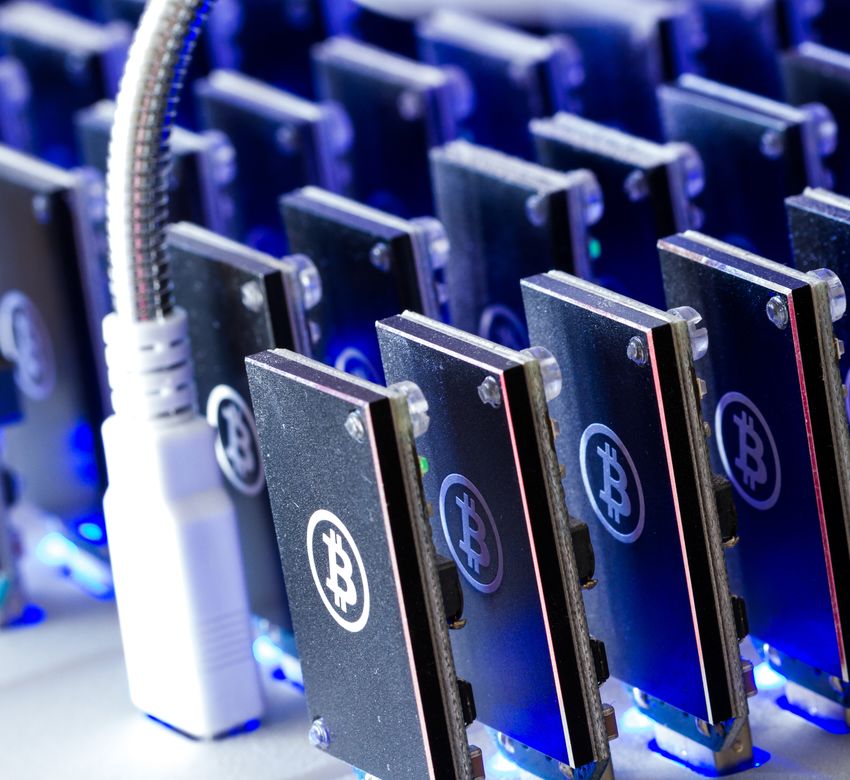
 Bitcoin mine close-up (jure@Bigstock.com)
                                                                               Although it was originally expected that all 21
                                                                               million bitcoins would be mined by 2140, the
    All blockchain systems, including those                                    rapid changes in valuation and the continued
underlying cryptocurrencies, rely on a distributed                             building of large-scale bitcoin mining facilities
ledger and network nodes to verify the                                         could accelerate the exhaustion of the supply of
authenticity of a specific block, such as a unique                                        13
                                                                               bitcoins. Of course, other cryptocurrencies have
unit of cryptocurrency. The distributed ledger                                 been and will likely continue to be created with
attempts to prevent fraud and counterfeiting                                   new, artificially architected raw supplies
through self-verification, effectively doing away                              available for mining across our technological
with the need for oversight of the cryptocurrency                              world.
                                                                                      14
                                     9
by a central bank or administrator.                                                The algorithms needed to link the coins and
    Cryptocurrencies are completely electronic.                                generate proof-of-work are major elements in
New coins are created through a process called                                 what makes cryptocurrency mining so difficult.
“mining”: Computers are used to create a new                                   Large banks of dedicated computers and servers
block, which includes an algorithmic                                           are used in massive, loud, heat-generating old
cryptographic hash that links the new block to the                             warehouses and factories that have been
prior block (hence creating the blockchain) and a                              repurposed as mining facilities. Concerns have
proof-of-work that includes a number referred to                               been raised about energy consumption and the
as a nonce. The proof-of-work requires the                                     environmental effects of these activities.
                                                                                                                          15
                                       10
solutions to mathematical problems, and the
system readjusts periodically to raise the
difficulty of these computations to effectively
                                                                                  11
                                                                                    Difficulty is generally expressed as the estimated number of hashes
                                                                               required divided by 232 (approximately 4.3 billion). Between March 1,
                                                                               2014, and March 1, 2015, the average number of hashes miners had to try
                                                                               before creating a new block increased from 16.4 quintillion to 200.5
                                                                               quintillion, which could also be expressed as a difficulty change from
                                                                               approximately 3.8 billion to approximately 46 billion. Since the start of
                                                                               2016, the difficulty has continued to increase precipitously: Difficulty as
                                                                               of December 24, 2017 was approximately 1.8 trillion (or requiring
                                                                               approximately 7.74 x 10²¹ attempted hashes).
                                                                                  12
                                                                                       Jerome Morrow, “What Is a Coinbase Transaction?” Cex.io, Oct. 29,
                                                                               2014.
                                                                                  13
   9                                                                                 The year 2140 was an estimate. Given that each added block
    Shyam Shankar, “Centralized Ledgers vs. Distributed Ledgers
                                                                               includes transaction fees for the successful miner and that successive
(Layman Understanding),” Medium.com, July 12, 2017.
   10                                                                          blocks reward miners with fewer new bitcoins, by the time miners are
     Adding leading zeroes to the solution of the mathematical problem         close to 21 million bitcoins the transaction fees themselves may be a
increases the difficulty exponentially. For example, the hash of the           sufficient incentive to mine.
genesis block had 10 leading zeroes. In early days, the number of leading         14
                                                                                   Prableen Bajpai, “The 6 Most Important Cryptocurrencies Other
zeroes fell as low as eight, but it has increased dramatically to around 18.
                                                                               Than Bitcoin,” Investopedia, Dec. 7, 2017.
Kiran Viadya, “Decoding the Enigma of Bitcoin Mining — Part I:                    15
Mechanism,” All Things Ledger, Dec. 14, 2016.                                          Popper, “Into the Bitcoin Mines,” The New York Times, Dec. 22, 2013.

TAX NOTES, FEBRUARY 19, 2018                                                                                                                        1003

                                              For more Tax Notes content, please visit www.taxnotes.com.
SPECIAL REPORT

                                                                                                                                                     © 2018 Tax Analysts. All rights reserved. Tax Analysts does not claim copyright in any public domain or third party content.
B. Tracking Ownership: Keys and Wallets                                   each fraction registered separately as part of the
                                                                          blockchain, potentially even segregated into
    Each bitcoin has a unique electronic address.
                                                                          discrete wallets, each with its own public and
Transfer of a bitcoin requires both a public and
                                                                          private keys.
private key. The public key is on the blockchain,
while the private key is only in a miner’s digital                            Bitcoin can also be owned indirectly. Some
wallet. It is virtually impossible to reverse-                            entities may have restrictions on investment types
engineer a private key. In an exchange, the public                        that could prohibit direct investments in
key identifies the electronic address and the                             alternative assets like cryptocurrencies. Indirect
private key verifies the transaction, like a digital                      investments in custodial arrangements offered by
signature. Losing a private key is equivalent to                          some market participants might avoid those
losing cash, because the network does not                                 restrictions.
recognize any method of ownership besides
                                                                          C. Forks and Coin Creation
private keys. This point is emphasized by the
story of a man who claims to have lost the private                            As a blockchain, each block of bitcoin
keys for 7,500 bitcoins in 2013 because he had                            transactions effectively links under prescribed
accidentally thrown away a hard drive containing                          rules to all others. When the rules for a blockchain
them (worth approximately $75 million,                                    are updated or changed, older blocks in the chain
                                                    16
assuming a bitcoin value of $10,000 per coin).                            may no longer meet the newer requirements and
    A software wallet holds the information                               may therefore no longer be linked to the blocks
needed to identify bitcoins, and it can be online                         created after the update or change. This creates a
(permitting ready access) or offline. It essentially                      fork (like a fork in the road), or the creation of two
stores a person’s credentials that identify bitcoin                       different potential paths: an existing path, which
holdings (the private and public key pairs).
                                                 17
                                                                          simply follows the old rules; and another
Bitcoins can be stolen if the private keys are                            potential path, on which new blocks are linked
stolen, so security of this information is critical. A                    based on the updated or changed rules. Because
theft of this kind notably occurred in 2011 with                          bitcoin is not centrally managed, each of its
Mt. Gox, a Tokyo-based bitcoin exchange.
                                              18
                                                                          participants has the ability to decide which path
Accordingly, to manage security risks, this                               they want to take. The viability of each path
information may sometimes be kept in a paper                              depends on the mining power represented by the
wallet (physically printed and stored) or a                               participant’s choice. Presumably, a consensus will
hardware wallet (the storage of the information                           emerge based on values in the marketplace.
electronically but offline, not connected to the                              A hard fork can be an intentional result of
internet).                                                                newer rules that might be added to correct
    A single bitcoin has often had a value of                             security risks or provide some other technological
                                                                                   20
hundreds or thousands of dollars, but there are                           benefit. A bitcoin hard fork took place in August
standardized fractions of bitcoins that can be held,                      2017, arising because some participants wanted to
bought, or sold. The smallest fractional amount                           change the one-megabyte standard size of a
recorded by the blockchain is a “satoshi,” which                          bitcoin block to eight megabytes to increase
represents one hundred millionth of a single                              transaction processing speed. This hard fork
        19
bitcoin. Accordingly, individuals could acquire                           created a split in the bitcoin blockchain, and for
small fractions of bitcoins at different times, with

                                                                             20
                                                                                A soft fork differs in that the new blocks comply with all the old
   16                                                                     rules but are also subject to new rules. Soft forks rely on miners
      Aatif Sulleyman, “Man Who ‘Threw Away’ Bitcoin Haul Now             switching over to the new rules. This means that while nodes mining
Worth Over $80M Wants to Dig Up Landfill Site,” The Independent, Dec.     under the old rules will recognize the new blocks as valid, nodes mining
4, 2017.                                                                  under the new rules might not recognize blocks mined under the old
   17
      “How to Choose the Best Bitcoin Wallet,” www.bitcoin.com (Jan.      rules after the fork. For example, if 75 percent of miners recognize the
27, 2017).                                                                new rules, 25 percent of the new blocks generated might not follow the
   18                                                                     new rules. Nodes running the old rules will see them as valid, but new
     Robert McMillan, “The Inside Story of Mt. Gox, Bitcoin’s $460
                                                                          nodes will probably ignore them. Theoretically, this should result in
Million Disaster,” Wired, Mar. 3, 2014.
   19                                                                     speedy adoption once the majority of nodes follow the new rules, since
     Popper, supra note 5.                                                miners do not want their nodes to be rejected.

1004                                                                                                    TAX NOTES, FEBRUARY 19, 2018

                                          For more Tax Notes content, please visit www.taxnotes.com.
SPECIAL REPORT

                                                                                                                                                       © 2018 Tax Analysts. All rights reserved. Tax Analysts does not claim copyright in any public domain or third party content.
pre-fork holders of bitcoin it essentially resulted                        held a bitcoin before both forks can effectively sell
in ownership of two separate sets of coins: bitcoin                        the bitcoin three times: once under the bitcoin
                  21
and bitcoin cash. In practice, all holders of                              gold rules, once under the bitcoin cash rules, and
                                                                                                                  24
bitcoin as of the date of the hard fork (as                                once under the original bitcoin rules.
referenced by a particular block in the bitcoin
chain) received the right to an equal number of                            D. Other Cryptocurrencies and Tokens
bitcoin cash units. After the hard fork, the relative                          There are several cryptocurrencies other than
ownership of bitcoin and bitcoin cash was                                  bitcoin. Bitcoin cash and bitcoin gold have already
expected to quickly diverge. Miners could                                  been mentioned, but others of note include
prospectively mine either cryptocurrency,                                  Litecoin and Ripple. Future cryptocurrencies are
deciding on an ongoing basis whether bitcoin or                            inevitable; in general, they are intended to
bitcoin cash would result in better profitability to                       function as a standardized and liquid medium of
the miner. Similarly, investors could decide which                         exchange that does not rely on a central banking
cryptocurrency they would rather prospectively                             system. Electronic currencies are often intended
acquire: bitcoin or bitcoin cash.                                          to provide global access to a currency that may be
    In November 2017 another hard fork of bitcoin                          more stable than local currencies. The blockchain
occurred, resulting in bitcoin gold. It was believed                       architecture and distributed record system is
that the bitcoin mining algorithms tended to                               intended to facilitate lower fees for exchange
create a centralization of the mining environment.                         transactions than those that typically arise with
Bitcoin gold’s algorithms were designed in a                               existing centralized-bank-supported currency
manner intended to provide better opportunities                            exchange systems.
                                                                                               25
                     22
for smaller miners. All holders of bitcoin as of the                           Related but distinguishable from
date of the November hard fork (as referenced by                           cryptocurrencies are tokens or smart contracts
a particular block in the bitcoin chain) effectively                       like Ethereum, Filecoin, Storj, and Blockstack.
                                                                                                                           26

received the right to an equal number of bitcoin                           Rather than serve as a medium of exchange,
gold units. Mining and investment of bitcoin and                           tokens or smart contracts use blockchain and a
bitcoin gold was similarly expected to rapidly                             distributed record system to track ownership of
diverge. An investor holding a single bitcoin that                         assets and facilitate execution of promises and
was mined before either fork, before making any                            other agreements electronically in a manner that
trades, theoretically holds a unit each of bitcoin,                        eliminates the need for access to centralized and
bitcoin cash, and bitcoin gold following the                               stored records or existing signature verification
             23
second fork. After both forks, an investor who                             protocols.
                                                                                      27

                                                                           E. Cryptocurrency Derivatives
                                                                              “It is rare that you see something more
                                                                           volatile than bitcoin, but we found it: bitcoin

                                                                              24
                                                                                 For example, bitcoin cash nodes recognize bitcoin balances from
                                                                           before the fork but don’t recognize spending transactions on the bitcoin
   21                                                                      chain after the fork, and bitcoin nodes likewise recognize bitcoin cash
     Amy Castor, “Bitcoin Cash 101: What Users Need to Know Before
                                                                           balances but don’t recognize bitcoin cash spending transactions. Post-
the Fork,” Coindesk.com, July 31, 2017.
   22                                                                      fork, a holder can dispose of the bitcoin he held before the fork twice —
      The two major changes were shifting to a more memory-intensive       once with a bitcoin spend transaction, and once with a bitcoin cash
and less processor-intensive mining algorithm, and adjusting mining        spend transaction. Jim Calvin, “Adequately Identifying Bitcoin
difficulty after each block rather than approximately every two weeks.     Dispositions for Federal Income Tax Purposes,” 58 Tax Mgmt. Memo. 363,
Aaron van Wirdum, “Bitcoin Gold Launches on November 12,” Bitcoin          366 (2017).
Magazine, Nov. 11, 2017.                                                      25
   23                                                                            Satoshi Nakamoto, “Bitcoin: A Peer-to-Peer Electronic Cash
      Depending on the method of bitcoin storage, some bitcoin holders     System,” bitcoin.org, at 1 (undated) (“The cost of mediation increases
may not immediately be able to access the forked virtual currency. For     transaction costs.”). Satoshi Nakamoto is a pseudonym; the real identity
example, the cryptocurrency exchange Coinbase did not initially permit     of the author or authors is unknown.
users to withdraw the bitcoin cash they received because of the fork.         26
                                                                                David J. Shakow, “The Tax Treatment of Tokens: What Does It
“Bitcoin Cash — Frequently Asked Questions,” coinbase.com, Dec. 19,
                                                                           Betoken?” Tax Notes, Sept. 11, 2017, p. 1387.
2017. Note substantial price variances can occur between the date of the      27
fork and access to the forked virtual currency.                                 Id.

TAX NOTES, FEBRUARY 19, 2018                                                                                                                 1005

                                           For more Tax Notes content, please visit www.taxnotes.com.
SPECIAL REPORT
© 2018 Tax Analysts. All rights reserved. Tax Analysts does not claim copyright in any public domain or third party content.
futures,” said Zennon Kapron, a consultant regulations, when they give specific direction or
quoted by Bloomberg, on December 10, 2017 — guidance (as opposed to being only
the day bitcoin futures began trading on the announcements), notices are considered tax
28 31
Chicago Board Options Exchange (CBOE). authority. Given the lack of other guidance on
Not surprisingly, derivatives for bitcoin and cryptocurrencies and the specific direction and
other cryptocurrency have emerged. These permit guidance in the notice, it is informative of the
indirect investment in cryptocurrencies, facilitate IRS’s views. Notice 2014-21 provides its guidance
shorting and potential arbitrage opportunities, in the form of answers to several frequently asked
and may offer different levels of liquidity and questions. Although many commentators concur
other benefits of exchange-traded investing. On with the conclusions in the notice, some have
December 10 and December 17, 2017, raised concerns that tax compliance with its
respectively, bitcoin futures were introduced by positions, particularly for small transactions, is
32
both of the Chicago-based futures exchanges: the burdensome.
CBOE and the Chicago Mercantile Exchange
29
(CME). Other financial derivatives also permit B. Bitcoin: Currency or Property?
investors to indirectly take positions in As is often discussed, U.S. income taxation of
cryptocurrencies. For example, Grayscale financial instruments is generally based on a
manages an investment trust that holds bitcoin schema premised on a particular financial
(over-the-counter markets ticker GBTC), and instrument’s tax classification. The applicable tax
investors can purchase shares that represent a rules are generally determined by that tax
30
portion of the trust’s holdings. In May 2015 classification. Subpart J (of Part III of subchapter
issuer XBT Provider began offering exchange- N of the code) provides a set of tax rules that
traded notes (ETNs) in Europe that are intended applies to transactions concerning currencies.
33
to mirror the returns of bitcoin (one is based on Notably, those rules do not include an explicit
the Swedish kroner and another is based on definition of currency. Thus, a threshold issue is
euros). whether cryptocurrencies are considered
currencies or property for U.S. income tax
II. U.S. Taxation purposes.
A. Notice 2014-21 That issue was addressed by Notice 2014-21.
The notice begins by defining a virtual currency
In March 2014 the IRS released Notice 2014-21, as “a digital representation of value that functions
2014-16 IRB 938, which provides the agency’s as a medium of exchange, a unit of account, and/
conclusions on some basic tax principles or a store of value,” and further defines a
concerning cryptocurrencies. Although notices do convertible virtual currency as a subset of virtual
not have the force and effect of statutes or currencies “that has an equivalent value in real
31
See, e.g., reg. section 1.6662-3(b)(iii) (providing that for purposes of
the penalty for underpayments attributable to negligence or disregard of
rules or regulations, rules and regulations include code provisions,
temporary or final Treasury regulations issued under the code, and
revenue rulings or notices (other than notices of proposed rulemaking)).
Reg. section 1.6662-3(b)(2). See also reg. section 1.6662-4(d)(3)(iii)
(identifying notices as an authority concerning the substantial authority
28
defense to the imposition of understatement penalties).
Yuji Nakamura, Camila Russo, and Rob Urban, “Bitcoin Futures 32
William Hoffman, “After March IRS Notice, Bitcoin Users Await
Deliver Wild Ride as Debut Brings Rally, Halts,” Bloomberg, Dec. 10, More Tax Guidance,” Tax Notes, Sept. 8, 2014, p. 1128 (reporting that
2017. David Golden, director of the capital markets tax practice at EY, said
29
See CBOE XBT Bitcoin Futures, and CME Group Bitcoin Futures “The IRS could provide a de minimis rule for taxpayers’ administrative
Key Information Document. convenience for when bitcoin is used in a personal transaction as a
30 medium of exchange.”). See also Eric Kroh, “More Guidance Sought on
The investment trust, formed in 2013, functions like a commodities
investment trust. Each share represents approximately 0.09181239 Bitcoin and Other Virtual Currencies,” Tax Notes, Apr. 7, 2014, p. 32.
33
bitcoin, as of January 3, 2018. Although a registration statement for the Sections 985 through 988. Note these provisions only apply to non-
Bitcoin Investment Trust was filed with the SEC on May 4, 2017, it was functional currencies. In general, this report does not discuss cross-
withdrawn on October 25, 2017. Bitcoin Investment Trust, “Registration border or other international tax issues, including those related to
Statement” (Form S-1) (May 4, 2017). sourcing or withholding.
1006 TAX NOTES, FEBRUARY 19, 2018
For more Tax Notes content, please visit www.taxnotes.com.SPECIAL REPORT
© 2018 Tax Analysts. All rights reserved. Tax Analysts does not claim copyright in any public domain or third party content.
currency, or that acts as a substitute for real currency is a currency subject to subpart J under
34 41
currency.” The notice provides that bitcoin is a similar circumstances.
convertible virtual currency, and it cross- Despite the guidance of Notice 2014-21,
references guidance issued by the Financial important questions remain. The notice does not
Crimes Enforcement Network for a address the kind of property that virtual property
42
comprehensive description of convertible virtual should be regarded as for tax purposes. For
35
currencies. The notice limits its scope of example, could it be considered a commodity or a
application to convertible virtual currencies and security? The Commodity Futures Trading
states that it does not provide guidance outside Commission has already ruled bitcoin a
43
that scope. Accordingly, its guidance presumably commodity for purposes of futures trading.
does not apply to Ethereum or other token-based Could bitcoin therefore be considered a
36 44
blockchain systems like smart contracts. commodity for tax purposes? Alternatively,
Notice 2014-21 provides that virtual currency could a virtual currency be classified as stock for
45
is treated as property for federal income tax federal income tax purposes? A further
purposes, not as currency that would be subject to complication is that the same terms can have
rules applicable to currency transactions under different definitions under different tax
37 46
subpart J. The release of the notice and its provisions. The lack of additional clarity is a
conclusion regarding the treatment of virtual major concern in trying to understand the
currencies like bitcoin was generally greeted with potential tax consequences of virtual currencies in
agreement and relief by tax practitioners and several contexts, as discussed later.
38
commentators. However, some noted that
property treatment would likely reduce the use of
virtual currencies for payment because of the
potential to recognize gain or loss on each
39
disposition. Some concerns have been raised
regarding whether virtual currencies could still be 41
ABA tax section, “Comments on Notice 2014-21,” at 3 (Mar. 24,
considered currencies if facts become different 2015) (asking whether a virtual currency might be considered foreign
than those posited in the notice, like the effect of currency subject to subpart J if adopted as legal tender by a foreign
country. Note that this concern is far from purely speculative; Japan
participation by a central bank. For example, recognizes the bitcoin as legal tender). See Emiko Terazono, “Bitcoin Gets
Venezuela is reportedly close to founding a Official Blessing in Japan,” Financial Times, Oct. 17, 2017.
42
40
cryptocurrency backed by its oil. A report by the Hoffman, supra note 32 (quoting Golden as saying that the IRS “has
not offered guidance on what type of property bitcoin is, which might
American Bar Association Section of Taxation on determine how it can be taxed”).
43
the notice raises the question whether a virtual See In re Coinflip Inc., d/b/a Derivabit, and Francisco Riordan, CFTC
Dkt. No. 15-29, Comm. Fut. L. Rep. (CCH) para. 33,538 (CFTC Sept. 17,
2015) (consent order); and In re TeraExchange LLC, CFTC Dkt. No. 15-33
Comm. Fut. L. Rep. (CCH) para. 33,546 (CFTC Sept. 24, 2015) (consent
order).
34 44
Notice 2014-21 at 938. At least one commentator believes the classification of bitcoin as a
35 commodity for tax purposes is likely. See Calvin, supra note 24, at 367
Id. FinCEN, “Guidance on the Application of FinCEN’s Regulations n.45.
to Persons Administering, Exchanging, or Using Virtual Currencies,” 45
FIN-2013-G001 (Mar. 18, 2013). A recent article raises this possibility, turning largely on the
36 difficult interpretive question of whether holders of cryptocurrencies are
Presuming that there is a clear, understandable delineation jointly participating in business profits. Shakow, supra note 26. Analysis
between cryptocurrencies and other token-based systems. However, at of this question would examine whether participants in a
least one commentator argues that the delineation is less than clear. See cryptocurrency system could be considered a cohesive group and
American Institute of CPAs, “Comments on Notice 2014-21: Virtual whether the token or coin generated could be considered a share in an
Currency Guidance” (June 10, 2016). enterprise, like a share of stock, certificate of participation, or other unit
37
Notice 2014-21, Q&A-1 and Q&A-2. of representation that could be a stock or security under tax or securities
38 law. Could the group be an association taxable as a corporation? Under
Hoffman, supra note 32. William R. Davis, “Bitcoin Guidance Not section 7701 and its regulations, as well as the earlier case law, it appears
Designed to Answer All Questions,” Tax Notes, Mar. 30, 2015, p. 1603. difficult to combine cryptocurrency creators, miners, and/or holders as a
39
Kroh, supra note 32 (“Victor Fleischer of the University of San partnership, de facto corporation, or any type of enterprise of persons
Diego School of Law said the IRS guidance results in the correct tax contributing capital or acting together. See reg. section 301.7701-2(b)(2)
treatment of virtual currencies but doesn’t leave much room or (defining the term “corporation” to include an association as determined
accommodation to allow virtual coins to be functional currencies.”). under reg. section 301.7701-3); Commissioner v. Tower, 327 U.S. 280 (1946);
40 and Commissioner v. Culbertson, 337 U.S. 733 (1949).
See “Venezuela Oil-Backed Cryptocurrency to Launch in Days, 46
Government Says,” CNBC (Dec. 29, 2017). Similarly, Israel is considering For example, securities can include stock or can be limited to
offering a national cryptocurrency. See Jon Buck, “Israel Government specific debt instruments, depending on the particular application in the
Considering National Cryptocurrency,” Cointelegraph, Dec. 24, 2017. code.
TAX NOTES, FEBRUARY 19, 2018 1007
For more Tax Notes content, please visit www.taxnotes.com.SPECIAL REPORT
© 2018 Tax Analysts. All rights reserved. Tax Analysts does not claim copyright in any public domain or third party content.
C. Miners, Dealers, and More D. Taxation of Mining and Payment
The tax treatment of property can radically Notice 2014-21 provides that convertible
differ depending on a person’s relationship to the virtual currencies (cryptocurrencies) received as
property — that is, the purpose for which the payment for goods and services must be included
taxpayer holds the property. For example, special in gross income for tax purposes based on the fair
tax rules and tax treatment typically apply to market value of those cryptocurrencies as of the
49
manufacturers and dealers. Those rules are date received. The notice specifies that a
usually very different from the tax rules and tax taxpayer who mines virtual currency must
treatment that typically apply to persons that include the FMV of the virtual currency received
50
merely acquire and hold that created, in gross income as of the date of receipt. If the
manufactured, or sold property. As discussed mining activity is carried on as a trade or business
above, there are miners of bitcoin and other and the miner is not conducting those activities as
cryptocurrencies. There are also dealers and an employee, the earnings from the mining
issuers of related derivatives. Some merchants activity (net of allowable business expense
that do not mine may simply acquire or exchange deductions) constitute self-employment income
51
cryptocurrencies in connection with their trades and would be subject to self-employment tax.
or businesses. Purchasers of cryptocurrencies and The notice further clarifies that an independent
related derivatives may be dealers, traders, or contractor who mines virtual currency has self-
52
investors from a tax perspective. And some employment income. Similarly, if a miner
holdings could be personal. The character and conducts mining activities and receives virtual
timing of income and the deductibility and timing currency as an employee, the value of the
of expenses related to cryptocurrencies may differ cryptocurrencies received are considered wages
47
substantially depending on those relationships. subject to federal income tax withholding by
53
For example, one commentator noted that gains employers, according to the notice. It further
from cryptocurrencies held as personal property provides that FICA and FUTA taxes also apply
would generally be taxable, whereas losses would and must be reported in connection with the
48 54
not. receipt of virtual currency.
This report generally focuses on basic tax
issues concerning investors and does not E. Forms 1099 and Backup Withholding
comprehensively address the potential tax In general, when a business pays $600 or more
consequences of miners’ activities. It does, to an independent contractor for the performance
however, discuss the pronouncements of Notice of services, the payer must timely file a Form
2014-21 regarding miners of cryptocurrencies. 1099-MISC with the IRS and provide a copy to the
55
payee (a reportable payment). Each payee must
generally give the payer their tax ID and related
information on Form W-9. If a tax ID is requested
and the payee does not timely and properly
provide it to the payer, the payer must withhold
47
Other relationships will continue to present themselves as
tax from the related payment (backup
blockchain technology’s effects resonate through the financial sector.
Some banks and credit card companies intend to use Ripple’s
blockchain-based method of clearing cross-border payments. See Martin
Arnold, “Ripple Cryptocurrency Surges as Japanese Groups Agree to
49
Use It,” Financial Times, Dec. 29, 2017; and Ryan Brown, “American Notice 2014-21, at 938, Q&A-1.
Express, Santander Team Up With Ripple for Cross-Border Payments 50
Via Blockchain,” CNBC (Nov. 16, 2017). Ripple also has an eponymous Id. at 939, Q&A-8.
51
cryptocurrency. Note that income-sourcing concerns are beyond the Id. at 939, Q&A-9.
scope of this report. 52
48 Id. at 939, Q&A-10.
David Stewart, “IRS Preps Bitcoin Investigators as Treatment 53
Questions Remain,” Tax Notes, Sept. 29, 2014, p. 1538 (“Steven M. This is not limited to mining services performed by an employee;
Rosenthal of the Urban Institute said that given Treasury and the IRS’s virtual currency paid by an employer as remuneration for any services
position, a person who uses bitcoin exclusively for consumption will be generally constitutes wages. Id. at 939, Q&A-11.
required to recognize gains, but would be denied deductions for any 54
Id.
losses because the transaction was not entered into for profit as required 55
by section 165(c)(2).”). Id. at 939, Q&A-13.
1008 TAX NOTES, FEBRUARY 19, 2018
For more Tax Notes content, please visit www.taxnotes.com.SPECIAL REPORT
© 2018 Tax Analysts. All rights reserved. Tax Analysts does not claim copyright in any public domain or third party content.
withholding).56 Notice 2014-21 provides that of property ownership), or whether it is received
payments made in connection with a trade or when record ownership is transferred.
business in bitcoin or other virtual currencies are
subject to backup withholding under those G. Uncertainty for Miners and Merchants
circumstances, just like other payments made in The ABA tax section has raised concerns
57
property. about the reporting of fees for facilitating virtual
Credit card intermediaries are also subject to 62
currency transactions. Both the ABA tax section
specific information reporting requirements and the American Institute of CPAs have
under the tax law. They must generally report recommended a de minimis rule for reporting
payments made to merchants on Form 1099-K if, virtual currency gains and losses (similar to the
for a calendar year, more than 200 transactions are rule that applies to currency transactions under
settled for the merchant and gross payments section 988(e)), even though legislation may be
made to the merchant exceed $20,000. The notice 63
needed to authorize that treatment. The ABA tax
provides that payments made in bitcoin or other section has also requested guidance on the
virtual currencies can be reportable on Form 1099- documentation that will be expected to establish
58
K. cost, holding periods, and measures of value,
A miner may be considered as receiving particularly for exchanges that do not use the U.S.
virtual currencies in connection with the 64
dollar for virtual currency valuations. The
performance of services. However, investors and AICPA has requested guidance on charitable
traders in virtual currencies may simply receive contributions of virtual currency.
65
them in exchange for property or cash, and not in The ABA tax section also asked for guidance
connection with services. Notably, Notice 2014-21 on the tax treatment of mining costs and the
does not address the information reporting timing and manner of related deductions, as well
consequences of virtual currency transactions in as guidance on the tax consequences of pooled
exchange for property or cash that are not 66
mining activities. For example, are the pools
59
reportable on Form 1099-MISC or Form 1099-K. considered partnerships for tax purposes? Can a
section 761 election be made? What would be the
F. Each Bitcoin Has a Unique Basis timing and character of pooled activity income?
Notice 2014-21 provides that the cost basis of The tax treatment of pooled mining is of critical
a unit of cryptocurrency received as a payment for importance because many miners work
goods or services is equal to the FMV of that unit collectively on a pooled basis due to the
60
in U.S. dollars on the date received. The ABA tax technology and power required to mine.
section, in comments on the notice, requested that Even more fundamentally, the ABA tax
61
the meaning of the term “received” be clarified. section requested additional guidance on the tax
The group also asked whether bitcoin is deemed consequences and nature of each of the steps
received on the date earned (presumably the date constituting mining activities (as services or as
the benefits and burdens of ownership of the mere investment). Could specific mining
cryptocurrency unit are considered transferred activities result in “prize income, earned income,
67
for tax purposes under tax common law concepts or even in some instances capital assets”?
62
56
Id. at 3 (If “third-party exchanges charged transaction fees for
Id. at 939, Q&A-14. facilitating transactions, how would a merchant conducting business
57 report such fees?”).
Id. 63
58 Id. at 4; and AICPA, supra note 36, at 4.
Id. at 939, Q&A-15. 64
59 ABA tax section, supra note 41, at 4. The AICPA has also raised
Id. at 939, Q&A-13 and Q&A-15. But see the discussion below of cost concerns about how to measure the value of cryptocurrency, since
basis reporting regarding whether the definition of a commodity under different exchanges often report different values concurrently. AICPA,
reg. section 1.6045-1(a)(5) potentially triggers Form 1099-B reporting and supra note 36, at 2.
related backup withholding obligations under sections 3406 and 6045. 65
60 AICPA, supra note 36, at 4.
Notice 2014-21 at 941, Q&A-15. 66
61 ABA tax section, supra note 41, at 5.
ABA tax section, supra note 41, at 4 (“When is virtual currency 67
received?”). Id.
TAX NOTES, FEBRUARY 19, 2018 1009
For more Tax Notes content, please visit www.taxnotes.com.SPECIAL REPORT
© 2018 Tax Analysts. All rights reserved. Tax Analysts does not claim copyright in any public domain or third party content.
H. Taxation of Receipt and Disposition I. Character of Gain or Loss Recognized
Notice 2014-21 provides taxpayers can Notice 2014-21 provides that the character of
recognize taxable gain if they exchange virtual gain or loss on the disposition or exchange of
currency for property or cash. The amount of gain virtual currency depends on the nature of the
76
is the amount by which the FMV of property or holdings in the hands of the taxpayer. As
the amount of cash received exceeds the discussed above, a miner, dealer, or issuer might
taxpayer’s adjusted basis of the virtual currency hold bitcoins or other virtual currencies as
68
exchanged. If the basis of the virtual currency inventory for sale in that person’s trade or
disposed of exceeds the FMV of property or the business. Alternatively, bitcoin or other virtual
69
amount of cash received, the taxpayer has a loss. currencies could be held by a trader or investor.
The notice provides that the deductibility of the And some holdings could be personal. The tax
loss depends on other factors, and it cross- consequences and character of gain or loss could
references IRS Publication 544, “Sales and Other be very different depending on the nature of a
70
Dispositions of Assets.” In general, losses from person’s holdings. The notice cross-references
77
the exchange or disposition of assets held for Publication 544 for additional information.
71
personal purposes are not deductible. For investors, the notice indicates that gain or
The ABA tax section comment letter72 requests loss on the sale or exchange of virtual currencies
guidance on how the FMV of property received is will likely be capital gain or loss. Capital gains
determined when one virtual currency is and losses are segmented depending on whether
exchanged for another, and the AICPA comment they are long term (for assets held for at least one
73
letter raises concerns about differing quoted year) or short term (held for less than a year)
values by different market makers. Questions also based on a disposed asset’s holding period at the
remain about nonrecognition or deferral of gain time of sale, exchange, or other taxable
74
or loss under several other provisions. And as disposition. Long-term capital gains can be
discussed above, commentators have requested a eligible for favorable tax treatment and lower tax
78
de minimis rule to permit taxpayers to better rates than other types of income. Capital losses
manage the burden of calculating gain or loss for are typically limited under the tax law so that only
75
small transactions. $3,000 per year can be recognized, and any losses
exceeding $3,000 for individuals (and zero for
corporations) are carried forward under special
79
carryforward rules and limitations. Generally,
an asset’s holding period begins on the day after it
is acquired and ends on the date of sale or
80
disposition.
If significant losses in market value occur,
68
holders of virtual currencies may argue that they
Notice 2014-21 at 938, Q&A-6. are not investors but rather traders who can elect
69
Id.
70
Id.
71
Hoffman, supra note 32 (quoting Rosenthal as saying, “That means
that personal bitcoin gains can be taxed, but personal losses cannot be
recognized or deducted.”).
72
ABA tax section, supra note 41, at 5.
73
AICPA, supra note 36, at 2.
74
For example, the ABA tax section specifically requested guidance
regarding like-kind exchanges under section 1031. ABA tax section,
supra note 41, at 5. We note that although section 13303(a) of the Tax Cuts
76
and Jobs Act (P.L. 115-97) limits like-kind exchanges under section 1031 Notice 2014-21 at 938, Q&A-7.
to exchanges of real property, questions may remain for transfers before 77
its effective date. Further, sections 1091 and 1092 might apply to defer Id.
losses on the sale or exchange of financial instruments, and questions 78
Section 1(h).
remain concerning whether installment sales provisions might apply to 79
defer the timing of recognition of gain. AICPA, supra note 36, at 3. Section 1211.
75 80
ABA tax section, supra note 41, at 4; and AICPA, supra note 36, at 4. Section 1223.
1010 TAX NOTES, FEBRUARY 19, 2018
For more Tax Notes content, please visit www.taxnotes.com.SPECIAL REPORT
© 2018 Tax Analysts. All rights reserved. Tax Analysts does not claim copyright in any public domain or third party content.
mark-to-market tax treatment of those holdings property (and, implicitly, the amount of cash)
81
under section 475. Eligibility for mark-to-market received on that transaction and the adjusted
86
treatment depends on virtual cryptocurrencies basis of the virtual currency exchanged.
constituting either a commodity or a security Two important issues are apparent. First, the
82
under section 475. This would permit ordinary adjusted basis at the time of the sale of the virtual
(rather than capital) losses without a $3,000-per- currency must be determined. Second, if more
year limitation but would also result in than one tax lot of virtual currency was acquired
recognition of mark-to-market ordinary income by the taxpayer, it must be determined which
(rather than capital gains) on any appreciation in specific lot was considered sold.
holdings occurring during each applicable tax Section 1012 generally provides that a
year (rather than the recognition of gain or loss taxpayer’s basis in property is its cost. Section
83
strictly at the later time of disposition). 1016 sets forth rules regarding adjustments to
There is substantial litigation between the IRS cost. Commissions on the acquisition of property
and taxpayers regarding the availability and are an example of costs that brokers must add to
87
timing of eligibility for the mark-to-market basis when reporting. Section 1016 includes
election, so careful planning is critical if the other adjustments that can apply depending on
84
election is contemplated. Commentators and the the classification of property as stock. For
ABA tax section have noted that merchants could example, stock splits, reverse splits, stock
be harmed if cryptocurrency gains and losses are dividends, and corporate reorganizations can
treated as capital while their other business each have significant consequences on the cost
activities are not, resulting in a risk of capital basis of related stocks exchanged or received. In
85
losses that cannot offset ordinary income. determining the basis at time of sale, one must
always consider whether basis allocations or
J. Adjusted Basis Upon Sale or Exchange similar adjustments could apply to virtual
Notice 2014-21 provides that the amount of currencies.
income or loss realized in connection with the Similarly, the application of special rules that
sale, exchange, or disposition of virtual currencies apply to stocks and securities (including contracts
is based on the difference between the FMV of the or options to acquire stocks or securities) can also
88
have significant consequences on cost basis. The
wash sale rules, which can substantially affect
basis and holding period calculations of tax lots,
81
Section 475(f) permits traders in securities or commodities to make may not apply to direct holdings in virtual
the election. Section 475 does not apply to securities held for investment.
See section 475(b)(1). That restriction also applies to commodities held currencies and would not apply to section 1256
for investment. See section 475(e)(1). See Allyson Versprille, “Should contracts such as CME and CBOE bitcoin futures.
Bitcoin Investors Become ‘Traders’ for Tax Purposes?” DTR, Jan. 18,
2018. Attorneys cited in the article have noted that although the new tax However, they could apply to other virtual
law causes the loss of itemized deductions for investment-related
expenses — including specialized computer equipment and website
subscriptions — for traders under section 475, those expenses would be
fully deductible. Other concerns include some important downsides to
trader status: the loss of long-term capital gains, and self-employment
tax on net gains. The article notes opposing views on whether
cryptocurrency could be a security under section 475, but it does not
address possible classification as a commodity.
82
See section 475(e)(2) regarding the definition of a commodity and
section 475(c)(1) regarding the definition of security for purposes of this
election.
83
Section 475(b)(3).
84
See, e.g., Poppe v. Commissioner, T.C. Memo. 2015-205; and Spicko v.
Commissioner, T.C. Memo. 2016-41 (taxpayers failed to make valid
section 475 mark-to-market elections).
85
Davis, “Bitcoin Is Property, Not Currency, IRS Says,” Tax Notes, 86
Mar. 31, 2014, p. 1399 (“David S. Miller of Cadwalader, Wickersham & Notice 2014-21 at 938, Q&A-6.
Taft LLP provided a hypothetical situation in which a merchant accepts 87
Reg. section 1.6045-1(d)(6)(i). Similarly, brokers must subtract
$100 worth of virtual currency for merchandise and then sells the
commissions or transfer taxes for sales of securities when reporting. Reg.
currency for $90. In that scenario, the merchant would net only $90, but
section 1.6045-1(d)(5).
unless it had capital gains from other sources to offset the capital loss, 88
the merchant would be taxed on $100.”). Reg. section 1.6045-1(d)(6)(iii).
TAX NOTES, FEBRUARY 19, 2018 1011
For more Tax Notes content, please visit www.taxnotes.com.SPECIAL REPORT
© 2018 Tax Analysts. All rights reserved. Tax Analysts does not claim copyright in any public domain or third party content.
currency derivatives. The straddle rules could first-out method. Specific ID is available on the
apply to virtual currencies and virtual currency disposition of stock only if the taxpayer can
89
derivatives. These issues are discussed in more adequately identify (in a manner specified in the
93
detail below. regulations) which particular lots were sold. An
In general, under section 1012, the basis of average cost method (averaging) is also available
each item of property is separately tracked and under the regulations for stock if various
94
must be used to compute gain or loss upon the requirements are met. Related rules also permit
90
disposal of property. This method for the use of those three methods for bonds and
95
determining the basis upon disposition is book-entry securities.
generally referred to as specific identification. The regulations’ special rules for stocks,
Because ownership of cryptocurrencies is bonds, and book-entry securities make sense
established through private keys, at first blush because individual certificates or book-entry
each specific purchase can be readily identified. records of the same stocks or securities are
However, tracking could be more challenging or generally treated as fungible. Because these
artificial if an investor holds positions in methods are used to manage the tracking of gains
cryptocurrencies through a third-party wallet or and losses from individual lots or blocks of stocks
other intermediary. Under some circumstances, it or securities acquired and held, they are generally
might be difficult to demonstrate which specific referred to as lot relief methods. The use of FIFO,
cryptocurrency tax lot was sold. specific ID, or averaging lot relief methods
To the extent basis allocations arise in provides efficiencies to both investors and
connection with cryptocurrencies, or the straddle intermediaries in managing the tracking of
rules apply, related basis (and holding period) positions in stocks or securities and computing
91
adjustments (or loss deferrals ) may apply or deemed gain or loss on dispositions. Specific
relate to only a portion of a tax lot, thereby guidance in the regulations also benefits the fisc
creating two separate tax lots (one position that by providing clear rules to reduce gamesmanship
was subject to the adjustments, and one that was and inconsistent reporting.
not). We often refer to these resulting tax lots as Does it make sense that the three different lot
“sublots.” For stocks and securities, it can be relief methods also potentially apply to measure
challenging as an operations matter to specifically gains and losses on dispositions of virtual
track these sublots. Similar challenges could arise currencies? Should the availability of those
in identifying sublots in connection with methods be determined based strictly on whether
cryptocurrencies or cryptocurrency derivatives. virtual currencies are or should be considered
The cost basis regulations also provide stocks or securities rather than commodities (or
specific guidance on determining the basis when
92
stock is sold. Under those specific rules, the basis
of stock sold is generally determined on a first-in,
89
As a technical matter, the straddle rules do not provide for basis
adjustments related to deferred losses similar to the wash sale rules.
Instead, the applicable temporary regulations provide that disallowed
losses related to dispositions of positions comprised in a straddle are
deferred and are not allowed unless the positions that resulted in the
deferral are disposed of during the tax year (and the straddle rules do
not trigger further disallowance). Reg. section 1.1092-1T(b). Separately 93
Reg. section 1.1012-1(c)(1)-(3). Under these regulations, adequate
tracking those loss deferrals for allowance later, in lieu of mechanically
confirmation is made if at “the time of the sale or transfer, the taxpayer
adjusting the basis of related positions, could create additional
specifies to such broker or other agent having custody of the stock the
accounting and operations challenges. There may be little practical
particular stock to be sold or transferred, and . . . [w]ithin a reasonable
difference between basis adjustments to deferral-triggering tax lots
time thereafter, confirmation of such specification is set forth in a written
under the wash sale rule and separately tracking and maintaining a
document from such broker or other agent.” Concerns have been raised
pending deferral ledger.
90 regarding the ability to satisfy these requirements in the context of
Reg. section 1.1012-1(a). cryptocurrencies. See Calvin, supra note 24, at 369.
91 94
Rather than explicit basis adjustments for straddles. Reg. section 1.1012-1(e) (election to use average basis method).
92 95
Reg. section 1.1012-1(c). Reg. section 1.1012-1(c)(6) and (7).
1012 TAX NOTES, FEBRUARY 19, 2018
For more Tax Notes content, please visit www.taxnotes.com.You can also read


