2018 2019 GETREADY GETSET GOFORIT - LEARN MORE ABOUT HIGH SCHOOL AND PLAN FOR YOUR SUCCESS - CBE
←
→
Page content transcription
If your browser does not render page correctly, please read the page content below
cbe.ab.ca

  2018          Get Ready         ■
                                      Get Set     ■
                                                      Go For It
  2019          Learn more about high school and plan for your success

Your Detailed
 High School
   Course
    Guide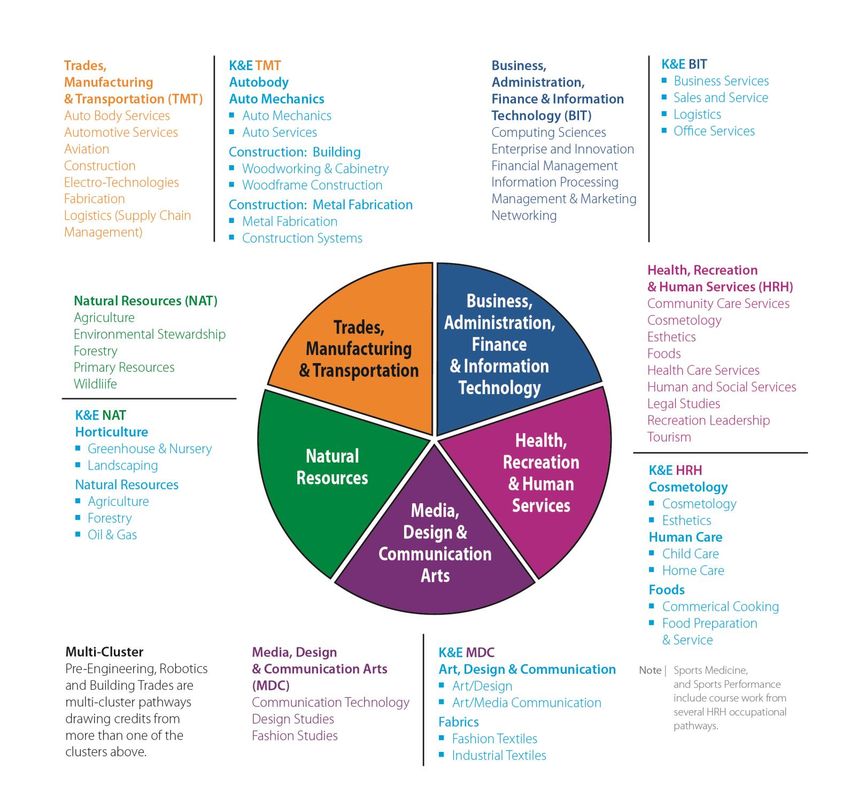
Get Ready | CBE High Schools and Learning Centres

In 2017, the CBE
changed from five
geographic Areas to
seven administrative
Areas. These seven
administrative Areas
use a feeder school
model to more
effectively support
student transitions.

Based on where you
live in the city, you are
connected to a high
school, which is your
home school.

Use the Find a School
link to learn about your
home school or to learn
the locations of
programs of choice.
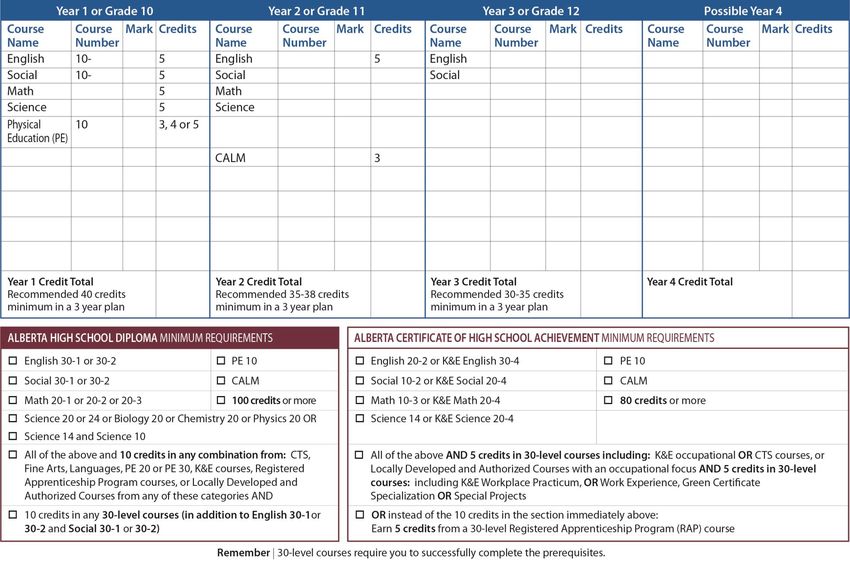
Table of Contents
Get Ready........................................................................................................................................... 1
Planning For Your Success ............................................................................................................. 2
Choose Required Courses First ...................................................................................................... 7
    English Language Arts (ELA) ........................................................................................................................ 7
    Mathematics (Math) ...................................................................................................................................... 8
    Science ......................................................................................................................................................... 9
    Social Studies (Social) ................................................................................................................................ 10
    Wellness | CALM and PE ............................................................................................................................ 11
    English Language Learning (ELL) ............................................................................................................... 12
Career and Technology Studies (CTS) and .................................................................................. 16
Knowledge & Employability (K&E) Occupational Choices ......................................................... 16
    Business, Administration, Finance & Information Technology (BIT) ........................................................... 18
    Health, Recreation & Human Services (HRH) ............................................................................................. 20
    Media, Design & Communication Arts (MDC) ............................................................................................. 23
    Natural Resources (NAT) ............................................................................................................................ 25
    Trades, Manufacturing & Transportation (TMT) .......................................................................................... 27
    Multi-cluster Pathways ................................................................................................................................ 29
Off-campus Education .................................................................................................................... 30
Unique Opportunities ..................................................................................................................... 31
Fine and Performing Arts Choices ................................................................................................ 32
    Arts-Centred Learning Programs (ACL) ...................................................................................................... 32
    CBE Fine and Performing Arts Certificate ................................................................................................... 32
    Performing and Visual Arts (PVA) ............................................................................................................... 32
    Leadership in the Arts 35 ............................................................................................................................ 32
    An Overview of Fine and Performing Arts Courses ..................................................................................... 33
    Dance.......................................................................................................................................................... 34
    Drama ......................................................................................................................................................... 36
    Music: Instrumental Music ........................................................................................................................... 38
    Music: Choral Music .................................................................................................................................... 39
    Music: General Music.................................................................................................................................. 40
    Visual Arts ................................................................................................................................................... 41
Languages | Programs and Courses ............................................................................................ 43
    French Language Arts (FLA / Immersion) ................................................................................................... 44
    French as a Second Language (FSL) ......................................................................................................... 45
    Bilingual Programs and Courses ................................................................................................................. 46
    International Language and Culture Choices .............................................................................................. 47
Complementary Courses ................................................................................................................ 49
    Aboriginal Studies ....................................................................................................................................... 49
    English Language Arts (ELA) ...................................................................................................................... 49
    Interdisciplinary ........................................................................................................................................... 50
    Learning Competencies .............................................................................................................................. 50
    Mathematics ................................................................................................................................................ 51
    Science ...................................................................................................................................................... 51
    Social Sciences ........................................................................................................................................... 53
Unique or Alternative Programs and Settings ............................................................................. 59
    Alternative Programs and Settings of Choice .............................................................................................. 59
Internationally Recognized Programs .......................................................................................... 62
    Advanced Placement (AP) Program ........................................................................................................... 63
    International Baccalaureate (IB) Programme .............................................................................................. 67
International Opportunities ............................................................................................................ 72
Summer School ............................................................................................................................... 73
Awards and Scholarships .............................................................................................................. 74
Appendices ...................................................................................................................................... 75
    Appendix A | Possible Pathways for a Certificate of High School Achievement .......................................... 75
    Appendix B | Part 1 | Course Sequences and Transfer Points .................................................................... 80
    Appendix B | Part 2 | Knowledge and Employability Occupational Course Sequences .............................. 83
    Appendix C | CTS and K&E Occupational Pathways By High School Facilities .......................................... 88
    Appendix D | Course Challenge – Questions and Answers ........................................................................ 92
    Appendix E | Advanced Placement (AP) Courses by School and CBE Area .............................................. 94

                       Your Detailed CBE High School Course Guide 2018 - 2019                                                                                    i
List of Tables
     Table 1 | My High School Program Planning ............................................................................ 6
     Table 2 | ELL / ESL Courses and Language Proficiency Levels ............................................ 14
     Table 3 | Locations for French Immersion and Spanish Bilingual Programs of Choice ......... 43
     Table 4 | AP Schools by Area ................................................................................................. 62
     Table 5 | IB Programme .......................................................................................................... 62
     Table 6 | Sample A Possible Pathways for a Certificate of High School Achievement .......... 75
     Table 7 | Sample B Possible Pathways for a Certificate of High School Achievement .......... 76
     Table 8 | Sample C Possible Pathways for a Certificate of High School Achievement .......... 77
     Table 9 | Sample D Possible Pathways for a Certificate of High School Achievement .......... 78
     Table 10 | Sample E Possible Pathways for a Certificate of High School Achievement ........ 79
     Table 11 | CTS and K&E Occupational Pathways by High School Facilities ......................... 89
     Table 12 | Advanced Placement Courses offered in CBE High Schools ............................... 95

List of Figures
     Figure 1 | Alberta High School Diploma & Certificate of High School Achievement
          Requirements .................................................................................................................... 5
     Figure 2 | An Overview of CTS Occupational Areas and K&E Occupational Courses........... 17
     Figure 3 | An Overview of Fine and Performing Arts Courses ................................................ 33
     Figure 4 | An Overview of the Social Sciences Complementary Course Choices ................. 53
     Figure 5 | Recommended English Language Arts Transfer Points ........................................ 80
     Figure 6 | Recommended Mathematics Transfer Points ........................................................ 81
     Figure 7 | Recommended Science Transfer Points ................................................................ 81
     Figure 8 | Recommended Social Studies Transfer Points ...................................................... 82
     Figure 9 | Recommended (FLA) Course Sequences and Transfer Points ............................. 82
     Figure 10 | Recommended Transfer Points for K&E occupational and CTS courses ............ 83
     Figure 11 | K&E Business Services -4 Sequences ................................................................. 83
     Figure 12 | K&E Cosmetology -4 Sequences ......................................................................... 84
     Figure 13 | K&E Foods -4 Sequences .................................................................................... 84
     Figure 14 | K&E Human Care -4 Sequences .......................................................................... 84
     Figure 15 | K&E Art/Design and/or Art/Media -4 Sequences .................................................. 85
     Figure 16 | K&E Fabrics -4 Recommended Pathways ........................................................... 85
     Figure 17 | K&E Horticulture -4 Sequences ............................................................................ 85
     Figure 18 | K&E Natural Resources -4 Sequences ................................................................ 86
     Figure 19 | K&E Auto Mechanics and Services -4 Sequences............................................... 86
     Figure 20 | K&E Construction: Building -4 Sequences ........................................................... 86
     Figure 21 | K&E Construction: Metal Fabrication -4 Sequences ............................................ 87
     Figure 22 | K&E Workplace Readiness & Practicum - Sequences......................................... 87

                Your Detailed CBE High School Course Guide 2018 - 2019                                                                 ii
Get Ready…
Note | Please check the Welcome to high school with the Calgary Board of Education (CBE)
online version of the
2018-2019 Detailed High
School Course Guide for Learning in CBE High Schools
the most up-to-date
edition. It is available on
the High School page of High school is about you—your interests, goals and learning. At the CBE, we are
the CBE website. committed to your success. Teachers, student services counsellors, administrators and
career practitioners, as well as your family, are all here to support you in making choices
to ensure your success.
The CBE detailed high school course guide has 3 sections
GET READY | In this section:
Reflect on your learning style, goals and interests
Learn about the credits, course numbering and prerequisites
Learn about Diploma and Certificate of Achievement requirements
Use the My High School Program Planning form to track courses you are considering
GET SET | In this section:
Learn about selecting set or required courses to ensure your success in school and
in the future
Discover how English Language Learning sets you up for success when your first
language is not English
GO FOR IT | In this section:
Explore your interests and discover new passions with:
Complementary Courses
Off-campus Education and Unique Opportunities
Programs and Settings of Choice
Immersion and Bilingual Programs
Internationally Recognized Programs
Advanced Placement
International Baccalaureate
International Opportunities
Online learning, evening classes and summer school
Learn about scholarships available to high school students
Important | The Table of Contents is linked to sections of this document, so you can
navigate quickly to areas of interest. Throughout the guide, there are links to relevant
information on the CBE website and to related parts of the guide. Blue underlined words
indicate a link.
So GET READY | GET SET | GO FOR IT
Your Detailed CBE High School Course Guide 2018 - 2019 Page 1 of 95
GET READY | Planning For Your Success
If you attend a CBE High school has programs and pathways that lead toward university entrance, college
junior high or middle and technical schools or directly to work. Most students are not absolutely sure about
school, high school the paths they want to take. There is no one path that suits everyone. Planning is about
counsellors will visit your
school to guide your finding the routes that support your learning, goals and interests. We are here to support
course selection. you in making your choices confidently.
There will also be high Your home school is your community of support, where you take most of your courses,
school open houses and build supportive relationships with staff and students, and engage in extracurricular
information sessions that
provide you with a better activities. Schools may not offer all the program choices in this course guide.
sense of the school you
will be attending. If there is a program you want to pursue, the principal at your home school will help you
find the best way to access it – by attending another school for part of the day or
through a transfer process. Either way, your relationships with all of the adults and
students in your high school will support you in personalizing your learning experiences
and pursuing success.
Get Ready | Reflect
1 | Consider what you already know about:
a | your learning strengths and needs, and
b | your interests and employment or career aspirations
c | post-secondary entrance requirements
Career Cruising, an online planning tool, is used in a number of CBE
high schools to support you in planning and connecting high school
courses, post-secondary education, and career aspirations
see your counsellor or career practitioner for login information
2 | Talk with the people who want the best for you: parents, teachers, counsellors,
career practitioners, school administrators.
3 | Enjoy exploring the many choices available to you as a CBE high school
student.
As you learn more about yourself and discover new possibilities in high school, we will
support you as you re-visit, review and revise your plans.
Flexibility as You Complete High School
All CBE high school students may take courses at other locations including:
the Career and Technology Centre (CTC) at Lord Shaughnessy
earn credits in Career and Technology Studies (CTS) while completing
equivalent Alberta Industry and Training (AIT) courses for your journeyman
technical training
online high school classes and online summer school at CBe-learn
evening high school courses, adult classes and summer school at Chinook Learning
Services
Unique Opportunities and Off-campus Education
enhance your learning through a partnership of schools, employers or post-
secondary institutions that connect you with career interests and potential
pathways into the workplace
other high schools in the CBE may offer CTS occupational areas and K&E
occupational courses that are unavailable at your high school. All CBE high
schools work together to provide a variety of complementary courses that
provide you with rich possibilities to extend your learning. For more
information, talk to a counsellor at your high school.
Your Detailed CBE High School Course Guide 2018 - 2019 Page 2 of 95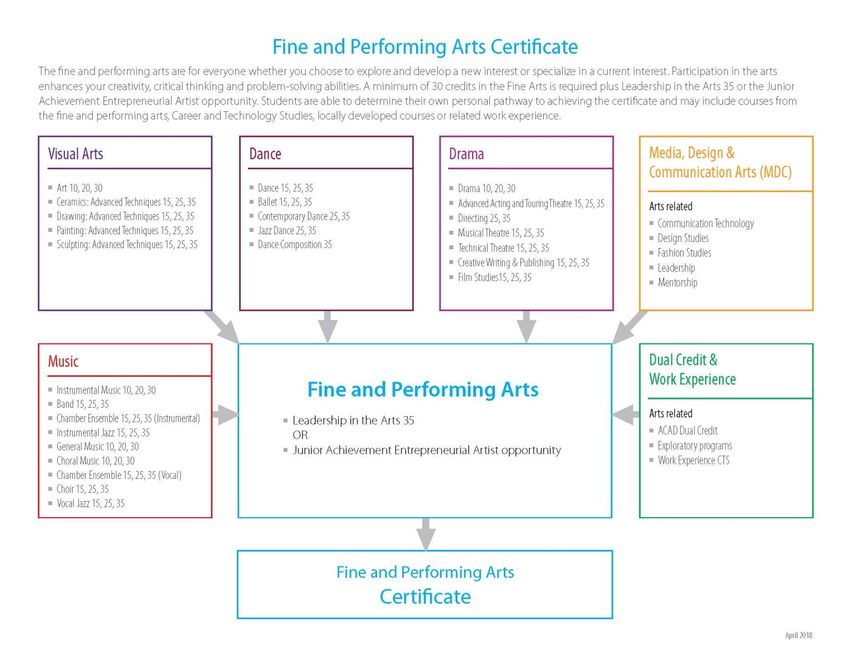
GET READY | Completing High School
In Alberta, there are several ways the province recognizes high school completion:
A High School Diploma (see page 5 for the requirements)
A Certificate of High School Achievement (see page 5 for the requirements)
Transitioning to a post-secondary institution or apprenticeship in Alberta
Most students complete a High School Diploma in three years; others do so in four
years. In CBE schools, counsellors, teachers, school administrators, and career
practitioners support you in developing a unique learning plan that is based on your
learning style, interests, goals and career aspirations.
Details about the Certificate Alberta also recognizes the achievement of high school students with exceptional needs
of School Completion are and significant cognitive challenges with a Certificate of School Completion.
available in Alberta
Education’s Guide to
Education. Course Numbers and Sequences
Courses are arranged in sequences and are assigned course numbers that indicate
both the grade level and the type of challenges in the course.
1st year or Grade 10 courses start with the number 1 (for example, 10, 15, 1000) or
are called Introductory in Career and Technology (CTS) courses
2nd year or Grade 11 courses start with the number 2 (for example, 20, 25, 2000) or
are called Intermediate in CTS courses
3rd year or Grade 12 courses start with the number 3 (for example, 30, 35, 3000) or
are called Advanced in CTS courses
Depending on your goals, sometimes the courses you take do not correspond to your
grade level.
If you are a Grade 10 student, you might register in a 20-level course in the second
semester if you have successfully completed the 10-level course in the first
semester.
If you are a Grade 11 student, you might register in a 10-level course to explore
another area of interest.
If there is more than one course sequence in a subject, the last digit of the course
number indicates the sequence. In high school, you have choices of academic courses
(such as, English 10-1, English 10-2, or English 10-4).
Course sequences ending in -1 emphasize abstract and ambiguous challenges.
Course sequences ending in -2, -3, and -4 do include abstract challenges, but they
emphasize increasingly concrete and practical challenges.
You do NOT need to select all your courses from the same sequence.
For example, depending on your strengths, needs, interests and goals, you could
choose English 10-1 and Social 10-2.
There is flexibility to transfer from one sequence to another. The process begins by
having a conversation with your teacher to review your work and the course outcomes.
For more detail | See Appendix B | Part 1 | Course Sequences and Transfer Points as
well as Figure 10 in Appendix B | Part 2.
Your Detailed CBE High School Course Guide 2018 - 2019 Page 3 of 95
GET READY | Credits
You earn credits in a course if you have a final course mark of 50% or higher.
Credits show you have satisfactorily achieved the outcomes in a course.
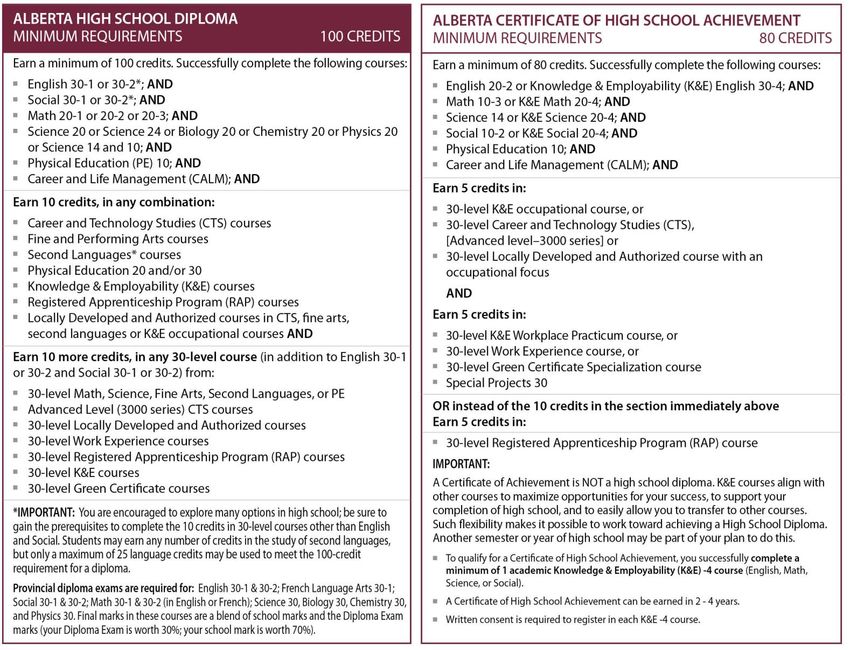
100 credits, minimum, are needed for a High School Diploma
80 credits, minimum, are needed for a High School Certificate of Achievement
Most students earn more than the minimum required to take advantage of the
choices available and to meet post-secondary education or career requirements
Credits can only be earned once for any course. For example:
If you earned 45% in Science 10, you do NOT earn 5 credits. If you repeat
Science 10 and earn 55%, you earn the higher mark and 5 credits.
If you earned 50% in Science 20, you earn 5 credits. If you repeat Science
20 and earn 70%, you keep the 5 credits and earn the higher mark. You do
NOT earn additional credits.
Prerequisites and Co-requisites
When you earn a grade of 50% or more in a given course, you gain credits for the
course and the prerequisite to move to the next course in a sequence (for example,
English 10-1 to English 20-1).
If you do not meet the minimum final grade of 50%, you may choose to repeat the
course at your home high school, online (at CBe-learn), or during summer school (at
CBe-learn or Chinook Learning Services).
If your grade is between 40-49%, you may continue on to the higher level in an
alternative course sequence with a higher last digit number.
For example, if you earned 45% in English 10-1, you may continue to English 20-2.
When you successfully complete English 20-2, the retroactive credits from 10-2, the
prerequisite course, will be added, OR
You may develop another credit recovery plan: see your school principal or assistant
principal to learn more.
Important l If you have difficulty in a course, talk to your teacher right away. Use
feedback and attend tutorials before retroactive credits or credit recovery is necessary.
Some courses have a co-requisite. This means you take a required course at the same
time as the course with a co-requisite. For example:
Math 31 requires a prerequisite or co-requisite of Math 30-1.
Advanced Acting and Touring (AAT) 25 has a pre-requisite of AAT 15 OR a co-
requisite of Drama 20.
Provincial Diploma Examinations
Final marks in 30-level diploma courses are a blend of the school mark and diploma
exam mark—your class mark is worth 70%; the Diploma Exam is worth 30%.
If you pursue a High School Diploma in Alberta, Provincial Diploma Exams are required
for the following Grade 12 courses:
English 30-1 or English 30-2, and
Social Studies 30-1 or 30-2
Additional Diploma Exams are required for students taking:
Math 30-1 or Math 30-2
Science 30, Biology 30, Chemistry 30, Physics 30
French Language Arts 30-1
French Immersion students pursuing a High School Diploma in Alberta, note:
English 30-1 or 30-2 instruction is in English; the Diploma Exam is written in English
Social 30-1 or 30-2 instruction is in French; the Diploma Exam is available in French
French Language Arts 30-1 instruction is in French; the Diploma Exam is in French
Math -1 or -2 instruction is in French; Math 30-1 or 30-2 exams are available in
French
Science, Biology, Chemistry and Physics instruction is in English; the Diploma
Exams are written in English at the 30-level
Your Detailed CBE High School Course Guide 2018 - 2019 Page 4 of 95
Learn about Diploma and Certificate of High School Achievement Requirements
GET READY |
Most students go beyond the minimum diploma or certificate requirements listed below because they want to take advantage of
the many choices available in high school or to meet post-secondary entrance requirements. If you are undecided about the
path you might take after high school, you are like many students. You will discover your talents and interests while working toward your Diploma or
Certificate of High School Achievement.
Learn more | visit:
Alberta Education’s Guide
to Education.
Note | Many high school
students complete high
school in three years.
Some reasons for a
possible fourth year
Your Detailed CBE High School Course Guide 2017- 2018
include:
taking English as a
Second Language
courses to develop
academic language if
English is not your
first language
meeting Diploma
requirements after
earning a Certificate
of High School
Achievement
achieving a balance
of academic goals,
complementary
course interests and
extra-curricular
commitments.
Talk with your counsellor
and principal if a fourth
year is part of your high
school plan.
Page 5 of 95
Figure 1 | Alberta High School Diploma & Certificate of High School Achievement Requirements
GET READY | My High School Program Planning
                                                         Use this form as you read through the course descriptions in the detailed course guide and select possible courses. Blank spaces are for adding
                                                         your complementary courses, and if English is not your first language, take English as Second Language (ESL) courses. List your initial choices.
                                                         Make a plan; revisit your plan; change the plan as necessary.
Your Detailed CBE High School Course Guide 2017 - 2018
Page 6 of 95

                                                                                                                                                                   Table 1 | My High School Program Planning
GET SET | Choose Required Courses First
In high school, you choose from different courses in English Language Arts, Mathematics,
Social Studies and Science. It’s exciting to have choices; sometimes making decisions may
seem overwhelming. Parents, counsellors, teachers, school administrators and career
practitioners will support you as you make choices about your high school courses.
There is flexibility to transfer between course sequences. For details about transfer points
between course sequences and a recommended process (see Appendix B | Course
Sequences and Transfer Points)
Some high schools offer blended classes in Grades 10 and/or 11 ELA, Math, Social
and/or Science to make it easier for you to change course sequences. A blended class
combines two or more course sequences in the same classroom. As you meet the
outcomes for a particular course sequence, you achieve credits for that course.
English Language Arts (ELA)
One requirement for a
Diploma is successful High school English Language Arts (ELA) is more than reading and writing. ELA involves:
completion of English 30- communicating effectively in various places for many different audiences and reasons
1 or 30-2. selecting appropriate forms, structures and technology for a variety of contexts
understanding, appreciating and creating a broad range of texts (including multi-media,
In English 30-1 or visual, oral, and print)
English 30-2, you write a
provincial Diploma Credits: The following ELA courses are 5 credits.
Exam, worth 30% of your Prerequisites:
final grade.
50% minimum is required to progress to the next level in a sequence
One requirement for a see Appendix B for details about transfers between course sequences
Certificate of High
School Achievement is Important | Some schools have separate English classes in which English Language
successful completion of Learners develop language abilities and background cultural knowledge while learning
a minimum of English 20- course content, skills and strategies.
2 or K&E English 30-4.
Be sure to take the
Diploma Path | -1 and -2 Course Sequences
prerequisites at the 10 or ELA10-1, 20-1, 30-1
20-level. engage with Canadian and international print and multi-media texts
emphasize literary analysis to develop critical thinking skills
develop strong comprehensive and communication skills for university and many post-
secondary programs (entrance requirements for post-secondary institutions vary; be
sure to check their websites)
ELA 10-2, 20-2, 30-2
engage with a wide range of texts and some literary analysis
develop your communication skills through practical, creative and persuasive writing
and representing
prepare you for some post-secondary education programs (entrance requirements for
post-secondary institutions vary; be sure to check their websites)
Important | English 20-2 meets requirements Certificate of High School Achievement
requirements
Certificate of High School Achievement Path | -4 Course Sequence
ELA 10-4, 20-4, 30-4
build language skills and learn additional reading and writing strategies for success
emphasize practical applications that support your understanding, communication, and
other occupational skills
prepare for the world of work or further training that may not involve post-secondary
Important | written consent and a learning plan are required to register in each -4
Knowledge and Employability (K&E) course
Your Detailed CBE High School Course Guide 2018 - 2019 Page 7 of 95GET SET | Mathematics (Math)
The main goals of mathematics education are to prepare you to:
solve problems
communicate and reason mathematically
make connections between mathematics and its applications
become mathematically literate
appreciate and value mathematics
make informed decisions as contributors to society
Credits: The following Math courses are 5 credits.
Prerequisites:
50% minimum is required to progress to the next level in a sequence
Learn more | see Appendix B for details about transfers between course sequences
Diploma Path | -1 and -2 Course Sequences
Minimum math Math 10C
requirements for a High
School Diploma include 5 involves topics such as measurement, powers, irrational numbers, functions and relations, and
credits at the 20-level in trigonometry
Math 20-1, 20-2, or 20-3. focuses on algebraic skills and reasoning
provides several choices after you successfully complete it and move to 20-level courses
One requirement for a
Certificate of High School Math 20-1, 30-1
Achievement is successful investigate the relationships between relations and functions, and engage in trigonometric topics
completion of Math 10-3 or
K&E Math 20-4.
develop abstract reasoning and visualization in a problem-solving environment
prepare you for a entrance requirements for post-secondary institutions vary; be sure to check
Be sure to take the
their websites
prerequisite courses. Math 20-2, 30-2
focus on investigation into logical reasoning, relations and functions, and trigonometry
In Math 30-1 or 30-2, you
write a provincial Diploma develop problem-solving, reasoning and communication in many ways, including a self-selected
Exam worth 30% of your research project on a topic of interest
final grade. prepare for a post-secondary program that does not require calculus (entrance requirements for
post-secondary institutions vary; be sure to check their websites)
Note | For French
Immersion students, you Post-secondary Path | Requiring Calculus
take Math 10C and -1 or -2 Math 31
courses in French. Math
Diploma Exams are prerequisite or co-requisite: Math 30-1
available in French. introduces skills and topics in calculus
investigates a variety of topics; focuses on the limit of a function and looks at the relationship
between differentiation and integration
Diploma Path | -3 at the 20-level or higher
Certificate of High School Achievement Path | -3 at the 10-level
Math 10-3, 20-3, 30-3
engage in measurement skills, geometry, personal and business finances, and statistics and
probability
emphasize practical math found in day-to-day activities
prepare you for entry into some apprenticeship programs, trades or the workforce after high
school completion
Certificate of High School Achievement Path | -4 Course Sequence
Math 10-4, 20-4
engage in measurement skills, number concepts and probability as they would be used in the
workplace
develop problem-solving and reasoning skills in a team environment
prepare you for the workplace or further training that may not involve post-secondary education
Important | written consent and a learning plan are required to register in each -4 Knowledge
and Employability (K&E) course
Your Detailed CBE High School Course Guide 2018 - 2019 Page 8 of 95GET SET | Science
In high school science courses, you focus on interconnected ideas and principles, such as
change, diversity and energy. You develop scientific knowledge through collecting,
analyzing and interpreting experimental evidence. Additionally, you make connections
among science, technology and society. You continue to develop your sense of wonder
about the natural world.
Credits: The following Science courses are 5 credits.
Prerequisites:
50% minimum is required to progress to the next level in a sequence
see Appendix B for details about transfers between course sequences
Minimum requirements Diploma Path | 10, 20, 30 Course Sequences
for a Diploma, include at
least one of the following: Science 10
Science 20 introduces biology, chemistry, physics and global energy systems
Science 24
Biology 20
allows you to choose from Biology, Chemistry, Physics and/or Science at the
Chemistry 20 20-level, depending on your interests, abilities and goals
Physics 20, OR
Science 14 and
Science 20, 30
Science 10 extend the application of biological, chemical, physical and earth sciences in Science 20
and apply them to current world scenarios
In Science 30, Biology analyze interactions in biological, chemical, physical and global energy systems in
30, Chemistry 30, and
Physics 30, you write a
Science 30
provincial Diploma enhance scientific literacy and prepare you for post-secondary programs*
Exam worth 30% of your Important | Biology 20, Chemistry 20, Physics 20 or Science 20 can be used as a
final grade. prerequisite to Science 30
Minimum requirements Biology 20, 30
for a Certificate of High engage in examining interactions of living systems with each other and their
School Achievement
include a Science 14 OR
environment
K&E Science 10-4 and Biology 20 emphasizes energy and matter exchange
K&E Science 20-4. Biology 30 focuses on adaptation and change in biological systems
enhance scientific literacy and prepare you for post-secondary programs*
Be sure to take the
prerequiste courses. Chemistry 20, 30
engage with the study of matter and its changes in the natural and industrial worlds
*Entrance requirement for enhance scientific literacy and prepare you for post-secondary programs*
post-secondary
institutions vary; be sure Physics 20, 30
to check them online. engage in the exploration and analysis of the interactions between matter and energy
understand the physics behind natural events and technology
enhance scientific literacy and prepare you for post-secondary programs*
Diploma Path | at the 24 level
Note | Although the Certificate of High School Achievement Path | at the 14 level
recommended transfer Science 14, 24
point from Science 24
apply scientific knowledge and skills to everyday experiences
is to Science 10, in
exceptional cases, are general sciences that meet the credit requirement for a high school diploma
students may be
placed by the principal Certificate of High School Achievement Path | -4 Science Course
in 20-level courses, as Sequence
serves the student’s
best interests. Science 10-4, 20-4
apply scientific knowledge and skills to everyday life and the workforce
Important | written consent and a learning plan are required to register in each -4
Knowledge and Employability (K&E) course
Your Detailed CBE High School Course Guide 2018 - 2019 Page 9 of 95GET SET | Social Studies (Social)
Social Studies courses explore relationships among individuals in various societies and
between societies. You examine cultural, economic, ethical, legal, and political issues that
communities face. These courses focus on understanding: who am I, what kind of society
do I want, and how do I and others shape our world?
Credits: The following Social Studies courses are 5 credits.
Prerequisites: 50% minimum is required to progress to the next level in a sequence
see Appendix B for details about transfers between course sequences
Sometimes schools offer a blended Social class, which combine two or more course
sequences in the same classroom.
Some schools have separate Social classes in which English Language Learners develop
language abilities and cultural knowledge while learning course content, skills and
strategies.
Diploma Path | -1 and -2 Course Sequences
One requirement for an
Alberta High School Social 10-1, 20-1, 30-1
Diploma is successful
completion of Social 30-1 examine historical and contemporary aspects and relationships among citizenship,
or 30-2. identity and:
globalization in 10-1
In Social 30-1 or 30-2, nationalism in 20-1
you write a provincial
Diploma Exam worth ideologies, such as liberalism, in 30-1
30% of your final grade. examine relationships between citizenship and ideologies
Social 10-2, 20-2, 30-2
Note | In French
Immersion, you take explore historical and contemporary aspects and relationships among citizenship,
Social -1 or -2 in French. identity and:
Social Diploma Exams globalization in10-2
are also available in
French. nationalism in 20-2
ideologies, such as liberalism, in 30-2
Certificate of High School Achievement Path | -4 Course Sequence
The minimum
requirement for a Social 10-4, 20-4
Certificate of High
School Achievement is connect your learning to everyday experiences as you respond to key questions:
successful completion of “Should we embrace globalization?” in 10-4
Social 10-2 or K&E “Should we embrace nationalism?” in 20-4
Social 20-4. emphasize the importance of diversity and respect for differences to promote a sense of
belonging and acceptance
Be sure to take the
prerequistes courses.
Important | written consent and a learning plan are required to register in each -4
Knowledge and Employability (K&E) course
Your Detailed CBE High School Course Guide 2018 - 2019 Page 10 of 95GET SET | Wellness | CALM and PE
Physical Education (PE) supports you in acquiring skills through a variety of
Requirements for a developmentally appropriate movement activities. You will gain experience within various
Diploma or Certificate of physical activities assisting you in further understanding health and wellness benefits,
High School
Achievement include a
promoting positive interactions and leading an active lifestyle.
minimum of:
Career and Life Management (CALM) helps you develop your ability to make well-
3-credit course in PE informed decisions and choices that contribute to the well-being and respect of yourself
10 AND and others.
a 3-credit course in
CALM
Career & Life Management (CALM)
Credits: 3 | REQUIRED COURSE
Prerequisite: none
In CALM, you:
apply an understanding of the emotional, psychological, intellectual, social, spiritual and
physical dimensions of health
learn responsible financial decision-making to reflect your values and goals and to
demonstrate commitment to self and others
apply strategies to manage your wellness and lifelong career development
learn online at many high schools
Important | most students take this course in Grade 11, but it can be taken in Grade 10 or
12, depending on your personalized high school program; a few schools offer CALM
through their Teacher Advisory programs.
Physical Education (PE) 10
Credits: 3, 4, or 5 | REQUIRED COURSE
Prerequisite: none
acquire skills through a variety of movement activities
understand, experience and appreciate the health benefits and wellness that result from
physical activity
interact positively with others
assume responsibility to lead an active lifestyle
continue to enhance your wellness in optional PE 20 and 30 courses
Physical Education (PE) 20, 30
Credits: 3, 4, or 5 each | courses of choice
Prerequisite:
successfully complete the preceding
courses for 20 and 30 levels
engage in more activities that promote lifelong
physical activity
connect and engage with lifelong active living
and wellness
Your Detailed CBE High School Course Guide 2018 - 2019 Page 11 of 95GET SET | English Language Learning (ELL)
When your first language is not English, you learn English to talk to friends, buy things, or
find your way around the city. This is everyday English and it usually takes one or two
years to learn.
Note│As an English
Language Learner, you
may take more than three You also learn academic English—reading, writing, understanding and talking about
years to complete a High complex ideas in English. This may take five or more years. Academic English learned in
School Diploma or English as a Second Language (ESL) / English Language Learning (ELL)* courses
Certificate of High School
Achievement contributes to success in high school, post-secondary and future employment.
The Admissions Office at
Kingsland Centre
registers students new to
the CBE who are NOT
Canadian citizens.
Kingsland Centre is open
year-round for your
What to expect as an English Language Learner
convenience.
Build a personalized course plan with the assistance of your high school to:
To book an appointment
call 403-777–7373 determine your current and developing English language abilities in relation to the
(ext. 1)
Alberta Education ESL Proficiency Benchmarks
learn how your English language abilities improve as is evident in ongoing language
assessments
take English as a Second Languages (ESL)* courses as needed to:
support your learning of academic English and
earn credits toward your Diploma or Certificate of High School Completion
register and succeed in high school courses based on your current and developing
language strengths
when appropriate, be connected with an adult learning centre to continue studies toward
your high school Diploma or Certificate of High School Achievement
*Alberta Education uses assess credit for high school courses you completed outside of Alberta
English as a Second
Language (ESL) courses.
The CBE uses English
Language Learning (ELL)
Strengthen Communicative Competence With ELL
rather than ESL because
many newcomers have
Programming
more than two languages.
What is communicative
Why is communicative competence important?
competence?
Communicating in
The ability to Academic Ways Communicative
understand and use Communicative
Using Social Rules competence strengthens competence supports
language effectively of Language all of the interactions
in authentic social participation in non-
Talking and required for learning in academic aspects of
and school school.
environments. Working in Groups school such as sports, Communicative
Using Background clubs, volunteering competence is
and Cultural and social functions. required for
Knowledge success in life,
Using Language In turn, participation in work and
Learning these types of continued
Strategies activities supports learning.
Organizing social belonging,
Language further development of
Appropriately language and overall
Building academic success.
Vocabulary
Your Detailed CBE High School Course Guide 2018 - 2019 Page 12 of 95GET SET | Language Proficiency Levels 1 - 5
Level 1 Beginning | You will develop basic communicative English skills with a focus on
listening and speaking through a variety of interactive learning experiences. You will begin
to read and write texts with familiar vocabulary and sentence structures.
Level 2 Developing | You will build on communicative English language skills in listening,
speaking, reading and writing. With direct instruction and support you will learn about
reading and writing informational texts as you acquire a broader range of vocabulary.
Level 3 Expanding | Basic communication is becoming easier. You will continue to learn
and develop academic language skills when listening, speaking, reading and writing. These
skills will need to be further developed across high school courses.
Level 4 Bridging | You will continue to develop academic language skills with a focus on
reading and writing a variety of increasingly complex fiction and nonfiction texts. You will be
supported in building these skills as well as refining listening and speaking skills to help
you reach your academic goals.
Level 5 Extending | You have acquired the social and academic language skills that help
participate across classes. You apply language strategies and continue to strengthen the
academic language skills required to interact with unfamiliar texts. You are able to speak
and write about a variety of academic topics while still developing more complex academic
language skills.
Your Detailed CBE High School Course Guide 2018 - 2019 Page 13 of 95GET SET | English Language Learning (ELL / ESL*) Courses
Language
Course Names Credits Course Description Proficiency Level
1 2 3 4 5
ESL 1 0
ESL 2 5
5
ESL 3 Each course further develops academic
5 language skills by building on your current
language strengths.
ESL 4
5
ESL 5 0
Students in this course will develop their
ESL Introduction academic language in Mathematics to
5
to Math 15 successfully move into required math
courses.
Students in this course will develop the
ESL Introduction to
5 academic language required for success in
Science 15 future Science courses.
ESL Introduction to Students in these courses will develop
5 academic language skills and Canadian
Canadian Studies 15
content backgroung knowledge necessary
ESL Introduction to for success in future required Social Studies
5
Canadian Studies 25 courses.
ESL Expository English 15 5 Students in these courses will strengthen
their understanding and application of
ESL Expository English 25 5 expository (informational) texts.
Students in this course will experience
ESL English for intensive, specific, and focused language
3 or 5
Academic Success 35 instruction to enhance their reading and
writing skills for academic courses.*
Academic Achievement Through Students in these courses will build and
3
English Language Development 15 extend their academic language proficiency
Academic Achievement Through and overall communicative competence
English Language Development 25 3 within all aspects of literacy (listening,
Academic Achievement Through speaking, reading, writing, viewing,
3 representing).*
English Language Development 35
Table 2 | ELL / ESL Courses and Language Proficiency Levels
*These courses may be offered alongside/blended with an academic courses as an adjunct course
to provide additional time and support for your success.
Your Detailed CBE High School Course Guide 2018 - 2019 Page 14 of 95GO FOR IT | Complementary Courses and
Explore Programs of Choice
Your home high school is the community, where you:
study your core and most of your complementary courses
participate in extra-curricular and volunteer activities
You may use 10 credits Each high school offers a combination of unique programs and courses. CBE high schools
from 30-level work closely with each other to support you in accessing specialized opportunities across
complementary courses the CBE to find and pursue your passions.
to meet the Diploma
requirements (other than
English 30-1 or 30-2 and In this section, learn more about complementary courses, programs of choice, online
Social 20-1 and 20-2). learning, evening classes, summer school, international opportunities and scholarships.
High schools work closely with each other to support you in accessing specialized
Learn more | Examine opportunities and settings across the CBE.
page 5 of the guide to
review the requirements
for a Diploma or Complementary courses and programs of choice include:
Certificate of High School
Achievement.
Career and Technology Studies (CTS) and Knowledge and Employability (K&E)
occupational courses
Off-campus Education and Unique Opportunities
Fine and Performing Arts | Dance, Drama, Music, Visual Arts courses
Arts Centred Learning Program (ACL)
The Performing and Visual Arts Program (PVA)
Languages
French Immersion Program
Bilingual Programs and Courses | Spanish
a wide range of different Language and Culture Courses
CBE International Certificate
Learning Support courses
Complementary courses for exploring an area of a subject in detail
Language Arts, Mathematics, Science, Social Sciences, Wellness
Internationally Recognized Programs
Advanced Placement (AP)
International Baccalaureate (IB) in English or French Immersion
Unique settings for athletes
High Performance Athlete Development
National Sport Academy
National Sport School
Online learning at CBe-Learn
Evening classes and high school upgrading at Chinook Learning Services
Summer School
CBe-learn
Chinook Learning Services
Career and Technology Centre
Your Detailed CBE High School Course Guide 2018 - 2019 Page 15 of 95GO FOR IT | Career and Technology Studies (CTS) and
Knowledge & Employability (K&E) Occupational Choices
CTS and K&E pathways build on the Career and Technology Foundations (CTF) that
promotes authentic exploration of career pathways from Grades 5 – 9. CTS involves five main
Note | The title of each clusters composed of occupational areas with industry commonalities. The 5 CTS
cluster on the right is clusters are:
linked to the particular
section of the guide so BIT: Business, Administration, Finance & Information Technology
you can navigate quickly HRH: Health, Recreation & Human Services
to an area of interest.
MDC: Media, Design & Communication Arts
NAT: Natural Resources
TMT: Trades, Manufacturing & Transportation
If a CTS occupational Multi-cluster: combines two or more of the clusters
area or a K&E
occupational course is not
available at your school, it To enhance flexibility and transitions for you as a student:
may be available at
another CBE high school 1 | CTS courses are combined into pathways (groups of 1 credit courses where you
or at the Career and acquire attitudes, skills and knowledge for a career based on your interests). This
Technology Centre, see course guide describes each occupational CTS area as there are numerous ways
Appendix D. Talk with
your counsellor to learn CBE high schools combine the 1-credit CTS courses under each occupational area.
how to access it.
2 | CTS courses in each occupational area are offered at the:
For a list of CTS a | Introductory or 1000-level
occupational areas or b | Intermediate or 2000-level
K&E occupational
courses offered at various c | Advanced or 3000-level
schools, see Appendix D | d | Credentialed 3400-level
Opportunities in CTS and
K&E Occupational 3 | Approved Locally Developed and Authorized CTS courses will have the credits
Courses by School. listed after the course name. The levels for these are:
a | Introductory or 15-level
b | Intermediate or 25-level
c | Advanced or 35-level
4 | A credential is a recognition awarded by a community group or industry. Some
CTS pathways support you to earn or apply for a credential.
5 | Dual Credit CTS pathways allow you to earn credits in high school and at post-
secondary institutions at the same time. Learn more | visit Dual Credit on the CBE
website.
6 | Knowledge & Employability (K&E) occupational courses are 5-credit courses
that run parallel to CTS occupational areas.
K&E occupational course descriptions appear after the CTS course descriptions
in each occupational area
for diagrams of K&E occupational sequences and transfer to CTS courses, see
Appendix B | Part 2 K&E Occupational Courses, starting at Figure 10
7 | A variety of CTS pathways and/or K&E occupational courses are available at:
your community high school
the Career and Technology Centre (CTC) at Lord Shaughnessy
Learn more | visit the CTC website
Off-campus Education
Unique Opportunities and Off-campus Education
other high schools in the CBE
Learn more | see Appendix D | CTS and K&E Occupational Courses by
School or talk to a counsellor at your high school
Your Detailed CBE High School Course Guide 2018 - 2019 Page 16 of 95GO FOR IT | An Overview of CTS and K&E Occupational Courses
Figure 2 | An Overview of CTS Occupational Areas and K&E Occupational Courses
Remember:
1 | Specialized Off-campus Education and Dual Credit opportunities are added throughout the school year.
Learn more | visit Unique Opportunities and Off-campus Education on the CBE website
2 | Written consent is required to register in each K&E course
Your Detailed CBE High School Course Guide 2018 - 2019 Page 17 of 95GO FOR IT | Business, Administration, Finance & Information
CTS Technology (BIT)
Occupational Areas
The BIT cluster focuses on management, marketing and use of electronic technologies to
access, use and manipulate information within your personal, family, workplace,
community and global contexts. The occupational areas in BIT include:
If a CTS occupational
area or a K&E
occupational course is not Computing Science
available at your school, it
may be available at
use mathematical concepts to explore, design, build and test computer programs using
another CBE high school a variety of languages which may include Java, C++, C#, Alice and/or Visual Basic
or at the Career and AP Computer Science A available at select schools
Technology Centre, see Credentials available: Alberta universities accept 5 credits in Computer Science–
Appendix D. Talk with
your counsellor to learn
Advanced as a 30-level science requirement
how to access it.
Enterprise and Innovation
For a list of CTS
occupational areas or draw upon your entrepreneurial spirit and learn how to create, analyze, finance, market,
K&E occupational create and manage a business venture
courses offered at various the Entrepreneurial Artist program develops your ability to apply financial literacy and
schools, see Appendix D | business skills to your arts discipline
Opportunities in CTS and
K&E Occupational the Entrepreneurial Trades program develops your ability to apply financial literacy
Courses by School. and business skills to a trade
Learn more | visit Unique Opportunities and Off-campus Education for a
detailed description of the Entrepreneurial Artist Program
Financial Management
learn about personal financial literacy and general accounting principles
explore small businesses and venture planning
Information Processing
become proficient with the use of Office applications
Credentials available: Microsoft Certified Application Specialist
K&E Courses available: see Business Services and Office Services -4 at the end of
the BIT section
Management and Marketing
explore basic management concepts and describe retail merchandising strategies of
value to the retail employee, manager and/or owner
learn about e-commerce, marketing and communication strategies
K&E Courses available: see Business Services -4 and Sales and Services -4 at the
end of the BIT section
Learn more | visit Dual Credit on the CBE website to see the dual credit
opportunities for this course
Networking
learn about Information Technology (IT) and networking with a focus on the design and
maintenance of computer hardware and networks
Credentials available: CompuTIA+ and CompuTIA Network+ and Focus on
Information Technology (FIT)
Your Detailed CBE High School Course Guide 2018 - 2019 Page 18 of 95GO FOR IT | Knowledge & Employability (K&E) Business Services -4
Credits: 5 each
K&E Prerequisites:
Occupational Courses | see Appendix B | Part 2, Figure 11 for a diagram of Business Services
BIT pathways and prerequisites
none for Business Services 10-4
successfully complete Business Services 10-4 for 20 levels of Sales and
Service, Office Services and/or Logistics
successfully complete 20-4 for 30-4 levels in each course sequence
Business Services 10-4 develops occupational knowledge and skills for entry-level
positions in office services, sales and service and logistics (supply chain)
Sales and Service 20-4 and 30-4 focus on service in retail and hospitality
Logistics 20-4 and 30-4 focuses on delivery and transportation of goods
Office Services 20-4 and 30-4 focuses on office operations and business strategies
take as many courses as possible at the 20 and 30 levels for employability
take a related Workplace Practicum or Work Experience course for additional practical
experience
Important | Written consent and a learning plan are required to register in each -4
Knowledge and Employability (K&E) course.
Your Detailed CBE High School Course Guide 2018 - 2019 Page 19 of 95You can also read


