ZERO-EMISSION CREDITS - April 2018 - Nuclear Energy Institute
←
→
Page content transcription
If your browser does not render page correctly, please read the page content below
ZERO-EMISSION
CREDITS
April 2018
INTRODUCTION
Nuclear energy provides reliable          Nuclear plants in New York and
baseload electricity without carbon       Illinois were facing early closure
emissions or other air pollution.         in the face of deteriorating
The plants that produce this              economics. State leaders
electricity are economic engines          recognized the benefits that would
for their communities, each one           be lost and developed methods
employing hundreds of workers,            to compensate reactors for the
supporting thousands more job in          valuable attributes they provide.
local communities, and generating         Each state implemented a zero-
hundreds of millions of dollars in        emission credit (ZEC) to ensure that
economic activity. In spite of these      the value of generation without air
benefits, many nuclear plants have        emissions would be factored into
been facing the prospect of early         decisions about the future of the
closure, as market forces have            plant. Because these policies were
challenged their economic viability.      implemented, five nuclear stations
Nuclear plants are paid for their         that had been facing doubtful futures
electricity, but wholesale power          have instead been given a new
prices have fallen dramatically           lease on life. Investments are being
over the last five years, leaving the     made to ensure their operation for
plants’ future operation in doubt.        years to come.
Unless the plants are compensated
for the reliability and clean air that
they provide, there will not be an
incentive to provide those benefits.

This paper discusses the key features of a zero-emission credit
program and identifies some of the differences between the
programs in New York and Illinois.

Nuclear Energy Institute | April 2018                                             Zero Emission Credits   2
What Are Zero-Emission Credits?                            To make the program work, regulators must turn
                                                           the SCC into a dollars-per-megawatt-hour value.
Zero-emission credits are payments that electricity
                                                           This conversion is done by multiplying the SCC by
generators receive to compensate them for the
                                                           the average emissions generated by plants running
valuable attribute of not emitting greenhouse gases
                                                           on natural gas or coal. If the fuel is natural gas, the
in the production of electricity. ZECs are modeled
                                                           emissions rate will likely be somewhere around
after credit programs in many states that support
                                                           0.5 tons per megawatt-hour. If coal plants are
renewable energy production. Like renewable
                                                           part of the state’s mix, then the amount of carbon
energy credits (RECs) that are generated by wind
                                                           dioxide emitted per megawatt hour would increase.
and solar generators and sold to utilities, ZECs are
                                                           Multiplying the SCC by an emissions rate will
credits generated with each megawatt-hour (MWh)
                                                           yield a baseline ZEC measured in dollars
of electricity produced by the plants. Just as wind,
                                                           per megawatt-hour.
solar and other non-emitting generators have been
compensated through REC programs, ZECs have                The ZEC programs also include a phaseout provision
been established for nuclear energy production,            that can reduce the value of credit payments. The
specifically for those plants facing imminent closure.     driver for these programs was recognition that low
                                                           market prices for electricity were creating economic
Each utility is required to purchase a certain number
                                                           challenges for some nuclear plants. The programs
of these credits from the plants that produce zero-
                                                           are designed so that the payments will decrease
emissions electricity. The utility rolls the cost of the
                                                           if market prices for electricity rise. The goal is to
credits into the electric customers’ bills.
                                                           minimize the impact on consumers.
From the point of view of a nuclear plant owner,
                                                           1Capacity markets are designed to ensure that there will be
ZECs provide a source of revenue for an attribute
                                                            sufficient generation at times when the electricity system is
that had previously been provided for free. Before          most stressed. Since nuclear plants run over 90 percent of
these programs were in place, the markets paid              the time, the vast majority of the revenues for these plants
primarily for the electricity that the plants produced,     are from wholesale electricity sales. When ZEC prices
plus a small supplement for the capacity certainty          are calculated, capacity payments are factored in on a
that they provided.1 (State air regulators and public       per-megawatt-hour basis.
health advocates did recognize the clean-air               2U.S. Government Interagency Working Group on Social
benefits, but nobody paid for them directly.) With          Cost of Greenhouse Gases, Technical Support Document:
these credits, each megawatt-hour of generation will        Technical Update of the Social Cost of Carbon for Regulatory
receive a ZEC in addition to the price of electricity at    Impact Analysis. July 2015.
that moment.

Setting a ZEC Price
Since the idea of the ZEC is to provide an incentive
to preserve non-emitting generation, the price of
the ZEC should relate to the value of the avoided
emissions. ZEC programs used the 2016 social cost
of carbon (SCC) as the starting point for determining
credit value. The SCC was estimated by experts2
across U.S. government agencies using computer
models of the economy and environment to estimate
the long-term economic impact of emissions so that
these costs can be factored into a range of cost-
benefit analyses. The central estimate for this cost
was $42 per ton emitted.

Nuclear Energy Institute | April 2018                                                              Zero Emission Credits    3
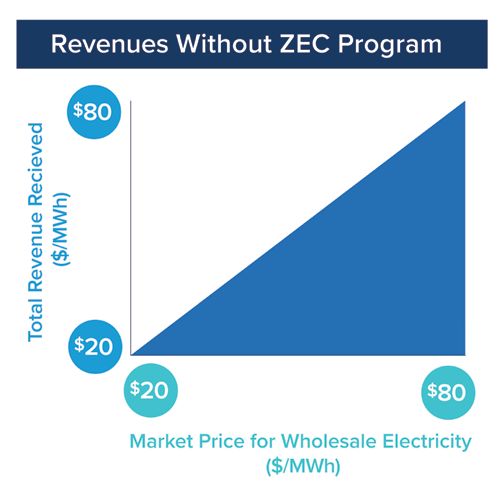
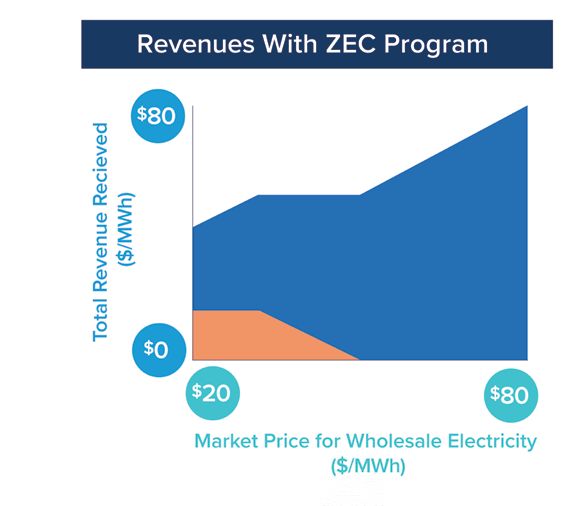
The figures below depict the framework. The first Economic Impacts
chart shows the one-to-one relationship between
The zero-emission credit programs enacted in
the market price of electricity on the bottom axis and
New York and Illinois have enabled the continued
the final value received by the nuclear generator, in
operation of five nuclear plants that were otherwise
blue, on the vertical axis. The second figure shows
facing early closure.
the impact of the ZEC and how it phases out as
market prices increase. Once the wholesale power Notably, though consumers will cover the cost of
price increases to a preset level (notionally depicted ZECs through electricity bills, the net impact of these
at $33 per megawatt-hour in this simplified example) programs will reduce those bills. Studies by The
the ZEC, shown in orange, is reduced dollar-for- Brattle Group, a respected economic analysis firm,
dollar as market prices exceed this threshold. The examined the economic impacts of ZEC programs
total revenues received for the nuclear generation proposed in New York and Illinois and found in both
hit a plateau until such a point that market prices cases that by retaining nuclear generation, more
greatly exceed recent history and the ZEC has been electricity was being provided by low-cost sources
completely phased out. than would have been the case if the reactors
closed. The reason is that the replacements for the
nuclear plants would have been more costly fossil
generators.3 In a relatively small electricity grid
such as New York’s, this effect was dramatic. Brattle
estimated that the ZECs would cost $482 million
per year. However, if the plants closed, consumers
would avoid paying the $482 million, but their total
electricity bill would rise by $1.7 billion per year as
more expensive fossil units were put into service.4
New York
The New York Clean Energy Standard (CES) includes
a zero-emission credit that values the non-emitting
attribute of nuclear energy. The Clean Energy
Standard will allow Exelon Corp. to continue
operation of two plants (Ginna Nuclear Power Plant
and Nine Mile Point Nuclear Station) that had been
facing early closure. Exelon was also able to buy the
FitzPatrick Nuclear Power Plant from Entergy Corp.
and continue to operate it. Entergy had planned to
close the facility in early 2017.
3In competitive wholesale electricity markets, the price paid to
all generators is set by the most expensive unit that is needed
to serve the demand at a given time. Since nuclear plants run
all the time, they act as “price takers” effectively bidding at
zero and allowing fossil fuel plants to set the market price. If
the nuclear units were removed from the system, fossil plants
that would have been too costly to be called upon would now
be used to fill the gap left by the nuclear plants, increasing the
market price that would be paid by all customers.
4The Brattle Group, Preliminary Comment on New York
Department of Public Service “Staff’s Responsive Proposal for
Preserving Zero-Emissions Attributes,” July 2016.
Nuclear Energy Institute | April 2018 Zero Emission Credits 4On Dec. 2, 2015, New York Gov. Andrew Cuomo The price of a ZEC is set for two years at a time,
directed the state Public Service Commission based on a formula set in the policy. The calculation
to develop a Clean Energy Standard. The CES starts with the social cost of carbon, estimated
was to enable the state to meet the ambitious by the federal government to be $42 per ton of
environmental goals in the New York State Energy emissions in 2015. Since New York participates in
Plan, including a 40-percent reduction in greenhouse the Regional Greenhouse Gas Initiative (RGGI)
gas emissions from 1990 levels by 2030. This carbon pricing system, a small portion of that
40-percent reduction is intended to move the avoided emission value is already captured by
state toward a longer-term goal of an 80-percent RGGI, so the expected price of a RGGI allowance
decrease in carbon emissions by 2050. The state is subtracted from the ZEC value. The remaining
aims to have 50 percent of electricity consumed in carbon cost is multiplied by the carbon emission
New York come from renewable sources. rate for New York to calculate the credit in terms
of dollars per megawatt-hour. Under current values,
Cuomo recognized the challenge that New York the ZEC value would be worth $17.48 per megawatt-
would face if it were to lose any of its nuclear plants. hour. The value of the credit is expected to grow
In his letter directing the Department of Public in the future as the social cost of carbon increases
Service to develop a Clean Energy Standard, he said over time and with inflation. The ZEC concept
that the closure of nuclear facilities “would eviscerate includes a provision that will limit the value of the
the emission reductions achieved through the state’s credit if electricity market prices rebound in the
renewable energy programs, diminish fuel diversity, future. If the market revenues for electricity and
increase price volatility, and financially harm host capacity payments are forecasted to exceed
communities.” (In 2015, New York’s nuclear power $39 per megawatt-hour, then the ZEC price will
plants produced 44.6 million megawatt-hours of be lowered by the amount above that threshold.
non-emitting electricity, which is 59 percent of the
state’s clean electricity, and avoided the emission Analysis of the CES has shown that the cost to
of about 26 million tons of carbon dioxide.) provide ZECs is more than offset by lower power
prices to New York consumers. The Brattle Group
On Aug. 1, 2016, the Public Service Commission found that electricity costs would be $1.7 billion a
adopted the Clean Energy Standard, including a year lower by preserving the at-risk nuclear units,
separate tier that addresses nuclear facilities in the since they would have been replaced by more
state to complement the tiers for new and existing costly generation. With the cost of the ZEC program
renewables. Under the plan, at-risk nuclear plants estimated to be less than $500 million a year in
in the state will receive a ZEC for each megawatt- the first two years of the program, the net savings
hour they produce. The ZEC program recognizes to consumers are expected to be more than
that nuclear can help the state meet its emission $1 billion every year.
reduction goals, and the credit provides monetary
value to encourage continuing investment and As soon as the Public Service Commission finalized
operation. The ZEC is structured to parallel the the CES, Exelon, owner of the Ginna and Nine Mile
renewable energy credits received by wind and Point nuclear plants, announced its intention to
solar under many state policies, like renewable invest $200 million in those plants to enable their
portfolio standards (RPS). long-term operation. (Exelon had announced that
Ginna and Nine Mile Point Unit 1 were facing early
The New York State Energy Research and closure.) In addition, Exelon and Entergy announced
Development Authority will conduct the transaction. an agreement under which Exelon would purchase
The authority will pay nuclear plant owners for the the Fitzpatrick plant and continue to operate it.
credits they produce. The load-serving entities in (Before the CES, Entergy had intended to close the
New York are then required to buy the ZECs from plant in January 2017.) The sale was completed in
the authority. The number of ZECs that each load- March 2017.
serving entity must purchase is determined by its
share of the electricity consumed in the state.
Nuclear Energy Institute | April 2018 Zero Emission Credits 5Illinois As part of the broad package of reforms in the
Future Energy Jobs Bill, a second limitation was
On Dec. 1, 2016, the Illinois Legislature passed the
included to ensure wide support for the legislation.
Future Energy Jobs Bill. The bill included several
The cost of the zero-emission credits is subject to
changes to the state’s electricity system, including
a cap on the final rate increase for consumers.
changes to the Illinois Renewable Portfolio Standard,
Should the cost of the ZECs result in a rate increase
increased support for energy efficiency and the
greater than 1.65 percent, then the number of ZECs
creation of zero-emission credits for nuclear plants
to be purchased would be reduced to a level that
in the state. The passage of this bill allowed Exelon
would comply with this constraint rather than the
to reverse its decisions to close the Clinton Power
goal of 16 percent of total electricity sales.
Station in central Illinois and the Quad Cities
Generating Station on the Mississippi River. These
plants support around 4,200 direct jobs and Legal Challenges
$1.2 billion in economic activity in the state. Each state program was challenged in
federal court early in 2017. The complainants
The legislation highlighted the need to retain zero- in each included generation companies that
emission sources of electricity for the state to meet competed in the same markets as nuclear plants
its environmental goals. It also highlighted the eligible for ZECs. The plaintiffs argued that ZECs
findings of a 2015 report5 issued by four different interfered with the wholesale power prices set by
state government agencies on the potential impacts competitive markets and the state policies should
of nuclear plant closings: increased emissions, therefore be invalidated.
higher electricity rates for customers, increased
reliability challenges in the region and the loss Each court dismissed the complaints and allowed
of jobs. In the face of these risks, the legislature the ZEC programs to move forward. In a July 2017
crafted a zero-emission standard that included the order, Judge Manish Shah held that the policy in
establishment of ZECs for nuclear generation. Illinois did not impede on the authority of the Federal
Energy Regulatory Commission to regulate interstate
Each utility must purchase ZECs equivalent to wholesale electricity markets. Since the value of
16 percent of the megawatt-hours it sold in 2014, ZECs is based on the social cost of carbon, “ZEC
a level based on the RPS targets already established payments do not…alter the amount of money that is
in the state. The ZECs will be awarded on a exchanged for wholesale electricity.”
10-year contract that will obligate plants to continue
operating during that period, barring an exceptional On July 25, 2017, Judge Valerie Caproni dismissed
event such as the imposition of a tax on nuclear the challenge in New York. Caproni drew a clear
facilities in the state or the discovery of the need connection between the establishment of RECs
for a major capital expense. Applicants for ZECs for renewable generation and ZECs for nuclear
must provide information on their operational and electricity: “Like RECs, ZECs are credits for the
financial outlook to the Illinois Power Agency, environmental attributes of energy production.
which will procure credits based on the long-term Like the sales of RECs, sales of ZECs are
environmental impacts for the state, including the unbundled from wholesale sales for energy or
preservation of environmental attributes that would capacity. If RECs are not preempted…then the
be lost through closures. Court fails to see how ZECs are.”
The legislation sets the value of a ZEC to be Both of these cases are being appealed to the
$16.50 per megawatt-hour based on the U.S. Court of Appeals.
social cost of carbon. This rate increases by
5Illinois Commerce Commission, Illinois Power Agency, Illinois
$1 per megawatt-hour in 2023 and each subsequent
year. As described above, this rate will be reduced Environmental Protection Agency, Illinois Department of
Commerce and Economic Opportunity, Potential Nuclear
if electricity prices exceed a market price index that Power Plant Closings in Illinois: Impacts and Market-Based
will be calculated annually based upon projected Solutions, Response to the Illinois General Assembly
power prices for the upcoming year. The index Concerning House Resolution 1146, Jan. 5, 2015.
averages future electricity prices across the state Available at: http://www.epa.illinois.gov/topics/air-quality/
and includes capacity payments that plants in the planning-reporting/nuclear-plant-closings/index.
state would be expected to receive. The baseline
market price index for the initial year is calculated
to be $31.40 per megawatt-hour.
Nuclear Energy Institute | April 2018 Zero Emission Credits 61201 F Street, NW, Suite 1100
Washington, DC 20004
nei.org
© 2018 Nuclear Energy Institute, Inc.,
Zero Emissions Credit all rights reserved.
No part of this report may be reproduced, transmitted or modified without written permission
of the Nuclear Energy Institute, Inc.You can also read


