10 year Adult Literacy, Numeracy and Digital Skills Strategy: Education and Training Boards Ireland Sectoral Submission - Version 15 January 2021 ...
←
→
Page content transcription
If your browser does not render page correctly, please read the page content below
10‐year Adult Literacy, Numeracy and Digital
Skills Strategy: Education and Training Boards
Ireland Sectoral Submission

     Version 15 January 2021              [Type here]
Education and Training Boards Ireland

1
Contents:

Introduction……………………………………………………………………………………………………………………3
Background…………………………………………………………………………………………………………………….3
Introduction to ETBI……………………………………………………………………………………………………………3
The ETB Sector……………………………………………………………………………………………………………………4
Further Education and Training (FET) Provision…………………………………………………………………..6
ETBI Active Inclusion……………………………………………………………………………………………………………7
Existing ALND Provision……………………………………………………………………………………………………….7

Submission Strategy and Policy Background…………………………………………………………………….8

Consultation Process………………………………………………………………………………………………………..9

Submission Framework…………………………………………………………………………………………………..10

Findings………………………………………………………………………………………………………………………….11

Conclusions and Recommendations……………………………………………………………………………… 18

Tables:
Table 1: Numbers of Unique FET Learners ……………………………………………………………………………6

Appendices:

Appendix 1: Examples of Innovative and Creative Practice…………………………………………………20

                                      2
Introduction
This sectoral submission is being made on behalf of Education and Training Boards Ireland
(ETBI). ETBI is the national representative body for Irelands’ sixteen Education and Training
Boards (ETBs), established on 1 July 2013 to provide education and training provision in
communities throughout Ireland. The purpose of this submission is to present a sectoral
perspective and recommendations regarding the development of a 10‐year Adult Literacy
Numeracy and Digital (ALND) Skills Strategy. This submission is a collation of individual ETB
ALND skills strategy submissions, highlighting areas of importance to ETBs regarding the
development of the strategy. ETBI considers the promotion of ALND skills development across
ETBs as essential. Therefore, the development of the 10‐year ALND Strategy is extremely
important for ETBI and its member ETBs. It is the opinion of ETBI that implementation of our
recommended actions will enable the successful integration of ALND skills across ETB Further
Education and Training (FET) Provision.
This submission will begin by providing a background to this submission including an
introduction to ETBI, a short overview of the ETB Sector and FET Provision. Active Inclusion
as the guiding strategic area within the ETBI FET Directorate will be briefly presented followed
by an overview of existing ALND skills programmes across FET. The submission’s strategy and
policy background will be summarised, and a review of the consultation process and analysis,
in line with the themes identified in SOLAS strategy consultation paper, will be described prior
to a presentation of findings, key conclusions and recommendations.
Background
Introduction to ETBI
ETBI Vision, Mission and Values
Under the Education and Training Boards Act 2013, ETBI is defined as:
An association established to collectively represent education and training boards and
promote their interests, which is recognised by the Minister for the purposes of this Act.
As outlined in ETBI Strategic Vision 2016 – 2020, the mission of ETBI is to act as a central
resource for the ETB sector, providing, procuring, and coordinating a range of support services
which are most appropriately and efficiently delivered at national level. ETBI provides a range
of coordinated services that include:
• Staff negotiations and staff development
• Policy analysis, research, and administrative support services
• Management services required by ETBs in the performance of their executive and reserved
functions
3• Specialised supports to assist ETBs in promoting equality of opportunity in education and
training, and in responding to the needs of disadvantaged communities
• Services as required by the Minister for Education and Skills.
ETBI Directorates include:
Further Education and Training
Schools Directorate
Organisation Support and Development
Change Programme
ETBI vision is to be an effective organisation that represents and promotes the development
of the ETB sector by providing innovative and quality support services to meet the needs of
ETBs and other stakeholders in the rapidly changing world of Irish public‐sector education and
training. As outlined in ETBI Strategic Vision 2016 – 2020, ETBI values include:
• ETBI collaborates with ETBs to promote an inclusive ethos of learning, underpinned by
excellence and innovation.
• ETBI fosters a sense of shared responsibility for the successful performance of the executive
and reserved functions of ETBs, in the interests of achieving the very best outcomes for all
learners.
• ETBI’s working relationships with ETB staff, Boards and other stakeholders are based on
fairness, transparency, and professionalism.
• ETBI promotes a culture of collaboration and collegiality between the professionals working
in ETBs and the members of boards, based on common shared values and commitment to
quality in education and training.
The ETB Sector
ETBs are statutory local education authorities governed by the Education and Training Boards
Act 2013. Sixteen ETBs across Ireland have responsibility for education and training, youth
work and a range of other statutory functions. ETBs manage and operate second‐level
schools, further education colleges, multi‐faith community national schools and a range of
adult and further education centres delivering education and training programmes. The
general functions of an education and training board is to establish and maintain recognised
schools, centres for education and education or training facilities in its functional area.
4ETBs plan, provide, coordinate, and review the provision of education and training, including
education and training for the purpose of employment, and services ancillary in its functional
area. ETBs also support the provision, coordination, administration, and assessment of youth
work services in its functional area. The ETB sector is the leading provider of education and
training in the state, active in local communities through the direct provision of training and
education programmes in training centres, colleges and other training and educational
settings. ETBs seek to make a real difference to the lives of the people they serve and
continue to respond in a proactive and dynamic way to the needs of the communities that it
serves.
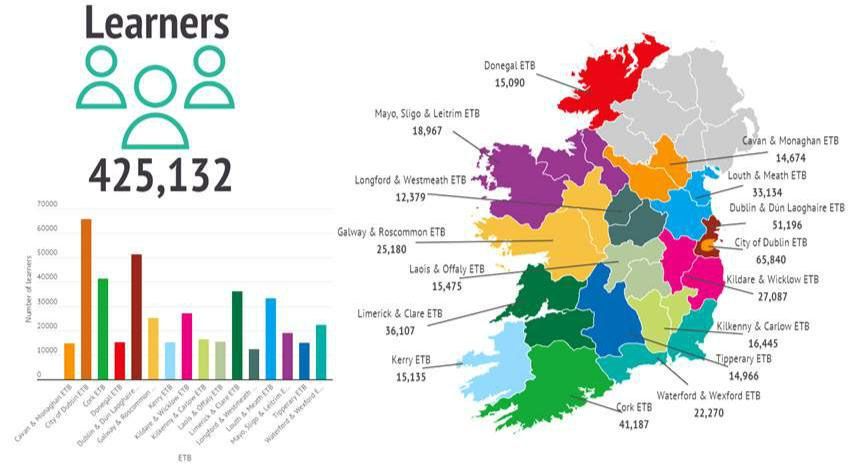
The following infographics provide an overview of the number of ETB learners in 2018 (ETBI
Annual Report 2018‐2019 p 8):
5Further Education and Training (FET) Provision
As outlined in SOLAS Future FET: Transforming Learning The National Further Education and
Training Strategy 2020 – 2024, the majority of SOLAS funding invested in FET is channelled
through ETBs. ETBs deliver FET provision either directly or via a network of contracted
training or community education and training providers in response to the needs of their
respective regions. The SOLAS FET Strategy 2020‐2024 categorise FET programmes as
focusing on the following skills:
‘Foundational’, prioritising transversal skill development and encompassing
programmes including Adult Literacy; English for Speakers of Other Languages (ESOL)
and Intensive Tuition in Adult Basic Education (ITABE).
‘Bridging’, prioritising the skills needed to bridge the gap between foundational
learning and accessing vocational education and training including Youthreach, Back
to Education Initiative, Skills for Work, Skills to Advance.
‘Vocational’ skill development, encompassing Post‐Leaving Certificate (PLC) provision
and work‐based learning include traineeships, apprenticeships, and specific skills
training; concerned with facilitating progression to higher education and direct
generation of employment outcomes.
Table 1: Numbers of unique FET learners participating in each category (Future FET:
Transforming Learning The National FET Strategy 2020 – 2024 p24):
Skill Learner Numbers
Foundation Skills (NFQ Level 1‐2) 100,000
Bridging Skills (NFQ Level 3‐4) 40,000
Vocational Skill (NFQ Level 5‐6) 60,000
Community education is a critical aspect of FET provision, particularly with respect to the
10year ALND Strategy; incorporating initiatives developed to serve the needs of localities,
often in partnership with local organisations. Much of this provision helps to develop core or
foundational skills.
6ETBI Active Inclusion
ETBI FET Directorate supports the following Strategic Areas:
Strategy and Policy
Quality
Active Inclusion
Work Based Learning
Planning, Resources and Reporting
ETBI strategic area of Active Inclusion, in line with SOLAS FET Strategy 2020‐2024, regards
inclusiveness within FET as unconditional positive regard for all people. FET must be readily
available to all and accessible by all, regardless of their location, culture, language,
disadvantage, or disability. Provision should facilitate equality of participation in and
outcome from education. Moreover, FET resources and opportunities must be targeted at
those who are most educationally disadvantaged.
ETBI Annual Report 2018 – 2019 highlights achievements within the strategic area of Active
Inclusion including:
Contribution to the development of the following SOLAS‐ETBI research:
Guidelines for Universal Design for Learning (UDL) in FET
Initial and Ongoing Assessment of English Language Competency of Migrant
Learners in FET at Levels 1‐3
Initial and Ongoing Assessment of Adult Literacy and Numeracy at NFQ Levels
1‐3
Best Practice Guidelines for Inclusion of Learners with Intellectual disabilities
Best Practice Guidelines for Family Learning
Evaluation of Recognition of Prior Learning (RPL) Programme ‐Tobar
Upskilling Pathways Report – An Irish Context
Vulnerable Adult Policy and Child Protection Policy.
Development of Community Education and Active Inclusion Position Papers
Existing FET ALND Skills Provision
As indicated previously, provision including Adult Literacy Programmes; English for Speakers
of Other Languages (ESOL) and Intensive Tuition in Adult Basic Education (ITABE) is primarily
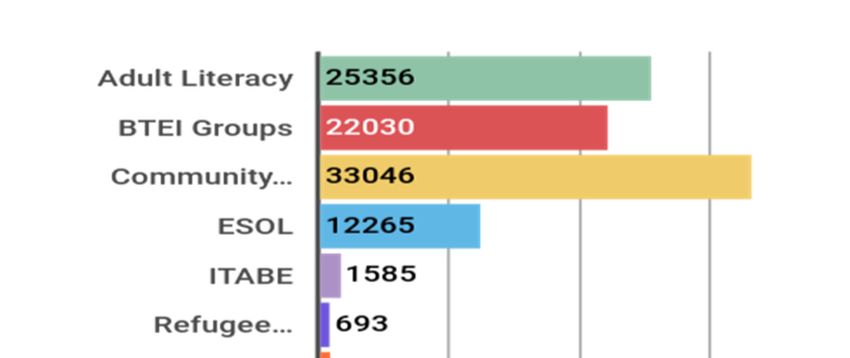
located within Foundational FET programmes. The following infographic presents an
overview of those learners engaging on a part‐time basis with programmes including Adult
Literacy Groups, BTEI Groups, Community Education, ESOL, ITABE, Refugee Resettlement,
Voluntary Literacy Tuition and Recognition of Prior Learning in 2019 (This is FET Facts and
Figures 2019 p9, SOLAS 2019).
7Submission Strategy and Policy Background
The FET Strategy 2020‐2024 Transforming Learning underpins this submission. This
strategy identifies Fostering Inclusion as a strategic priority and the following as focus areas:
Embed Inclusive Practice
Prioritise Target Cohorts
Consistent Learner Support
Literacy and Numeracy
With respect to ALND skills, SOLAS has already set out an overall framework for literacy and
numeracy development over the next 5 years, to include the development of:
Recognition and Awards
Raising Awareness
Consistent Assessment Approach
Diverse Provision
Digital Focus
Link to FET Pathways
Integration Across FET
Developing Pathways
8Relevant national and international policy with respect to learner access, transfer and
progression and sustainable and equitable economic and social development includes:
QQI Policy Restatement ‘Policy and Criteria for Access, Transfer and Progression in
Relation to Learners for Providers of Further and Higher Education and Training’
(2015)
European Skills Agenda 2020 2025
Transforming Our World ‐ 2030 Agenda for Sustainable Development
Digital Education Action Plan for 2021‐2027: Resetting Education for the Digital Age
Roadmap for Social Inclusion 2020 ‐ 2025 Ambition, Goals, Commitments.
Relevant national strategy documents with respect to ETBI development, the digital divide,
securing outcomes for young people and the inclusion of minority, vulnerable and
marginalised communities include:
ETBI Strategic Vision 2016 – 2020
National Digital Strategy, 2013
The National Youth Strategy 2015‐2020
The Further and Higher Education Roadmap Government’s Strategy contained in
‘Roadmap for Social Inclusion 2020‐2025 Ambition, Goals and Commitments’
National Skills Strategy 2025
National Disability Inclusion Strategy 2017‐2021
National Traveller and Roma Inclusion Strategy 2017–2021
National Strategy for Higher Education to 2030
National Plan for Equity of Access to Higher Education 2015‐2019
Consultation Process
This submission has reviewed consultation documents received from the following ETBs:
Limerick and Clare ETB
Donegal ETB
Galway and Roscommon ETB
Kilkenny and Carlow ETB
Kildare and Wicklow ETB
Mayo, Sligo and Leitrim ETB
City of Dublin ETB
Cork ETB
9To ensure a participative approach, ETBs consulted with groups including:
Senior Management Team
FET Programme and Project Coordinators, Organisers and Facilitators
Adult Literacy Organisers
FET Tutors, Teachers and Trainers
Quality Assurance Support Service
Guidance Service
Community Education Providers
Students
Public
Consultations were conducted through questionnaires, facilitated focus groups and
interviews. In addition, ETBI considered the proposed approach to a 10 year ALND Strategy
at an ETBI facilitated Thematic Discussion engaging FET Directors. Observations gathered
from this thematic discussion are included in this submission.
Submission Framework
In line with the SOLAS Consultation Paper developed to assist the development of
submissions, this submission will first present findings around ALND skills meanings with a
focus on understandings of a digitally inclusive society. It will then identify the actions
needed to meet ALND skills challenges and opportunities, under the following headings:
The environment
Supports and service delivery including tailored supports
Cross‐sectoral, inter‐departmental or interagency approaches
Collaborative Partnerships
Role of communities
Awareness and access to information including for hard‐to‐reach groups
Measuring success.
Examples of good practice.
Appendix 1 is added to present findings around examples of creative ALND skills practice.
10Findings
ALND Skills Meanings:
Social practice model: ALND skills as functional, for use in everyday social, working and
home life, ‘Learning for Living’.
Essential for social, economic and cultural development.
Core skills of listening, speaking, reading, reading comprehension, and writing. Oral
language extremely relevant for learner agency and voice.
Transversal skills including learning to learn; independent learning; critical
thinking; decision making; self‐advocate; respond to external pressures and change;
social and emotional development for example confidence and self‐esteem. A focus
on the whole person.
A human rights and equality concern.
Incremental in nature; evolving and developing over time – Lifelong Learning.
Emergence of new literacies in addition to ‘traditional’ literacies: Critical Literacy;
Media Literacy; Financial Literacy; Health Literacy; Environmental Literacy; Digital
Citizenship and Citizenship
Numeracy Skills include the ability to access, use, interpret and
communicate numerical information and ideas in day‐to day transactions for example
shopping, banking, and cooking.
Digital skills required for daily living including the use of self‐service check‐outs and
ATM style machines replacing tellers in banks. Require the capacity to use office‐
based ICT resources, engage in online activity and ‘adapt’ to changing ICT and
software and systems.
ALND skills are interdependent; one skill cannot be emphasised over another – broad
and flexible understandings.
Varying learner needs– spiky profile.
Movement away from a deficit model, towards learners’ abilities and the value of life
experiences. Language and Terminology – promote ‘foundation,’ ‘core’ and/or
‘essential’ rather than ‘Basic Skills,’ which risks demeaning the existing strengths and
life skills of FET learners. Also applies to ALND skill development within the context of
ESOL learners – recognise the value of learners’ mother tongue avoiding deficit
discourse.
11Digitally Inclusive Society:
Digital citizenship is a critical component of digital literacy and includes online
etiquette; safety and security; the ability to evaluate online content; personal
bias and understanding copyright laws.
The digital divide is reinforced by the in/capacity to access and fully use devices and
to reliable and affordable broadband. A fear of the unknown is strong. Results in
marginalisation; a reduced sense of worth and self‐confidence; dependency on family
or friends to complete basic tasks; reduced access to cost saving offers; reduced
access to public services including health and education; limited engagement with
school online platforms; exaggerated fears of scamming, phishing, and a genuine
vulnerability to online scams.
Isolation due to lack of capacity to engage digitally with family and friends especially
apparent during lockdowns.
Tutor use of Technology Enhanced Learning (TEL) enable learner‐centred approaches,
learner independence and self‐assessment. Further supports learner confidence to
engage with software and systems. WhatsApp is a particularly simple and accessible
tool.
ICT can provide a gateway to education as learners are less likely to feel stigma;
providing an opening to additional ALND development.
Solutions, Priorities and Actions
The Environment:
Ring‐fenced ALND skills budgets supporting development and continuity. Parity of
structures and supports for services across ETBs.
Investment in a sustainable staffing structure with suitable terms and conditions for
qualified staff and accompanying recruitment drives. Reduce administrative burdens
on teaching staff.
National and local level Literacy Awareness Training (LAT) across government, public
and community bodies including 3rdlevel Initial Teacher Training institutions.
A Common European Numeracy Framework including a nationally agreed definition
of numeracy.
The development of a national ESOL strategy, which would include a focus on learners
who are developing ALND skills for the first time through English.
Progression routes from literacy courses into higher level certified courses and/or
progression routes into employment.
Review of accredited QQI level 1‐4 modules. Specifically, digital skills accreditation and
with respect to the needs of the learner.
Acknowledge the need to integrate ALND skills across all levels, prioritising intensive
integration across Levels 1‐4.
Deliver ALND supports for PLC and Training Centre learners.
12 Travel allowances, access to affordable childcare, meal allowances, access to transport
in rural areas outside major cities. Prioritise varied local provision. Increased
opportunities for adults to return to learning at Levels 1‐4 while maintaining social
welfare allowances.
Reliable and affordable broadband. Grants/tax credits for purchase of devices and
access to affordable Wi‐Fi particularly throughout the pandemic. Unlimited data to
mobile phone users. Interpret broadband providers on terms including fair usage and
data limits. Provision of devices and assistive technology for learners – accessible
grants and lending library.
Infrastructural development supporting delivery in bright, modern, comfortable,
professional environments. Accessible buildings.
Supports and Service Delivery Including Tailored Supports:
‘The first step is by far the most difficult’ ‐ Support initial engagement via welcoming,
trusting, fun and social, informal, and non‐judgemental environments.
Confidential, discreet, and accessible learner friendly registration processes.
Understanding of individual learner contexts and experiences, recognising negative
associations with the ‘school’ experience.
Recognise differing learner motivations for example helping their child with
homework, employment, and household budget.
Blend formal and informal initial assessment for example the Wide Range
Achievement Test (WRAT) and the ‘Progress Framework’. Initial assessment is key in
the development of Individual Learning Plan (ILP) and in planning and tailoring ALND
supports.
Learner‐centred interactive methodologies. The use of one to one and small group
methods.
Ensure integrated and thematic approaches for example integration across
programmes including childcare and horticulture.
Integrated provision across all levels of and type of provision (Levels 1‐6) with more
intense and targeted provision at levels 1 – 3.
Focus on the delivery of Maths/numeracy skills for apprenticeships and progression
to higher education. Delivery of Maths as a standalone module.
Well‐being supports developing learner confidence, self‐belief, and resilience, for
example guidance and counselling services and self‐care workshops.
Affordable and accessible educational psychologist service.
Taster sessions and Step‐Up access programmes are welcoming and non‐
threatening.
Resources, which reflect local contexts. Examples of Irish speaking voices on Irish
resources – creating indigenous resources.
13 Support ETB sharing of resources for example Support to Apprentices Group’ (SAG)
resources for apprentices. Resource toolboxes for use across programmes. Sharing
resources via ETB digital/lending library, Newsletter. Develop communities of
practice.
ALND skills pathways and progression and skills development linked to vocational
awards. Summative assessment is essential in attaining recognised accreditation.
Progression matched to learner needs with the potential for non‐accredited
provision offered in engagement stage and accreditation thereafter. Limit a focus on
and the pressure of accreditation.
Support lifelong learning, flexibility, and progression for example through blended
learning opportunities, flipped classrooms, Recognition of Prior Learning (RPL)
enabling flexible attendance and progression.
Access to short, non‐accredited digital skills programmes for all learners regardless
of educational attainment or means. Embed ICT in all programmes.
FET Centre Digital Learning Hubs with Digital drop‐in services. Support in learner use
of assistive technology.
Peer mentors / learner ambassadors.
Staff professional development in areas including: UDL; Integrated and themed
methodology; Language Aware Teaching Methodology; Assessment; Literacy
Awareness Training (LAT) for frontline staff; Technology Enhanced Learning (TEL) and
Maths/Numeracy.
Uniform volunteer training for volunteer tutors.
Dedicated Learner Support service and Access Officer based on a Universal Design for
Learning (UDL) model of delivery.
Customer service strategies are essential to engaging marginalised demographic ‐
adopting in person traditional face to face methods of communication.
Prioritise ALND skills supports for the language and literacy needs of learners from
diverse linguistic backgrounds. For example language‐aware teaching methodologies
enabling ESOL/plurilingual learners to develop English language skills.
Intercultural and ALND skills supports for learners from diverse linguistic backgrounds
experiencing challenges including incarceration, homelessness and addiction, young
people with little or interrupted education and for parents of school going children.
Supports for learners with additional support needs including Dyslexia.
14Awareness Raising:
Unified messaging from across government, public services, and wider community
groups.
Framed by effective ETB communications policy with a strong, visible social media
presence. Ring‐fenced funding for the development of ETB media presence.
Nationwide ETB branding and logos to increase regional and community recognition
informed by a strong ETB identity.
ALND skills services and supports branded within the ETB.
Linking campaigns to local delivery options; use of local phone numbers. Clarification
on referrals resulting from calls to national helplines.
Local advertising and social media campaigns in ETB regions. Community based
newspapers, church newsletters, radio, billboards. Local campaigns will support local
referrals.
Dedicated Learner Support information on social media.
Increasing visual presence of providers in the community, pop up stalls at retailers,
community centres, GAA or sports centres, informal open days and showcasing the
breadth of provision.
Create awareness using high‐profile organisations/individuals in the
community. Promoting Learner Champions within the community.
Visual as opposed to verbal messaging including short, animated videos. Personal
stories/testimonials enabling relatability and inspiration. Provide visuals of modern
adult learning environments representing collaboration, discussion and technology as
opposed to chalk and talk.
Include people in advertising campaigns from marginalised groups.
Awareness raising that broadens the understanding of learners with ALND skill’s
needs; not only early school leavers.
Focus advertising on the positive outcomes of returning to education as opposed to a
negative school experience. Foster a culture of collective responsibility
Reduce stigma through normalising ‐ literacy is not only a service for special learners.
Less stigma around acknowledging poor numeracy/maths skills.
Demystify ALND as doable., particularly numeracy, maths, and STEM subjects.
Decoupled literacy, numeracy, and digital literacy promotion.
Campaigns in English and in Irish.
Campaigns targeting specific cohorts of society or the workforce. Geographical
targeting. Specific campaigns around skills for example numeracy/maths and/or
target groups for example under 30s.
Campaigns targeting marginalised groups for example disability groups, direct
provision centres, homeless hubs, travelling community, prisons.
Promotion of services to employers.
Promote ETBs as ideally placed to address the digital needs of adult learners.
15Cross‐sectoral, inter‐departmental or interagency approaches:
National level policy supporting structured local level interagency collaboration and
complementarity, minimising ad hoc relationships. For example, in facilitating ETB
links with national and local government departments statutory agencies and other
stakeholder groups (NALA, DAI, HSE, DEASP, Local Development Companies, LEADER
Partnerships, TUSLA, CYPSC, Social Services, CIC, SEN Organisations, Community
Employment Schemes, TUS, MABS, Disability Agencies ‐DSI, INTREO, Direct Provision
Centres).
Clarity around the role of the various agencies. Sectoral MOUs.
Clear referral networks/lines/protocols. Promote local referral networks.
Statutory bodies have an obligation to be informed about ALND and engage with the
ETB AES. Capacity development for stakeholder organisations ‐ LAT, plain English,
supporting learners to engage with and navigate ICT systems for social welfare, farm
IT, car tax. Training delivered by ETB Adult Literacy Services.
Collaborative partnerships:
Creative partnerships with Corporate/Local Sponsors.
Increased engagement with employers and employees for example programmes and
modules for learners and incentives including paid leave. Support employers to
support learners and understand the benefits of ALND development for their staff.
Development of a work based ALND development programme delivered in
partnership with local employer agencies and trades unions and targeting sector
specific needs for example construction, manufacturing, hospitality.
Developing and delivering Family Literacy Programmes in collaboration with schools,
Home School Liaisons, early years settings, local children services committees, family
resource centres and homeless services. Family Literacy Programmes as a gateway to
further education opportunities for parents with low‐level skills.
Collaboration via Mitigating Educational Disadvantage Fund specifically around hard
to reach groups.
Role of Communities:
Resourcing and support for ETB staff to take on an outreach role, developing greater
links with local schools and community groups including local resource centres,
homework clubs, family support centres, Women’s Projects, Men’s Sheds, Active Age
Groups, Pavee Point, Exchange House and Parish Centres.
Exploration and sharing of good practice of innovative, creative approaches to
building local links with community groups.
Library partnerships built on protocols ‐ engaging with the local library as a natural
extension of the classroom and another space where adults can access a range of
digital technologies and supports.
16 Foster community engagement through inviting learners to bring a friend and/or
family members.
Emphasis on intergenerational learning and parents as primary educators of their
children.
ETB Adult Education Service is best placed to meet ALND development within
communities.
Measuring Success:
Accreditation should not be the primary measurement of success with equal status given
to the measurement of soft outcomes and to lateral progression.
Professional capacity development in outcome‐oriented planning and evaluation.
Resource supports for documenting and reporting.
Staged, Longitudinal and Sampled measurement.
Process indicators could include access to flexible, high quality teaching and course
attendance.
Outcome indicators centred on the development of transversal skills, Wider Benefits of
Learning (WBL)/Wealth Models in addition to participation and course completion /
progression.
Societal outcomes.
Qualitative and quantitative measurement tools could include:
International and European measurement studies and surveys: PIACC/PISA ‐ adapted
for Irish contexts
Learner Stories/Testimonials/Case studies
Learner Self‐assessments/Ratings – Distance Travelled Tool
Learner Questionnaires / Interviews /Surveys/Focus Groups
Learning Journals / Diaries.
Staged, Longitudinal and Sampled measurement
Conclusion and Recommendations
ALND Skills Meaning
In terms of ALND meanings and understandings, this submission supports understandings
underpinned by a social practice model; prioritising ALND skills for use in everyday life.
Recognising the interdependence between transversal and ALND skill development is
essential. ALND skills evolve and develop over time and encompass ‘new’ and ‘traditional’
literacies. ALND skills are interdependent; making it difficult to emphasise one skill over
another. Any definition should emphasise learners’ abilities as opposed to deficits.
17Digital citizenship is a critical component of digital literacy. The digital divide has become
particularly apparent throughout the COVID crises resulting in further marginalisation;
reduced sense of worth and self‐confidence; dependency on family or friends to complete
basic tasks; reduced access to public and/or health services and limited parental engagement
with school platforms. ETBs are particularly well‐placed in terms of digital skills development.
Solutions, Priorities and Actions
Environmental recommendations prioritise ring‐fenced ALND skills budgets supporting parity
of sustainable structures and supports across ETBs. ALND skills capacity development across
government, public and community bodies. The development of a Common European
Numeracy Framework including a nationally agreed definition of numeracy and the
development of a national ESOL strategy, which would include a focus on learners who are
developing ALND skills for the first time through English. The identification of clear
progression pathways across all educational levels along with a review of accredited QQI level
1‐4 modules with respect to ALND skill development and intensive provision at these levels.
Financial and other supports including maintaining social welfare allowances, travel
allowances, access to affordable childcare, meal allowances, access to transport in rural areas
outside major cities. Finally, local provision is prioritised.
Supports and service delivery priorities including tailored supports emphasise accessible
welcoming, learner centred, trusting, social, informal, and non‐judgemental environments
informed by an understanding of learner’s contexts and motivations. Initial assessment is key
in planning and tailoring supports. Integrated provision from levels 1‐6 in tandem with more
intense and targeted provision at levels 1 – 3. Well‐being supports are essential in developing
learner confidence, self‐belief, and resilience. ALND skill’s resources should reflect local
contexts and language. Support resource sharing and communities of practice. Recognising
progression and accreditation while keeping initial engagement informal and flexible. Staff
professional development/upskilling is essential. Dedicated Learner Support services, digital
hubs and the development of ESOL supports for the language and literacy needs of learners
from diverse linguistic backgrounds are emphasised.
With respect to awareness raising, local campaigns promoting local delivery options are
emphasised. Visual as opposed to verbal messaging including short, animated videos and
personal stories/testimonials enabling relatability and inspiration were noted. Visuals of
modern adult learning environments representing collaboration, discussion and technology
as opposed to chalk and talk were prioritised as was stigma reduction via normalising and
demystifying ALND. Targeted campaigns including specific cohorts and geographical areas
was highlighted.
18Interagency collaboration, partnership and community engagement recommendations
prioritise national level policy supporting structured local level interagency collaboration and
complementarity, to minimise ad hoc relationships, enable clarity around the role of the
various agencies and support clear referral networks/lines/protocols. Creative partnerships
with Corporate/Local Sponsors, employers and schools were highlighted. Community
engagement via outreach roles and the key role of the library was also emphasised.
Finally, with respect to measuring success, that accreditation should not be the primary
measurement of success was endorsed. Transversal skill measurement via Wider Benefits of
Learning (WBL)/Wealth Models was noted in this regard. Professional capacity development
in outcome‐oriented planning and evaluation while recognising the additional administrative
burden of documenting and capturing outcomes was highlighted.
19Appendix 1: Examples of Innovative and Creative Practice
Get Connected –support access to online and blended learning for adult literacy
students at the start of the pandemic ‐
https://view.genial.ly/5f08955c1ff5300d26bd2278
‘Outsmarting your Smart Phone’ ‐ short, themed programme to enable better
communication skills.
Decoding Dyslexia ‐ for adults with the Specific Learning Difficulty (SpLD) Dyslexia
BYOD – Bring Your Own Device policy
Little Lessons ‐ two‐minute videos that address topical and common literacy mistakes.
https://www.youtube.com/playlist?list=PL1HRy1EecPt2lmUCRgP2KobKR356Qw7X8
Touch Type and Spell ‐ An intensive summer course to help dyslexic learners improve
their spelling and reading.
Eurowatchers course in Partnership with MABS.
Family Literacy Programmes – My Baby and Me; Digital Family Learning Project; Mini
Museum Project; Storysacks; At the Kitchen Table; Maths for Parents; Irish for Parents;
Internet Safety for Parents; Help your child with spelling and grammar; Digital Family
Literacy; Intercultural Family Learning
Digital literacy for older people living in sheltered housing
Maths for Trades booklets ‐ ALND resources for apprentices developed by Support to
Apprentices group (SAG); a national community of practice.
Tobar RPL Project in collaboration with the defence force.
New Horizons programme – Interagency collaboration with the DEASP targeting
engagement of long‐term unemployed.
Acorn tablet training.
Website ‐ www.CoolockALS.ie showcasing students’ writing and visual work
http://www.coolockals.ie/
Youtube ‐ https://www.youtube.com/watch?v=2‐oV8iAnif0
Access Maths programme.
Get Started Kits.
Work and Learn Programme for adults with intellectual disabilities in the houses of
the Oireachtas.
Youth and Education Service for Refugees and Migrants ‐ an access programme
focussing on English language, literacy, maths and life skills for newly‐arrived
teenagers before they transition to mainstream school
20You can also read


