2018 2021 Budget Report Newquay Precept & Expenditure
←
→
Page content transcription
If your browser does not render page correctly, please read the page content below

2018 – 2021 Budget Report
Newquay Precept & Expenditure

      Page 1 of 58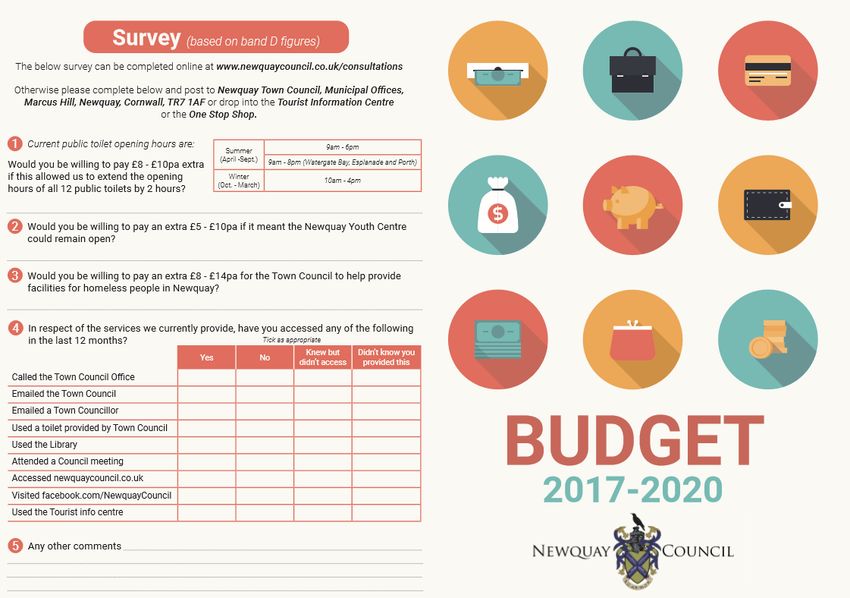
Status of this Report:
                                       Final v2.0 (PUBLIC VERSION)
                                 Report to:
                                       Full Council
                           Date of Report:
                                       05 December 2017
                                      Title:
                                       Finance & Policy Committee Budget
                                       Recommendations for Full Council
                         Service Area: All service areas affected
                     Ward(s) Affected: All wards affected
   Relevant Working Party/ Committee: N/A
           Key Decision:   Y           Procurement Method:           N/A
        Urgent Decision:   Y   Date next steps can be taken:      14.12.2017
                                            (e.g. referral on of recommendation or
                                           implementation of substantive decision)

   Appropriate pre-decision notification given to ward member if delegated?                 N

      Author: Andrew Curtis     Role: Town Clerk & Responsible Finance Officer
     Contact: Tel: 01637 878388   Email: acurtis@newquaycouncil.co.uk

   Recommendations
   It is RECOMMENDED that Full Council considers and adopts the below recommendation
   from this report as the submission to Cornwall Council for the 2018/19 financial year:
                                         2018-2019
                        Gross Expenditure Budget                   £2,428,000
                        Precept                                    £1,680,811
                        General Fund Balance                        3 months

   This equates to an Expenditure and Precept demand submitted to Cornwall Council as
   followed:
   Band D Impacts:
                        Current 2017/18 Band D Rate        £215.49
                           New 2018/19 Band D Rate         £215.49
                                         % Increase          0%
                                     Annual Increase         £0
                                    Weekly Increase          £0

1) The proposal results in a NIL increase for Newquay Town Council ratepayers for the Town
   Council’s element of Council Tax.
2)
3) Please note: in adopting this recommendation, all the requisite EMR, Accrual and Budget
   movements and changes as contained within Appendicies 12A-12O are acted upon by the RFO
   in so much as any additional changes formally made to budgets and EMR/Accrual movements
   between now and April 2018 will also be acted upon subject to any accounting regulations and
   deadlines.
4)
5) The Precept cannot be altered once set.
6)

                                           Page 2 of 58
Contents
1.0 Report Background ............................................................................... 5
2.0 Report Overview................................................................................... 6
3.0 2018-21 Budget Setting Process ............................................................. 8
  3.1 Budget Timetable .............................................................................. 8
  3.2 Financial Stability .............................................................................. 9
  3.3 Adequacy of Balances and Reserves ..................................................... 9
  3.3.1 Analysis of EMRs ........................................................................... 10
  3.4 Council Tax Support Grant ................................................................ 12
  3.5 Bank Accounts................................................................................. 12
  3.6 Investment Strategy ........................................................................ 13
  3.7 Referendum Principles/Capping ......................................................... 13
4.0 Financial Risk Assessment ................................................................... 15
5.0 Recommended Budget Overview .......................................................... 16
6.0 Recommended Budget ........................................................................ 17
  6.1 Alternative Budget Options looked at ................................................. 18
7.0 Responsible Financial Officer’s Comment ............................................... 20
Appendix 1: Summary of Recommended Budget .......................................... 23
Appendix 2: Summary Budget Recommendations NET of EMRs ...................... 24
Appendix 3: Analysis of Budget per Committee and Identified Risks ............... 26
  Overall Assumptions .............................................................................. 26
  Corporate Services ................................................................................ 26
  Finance & Policy (F&P) ........................................................................... 27
  Staffing ................................................................................................ 27
  Council Offices ...................................................................................... 29
  Economic Development & General Purposes (EDGP) .................................. 30
  Public Conveniences .............................................................................. 31
  Footpaths, Bridleways and Open Spaces (FBOS) ....................................... 33
  Tourism and Leisure (T&L) ..................................................................... 34
  Visit Newquay TIC ................................................................................. 34
  Library and Information Service (LIS) ...................................................... 35
  Quality Status ....................................................................................... 35
  Planning and Licensing (P&L) .................................................................. 36
  Localism............................................................................................... 36
  Contingency ......................................................................................... 36
  Mountwise Building ................................................................................ 37

                                              Page 3 of 58
EMR Balances and Movements ................................................................ 37
Appendix 4: UK Inflation for 2017 .............................................................. 39
Appendix 5: Finance and Policy Budget Leaflet............................................. 40
Appendix 6: Newquay Town Council Budget Leaflet Survey Results ................ 42
Appendix 7: 2018-19 Staff Hierarchy (Subject to Change) ............................ 43
Appendix 8: Service-Level Strategic Risk Assessment ................................... 44
Appendix 9: T&P Council Precepts Letter from Cornwall Council ..................... 49
Appendix 10: Council Tax Support (CTS) Grant Information per Council.......... 52
Appendix 11: Provisional Taxbase 2018/19 with 2017/18 comparison............. 55
Appendix 12: Individual Budgets by Committee or Service ............................ 58
Page 4 of 581.0 Report Background
This report has been prepared by the Town Clerk and Responsible Financial Officer
(RFO) of Newquay Town Council as part of the Budget and Precept setting process
for the financial years 2018-21. The report aims to clarify and give background
information to members on significant changes to the budgetary
recommendations and decisions made of each committee since the 2017-20
budget setting.
This report:
• attempts to ensure all councillors are aware of the decision making process
behind any significant propositions.
• identifies the key factors and detail behind the recommended budget
expenditure figures (and precept) from the committees and the Finance and
Policy Committee.
• provides a top-level strategic risk assessment based on the proposals and
As part of the Council’s Risk Management Strategy, this report also identifies
potential implications on Newquay Town Council’s ability to deliver services and
projects.
All financial, legislative and background information within this report has been
put together as objectively and diligently as possible and with the assistance of
the Town Council’s accountant, the Town Council’s management team and based
on the best figures and knowledge held at the time.
Page 5 of 582.0 Report Overview
The Local Government Act 1992, Section 49A requires a Local Precept Authority
(Newquay Town Council) to prepare a budget to calculate its Precept requirement.
The Town Council must therefore prepare an annual budget giving details of its
planned expenditure for the forthcoming year to ensure its financial resources are
aligned to its priorities and used to deliver priority outcomes for local communities.
There is a process of monitoring performace against budget.
Under the Terms of Reference of the Finance and Policy Committee, the
Committee has specific budget-related responsibilities as followed:-
The F&P Committee have delegated powers from Full Council to:
7.4 monitor all budgets on a quarterly basis, taking action where required
to vire unspent provisions to ensure that the overall budget strategy
is maintained.
7.5 establish a budget strategy for recommendation to Full Council as
laid down in Financial Regulation 3.1. This includes an Admin budget
which will be produced by the Town Clerk and an F&P Committee
budget in-line with Financial Regulation 3.1.
7.6 spend up to its annual budget, without the requirement to go back
to Full Council for approval; subject to such spends falling within the
remit of Finance and Policy or General Purposes (not covered by any
other Town Council committee) and are F&P committee projects,
budgeted for in-line with Financial Regulation 3.1.
7.7 make decisions and project manage any Newquay Town Council
initiatives which fall within the budget or scope of this committee.
7.8 consider and make relevant decisions on any matter referred to it by
Full Council.
7.9 refer any budget request by any Committee back to that Committee
or Full Council if it is felt that the financial implications would be
outside normal budget limits. This may include considerations from
public consultations, reviews on the budget or other relevant sub-
committee/working party recommendations.
7.10 consider any expenditure outside of the established budget strategy
when required to do so and make recommendations to Full Council.
7.12 investigate any proposal involving financial implications brought to
Full Council or any other Committee (and shall seek input and
approval of the Staffing Committee and Town Clerk should these
proposals have any impact on staff resources).
7.14 following a request from a committee, consider and recommend to
Full Council having any unspent budgets placed within a specific
Committee earmarked reserve or the spending of contingency or
earmarked reserves in accordance with Financial Regulation 4.9.
Page 6 of 587.17 consider and investigate sources of external funding (including
grants) for any projects, but should always seek guidance and input
from relevant committee(s) responsible for the service/deliverable
the grant will support unless there is not enough time for the relevant
committee to feed in to the application.
7.22 recommend the level of precept to the Full Council for approval on
an annual basis.
7.23 ensure that Risk Assessments for all the Council’s activities are kept
up to date, including the commissioning of external providers to
undertake this work.
7.25 ensure that adequate insurance provision for all assets of the Council
is in place, in conjunction with the Town Clerk and Financial
Administrator.
7.26 The RFO has delegated powers from Full Council with the committee
Chairman and Vice Chairman to monitor, review and recommend re-
investing the Council’s investments in conjunction with the Council’s
policy and as advised by an independent financial advisor.
7.18 ensure that adequate insurance provision for all assets of the Council
is in place, in conjunction with the Town Clerk and Financial
Administrator.
7.29 The RFO has delegated powers from Full Council with the committee
Chairman and Vice Chairman to monitor, review and recommend re-
investing the Council’s investments in conjunction with the Council’s
policy and as advised by an independent financial advisor.
Page 7 of 583.0 2018-21 Budget Setting Process
3.1 Budget Timetable
• Town Clerk, Accountant, Deputy Clerk and Managers (September 2017)
• Town Clerk works with the Accountant to pull together forecast and actual budget
1 expenditure reports. The Deputy Clerk and service managers also work on obtaining
updated figures and meter readings and reports back to the Town Clerk.
•Committee Chairs/Vice Chairs Informal Budget Meetings (Oct-Nov 2017)
• Town Clerk, Accountant and Chair of F&P meet with Standing Committee Chairs and Vice
Chairs to explore reasons behind proposed budgets and look at budget efficiencies,
2 providing a more direct scrutinising role, pre-committee debates and formal
recommendations.
• Committee (November 2017)
• Committees go through their budgets and recommendations and pull together draft
3 recommended budgets for the F&P Committee to consider as part of the F&P Budget
Report.
• Town Clerk, Accountant and Chair of F&P (November 2017)
• Town Clerk works with the Accountant to compile a Section 151 report (this report) and
budget recommendations from committees for F&P which includes a risk assessment on the
4 proposals from committees and the overall Precept impact for 2018-19 based on the Band
D Council Tax levels.
• F&P Committee (27 November 2017)
• The F&P Committee receives this report, having has the time to read the report before the
meeting, makes decisions over the recommended precept and expenditure levels and give
5 authority to release the recommneded information to the public as part of its on-going
consultation process.
• Town Clerk and Accountant
• The Town Clerk completes any amendments to the report made by F&P and evolves the
6 report into the F&P Adopted Recommended Budget Report for 2018-2021.
• Full Council Budget (13 December 2017)
• Full Council holds a Budget Setting meeting and ratifies the recommendations contained
7 within the F&P Recommended Budget report (subject to any amendments successfully
made at the meeting by individual members, in accordance with Standing Orders).
Page 8 of 583.2 Financial Stability
This establishes how the amount available to spend on council services is
determined and how local and national influences impact on funding.
External economic pressures which impact on the budget include:
o Pay expenditure
o Pension provision
o National Economic situation & Inflation
o Unemployment levels
o Referendum Principles (government consultion on its implementation this
year)
o Continued reductions to Cornwall Council Services
Internal Pressures:
o Income Generation
o Business Development
o Continuous Review of Income & Expenditure
o Local Political pressures
The Town Council’s strategy is to maintain adequate reserves to protect against
risk and support investments.
3.3 Adequacy of Balances and Reserves
The Town Council has two types of reserves:
Type 1: General Reserves (also referred to as the General Fund)
Balances in this category are not identified for specified purposes, but will be used
to cushion against the impact of emerging events or genuine emergencies.
The Council’s existing policy is to ensure a minimum of 3 month’s expenditure
remains within the General Fund. However, this can be increased where higher
levels of risk to the Council are identified for major projects.
Type 2: Earmarked Reserves
Balances in this category are set aside for specified projects where spending will
occur outside of the usual annual spending pattern of the budget.
The assessment of the adequacy of the Council’s balances and reserves has been
based on the guidance note on Local Authority Reserves and Balances, whilst not
a statutory requirement, it is considered to set out current best practice with
regard to balances and reserves.
The guidance states that no case has yet been made to set a statutory minimum
level of reserves and that each local authority should take advice from its Chief
Financial Officer and base its judgement on local circumstances.
A well-run authority with a prudent approach to setting its budget, will each year
consider its level of general balances. These general balances will also need to be
Page 9 of 58supported by earmarked reserves for specific needs and commitments. In coming
to a view on the adequacy of the Town Council’s reserves, account needs to be
taken of the risks facing the Council in terms of any significant unforeseen
spending commitments.
3.3.1 Analysis of EMRs
The EMR releases are all captured within the expenditure summary in Appendix 1
and also run through the various committee budgets to offset known expenditure
or building up a sinking fund for larger projects in 5-15 years from now. A full
breakdown of EMR balances including movements can also be found in Appendix
12R.
Whilst many EMRs do not have any spend against them, this is not a true reflection
of reality, where most if not all of the EMRs will have spend against them over
time. When budgetting, one of the challenges is to pin-point some of the spends
from EMRs and their likely size. This can give an impression that the Council is
sitting on significant funds with no plan to release/utilise them over time.
However, this is not the case and in the short-term for 2018/19 approximately
£737.2k is planned to be released from EMRs.
A summary of the EMR Balances for each committee can be seen overleaf:
Page 10 of 58Last Year This Year 2018/19 2019/20 2020/21
Forecast Budgetted Budgetted Budgetted
Opening
Closing Closing Closing Closing
Balances Balances Balances Balances Balances
31.03.2017 31.03.2018 31.03.2019 31.03.2020 31.03.2021
ADMINISTRATION
- IT/Software Upgrades 18,304 23,304 13,304 18,304 18,304
- Council Offices/Property Related 396,295 357,295 146,295 246,295 246,295
- Capital Fund 100,000 200,000 300,000 384,000 384,000
- General Equip.& Furniture 2,506 6 5,006 10,006 15,006
- Election Expenses 35,573 25,573 25,573 25,573 25,573
- Staff Training Fund 5,000 7,500 10,000 12,500 15,000
- Members Training Fund 2,000 3,500 5,500 7,500 9,500
- Staff Fund 19,453 19,453 24,453 29,453 34,453
- Legal & Professional 0 5,000 10,000 12,500 15,000
- Community Emergency Plan 100 100 100 100 100
579,231 641,731 540,231 746,231 763,231
FINANCE & POLICY
- Dinard Twinning 2,559 2,559 2,559 2,559 2,559
- Homeless Pilot Project 950 950 950 950 950
- Sports Fund 9,730 7,490 7,490 7,490 7,490
- Grants - General 38,827 38,827 38,827 38,827 38,827
- COMA Grant 2,000 0 0 0 0
54,066 49,826 49,826 49,826 49,826
EDGP
- Streetsafe Scheme 3,934 2,649 1,899 1,119 305
- Youth Initiative Project 7,990 0 0 0 0
- Lights 10,096 15,096 20,096 25,096 30,096
- CCTV - Fund 100,101 100,101 125,101 150,101 175,101
- Public Conveniences 176,358 154,589 125,589 156,589 187,589
298,479 272,435 272,685 332,905 393,091
FBOS
- Gannel maintenance 4,676 3,426 3,926 3,926 3,926
- Refuse Bins 1,624 1,278 932 586 240
- St Columb Minor Plaque 189 189 0 0 0
- Benches 286 0 0 0 0
- Open Spaces 35,856 30,000 30,000 30,000 30,000
- Skateboard Facility 46,754 166,754 0 0 0
89,385 201,647 34,858 34,512 34,166
T&L
- Tourism Projects 10,287 9,278 9,278 9,278 9,278
- Event Boards 4,450 4,450 4,450 4,450 4,450
- TIC Equipment 2,500 2,500 2,500 2,500 2,500
- Marketing grant 4,685 4,685 4,685 4,685 4,685
- LIS 0 68,589 68,589 68,589 68,589
- Tourist Information Centre 57,255 57,255 44,635 44,635 44,635
79,177 146,757 134,137 134,137 134,137
QUALITY STATUS
- Quality Status 6,525 2,525 2,525 2,525 2,525
LOCALISM
- Localism 97,951 203,951 129,408 181,705 215,698
97,951 203,951 129,408 181,705 215,698
NEIGHBOURHOOD PLAN
- Neighbourhood Plan 17,525 2,563 0 0 0
Total Earmarked Reserves 1,222,339 1,521,435 1,163,670 1,481,841 1,592,674
Page 11 of 583.4 Council Tax Support Grant
As part of the 2010 Spending Review, HM Government announced that it would
localise support for Council Tax from 2013/14. The Welfare Reform Bill 2011
contained provisions for the abolition of Council Tax Benefit paving the way for a
new localised scheme.
However, although Cornwall Council is continuing to maintain the Council Tax
Support Grant to local councils, they have consistently indicated there will
normally be a reduction of about 15% applied for subsequent years.
Due to Newquay Town Council’s Precept not rising above the growth in housing
stock in 2017/18, the CTS Grant for 2018/19 will be £80,457. This is a real-term
reduction of 21.1%; which shows how volatile the CTS Grant reductions are. We
have continued to budget for a reducing CTS Grant, with the funds effectively
going straight into reserves to ensure services are not adversely affected by the
reductions; but this is a growing risk to the Council.
See Appendix 10 to see the differences across Cornwall. This relies on a number
of external factors which include:
o Number of Newquay’s eligible claimants
o Precept changes of any other Town or Parish Council in Cornwall (likely to
increase in 2017-18)
o Amount of funding provided by Government to Cornwall Council
o Cornwall Council continues to pass on the Funding
o Future political policy changes
Whilst there has been a trend of approximately a 15% annual reduction in the CTS
Grant (subject to the above factors), it is clear from the Government’s latest
spending review that the Public Sector is to receive greater cuts in funding going
forwards. There is a clear desire for local government to be self-sustaining and no
longer reliant on central government funding. This is displayed further by the
devolution of Business Rates to Local Authorities, which will result in a significant
reduction/ceasation of central government funding to Local Authorities and in turn
no further CTS Funding for Towns and Parish Councils, which could be as soon as
2020. It is for that reason that the budget proposals account for the CTS Grant by
placing it within the Localism EMR, thus removing the Town Council’s direct
reliance on the grant for delivering of services.
3.5 Bank Accounts
The Town Council now has two Banking providers. The main operational current
accounts are held with Unity Bank and its reserves are held with National
Westminster (Natwest) Bank. Unity Bank is being used for the purposes of more
efficient and effective online account management and through a Payment
Authorisation Process that provides a robust control of the Council’s finances.
Page 12 of 58Given the recent announcement that NatWest are closing their Newquay Branch,
we are now in the process of closing those accounts and transferring the funds to
Unity Bank. However, this does bring an element of risk as the Town Council is
not covered by the Financial Compensation Scheme and thus should anything
happen to Unity Trust, there is a risk all funds could be lost. We have identified
one option for mitigation, which is explained more in 3.6 Investment Strategy.
3.6 Investment Strategy
The Town Council has an established Investment Strategy, but until now it has
not implemented it in respect of Council financial investments. This year (2017)
we have worked hard to identify and join a compliant and relevant scheme that
will spread the Council’s financial risks, whilst maintaining or exceeding the current
interest income received on its bank deposits.
CCLA is the organisation we have signed up with and we are due to authorise an
initial deposit of £100k-£250k to be placed within their instant access deposit fund.
This fund is yielding higher interest returns than existing banking providers; but
with the added benefit of spreading the funds across 30 different banking
establishments that are (following an assessment of rating etc. by CCLA)
considered low risk of going into liquidation. This provides a much stronger
position than we have at present, where all funds are held by either NatWest or
Unity Bank. Should one or both of those banking institutions go into liquidation,
the Council is not covered by the Government Compensation Scheme and so its
entire funds would be at risk.
3.7 Referendum Principles/Capping
During the Technical Consultation for the 2017/18 Local Government Financial
Settlement, the Government consulted on the implementation of Referendum
Principles for Town and Parish Councils. This focused on limiting non-devolution
related expenditure; effectively meaning if a Town or Parish Council who were the
qualified level of Band D (which we would be), could not increase their Precept by
more than 2% or increase their Band D contribution demands by more than £5
per annum (whichever is higher).
The vast majority of the sector, including Local and National associations have all
objected strongly to the principle and the way in which the conditions and
limitations have been derived; as they have been based on the lowest District
Council level of Band D and Precept. There has been no attempt to factor in
whether that District Council runs any services, has other income sources that are
not available to Town and Parish Councils or that there is a District and County
Council in that area (not a unitary authority like in Cornwall).
It is the Minister’s intention to extend referendum principles to Town and Parish
Councils where “lack of restraignt” is shown in respect of local council tax
increases.
Page 13 of 58Whilst members have been warned by the RFO and others in past Budget reports
that Government is seeking to do this, given that was the first technical
consultation to include points about extending the referendum principles to Town
and Parish Councils, it is beyond doubt that this is simply a matter of when, not
if. The Cornwall Council Precept letter for 2018/19, found in Appendix 9 further
supports this as it outlines the recent Technical Consultation and government
statement in relation to Town and Parish Council precept setting.
Page 14 of 584.0 Financial Risk Assessment
Similar to 2017/18 budget setting; given the context of developments in the public sector, the current economic climate, and the
Council’s need to deliver local priorities within the limits of available funding, risk management continues to have an increased profile.
It is important that the Town Council is able to demonstrate that it has effective financial risk management processes in place. A key
corporate risk relates to financial control and the impact this may have on the Council’s financial stability. The following highlights the
existing controls and planned improvement actions. A service-level strategic risk assessment can be found in Appendix 8.
Risk Description
Financial Control Existing Controls and Evidence Actions for 2018/19
Risk that the There are clearly defined financial roles, responsibilities General Inflation
Council fails to and decision making processes, set out in the Council’s Average rate of inflation has consistently remained above
3%
manage Financial Regulations. 2% and has now hit 3%. There is a risk this could rise
expenditure within further (see Appendix 4: UK Inflation for 2017).
budget and Fully integrated financial management system. Insurance (based on plans)
maintain an
adequate level of Well-developed financial reporting providing scheduled Supplies and Services 3%
reserves, hereby and ad-hoc reports for management and monitoring
threatening purposes. Postage 3%
financial stability (increase in digital distribution of agendas and minutes)
and service Robust medium term financial planning linked to service
continuity and performance and corporate objectives as part of the Non-domestic Rates 3% (if forecast
preventing the business planning process. is more than
achievement of budget)
corporate Basic general reserves strategy incorporating specific Gas and Electricity 6%
objectives. analysis of financial risks, forward forecasting and
Water 6%
assessment of the adequacy of general balances.
Quarterly financial updates incorporating variance
analysis and spending projections at service level and
overall assessment of impact on balances.
Ongoing review by internal and external audit of the
adequacy and effectiveness of financial and
management controls.
Price Inflation Actual costs plus 2%. Actual costs plus 3%
Page 15 of 585.0 Recommended Budget Overview
The Budget for 2018-21 has now gone through a number of phases and reviews
as shown in section “3.0 2018-21 Budget Setting Process”.
The results of the committee decisions now form the Recommended Budget for
F&P to consider, as followed:
F&P Recommendations to Full Council
Precept for 2018-19 £1,680,811
Expenditure for 2018-19 £2,428,000
New 2017-18 Band D Rate £215.49 per annum
(£4.14 per week)
Current 2017-18 Band D Rate £215.49 per annum
(£4.14 per week)
Band D Increase £0.00 per annum
(£0.00 per week)
Increase on Current Precept 3.98%
Increase in Newquay Housing Base 3.98%
Current Forecast Expenditure for 2017-18 £1,535,380*
*This includes a “Capacity Related Delays” re-valuation, which effectively reduced
the level of forecast expenditure (as quoted) by £330,091. What this does is
recognise that there are delays with projects that have been costed out and
budgeted for and tries to stabalise/reflect the overall financial landscape to which
the Town Council is working. It effectively means we would revaluing down the
spend rate and carry a circa £330,000 underspend each year based on the budget
and forecast spends, inflating the General Fund accordingly. This is as a direct
result of either delays or simply capacity for spending the funds – there is a risk
that with increased capacity we do spend this in the future, at which point a
contingency plan would need to be put into place by F&P to either limit
activity/spending or seek Full Council approval to release reserves to mitigate this.
All committee budget proposals can be found in the appendix section of this report
(from Appendix 12 onwards). There is also a summary outline of major
developments and items to note for each committee/service, identified by the
Town Clerk/RFO in Appendix 3.
Page 16 of 586.0 Recommended Budget
This budget achieves the following: protects the Council from proposed referendum principles,
maintains a contingency budget (albeit reduced), provides funds for the Capital Fund EMR and
Property Fund EMR, achieveing the devolution of the Library and Information Service, keeping pace
with the previously budgeted Open Spaces resource, maintains a Localism EMR using existing
balance plus CTS Grant payments (ensuring the CTS Grant doesn’t affect the precept).
2018/19 Expenditure Budget - £2,428,000 2018/19 Precept - £1,680,811
Band D Impacts:
Current 2018-19 Band D Rate £215.49
New Band D Rate £215.49
% Increase 0%
Annual Increase £0.00
Weekly Increase £0.00
Strengths/Positives Weaknesses/Risks
• Base Rate remains more stable going forwards with • Referendum principles in the future are
minimal effect when capping/referendum principles currently proposed to not allow a precept
come into force. increase of more than 2% (or a Band D
• Allows the Council to achieve its commitments and increase of £5 – whichever is greater). The
project plans for 2018/19 as well as the ability to do Town Council is not utilising its opportunity to
more in the future. increase the precept this year and didn’t last
• Band D remains lower than other major Cornish year. This represents a real-terms reduction
Towns. in the Town Council’s element of the Council
• General fund remains in line with the Council’s policy tax as an increase of housing stock does mean
of a minimum of 3 months of expenditure. an increase in the use of services provided by
• Future precepts continue to be projected to rise by the Town Council. As a larger authority,
inflation and adequately cover the known issues and Cornwall Council continues to suffer as a
projects, with at-least a 3 month General Fund result of past decisions to keep its precept the
balance. same and cuts to public sector spending, we
• Increasing the capacity of the Council, in-line with may find we are in a similar situation in the
other large Councils in Cornwall. future.
• Opportunity to derive an income from multiple • It is clear the Town Council will increasingly
buildings and meet some of the local priorities around be called upon by Cornwall Council, health
community space, albeit slightly delayed by other authorities, community groups and other
external factors. organisations to provide financial assistance
• Ability to continue to consult widely on the level of or take over specific activities – some of which
Open Spaces involvement and priorities. may be deemed vital to the Newquay
• Allows the Council to continue to work within its 4 year ratepayers. Without increasing the precept by
Corporate Business plan and Strategy Document more than simply the housing stock growth
where the numbers can be relied on, backed up by (or cutting the services we offer) means we
evidence and a transparent consultation process. will have a diminishing ability to provide this
• Ratepayers are already supporting a stable Town extra support.
Council precept.
• The Town Council is able to maintain and slightly grow
the Open Spaces Team that are already tackling key
issues within Newquay.
• Provides the resources to implement a Council-wide
strategy of increased commercialisation for some of
the services delivered.
Page 17 of 586.1 Alternative Budget Options looked at
In looking at the budget for 2018/19, the RFO spent some time on a desktop
exercise, exploring alternative options as followed:
Alternative Option 1: Reduce Precept by 25%
Following calls from a minority of members, the RFO explored what the budget
would look like if the current precept was reduced by 25% (which in real terms
represented a reduction of 31.89%, as it also didn’t take into account the 3.89%
growth in housing stock or normal inflation that is running at 3% at present.
Under this option, the Council would be asking for a precept of £1,212,368 which
reduces the Band D rate from £215.49 to £155.43. This represents a weekly
reduction of £5.
For the Council to achieve this, whilst maintaining the levels of EMRs planned for
Capital, Council Property and Localism as well as funding any disposal
costs/making defunct buildings secure enough to mothball/sell; you would need
to completely cease or remove the following services/committee budgets on or
before April 2018 (or an equivalent level of expenditure):
• Public Toilets
• Tourism and Leisure Committee
• F&P Committee
• Quality Status Committee
• Contingency Fund
With further cuts to services from 2019 onwards as followed:
2019 – fully fund Visit Newquay TIC from EMR then cease operating it in 2020.
2020 – Scale back FBOS Committee in relation to footpaths, weed control, hanging
baskets etc and then in 2021, start reducing the Open Spaces activity further.
Given the dramatic and profound effect this would have, taking the Council
backwards in respect of the services it delivers for the residents of Newquay, this
proposal has not been progressed further and is not recommended. The reduction
in income to the Town Council (if we inflate the new reduced precept by the level
of growth in housing for 2019/20 and 2020/21 respectively) would mean we would
have to find savings in the order of £1.433m over that period, with further savings
needed to be made after 2020/21.
Page 18 of 58Alternative Option 2: Increase Precept by 3% above the housing stock
increase
This option effectively takes account of inflation and the increased resource used
as a result of the growth in housing stock. It means a real-terms increase in the
Precept by inflation. The Precept would rise to £1,731,236, generating an extra
£50,424 for 2018/19. This extra funding could be spent on:
• Youth Services – nothing is in the budget for this at present
• Homeless Initiative – nothing is in the budget for this at present
• Contingency and topping up EMRs – The recommended budget
proposals reduced the Contingency Budget and Localism EMRs by a higher
level than the £50,424
• General Fund – taking the General Fund above 3.0 Months Gross
Expenditure. This protects against the risk of a lower capacity related
delays revaluation or additional expenditure not yet budgeted for.
The increase in Precept would result in a Band D of £221.95 per annum or an
increase of £0.54 per month. However, the increase, if inflated in future years by
just an average 2% growth in housing (no extra inflation) then with a new Band
D rate of £221.95 staying the same, the Town Council would receive
approximately £154,317 more between April 2018 and March 2021, than the
current recommended budget.
Whilst there is no doubt, there will be a need in the future to increase the Precept
by more than simply the increase in housing stock, there would appear to be little
support for increasing the precept above that growth for 2018/19. There are still
key services that have not yet come across to the Town Council and those alone
are creating underspends that were not budgeted for last year; reducing the short-
term need to generate extra revenue.
The RFO therefore believes this option is unlikely to carry favour and in-light of
the known underspends that have been factored into the 2017/18 forecast and
EMR balances, supports the recommended budget over this alternative option.
It is important to labour the point that this will become an increasing risk to the
Council and we may be faced with either reducing services or increasing the
Precept by more than inflation (and growth in housing) in the future, if we keep
the Band D rate at £215.49 – especially if cuts from Cornwall Council ramp up the
devolution agenda or service improvements are demanded locally over and above
what we are budgeting to provide.
Page 19 of 587.0 Responsible Financial Officer’s Comment
In this section, the Responsible Finance Officer (RFO) has commented on key
areas of the Council, specific new services or those with significant changes
proposed. There is also a view from the RFO on the recommended budget and
precept proposal.
Further more detailed information of each committee/service can be found in
Appendix 3.
Devolution
Similarly to last year, the Council continues to look at the devolution agenda and
the repatriation of assets, protecting services and considering projects which will
inevitably have an impact on the levels of the council’s budget and precept. The
main driving force for taking on services and assets is either to safeguard them
from cuts at Cornwall level or to reshape the focus of those services/assets to one
that is more aligned to what Newquay residents/businesses expect.
Landscape
This budget setting continues to follow the 2016/17 stablisation budget, which
saw a significant increase in the precept. At the time, it was planned in the budget
recommendations and report that the precept would remain stable, with minimal
changes (other than inflation) in order to ensure the future viability of the Town
Council, its services and activities. Having reviewed the planned activity and likely
service requirements in the future, it is my view that the precept recommendations
that have been set out for 2018/19 continue to take account of the direct impact
on services the increase in housing stock has. There is an argument that we should
consider inflation above the growth in housing, but as we benefit from healthy
reserves and made difficult decisions in the past, we can meet our service plans
for 2018/19 without the need to increase the precept above the increase in
housing stock.
General Fund
The Council has a policy of holding a MINIMUM General Fund balance of 3 months.
However, there are times where large projects or unknown issues result in
heightened levels of risk to the Town Council, where a higher than 3 month
General Fund balance would be recommended. Below are the planned levels in
the recommended figures:
Budget Year 2018/19 2019/20 2020/21
General Fund Equivalent Months (Gross) 3.0 3.0 3.0
Given the Council’s continuingly ambitious programme of projects over the next
48 months, I, along with the Council’s accountant and independent internal
auditors have concluded that in an ideal world, the Council should have more than
3 months of expenditure as a General Fund balance. However, as we have healthy
EMR balances and still maintain a Contingency Budget, we have provided
Page 20 of 58mitigation against the heightened risk. We may wish to go further and put in place
contingency planning that would be followed should particular scenarios occur, but
this is something that the Finance and Policy Committee will work on with me
between now and April 2018.
CTS Grant
The Council still factors in the CTS Grant into its budget, however, in the
recommended proposals, the Grant effectively gets placed within the Localism
EMR. Whilst this is a reduction in what was originally budgeted to go into that
reserve, as there are no immediate devolution projects (other than those
budgeted for already or the Atlantic Road Play Area and Car Park) there are no
short-term spend requirements from this reserve. It is therefore proposed that
the Localism EMR additions are reduced to simply be the CTS Grant amounts going
forwards. This means the Town Council’s core operations and services are not
reliant on the CTS Grant and so this reducing income stream should not translate
into services being adversely affected.
Environment Service
For the first time, the Town Council has established and now runs its own
Environment Service. The service currently consists of 3 (1 manager and 2
operatives) with plans to increase this by a further operative from April 2018. The
focus of this Service is to improve and enhance the quality of the Open Spaces
investment Newquay currently receives, over and above the standard service
level. The results speak for themselves and the recommended budget allows us
to continue to make inroads into what has been significant underinvestment in
Newquay’s Environment Assets over the past decade.
Public Conveniences
Looking at Public Conveniences – Newquay is held up locally as the leading Council
for the delivery of well-run public conveniences. A number of local Town and Parish
Councils have been to see how we deliver this important local service and how we
are investing in the assets in the face of continued vandalism and anti-social
behaviour. The 2018/19 budget allows the Council to invest further in the Council-
run facilities, by opening them for longer hours and establishing a ‘Changing Places
Toilet’ within the Town (likely at the Railway Station toilets). This means more
accessibility to existing facilities, but crucially visitors who struggle to find Towns
that can accommodate the sometimes quite complex needs of a member of their
family, will be able to add Newquay to their list of destinations.
Visit Newquay TIC
This service has now come under the umbrella of the Tourism and Leisure
Committee, who are driving the service to become more commercially focused.
There is a push to increase the levels of income into the service to ensure this
vital resource minimises it’s reliance on the local precept. A scheme of review is
already underway, with plans being developed to help shape Visit Newquay TIC’s
future.
Page 21 of 58Library and Information Service
Still not devolved but working on the final ‘deal’. Already looking at improvements
to the services and physical assets. Likely to be devolved (subject to Cornwall
Council) early into the 2018/19 financial year.
Mountwise Building
This year the Town Council resolved to put in place plans to renovate the acquired
Mountwise Building, in order to provide a mixed-use commercial and community
building. The project is now underway with contractors/project manager due to be
appointed in January 2018, for works to commence between January and March
2018 if everything goes according to plan. This facility should provide an income
stream, a valuable strategically placed resource and increased capacity for the
Town Council to continue to grow and deliver new and existing services at a local
level.
Overview of Recommendations
When taking into account the financial landscape we are currently working within,
the external influences within the Public Sector and the proposed activities of the
Council over the next few years, I am fully supportive of the recommended budget
proposals within this report for 2018/19. In my professional opinion, this is the
best option available. It continues to grow and enhance the services we are
delivering locally, continues this period of stability for the Council, whilst taking
stock of the various risks we face as an organisation.
The recommended budget and precept results in a 0% increase in Band D and
only accounts for the increase in housing in Newquay; which in-itself has a clear
and direct impact on the services we provide as a Council. Similarly to last year,
I have also looked at what a stand-still precept would look like (reducing the Band
D), but without changing EMRs and proposed spending (reducing both), it results
in less than 3 months of General Fund balances each year as well as an unstable
and fluctuating precept.
For more detailed comments on individual committee budgets please refer to
Appendix 3 and 12 respectively.
Page 22 of 58Appendix 1: Summary of Recommended Budget
Page 23 of 58Appendix 2: Summary Budget Recommendations NET of EMRs
Page 24 of 58Page 25 of 58
Appendix 3: Analysis of Budget per Committee and Identified Risks

Within this section each committee/major service is broken down, with key issues
which members should note/be aware of, as well as a professional opinion on
whether the Budget adequately takes account of the risks and issues identified.
This section does not provide a line-by-line commentary of each budget submitted
as there is too much detail.

Overall Assumptions

Throughout all budgets the following conventions have been used wherever
relevant:

                           Inflation
            Item                                      Reason/Notes
                            Applied
 Electricity Costs            6%       Appears to be increasing faster than inflation.
                                       Applied to the forecast, not previous budget.
 Water Costs                  6%       Appears to be increasing faster than inflation.
                                       Applied to the forecast, not previous budget.
 Non-domestic Rates           3%       Unknown level of increase (rate not set for
                                       next financial year yet). There is still a bit of
                                       fluctuation post transfers from Cornwall
                                       Council to Town Council, but this should start
                                       to stabilise.
 General Inflation            3%       Current inflation level (see appendix 4).

Corporate Services
The recommended Corporate Services budget (see Appendix 12C) has, similarly
to last years budget; been based mainly on inflating the current actual or forecast
spends by inflation. The 2017/18 NET forecast spend is approximately £6.9k above
budget, when taking account of EMR releases. This is mainly centred around
higher than budgeted for Telephones and Broadband Costs, Computing and IT
costs and GDPR (General Data Protection Regulations) Complaince Costs.

Gowing forwards IT, Telephones and Broadband, Insurance and GDPR Compliance
Budgets are the main increases. These fall across the entire Council, not just in
relation to the office costs. As we grow as an organisation, you would expect
growth these costs. The only significant unknown is the GDPR costs. We have been
advised to hold a budget of around £35,000 per annum to cover any and all costs
associated with being compliant to the new regulations (including the potential
requirement to employ/commission an independent Data Protection Officer) from
May 2018. The regulations are already having a significant bearing on the
workload of the office staff as new processes are having to be developed that meet
the regulatory standards – including changes to the IT system we currently have,
in order to help prevent data breaches now and into the future.

RFO Comment: Like last year, the Corporate Services budget covers a
range of spends which are predicated on the activity of the Council as a

                                   Page 26 of 58
whole. Insurance, audit, accounting, IT etc. are all costs that the office
have no control over and are not really Office costs.
GDPR is a significant unknown that has been mitigated by having a
significant budget that can be re-valued during the 2019/20 budget
setting, if it turns out to be too high (or indeed too low).
Given what the Council is planning and the likely increasing activity, the
level of costs proposed in the recommended budget seem to meet the
known growth as well as providing extra resource for new regulations
coming into force. With the entire landscape in mind, I believe the
recommended budget for 2018/19 will adequately cover the known
activities and ensure adequate resources to help the Council’s Office to
run as efficiently as possible.
Finance & Policy (F&P)
The recommended F&P Budget (see Appendix 12D) is again pretty simple and
arguably quite low given the amount of grant monies awarded by the Council for
a number of years. Many of the grants are awarded out of a number of other
EMRs, with one General Grants budget of £5000 per annum. As in 2017/18’s
budget report, the key issue remains - at some stage there will be no grants EMRs
left unless the Council tops them up. However, as we are likely to be capped in
the future, the top-ups will be harder to undertake, unless other EMRs such as the
Localism EMR are in full (or part) used for that purpose.
RFO Comment: Whilst the annual budgte remains low, the grants EMRs
have a combined balance of approximately £49,826 as at March 2018
(subject to no further activity) and so unless there are any significant
requests in the near future, the Council is likely to be able to meet any
requests that they may wish to support. There is also the question as to
whether the Council should now limit grant funding for specific purposes
or upto set limits, in order to ensure the EMRs do not depleat as quickly.
This forms part of an on-going review of EMR balances by the F&P
Committee and so future decisions over setting a policy, can be had later.
Staffing
The recommended Staffing budget (see Appendix 12E) provides all staff costs
across the Council. This is a critical budget that ensures the smooth-running of
the Council and its services. Training remains a key element that will be called
upon going forwards to ensure compliance and the development of the staff and
councillors.
Unlike other complex budgets, we are able to model the Staffing budget through
known and relatively stable Payroll software. So, unless significant issues occur or
Page 27 of 58there is a higher turnover of staff, the expenditure levels should remain stable and
on-budget.
The significant changes proposed for the Council for 2018/19 are outlined below
(compared to what was budgeted for during 2017/18 budget-setting):
Part-time Compliance Officer
This role will undertake risk assessment (and checking assessments are carried
out and held on file for all our activities), ensuring everyone has completed their
training and organising this if there are short-falls that need to be addressed,
checking all documents and reports have been impact assessed with equality
assessments also being carried out on planned and new activity and being
responsible for ensuring the on-going commissioning of compliance checks across
the Council. As the Town Council is increasing its activity and productivity, this
role will be vital in ensuring protection against the increasing litigatory world we
operate within. Having strong, consistent and compliant evidence is vital to
ensuring the Town Council is protected and has the best defence against claims
going forwards.
Part-time Accounts Assistant
Given the significant increase in financial transactions and the higher level or
reporting required (with the implementation of a new purchase order system), it
has become apparent that the existing resources within the Office can no-longer
keep up with the rising processing needs of the Council. This, coupled with the
rising accountancy costs has led to the proposal to employ a part-time accounts
assistant, who can help the Responsible Financial Officer to manage the Council’s
finances in a timely way as well as meeting our growing needs to put in place a
business continuity plan, should external resources be unavailable when needed
(short-term or long-term).
Part-time Planning Committee Administration Resource
Following the departure of a member of the Council who brought in new processes
in relation to the Planning Committee, as well as changes Planning Applications
now being paper-less; there has been a growing demand on specifically the
Deputy Town Clerk’s time but also the office, in ensuring the fortnightly meetings
have been prepared for fully. This resource is designed to provide an officer who
can be solely responsible to ensuring all the preparatory work is undertaken and
completed for the meetings, whilst also being responsible for liaising with Cornwall
Council officers, planning applicants and following up on 5 day protocol emails.
Full-time Project Officer
Following the return of the PA to Town Clerk from Maternity Leave, the existing
12 month fixed term post was informally assessed as needing to continue. That is
because the work they have taken on from other members of staff has significantly
grown since they started. The post does cover a range of projects – both existing
with growing demands, and new projects that have taken significant research and
Page 28 of 58setting up time. Those projects are all in their infancy and members have
expressed a wish to grow and improve them, so there is a clear need for this
resource to continue. Subject to the budget and an assessment into the demand
for the specific role, the 2018/19 budget assumes the cost of keeping the post
after the expiration of the 12 month contract.
Full-time Facilities Operative x2 (and making an existing Operative a supervisor)
The EDGP committee has proposed opening the public conveniences for an extra
2 hours each day. This is in response from calls members have received to keep
toilets open longer. To achieve this without significantly impacting the cleanliness
and effectiveness of the service, there is a need to employ a third team of 2
operatives and promoting one of the existing operatives into a supervisory post,
to support the Facilities Manager (who also cleans toilets).
Full-time Environment Service Operative
Following the success of the Environment Service (Open Spaces Team) and in-line
with the budget plans over the next 3 years, the FBOS committee have
recommended to continue the planned recruitment of a 3rd operative. This will not
only increase the team’s resources, but it overcomes occasional lone working
issues that exist at present. The Team also supports other services such as the
erection of marquees on the Killacourt for events, as well as assisting with the
putting up of the Christmas tree, in addition to their vital work in enhancing
Newquay’s environment assets.
RFO Comment: Even with the increase in office staff resources, the RFO
still believes the administration element of the Staffing budget is simply
the start of a catch-up in resources as there has been little by way of
putting in place extra resources to meet the growth in workloads and
demands of the Council. There will still be a resource issue that will
remain under review going forwards, especially as growth is still planned
for the Council. The recommended budget covers everything that has
been requested and so unless there are unforeseen issues or higher than
anticipated staff turnover, the budgets should cover the costs of the staff.
Council Offices
As part of the Library and Information Center (LIS) devolution, the Town Council
negotiated the Freehold transfer of the Municipal Offices and Library Buildings.
The Municipal Offices have been designated as the main immediate home for the
Town Council’s service delivery and so we are planning a level of investment to
re-decorate the building and chip away at the decades of under-investment by
Cornwall Council and previously by Restormel Borough Council. However, until we
have taken ownership of the Building, we are not yet able to understand the true
magnitude of the running costs and so have maintained the budgeted figures as
per last year’s budget setting.
Page 29 of 58RFO’s Comment: The RFO agrees with this approach, as there has been
significant underinvestment in the Council Offices, it is difficult to assess
what degree of spend will be required to bring the building back into its
former glory and the associated running costs. Underspends are planned
to be used for the immediate renovation/upgrade works, but then on the
costs for running the building will come from the budget that has been
set.
Economic Development & General Purposes (EDGP)
As with the 2017/18 budget setting, this budget remains the biggest budget of
the Council and due to the varied makeup of the committee’s project portfolio, the
budget is quite complex and has been split into 2 – the EDGP Budget (CCTV,
Lights, Fountain and Other) and Public Conveniences Budget.
EDGP Budget
The 2018/19 recommended EDGP budget (see Appendix 12G) continues to contain
quite complex calculations and projects which are of an operational nature. Costs
remain affected by external influences such as vandalism, weather, accidental
damage and market forces. Key issues have been identified in the table below:
CCTV This year the CCTV service has received a proposal to join the Tolvaddon Scheme,
which would mean the transfer of staff and monitoring control to Cornwall Council’s
Fire Service based in Tolvaddon (Nr Pool). Whilst a final decision has yet to be
formally made, the proposal is predicated on signing up to a 7 year contract, would
cost the Council significantly more than the current operation and both Newquay
and St Austell Town Councils must transfer over. With this in mind, the committee
has authorised the drawing up of sales material which would provide scope for the
commercialisation of the service and attracting new Town or Parish Councils to
commission the monitoring of their cameras from Newquay Town Council, from our
CCTV Control Room.
Lights Following the transfer of the Christmas event, fireworks and tree budget to the
Tourism and Leisure (T&L) Committee, the EDGP Committee has focused its efforts
on expanding and enhancing the decorative and Christmas lighting, with new
displays and enhancements to the infrastructure to reduce tampering. The 2018/19
budget has been increased to recognise the actual annual spend and allow the Lights
EMR to build up in anticipation for a total overhaul and refurbishment of the
infrastructure in a few year’s time, when it is expected to become necessary.
Fountain Following the total failure of the fountain again this year, the committee consulted
locally on whether to continue to repair the fountain, or to simply turn it into a static
feature. The overwhelming response was to stop spending significant funds on the
fountain and simply turn it into a sculpture. The budget for 2018/19 recognises the
cessation of the water supply, but factors in on-going maintenance/repair costs as
well as the ability to install uplighters/LEDs as an enhancement.
Page 30 of 58You can also read


