2020 Handbook ISS Research Design Challenge: CELERE - NASA
←
→
Page content transcription
If your browser does not render page correctly, please read the page content below
ISS Research Design Challenge: CELERE
Capillary Effects on Liquids Exploratory Research Experiments
https://www1.grc.nasa.gov/space/education-outreach/drop-tower-competition/current-drop-
tower-challenges/2020-celere-iss-research-design-challenge/

2020 Handbook
By Andrew Wollman (formerly Portland State University, Oregon)
Dennis Stocker (NASA Glenn Research Center, Cleveland, Ohio)
Tyler Hatch (NASA Glenn Research Center, Cleveland, Ohio)

Contents                                              Page
        Design Challenge Overview                         1
        Capillary Flow, Drop Tower, PSU                   2
        Eligibility, Selection                            3
        Conference, Cost, Files …, Key Changes …          4
        How to Participate                                5
        Experiment Hardware, Testing, and Analysis        6
        Design Requirements                              11       This section and the next are VERY IMPORTANT!!!
        Common Mistakes                                  15
        Design Challenge Suggestions, Design Hints       16
        Questions, Appendix: Past Experiments            17

The tutorial, drawing template, entry form, and flyer are separate files and can be downloaded from
https://www1.grc.nasa.gov/space/education-outreach/drop-tower-competition/current-drop-tower-
challenges/2020-celere-iss-research-design-challenge/

http://tinyurl.com/SEECmicrogravity (alternate source of CELERE files)
Design Challenge Overview
CELERE is a joint educational program of NASA and Portland State University (PSU) enabling
students to participate in microgravity research on capillary action related to that conducted on
the International Space Station (ISS). The students create their own experiments using Computer-
Aided Design (CAD) with a provided template and DraftSight software, which can be downloaded
for free from www.3ds.com/products-services/draftsight-cad-software/free-download/.
Experiment proposals, which consist primarily of a single CAD drawing, are submitted to NASA.
The test cells are then manufactured by PSU using the drawings and a computer-controlled laser
cutter. Each experiment is conducted in PSU’s Dryden Drop Tower (www.pdx.edu/dryden-drop-
tower/), where it will fall 22 meters (73 feet) and experience 2.1 seconds of apparent near
weightlessness, i.e., microgravity. Video and still images from each drop are provided online for
student analysis and the reporting of results, for example in a science fair or class presentation.
The example image shows a 2013 experiment (from Columbus, GA) during the middle of the drop,
where the scalloped channel wall has slowed the upward motion of the oil (relative to the oil’s
motion in the straight-walled channel).

CELERE enables students to participate in research related to space station science and learn about
computer technology (e.g., CAD), both of which can inspire the pursuit of STEM careers - where
STEM stands for Science, Technology, Engineering, and Mathematics. Boy Scouts could use the
CAD drawing toward completion of the Drafting merit badge. And selection in a nation-wide NASA
design challenge is an accomplishment worth noting on college applications!

                                                              1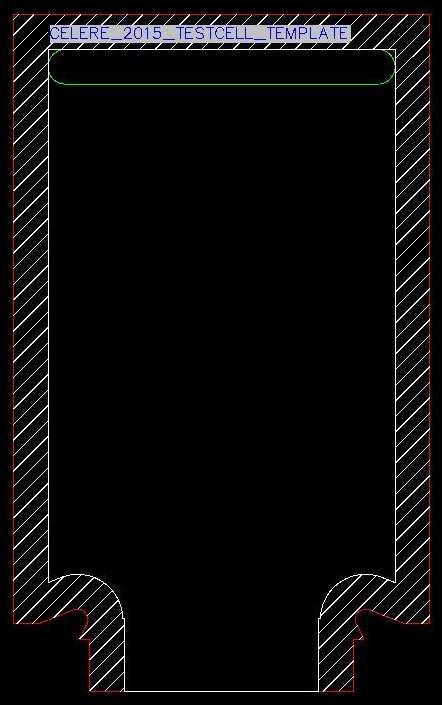
CELERE 2020 Handbook                                                                              27 August 2019

Capillary Action
NASA is very interested in capillary action because of its importance in liquid systems on spacecraft. On Earth, liquids
naturally flow downward because of gravity and equipment is designed and built to take advantage of that natural process.
For example, cars draw gasoline from the bottom of the fuel tank. But in microgravity, liquids naturally flow because of
capillary action making it important for propellant, water processing, thermal control systems – as well as in some
materials processing.

Capillary action happens when the molecules of a liquid (like water) are more attracted to a surface than to each other. In
paper towels, the molecules move along tiny fibers. In plants (like celery), they move upward through narrow tubes called
capillaries. For more basic information about capillary action, see for example:
         http://water.usgs.gov/edu/capillaryaction.html
         http://web.mit.edu/nnf/education/wettability/index1.html
         http://hyperphysics.phy-astr.gsu.edu/hbase/surten2.html#c4

Capillary action can be difficult to observe on Earth because of gravity, except in small capillaries. But while experiments
fall in a drop tower, where there seems to be almost no gravity, capillary effects are easy to see and study.

Drop Tower
In PSU’s Dryden Drop Tower, your experiment will be dropped down a tall shaft and while it is falling,
it will behave as if there is nearly no gravity – of course neglecting the fall! Gravity will still be
present, but our sensation of gravity and weight comes from a resistance to its pull, for example
because of the floor holding us up. But while freely falling, we feel weightless and that is the basis
for many amusement park rides. This works because of the surprising situation where all objects
fall at the same acceleration unless acted upon by another force. As one result, the astronauts and
the International Space Station fall together (around the Earth) such that the astronauts float within
the space station. This happens even though the space station is so close to the Earth that gravity
there (in a low-Earth orbit) is only about 10% less than that on the planet’s surface. While this is
space science, the concept of apparent near weightlessness through free fall, i.e., microgravity, was
put to practical use in the late 1700s when shot towers were first built to produce superior shot for
hunting. In those towers, droplets of liquid lead became spherical because of the surface tension
resulting from the liquid’s attraction to itself. You can learn more about microgravity at:
          http://www.nasa.gov/centers/glenn/shuttlestation/station/microgex.html
          http://www.nasa.gov/audience/foreducators/microgravity/home/index.html

                              PSU
                              PSU’s Prof. Mark Weislogel (http://www.pdx.edu/profile/meet-professor-mark-weislogel) is
                              a world leader in the study of capillary action and with NASA support has had such
                              experiments conducted in drop towers, on the space shuttle, on the Russian Mir space
                              station, and the International Space Station (ISS) where the following are two examples of
                              his ISS experiments:
                                 Capillary Channel Flow (CCF)    http://issresearchproject.grc.nasa.gov/MSG/CCF/
                                 Capillary Flow Experiment (CFE) http://issresearchproject.grc.nasa.gov/MWA/CFE/
                              Now you can design your own microgravity experiment and investigate capillary action just
                              like Prof. Weislogel and the astronauts. Begin by visiting the CELERE web site and reading
                              this guide!

                                                             2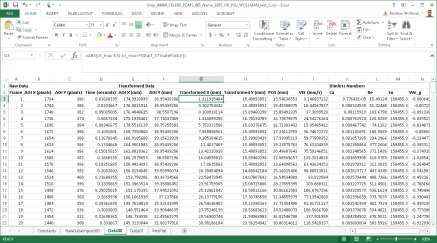
CELERE 2020 Handbook                                                                             27 August 2019

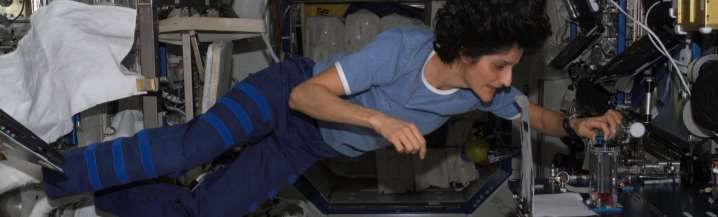
Many astronauts have participated in microgravity studies of capillary action, including for example the following for CFE:
Joe Acaba, Clay Anderson, Dan Burbank, Chris Cassidy, Cady Coleman, Tracy Caldwell Dyson, Mike Fincke, Kevin Ford, Mike
Fossum, Mike Hopkins, Scott Kelly, Mike Lopez-Alegria, Bill McArthur, Tom Marshburn, Karen Nyberg, Don Pettit, Shannon
Walker, Peggy Whitson, Jeff Williams, and Sunita Williams (shown above operating CFE on the space station).

Eligibility
The design challenge is for youth in grades 8-12, who may participate as individuals or in teams of any size. Teams may
also include younger students as long as there is at least one team member in grades 8-12, where this option can facilitate
the participation of informal science clubs, Scouts, etc. Youth are free to get help from adults, for example in creating
their CAD drawing. But this program is for youth.

The program is limited to youth from the United States, but citizenship is not required. More specifically, CELERE is open
to all fifty states, the District of Columbia, Puerto Rico, American Samoa, Guam, the Northern Mariana Islands, the U.S.
Virgin Islands, and all DODEA schools, i.e., schools of the U.S. Department of Defense Education Activity for the children
of U.S. military personnel.

Whether as an individual participant or team member, a student may be associated with at most a single CELERE 2020
proposal. Furthermore, a maximum of 7 experiment proposals may be submitted by a single school or organization for
the 2020 challenge. All proposals and communication with NASA personnel must be conducted in English.

Selection
Since the initiation of this design challenge, 100% of the entries received were selected for fabrication and testing in
microgravity. However, this was often been after team revision of the CAD drawings because they failed to meet the
design requirements specified in this document. Please know that the tentative plan for 2020 is to reject such
submissions, i.e., which violate the design requirements, to reduce the NASA and PSU workload associated with the
challenge. The CELERE director, Mr. Dennis Stocker, is now busy guiding testing on International Space Station for the
Advanced Combustion via Microgravity Experiments (ACME) project, which consists of six experiments. ACME tests will
be conducted on an ongoing basis for the next few years, so it is further anticipated that the CELERE design challenge will
not be offered in the future. However, NASA has begun offering annual problem-based Drop Tower Challenges in which
teams of high school students design and build experimental hardware which is tested in NASA’s 2.2 Second Drop Tower
in Cleveland, Ohio. The challenge problem has changed from year to year, where the 2020 challenge is a “Paddle Wheel
in Microgravity” found here: https://www1.grc.nasa.gov/space/education-outreach/drop-tower-competition/

Revisions were requested of roughly 50% of the CELERE entries submitted last year, so close attention should be paid to
the design requirements and common mistakes described in this document. Failure to do so may easily lead to rejection.

                                                            3
CELERE 2020 Handbook 27 August 2019
NASA will not check drawings to make sure that they are acceptable prior to the entry deadline, but will answer questions
about the design requirements. Nonetheless, it is the submitting team’s responsibility to review this document and ensure
that the requirements are met.
If the design and submission requirements are met, the odds of selection in 2020 are quite high, where at least one
qualifying entry is guaranteed for each state, etc. listed under ‘Eligibility.’ This guarantee includes selection of at least one
qualifying entry from an overseas DODEA school. Selection is also guaranteed for at least one qualifying entry from a
Bureau of Indian Education (BIE) school. In past years, i.e., 2013-2019, there have only been participants from 17 states
and one overseas DODEA school (in Germany), so your entry could easily be the first from your locale.
Conference
Some CELERE participants - based on their experiment design, data analysis, and written report - will be invited to present
their results in a student poster session at the 2020 meeting of the American Society for Gravitational and Space Research
(ASGSR, www.asgsr.org) in Fall 2020. Limited financial support may be available for invited non-local teams to travel to
Denver, Colorado for this purpose. It is envisioned that at up to six teams will be invited to the conference, where three
are local and three are non-local, e.g., from more than 150 miles away from the conference site.
Cost
There is no cost to participate in CELERE other than the optional conference travel.
Files & Educational Resources
Access CELERE files and various educational resources related to microgravity via http://tinyurl.com/SEECmicrogravity.
Key Changes from 2019
All CELERE entries must be submitted in
English. Any communication with NASA
regarding CELERE will also be conducted in
English.
The tentative plan is to reject entries which
violate the design requirements, whereas the
2013-2019 approach was to request the
teams to revise their CAD drawings to correct
shortcomings. This will be determined by
NASA based on the number of total entries,
so it is very important to make sure your
drawing is correct the first time! It is
anticipated that the CELERE design challenge
will undergo some changes and may not be
offered in the future, i.e., after 2020.
The freely-downloadable DraftSight software
upon which the tutorial is based has been
and continues to be updated.
The drawing template has been updated. Please use the 2020 drawing template which can be downloaded from:
https://www1.grc.nasa.gov/space/education-outreach/drop-tower-competition/current-drop-
tower-challenges/2020-celere-iss-research-design-challenge/
OR http://tinyurl.com/SEECmicrogravity
The other supporting documents - such as this handbook, the tutorial, and entry form - have also been updated.
4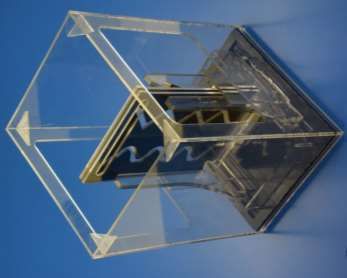
CELERE 2020 Handbook 27 August 2019
How to Participate
Preparation and Submission
o Explore the CELERE website at https://www1.grc.nasa.gov/space/education-outreach/drop-tower-
competition/current-drop-tower-challenges/2020-celere-iss-research-design-challenge/.
o If you are a Facebook user, ‘like’ the CELERE page at www.facebook.com/NASA.celere.
o Read this handbook.
o Learn about capillary action, e.g., through:
http://ga.water.usgs.gov/edu/capillaryaction.html
http://hyperphysics.phy-astr.gsu.edu/hbase/surten2.html#c4
http://web.mit.edu/nnf/education/wettability/index1.html
o Review past experiments through the appendix of this handbook at a minimum, and ideally at
https://www.youtube.com/user/DIME10NASA/videos and any videos posted on the main website.
o Download the CELERE 2020 tutorial from https://www1.grc.nasa.gov/space/education-outreach/drop-
tower-competition/current-drop-tower-challenges/2020-celere-iss-research-design-challenge/.
o Download the 2020 drawing template from https://www1.grc.nasa.gov/space/education-outreach/drop-
tower-competition/current-drop-tower-challenges/2020-celere-iss-research-design-challenge/. The use
of past templates is unacceptable.
o From https://www.3ds.com/products-services/draftsight-cad-software/free-download/, download the
Draftsight CAD software and go through the CELERE tutorial. You may use other CAD software that works
with ‘dwg’ files, but the tutorial is based on the free Draftsight software.
o Review the design requirements and common mistakes in this handbook.
o Develop your research question.
o Design your test cell so that (1) the results will answer your research question and (2) it is different from
the past CELERE experiments shown in the appendix.
o Download the entry form from https://www1.grc.nasa.gov/space/education-outreach/drop-tower-
competition/current-drop-tower-challenges/2020-celere-iss-research-design-challenge/ and fill it out.
o Verify that all design requirements are fully met or risk rejection!
o E-mail the drawing file and entry form to celere@lists.nasa.gov (where this step might be done by your
teacher/advisor) by March 1.
Testing and Analysis
o Selected experiments are normally conducted during the month of their submission deadline.
o When notified, download the results from the personalized web link that will be provided. Note that the
video files are not standard, but can be viewed using VLC Media Player, which can be freely downloaded
from http://www.videolan.org/vlc/index.html.
o Analyze the results by comparing the capillary motion in your test cell’s channels. You can determine the
position of the oil in each channel as a function of time (e.g., knowing that high-speed video includes 60
frames per second). The position can be determined in pixels, e.g., using Microsoft Paint, which shows
the position of the crosshairs in pixels, and then converted later into millimeters.
o From the position data, average speeds can easily be determined.
Reporting
o Prepare a written report about what you learned, and e-mail it by May 1 to celere@lists.nasa.gov (where
the submission might be done by your teacher/advisor). The report should include discussion of what
was good about the CELERE design challenge and what needs improvement.
o If invited, optionally present your results in a student poster session at the 2020 meeting of the American
Society for Gravitational and Space Research (ASGSR, www.asgsr.org) in fall 2020 (details will be
announced soon). Limited financial support may be available for non-local teams to travel for this purpose.
Note that product references do not indicate an endorsement on the part of NASA or the federal government.
5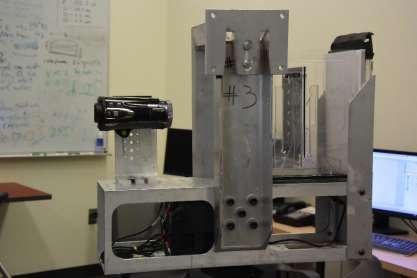
CELERE 2020 Handbook                                                   27 August 2019

Experiment Hardware, Testing, and Analysis
Instructions & comments                      Screen shots, images, and diagrams
Computer-Aided Design (CAD) image of a
sample test cell showing the three layers
separated in an “exploded” view. CELERE
participants design the black middle
layer which will be sandwiched between
the clear front and black plates. Those
two standard plates have air vents at
their top.

VERY IMPORTANT! The channels cut in
the middle layer must extend from the
base to the air vents to enable the
capillary action. The liquid won’t rise if
(1) the liquid can’t enter the channels or
(2) the air above the liquid can’t escape.

CAD image of the example test cell
assembled, with the three layers
together.

                                             6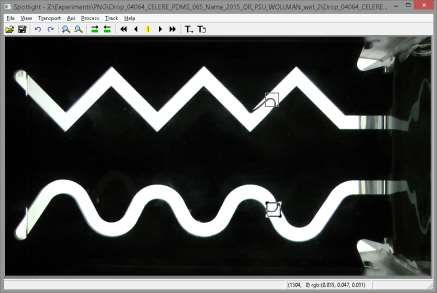
CELERE 2020 Handbook                                  27 August 2019

You will use the free CAD software
package, DraftSight, and a provided
template to design and draw the middle
layer of your test cell. Your submitted
drawing will be used to fabricate the
middle layer. In this image, the black is
the template for the middle layer, the
green shows the air vents in the front and
back layers, and the red shows the
channels in which the liquid will rise.

Draftsight can be freely downloaded for
Windows, Mac, etc. from:
https://www.3ds.com/products-
services/draftsight-cad-software/free-download/
but it is not compatible with Windows
98. Earlier versions of the software can
be downloaded elsewhere, but they may
or may not function.

Please make sure to use the 2020
drawing template which is available for
download from:
https://www1.grc.nasa.gov/space/educ
ation-outreach/drop-tower-
competition/current-drop-tower-
challenges/2020-celere-iss-research-
design-challenge/
Portland State University (PSU) will cut
your team’s middle layer, with its unique
channels, out of black acrylic using a
computer-controlled laser cutter and
your CAD drawing.

                                                  7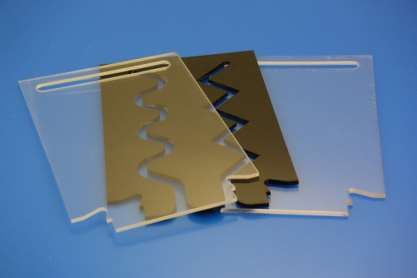
CELERE 2020 Handbook                                                         27 August 2019

PSU will assemble your test cell and
mount it in a container so that its base is
within a reservoir of a low-viscosity
silicon oil. This oil is attracted to the
acrylic and will respond quickly during
the short duration of the drop.

With this approach, the fluid is not an
acceptable variable in your CELERE
experiment.      Instead, you will be
studying the differences in the capillary
motion in each of your test cell’s
channels. In the example test cell shown,
the effect of curved and sharp corners
are compared, i.e., in the two zigzag
channels.

The test cell and reservoir will be placed
on an experiment rig between a video                                                   Light
camera and a light source, such that the
test cell will be back lit.
                                                  Camera

                                                                             Test cell in
                                                                             Reservoir

The experiment rig will be placed inside a
drag shield at the top of PSU’s Dryden
Drop Tower. When everything is ready,
the drag shield and the experiment rig
will be dropped and fall for 2.1 seconds
during which time it will experience
apparent near weightlessness (i.e.,
microgravity). During the drop, the
camera will image the capillary rise of the
liquid inside the channels.                       Sample images every 0.3 second.

                                              8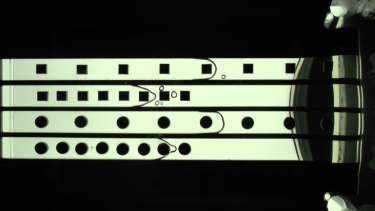
CELERE 2020 Handbook                                27 August 2019

One option for analyzing your results is
through NASA’s Spotlight software,
which can be freely downloaded at:
http://microgravity.grc.nasa.gov/spotlight/
In this example, Spotlight-16 is being
used to track the location of the menisci,
i.e., liquid-air interface, from frame to
frame as it rises within the channels. In
this image, up is the left and down is to
the right. Furthermore, it is the lowest
(farthest right) point on the meniscus
surface that is being tracked. Note that
Spotlight is not currently supported and
Spotlight-8 is not compatible with
current versions of Microsoft Windows.

Tracker is another free software package
for video analysis; it can be downloaded
from:
https://www.cabrillo.edu/~dbrown/tracker/

But you can also make position
measurements with simple software, like
Microsoft Paint, which continually
reveals the position of its crosshairs (e.g.,
in the bottom left of the window). Simply
load an image, move the crosshairs to
each desired position and write down
their values (i.e., by hand). Repeat to
track the positions as a function of time.

You can even make measurements
manually by taping a transparent overlay
to your computer monitor and marking
the positions using a permanent marker.
You can make measurements for
multiple images (i.e., times) using the
same transparency by marking each
position with the image number.

This task can be simplified by only making
measurements at every tenth frame (for
example), where that equates to every
one sixth of a second.

                                                9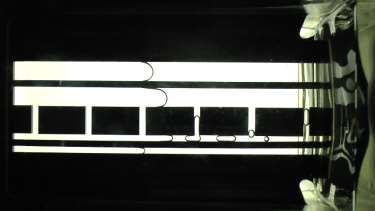
CELERE 2020 Handbook                               27 August 2019

Spotlight can output a data file, which in
this example includes the position of the
meniscus for each sequential frame.
With CELERE’s high-speed video, there
are 60 frames per second.

Spotlight data files can be imported into
Microsoft Excel or similar software for
data analysis and plotting.

If you measure the capillary motion, you
will need to correctly scale your
measurements, e.g., converting pixels to
millimeters. The three test cell plates are
76 mm across at their base, so you can
measure that distance (e.g., in pixels) to
determine the scaling factor.

Measurement to be made to calculate a
scaling factor, as shown by the double-
ended red arrow. The distance is 76 mm
across as shown in the preceding figure.

                                              10
CELERE 2020 Handbook 27 August 2019
In this example plot, the fluid rise within
the channels can be seen. The blue and
red reveal the rise in the rounded (left)
and sharp (right) channels, respectively
(as seen in the images on the previous
pages).
The results show that the fluid generally
slowed down at each corner, but more so
in the sharp cornered channel. Therefore
the fluid travels farther in the round
cornered channel.
Detailed analysis such as this is not
required for CELERE, but all participants
are required to briefly report on their
findings.
Design Requirements
These requirements are VERY IMPORTANT because they will be used in selecting experiments for fabrication and testing.
You risk rejection if you do not closely follow these requirements!
Experiment requirements
o The experiment must have a research question that is specific to the test cell’s channels,
o The research question must address the effect of the channel shape and/or size on the capillary flow,
o The experiment must include only one test cell (and thus only one drawing),
o The test cell must have at least 2 channels,
o The channels should ideally differ in a single way,
o The variation between the channels must address the research question,
o The experiment must differ from the past CELERE experiments depicted in this handbook’s appendix,
o The drawing and entry files must be named as:
CELERE_2020____
where the drawing is a dwg file and the entry file is in a pdf or doc format. Furthermore, sufficient abbreviation
is required that the file name fits within the drawing’s test cell outline in a single line.
Drawing requirements
o Cut lines must be in the CUT layer (which normally appears in red in DraftSight),
o Cut lines must be continuous (i.e., without gaps),
o Cut lines must begin at the test cell base, pass into the green-outlined vent zone, and return to the test cell base,
o Cut lines must not cross themselves or each other,
o Cut lines must not touch the border zone (marked with the diagonal pattern) including its inner edge,
o Channels must be at least 3 mm apart,
o Channels may not merge - so ‘islands’ (i.e., loose cut pieces used in the test cell) are not allowed, and
o Nothing (including text) can be outside of the boundaries of the test cell.
11CELERE 2020 Handbook 27 August 2019
Discussion
For the CELERE Design Challenge, the research question must be about the effect of the channel’s shape and/or size on
the capillary flow. The liquid will not be accepted as a parameter because a low-viscosity and thus fast-acting oil will be
used for all CELERE experiments. A research question is required for each CELERE submission, but hypotheses are optional
and will not be used as the basis for selection. Research questions are expected to be specific to the experiment. Generic
questions such as “in which channel will the oil rise most quickly?” are inappropriate. An example of a good research
question is “in zigzag channels, will the oil rise more quickly when the corners are curved or sharp?”
CELERE experiments must have two or more channels because they are conducted with a single test cell. Therefore, two
or more channels are required to allow comparison of the resulting behavior. The other key is that the channels should
ideally differ from each other in only one way so that the cause of any differences in the capillary action will be obvious.
If the channels differ in two or more ways, then it won’t be clear which factor caused the resulting differences in the
capillary flow.
Of course, the research question must be answered by successful conduct of the experiment, i.e., with the variation
between the channels. For example, if the research question is “in zigzag channels, will the oil rise more quickly when the
corners are curved or sharp?”, then the experiment must have zigzag channel with both curved and sharp corners.
Some examples of past experiments which meet the experiment requirements are shown below. The experiment shown
on the left is arguably the simplest example, where it clearly examines the effect of the channel width on the capillary
action. In the center experiment, the effect of the curvature on the capillary action is explored through a comparison
between the oil’s motion in curved and straight channels. Meanwhile, the experiment shown on the right explores the
effect of elliptical cavities on the capillary motion.
In the previous examples, the comparison is consistently made against a straight vertical channel. While acceptable and
appropriate for many experiments, that shape is not required for a good CELERE experiment. For example, the experiment
shown subsequently (on the left) has channels which narrow with height. But the experiment can still clearly reveal the
12CELERE 2020 Handbook 27 August 2019
effect of the triangular cavities on the capillary phenomena. Meanwhile, the effect of the cavity shape can be clearly
explored in the other two experiments shown below.
The two test cells shown to the right are
examples of the use of ‘islands,’ i.e.,
where there are loose pieces cut from
the middle layer that are used in the test
cell. While this is an interesting area of
study, much more work is required to
prepare test cells when such features are
included. Therefore, test cells with
‘islands’ are prohibited. Note that the
merging of channels will result in one or
more ‘islands,’ so channel merging is also
prohibited.
13CELERE 2020 Handbook 27 August 2019
Your Computer-Aided Design (CAD) drawing must be submitted so that it ready for use in fabricating the test cell with the
computer-controlled laser cutter. Errors in the drawing may lead to rejection.
To ensure that the drawing is correctly prepared, it is helpful to imagine the laser cutter in operation. To cut a channel,
the laser cutter must move upward from the bottom edge of the test cell, extend into the air gap location (marked in
green), and then return back to the base of the test cell. To be clear, the channel cut must cross the green outline and not
simply reach it. And the cuts must be continuous; i.e., there can be no gaps in the cut lines.
It is critical that the channels are vented by the air gaps at the top of the test cell. Otherwise, the trapped air will prevent
the oil from rising in the channels during the experiment, although the shape of the meniscus will still change during the
drop. Also note that the green line only shows the location of the air gaps which are in the front and back layers and not
in the center layer which you are designing. As such, the green line is effectively virtual and cannot be part of the cut. The
only automatic cuts in the middle layer are the outline, shown on the right above.
Although the channel cuts must cross into the air gap zone (outlined in green), they must not touch or cross into the
border zone, marked with the diagonal pattern.
Channels must be at least 3 mm apart as very close spacing could allow the plastic to curl or break in handling. And of
course, the cut lines must not cross each other or themselves.
14CELERE 2020 Handbook 27 August 2019
There must be absolutely nothing outside the boundaries of the test cell when you have completed your drawing, including
descriptive text, lines, etc.
Drawing and entry files must be named with the format:
CELERE_2020____
where the drawing files must be in the dwg format. The entry files should be pdf or doc files. As you might expect, your
entry may not be selected if the files are unreadable.
As an additional note, please weld the line segments together that you can.
Common Mistakes
Channels that don’t extend into the green vent space
Channels that have left and right sides which aren’t connected at the top
Channels which extend from the border zone instead of the test cell base
Channels which touch the border zone (whether they extend to the test cell base or not)
Channels which differ in more than way where the effects of the differences cannot be independently assessed,
Drawings which have lines or text outside of the test cell borders
Files in the wrong format, e.g., where entry forms must be in either a doc or pdf format.
Files which are improperly named
The first four mistakes are illustrated in the figures below, where the left side of each figure shows the mistake and the
right side shows a corrected version. All of these mistakes are violations of the design requirements and are grounds for
rejection.
Design Challenge Suggestions
15CELERE 2020 Handbook 27 August 2019
The CELERE Design Challenge is intended for open-ended, curiosity-driven research. There is no set CELERE challenge
other than to design and submit an entry which follows the design requirements. However, participants are free to choose
their own design challenge. Some suggestions include:
Make the flow as bubbly as possible, i.e., where the bubbles are mixed with the oil and not just stuck in cavities.
Make a ‘fountain,’ where the oil doesn’t touch the left or right walls of the channel, rise as far as possible. To be
clear, the oil rises because of its contact – and capillary action - with the front and back layers, so it really isn’t
unconfined. There are a few past examples of this type can be seen in the appendix.
Make the oil rise as quickly as possible in a channel, for example, by variation of the inlet section.
Advance what can be learned from past CELERE experiments by taking ‘a next step.’ For example, choose a past
experiment that you find to be interesting and design a related experiment that can bring new understanding.
Try something completely new!
Design Hints
FOCuS: Focus On Criteria for Selection
The most important hint should hopefully be obvious to all participants, but is nonetheless worth mentioning because of
its critical importance. If you would like your experiment to be selected, then make sure to fulfill all of the design
requirements, i.e., selection criteria. In the attack on the Death Star portrayed in Star Wars IV: A New Hope, the pilot Gold
Five pilot tells Gold Leader to “Stay on target.” Keep that quote and the design requirements close to mind when you are
preparing your entry.
MOOD: Mainly Only One Difference
It is very important that the channels in your experiments vary in only one way! If you have two channels which differ in
multiple ways, it will be very difficult to clearly determine how each difference affected the capillary motion. However
with proper design, the effects of two differences (for example) can be independently assessed with three or more
channels.
PEP: Past Effects the Present
The capillary motion in the upper part of a channel (i.e., the present) is affected by the channels’ lower portion (i.e., the
past). While features in a channel can change with height, the effect of the variation cannot be independently assessed
with a single channel. For example, if you want to study the differing effects of square and circular cavities on the capillary
motion, then they should be in separate channels. If they are both in the same channel, then the lower cavity will affect
how the oil flows into the upper cavity. The dependence of the oil’s flow on lower features should also be considered
when designing comparison, e.g., control, channels, because it is often more important to match the bottoms of the
channels rather than their tops.
ABS: Action effected by Both Sides
The capillary action is affected by both sides of each channel (as well as the front and back layers, but they are standard).
While the left and right sides of a channel can be different, the effect of each side on the oil’s motion cannot be
independently assessed with a single channel. If you want to study the effect of two different channel sides, then they
should be alone in two separate channels - but could be combined in a third channel.
KISS: Keep It Simple, Smarty!
The last three hints can be summarized by this simple but important phrase.
16CELERE 2020 Handbook 27 August 2019
Questions
As a start, please review the CELERE information available on the web at:
https://www1.grc.nasa.gov/space/education-outreach/drop-tower-competition/current-drop-tower-
challenges/2020-celere-iss-research-design-challenge/
www.facebook.com/NASA.celere
For more information, please e-mail celere@lists.nasa.gov.
Appendix: Past CELERE Experiments
Past CELERE participants have been from across the United States, including states on both coasts. We’ve also had
participation from a DODEA school in Germany for the children of U.S. military personnel! Thus far, most submissions
have come from Ohio because of the word-of-mouth promotion by the CELERE staff who work at the NASA Glenn Research
Center in Cleveland, Ohio.
State City Organization
California El Cajon Granite Hills High School
California Ramon California High School
California San Diego Canyon Crest Academy
California San Diego Carmel Valley Middle School
Colorado Greenwood Cherry Creek High School
Connecticut Bethel Bethel High School
Georgia Columbus Columbus High School
Illinois Aurora Illinois Mathematics and Science Academy
Illinois Springfield Springfield Southeast High School
Indiana Michigan City Michigan City High School
Massachusetts Hyannis Sturgis Charter Public School
Massachusetts Lexington Jonas Clarke Middle School
Michigan Troy Troy High School
Montana Livingston Park High School
Nevada Henderson Green Valley High School
New Hampshire Bedford Bedford High School
New York Ava Neighborhood After School Science Association (N.A.S.S.A.)
New York Brooklyn Bishop Kearney High School
New York New York City Bard High School Early College Manhattan
New York New York City Stuyvesant High School
New York Rochester Gates Chili Central School District
Ohio Cleveland Villa Angela - St. Joseph High School
Ohio Columbus Bishop Watterson High School
Ohio Dalton Dalton Intermediate School
Ohio Lakewood St. Edward High School
Ohio Medina Broadway Creek Homeschool Academy
Ohio Niles Niles Middle School
Ohio Toledo St. John's Jesuit High School and Academy
Ohio Toledo St. Ursula Academy
Ohio Wickliffe Wickliffe High School
Oregon Lake Oswego Lake Oswego Junior High School
Pennsylvania Holland Council Rock High School South
Tennessee Greeneville Chicks in Space Science Club
17CELERE 2020 Handbook 27 August 2019
Texas Austin Liberal Arts and Science Academy
Texas Celeste Celeste High School
Texas Houston Alief Early College High School
Virginia Fairfax Thomas Jefferson High School for Science & Technology
Virginia Herndon Rachel Carson Middle School
Virginia Vienna James Madison High School
Washington Redmond The Overlake School
Germany Kasierslautern Kasierslautern High School (which is a DODEA school)
Selected experiments are depicted and briefly described on the following pages. The experiments are generally shown at
approximately halfway through the drop test (i.e., approximately 1 second after the release), where up is to the left and
down is to the right. The position of the oil can be seen by the curved meniscus (i.e., liquid-gas interface) which is visible
in each channel. The experiments are nominally organized by the general nature of their study, i.e., where they
investigated the following effects on the capillary motion.
1. Channel width (submission of this type are now discouraged)
2. Channel path
3. Channel entry
4. Uniform expansion and contraction
5. Abrupt expansion and contraction
6. Cavities and protrusions
7. Channel roughness
8. Branching
9. Miscellaneous
10. Combined effects (submission of this type are generally discouraged)
Most of the experiments that are not included in this review are from 2013 when the design challenge was pilot tested on
an invitational basis. During that phase, there wasn’t a requirement for two or more channels and some experiments
were submitted with a single channel. Those test cell designs don’t meet the current CELERE requirements and were
excluded from this guide for brevity. Likewise, past experiments featuring ‘islands’ are also excluded from this review,
where they were not prohibited until 2016.
The results of some past experiments can be viewed on the main experiment website at
https://www1.grc.nasa.gov/space/education-outreach/drop-tower-competition/current-drop-tower-challenges/2020-
celere-iss-research-design-challenge/
and some additional examples at https://www.youtube.com/user/DIME10NASA/videos.
1. Effects of the Channel Width
The three following experiments examined the effects of the channel width on the capillary action in vertical straight-
walled channels. Students are discouraged from submitting additional experiments of this type, because the effect of
the channel width can be assessed from the results of these past experiments! Note that up is to the left in these images,
and down is to the right (i.e., where the cameras was on its side).
18CELERE 2020 Handbook 27 August 2019
This 2013 experiment from St. Ursula Academy (Toldeo, OH)
compared the capillary action in channels with five different
widths, where the width was the only difference between the
channels.
This 2013 experiment from St. Ursula Academy (Toldeo, OH)
compared the capillary action in channels with three different
widths.
This 2013 experiment from Park High School (Livingston, MT)
compared the capillary action in channels with five different
widths. The fluid motion was assessed in part by having an
identical volume in each of the channels - up to the abrupt
contraction to the narrow bent portion.
2. Effects of the Channel Path
Note that up is to the left in these images, and down is to the right (i.e., where the cameras was on its side).
This 2014 experiment from St. Edward High School (Lakewood,
OH) investigated the effect of a single orthogonal offset in the
vertical channel.
19CELERE 2020 Handbook 27 August 2019
This 2014 experiment from St. Ursula Academy (Toldeo, OH)
studied the effect of a single orthogonal back-and-forth shift in
the otherwise vertical channel.
This 2014 experiment from St. Ursula Academy (Toldeo, OH)
examined the effect of a back-and-forth orthogonal path (with
rounded outer corners) on the capillary action.
This 2017 experiment from the Gates Chili Central School
District (Rochester, NY) examined the effect of angled bends
in the channel on the rise of the silicone oil.
This 2015 experiment from St. Ursula Academy (Toldeo, OH)
investigated the effect of turn angle on the capillary motion of
the oil.
20CELERE 2020 Handbook 27 August 2019
This 2017 experiment from the Chicks in Space Science Club
(Greeneville, TN) explore the effect of a zig-zags on the
motion of the silicone oil.
This 2017 experiment from the Celeste High School (Celeste,
TX) examined the effect of rounded vs. sharp turns in
zigzagging channels.
This 2015 experiment from Columbus High School (Columbus,
GA) studied the effects of truncated turns on the capillary flow
in a zigzagging channel.
This 2015 experiment from St. Ursula Academy (Toldeo, OH)
examined the effect of rounded and sharp corners on the
capillary flow through a diagonally shifting path.
21CELERE 2020 Handbook 27 August 2019
This 2013 experiment from Columbus High School (Columbus,
GA) studied the effect of channel curvature on the capillary
motion.
This 2015 experiment from St. Ursula Academy (Toldeo, OH)
investigated the effect of a simple curved path on the capillary
action.
This 2015 experiment from St. Ursula Academy (Toldeo, OH)
studied the effect of a curving path with two turns on the
capillary action.
This 2015 experiment from the Illinois Mathematics and
Science Academy (Aurora, Illinois) investigated the effect of a
curving path’s wavelength on the capillary action.
22CELERE 2020 Handbook 27 August 2019
This 2015 experiment from St. Ursula Academy (Toldeo, OH) is
similar to the previous experiment, where it again examined
the effect of a curving path’s wavelength on the capillary
action. However, these channels turn a full 180 degrees while
the channels in the previous experiment turn at smaller angles
in a nominally zigzag pattern.
This 2014 experiment from St. Ursula Academy (Toldeo, OH)
investigated the effect of a (generally regular) curving path on
the capillary action.
This 2016 experiment from the Granite Hills High School (El
Cajon, CA) is similar to the preceding entry with its (generally
regular) winding path, but also adds a simple curved path.
This 2014 experiment from St. Ursula Academy (Toldeo, OH)
studied the effect of an irregular curving path on the capillary
action.
3. Effects of the Channel Inlet
Note that up is to the left in these images, and down is to the right (i.e., where the cameras was on its side).
23CELERE 2020 Handbook 27 August 2019
This 2016 experiment from Bedford High School (Bedford, NH)
investigates the effect of various contractions on the capillary
rise of the oil.
While it is difficult to see from this image, this 2016 entry from
Bethel High School (Bethel, CT) examines the influence of
uniformly narrowing inlet sections of different sizes on the
capillary motion. However, the test cell drawing for this and
the rest of the experiments can be found online with all of the
associated results at http://celere.mme.pdx.edu/.
Similar to the preceding experiment, this 2017 experiment
from St. Ursula Academy (Toldeo, OH) examined the effect of a
narrowing inlet section on the capillary rise of the silicone oil.
This 2017 experiment from St. Ursula Academy (Toldeo, OH)
investigated the effect of triangular inlet sections on the rise of
the silicone oil.
24CELERE 2020 Handbook 27 August 2019
This 2014 experiment from St. Ursula Academy (Toldeo, OH)
compared the capillary motion in a straight channel with two
channels with uniformly narrowing entry sections of different
sizes. It is similar to the previous experiment, but the
contraction is only on the left (bottom) side of the channel.
While it is very difficult to see from this image, this 2017
experiment from St. Ursula Academy (Toldeo, OH) examined
the effect of the curvature at the channel inlet on the capillary
motion of the silicone oil.
While it is difficult to see from this image, this 2017 experiment
from St. Ursula Academy (Toldeo, OH) investigated the effect
of the channel inlet on the rise of the silicone oil in the two
channels.
This 2016 entry from the Michigan City High School (Michigan
City, IN) examines the effect of various inlets on the capillary
motion.
25CELERE 2020 Handbook 27 August 2019
Similar to the previous experiment, this 2016 experiment from
Troy High School (Troy, MI) examines the effect of various
inlets on the capillary motion … where the results are similar.
While it very difficult to see from this image, this 2016
experiment from the Liberal Arts and Science Academy (Austin,
TX) also examines the effect of inlet sections of different
shapes on the rise of the oil. Again, the test cell drawing for
this and the rest of the experiments can be found online with
all of the associated results at http://celere.mme.pdx.edu/.
4. Effects of Uniform Expansion and Contraction
Note that up is to the left in these images, and down is to the right (i.e., where the cameras was on its side).
This 2014 experiment from St. Ursula Academy (Toldeo, OH)
compared the capillary motion in two uniformly-widening
wedge-shaped channels, where one side is vertical and other is
angled (where the angle was varied between the two
channels).
26CELERE 2020 Handbook 27 August 2019
This 2014 experiment from St. Ursula Academy (Toldeo, OH)
compared the capillary motion in straight, uniformly
expanding, and uniformly narrowing channels.
This 2017 experiment from St. Ursula Academy (Toldeo, OH)
examined the effect of the contraction angle on the capillary
action, although for much of the drop the effect of the channel
width was revealed.
This 2014 experiment from St. Ursula Academy (Toldeo, OH)
investigated the size effect on the capillary motion through an
hourglass-shaped contraction and expansion.
Like the preceding experiment, this 2014 experiment from St.
Ursula Academy (Toldeo, OH) studied the size effect on the
capillary motion through an hourglass-shaped contraction and
expansion.
5. Effects of Abrupt Expansion and Contraction
Note that up is to the left in these images, and down is to the right (i.e., where the cameras was on its side).
27CELERE 2020 Handbook 27 August 2019
This 2015 experiment from St. Ursula Academy (Toldeo, OH)
investigated the effect of the width of an abrupt expansion on
the capillary motion.
This 2014 test cell from St. Ursula Academy (Toldeo, OH)
compares the effect of an abrupt expansion with a uniform
expansion to a larger channel width.
This 2017 experiment from the Liberal Arts and Science
Academy (Austin, TX) examined the effect of the contraction
leading into an abrupt expansion on the silicone oil’s motion.
This 2015 experiment from the Illinois Mathematics and
Science Academy (Aurora, Illinois) investigated the effect of
both the gap size (via the leftmost channels shown at the
bottom) and the contraction length (via a comparison of the
leftmost and rightmost channels) on the oil’s motion.
28CELERE 2020 Handbook 27 August 2019
This 2017 experiments from the Broadway Creek Homeschool
Academy (Medina, OH) examined the effect of different
throat geometries on the motion of the silicone oil.
This 2014 experiment from St. Ursula Academy (Toldeo, OH)
examined the effect of an abrupt (circular) expansion on the
capillary motion.
This 2015 experiment from Columbus High School (Columbus,
GA) investigates the effect of the abrupt expansion’s shape on
the oil’s motion.
This 2016 experiment from Bishop Kearney High School
(Brooklyn, NY) investigates the effect of an abrupt expansion
into a complex shape on the motion of the oil.
29CELERE 2020 Handbook 27 August 2019
This 2016 experiment from Kasierslautern High School (a
DODEA school in Kasierslautern, Germany) examined the
effects of having the channel extend into the wide section.
6. Effects of Cavities and Protrusions
Note that up is to the left in these images, and down is to the right (i.e., where the cameras was on its side).
This 2016 experiment from Wickliffe High School (Wickliffe,
OH) examined the effect of a stepped cavity on the capillary
flow.
This 2014 experiment from St. Ursula Academy (Toldeo, OH)
compared the capillary flow in channels with triangular cavities
of different sizes.
This 2014 experiment from St. Ursula Academy (Toldeo, OH)
examined the effect of a triangular cavity’s vertical orientation
on the capillary motion.
30CELERE 2020 Handbook 27 August 2019
This 2014 experiment from St. Edward High School (Lakewood,
OH) investigated the effect of different downward-facing
triangular cavities on the capillary flow.
This 2013 experiment from St. Ursula Academy (Toldeo, OH)
examined the differences between triangular and semicircular
cavities on the upward capillary flow.
Like the preceding experiment, this 2014 experiment from St.
Edward High School (Lakewood, OH) investigated the effect of
triangular and semicircular cavities on the upward capillary
flow.
This 2016 experiment from Sturgis Public Charter School
(Hyannis, MA) examines the effect of rounded vs. sharp corners
in the repeating symmetric cavities.
31CELERE 2020 Handbook 27 August 2019
This 2013 experiment from St. Ursula Academy (Toldeo, OH)
also explored the effect of triangular and semicircular cavities,
but with cavities of increasing size with channel height.
This 2014 experiment from St. Ursula Academy (Toldeo, OH) is
similar to the previous one, but explored the effect of
rectangular cavities, where the cavities grew (with channel
height) in the left channel (i.e. on the bottom in the image
above) and in width in the right channel.
This 2014 experiment from St. Edward High School (Lakewood,
OH) evaluates the effect of size of repeating rectangular
cavities on the capillary motion.
This 2017 experiment from the Liberal Arts and Science
Academy (Austin, TX) examined the effect of cavity size on the
capillary rise of the silicone oil.
32CELERE 2020 Handbook 27 August 2019
This 2016 experiment from the Alief Early College High School
(Houston, TX) evaluates the effects of repeating cavities on the
capillary motion.
This 2013 experiment from Columbus High School (Columbus,
GA) examined the effect of a scalloped channel wall on the
capillary motion.
This 2016 experiment from the Michigan City High School
(Michigan City, IN) examines the effects of both scalloped and
zigzagging channel walls.
This 2015 experiment from Bishop Watterson High School
(Columbus, OH) explored the effect of repeating ellipsoidal
cavities on the capillary motion, where the cavities increase or
decrease in depth with channel height.
33CELERE 2020 Handbook 27 August 2019
This 2013 experiment from the Niles Middle School (Niles, OH)
examines the effect of repeated elliptical cavities on one, both,
or neither sides of the channel.
This 2013 experiment from the Niles Middle School (Niles, OH)
is similar to the previous experiment, but instead investigates
the effect of the cavity shape, specifically elliptical vs.
triangular, where the cavities are on one side of the channel.
34CELERE 2020 Handbook 27 August 2019
This 2017 experiment from The Overlake School (Redmond,
WA) examined the effect of triangular cavities – pointed
upwards, downwards, and orthogonally – on the upward
motion of the silicone oil.
This 2014 test cell from Villa Angela - St. Joseph High School
(Cleveland, OH) effectively includes two experiments. The
three central channels are used to evaluate the effect of the
circular and rectangular cavities on the capillary motion. The
two outermost channels were used to assess the influence of
the size of triangular cavities on the capillary motion, after a
bend in the path.
This 2013 experiment from the Niles Middle School (Niles, OH)
examines the effect of triangular cavities on capillary motion in
a narrowing channel. In contrast, most of the CELERE
experiments investigating cavity effects have thus far used
channels of a constant width (of course neglecting the cavities
themselves).
This 2016 experiment from the Council Rock High School South
(Holland, PA) examines the effect of cavities on the capillary
action within zigzagging channels.
35CELERE 2020 Handbook 27 August 2019
This 2016 experiment from Michigan City High School
(Michigan City, IN) investigates the effects of smoothly
expanding and contracting cavities on the capillary action.
This 2017 experiment from Bishop Kearney High School
(Brooklyn, NY) examined the effect of letter-shaped cavities on
the rise of the silicone oil. Unfortunately, the considerable
difference between the letter shapes complicates the
interpretation of the results.
This 2017 experiment from Bishop Kearney High School
(Brooklyn, NY) examined the effect of irregular (mostly)
triangular cavities on the rise of the silicone oil. Interpretation
would have been facilitated with the use of regular cavities.
Like the preceding experiment, this 2017 experiment from
Bishop Kearney High School (Brooklyn, NY) examined the effect
of irregular cavities on the rise of the silicone oil. Interpretation
would have been facilitated with the use of regular cavities.
36CELERE 2020 Handbook 27 August 2019
7. Effects of Channel Roughness
Note that up is to the left in these images, and down is to the right (i.e., where the cameras was on its side).
This 2014 experiment from St. Ursula Academy (Toldeo, OH)
explored the effect of channel roughness on the capillary
motion.
This 2014 experiment from St. Ursula Academy (Toldeo, OH) is
similar to the previous one and again explored the effect of
channel roughness on the capillary motion, but in this case the
roughness is on one, both, or neither side of the channel.
This 2016 experiment from Bishop Kearney High School
(Brooklyn, NY) investigates the effect of a sequence of small
varying cavities on the motion of the oil.
This 2017 experiment from Council Rock High School South
(Holland, PA) examined the effect of channel roughness on the
rise of the fluid through bending channels.
8. Effects of Branching
37CELERE 2020 Handbook 27 August 2019
Note that up is to the left in these images, and down is to the right (i.e., where the cameras was on its side).
This 2017 experiment from Bard High School Early College
Manhattan (New York City, New York) investigates the effect of
a Y-shaped branch on the fluid’s motion.
This 2014 experiment from St. Edward High School (Lakewood,
OH) explores the effect of a branching channel, with an
orthogonal four-way intersection, on the capillary motion.
This 2014 experiment from St. Edward High School (Lakewood,
OH) is similar to the previous one, but explores the branching
effect with branches which are angled upward.
This 2015 experiment from California High School (Ramon, CA)
examined the effect of the branching angle, where the
branches were dead-end paths.
38CELERE 2020 Handbook 27 August 2019
This 2014 experiment from St. Edward High School (Lakewood,
OH) explores the effect of branching into dead-end paths
(oriented in the reverse direction) on the capillary motion.
This 2015 experiment from St. Ursula Academy (Toldeo, OH)
explored the effect of the channel width on branching flow.
This 2016 experiment from the Jonas Clarke Middle School
(Lexington, MA) investigated the effect of repeated channel
branching on the capillary flow.
9. Miscellaneous
These experiments don’t fit well in the other categories but are appropriate experiments.
This 2016 experiment from the Thomas Jefferson H.S. for
Science & Technology (Fairfax, VA) has channels which match
on one side, but differ on the other size. This design resulted
in the comparison of a zigzagging channel with a channel with
repeating cavities.
39CELERE 2020 Handbook 27 August 2019
Like the preceding entry, this 2016 experiment from Wickliffe
High School (Wickliffe, OH) has channels walls that are
nominally identical on one side but differ on the other side.
10. Combined Effects
Submissions with combined effects are generally discouraged unless each effect can be assessed independently through
the careful use of three or more channels! Most of the experiments in this section do not follow the design rule that “the
channels should ideally differ in a single way.” Note that up is to the left in these images, and down is to the right (i.e.,
where the cameras was on its side).
This 2016 experiment from Wickliffe High School (Wickliffe,
OH) is an appropriate example of a test cell investigating
multiple effects. Comparison of left and right channels allows
for assessment of the channel width effect. Meanwhile,
comparison of the left and center channels allows one to
investigate the effect of the channel path. If two effects are
being studied than a test cell should have at least three
channels, as was the case in this experiment.
Although it is not clear from the image, this 2013 experiment
from the Niles Middle School (Niles, OH) includes two different
effects. The left channel (i.e., bottom in the image) is vertical
with straight walls, the center channel includes a uniformly
narrowing channel entry, and the right channel further adds
the elliptical cavities. Comparison of the first two channels
allows assessment of the entrance section, while comparison
of the second and third channels allows study of the cavities.
This is an appropriate use of combined effects, where two
experiments are conducted with one test cell.
40You can also read


